On the northwest corner of Third and Hill Streets (Pier View Way and North Coast Highway) sits an empty building that has seen better days, with its exterior scraped away, windows broken and metal awning left to rust. No one can remember the building in its glory days but many will remember the H&M Military store owned by Harry and Mary Cathey, a popular destination for Marines needing essential gear. It was the largest of the many military stores that once filled Oceanside’s downtown business district.
Mason building, aka H&M Military Store at 301 North Hill Street/Coast Highway. (Photo taken March 8, 2024)
But the building pre-dates Oceanside’s relationship with Camp Pendleton and its Marines. Nine decades ago this was once a beautiful art deco style building. Modernization may hide its original exterior but perhaps one day it will be restored.
Prior to the present building, Charles D. Merrill and his brother William owned the property. They were the first licensed Ford dealership in Oceanside and in 1920 built a new building on the prominent corner in downtown Oceanside and further expanded it after 1925.
Merrill’s Garage was a Ford dealership, located at Third and Hill Streets in the 1920s. Note the historic Schuyler building to the left. Oceanside Historical Society
Paul Beck, co-owner of the Oceanside Blade Tribune newspaper recalled the Merrill’s dealership when he arrived in Oceanside in 1927: “Across the street to the West was the Merrill Brothers Ford Agency. Having no transportation upon arrival in Oceanside, one of the first deals that the young Becks made was for a Model A Ford. As I recall, the total price was $475, and we talked the Merrill’s into a “due bill”, which meant $400 cash and $75 in advertising.”
The Merrill building included a storefront that was situated on Third Street (Pier View Way). In 1929 Ed Wolmer leased that space, at 410 Third Street, to open a music store.
The February 5, 1929 Oceanside Blade reported: Rebuilding of the lower floor of the building at 410 Third Street to be occupied by the Ed Wolmer Music House is well along and Mr. Wolmer states that he is expecting to be in his store by the last of the month. The front has been modernized and the interior handsomely refinished and when completed the store will be a most attractive salesroom for the display of the extensive line of pianos, radios, panatropes, and musical merchandise which will be carried.
Two years later the Merrill Bros. moved their Ford dealership just to the north, near the center of the block, and sold the property to B. A. and Marian Mason in 1931. Despite the fact that a Depression was gripping the country, the Masons began construction of a two-story brick building on the property.
The November 19, 1931 Oceanside Blade Tribune reported the following: Operations on the new Mason building, being erected at Third and Hill Streets, will be resumed tomorrow, according to a statement from Omer Nelson, superintendent in charge. Delay in the erection of the building was brought about by negotiations regarding the expansion of the building to take in another story. “We are resuming operations,” said Nelson, “while the parties continue their negotiations toward the expansion of the building. We are holding things open so that if necessary, we can make a third story to the build.” Work on the building has been at a standstill for the last few days, with part of the brick walls erected. Nelson is on the job today, preparatory to getting the full construction crew back on the job again tomorrow.
The third story was not added and the building was completed in early 1932. The lessee was Wolmer’s Music House who moved from their former location fronting Third Street into the new Mason building fronting Hill Street.
Ed Wolmer’s Music House on the northwest corner of Third and Hill Streets, 1932. Oceanside Historical Society
Oceanside resident Ernest Carpenter remembered in an interview: “It was a music store, sheet music and all that kind of stuff. They had a big statute and I can’t remember, a dog, a big statue of a Dalmatian in the front. When I was a little kid I didn’t want to walk on that side of the street because I was afraid of that dog!”
Mason building to the right, looking west on Third Street (Pier View Way). Note the dog statute. Oceanside Historical Society
Wolmer’s Music Store, remained at 301 North Hill Street for several years, and also sold appliances. In 1946 Bob Shaffer and Gordon Duff purchased the appliance business and moved it to Third and Freeman Streets.
In 1940, Henry and Lina Howe bought the Mason building at 301 North Hill Street and owned it for several years, later deeding the property to their son and his wife, Tracy and Ethel Howe. The Howe’s owned a hardware store on Mission Avenue in downtown Oceanside.
Motorcycle office Guy Woodward stands on the center line of the 300 block North Hill Street (Coast Highway) in 1949. Mason building is to the center right, with a portion of the original brick exposed. Oceanside Historical Society
Harold C. Cross, attorney rented an office upstairs in the 1940s, along with a variety of other businesses in the 1950s, including the Merchants Credit Association, and attorneys Daubney & Stevens.
View of stairway leading from first floor to the second level (photo taken in 2017)
By the mid to late 1940’s the building was divided into three suites fronting Hill Street or Coast Highway, to include 301, 303 and 305. The Fun Shop, a novelty store occupied one suite at 301 North Hill from 1948 to at least 1963, which was operated by T. L. O’Farrell and L. K. Broadman. Swanson’s Service Studio occupied the storefront at 303 North Hill Street from about 1948 to 1959, which was later occupied by Marine Tailors in the 1970s and 1980s. Artcraft Cleaners occupied the third suite at 305 North Hill from the mid 1940’s to about 1981.
300 block of North Hill Street/Coast Highway circa 1948. To the right is the Mason Building with Swanson’s Studio and Artcraft Cleaners signage. Oceanside Historical Society
Years before Room 204 was used for polygraph exams (curiously), the office suite was used for a tailor’s shop in the mid 1940s, then rented out to Lorraine Nelson, a public stenographer.
One of the upstairs suites used for at one for polygraph exams (photo taken in 2017)
In or about 1965, the owners “modernized” the exterior of the building, placing the metal screening along the upper portion and adding the large awning which changed the whole look of the building. Ceramic tiling was added to the exterior and the beautiful grating above the windows was either removed or covered as well.
Mason Building/H&M Military Store, 1979 Oceanside Historical Society
In 1973 Harry and Mary Cathey purchased the building at 301 North Hill/Coast Highway. Prior to that they had been tenants operating H&M Military Store which became a very successful business for decades. The Cathey’s and their store were fixtures in downtown Oceanside, supporting the military and their community. They sponsoring the local parades for many years.
301 North Hill aka Coast Highway (google view 2017)
Harry Eugene Cathey was born in Arkansas in 1928. He served in the United States Marine Corps and was stationed at Camp Pendleton. After he got out of the service, he and his wife Mary made their home in Oceanside. Harry operated Harry’s Shoe Repair store at 304 Third Street in 1954, and later moved into the Mason Building at 410 Third Street (Pier View Way) opening the Square Deal Shoe Repair store.
John Gomez with patron in the Esquire Barber Shop, 412 Third Street/Pier View Way, circa 1970s. Oceanside Historical Society
In 1954 Jack Noble operated Noble’s Barber Shop at 412 Third Street which later became the Esquire Barber Shop by 1959 and still operates under the same name today and owned by John Gomez.
410 and 412 Pier View Way (photo taken in 2019)
While the barber shop and another storefront continues to operate at 410 and 412 Pier View, the majority of the building sits empty. Its exterior has been marred by the removal of ceramic tiling (not original to the building) with boarded windows.
Damage to exterior with the removal of the ceramic tile. (photo taken March 8, 2024)
There is hope for the building. The large, corrugated metal façade which wraps around the upper portion of the building could be removed and the original exterior on the second story appears largely, if not completely, intact and would reveal its original cement finish in art deco style.
View of metal façade from interior second floor (photo taken in 2017)
Just what will become of the building is unknown but certainly its history is worth knowing and the building worth preserving. The potential for exposing the beautiful Art Deco façade and beautifying this downtown corner is just waiting to happen.
Historic homes and buildings provide character and a sense of place. “How will we know it’s us without our past?” – John Steinbeck, Grapes of Wrath
In the mid-1930s, a young crow landed or flew into the grounds of the Mission San Luis Rey and into the hearts of the priests. The bird was friendly and curious, and the students there named him Julius.
Julius became an attraction at the Mission and provided “fun and diversion for those in residence” and “was a source of surprise to visitors” many of whom he befriended as well. He came to the call of Father Dominic and would often land on the heads of his friends, to the delight of onlookers.
Julius the Crow at the Mission San Luis Rey, 1938. Herman J Schultheis Collection Los Angeles Photographers Collection
Julius became something of a local celebrity and even drew the attention of a photographer, Herman J. Schultheis. Schultheis worked in the film industry in Los Angeles, including Disney where he worked on the animated features Fantasia, Dumbo, Bambi and Pinocchio.
Schultheis was also an avid amateur photographer who traveled the world. He visited the Mission San Luis Rey in 1938 to take a photo of Julius, the only known images of the beloved bird. In the photos Julius appears to be interested in the photographer, looking directly into the camera.
Julius the Crow at the Mission San Luis Rey, 1938. Herman J Schultheis Collection Los Angeles Photographers Collection
Crows can recognize human faces and are the only non-primates that can make tools. They are also capable of abstract reasoning, problem-solving, and even group decision-making.
Hower, as smart as a crow can be, Julius did not understand electricity. One September day in 1938, after taking a bath in the Mission fountain, feathers still wet, he flew to rest on a power wire and was immediately killed.
The fountain at the Mission San Luis Rey where Julius took his last bath. Oceanside Historical Society
The local newspaper reported there was “mourning among the padres and brothers out at the Old Mission of San Luis Rey, and among the Sisters at the Academy nearby.”
Days before his untimely death, the Mission held their annual Fiesta at which Julius, who was “perpetually hungry” was a beloved guest and “feasted from most of the plates.”
Julius, who was hand-raised “in the church”, was likely given a proper burial and a final blessing.
Julius the Crow at the Mission San Luis Rey, 1938. Herman J Schultheis Collection Los Angeles Photographers Collection
Did you know that one of the earliest motor vehicles was designed right here in Oceanside? It was invented by Wilton S. Schuyler, who named his motorized vehicle the “Oceanside Express”.
Wilton was the son of John F. and Anne (Barlow) Schuyler. Born in 1875 in Superior, Nebraska, Wilton Sumner Schuyler came to Oceanside with his parents in 1887.
John Schuyler’s Hardware Store, 408 Third Street (Pier View Way) circa 1888
In 1888 his father built a hardware store on Third Street (now Pier View Way). It is very likely that Wilton began working on his invention at his father’s store, which was later converted into a boarding house and is now The Brick Hotel at 408 Pier View Way.
The July 23, 1898, edition of the Oceanside Blade newspaper reported: “W. S. Schuyler, the Oceanside inventor, has just been granted seventeen claims for patents on a motor carriage. Oceanside is getting to the front with its representation of inventions. We’ll soon be riding in motor carriages …”
Wilton Schuyler was just 24 years old when he developed his prototype and was issued his patent for “a gasoline-engine, propelled vehicle.”
Wilton Schuyler’s prototype of his motor vehicle (chassis) the “Oceanside Express”
He commented years later, “At the time I commenced designing the self-propelled vehicle, the word ‘automobile’ was not yet used. Horseless carriage and motor vehicle were the names used in such vehicles. The only such a vehicle I had ever heard of at that time was made in Los Angeles, California, and it had four 1-cylinder engines, located on the four corners of a frame and all solid to the axles.”
Schuyler filed his patent for his vehicle on April 1, 1898, and then received Patent, No. 624,689, on May 9, 1899.
Patent image of Schuyler’s vehicle
A portion of his patent paperwork read: “Be it known that Wilton Sumner Schuyler, a citizen of the United States, residing at Oceanside, in the county of San Diego and State of California, have invented new and useful improvements in Motor Vehicles, of which the following is a specification:
“One particular object of my invention is to so arrange a motor-vehicle that the motor and all of the heavy mechanism may be carried upon a spring-supported vehicle-bed, so as to avoid the loss of power….
“A particular object of my invention is to provide means whereby a motor-vehicle capable of satisfactory general use may be produced and without the use of pneumatic tires, which are expensive, liable to wear out, and unsatisfactory in use from various other reasons.“
Schuyler’s vehicle also included a headlight which turned in the same direction as the front wheels were turned, as well as a power steering apparatus.
February 3, 1949 Springfield News, (Springfield, Ohio) Courtesy Clark County Historical Society
The headlight invented by Schuyler was used on some of Henry Ford’s first Model T’s and for awhile Wilton was engaged in the manufacturing of these headlights. The power steering device which Schuyler designed was used on various types of modern heavy machinery.
By 1910 Wilton Schuyler and his wife Carrie, whom he married in 1897, had moved to Missouri where he manufactured gas stoves. In addition to his prototype automobile, Schuyler had a number of other patents which included a fire alarm, a pancake turner, an adjustable pulley-hanger, a washing machine and an accelerator for combustion engines.
Schuyler died in Springfield, Ohio in 1949 at the age of 73. His obituary, which was published in dozens of newspapers from coast to coast, made mention of his early “automobile” invented in Oceanside, California.
The State (Columbia, South Carolina) · Fri, Feb 4, 1949 · Page 22 Wilton S. Schuyler’s obituary was published around the US, noting his invention of an early “automobile”
If you’re a Strand cruiser or a beach walker, you may have noticed a curious concrete structure on the 400 block of the South Strand. There used to be two, one at 416 South Strand and one at 408. The latter one is still very visible.
What remains of a beach patio, 408 South Strand, Google View 2022
What was the purpose of the structures? Very simply – beachfront patios. The patios were built in the 1950s as an amenity for guests staying at the beach cottages of Vista by the Sea, 408 S. Strand, owned by Joseph Harris. The other patio was built in front of McComas Terrace Motel, 416 S. Strand, owned by Max McComas.
The beach patio in front of the McComas Terrace Motel, 416 South Strand.
The patios provided guests a somewhat “private” perch just across from the beachfront property they were renting and included steps down to the sand. The concrete pad in front of the McComas Motel had convenient openings in order to erect beach umbrellas.
Beach side view of concrete wall at 408 South Strand, 2010
The patios were likely constructed by the property owners, as erosion began taking a toll on Oceanside’s beach south of the pier in the early 1950s. As sandy areas for beachgoers dwindled, the patios were meant for motel/cottage guests only (implied or otherwise).
However, this was public beach and around the time the 1976 California Coastal Act was approved, the patios could no longer be maintained or kept private.
Remnants of “McComas” patio, 416 South Strand, Google View 2016
After decades of heavy surf, the concrete slabs have deteriorated and the steps washed away. By 2022 rocks covered any semblance of the McComas patio in front of 416 South Strand.
The large brick building at 1722 South Coast Highway is going over extensive changes and a “new transformation” but here’s a brief history of the building and some of the newspaper’s owners and publishers.
The building was built to house the Oceanside Blade-Tribune newspaper, which originated as the Oceanside Blade in 1892. It was a small but important weekly newspaper which provided world and local news to the residents of Oceanside.
Paul Beck, co-owner of the Oceanside Blade Tribune
Brothers Paul and Harold Beck, brothers who hailed from Iowa arrived in Oceanside in the late 1920s. They purchased the Oceanside Blade along with with another newspaper, the Oceanside News, and created the Oceanside Daily Blade Tribune and the paper went from a weekly publication to a daily one.
The Blade Tribune building at 401 First Street (Seagaze Drive) in 1936
In 1936 the Becks hired architect Irving Gill to design a new building for their growing business. Located at 401 First Street (now Seagaze Drive) it was Gill’s last design, which was restored in 2019.
Tom Braden with wife Joan and their 8 children.
The Becks sold the Blade-Tribune newspaper in 1954, to Thomas W. Braden. Braden was at one time an official at the Central Intelligence Agency, and his wife Joan worked for Nelson Rockefeller. Rockefeller loaned Braden the money to purchase the Oceanside Blade-Tribune.
The Bradens were connected in both political and social circles. Joan was a close friend of Jacqueline Kennedy. Tom Braden was a regular on “Meet the Press” and was appointed president of the California State Board of Education.
In 1975 Braden authored a book about his family which became a popular television series under the same name: “Eight is Enough.” The Braden family lived on South Pacific Street near the gated entrance of St. Malo.
Braden’s book inspired a television series in the 1980s.
Braden sold the newspaper to Robert S. Howard of Naples, Florida in 1967. Howard founded Howard Publications in 1961 which eventually included 19 newspapers from around the country.
Howard was the son of a small weekly newspaper publisher in Wheaton, Minnesota. Born October 23, 1924, he was the third of three children. During World War II Howard left the University of Minnesota to join the military. As a Second Lieutenant in the Army Air Corp he was a navigator and nose gunner in bombers over the South Pacific. He served valiantly, earning a Purple Heart after being shot down in the Battle of Leyte in 1944.
After his return to Wheaton, he took over the family newspaper and over his lifetime amassed 18 newspapers as Howard Publications, with over 2,000 employees and nearly a half million circulation.
The Blade Tribune Building, 1722 South Hill Street (Coast Highway) circa 1980s.
In August of 1967 construction began of 11,500 square foot “modern printing plant” at 1722 South Hill Street (Coast Highway) at an estimated cost of $700,000. That same year, Thomas Missett became the general manager and publisher. The new publishing plant was built by local contractors, Richardson Brothers, and completed in 1968.
Tom Missett, publisher of the Oceanside Blade Tribune
A large two-story addition was made years later. In 1989 the Blade-Tribune was changed to The Blade-Citizen and then again in 1995, renamed the North County Times, which ceased publication by 2013. After 120 years of a hometown newspaper, the Oceanside Blade was no more.
The building has had several tenants over the years, including a vintage market. While Oceanside’s newspaper days may have ended, the two buildings built by the publishers are still standing, one repurposed as a restaurant, the Blade 1936, and the other in South O, in the process of being reinvented.
The worn and weathered motel and adjacent property at 815 North Coast Highway has seen better days, and its remaining days are numbered. There is no arguing that the property is an eyesore but there’s a history behind each building and this one is worth telling.
The cornerstone of the old Mira Mar Restaurant and Motor Inn complex was a house built in 1887, which was once the home of William Bandini Couts. Even after 135+ years, it is still recognizable because of its architectural details and roofline. This residence was originally located on the east side of the 700 block of North Hill Street (North Coast Highway). It was moved to its location at 815 North Hill Street in about 1920 and doubled as a residence and a roadside cafe called the M&M Barbecue.
The home of William B. Couts was built in 1887 and originally located on the 700 block of North Hill Street (North Coast Highway) before it was moved to 815 North Hill Street in 1920.
Prior to its role as a restaurant, after it was moved, the site served as Baker Nursery owned by James Baker who promoted and sold avocado and naval orange trees in 1927 to 1929.
In about 1930 the building became a restaurant called Ray’s Café that did quite well because of the traffic coming through Oceanside on the Highway 101. Ray’s moved one block north and the former Couts’ residence would become the M & M Bar-B-Q operated by a couple named Mac and Mazie.
A parade float sits in front of the M & M Bar-B-Q in the 1930s
“Mack” Roman Evashchuck was born in 1896 in Russia and came to the US in 1916. As a new immigrant, he enlisted in the service in March of 1918 during World War I, assigned to the Medical Attachment of the 137th Aero Squadron. He served a little more than a year and was honorably discharged.
In 1930 Mack was living in Beverly Hills, California and working as a chef. He came to Oceanside in 1932 and along with Mazie S. Eckhart, opened the M&M Barbecue. Their roadside café was an instant success.
Mack’s business partner, Mazie Grace Severt, was born in 1898 in Pike, Oregon. She was married to Clarence Eckhart in 1925 and the couple moved to Los Angeles in 1930. Clarence worked for an ice company while Mazie worked as a waitress. Clarence died in a tragic accident on August 18, 1930 while driving his delivery truck.
It is very likely Mack and Mazie were working together at the same restaurant in Los Angeles when they decided to go into business together in Oceanside.
The M&M Bar-B-Q was the perfect place to stop for hungry motorists coming into Oceanside. It would be one of the first restaurants they would see coming into town. It was also convenient that Harold Fikstad had a service station next door to the south.
The Associated Service Station owned by Harold Fikstad located next door to the M&M Bar-B-Q (the building is just visible between the pumps)
In 1936 Mack, as a representative of the Oceanside Chamber of Commerce, began to promote semi-pro baseball, eventually serving as commissioner. In November of that year Mack and Mazie traveled to Reno, Nevada where they were married.
Their happiness would be short lived, however, as Mack became ill and was hospitalized for over a year. He died May 7, 1939 and was buried at the Los Angeles National Cemetery. Mazie did not stay in Oceanside. The restaurant which bore their initials M&M closed temporarily but would reopen and come back better than ever.
Oliver Morris, owner of the Carlsbad Hotel, purchased the property in 1942 and opened M & M Restaurant, elevating the roadside café to a destination spot. A grand opening was held July 28, 1942.
The new M&M Restaurant owned by Oliver Morris. The Couts house is still visible after the remodel.
It would become one of the most popular restaurants in Oceanside (and perhaps North San Diego County) in its time, frequented by residents and tourists along with Hollywood celebrities and politicians, such Bing Crosby, Bob Hope, Barry Goldwater, Pierre Salinger, and California Governor Ronald Reagan.
The M&M in about 1948 after another remodel of front entrance.
Oliver Miller Morris was born in 1895 in Ohio. He too served in World War I and in 1917 married Gladys Genevieve Goodwin, whose father was an hotelier. In 1919 “Ollie” Morris owned and managed the Hotel Akron in Ohio. He and Gladys were mentioned countless times in the “society” columns of the local newspaper there. They had three daughters, Georgeann, twins Mary and Barbara, and a son Thomas.
Oliver Miller Morris
In 1938 Morris sold his hotel in Akron and the following year it was announced that he had purchased the California-Carlsbad Hotel in Carlsbad, California.
With the opening of his new restaurant in Oceanside, Morris aimed to make the M & M Restaurant memorable, referred to as a swanky place and noted in society and travel columns in Los Angeles and Palm Springs.
In 1942 daughter Georgeann Morris married Nacio Herb Brown, a songwriter who wrote popular songs and Broadway hits such as “Singin’ in the Rain” and “Good Morning”, among others. Brown had a home in Oceanside’s exclusive enclave, St. Malo, and the restaurant benefitted with this “Hollywood” connection.
Morris sold the Carlsbad Hotel in the 1940s and he and Gladys Morris purchased a large ranch on Gopher Canyon Road. Sadly, Gladys Morris died in 1946.
The MiraMar Restaurant in about 1949
Oliver Morris became president of the Ocean-Desert Highway Association in 1949, promoting travel between Oceanside and Palm Springs. He was also elected as president of the Oceanside Chamber of Commerce. He continued to operate his Oceanside restaurant renamed the MiraMar Restaurant in 1949, which was advertised as “one of Southern California showplaces.” Angel Crosthwaite was the head of the MiraMar’s “special entertainment staff” in the Ship Room. Assisting him were Doris Ferris and Thelma Sheets.
The Ship Room at the MiraMar Restaurant
One of the most notable features of the MiraMar was the Rocking Ship that marked its entrance. It was built by B. E. Jones in the late 1940s. In 1952 a wine and food shop was added to the north side of the restaurant.
In the late 1950’s Morris became co-owner of the Bel Air Hotel in Los Angeles. It was frequented by Hollywood stars including Marilyn Monroe, Cary Grant and Audrey Hepburn.
Morris remarried in 1962 to Patti Higgins, public relations director for the Beverly Hilton Hotel where she handled hotel relations with many notables, including Presidents Truman, Eisenhower and Kennedy. The couple honeymooned in Europe, their nuptials featured in society and gossip columns.
Clyde Truss and wife, left, Mrs. and Mike Daugherty, center right, and Ray Feist with wife, at the MiraMar circa 1955
In 1955 the MiraMar Restaurant was sold to Frank Marcom and D. R. “Mike” Daugherty. The pair had managed the restaurant for nearly five years. A corporation, the MiraMar Restaurant, Inc., was formed with Morris as president, Daugherty as vice-president and Marcom as secretary-treasurer.
Coffee Shop Diner at the MiraMar
Mike Daugherty worked for Morris from 1934 to 1939 in the hotel business while living in Ohio. He came to California when Morris purchased the Carlsbad Hotel and then returned to Ohio until 1951 when he again relocated to California, along with his three children, Kathleen, Michael and Sue.
Postcard image of the MiraMar Restaurant and Mira Mar Inn
In January of 1958 Daugherty announced plans for a 25-unit motel and pool next door to the MiraMar Restaurant. The newspaper reported that “Oliver M. Morris, president of the firm, intends to build the first 25 units this year on land immediately” and that “future plans call for the addition of another 25 units.”
The architectural firm of Paderewski, Mitchell and Dean of San Diego, designers of the Mission Valley Country Club, Town and Country, the remodelers of the El Cortez Hotel and other commercial structures were hired to design the new motel.
Bar at the MiraMar Restaurant
Construction began in October of 1958. At that time the project was planned for a two-story, 32-unit building with garage space below. The motel features would include “soundproof walls and floors, tile baths, electric heat, switchboard telephone service, television and a heated swimming pool.” The builder was E. E. Betraun of Vista, who also built the Oceanside Beach Community Center and the local County Health Center at Mission and Barnes. Eventually a glass elevator was added to the structure bringing guests from the motel to the restaurant entrance.
In 1967 the MiraMar Restaurant underwent remodeling, adding a new dining room, named the First Cabin, and a new coffee shop. The dining room offered banquet services for parties up to 120 and was decorated in “dark walnut paneling and heavy beamed ceilings.” A nautical motif continued with “sailing ships, barometers and ship telegraph” and an open flame Franklin fireplace.
Event in the MiraMar Banquet Room, circa 1959
Oliver Miller Morris died in 1983 at the age of 88. He was buried in Ohio. Patti Morris continued to make her home on the Morris Ranch on Gopher Canyon Road until her death in 2009.
Oliver “Ollie” Morris
The MiraMar restaurant was sold to Warner Lusardi in 1976. He partnered with Bobby Astleford and Bert Lawrence. Bert Lawrence, whose family owned Lawrence Canyon, was infamous for riding his horse into the restaurant.
MiraMar Restaurant and Coffee Shop building, circa 1974
But by the 1980s, the restaurant was showing its age and tastes were changing. The MiraMar fell out of favor and was in decline. In 1985 the restaurant reopened as Jerard’s, a restaurant and nightclub advertising itself as “an old landmark with a new dimension” but its success was short-lived. In 1991 the building housed a realty office and eventually sat vacant, stripped of its nautical and antique décor.
The MiraMar Restaurant and Inn in 1979.
The MiraMar Inn’s clientele changed dramatically from the tourists of the 1950s and 1960s. In the 1980s its reputation was less than stellar and frequented by numerous problems and criminal activity. It was a sad fall from grace for a “cornerstone” property that was once so beloved and made popular by “Mack and Mazie” and then made glamorous by Ollie Morris.
Whether a hangout for Marines, Bikers, or thirsty locals in general, the Riverbottom Bar in the San Luis Rey Valley may have dated back to the 1870s. The bar was located in what was once the San Luis Rey Township, a rural but well established community by the 1860s.
Named because of its proximity to the Mission San Luis Rey, the township existed nearly two decades before the city of Oceanside was established in 1883. Residents in the valley came to the small village area because it offered a stage stop, Freeman’s blacksmith shop, Simon Goldbaum’s store, a post office and a school. San Luis Rey was featured in its own column in the San Diego Union newspaper, providing information on weather, crops and local happenings. Frank Whaley of San Diego’s Old Town eventually published a small newspaper called the San Luis Rey Star.
Early Map of the San Luis Rey Township in 1873. (Filed as Map 0076). In 1920 the County would build a road through the north half of Block 2, eliminating lots 1 through 7.
In 1873 E. G. Locke, who had been appointed postmaster in 1870, filed an official map of the township, of which he was listed as the proprietor. The township of San Luis Rey consisted of ten blocks and 7 streets. The street names no longer exist but were as follows: Main Street, San Luis Avenue, Broadway, Spring Avenue, University, Mission Avenue (not to be confused with the present-day road) and Locke Avenue, named after Elbridge G. Locke himself.
Locke partnered with local rancher William Wallace, operating a store as well as a hotel together. Wallace married Locke’s daughter, Alice on July 9, 1874.
In 1876 Locke erected a new hotel at San Luis Rey, which he named the Locke Hotel. After the new town of Oceanside was established, several businesses in San Luis Rey relocated there, including the San Luis Rey Star newspaper which then became the Oceanside Star. The Locke Hotel was to Oceanside and became one of its earliest hotels.
The Tremont Hotel on the 300 block of North Cleveland Street was once the Locke Hotel and located in San Luis Rey.
William Wallace, Locke’s one time partner, died in 1892. His widow Alice Locke Wallace owned a strip of land which is present day North El Camino Real (east of Douglas Drive). She served as postmistress in San Luis Rey from 1893 to 1908 and her son Lee Wallace followed her in the position until 1912.
On January 13, 1912 it was announced that “Lee Wallace has resigned as postmaster at San Luis Rey, and a petition is being circulated for the appointment of John W. Bradley.”
John Bradley then became postmaster, and the new owner of the Mission Store where the post office was located. In 1915 Crutcher Morris purchased the Mission Store and was subsequently appointed postmaster in 1916. William P. Jensen acquired the Mission Store and served as the postmaster of San Luis Rey from 1917 to 1932.
In 1932 Roy and Marian Sager purchased several lots in the township including Lots 8 through 13 in Block 2 from William Jensen. In 1933 Marian Sager was confirmed as postmistress of San Luis Rey. She then applied for a new location for the post office, just across the street.
1937 aerial view of the San Luis Rey Township. The red arrow indicates the Mission Store location owned by Sager and what would become the Riverbottom Bar. The blue arrow is the present day San Luis Rey Bakery; the yellow arrow is the San Luis Rey Schoolhouse built on the grounds of the Mission, and the green arrow indicates the west portion of the Mission itself.
In 1942 Roy and Marion Sager, father and son, announced their intention to sell their interest in their “grocery and meat market business consisting of merchandise and stock in trade known as the Mission store” which was “situated” on Lots 11, 12 and 13 of Block 2. While the Sagers maintained ownership of the real property, they sold the Mission Store business to Phyllis Goggin and C. Shaw.
Phyllis Mary Goggin was the widow of Daryl Henry Goggin, who was killed during the bombing of Pearl Harbor December 7, 1941. His is listed as one of the approximately 390 “unknowns” from the USS Oklahoma at the National Memorial Cemetery of the Pacific. Phyllis Goggin died just two years later at the age of 38 in 1943.
The newly opened San Luis Rey Inn in 1946
By 1946/47 the building owned by the Sagers was leased to Andrew and Marguerite Weir and would become a restaurant called the San Luis Rey Inn.
The San Luis Rey Inn had a flat roof, but the front façade and a portion of the west elevation featured a shed roof covered in clay tile. The front of building included five arched bays that resembled garage doors (an additional “bay” was also on the west end.)
A closer look at the building in several photos reveals a house on the west end, its sunken roof exposed to the elements, which was sometimes obscured from view by the leaves of the large Pepper Tree planted next door. (This structure is also clearly visible in Google Maps View from 2008 to 2019).
The San Luis Rey Inn building is similar in size and length to that of the Goldbaum Store and Hotel, once located in the San Luis Rey Township. A photo of Goldbaum’s store clearly depicts a house behind what is a “western store front”. This storefront could have easily been removed, along with the wooden parapet and then the porch enclosed. Even the name “San Luis Rey Inn” appears to be homage to Goldbaum’s San Luis Rey Hotel. As late as 1919 the building was used as polling place and believed to be used as the post office and store in the township in the 1920s.
Simon Goldbaum’s Hotel and Store in San Luis Rey. Simon is standing on the porch roof.
Simon Goldbaum was born in 1848 in Grabow, Prussia (now Germany). As a young man of about 18 he came to America. By 1868 he was living in San Francisco, but soon after moved to Los Angeles where he clerked at a general store.
Goldbaum became a Naturalized Citizen in 1871 and that year purchased a general store at Monserate (near Fallbrook). By 1873 Goldbaum moved to the San Luis Rey Township where he purchased a store and hotel building.
Ad for the Goldbaum Hotel, 1875
Simon had four brothers, William, Louis, Max and Albert who would all settle in San Diego County, namely San Luis Rey and the new town of Oceanside.
The Goldbaum his hotel and store was a social gathering spot with dances and other events held there. 1878 Simon Goldbaum was appointed postmaster of San Luis Rey and his hotel/general store would have housed the post office as was customary. He was appointed postmaster again in 1883 and 1885. He was so well known and liked, Goldbaum was called the Mayor of San Luis Rey.
He married Margaret Marks in 1886 and they had two daughters, Pearl and Helen. Pearl died in 1904 at the age of 16 due to pneumonia.
In 1901 Goldbaum was granted a license to sell alcohol at this San Luis Rey Store. He sold his business in 1907 and moved to San Diego. However, he still maintained ownership of nearly 1,000 acres of farmland in the San Luis Rey Valley. Simon Goldbaum died in 1915 at the age of 69.
If the Riverbottom Bar building was in fact the Goldbaum building, it certainly followed the historical trend as store, post office, hotel (of sorts) and saloon remodeled and transformed as the San Luis Rey Inn.
In 1947 the San Luis Rey Inn was owned by Andrew Weir and his wife Marguerite, who provided patrons food and drinks along with the opportunity to join in a community dance at what was referred to as a “Hoedown”. An ad from the 1947 Oceanside Blade Tribune read:
“Big Okie Hoedown at the San Luis Rey Inn. Dance to the music of the Okie Hoedown. Hours from six to midnight.”
The San Luis Rey Inn was frequented by both locals and Marines from the nearby military base, Camp Pendleton, established in 1942. Although it was considered “out of the way” for Oceanside residents, it was a popular nightspot beckoning customers with the romance of “Mission Days”….
“Tonight and every night in old Spanish settings, dining and dance at San Luis Rey” … “All lit up in neon and next to the large Texaco station.”
Betty Lanpher Miranda, born and raised in the San Luis Rey Valley, remembers as a child that the owner of the restaurant kept a monkey in the large, old Pepper Tree. It startled her one day as she was standing outside, but she also recalled it was tethered in some manner so as not to run away.
Owner Andrew Weir died suddenly of a heart attack in 1948, however, and wife Marguerite put the establishment up for sale by placing a classified ad in the local newspaper:
“Must be sold San Luis Rey Inn. Beer, Cafe, party or club room. Living quarters, lease and equipment. Best offer takes.” (It is noteworthy that “living quarters” is mentioned in this ad, in what may have been the Goldbaum hotel.)
The following year the San Luis Rey Inn was under new management. New owners “Johnny and Nell” (Doris M. Danforth and Nellie Burdick) offered their clientele “home-cooked foods and Coors beer on tap.”
Richard Miranda, who came to Oceanside at a young age in the 1930s, remembered that he and his friends were sold beers by the bartender when they were still in high school. However, they were not allowed to stay and had to take their beers outside and drink elsewhere as they were underage!
Interior shot of the bar in early 1950s. Helen Burgess to the far left. Owner is on far right (perhaps Nellie Burdick). Photo courtesy Tom Burgess
Helen Burgess worked at the bar/restaurant in the early 1950s. A “Spanish plate” was just 95 cents and chili beans were 35 cents. Her four children attended school at the one-room schoolhouse located nearby on the grounds of the San Luis Ret Mission. Tom Burgess and his siblings remember the establishment as “Mom’s Place.”
The San Luis Rey Inn remained a popular eatery in the 1950s offering customers “specialty steak and one dollar Spanish plates” of “tacos, tamales enchiladas at reasonable prices.”
The small township benefited from increased traffic from the “Camp Pendleton Road” as Marines and farm workers traveled through. Its small business “district” expanded including Webster & Light Radiator Repair, Brandt’s Cut Rate Rocket Station and Rudy’s Auto Wrecking.
The town of San Luis Rey in 1958. (looking east)
In 1958 Nellie Burdick sold the San Luis Rey Inn to Gene and Ethel Weaver. A legal notice read:
“All stock in trade, fixtures, equipment and good will of a certain cafe business known as SAN LUIS REY INN and located at across from the Post Office, Mission Road street, in the City of San Luis Rey, County of San Diego.”
The Weavers also owned the Base Café on North Hill Street (Coast Highway). They renamed their newly acquired establishment “Ethel’s Bar & Grill.” On February 13 1959, Tommy Duncan, a well known Western singer/songwriter performed at Ethel’s.
But the following month, in March 1959, a shooting occurred at Ethel’s and may have been the beginning of the establishment’s “reputation.”
Robert Abilez, a resident of Vista, entered the bar and asked fellow patrons to help him engage in a fight. When they refused Abilez pulled a .38 caliber revolver from his pocket but then dropped it on the floor. After picking up his weapon he sat next to two men, Almarez Vidales and Contreras Sanchez. As they drank their beers, Abilez insisted that the men go with him to fight. When they refused he drew the revolver again and fired. Sanchez stepped back and the bullet grazed his heavy leather jacket, and hit Vidales in the forearm. Lawrence Harris, the bartender, disarmed Abilez and held him while Ethel Weaver called the sheriff’s office.
The San Luis Rey Inn in 1958 before name change to Ethel’s.
Later Ethel’s would move to a location closer to the “back gate” of Camp Pendleton, and what was once known as the San Luis Rey Inn was renamed the Riverbottom Bar.
Even as Oceanside city limits expanded eastward, San Luis Rey remained a separate township, although the city of Oceanside limits surrounded it by the 1960s. It was even given its own zip code – 92068. By the 1970s it was annexed to the City. The Riverbottom Bar was given a new address of 473 North El Camino Real.
1969 Thomas Guide showing that the town of San Luis Rey and the Mission were part of the County and not city limits.
Roy Sager maintained ownership of the land that the Riverbottom and other businesses were located upon, (a total of 3 and half acres). In 1970 he sold Lots 8 through 13 in Block 2 and lots 1 through 7 in Block 3 to Roland House.
Bob Olsen, a resident of San Luis Rey, operated the bar in the early 1970’s, but records are not easy to find or determine.
One of the only pieces of memorabilia – a matchbook from Bob Olsen’s Riverbottom Bar circa 1973
In 1976 William and Donna Justus, owners of Auto Parts and Salvage Inc. purchased the 3.5 acre property but continued to lease the building to various bar owners. In the 1980s Suzanne Ochoa owned the Riverbottom Bar. Her mother Eunice Walker ran the Long Branch Saloon in downtown Oceanside before it was demolished in 1982.
In July 1997 Charles and Patricia Baker became owners of the Riverbottom and ran it for several years.
It was both a favorite “hole in the wall” to some and a dump to others. One loyal customer wrote a review in 2013 and shared its long association with Marines:
“Yes, it’s a dive bar. [It] has been here since roughly 1927. You grunts in Horno, cannon cockers in Las Pulgas, and grunts in San Mateo, ever heard of Iron Mike Hill? Well, he is real and he drinks here STILL! If you want off mainstream to have a blast come here!”
Riverbottom Bar, 473 North El Camino Real (Google view 2011)
Another reviewer in 2014 did their best in describing the Riverbottom Bar, while trying to keep expectations low:
“This place is good. This place is a true dive. Dives aren’t glitzy, cutesy or thematic, despite what hipsters like to think. You don’t hang out there to pick up women; it’s not where the “crowd” hangs out. Your standard clientele are older Marines; you’ll get some Bikers and off duty Law Enforcement on some nights. It’s one of the older buildings in the area; it was built in the 1920s as a post office. It serves beer and bar snacks, nothing too special. I used to drink here with my grandpa (retired Marine). I always had a nice time there. If you behave yourself and keep your standards and expectations low you’ll have a nice time.”
The Riverbottom Bar (Google view 2015)
The Riverbottom Bar with its uneven floors, crumbling walls, aging booths and bar remained “unremarkable” and “unpretentious.” It was described as a hideaway, a low-budget watering hole and a “local artifact.” (Perhaps over 140 years old!)
Eventually the Riverbottom closed its doors. There were plans to reopen but it never happened. One day in 2020, the old building and its Pepper Tree were bulldozed. No one noticed as it happened during the pandemic, but a piece of history, perhaps dating back to the 1870s in the small Township of San Luis Rey, quietly disappeared.
Beach concession stands have been around for 100 years or more, situated near and around Oceanside’s pier. They provided beach goers with many of the same essentials as they do today…food, cold refreshments, beach towels, etc.
One such amenity, however, has disappeared: the dressing room. Today folks come dressed for the beach — flip flops, bathing suit, cover-up or t-shirt and shorts. But oh so many years ago, flip flops and the bikini had yet to be “invented” and folks viewed trips to the beach a more formal affair — they came fully dressed.
In 1885 Founder Andrew Jackson Myers built a bathhouse below the bluff, north of the present day pier. Despite its name, it was not a place one could bathe, but instead change into “bathing attire” suitable for the beach. Dressing rooms remained in demand through the 1950s but as clothing and beach fashions change, they have since disappeared.
Myers’ bath house on the beach, circa 1888. Photo Oceanside Historical Society, Carpenter collection
Today restrooms sometimes double as a changing room, when needed. But in 1927 Ordinance 318 was passed which prohibited the Beach Comfort Station (aka beach restroom) as being used as a dressing room. There were several small dressing rooms operating on the beach (public and private).
In 1931 Archie Freeman built a small dressing room along The Strand, south of the Oceanside Pier and bandshell. The building and surrounding area would soon after be purchased by the City of Oceanside.
Dressing room in background (right) in 1940. Oceanside Historical Society, Marjorie Johnson collection
The dressing room was leased out to various people who operated it during the tourist season and summer months. Marie Jones managed it in 1941 and in 1943 Mary E. Belew was given the lease. In 1944 sister-in-laws Orene and Lora Fay Guest were granted the lease. They operated the dressing rooms for 14 years. In addition to providing changing rooms, the facility also rented out beach equipment such as chairs, towels and flotation devices
Nadine McGill and Nadine Nadon in front of Dressing Rooms at the beach, 1946. Oceanside Historical Society
In 1943 the building was enlarged to serve Oceanside’s expanding population, which was growing at a rapid rate after the establishment of Camp Joseph H. Pendleton in 1942.
View of Oceanside Pier, parking lot and the dressing rooms, circa 1945. Oceanside Historical Society
In about 1950 a small restaurant was built just to the south of the dressing rooms. This beach concession was named “Betty’s” (sometimes referred to “Betty’s on the Beach” and Betty’s Place). The space was leased from the city and operated by Elizabeth B. Smith.
Dressing rooms, beach rentals and Betty’s on The Strand, 1950s. Oceanside Historical Society
Elizabeth Carpenter was born in 1904 in Plymouth, Pennsylvania. She met Charles Mayer Smith in Ohio where they both worked at a restaurant. (Charles had a daughter from a previous marriage named Betty.) Elizabeth and Charles married in 1924 and by 1938 moved to San Diego County, and lived for a time in El Cajon where they operated a restaurant. Their daughter Merry Jacqueline was born in 1939.
Elizabeth “Betty” and Charles Smith in one of their restaurants. Oceanside Historical Society
By 1949 the Smith family had moved to Oceanside where they purchased “Willard’s House of Good Food” located at 309 South Hill Street (Coast Highway). They renamed their establishment Smith’s Dining Room which operated for one year. Charles and Elizabeth Smith then began operating the beach cafe that would become a local fixture and beach hotspot.
Dressing rooms and Betty’s on The Strand, 1950s. Oceanside Historical Society
Betty’s was a popular place for local teens and surfers. The adjacent parking on the Strand became nearly synonymous with the food stand. Betty’s remained on the Strand until the mid to late 1960s. Charles Smith died in 1964, Elizabeth in 1972. Both are buried at Eternal Hills Memorial Park in Oceanside.
Betty’s and the parking lot that “old-timers” still call “Betty’s Lot” 1950s
Betty’s on the beach was so memorable to so many that although the restaurant was torn down decades ago, many locals still refer to the parking lot on The Strand as “Betty’s Lot”.
Just two years after Oceanside was established in 1883, Magnus Tait arrived here from Lawrence, Kansas. He purchased considerable property from Oceanside Founder Andrew Jackson Myers and Tait Street is named after him. His youngest son, Magnus Cooley Tait, followed his father and became the manager of the Oceanside water works, bringing water into town by wagon.
The elder Magnus Tait was born in 1837 in Scotland, coming to America with his parents as a child. The family settled in Joliet, Illinois. In 1858 Magnus Tait married Antoinette Cooley and fathered four children.
Sons of Magnus Tait: Walter, Magnus and Thomas, courtesy Magnus Warren Tait
In 1862 the Scotsman enlisted in the Union Army and was assigned to the 1st Illinois Light Artillery. In 1864 his battalion went from Tennessee to Georgia to fight against the confederacy during the Civil War. He was captured and taken prisoner, in Camp Lawton, Blackshear and the infamous Andersonville Prison Camps, enduring with thousands of other Union soldiers, starvation, scurvy and torture. Near death he weighed just 67 pounds.
Original print of Magnus Tait’s Account
Magnus Tait wrote about his hellish experience, (note: insensitive language) published in a small booklet, which was then published in the South Oceanside Diamond newspaper in 1888 with the following headline:
IN LIVING HELLS!
A True Story of Rebel Prison Life!
By Magnus Tait,
Battery M 1st Illinois Light Artillery
In writing an account of my prison life, I may err some in dates, as it is all from memory, having kept no regular Diary, and most of us felt that if we survived the war, we would want to forget all as soon as we could; “but all of which I saw, and part of which I was.”
I enlisted in Battery M, First Regiment of Illinois Light Artillery, at Camp Douglas, Chicago, Illinois, on August 4th, 1862, and was mustered in the United States service on the 12th. Was promoted to Sergeant of No. 6 Gun, and left for the seat of war, Sept. 27.
Magnus Tait, circa 1890, courtesy Magnus Warren Tait
I will not follow our Battery from that time through all the different battles and skirmishes in which it was engaged, but leave for better hands to write its history. Since the war, I have heard Gens. Sherman and Sheridan, and Col. Bridges (who commanded the Artillery of the 4th Corps.) praise its fighting qualities.
After leaving Cleveland, Tenn., on the Atlanta campaign, and being engaged for about one hundred days–that is, some part of the day or night–the left section of the Battery was “turned over” as worn out and not considered safe for further use; so, at Marrieta, Ga., on June 30, 1864, No’s 5 and 6 Guns were “turned over”, most of the horses condemned and the men distributed among the other four gun squads. I was then put on detached duty, sometimes as Orderly for Capt. Spencer of our Battery, making trips back to our wagon train, returning with forage for the horses, hard tack and ammunition, and then escorting refugees back through the lines, and at the same time had orders from one of Gen. Stanley’s Staff to do some detective work.
At that time I had the only Chicago horse left in our Battery–the one I rode out of Chicago. He knew the drill as well as I did. I never had to go around a log or throw down a fence on the march. At two different times, I owed my life to this. Once in Georgia, I was alone, the rebels turned loose on me, after firing a volley, they started after me on the run. After a two mile run, I discovered a squad of “gray coats” in the road ahead, waiting for me to run into them. I turned, leaped the fence and headed for camp, and cleared three fences before I again struck the road. His name was “Festus”. When I was captured and a “Johnnie” rode him off–or rather, tried to–he turned his head and called, as much as to say–“Good-bye”. The brine came to my eyes–I could not help it–the last time I ever saw him. He was wounded twice–one only a scratch, at New Hope Church. At Resaca, he had a ball in his leg below the knee. I bound my handkerchief around it and after we got to camp, cut the ball out. “Noble Festus”, may his ashes rest in peace! and, if intelligence live hereafter, may we meet again.
ATLANTA, Aug. 25, 1864;–Today, the 4th Corps, with Sherman, swung around Atlanta. All extra baggage was left behind. Battery M had about four loads and a lot of stuff for Col. Bridges. I was detailed by Captain Spencer to remain in charge of it. His orders were verbal–about like this “Sergeant, you remain here and take charge of the ‘plunder’ until the wagons return for it, then you loan up and follow as quick as you can.” He probably did not then know the magnitude of that “flank movement,” as he called it; for, before the Battery had got out of sight, one of Gen. Stanley’s Staff rode up and asked me what I was going to do with those supplies and what were my orders. I told him my orders were from my Captain for me to remain there until the wagons returned for it. He smiled and said he did not advise to disobey orders, but that the pickets then in my front would be removed at 12 o’clock that night, and thought it would be safe after that; but the pickets were withdrawn between 9 and 10, and all firing ceased at dark, and I was taken in somewhere near midnight, by the 58th North Carolina Cavalry. They came from toward our lines, and I supposed they were our men until they sang out–“Surrender, you–Yank.” Next morning I was taken to Atlanta, before a General Pember or Penter, and was there questioned for half an hour, about Sherman and his army. He thought Sherman was on the back track towards Nashville, and that our army was out of grub, on account of Wheeler’s cutting the railroad so that we could not get supplies. I said “Yes,” to all that, and in twenty-four hours, Sherman was in Atlanta. This officer was an Englishman. He said that Sherman was worse than any pirate and his men were robbers. He said, “Your army has been firing into the city, with our women and children here, but have not killed anything but a wench and a mule, but this is not Sherman’s fault.” I took good notice, as I passed through, that we had knocked many a hole in the buildings: nearly every one that did not have a cellar, had a hole dug back of the house, covered with pine logs and dirt, to crawl into when we would open with our batteries. The night before the movement, our four guns fired one hundred (100) rounds, each.
On the morning of Aug. 6th., we started for Macon. Remained a few hours at East Point, where there were about 30 more “Yanks” brought in. I could see that the “rebs” were very anxious to get us off. If they had remained there a few hours longer, we would have been recaptured, as Sherman’s cavalry were up to the track next day.
Reached Macon 27th. Were put in a large building that looked like a warehouse. The guards told us that it had held “heaps of you-uns, before.” Here I was made to take off a good pair of artillery boots, almost new, and was given in exchange an old worthless pair of shoes, by a rebel officer. One of my guards next took my jacket. It was new–had drawn it only the week before and had not had time to put on my chevrons. They gave me an old blouse, taken as they said, from a dead “Yank”. The natives, all along the road, were very abusive and at some stations, the women were the worst. We would have fared badly had it not been for our guards.
Captain Henry Wirz, known as “the Demon of Andersonville”
Arrived at Andersonville, Aug. 29th., I think. Was marched in front of old Wirz’s headquarters–that infernal devil that was hung for obeying Jeff. Davis’ orders, and the Arch Traitor allowed to go free and is living today, (Sept. 1888,) and if he wished, could be drawing his $16 pension per month from the government he tried so hard to destroy, while thousands of old soldiers who gave the best three years of their lives to serve and maintain the Government, and now in poor-houses, throughout the land–many without pensions. But I have got off the track.
Illustration of Andersonville Prison, South View
There were about thirty of us in the squad. We all stood in single file. Wirz ordered a “reb” to search “every Cott tam Yank.” Those who showed any resistance were stripped. Money, watches, pocket knives, pictures of wives, children or other dear ones, were taken. One soldier had an ambrotype of his wife or mother, I did not learn which, as he was about half-way down the row and I was at the head. He tried to retain it which made Wirz so mad he snatched it from him, and threw it on the ground and with his boot-heel rent it in pieces. The boy made some remark for which he was taken off by two “rebs” and put in the stocks for six hours.
We were then turned into the pen. I will not attempt to describe it, for I could not do it justice; for, as comrade McElroy says in his book on Andersonville, that “would require a Carlyle or a Hugo,” so I would refer the reader to McElroy’s Book. I can vouch for the truthfulness of his statement in the different prisons in which I was confined, and will add that he has not all, for the English language cannot describe it. There had been 35,000 prisoners in there at one time; but at that date, there were reported to be 28,000, and the death-rate over 100 per day. We were piled with questions about Sherman, and if the Confederacy would soon be “played out”, and if there was any news about exchange, and many questions to relieve the minds and bodies that were starving to death by inches.
I wandered along, crossed the swamp near the rebel sutler’s tent and sat down on the ground and began to think what chance there was for me to live in such a place with not a thing to cook or even to eat my rations in, if I had any, except an oyster can a guard gave me in exchange for my tin cup, and an old jack-knife that I had slipped in my shoe with the photograph of my four children. These I kept all through and brought home with me.
Illustration of Andersonville Prison, North View
While sitting there, I could see the sand alive with “gray-backs,” so I got up and began to hunt for the “hundred” I was put in, but did not find it that night. Another sergeant who belonged to an Iowa regiment, who was turned in with me, and I, lay down on the ground, but not to sleep. We talked about what we had seen in the few hours we had been in. He said, “It does not seem possible that our Government can know or believe that it is one-tenth as bad as this, or it would march an army here at once and release the prisoners. Why if our women in the North, could even take one look in here, they would march down here and turn the ‘boys’ out!” That is the way we talked, until the sentry on the box sang out, “Three o’clock and all is well!” when we closed our eyes.
We did not find our squad next day, in time to draw our rations; but that did not trouble as much then as it did later on. We thought we never could eat wormy peas and a piece of half-baked corn bread. That night about sundown, I was beginning to feel as if I could eat something, if I could get it, so I went down to the “Providence Spring,” as it is now called. It had broken out a few weeks before I came in after a heavy rain. I think the water had dammed up against the stockade and followed along the bottom of a trench that it was set in, five or six feet deep, until it struck some of our tunnels, and then broke through on our side. It was a Godsend to the prisoners, no matter where it came from, and it probably saved thousands of lives that the rebels intended should go by drinking from the swamp that received the filth of 35,000 prisoners.
But to return:–I had taken a drink and filled my can and was returning, when I ran across Geo. Pickle, a comrade of the 100th. Illinois, captured at Chattanooga. We had been school-mates. We were both surprised and I was delighted to find some one in that hell I was acquainted with. I went to his hole in the ground, covered with half a “pup tent”, and there took my first meal in Andersonville. He had some soup made from cow peas, and every pea seemed to have from two to four bugs, and when he handed me some in my can I began to skim off the bugs, he smiled and said that in a few days I would be very glad to take my soup–bugs and all, which proved too true.
In about three weeks, I was taken with bloody flux, and did not expect to recover. Nothing but a determination to live and return, was all that kept most of us alive at that time. I told my Iowa friend (I wish I could recall his name,) to take my photographs and write my wife if he should ever be released. We had nothing over us, but lived in a hole scooped out of the bank. I had half a canteen. He had been watching for a rat he had seen come out of a hole near the cook house, and had made a snare from some horse hair to which he attached a string. Then he put the snare over the hole, and would lie and watch for hours. At last he “fetched him,” and I think he saved my life. I was able to sit up, but could not walk. I think I can taste that rat soup to this day! I soon got so I could walk around once more.
Some may think that swearing does not good. Well perhaps not, in “God’s Country”; but I have seen prisoners so low that they could not stand, who, after damning the rebels for ten minutes, could get up and walk!
From Library of Congress
Sometimes we would wish to be God for a while, and we should have the rebels suspended over hell, with a knife to cut the rope. This, talking about “something good to eat”, and various plans of escape, and the prospects of being exchanged, were about all our conversation. We wondered why our Government did not exchange us.
Many tunnels were started. Some of them were underway for months. The rebels would find them out by one who was nearly starved, betraying his comrades for the chance of being taken outside and having full rations. We would have killed them, if we could have got hold of them then, but now, when I look back and think it over, I cannot blame them, for in their starved condition, they were not accountable for what they did, when it was for something to eat.
I worked nights for three weeks, in one of those tunnels. We were all sworn to secrecy. Our tools were case and butcher knives, a half canteen and a broken shovel. We would haul the dirt up in bags made of meal sacks, hang them around our necks, and walk around the camp and scatter it as we went. In the morning nothing could be seen. We had dug under two of the stockades, (there were three around the prison,) and were waiting a favorable night to make a break, when it was discovered! Some thought we had been betrayed, but we could never spot the man. Some of the second row of logs of the stockade, began to sink. We had run up too close to them. The “rebs” began to dig, and soon found our hole.
I never tried tunneling after that in Andersonville, for I now began to feel the effects of my prison diet. Scurvy and diarrhea both began on me. One of my legs began to swell. My left foot got to be about twice the ordinary size. My gums were swollen and my teeth were so loose, I could pick every one of the front ones out with my fingers.
The few rags I had on were only kept together by sticks or stings. I never saw, while I was there in any of the prisons, one garment of any kind, issued by thee rebel government. The only way our supply was kept up, was by taking the clothing from the dead, and then we would draw lots for the different pieces. We would tie a string (with something for a tag, attached, giving his name and regiment,) around the neck of the dead. The rebels would throw the dead in the mule wagons like so many slaughtered hogs, and in the same wagons that they brought our rations in. There were some prisoners brought in–a Tennessee regiment, that Wirz stripped almost naked because they were from a Southern State and when I left Andersonville, a great many of them had nothing on but a piece of old blouse or drawers around the waist, like Indians; but unlike them, they had no blankets and no covering at night, but would huddle together like hogs, to keep warm; and in January, that winter, ice formed thicker than window glass, a number of nights; and almost every night, there was white frost.
Every day we would take of every rag we had on, and “esa” as we called it. We would turn our clothes and pick off the “graybacks,” throw them on the ground and then dress. When one became so weakly or negligent that he did not perform this duty every day, you could tell about how long he would live; for it was only a matter of time, if he had any clothes; for it would not take the “graybacks” long to suck out what little blood he had left in him, as the sand that we lay was alive with them.
My leg and foot began to grow some better so I could walk around. I dug some roots out of the swamp that received the filth of the camp, and pounded them up, steeped them in my can, and drank the tea. I did not know or care what they were.
About this time I sold some corn mean beer on commission, for a comrade who had in some way, smuggled in some greenbacks and bought a sack of meal. He would put some in water and let it stand in the sun, then add a little sorghum, and in two weeks it made splendid beer–that is, we thought so. For every four cups I sold, I got a 5 cent greenback or 25 cents “Confed”. I think this sour drink helped my scurvy.
Graveyard at Andersonville Prisoner of War Camp, Library of Congress
Our men did all the work of burying our dead comrades, and when any were taken out to do that work, they took an oath not to go over two miles from the camp, and they got full rations while out. When I first got in the pen, I found a brother Scot by the name of John B. Walker, a shoemaker. He was taken out to make shoes for Wirz’ wife and daughters. He made them from Yankee boot tops, as leather was $60 to $70 per pound. I sent work by a rebel driver, for Walker to get me out side to help in the cemetery, if possible. In about a week, I was taken out with four others, and sent to the Yankee prisoners’ quarters. I found Walker the man I think I owe my life to. He was from a Pennsylvania regiment. I forget the number. He showed me a pencil sketch of the pen, and at the close of the war, he had it lithographed and sent me a couple of views. I have not heard from him since. The first night out, we all ate too much. If it had not been for our friends, three of the five would soon have been laid in the shallow trenches that we went out to dig for others. I never can forget that night’s eating, for we wanted to eat all the time. It was good corn meal, not coarse stuff, such as was served to us inside. Two were turned back in a few days. I did not do one half my task, but some of my comrades helped me.
The trench was six and a half feet wide and two feet deep. The dead was laid in as close as they could be then a short board was put down at the head of each, with whatever name or regiment that was on the tag pinned on his rags or tied around his neck.
I was out two weeks; but had to be returned inside, as I was too weak to do any work. I saved about three pounds of meal to take back. I made me a shirt from a meal sack, by cutting a hole for my head and one for each arm. I had then been some time without any. I also made a pair of pants from another sack. I took in with me a hickory stick for a walking cane. The shavings that I cut off in making it, served to cook my peas. I have it yet.
While outside, we could hear the chaplains pray every night, asking God to destroy the “Yanks”, and drive the invaders from the South; but not one of them ever came inside or said one word to us about this world or the other–I mean of the Protestant ministers. There was a Catholic priest by the name of Hamilton–a pleasant-spoken man. I think he came from Macon. He would come among the prisoners and would perform the last rite of the church for one who wanted him to; but we could not get one word from him about how things were progressing outside. I asked him one day, to bring a newspaper, but he shook his head–he did not trouble himself about such matters. One day a little dog followed him inside the stockade. Whether it was his or some “reb’s”, we never knew. I followed him for nearly an hour, to catch the dog; but could not make it. I think he mistrusted, for the dog never came again. O, what a feast we would have had, if I had caught that dog! I could have cut him up and sold him for 50 cts. greenback, and his hide would have been a fortune!
To quote a few notes taken at the time–“Andersonville, Sept. 8th. This morning, 2,000 of us were taken out and put on board the cars, 80 in a car. The “rebs” told us we were going to be exchanged–300 having gone the day before. Were two days and nights on the cars. Were not allowed to get out for anything. The guards would give us but little water. Arrived at Savannah on 10th. Entered the city on Liberty street. Lay in the cars an hour, as the pen was not ready. We were surrounded by the Stay-at-home guards and the belles of the city. Some of the remarks of both, made us bite our lips; but we had to take it.
Sgt. Magnus Tait, posted by David Matthews, Findagrave.com
We were then unloaded and marched up Washington street past a large prison, to the outskirts of the city and halted, as the fence was not quite finished. It was a large enclosure somewhat like fairgrounds at the North–posts and strings with twelve foot boards nailed on the inside. As we lay there on the grass, what a contrast to the lice and filth we had left!
A few minutes after we were halted, a number of women with servants, carrying large baskets filled with victuals, covered with white clothes, asked permission to distribute them among the prisoners; but a rebel officer near me, ordered them to leave the grounds at once, or he would have them all arrested. O! what a tempting sight were those white covered baskets! They were so near the squad I was in so that we could smell the stuff, and I think I can smell it yet, after all these many long years! Remember, we had had nothing for the trip but one “hard-tack” and whatever we had on hand to start with.
We were turned inside Sept. 11th., the pen was so crowded that we could hardly lie down. They had put 1,000 more in that they had calculated on. They had been sent to some pen in South Carolina; but the “Yanks” had burned a bridge, so they were returned and put in there. We drew rations that day–the best we had had in the Confederacy, and more of them; meal–1/2 lb., bacon one inch square, rice–1 pint, salt–one tablespoonful and wood to cook with–something we never received at Andersonville, although we were there in midst of a pine forest. Every other day, we would get a small piece of beef instead of bacon. This is about what our rations were, while we were at Savannah. About once a week, they would drive in the pen with a barrel of poor molasses. Some of the boys called it Sorghum. Each one would get a small allowance. It was fine for the scurvy. Some would drink it and some would make beer with it and a little rice water.
When I was turned in, I looked around to see if there were any one I knew, but could find none. I sat down by the gate and wondered how long before we could see God’s country. I had now an old quilt, a tin plate, half-pint cup, a spoon I had made out of a piece of tin, and a 50 cent greenback I had made peddling tobacco. The quilt, cup and plate, I got from a comrade who was taken out for exchange.
While sitting there, three members of the 5th Indiana Cavalry, came along. Their names were Nathan Williams, Thompson Alexander and John Doughety. We formed a squad by ourselves. They had one blanket and one half “put tent”. I took my 50 cents and bought some small poles. We took the tent and blanket and made a cover to keep off the sun. By lying close together and “spooning”, we could be covered at night with my quilt.
That night I dug out under the fence, with my half canteen. The ground was sand, and the boards were down only a few inches. The night was very dark. I went right into the city, for we had heard there were many Union people in Savannah. I thought it I could only strike one of them and could be secreted until Sherman arrived, I would be all right.
When I had got well down into the town, had crossed two railroad tracks, and was wishing I could meet some darkey, (for I knew he would direct me O.K.), when I ran right into two men who took hold of me and asked me who I was and where I was going. I did not answer as quickly as I ought, and when I did, I gave myself away. One was a rebel corporal. He turned me over to the other who was a citizen. He took me to his house and locked me up in his smoke-house. Next morning I was given a corn pone and a bowl of milk–the first I had in the Confederacy. I was then taken down to the pend and hurried in without any punishment, as the lieutenant in charge said it was his business to hold us, and our to get away if we could.
The pen was terribly crowded. They had put in one-third more than was intended. The citizens were afraid we would breed some contagious disease. The mayor and others told the officer in charge, that if it were not enlarged or some of us sent away, they would tear the pen down some night. They did not care so much for our comfort as for their own health. They then extended the pen and also dug a ditch on the inside, a short distance from the fence, which stopped all further tunneling under it. The ditch also served as a dead line.
One day, in the afternoon, a darky drove in with his four-mule team and the barrel of “long-sweetening”, as the boys called it. It was a very warm day, and the jolting of the wagon had stirred it up, and when it was rolled off, it struck on the chimb, and the head blew out and scattered about one-half on the boys who stood around. In the confusion, I crawled under the wagon and got up on the hounds. When I had got in about as small space as possible, I looked around, and there lay another Yank on the front hounds! We did not have long to wait. The darky soon got up on the wheel-mule, took up his rope line and drove out the gate. We went about two miles, to the edge of the timber to a wood camp. I told my chum to lie quiet until dark, and we would then slip the city; but as soon as the driver unhitched and turned out his mules, he called to some other darky to come and help him “off wid de box an’ put on de wood-rack” to haul a load of wood to the prison next morning. When they lifted the box, we scared them so badly they let it drop! The white boss who was standing near, took charge of us, put us in one of the board shanties, gave us a good supper and breakfast and said he would have to turn us in, as there were two other white men there who saw us. This old man appeared to be for the Union, as much as he dared be. He was seventy-five years old, and said the Confederacy has about gone to h–l and he was glad of it–that he had lost two sons fighting for the d—d slave-holders.
We rode into the prison, next morning, under guard of one of the white men, armed with a fine English breech-loading shotgun. We escaped punishment again but every wagon that went out after that was searched inside and out. I never knew that comrade’s name, but he belong to an Iowa regiment, and if this should ever reach him, I wish he would write me at Los Gatos, Cal.
Map of Camp Lawton at Millen, Georgia. 8600 prisoners confined November 14, 1864, Library of Congress image
Savannah, Ga., Oct. 12th. This morning the rebels told us we were going to be exchanged–the old story, when they wanted to run us to some new place or “bull-pen”, as we called it. We were put in boxcars, eighty to a car, and run to Millen, Ga., called Camp Lawton. It is a new camp, with plenty of stump-wood. The trees had all been chopped down and hauled away. A stream of water runs by it like Andersonville, but no swamp. As we were among the first arrivals, we had plenty of wood. Rations not as good as Savannah-less meal and more cow peas. The man who donated this land for our use, was a rebel captain. His wife said they owned 900 acres of land there, and she hoped they would catch enough dirty Yanks to cover their entire tract. (That man since represented this government in Austria–one of Cleveland’s appointments.)
October 25th. This morning Thompson Alexander died. We drew lots for his clothes. His boots fell to me. I cut the tops off and traded them to a rebel guard for $5.00 worth of tobacco which I cut up in small pieces, half an inch wide, and peddled them around camp–sold them for 5 cts. greenbacks, or 25 cts. “Confed.” or one ration. I limited myself to three pipes per day.
Nov. 8th. This morning the rebel captain came in and told us they were voting for Lincoln and McClellan, in the North, and he wanted the pen to vote, to see how we stood. I was appointed one of the judges. The Johnnies came in to see that we had fair play. We used black beans for Old Abe and white ones for McClellan. When we counted up, we had polled 4,500 for Old Abe. At that time there were not over 6,000 in the pen. The vote made the rebels made. The keeper said he hoped that we would lay there until the maggots carried us out of the stockade.
In about a week or ten days an order came to exchange 700 prisoners. We never knew what the order from our Government was, but we heard it was to take 700 sick. But they took very few sick men, unless they had a watch or $50 in greenbacks; or, if they were Masons they were O.K. A $50 greenback, a gold watch, or even a silver one, was all that was needed to again see God’s country and Home!
About the 20th of November, several rebel officers came into camp and told us our Government had forsaken us and was content to let us lie in prison and rot–that England and France were about to recognize the Confederacy, and that the best we could do was to enlist in the Southern army. We would get good clothes and plenty to eat and the same pay as their soldiers. A few went out, but I never knew how many. I know that several were from New York city–mostly Irishmen who had been cursing Old Abe and praising McClellan, as much as they dared in the pen. The next day they called out every foreigner and wanted every man who was not born in the United States, to go outside the stockade. I supposed we were then going to be exchanged; but after drawing us up in line and separating the artillery, cavalry and infantry–each by themselves, they made about the same talk as the day before. I was offered a lieutenant’s commission in a battery; if I would join the Confederacy and take the oath; but I told them NO! I would do anything outside, that I was able to do, that did not require me to take an oath against my country–that I would try the pen awhile longer. There were a few who availed themselves of this way to get out–some few in good faith, hoping to get a chance to desert to our lines; but the most who went were men who hated the “d—d Nagur.” They said all the war was got up for was to free them. They were going on the other side.
Toward the last of November, we were ordered out and hurried into box cars–70 to 80 in a car, and given two hard-tack. The most of us took what cooking utensils we had along, although the guards told us we were going to be exchanged; but they had lied so often to us that we could not believe them. We heard rumors that Sherman was getting too close to Camp Lawton. We were run to Savannah, then changed cars and went on the Gulf road. We were five days going 80 miles. All we had to eat on this journey, was the two hard-tack and a pint of shelled corn. A great many died, when they came to eat the dry, hard corn. The engine was about played-out and if it had not been for a Yank who helped repair it, they would probably have had to abandon it. We arrived at Blackshear, Ga., Dec. 3d. 1864, in the night, and marched into an open field. It was the coldest night I ever felt, while a prisoner. Ice froze two inches thick. We had only two log fires for all 4,000 men. The strong kept away the weak ones from it. I tried it, but was shoved away, and I wandered around trying to keep warm or from freezing. I think I suffered more that night than nay other, while a prisoner–at least, I remembered it with greater horror than any other night! In the morning stiffened bodies lay around in all directions! I remember one place close to the track, where five men lay dead, with a thin, old blanket over them. I never knew, nor have I ever heard, whether these bodies have been removed, or if there is anything to mark their resting place. We never could get the right count; but we heard before we left, they had buried 300 Yanks, or, as the guards said: “We have 300 less to guard.” Others said there were only hundred and sixty.
Blackshear Prison, considered as a ‘corral’ for human beings.
We remained at Blackshear a few days. It was only a railroad station, in a heavy pine woods. A few long-haired natives–very old and slab-sided women–came to see us. They looked as if they thought we were some wild animals they had never seen before. I heard one woman say she had not thought the Yanks were so black, and another said we did not have thick lips and curly hair like their darkies. We were just as black as any Southern field hand, caused by the pine smoke from what little fire we did have and not having seen any soap from the time we went in. One thing that looked strange to us was–all the young women (and the old ones, too,) seemed to be as straight as the pine trees that surround them. Bosoms or busts they did not have, nor were there any visible, outward signs of any; and even the negro wenches we saw there, were not burdened in that way. Some of the boys, while we were waiting at the platform for the cars to be backed up, were making observations about how the children were raised, and most of them tow-headed, when one Yank said the country was so d—d poor that the women could not give milk to their children, and they had to be raised on cow’s milk. Some one in the crowd heard it and told the rebel captain. He called the man out and asked if he made those remarks. He acknowledged that he did, and told him what remarks they had been making about us. It pleased the captain so much that he told the guard to “give that Yank an extra hard-tack.” He said that the men who built that railroad through such a country ought to be hung; and if he remained there a few days longer, he would hunt around and kill all the cows and thereby cut off their supply, so they would have to move out, if they raised any more children. That gave us the laugh, and we moved into the cars, and the natives took an extra dip of snuff!
About Dec. 6th. or 7th., orders came to pull out, as Sherman was at Savannah; so we were again piled into cars, and run to Thomasville, the end of the Gulf R.R. We were fifty-two hours making the trip, with an old, asthmatic engine, and four, small hard-tack to eat, for the entire journey. That was all that was issued to us by the rebs; but there were a few who had some money, and they could some sweet potatoes and now and then, a pie which was sure death, unless the Yank who ate it, was able to walk around a few hours after. I got some sweet potatoes twice, on the trip. I traded some Yankee buttons that I had cut from the jacket of a soldier who died in the car that I was in, which I did if I could get to them first or before the rebel guards came around. The were just as good as greenbacks.
My teeth and gums were so bad with scurvy that I could not use them. I had a piece of hoop iron with one edge sharpened some on a stone. This I would use as a knife to scrape the potatoes. I began to improve from the first potato I got hold of.
Thomasville is quite a town, on a rise of ground, and is surrounded by swamps–the county seat of Thomas County–was reported by the natives where we were there, to have 2,500 inhabitants.
We were turned in the woods, and a strong guard placed. Several of the boys got away. Quite a number returned and gave themselves up. They told me they waded in swamps waist deep. They did not think it of use to try to escape, as the turnpike and railroad brides were both guarded but I heard of a few who did reach our gun-boats after terrible suffering.
Our rations were mostly yams–very little bread, some rice and pure water: so most of the camp began to pick up. A few of the very weak ones dropped away very quickly.
About Dec. 10th., the rebel sergeant in charge of the rebel guard, (who was a Scotchman from Canada, and as all the men in his department had to enlist, he enlisted in Home Guards; but was a good Union man) came in and he and I had a few talks on the sly, from which I inferred that the Confederacy was about on its last legs. One morning, he came to me and wanted to know if I could repair a piano. If I could, I would be taken outside and up town, and have plenty to eat. I told him I used to make pianos, in the North; but was afraid I could tune one then, as I had been out of practice so long.
Next morning, an order came from the captain, that I should go to headquarters and take an oath not to go two miles from the city, and must report every morning–the sergeant agreeing to stand for me. He told the captain that our fathers were acquainted with each other, in Canada. The sergeant told me that the furniture which I was to repair, belonged to one of the nobbiest families in town. I am sorry that I cannot recall his name; but the man was a colonel of a Georgia regiment, then in front of Richmond, and had charge of a brigade. I looked down at my baggy pants that I had cut and made myself, from meal sacks, and said I did not look presentable to go in a lady’s parlor; so he took me up to his quarters, and there, by the aid of soft soap, I did manage to take off most of the black that had been there from the time I first struck Andersonville. It was the first wash with soap of any kind, in the Confederacy. I had thrown away my old shoes that I had tied on my feet with strings, and had taken a very good pair from a dead comrade, in the cars, and I had just completed a shirt and a pair of pants, with very wide legs, from meal sacks. The sergeant cut my hair as close as shears could do it, and he gave me an old hat and jacket, and I was fixed! I lay around his tent that day, and that evening, went down to headquarters to report. Some of my old bunkmates did not know me. They thought I would not live long, I looked so white! I told them about soft soap, and smuggled them in some peanuts which I got from a New York man–an engineer on the road–with a promise of more and an invitation to go to his house.
The next morning I went to Mrs. Col. _____’s house with the sergeant, and was introduced as “Captain Tait, of the Yankee Army,” and was to remain there as long as she had work for me to do. They owned sixty negroes, but most of the able-bodied men were at the front, working on fortifications, or had run away. The negro quarters were full–or seemed so to me–of young ones, from babies up to fourteen. They were of all colors, from very black to very light complexions.
One of the casters had come off a leg of the piano, the rack that held the music was broken, some drawers in a bureau needed fixing, the runners had become loose, and the dining table needed some screws. Well, glue was one thing I wanted. She did not think there was any nearer than Savannah. She was very kind, and was surprised at my weak and emaciated condition–asked me all manner of questions. I told her if she thought I was thin, she ought to see some of those in prison. She said it was a shame to treat the prisoners so, when the Yankee government gave their prisoners so much to eat. She told me she had a brother captured in Shiloh, who was taken to one of the Northern prisons. He was exchanged and went home, and could not say too much in praise of the amount and quality of food we issued to the rebels.
It was there that I first beheld myself in a glass. To tell the truth, I did not know myself! If my photograph had been taken without my knowledge, and shown me, I should have asked who it was.
I told the lady that if I had some glue and tools, I could fix her furniture. She spoke to a servant and gave her a bunch of keys. In a few minutes she came in with a tray on which was piece of gingerbread and a glass of wine. She told me to take it–she knew it would help me, I looked so weakly. Now, this time I had made up my mind not to eat or drink too much, as I did at Andersonville. The wine, she said, was some that had run the blockade at Savannah, before our gun-boats got so thick. I did not know the name of it. I drank it. She sent out for an old darkey who looked to be a hundred years old. She told him to take me out to the carpenter’s shop, and see if I could find any tools, and to obey my orders, while I was at the house. I went to the shop. It was at one end of the negro quarters. The darky told me he did not think there was anything in the shop but a few old, broken tools, as Jeff. Davis had sent for their carpenter to repair the railroad, and he had taken all the tools.
I had just reached the shop. He opened the door–all I could see was a work bench. I remember taking hold of it as it came swinging around! and lay down on it. Imported wine was too much for me! when I awoke, it was afternoon, and I felt rested. The darky had closed the door to keep the young “trash” from crowding around the shop to get a peep at a real, live “Yank”. I told him to tell his mistress that I could not find any tools around the plantation; that I would go down to the round-house of the railroad and see if I could find some and be up next day. I took a back street to camp, to avoid being stared at by the natives. When I had got half way back, a young lieutenant, who was home on furlough, came up and told me he would arrest me and take me back to camp, as someone had seen me come out of the negro quarters. So I marched down and that young cub preferred those charges. I thought now that I had got myself into a scrape. I waited there about an hour, until the captain came. I told my story of how I went to the quarters. He wrote a note and sent an orderly up to the house. I never knew what the note contained, nor what answer came from the colonel’s wife, but I was released when he read it. He then gave me a pass that read something like this: “TO ALL WHOM IT MAY CONCERN,–Know ye, that Sergeant Tait, Yankee prisoner, is allowed to go anywhere within two miles of the city. He is to report at these headquarters every evening. Captain, C.S.A.
Next morning I went to the little repair shop and found my New York friend. I there got some prepared glue made in London, and some tools–a wood-saw, a file and a gimlet, for Mrs. “F.” as I will call her had brought half a dozen silver-plated knives and forks without handles, and wanted to know if I could put wooden handles on them. She seemed to think a “Yank” could do almost everything. So next morning I went to work, and in a week, had Mrs. F. well fixed up, considering the tools and material I had to work with. Every day, at dinner, when she was alone, I dined with her and the family. My breakfast and supper, I took in the kitchen; alone, waited on by one of the house-servants. The dinners consisted of milk, corn bread, bacon, and yams. She had had very little to eat for six months.
I was then invited to the New York man’s house, to dinner. He and his wife were both Union people, caught South when the war broke out. How anxious the wife was to return to her people! She gave me half a bushel of peanuts and I took them to camp.
I was afraid that I would then be again turned in; but about Dec. 20th, a carpenter by the name of Wood, from one of the New England States, came into camp and wanted to get some carpenters to out to work. He had gone South a few years before the war, and was even more bitter against the abolitionists, than the men were who owned slaves. He offered to give the carpenters good quarters and plenty to eat, and the oath we had to take was similar to the one I had taken. Nathan Williams, John Dougherty, I and some others whose names I cannot now remember, took the oath. [A few years ago, I had a letter from Comrade Dougherty who was then living in his native State, Indiana.]
We were to build works for slaughtering hogs. We had about 40 darkies to help us. They did all the heavy work, as we were not able to use an axe. We put posts in the ground about two feet, had them stick up seven feet and then pinned 2 x 10 pieces on them, flatwise. Then, every four feet, we put in a stout peg to hand the hog on. We put up several of these about ten feet apart, enough to hang up 200 hogs.
We had just got ready to slaughter, when word came that we were too near Sherman. An order came to drive the hogs to Oglethorpe 40 miles south of Macon. Mr. Wood and the “Yanks”, and negro cooks, started for Albany, in a wagon. There we took cars for Oglethorpe, a small town on the Southwestern R.R. There we erected the same arrangements for slaughtering, as we had made at Thomasville. We had good quarters in an old warehouse, where we found about 400 Bibles that were sent down from Boston before the war, to be distributed to the heathen. I gobbled one, and have it in my house now.
We slaughtered about 800 hogs, dry-salted the meat, and rendered the lard. We had plenty of fresh meat and corn meal, but no vegetables. Still, we could hardly do half a day’s work in a day. The scurvy now began to appear, and the diarrhea that seemed to ease up somewhat when we first got out and received full rations, now came back worse than ever.
There I saw the first slave woman stripped and whipped until the blood ran down her back. She was a house servant–an octoroon, eighteen or twenty years old. She was accused of stealing a turkey. Her hands were tied to a limb of a tree, above her head. Her feet were also tied. An old man did the whipping. The yard was full of white children and the rest of the slaves that I suppose, belonged to the place. He gave her twenty lashes on the back. She pleaded with her mistress to spare her, as she said she was innocent; but her mistress told her to confess and tell where the turkey had gone, and told the old devil to give her a dozen more. Before he got through her clothes fell from around her waist, to the ground. She appeared to swoon and hung by the rope that held her hands, stark naked, before the crowd. The slave women took her down and carried into one of the cabins. They did not know that a couple of Yanks were looking at them through cracks in the fence! About a week after, one of the darkies in our gang, told me he knew the negro that took that gobbler, and the girl knew nothing about it. It was over a week before we saw the girl out again.
Rumors began to come that “Sherman was raising h–l through Georgia.” That is the way our boss put it.
There were a few Union men there, but we could only converse with them after dark. They were mostly old men who had always voted the Whig ticket. I want to state here, that I never ran across a man in the Slave States, either while a prisoner or soldiering, who was a Union man and Democrat or had voted with that party; but every Union man had been a Whig and then was with the Republican party. Major Bacon, the man who had control of the whole business, was a very bitter rebel. He was quite old and had been in the Mexican War. He owned several slaves, but most of them had run into the Yankee lines. We said among ourselves, that we were making this bacon for “Uncle Billy” Sherman; and sure enough, the Union Calvary got every pound, but the live Bacon got away.
About the 15th. of February, orders came to stop slaughtering hogs, as Sherman’s cavalry was too near, all “pa-roled” Yanks were ordered in. We were told that we were to be taken back to Andersonville and there paroled; but we had been lied to so much, we did not and could not believe it. We three talked much about making a break for our lines. We had no means of knowing how close we were to them. Had we known, at that time, that our cavalry was so near, we could have made a break and got to them in a few days. We had about made up our minds to make the trail, when I broached the subject to Mr. Wood. I told him plainly that as he had used us like men, we would not try, while we were in his charge. We gave him our word that, while he had control, we would be on hand; but that the night that he might turn us over and get his receipt, we thought of taking “French leave.” He advised me, on his word as a Northern man, that the Confederacy was on its last legs and could last but a few months longer, and he thought the quickest orad home, was to go ahead and be turned over; and; sure enough, it went to h–l in a few months after.
We were taken to Albany and there met the remainder from Thomasville–between three and four thousand–I do not remember the number.
We marched across Flint river, over a covered bridge. When at the middle of the covered part, we met a darky with a mule team and a wagon loaded with ear corn, coming across. The rebel guards ahead, made him haul up along one side and they went on. By the time one third of the Yanks had passed, he did not have one ear of corn left. Some of them got two, three and four ears. I go two. They came very handy before we got to our lines, but I felt sorry for the poor darky. We wanted him to leave the team and go with us.
We went by rail to Montgomery and Selma, and then to Meridian, Miss. There we remained a few days, as the rest of the way to Vicksburg was to be made on foot.
My left leg was swollen to twice its natural size with the scurvy, and the diarrhea had been my greatest trouble since I left Andersonville.
Now, from there to the last day before we reached Black River, I do not remember anything. It is all a blank to me. All I know is what was told me by comrades who helped me along. I should like to know their names. One was a sergeant in the 5th or 8th Iowa.
We were in charge of a rebel major. It had been raining for several days, and we were the most deplorable-looking beings imaginable–scantily clothed, and what we had were rags. We crossed Black River on pontoons, about four miles from Vicksburg, I think, and then took the cars for some point near town.
I shall not try to describe the scene when we first saw the Old Flag floating over Vicksburg! We had at last got sight of “God’s Country”!
The Battle of Vicksburg. The Union Army gained control, with the surrender of the Confederates, on July 4, 1863, over a year before Tait made it there. Library of Congress image
Quite a number gave one cheer for that old flag and dropped down dead. The excitement of being exchanged and getting home, had nerved them up to this time; but the emotional feelings were too much for them in their weak and starved condition. As we marched or were carried, up the bank to the top of the hill where we were camped, we were served with coffee and whiskey, by colored soldiers who stood on each side. Some were so weak that a cup of coffee made them drunk!
We were then taken to McPherson Hospital, where our rags and “graybacks” were exchanged for a new suit of blue, but it took more than one scrubbing to get the black of prison-life, washed out.
We were put in wards according to the States we were from. Each State had agents from the Sanitary Commission, sent down with all kinds of delicacies. The one from Illinois, was a Miss Lovejoy, a kind, loving young lady who never seemed to tire of ministering to our wants; for she was with us late at night and the first one we would see in the morning.
The second morning, several of us were weighted by one of the sergeants. My weight was 67 1/2 pounds, without hat or boots. We were told that twenty were to be weighed and their weights sent to Washington, as evidence against Wirz; but I never knew whether they were sent for that purpose or to satisfy the scientific as to how poor and thin a man could get and live.
With all the kind treatment we received, a great many died. Some, when they got able to walk around, if no one watched them, would eat too much. They were like children. The day I got so I could walk outside with a crutch and cane, I could not go far. I sat down under a pine tree, or rather a stump that a cannon ball from one side or the other, had taken the top off about thirty feet from the ground, during the siege. Close to me lay a soldier, rolled up in his blanket–I supposed, asleep. Soon a couple of guards came along and pulled the blanket off his head, when he jumped up and gave a yell, and tried to run but fell. Under his blanket he had several loaves of bread, tin cups, canteens and tin plates! He had recovered so he could walk around, still he was afraid the rations would be short, and he told the guard it would soon be as bad as Andersonville, and he would have some to start with! That afternoon, he went into a tent where some colored soldiers stayed and ate all he could and carried off all that was left, so when he again went to Andersonville he would have a supply to start with. That night, the poor fellow died, raving about something to eat. Two days later, his wife came down, expecting to take him home. He belonged to an Indiana regiment.
Example of man’s inhumanity — Starved to death. “Private Phillip Hattle, Co. I. 31st Pa. Vol’s. died June 25th 1865, caused by ill treatment while a prisoner of war in the hands of the rebels.” Library of Congress
We were still in charge of the Rebel Major, and the way the bottom was being knocked out of the Confederacy, he found it very slow work to get a like number of rebs from Rock Island to exchange for us so he could make the trade and return South. About two o’clock one night, we received the news that Lincoln had been murdered. One who was not there cannot realize the feelings of those prisoners when they heard the account. I think we felt worse than the soldiers in the field! A few of us cut a rope from a tent and went for our rebel major with a firm intent to hang him to a pine tree that stood near, in retaliation, but in some way he got wind of our movements, and was gone, and next morning, he was nowhere to be found. We kept quiet and said nothing about our “neck-tie party”. I do not remember the names of any of the “party” or the regiments to which they belonged; but if this should ever be seen by any of those “boys”, I want to hear from them.
The next morning, they began work to ship North all who were able to go. The Sultana, a large boat, was loaded with over 2,000 persons. I begged to be allowed to go; but the doctor in charge said I was not able and must wait for the next boat, which I did, going up the river on the Baltic, to Jefferson Barracks, Mo. The Sultana, on the second night out, was blown up and some 1,600 lives lost, after they had braved death in the different rebel hells! They were so near home and liberty and were to be either blown to pieces or find a watery grave, by the traitor’s devilish work of placing a torpedo in the boat’s coal. The fiend who did it, acknowledged it in St. Louis, in 1887.
I was now down again unable to walk, with a large abscess back of the knee of my left leg, and I had to be carried to the boat on a stretcher. Before I was put in my berth, I saw a passenger run and jump overboard. They had had hard work to get him on the boat, as he thought they were taking him to another rebel prison! He had been lied to so much, and his mind being affected, he could not believe his own brother, who had come from Chicago to take him home. I did not learn whether they recovered his body. He belonged to the 85th or 86th Illinois.
When we reached Jefferson Barracks, I was out of my head. I do not remember anything about landing. When I became rational, I found myself on a clean cot, and my blue suit replaced by a clean shirt and a pair drawers. A man and woman were standing looking at me. She asked him if he thought I would live. He said the chances were against me. I closed my eyes and heard them talk of my chances and what I had been talking about while out of my head. They said I would talk about a wife and four children one minute, and d–n the rebels and old Wirz the next. This surgeon and his good wife were from Wisconsin. I would like to learn their names and address. I wrote the Assistant Adjutant General of the State, several years ago, but he failed to find any record of them, as they were probably detailed from some headquarters.
Magnus Tait, circa 1890, photo courtesy of Magnus Warren Tait
I heard him tell his wife to watch me closely and if I awoke in my right mind, to send for him at once, as he wanted to open the abscess and also to tell me that my wife would soon be there. When I awoke, she gave me something to drink that had considerable whiskey in it. She told me where I was and how I got there. The first thing I asked for was something to eat. I told her that it did not seem that our government was determined to finish the starving the rebs has so well begun; she smiled and said I could have anything I wanted, so I ordered six eggs; but do not remember what else; all of which she said I could have; but instead of getting them, the doctor came and took a look at my leg and told me it had to be opened at once or I would not live twenty four hours. He said the surgeon at Vicksburg ought to be discharged for not attending to it before I was put on the boat. I wanted him to give me some anesthetic while he ran his lance in, but he said–“No, you are too weak to stand it. To be plain with you, now that you are in your right mind, the chances are ten to one against you.” My leg was more than double its usual size. While he had been talking to me, he had thrown off the cover. The ward nurse had come in to assist in the operation.
His wife put her arms around my neck, put her face down to mine and gave me a good hug; when he, at the same time, ran his lance into my leg. His man was on hand with a basin. I fainted, although there was no pain. When I came to, I found they had taken out a pail of matter.
Antoinette Cooley Tait, wife of Magnus Tait, photo courtesy of Magnus Warren Tait
I began to improve from that time. I had written to my wife from Vicksburg, that we were to be sent to Jefferson Barracks, and I would be home as soon as I was able to travel. A few days, (I do not remember how many,) after were the operation, as I lay on my cot, (I had not yet tried to walk or stand,) who should walk in with the doctor, but my wife and brother John! To say that I was surprised, would be putting it too mildly. It was rather too sudden for me just at that time, and they say I did not want to go home; but next morning they started with me. With a pair of hospital crutches and their help, I could get along.
The Post Surgeon would not let me go unless I took my discharge (June 19, 1865,) which I ought not to have done, as I did not do any work for years; and after twelve years, I received a pension of four dollars per month! and am still (June, 1888) drawing that amount, with a constitution wrecked by exposure and starvation in the five living hells I was confined in–Andersonville, Savannah, Millen, Blackshear and Thomasville, and the old arch traitor (who caused, or at least appointed and retained in office Wirz and Winder and sanctioned and approved their devilish methods of slaughter,) is still alive and enjoying all the blessings of this free country he tried so hard to destroy. Hell will never be complete until he is there. If Jeff. Davis is not consigned to the warmest corner of it, the other world should be entirely obliterated.
“Solider, rest, thy warfare o’er!”
Hie thee to thy home once more,
There may our saved, united land
Reward thee, with a grateful hand.
THE END
Notes to publisher from Antoinette Tait
Editor’s Prologue (K. Hawthorne): Captain Henry Wirz, of Andersonville Prison was arrested and “accused of committing 13 acts of personal cruelty and murders in August 1864: by revolver, by physically stomping and kicking the victim, by confining prisoners in stocks, by beating a prisoner with a revolver and by chaining prisoners together. Wirz was also charged with ordering guards to fire on prisoners with muskets and to have dogs attack a prisoner.” (Wikipedia). He was found guilty on several counts and hanged on November 10, 1865.
Magnus Tait survived his ordeal but was never the same physically and his experience as a prisoner of war and the cruelties he suffered and witnessed haunted his memories. He died September 19, 1906 in Santa Clara County, California.
Magnus Cooley Tait, son of Magnus and Antoinette Tait, owned a home, built in about 1886/87 at 511 North Tremont Street. It still stands today.
Home of Magnus Cooley Tait (son of Magnus Tait), 511 North Tremont Street, Oceanside, Cal. circa 1990
After the demise of Oceanside’s first wharf in 1890, the beach was covered with its debris. Rather than let the lumber float away, or rot in the sand, Melchior Pieper, proprietor of the grand and beautiful South Pacific Hotel, began collecting the pilings and planks. He loaded them up on wagons and stored the material behind his hotel. Pieper even stamped his initials on the pilings and lumber.
What was his intention? He was looking to build interest and financial support for a new wharf to be built at the end of Third Street (Pier View Way). It would be beneficial to have a wharf at that location, attracting more business and more guests to the hotel, which was located just north of Third Street, but also moving the pier to a more central location in Oceanside’s small downtown.
The South Pacific Hotel. Melchoir Pieper and wife standing center.
Determined, Pieper even traveled to San Francisco in December of 1893 to meet with Anson P. Hotaling, owner of the South Pacific Hotel, (as well as considerable property throughout the city and South Oceanside) to attempt to persuade him to support the building a pier that would be beneficial for the hotel. Pieper’s trip was successful, as Hotaling agreed to support the construction of a wharf.
In April of 1894 a committee was formed and plans for the new wharf began. There was some resistance against the Third Street location, (a site between Second and Third was favored), but with Hotaling donating $350 and Pieper donating $100 and offering to board the workmen free, the disagreement was set aside.
Modest fundraising began with the Oceanside Silver Cornet Band holding a benefit ball at the Oceanside Opera House. Tickets were just a dollar but the Benefit, hailed as a success, and raised $50 for the wharf fund.
Oceanside’s Silver Cornet Band played at local events, including the Wharf Benefit Ball.
Specifications for the new pier were listed in the local paper: “The wharf will be 400 feet long from high water mark, 12 feet wide, and four inch iron pipe will be used for piling, which will be strongly braced. It will be floored with two inch planing and a wooden railing of 3 x 4 material will surmount it. The entire length from the bluff will be about 600 feet. The total cost will be about $1200.“
By June over $1,000 was pledged and two weeks of labor donated. John A. Tulip, a member of the wharf committee, persuaded a resident in joining him in digging the first hole for one of the pilings to be used in the wharf’s approach. Within days several bents and stringers were put in place and 200 feet of the approach were ready for flooring.
In June the wharf committee ordered 440 feet of iron pipe, which arrived from St. Louis in August. In September of 1894 the Oceanside Blade reported that, “Work on the wharf is at last underway. An overhang derrick, as it is called, has been constructed by Mr. Cook, the piles have been asphalted, the joints been banded and strengthened and the work of putting them in place begun.”
Work was done quickly, largely due to the diminished length of the new structure. Oceanside’s second pier was known as the “iron” wharf because of the iron that braced its pilings. When finished, the little iron wharf measured at a modest length of just over 600 feet.
The new pier was not without its hazards, as there was no railing added for the safety of fishermen, pedestrians and especially small children. Even after a railing was added in February of 1895, there is some speculation as to how really safe it was.
The Oceanside Pier in 1894, note the rear of the South Pacific Hotel faced the ocean.
In August of that year 14-year-old Fannie Halloran was a near victim after she fell from the pier, as the Blade reported: [Fannie] “while fishing on the wharf last Saturday, caught a fish and in trying to land it got the line fastened about one of the pile, and, in leaning over trying to get it loose, lost her balance and took a header to the water below, a distance of about 14 feet. She had learned recently to swim, immediately applied her knowledge in the direction to getting ashore, which, with some assistance from her father was easily accomplished. No injury resulted, but quite a different report would no doubt have been the result had the young lady not exhibited great coolness and presence of mind.”
Still, Oceanside’s new wharf was popular with residents and visitors as the Blade noted, “A great many people from the back country are enjoying fishing from the wharf here. It is a great attraction and the best investment the people of this place ever made.”
Additional view of the “little iron wharf” in 1894. Note the bathhouses on the beach.
But noting that the approaching Independence Day celebration and festivities it also added: “We should not forget the wharf, and its further extension into the Occident. [The] wharf is an investment that is an all-the-year standby. It will bring people as no other attraction here will or can. Fishing is almost a passion with many, and from observation often confirmed, it is–by virtue of the little iron wharf at the foot of Third Street–a source of the only meat supply of many others. But its length will not warrant many persons fishing at once, and for boating facilities, for the same cause, it affords none. The season should not be permitted to go by without extending it at least 200 feet further. As an investment to the town it is worth ten celebrations.”
That July 4th celebration in 1895 was a success but only highlighted the need for a longer pier, prompting a meeting by city leaders: “Dr. Nichols explained the call of the meeting to be for the above purpose and gave estimates which he had carefully compiled, based upon what work and expense had already been done. The amount necessary to extend the wharf two hundred feet further would entail an expenditure of close to six hundred dollars. He went on to state in his most eloquent fashion, the large benefit the wharf had already been to the city of Oceanside and that there was an assurance of a large number of families who would spend the summer here, and the cause of this was that Oceansiders were awake to the fact that to get the people from the hot interior towns to spend the heated, term, here, that inducements in the way of a pleasure and fishing wharf was an absolute necessity in connection with our natural inducements of climate, location, etc.“
Talk continued to extend the wharf, one hundred, two hundred and even three hundred feet but nothing was done because of lack of funding. However, on September 17, 1896, Matthew W. Spencer and Melchior Pieper, members of the wharf’s Executive Committee, officially deeded the pier to the City of Oceanside.
In May of 1897, Giles Otis Pearce, a self-described “assayer, metallurgist and mining expert” from Colorado, collaborated with Oceanside inventor Wilton S. Schuyler, son of businessman John Schuyler.
Wilton S. Schuyler, circa 1948
A legitimate inventor, Wilton actually designed and built an early automobile in 1898 which he called the “Oceanside Express.” He received a patent for the vehicle in 1899. He then invented and patented a “wave motor” which Pearce wanted to use for a dubious method to extract gold from the ocean after it was affixed to the Oceanside pier.
A detailed and lengthy article from the Oceanside Blade explained, in part, how it was supposed to work: “Mr. Pearce is the inventor and patentee of a process for extracting gold from the waters of the ocean, which are said to contain, in solution, four cents of gold to every ton of water. By the use of chemicals the gold is precipitated and caught in a deposit of charcoal in the bottom of a barrel or other receptacle. The cost of elevating the ocean brine into such receptacles has been the chief difficulty in the way of a successful solution of the question. It is believed that the Schuyler wave motor will accomplish the desired result.
“From each barrel, filled and refilled the proper number of times, it is claimed by Mr. Pearce that $153 gold per year can be saved. He also claims that every cubic mile of sea water contains $65,000,000 in gold. It is understood that negotiations are under way whereby the two patents will be consolidated. His patent is controlled by the Carbon Gold Precipitant Company of Colorado.”
While the extraction of gold was questionable, Schuyler’s invention may have been ahead of its time: “A test machine will be put in during the present summer. It is hoped it will prove a success, and that the almost unlimited power of the ocean breakers at our door will be turned to account. If this can be done, electric lights, manufacturing, water galore for irrigation and every other purpose, a railroad up the valley, all will come as a result of the capital that will surely follow the demonstration.”
The city council granted permission to use the wharf for “scientific purposes”, and to “erect such machinery necessary for the purpose of extracting gold from the ocean, such machinery not to interfere with the travel on same.”
Giles Otis Pearce may have been one of the first to perpetuate this ruse and claim he could extract gold from the ocean but he wasn’t the last. In 1898 Prescott Ford Jernegan claimed to have invented what he termed a “Gold Accumulator” that could extract gold from seawater using a process with “specially treated mercury and electricity.” His hoax was exposed and he was sued by investors.
Schuyler’s wave motor seemed to be a legitimate apparatus but its use to extract gold brought expected skepticism. The editor of the Escondido Advocate newspaper challenged the veracity of the editor of the Oceanside Blade to publish such claims: “The article states that Giles Otis, a mining expert, who has patented a process for precipitating the gold in ocean water, was in that city last week consulting with John Schuyler, who has patented a wave motor, and these two will join issue and put in an immense plant at Oceanside. It is estimated that each ton of ocean water contains five cents in gold or $65,000,000 for every cubic mile. It is proposed by the parties interested to handle about a cubic mile of ocean water daily, and with the surplus water power which is as unlimited as the confines of the ocean, a system of electrical power will be put in along the San Luis Rey for pumping plants and the entire country is confidently expected by be submerged under twenty feet of water by the first of October. They then will have electric lights and street railways for Oceanside with all kinds of manufacturing industries to follow. Ed, we take off our hat and unanimously vote you the greatest prosperity liar of the age.”
Giles Otis Pearce was a litigious eccentric. He filed dozens, if not hundreds of lawsuits, including the estate of Theodore Roosevelt. If he lost a suit, he promptly filed an appeal.
Born in 1851 in Muscatine, Iowa, Pearce was well known for his wild claims, and considered a “crank” by locals. He changed, or rather, collected, occupations including printer, journalist, assayer, chemist, smelter, and lawyer. He served as a private in the Ohio Calvary from 1872 to 1873.
In 1885 Pearce ran for governor for the territory of New Mexico. After President Grover Cleveland appointed someone else to that position, Pearce sued the government. In 1886 he claimed to be under the influence of spirits, threatening the lives of family members. He was placed in an asylum in Endicott, Nebraska, but escaped. In 1890 he was “judged insane but harmless” and allowed to retain his freedom as long as he “behaved” himself.
After moving to Colorado, he disputed the recorded height of Pike’s Peak and said that he had determined the actual altitude, which upset and angered locals. He then claimed to have the capital and means of driving a 17 mile tunnel through the Rocky Mountains, at an expense of $25 million. He did not win over any support for his claims and the residents of Cripple Creek asked him to leave. After leaving Colorado, Pearce made his way to Yuma, Arizona, San Diego and then to Oceanside.
But before Schuyler’s wave motor and Pearce’s gold extraction device could be put to the test, the pier needed to be extended and that would take another year. It was extended one hundred feet into the Pacific but it was far too short to provide “boating facilities.”
In June of 1898 work on the pier continued and the Blade provided this update: “Things are progressing nicely toward finishing the wharf. The money will be available in a few days and next season will find us provided with good boating facilities. It is suggested that the work of superintending further extensions be placed in experienced hands so that our pier may be a thing of beauty instead of bearing a resemblance to a tortured snake.”
In October of that same year, Schuyler had placed his wave motor on the pier and demonstrated that it would in fact pump water “in sufficient quantities to warrant the putting in as an experiment of a Pearce filter for extracting gold from sea water.”
However, little to mention of gold extraction and/or Giles Otis Pearce was made after that time. The experiment was apparently abandoned.
Pearce left for Los Angeles where he married (for a second time) to a 21-year-old woman (he was 49) in June of 1900. Just months later during a contentious divorce he declared publicly that his wife was insane. He tied her up to keep her from leaving him and then made a complaint to law enforcement that his wife’s aunt was trying to have him killed and insisted that she be arrested. Pearce died in 1924 at the age of 73 in the National Soldiers Home in Los Angeles. His hometown newspaper noted his passing and his “eventful life.”
From the San Francisco Call, February 18, 1906, page 39
On November 9, 1898, the board of city trustees met in adjourned session, where it was reported that the wave motor on the wharf was “straining that structure and Trustees Paden and Nicholas were appointed a committee to investigate and report on same.”
A year later the pier had still not been extended. In November of 1899 the Oceanside Blade published a plea to citizens to step up or see the second pier face the same demise as the first: “While the necessity is apparent of finishing our wharf in a substantial manner and extending it enough to make a good boat landing, the necessary lucre is not in sight as yet. We should be glad to publish suggestions or communications from any of our citizens, on the subject. Something should be done or we will wake up some fine morning after a storm and find the present wharf not present, so to speak. In other words washed away…defunct.”
The Pacific Ocean continued its assault on Oceanside’s little iron wharf until a new pier was built in 1903.
View of Oceanside looking east from the South Pacific Hotel, circa 1890


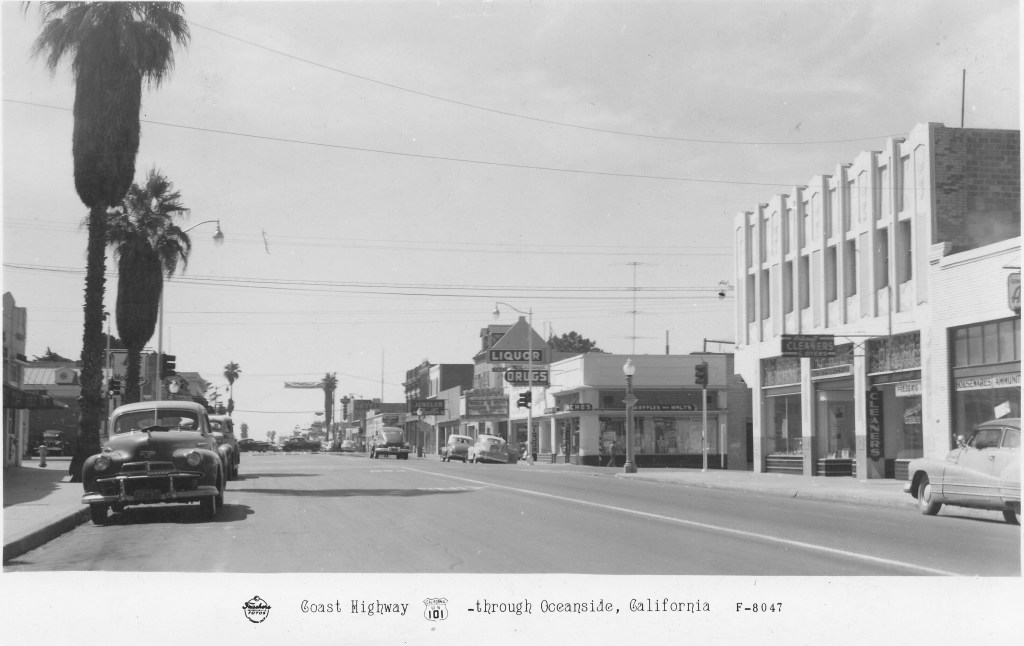

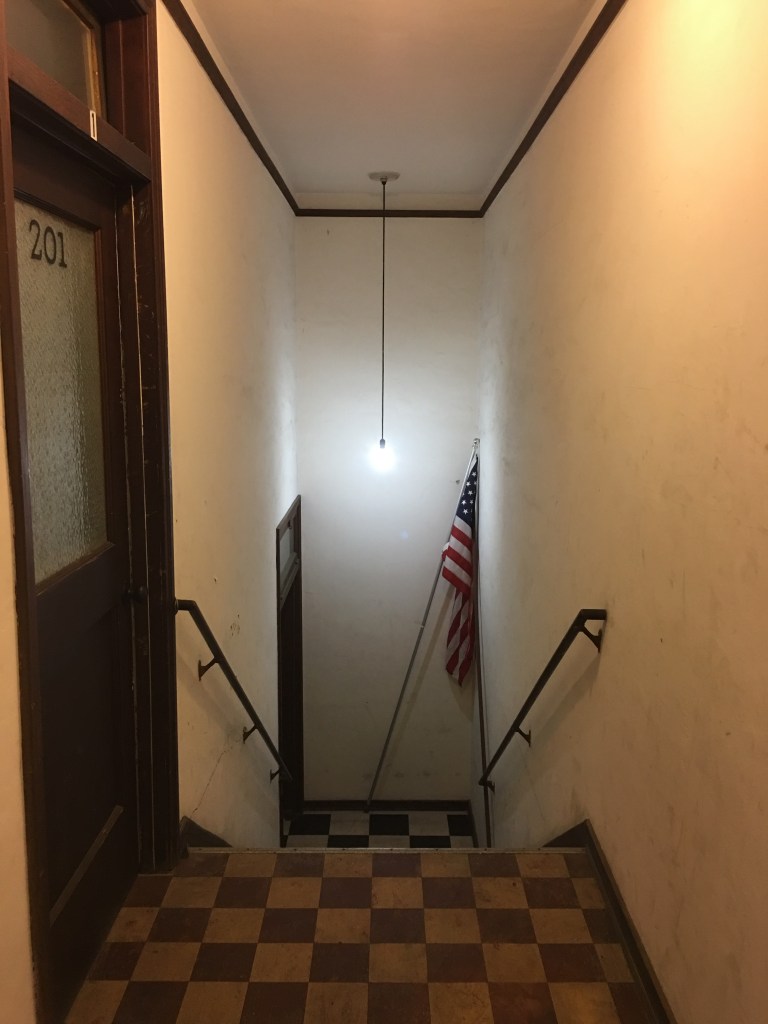


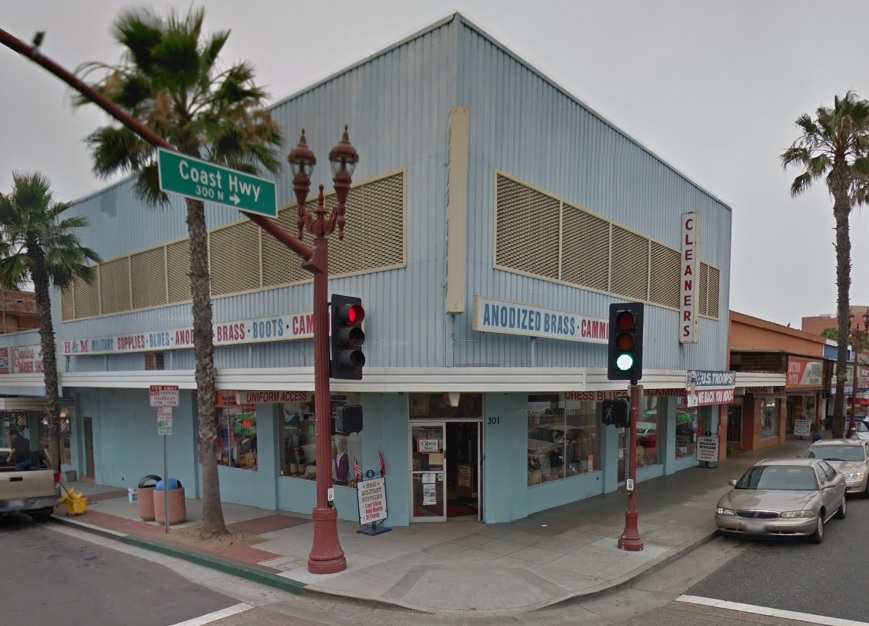


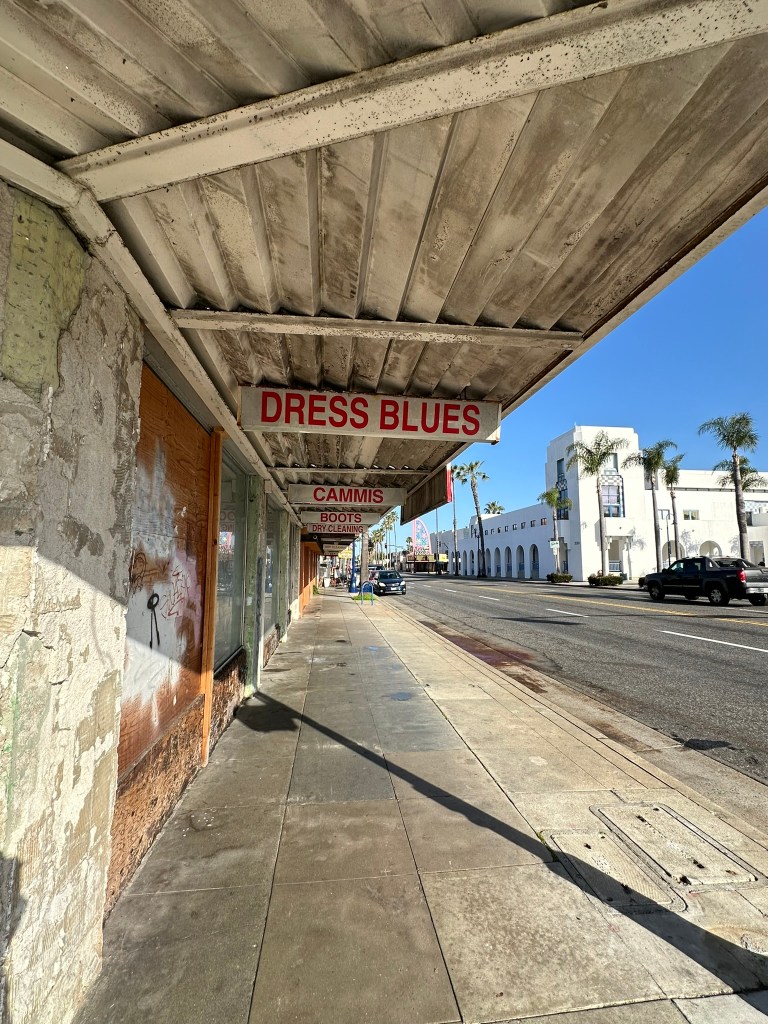
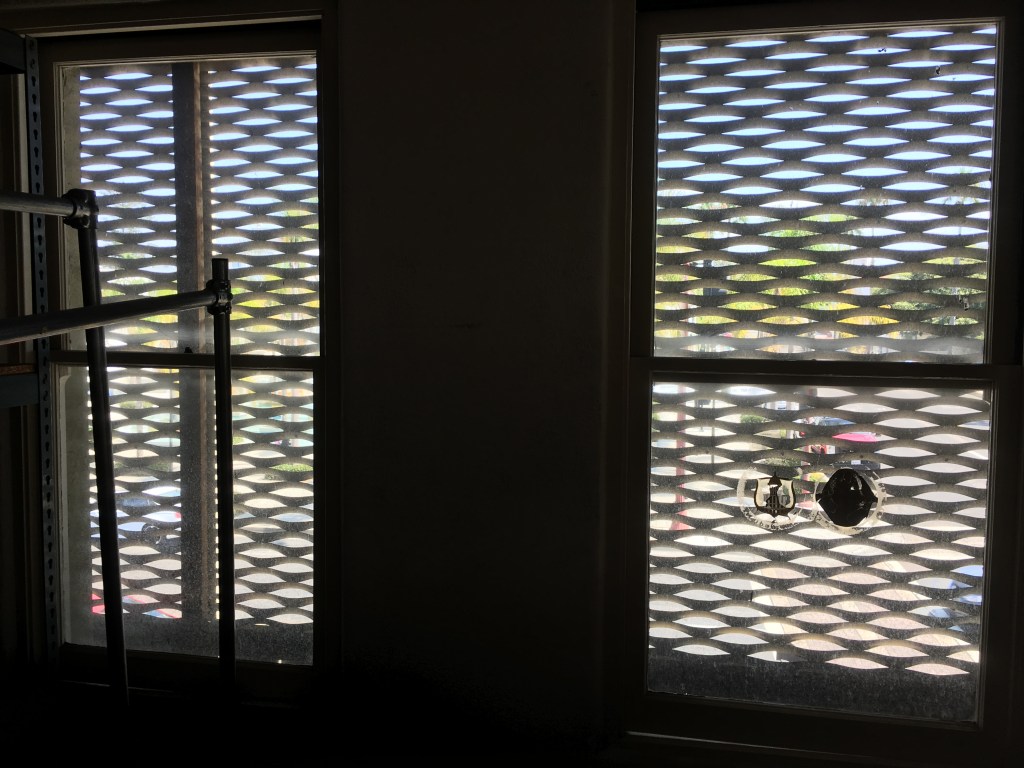

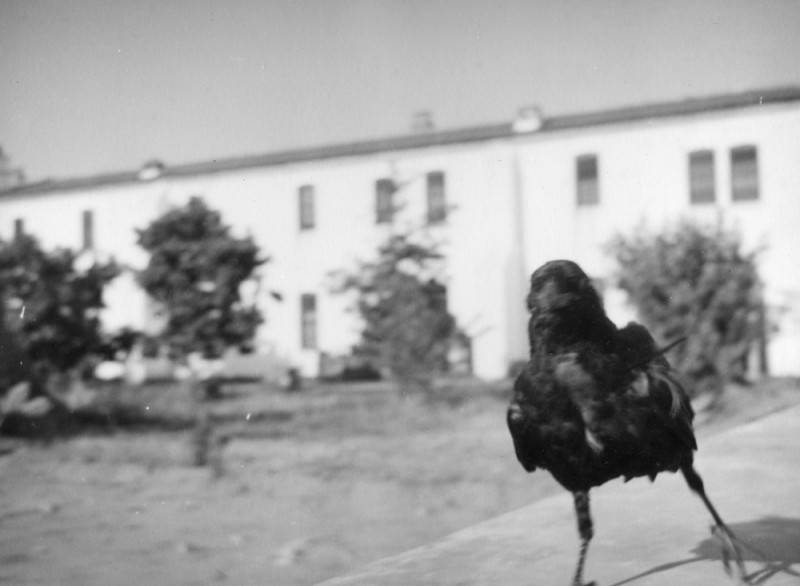
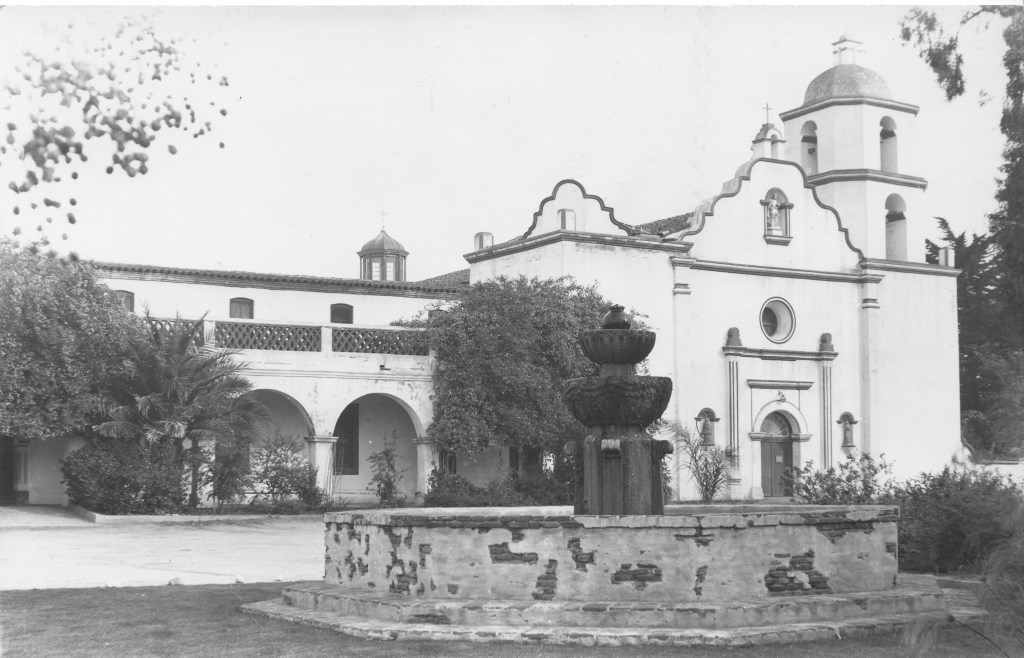


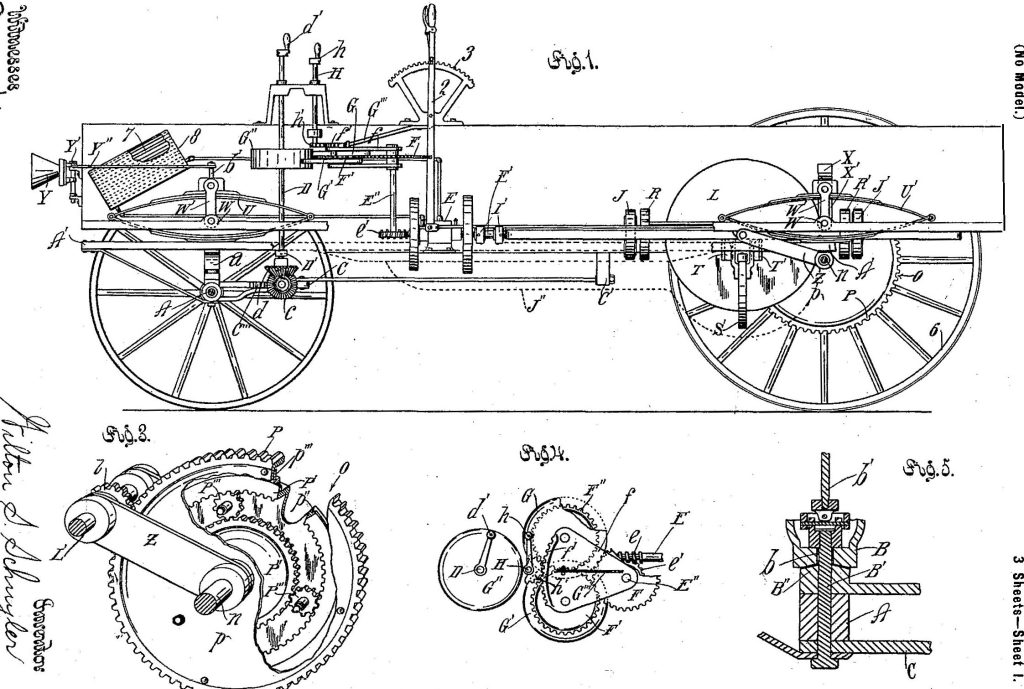


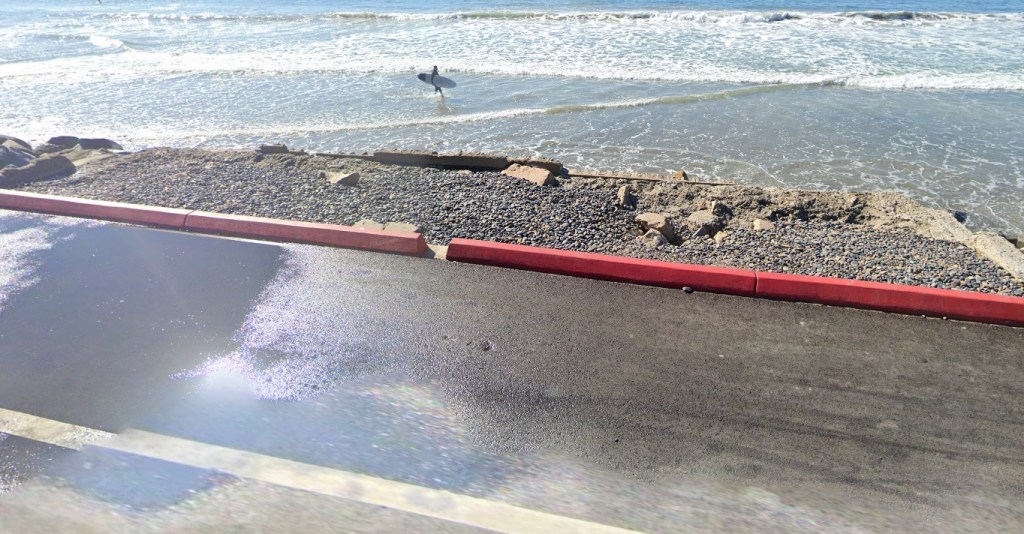


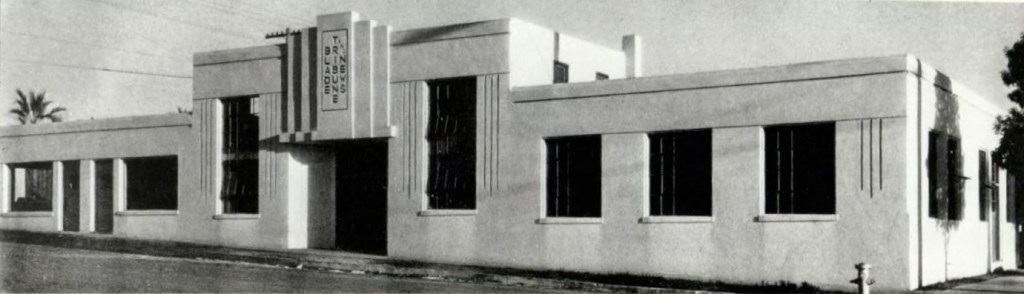
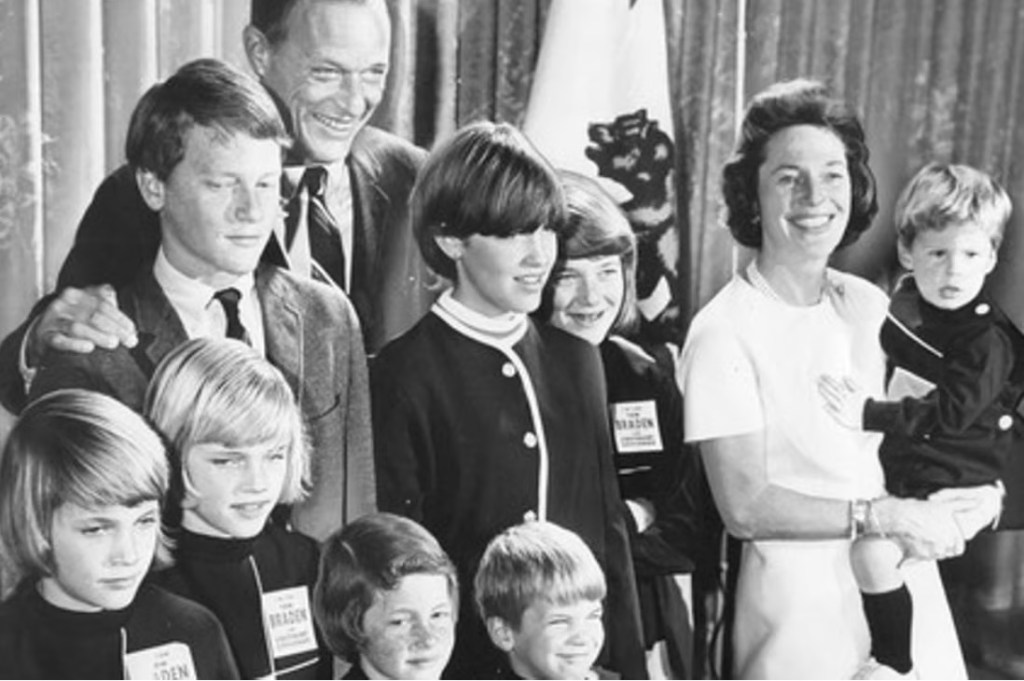


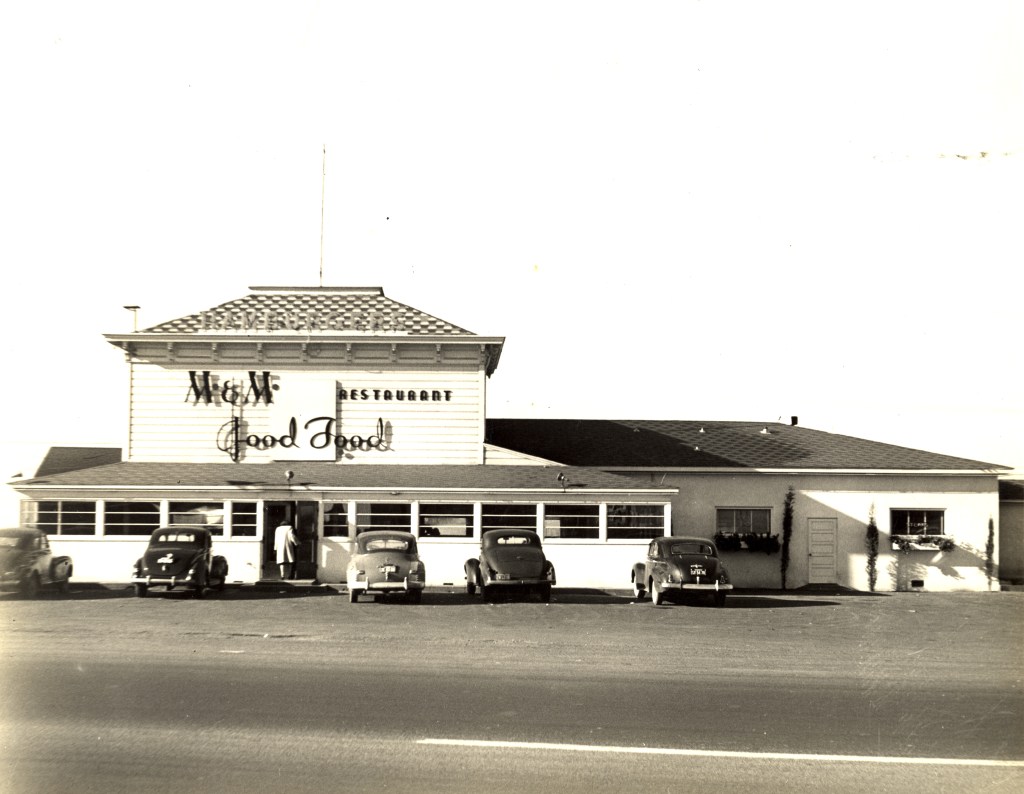


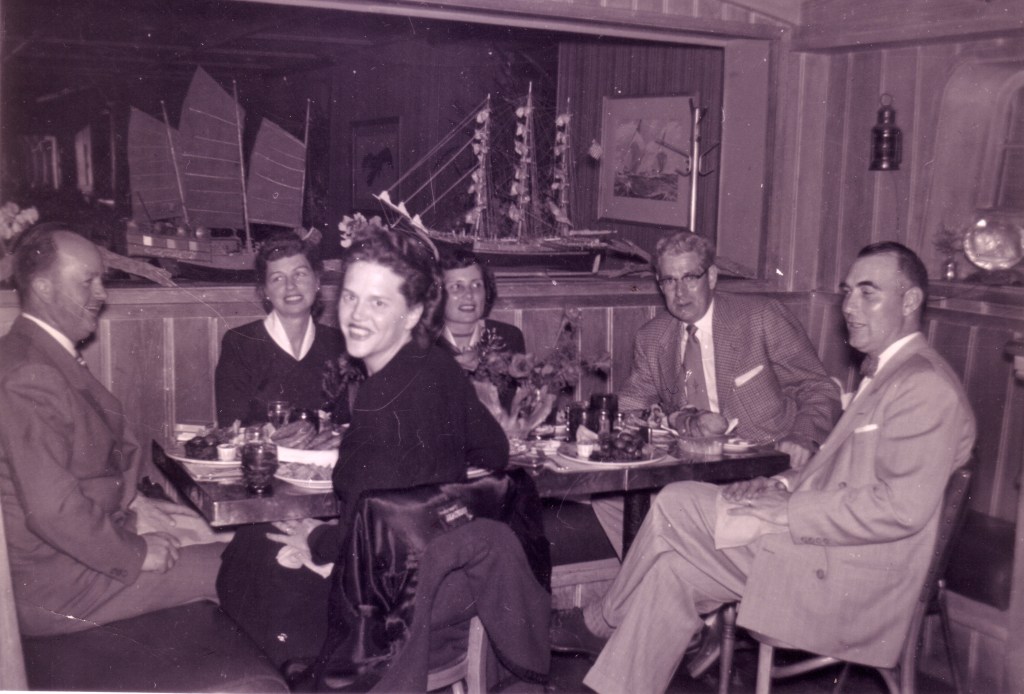
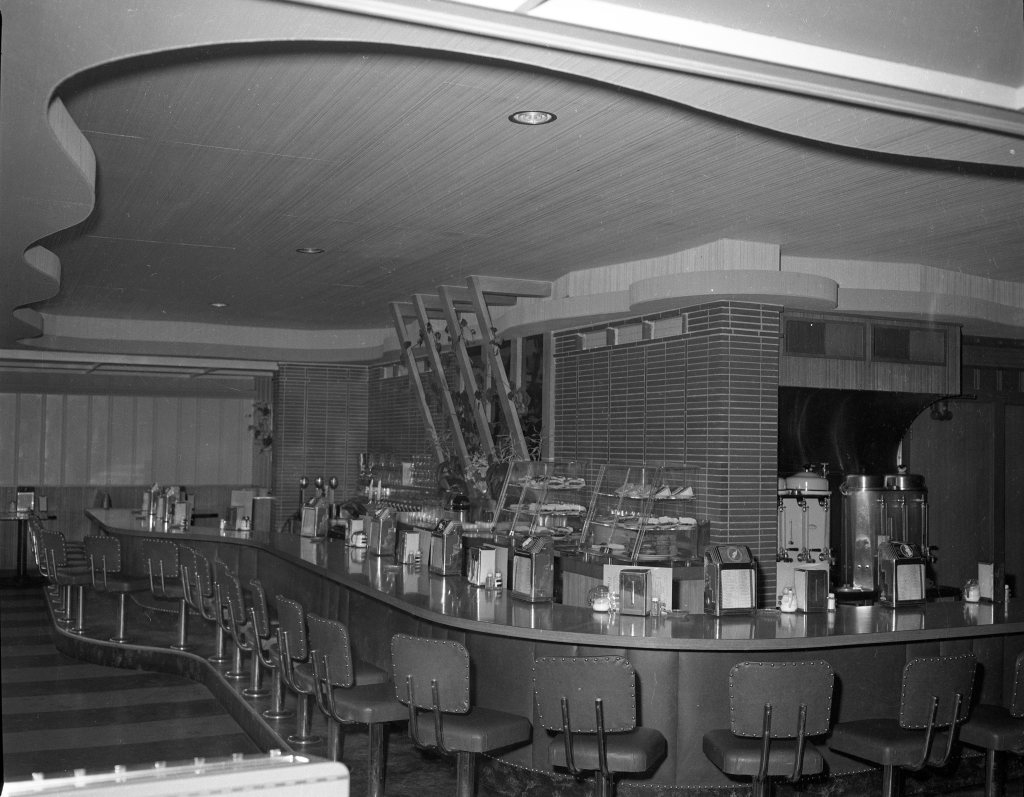


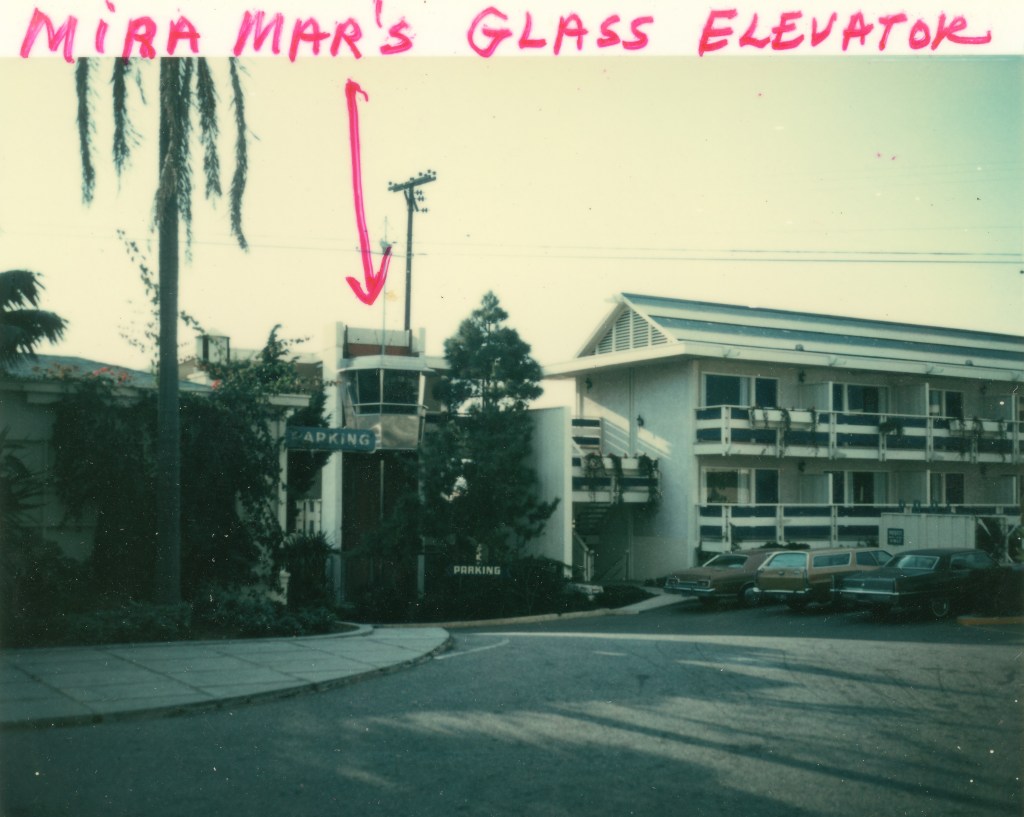

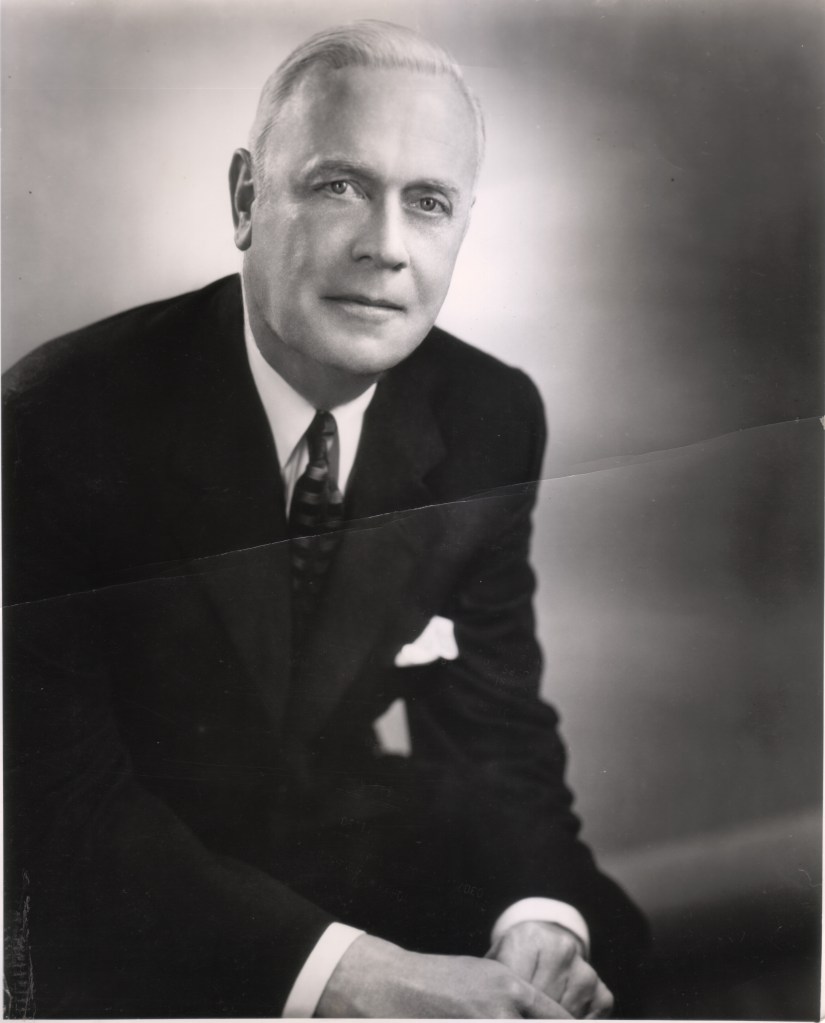


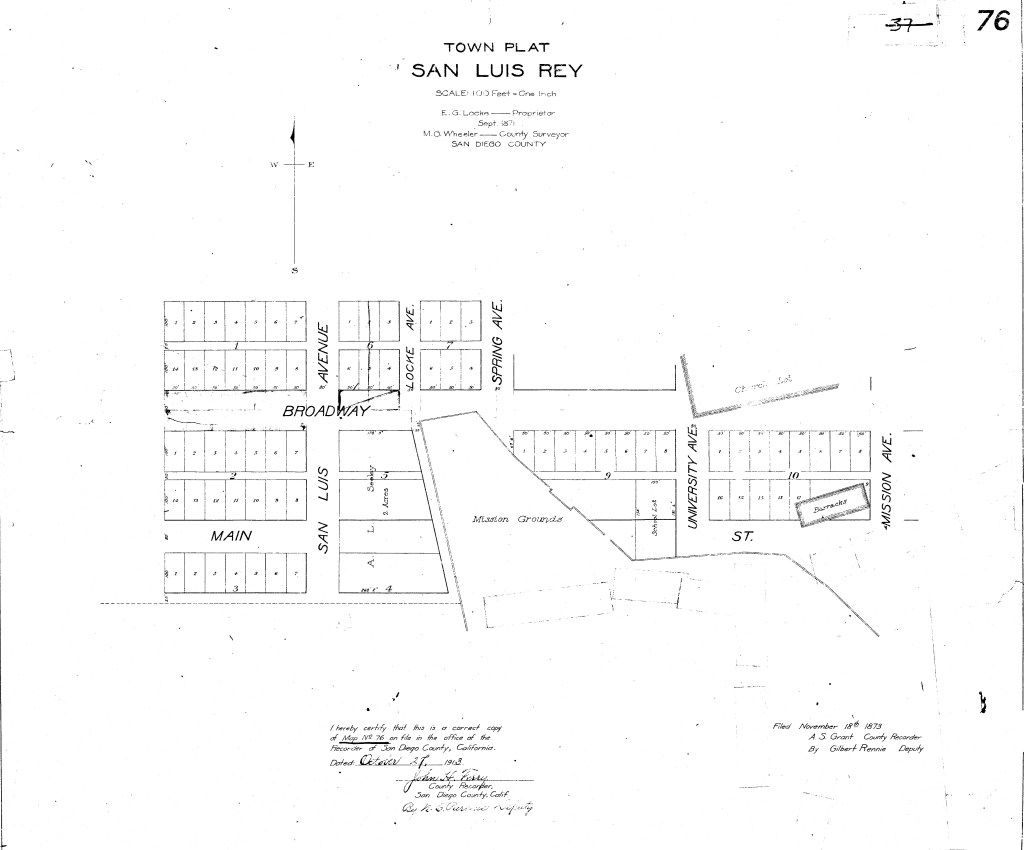
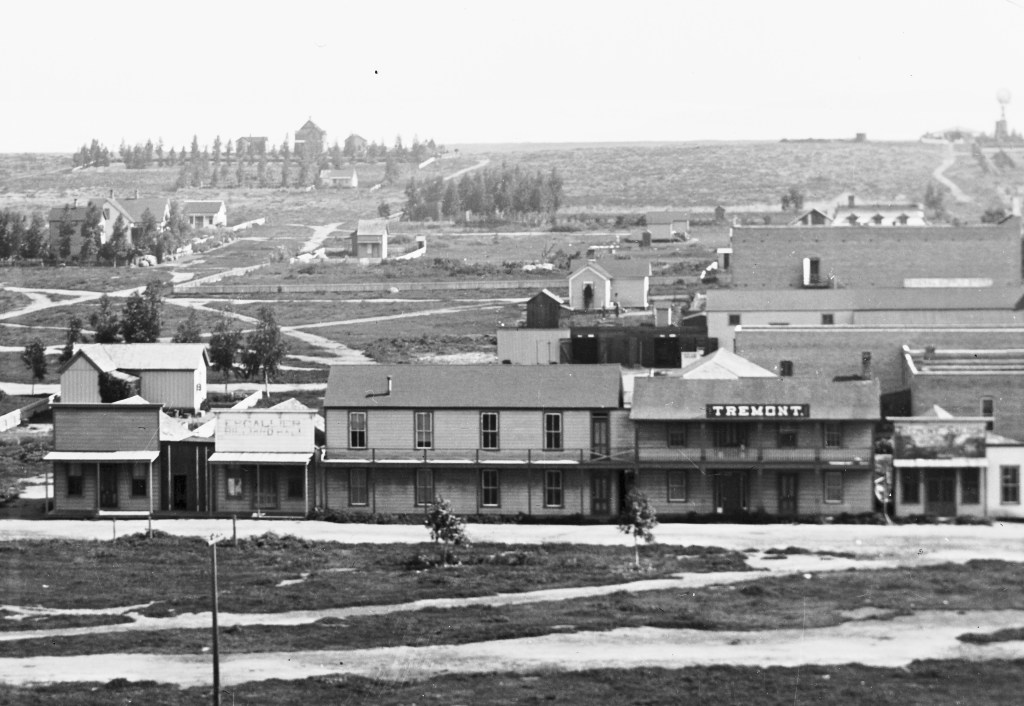
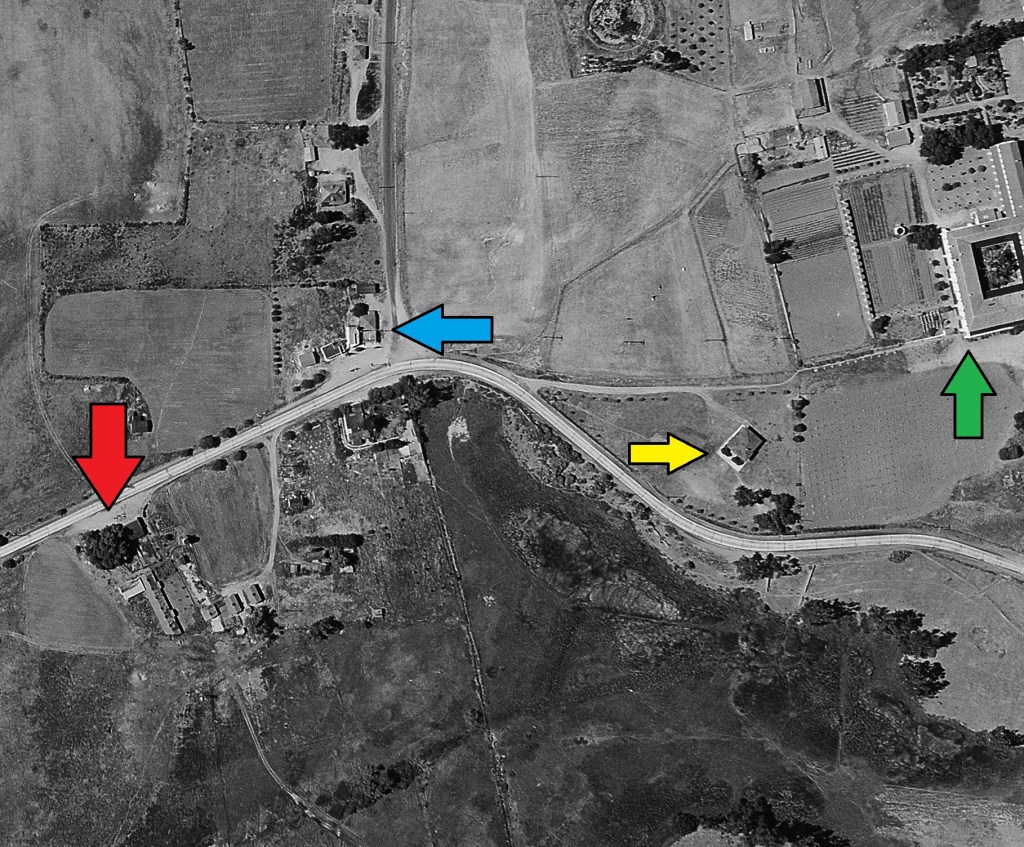


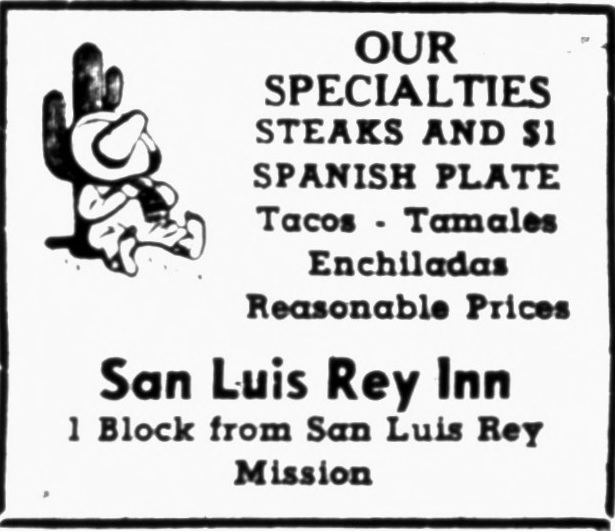


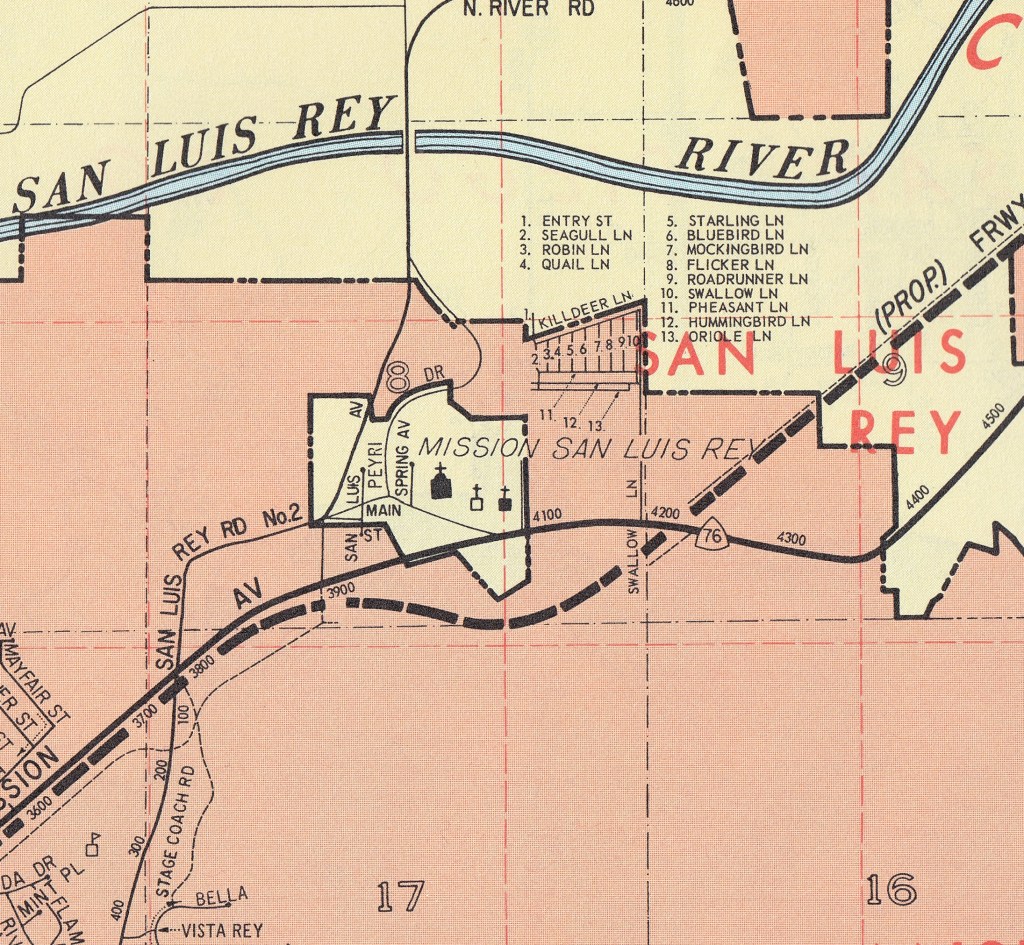


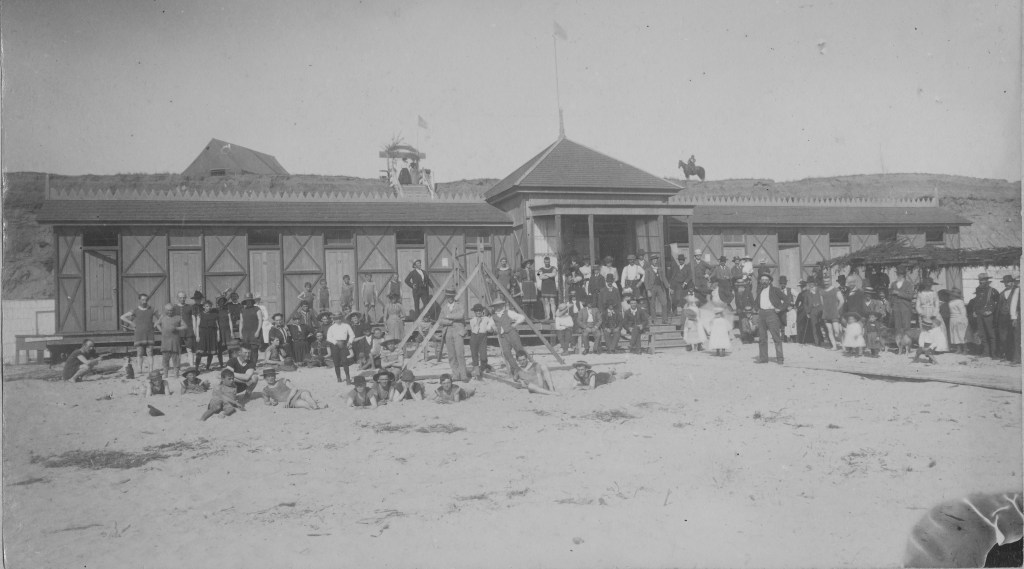

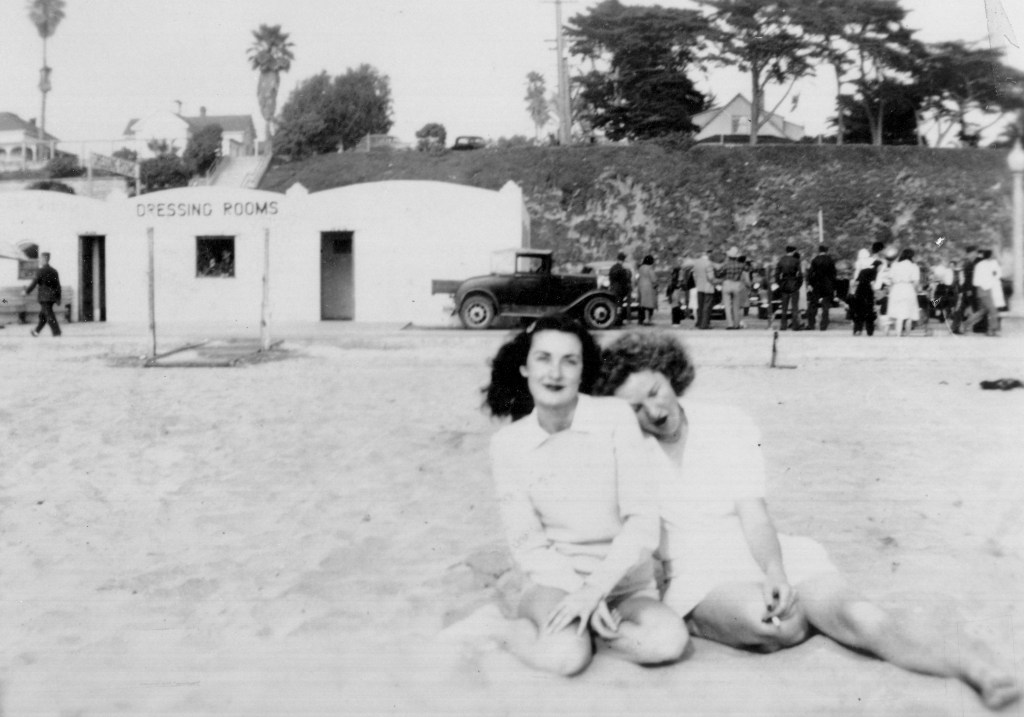


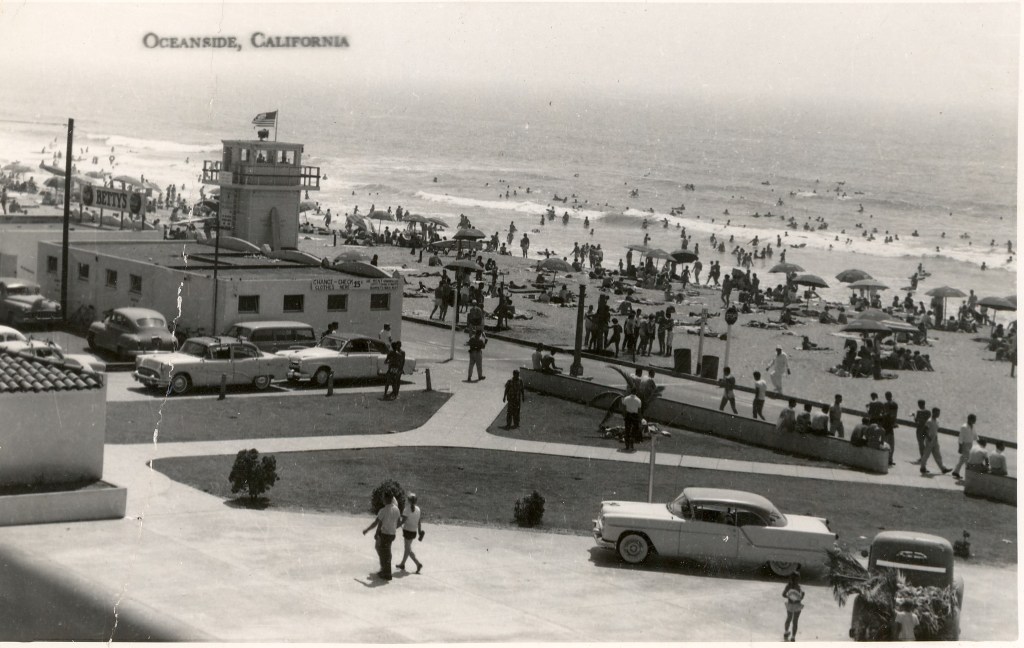
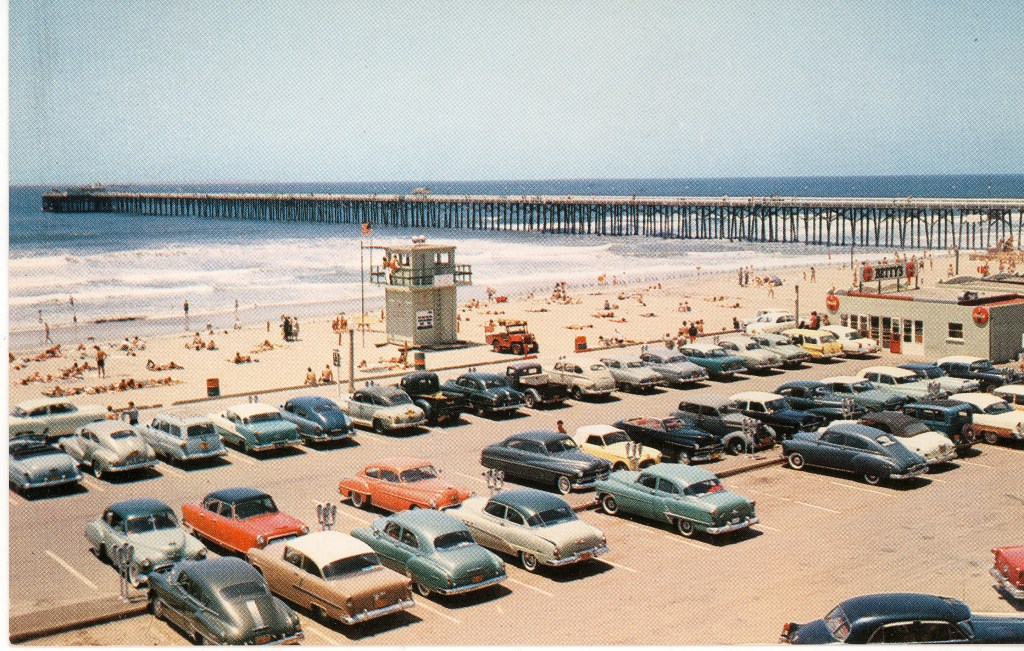


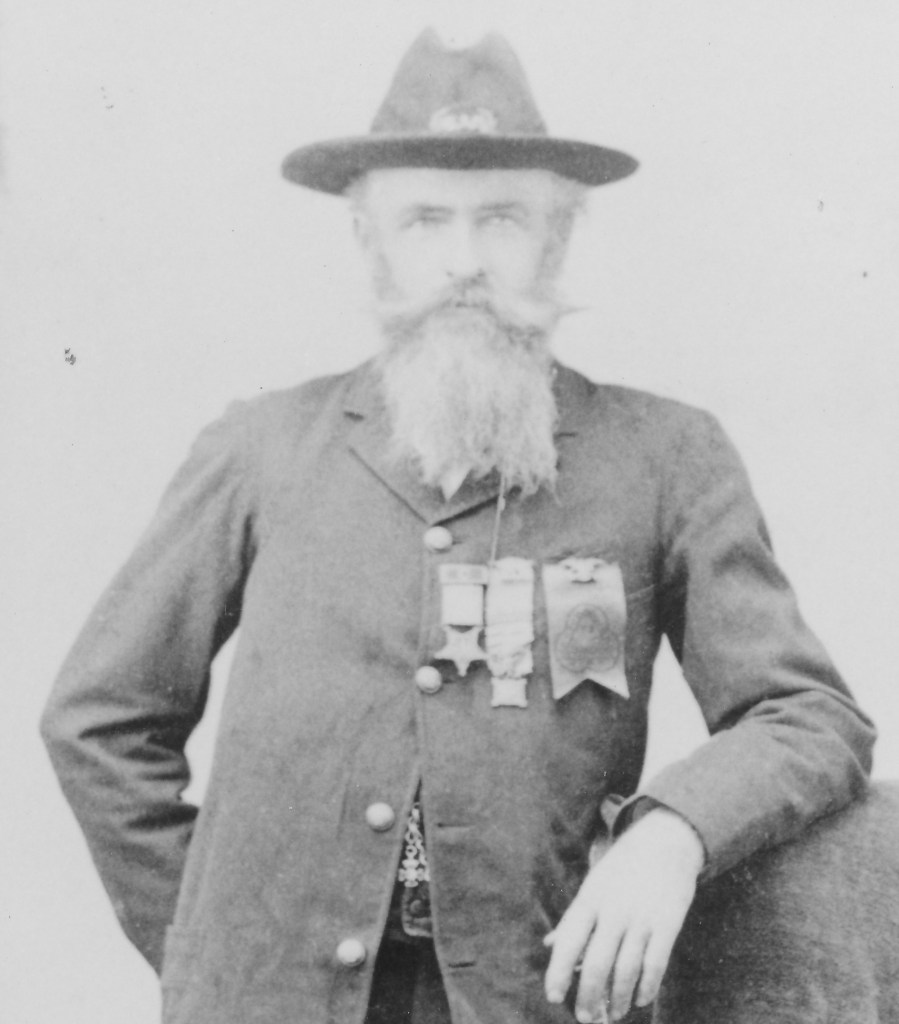


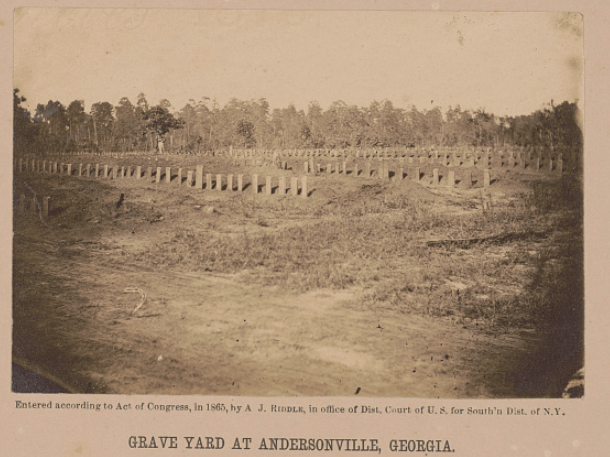
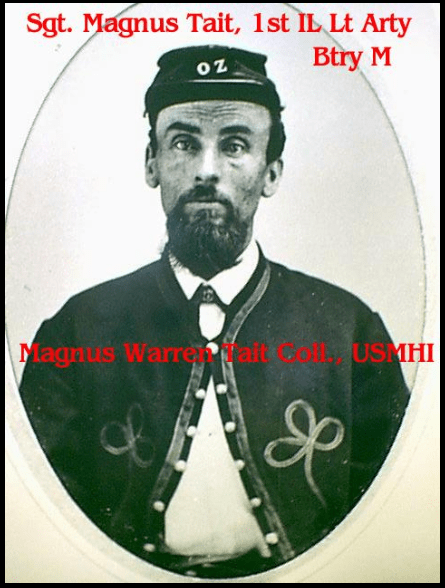


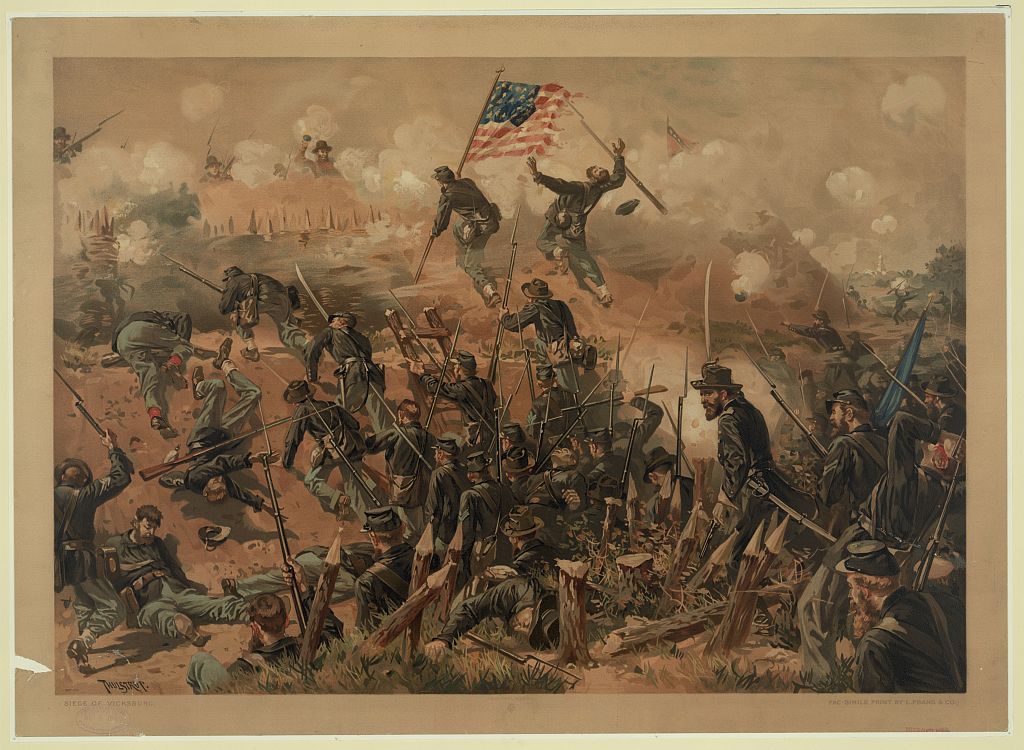


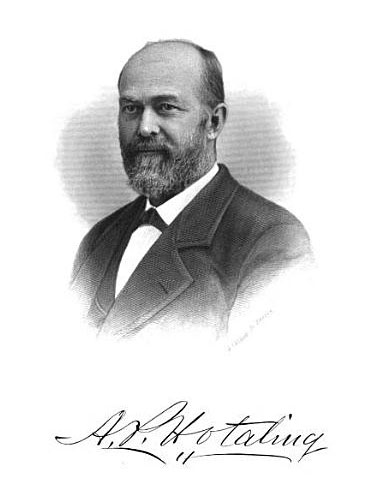

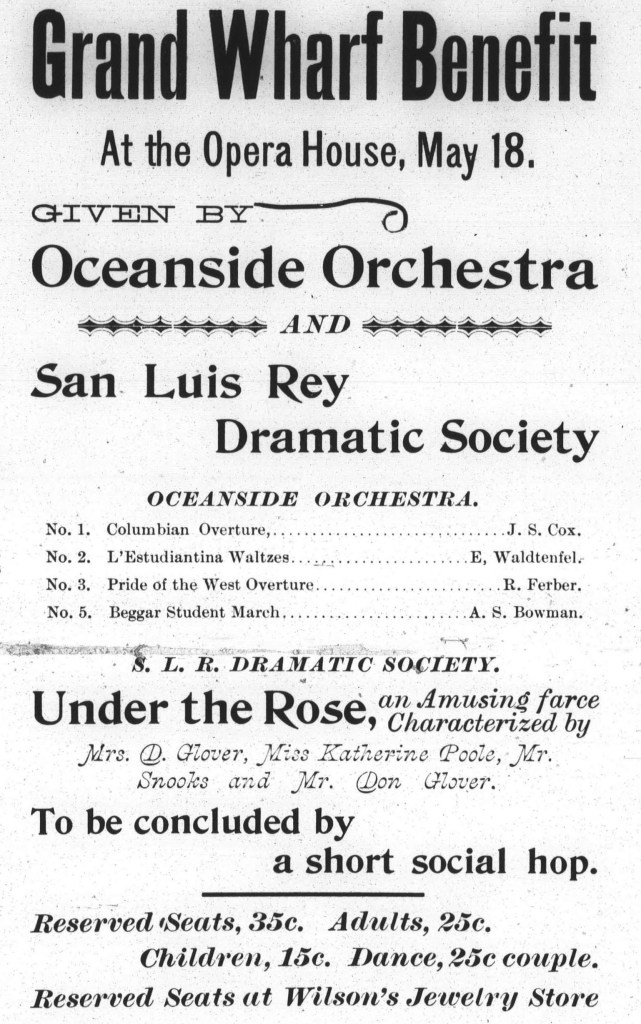


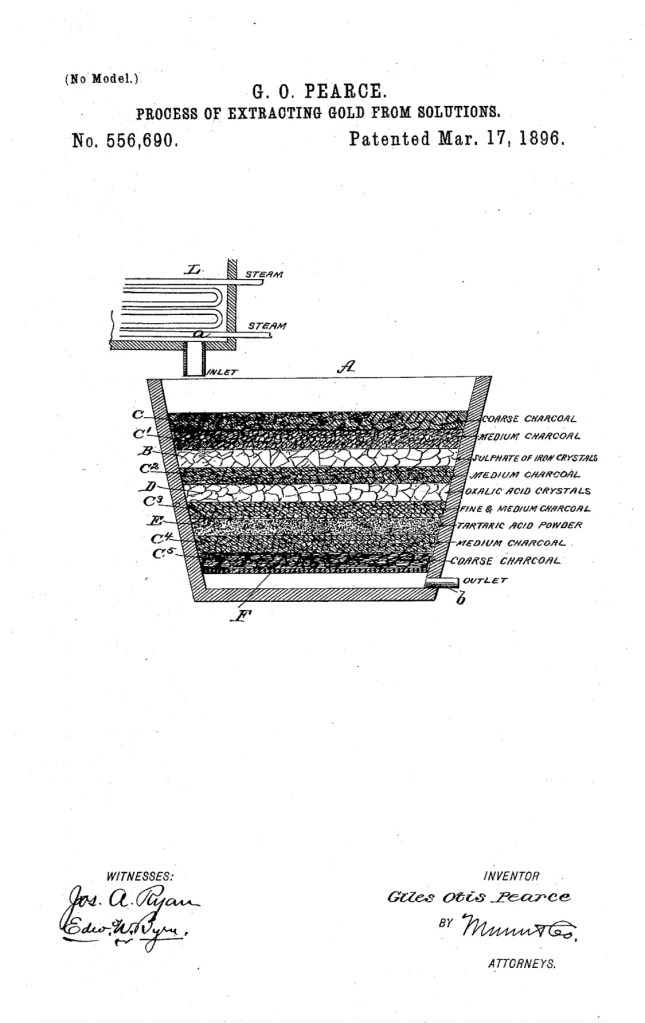

 Histories and Mysteries