The History of Oceanside’s 2nd Pier and the Promise of Gold

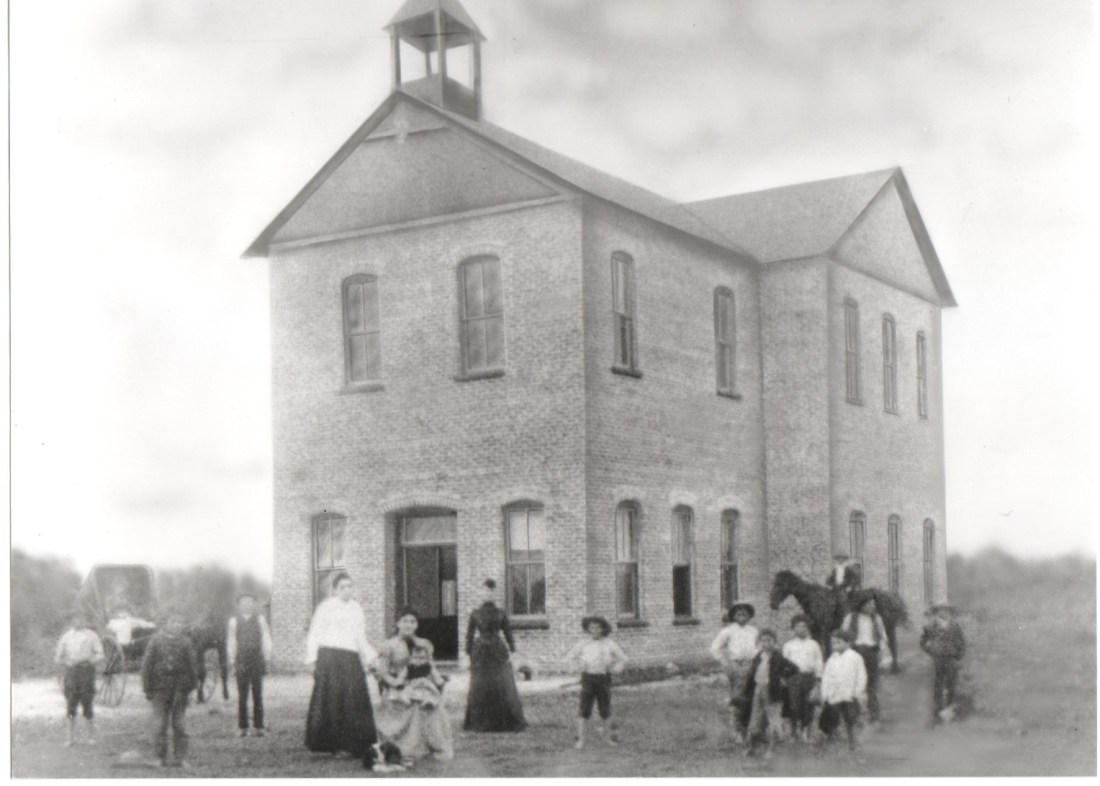
After the demise of Oceanside’s first wharf in 1890, the beach was covered with its debris. Rather than let the lumber float away, or rot in the sand, Melchior Pieper, proprietor of the grand and beautiful South Pacific Hotel, began collecting the pilings and planks. He loaded them up on wagons and stored the material behind his hotel. Pieper even stamped his initials on the pilings and lumber.

What was his intention? He was looking to build interest and financial support for a new wharf to be built at the end of Third Street (Pier View Way). It would be beneficial to have a wharf at that location, attracting more business and more guests to the hotel, which was located just north of Third Street, but also moving the pier to a more central location in Oceanside’s small downtown.

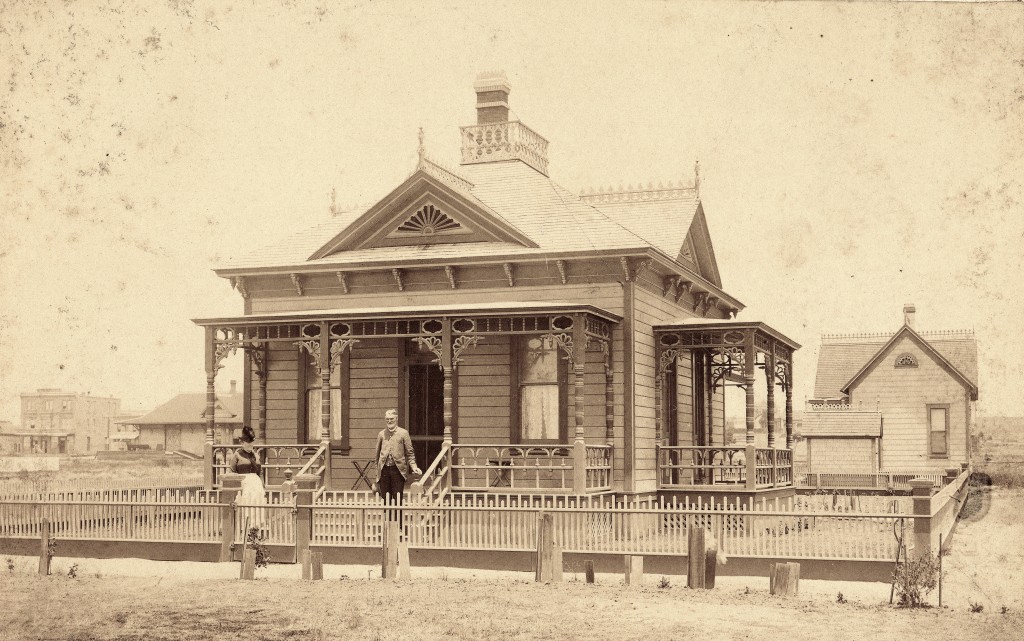
The South Pacific Hotel. Melchoir Pieper and wife standing center.

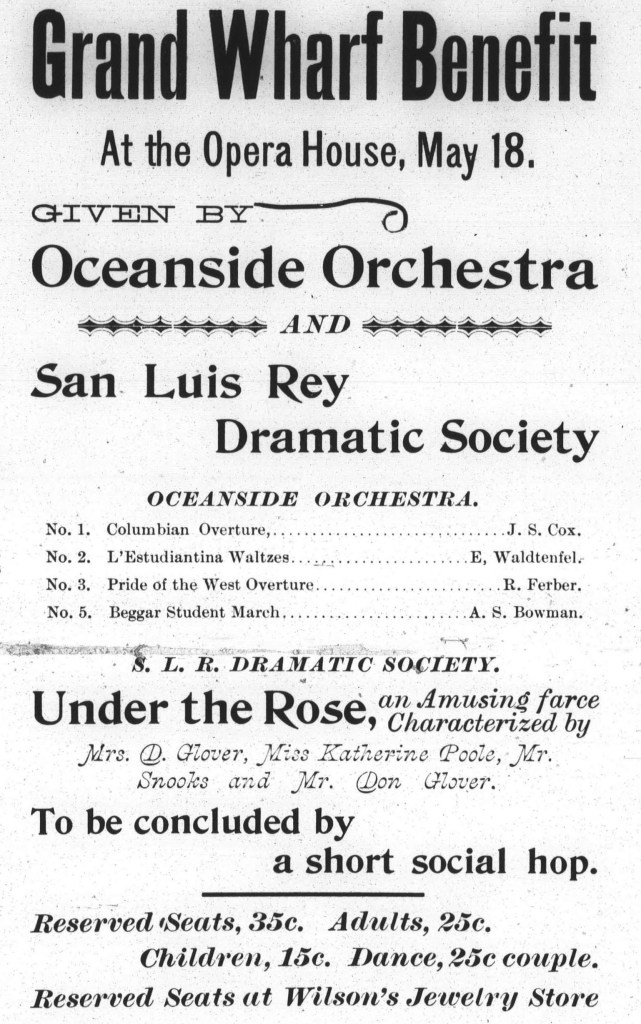
Determined, Pieper even traveled to San Francisco in December of 1893 to meet with Anson P. Hotaling, owner of the South Pacific Hotel, (as well as considerable property throughout the city and South Oceanside) to attempt to persuade him to support the building a pier that would be beneficial for the hotel.  Pieper’s trip was successful, as Hotaling agreed to support the construction of a wharf. 

In April of 1894 a committee was formed and plans for the new wharf began. There was some resistance against the Third Street location, (a site between Second and Third was favored), but with Hotaling donating $350 and Pieper donating $100 and offering to board the workmen free, the disagreement was set aside.
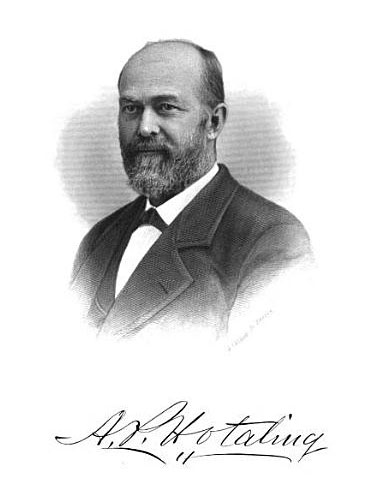
Modest fundraising began with the Oceanside Silver Cornet Band holding a benefit ball at the Oceanside Opera House.  Tickets were just a dollar but the Benefit, hailed as a success, and raised $50 for the wharf fund.

Oceanside’s Silver Cornet Band played at local events, including the Wharf Benefit Ball.

Specifications for the new pier were listed in the local paper: “The wharf will be 400 feet long from high water mark, 12 feet wide, and four inch iron pipe will be used for piling, which will be strongly braced.  It will be floored with two inch planing and a wooden railing of 3 x 4 material will surmount it.  The entire length from the bluff will be about 600 feet.  The total cost will be about $1200.

By June over $1,000 was pledged and two weeks of labor donated. John A. Tulip, a member of the wharf committee, persuaded a resident in joining him in digging the first hole for one of the pilings to be used in the wharf’s approach.  Within days several bents and stringers were put in place and 200 feet of the approach were ready for flooring.
In June the wharf committee ordered 440 feet of iron pipe, which arrived from St. Louis in August.  In September of 1894 the Oceanside Blade reported that, “Work on the wharf is at last underway.  An overhang derrick, as it is called, has been constructed by Mr. Cook, the piles have been asphalted, the joints been banded and strengthened and the work of putting them in place begun.”

Work was done quickly, largely due to the diminished length of the new structure. Oceanside’s second pier was known as the “iron” wharf because of the iron that braced its pilings. When finished, the little iron wharf measured at a modest length of just over 600 feet. 

The new pier was not without its hazards, as there was no railing added for the safety of fishermen, pedestrians and especially small children. Even after a railing was added in February of 1895, there is some speculation as to how really safe it was.

The Oceanside Pier in 1894, note the rear of the South Pacific Hotel faced the ocean.

In August of that year 14-year-old Fannie Halloran was a near victim after she fell from the pier, as the Blade reported: [Fannie] “while fishing on the wharf last Saturday, caught a fish and in trying to land it got the line fastened about one of the pile, and, in leaning over trying to get it loose, lost her balance and took a header to the water below, a distance of about 14 feet.  She had learned recently to swim, immediately applied her knowledge in the direction to getting ashore, which, with some assistance from her father was easily accomplished.  No injury resulted, but quite a different report would no doubt have been the result had the young lady not exhibited great coolness and presence of mind.”

Still, Oceanside’s new wharf was popular with residents and visitors as the Blade noted, “A great many people from the back country are enjoying fishing from the wharf here. It is a great attraction and the best investment the people of this place ever made.”

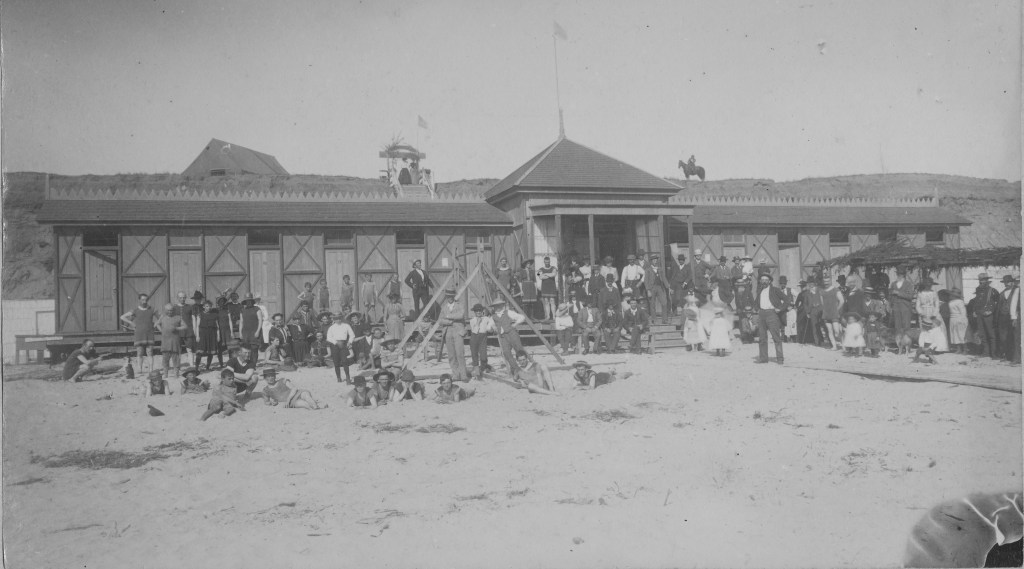
Additional view of the “little iron wharf” in 1894. Note the bathhouses on the beach.

But noting that the approaching Independence Day celebration and festivities it also added: “We should not forget the wharf, and its further extension into the Occident.  [The] wharf is an investment that is an all-the-year standby. It will bring people as no other attraction here will or can.  Fishing is almost a passion with many, and from observation often confirmed, it is–by virtue of the little iron wharf at the foot of Third Street–a source of the only meat supply of many others. But its length will not warrant many persons fishing at once, and for boating facilities, for the same cause, it affords none.  The season should not be permitted to go by without extending it at least 200 feet further. As an investment to the town it is worth ten celebrations.”

That July 4th celebration in 1895 was a success but only highlighted the need for a longer pier, prompting a meeting by city leaders: “Dr. Nichols explained the call of the meeting to be for the above purpose and gave estimates which he had carefully compiled, based upon what work and expense had already been done.  The amount necessary to extend the wharf two hundred feet further would entail an expenditure of close to six hundred dollars.  He went on to state in his most eloquent fashion, the large benefit the wharf had already been to the city of Oceanside and that there was an assurance of a large number of families who would spend the summer here, and the cause of this was that Oceansiders were awake to the fact that to get the people from the hot interior towns to spend the heated, term, here, that inducements in the way of a pleasure and fishing wharf was an absolute necessity in connection with our natural inducements of climate, location, etc.

Talk continued to extend the wharf, one hundred, two hundred and even three hundred feet but nothing was done because of lack of funding. However, on September 17, 1896, Matthew W. Spencer and Melchior Pieper, members of the wharf’s Executive Committee, officially deeded the pier to the City of Oceanside.

In May of 1897, Giles Otis Pearce, a self-described “assayer, metallurgist and mining expert” from Colorado, collaborated with Oceanside inventor Wilton S. Schuyler, son of businessman John Schuyler.

Wilton S. Schuyler, circa 1948

A legitimate inventor, Wilton actually designed and built an early automobile in 1898 which he called the “Oceanside Express.” He received a patent for the vehicle in 1899. He then invented and patented a “wave motor” which Pearce wanted to use for a dubious method to extract gold from the ocean after it was affixed to the Oceanside pier.

A detailed and lengthy article from the Oceanside Blade explained, in part, how it was supposed to work: “Mr. Pearce is the inventor and patentee of a process for extracting gold from the waters of the ocean, which are said to contain, in solution, four cents of gold to every ton of water.  By the use of chemicals the gold is precipitated and caught in a deposit of charcoal in the bottom of a barrel or other receptacle. The cost of elevating the ocean brine into such receptacles has been the chief difficulty in the way of a successful solution of the question.  It is believed that the Schuyler wave motor will accomplish the desired result.
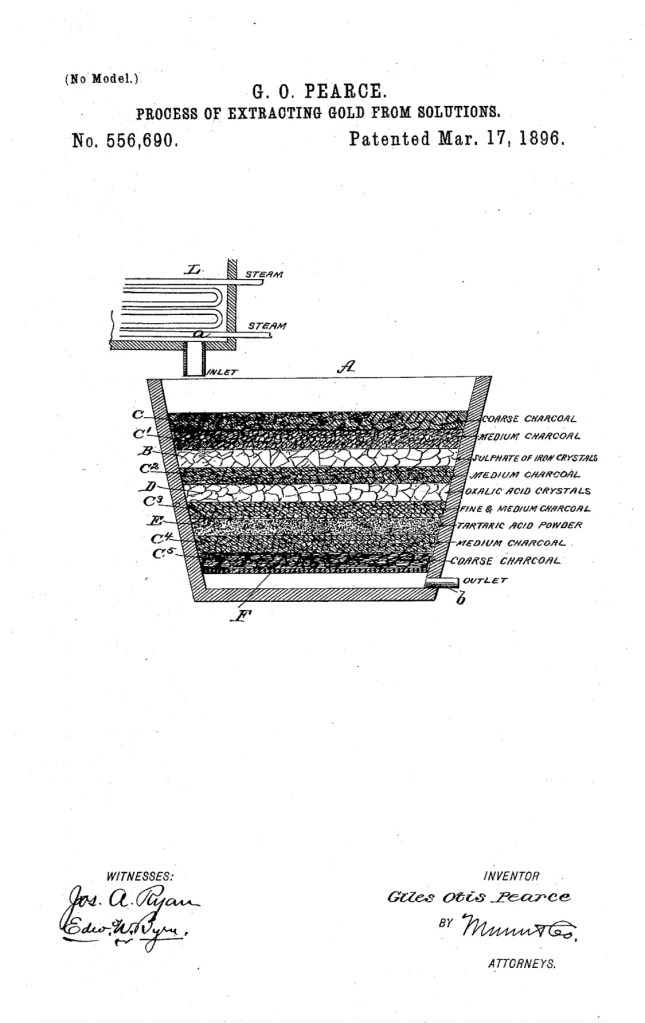
“From each barrel, filled and refilled the proper number of times, it is claimed by Mr. Pearce that $153 gold per year can be saved.  He also claims that every cubic mile of sea water contains $65,000,000 in gold.  It is understood that negotiations are under way whereby the two patents will be consolidated.  His patent is controlled by the Carbon Gold Precipitant Company of Colorado.”

While the extraction of gold was questionable, Schuyler’s invention may have been ahead of its time: “A test machine will be put in during the present summer. It is hoped it will prove a success, and that the almost unlimited power of the ocean breakers at our door will be turned to account.  If this can be done, electric lights, manufacturing, water galore for irrigation and every other purpose, a railroad up the valley, all will come as a result of the capital that will surely follow the demonstration.”

The city council granted permission to use the wharf for “scientific purposes”, and to “erect such machinery necessary for the purpose of extracting gold from the ocean, such machinery not to interfere with the travel on same.”

Giles Otis Pearce may have been one of the first to perpetuate this ruse and claim he could extract gold from the ocean but he wasn’t the last. In 1898 Prescott Ford Jernegan claimed to have invented what he termed a “Gold Accumulator” that could extract gold from seawater using a process with “specially treated mercury and electricity.” His hoax was exposed and he was sued by investors.

Schuyler’s wave motor seemed to be a legitimate apparatus but its use to extract gold brought expected skepticism. The editor of the Escondido Advocate newspaper challenged the veracity of the editor of the Oceanside Blade to publish such claims: “The article states that Giles Otis, a mining expert, who has patented a process for precipitating the gold in ocean water, was in that city last week consulting with John Schuyler, who has patented a wave motor, and these two will join issue and put in an immense plant at Oceanside. It is estimated that each ton of ocean water contains five cents in gold or $65,000,000 for every cubic mile. It is proposed by the parties interested to handle about a cubic mile of ocean water daily, and with the surplus water power which is as unlimited as the confines of the ocean, a system of electrical power will be put in along the San Luis Rey for pumping plants and the entire country is confidently expected by be submerged under twenty feet of water by the first of October.  They then will have electric lights and street railways for Oceanside with all kinds of manufacturing industries to follow.  Ed, we take off our hat and unanimously vote you the greatest prosperity liar of the age.”

Giles Otis Pearce was a litigious eccentric. He filed dozens, if not hundreds of lawsuits, including the estate of Theodore Roosevelt. If he lost a suit, he promptly filed an appeal.

Born in 1851 in Muscatine, Iowa, Pearce was well known for his wild claims, and considered a “crank” by locals. He changed, or rather, collected, occupations including printer, journalist, assayer, chemist, smelter, and lawyer. He served as a private in the Ohio Calvary from 1872 to 1873.

In 1885 Pearce ran for governor for the territory of New Mexico. After President Grover Cleveland appointed someone else to that position, Pearce sued the government. In 1886 he claimed to be under the influence of spirits, threatening the lives of family members. He was placed in an asylum in Endicott, Nebraska, but escaped. In 1890 he was “judged insane but harmless” and allowed to retain his freedom as long as he “behaved” himself.

After moving to Colorado, he disputed the recorded height of Pike’s Peak and said that he had determined the actual altitude, which upset and angered locals. He then claimed to have the capital and means of driving a 17 mile tunnel through the Rocky Mountains, at an expense of $25 million. He did not win over any support for his claims and the residents of Cripple Creek asked him to leave. After leaving Colorado, Pearce made his way to Yuma, Arizona, San Diego and then to Oceanside.

But before Schuyler’s wave motor and Pearce’s gold extraction device could be put to the test, the pier needed to be extended and that would take another year.  It was extended one hundred feet into the Pacific but it was far too short to provide “boating facilities.”

In June of 1898 work on the pier continued and the Blade provided this update: “Things are progressing nicely toward finishing the wharf.  The money will be available in a few days and next season will find us provided with good boating facilities. It is suggested that the work of superintending further extensions be placed in experienced hands so that our pier may be a thing of beauty instead of bearing a resemblance to a tortured snake.”

In October of that same year, Schuyler had placed his wave motor on the pier and demonstrated that it would in fact pump water “in sufficient quantities to warrant the putting in as an experiment of a Pearce filter for extracting gold from sea water.”

However, little to mention of gold extraction and/or Giles Otis Pearce was made after that time. The experiment was apparently abandoned.

Pearce left for Los Angeles where he married (for a second time) to a 21-year-old woman (he was 49) in June of 1900. Just months later during a contentious divorce he declared publicly that his wife was insane. He tied her up to keep her from leaving him and then made a complaint to law enforcement that his wife’s aunt was trying to have him killed and insisted that she be arrested.  Pearce died in 1924 at the age of 73 in the National Soldiers Home in Los Angeles. His hometown newspaper noted his passing and his “eventful life.”
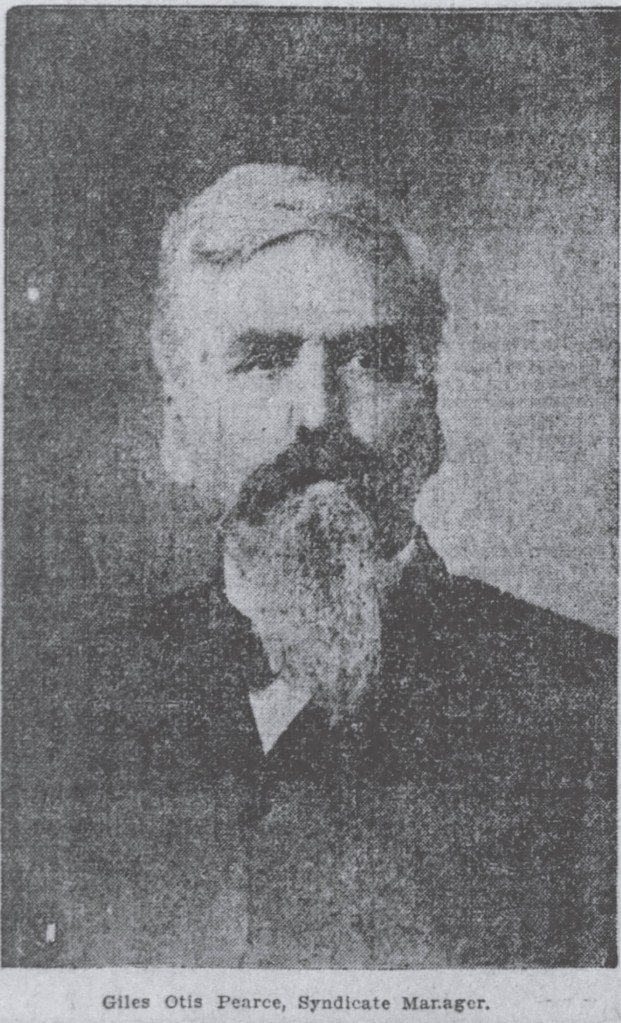
From the San Francisco Call, February 18, 1906, page 39

On November 9, 1898, the board of city trustees met in adjourned session, where it was reported that the wave motor on the wharf was “straining that structure and Trustees Paden and Nicholas were appointed a committee to investigate and report on same.”

A year later the pier had still not been extended. In November of 1899 the Oceanside Blade published a plea to citizens to step up or see the second pier face the same demise as the first: “While the necessity is apparent of finishing our wharf in a substantial manner and extending it enough to make a good boat landing, the necessary lucre is not in sight as yet.  We should be glad to publish suggestions or communications from any of our citizens, on the subject.  Something should be done or we will wake up some fine morning after a storm and find the present wharf not present, so to speak.  In other words washed away…defunct.”

The Pacific Ocean continued its assault on Oceanside’s little iron wharf until a new pier was built in 1903.

View of Oceanside looking east from the South Pacific Hotel, circa 1890

The Legend of the Castle House on Mesa Drive

For decades the mystery of the castle on Mesa Drive has captivated a select number of Oceanside residents. There are several social media threads in which people inquire “do you remember the castle house?” There are no pictures and little information. Only the memories of children and teenagers who remembered that the castle was haunted or spooky. Rumors or perhaps truth, that an old man lived there, who would threaten them with a salt rock rifle. The house looked odd and eerie. It was made entirely of beach rock they said.

Yolanda Mitchell remembers as a little girl growing up in the 1960s that the house was two stories, made of stone. It both captivated and frightened young children. “None of us had the nerve to go in there. In fact, we thought if you went in there you might not come out. So, we never did,” Yolanda said. But the memory of the castle is so vivid, even to this day, every time she drives down Mesa Drive, she still looks for the “castle.”

But just who built this castle-shaped house? Who lived there and what became of it?

Noah Freeman purchased a portion of Tract 8 in the Ellery Addition in about 1929. The subdivision was established by Henry E. Ellery in 1925, which runs along Mesa Drive from Rose Place to the then city limits (which ended just about where Pajama Drive intersects Mesa).

1939 Map of Ellery Addition in 1939

Little is known about Noah Freeman, but he was born June 19,1880 in Boston, Massachusetts. In 1920 he was living in Michigan working as a machinist. It appears he was never married. At some point, year unknown, he made his way to California and purchased a vacant lot in Oceanside.

Freeman lived a solitary life on his property off Mesa Drive, which provided expansive views of the San Luis Rey Valley. He made his living as a farmer and doing odd jobs. But as inconspicuous as the life of Noah Freeman was, the small home which he built upon his triangular shaped plot of land would make the newspaper for curious reasons. And little did anyone know — would become the stuff local legends are made of.

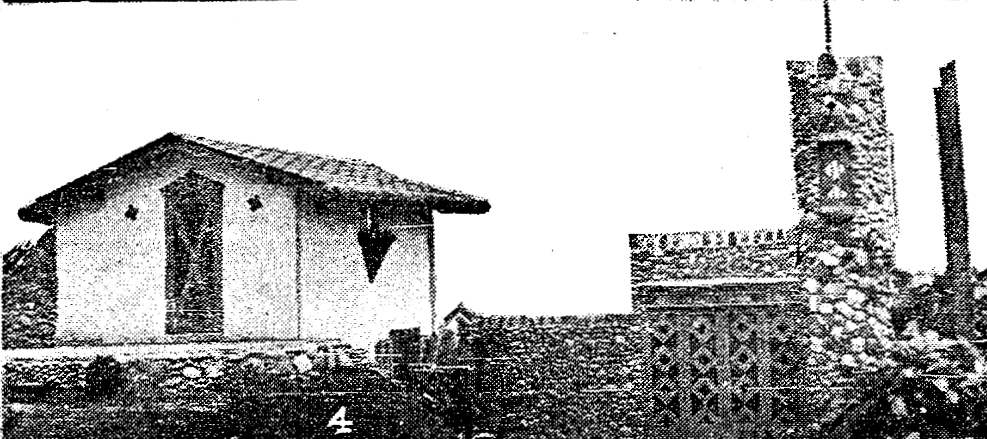
On July 15, 1934, the San Diego Union published an extensive piece about Oceanside, detailing its establishment and then its amenities as a city. Included in this feature were images of different architectural styles, namely the Mission San Luis Rey, the Healing Temple of the Rosicrucian Fellowship, the Oceanside-Carlsbad Union High School, Oceanside Pier, AND, the home of Noah Freeman, “self-made architect.”

It included the only image of the house that at present can be found. Are there others out there? It is very likely, but they have yet to be shared.

Noah Freeman’s Castle, from the July 15, 1934 Sunday edition of the San Diego Union

The article read as follows: “On Mesa Drive, [at] the rim of the hills east of Oceanside, is a residence that’s unique. It has been built, piece by piece and over a five-year period, by Noah Freeman, its owner, and behind its size and form there’s a story.

“Freeman first built a cracker box stucco room as a base for tending his avocado trees. Then he picked up a wheel barrel load of field stone and stoned one wall of the stucco house. ‘I had some stones left over, so I started a stone garage,’ says Freeman.

“Every time I finish something I had stones leftover, and I started something else. Then I had to get more stones to finish it, and I got enough to start something else again. I followed no plan or idea, unless it was subconsciously, and if the various units harmonize, it is because of intuition, not design.”

The article goes on to describe what would be known in later years as the “castle”: “The spectacular feature of Freeman’s rambling rock establishment is a tower room above the garage, barely large enough to contain a single bed. It is reached by a ladder, set vertically in the rounded interior of the tower’s base, so that the climbing visitor fits into available space, almost as smoothly as a cylinder in a pneumatic tube.

“In a single room of this distinctive structure, Freeman lives and ignores economic conditions almost entirely. ‘I keep a goat,’ he explains pointing to a newly finished goat yard built of old bricks burned in Oceanside in the 1880s, ‘and the goat keeps me. Her milk, with a little fruit and some vegetables, is all I require. I do odd jobs for money when taxes come due, and my avocados will bear pretty soon.’

The article finishes by saying that “Freeman is one of the many who have adapted to their own tastes like the slogan ‘Oceanside, where life is worth living.’”

1937 aerial view of Mesa Drive, (C-4261-44) CSB Library Geospatial Collection


Freeman was mentioned again in the San Diego Union on November 7, 1934, when it noted that “Noah Freeman, Oceanside, self-made architect, who designed and built his “most uniquest” home east of town climbed El Morro, nine years ago.” It went on to describe the large hill and the steep pitch reported by Freeman, but just why this was newsworthy, is unknown, but it suggests that Freeman had come to San Diego County as early as 1925.  

Noah continued to occupy his property until 1938 when the Oceanside Blade Tribune announced on April 16 that “a ranch in the Ellery tract that was owned by Noah Freeman has been sold to Mr. and Mrs. George Babb of Kansas City.” The Babb’s did not occupy the property but may have leased it.

By 1940 Noah Freeman was living at the Self-Realization Fellowship in Los Angeles and working as a janitor there. The census record of that year has a notation that reads: “Wages in this institution are paid in board and room, plus small cash allowance.”

Two years later he was working and living at the Page Military Academy in Los Angeles. In 1950 he was living in a small house he owned on Quail Drive. Sadly by 1967 Freeman had been declared “incompetent” and his property sold. He died on May 29, 1968, and his passing was noted only by a small death notice published in the Los Angeles Times. No survivors or family members were mentioned.

Noah Freeman’s death announcement in the Los Angeles Times, May 28, 1968

While that marked the end of Noah Freeman’s life, the little castle on Mesa Drive lived on. In 1940 the stone house and the property it stood upon was sold to Karl Stebinger. If Noah Freeman was somewhat of an enigma, the same can be said about Stebinger.

Stebinger was born December 26, 1873, in Freiburg, Germany. He came to the United States in 1893 and became a naturalized citizen. In 1900 he was living in Riverside, California and making a living as a farmer. By 1917 he was in Kern County, California engaged in stock raising. Moving to his property in Oceanside he was listed as a “nurseryman” in public records.

Like Freeman, Stebinger never married and lived in solitude. He occupied his little “castle” but over the years apparently grew tired, then angry at curious passersby. Stories of Stebinger chasing off, or at least scaring, trespassers with a rifle were shared amongst neighbors.

One Facebook member posted her memories: “I grew up on South Barnwell Street from 1960-1972. There was an old man who lived in that castle in the early years who supposedly built it. I used to sell stationery and stuff for Camp Fire Girls and would be the only one who would go near it because the kids were afraid of it. The man was old, and not very friendly, maybe a little crazy. When I knocked on the door he just shouted, “NO SOLICITORS!”. My parents told me never to go to that house again. It was shaped like a castle, made entirely of beach rock and shells and mortar, and it stood out because it did not match any other houses in the whole neighborhood. Even back then it had very little if any landscaping, so it looked abandoned, but someone definitely lived there, did not have a car, and had a magnificent view of the valley from the rear.”

Karl Stebinger sold his property in 1964 to residents Dave and Barbara Jones, but he may have continued to live there until his death on November 10, 1968 (the same year as Noah Freeman died).

Now unoccupied, the “castle” could be explored by those brave enough to venture onto the property. One neighborhood resident remembered going to the castle with her friends in the early 1970s. She described it as “dirty” with “empty wine bottles around” likely left from other visitors.

Stories abounded and the legend of the castle grew. Tales spread like wildfire and rumors became truth solidified in ghost stories told at slumber parties. Many believed a witch lived there and surely it was haunted.

Frank Quan posted his memories which echoed the fear of many at just the sight of the castle: “I rode past there every morning delivering the Union. I’d pedal as fast as I could and try not look over there.”

Sean Griffin remembers that the castle looked right down at his house on Turnbull Street and can still picture its turret-like roof and the fear the castle evoked. “As a kid, I always thought it was huge, but I know it really wasn’t that big. Growing up on Turnbull Street in the 1960s, the rumors of how it was haunted scared most of the kids in the neighborhood. At night, I would always run home from my friend’s house because I was scared of the castle. The older kids would dare us to go up and touch the wall and we would run down the hill scared to death.”

By 1999 the land once owned by Noah Freeman was cleared, and the castle he built torn down. By 2000 four new homes were under construction and the property it sat on became part of suburbia. But the legend of the “castle” lives on in the memories (and perhaps nightmares) of a select number of locals who long for just one more glimpse of that rock house, to either satisfy their curiosity or make their heart pound with fear again.

Thank you to Sean Griffin, Janice Ulmer, Randy Carpenter and Yolanda Mitchell for sharing their memories.

Forced to Leave: The Story of the Fujita Family

Denkichi Fujita immigrated to the United States from Japan in 1900, his wife Fuji in 1910. Like many Japanese in the Oceanside area, Denkichi engaged in farming to support his family. In 1930 there were of 132 Japanese living in the Oceanside census district, including the Fujita family. In 1940 the census records indicate that number to be 349.

The Fujitas raised three children, all born in San Diego County, including Minoru Fujita, who was born on February 10, 1917. Minoru, along with his siblings Isamu “Sam” and Audrey, who has born in Carlsbad, attended Oceanside-Carlsbad Union High School.

1931 Oceanside-Carlsbad High School Baseball team. Isamu “Sam” Fujita is second from left, middle row.

Both Isamu and Minoru played sports, football, baseball and track. Minoru was notably involved in the high school student body. In 1941, Audrey Fujita was noted for “the fastest speed ever typed in competition in Southern California Commercial Meets” typing 79 words per minute.

Minoru Fujita with fellow classmates Jerome Green, Lula Ley. Class of 1934 Oceanside-Carlsbad Union High School.

All three Fujita children were mentioned prominently in the local paper for their participation in local clubs and activities. It seems they were included and accepted in the local community and given due recognition for their many achievements.

After the bombing of Pearl Harbor and during World War II, heightened anger and suspicion grew of Italian, German and Japanese immigrants. In February 1942, registration of “enemy aliens” began. The local paper reported that there was a “long queue of applicants” being registered of “non-citizen residents of Japanese, Italian and German parentage. Mrs. Ferrell Lauraine, assistant postmaster, and Harold Ulmer, of the post office clerical staff, are conducting the examinations and issuing the identification certificates which bear the photo, thumbprints and detailed data.”

The local paper reported on April 1, 1942 that “Arrangements to put one of the most successful of the Japanese ranches on the Santa Margarita Rancho into trust, for the duration, has been completed this week, according to Mr. M. Tachibana of the Aliso at Sycamore canyon, seven miles north of Oceanside.” Tachibana leased over 200 acres on the rancho which was being transformed into a military base.

Two weeks later the South Hill Market was offering free cabbage with the purchase of 50 cents of grocery or meat. The ad said, “This cabbage was obtained from an abandoned Japanese ranch. It is the finest cabbage you have ever had. Come in and get yours while it lasts.” Of course the ranch had not been willfully abandoned; its owners had been rounded up and sent away.

It was estimated in 1942 that Japanese grew and farmed 35 to 50 percent of the vegetables grown in California. The government scrambled to find farm workers to replace both the Japanese farmers who were being interred and men who had been drafted to fight in the war.

Locals had mixed feelings but largely supported the evacuation of the Japanese. While feelings of hostility were on the rise, some came to the defense of the local Japanese community and in a letter to the editor of the Oceanside Blade Tribune Bessie Lindsey Stewart wrote, “I do not feel however, that developing a hatred toward these worthy Japanese people who have won the affections of the residents of Oceanside and Carlsbad will remedy this situation in the least. They, like us, are caught in the torrent from a broken dam but can do nothing to stop the onrush of the water.”

The following month curfew for Japanese was enacted. Public Proclamation Number 3, issued by Lieut. Gen. J. L. DeWitt, U. S. Army, was received by Oceanside Judge W. L. Hart on March 27, 1942. The proclamation, became effective at 6 am and “established” the hours which “Japanese nationals and citizens alike may be on the streets.” The order went on to say, “at no time are they allowed on the streets between 8 pm and 6 am, and at all other times such persons shall be at their place of residence or employment or traveling between these places.” In addition, Japanese were prohibited from firearms, weapons, ammunition, bombs, explosives, short wave radios, transmitters, signal devices, codes or even cameras.

The next month J. Amamato, a 57-year-old native of Japan, was arrested for breaking the new curfew. He was staying at a boarding house (The Bunker House) but had ventured up to Hill Street (Coast Highway) where he was detained. Many felt that the boarding house should be immediately cleared of all Japanese inhabitants because of its proximity to the electrical utilities yard directly behind it. Citizens expressed fears of sabotage.

Boarding House aka Bunker House at 322 North Cleveland Street.

The “relocation” of Japanese immigrants, and Japanese Americans began in San Diego in late March and early April of 1942. The Oceanside Blade Tribune reported that “Three hundred Japanese are preparing to leave Oceanside by train Friday for the Parker reception center on the California-Arizona line, and 300 more will leave Sunday.  This will complete the evacuation of all Japanese from San Diego County. The Japanese all must go by train and are allowed to take only limited personal effects.  Their cars have been stored in San Diego for the duration.”

Isamu “Sam” Fujita was the executive secretary of the Japanese-American Citizens League and was noted for his “valuable assistance and cooperation in the Japanese evacuation.” During the registration process he and his sister Audrey served as interpreters to their fellow countrymen and women.

Isamu “Sam” Fujita

Included in this forced relocation was the Fujita family, who were sent to the Poston Interment Camp in Yuma County, Arizona. Sam Fujita was quoted as saying, “It is part of our duty as Americans to go. If our departure will improve public morale, it is our job to accept it in the spirit possible. This seems to be the best way we can be of service, and we are taking it in our stride.

Despite the fact that he and his family were incarcerated by the US government, Minoru Fujita enlisted in the Army on May 21, 1943. He was injured during combat by an artillery shell in 1944 and was discharged December 28, 1945. The internment camp where his family lived had closed just one month earlier.
It is unknown whether the family returned to the immediate area after they were released. Sam Fujita died in 2003, four months before his 90th birthday in La Mesa. Minoru Fujita died at the age of 92. Audrey Fujita Mizokami died at the age of 101 in Hawaii.

History of the San Luis Rey Pioneer Cemetery

A small cemetery sits on a knoll in the San Luis Rey Valley. From its vantage point it provides panoramic views and a direct view of the Mission San Luis Rey and grounds.   It may go largely unnoticed by busy commuters driving past it while traveling on State Route 76 or Mission Avenue. Some of the earliest pioneer residents of the San Luis Rey Valley and Oceanside are buried there.

Decades before Oceanside was established, a small township was settled near the historic Mission San Luis Rey. The San Luis Rey Township was a vital, busy place with a post office, hotel, general store, and a newspaper called the “San Luis Rey Star. The township was also a stopping place for most travelers going to and from San Diego and Los Angeles before the railroad was built in 1881.

Simon Goldbaum’s store in San Luis Rey Township

Many families from various parts of the country (and even from abroad) came to settle in the area; families that included the Goldbaums, Lanphers, Libbys, Bordens, Hubberts, and Freemans.  They raised cattle, sheep and engaged in farming.

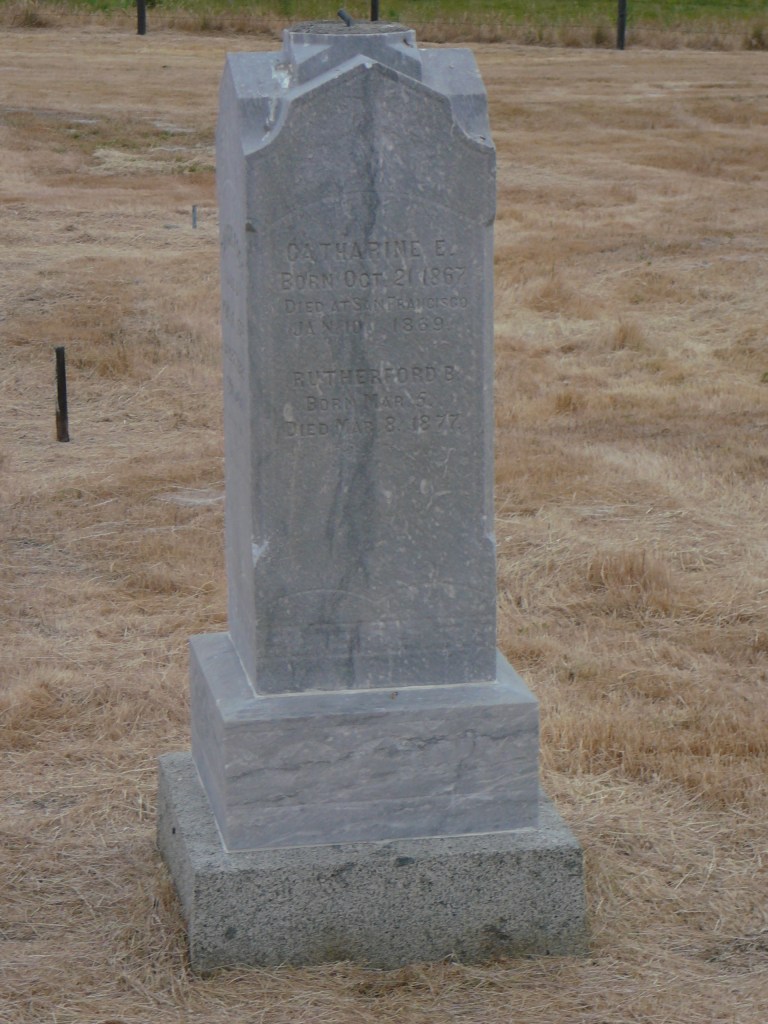
At that time there was only one cemetery in the area, that belonging to the Mission San Luis Rey, but it was in ruins. At some point in the late 1860’s land was designated for a cemetery, just south of the Mission. The first known interment in this burial ground was that of one-year-old Catherine Foss, who died in 1869. A few years later David and Rebecca Foss would lost another child, a boy who lived just three days.

Residents gather around the creamery building located in the San Luis Rey Valley.

Perhaps because of this initial burial of baby Catherine, and the imminent need of a proper cemetery, Isaac Kolb donated the land in 1875 to “reserve for public burying ground or cemetery where the same is now used for that purpose”.  The following year the cemetery was deeded to the San Luis Rey School District “to hold in trust for a public burying ground”.

Marker of Catherine Foss, along with her brother, father and mother. This headstone originally had an ornamental top which was likely stolen.

Among the arrivals to the valley were Andrew Jackson Myers and his wife Sophia, who settled there around 1875. In 1881, Maggie Myers, their infant daughter died and was buried at the cemetery.

In 1883 Myers received a land grant that would become the new town of Oceanside and Myers has his place in local history as the founder. But in 1886, tragedy struck the family again when another child died, his namesake, Andrew Jackson Myers, Jr.

The mortality rate for children in 1870 and 1880 was over 316 per thousand births, meaning over a third of children did not make it to their fifth birthday. Years later the Myers would lose two more older children to sickness, who also were laid to rest in the cemetery known simply as San Luis Rey.   

When Sophia Myers died in 1906, she was buried near her children. A year later, in 1907, Andrew Jackson Myers, died and was buried there as well. However, only two markers remained, that of little Maggie and Andrew, Jr.

The list of those buried in the modest country graveyard continued to grow, but was not chronicled. Life without modern medical care and antibiotics was a difficult one and even the most common ailments could turn deadly.

Susan Elizabeth Latimer Libby died at the age of 32 in 1900. She was the wife of Charles S. Libby and the mother of four children.  The newspaper reported that “A few weeks before her death she contracted a cold which resulted in pneumonia and a sudden turn for the worse caused her death.”

Death often comes suddenly and unexpectedly in tragic ways. In 1891 Dave Kitching was killed at the age of 22 in a farm accident.  The Diamond newspaper reported that the details, “The hay press guillotine had crushed his leg three days previous, and the shock was more than his constitution could stand. The young man had developed into a most promising worker and citizen, although his pathway was not strewn with flowers by any means. A dependent mother and several disconsolate sisters have lost their mainstay and support; San Luis Rey is deprived of its most exemplary young man.  Words cannot express the sorrow and grief of the community.  The Diamond sheds tears with the mourners who are legion and stand askance at the sad havoc cruel death has wrought of a sudden like a flash of lightening from a clear sky.” The paper further noted that the “untimely death of Dave Kitching has cast a gloom over the whole community” and that Ida Rooker, his fiancée was “prostated with grief.”

Marker of David Kitching, photo taken in 1989

In 1898 Antonio Subish, a resident of Bonsall, accidentally shot and killed himself. It was reported that he had placed his gun, “a short-barreled breech loader, against a log and as he picked it up by the muzzle and drew it toward him the weapon was discharged, the load entering the unfortunate man’s right breast causing death almost instantly.” Subish was 47 years of age, leaving behind a wife and several children. He was buried in the San Luis Rey Cemetery. 

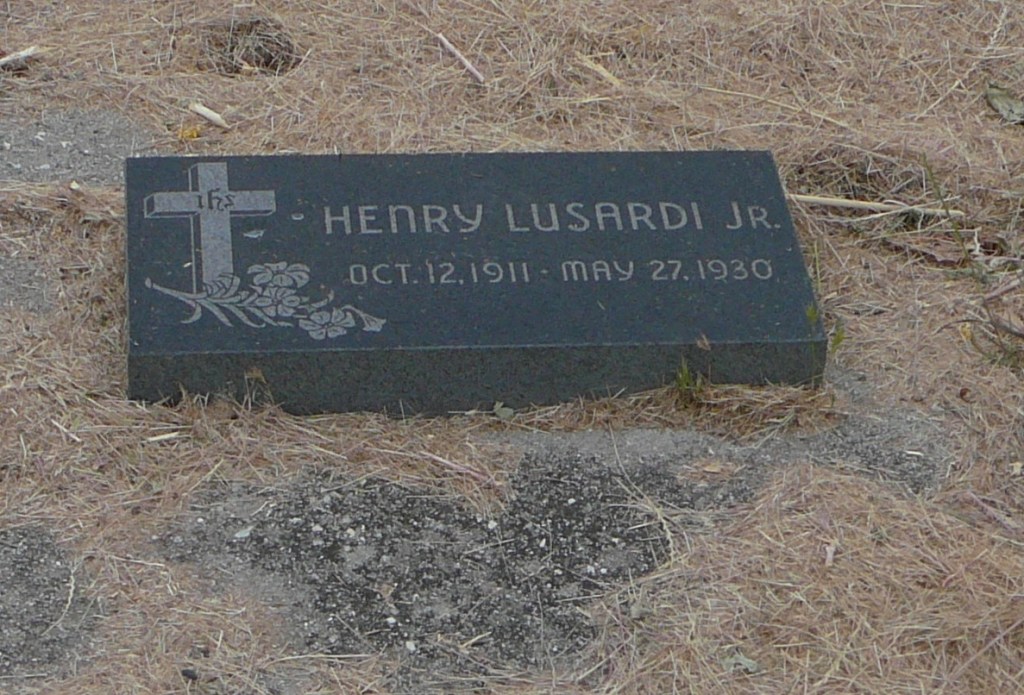
Henry Lusardi, Jr. was buried in the hilltop cemetery, carried by his classmates after drowning in 1930. Henry drowned after swimming in what was described as a deep pool three miles below Lake Hodges dam. His lifeless body was submerged more than 24 hours while his family and friends waited frantically for crews to locate him. The Oceanside Blade reported that “efforts of officers to raise the body had been futile because Lusardi had taken off all of his clothes before stepping into the water, and grappling hooks failed to attach.” Finally, Lt. A. H. Brown, equipped in a diving suit, descended into the water and brought up the lifeless body. Thirty-three years later, his father Henry Lusardi, Sr. would be buried near his son.

Lucia Nares, who died in 1932 and Ramona Heredia, who died in 1934, were both buried in the San Luis Rey Cemetery after bouts will illnesses. The two young girls were buried next to each other as the families were very close.

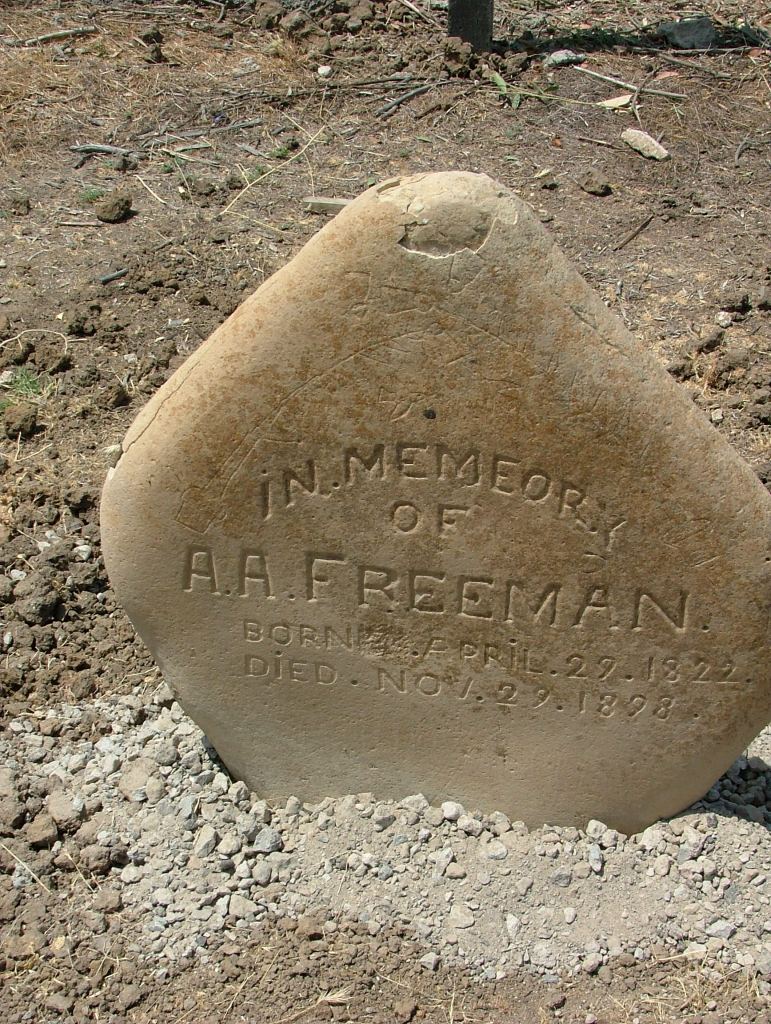
Alford (Alfred) A. Freeman, the patriarch of the Freeman family who came to San Luis Rey from Texas in 1870, was buried there with his wife Permelia. Their graves are marked by two unusual handmade markers, fashioned by their son Almarine. Members of the Freeman family were buried in the southwest corner of the cemetery. At one time a row of wooden crosses (now since removed or eroded by weather and time) signified the burials of several individuals. Others have more traditional headstones and in recent years concrete crosses have been erected.   

While no official list was kept, it seems that most families were given a specific row or area in the cemetery. Walking the cemetery, one can see a distinct row for the Lanpher, Woodruff, Libby, Hubbert, and other families like the Abilez (aka Avilez) were buried in groupings.

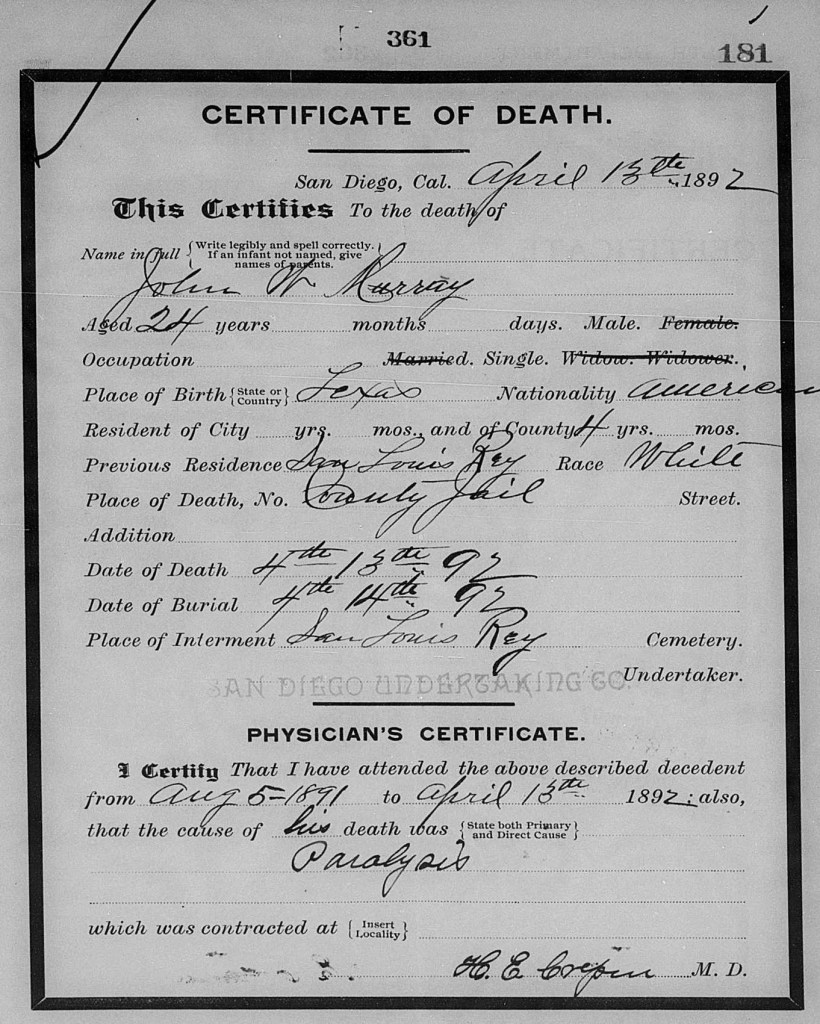
One notorious burial was that of John W.  Murray, who gunned down Oceanside’s Marshal Charles C. Wilson in July of 1889. Wilson was in the process of arresting John W. Murray for disturbing the peace.  Murray who, with another man by the name of Chavez, had consumed more than his share of alcohol at a nearby saloon, was still wanting “to paint the town” after the saloons closed.  Marshal Wilson instructed Murray and Chavez to go home and behave themselves, according to newspaper accounts, but this only incited Murray. Wilson managed to arrest Murray’s cohort Chavez, and in the process, without warning, Murray rode up to Wilson and shot him in cold blood.  J. Keno Wilson, a constable, watched in horror as his brother collapsed.  He then fired after Murray, hitting his horse, but Murray escaped in the night. Charles Wilson died in his brother’s arms as Oceanside’s Dr. Stroud was called, but it was too late. 

Murray fled to his uncle’s house, that of Benjamin F. Hubbert, a rancher in the San Luis Rey Valley. Unaware of the murder, Hubbert obliged his nephew breakfast and Murray went on his way. A reward for Murray “dead or alive” of $1300 was posted and he later surrendered to John Griffin, who with others, took him by wagon to the court in San Diego.

The twenty-three old Murray went to trial for murder and was found guilty. His conviction was appealed but his sentence of hanging upheld. Murray fell ill while awaiting both his appeal and pending death sentence and died April 13, 1892 in the county jail. He is buried at the cemetery along with his Uncle Ben Hubbert and other family members.

Murray’s death certificate

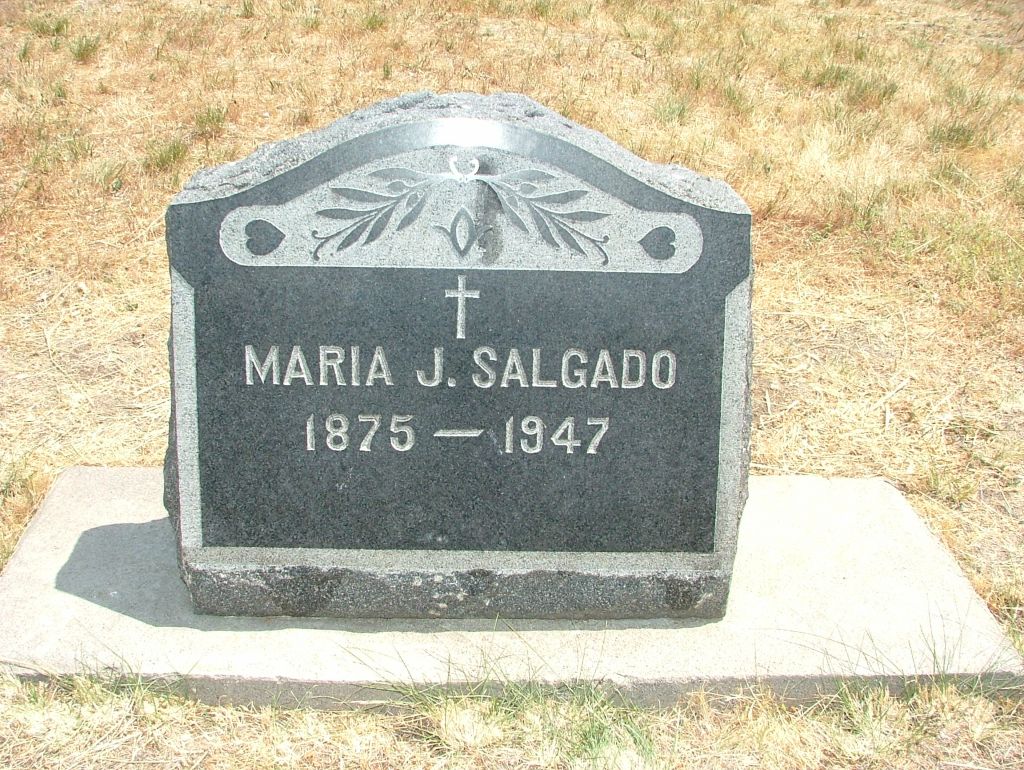
In 1947 Maria Susan Salgado died and was laid to rest in the cemetery. Her obituary stated that she was born on the Rancho Guajome and that “she could recount that her father worked in the San Luis Rey mission in the early days, and she could also recount many of the interesting early days of California, which was built around the old California ranchos.”

Marker of Maria Salgado, great granddaughter of Tomasa Huisch

Salgado was a direct descendant of Tomasa Huisch, a Native American woman born as early as 1796. Tomasa was the mother of Josephine Silvas, the grandmother of Gertrude Salgado and the great grandmother of Maria Salgado.

As one of four Luiseno Indian women who lived near the Mission San Luis Rey, Tomasa told visitors stories of how as children they helped to build the Mission. The Oceanside Blade featured three of the women in a story in 1895 and said of Tomasa, [She] “is known to be more than a hundred years old and is put by some above 130.  She claims that she packed “dobes” when the mission was built, and, as its construction was begun the first decade of the present century, there is little ground for doubting that she is, at least, in her second century teens.  She was the mother of a large progeny, some of whom lived to be very old, she surviving them all.

Photo of three of the Luiseno Women, Rosaria, Tomasa and Vaselia circa 1892

Tomasa Huisch died on June 8, 1899, and was buried on June 10th in the Mission San Luis Rey Cemetery, her burial recorded on page 9, paragraph 38 in the cemetery records. The Oceanside Blade reported her death: “Tomasa the ancient Indian woman, one of the landmarks of San Luis Rey died Thursday night.  She was said to be over one hundred years of age and as a little girl helped at the completion of the old Mission.” 

There are several other Native Americans buried at this historic cemetery including Nick L. Beyota, Andrea O’Campo and Lee Duro.

It is not known if an actual burial map or even a burial list of the cemetery ever existed, but it seems unlikely, and none has ever been found. The San Luis Rey School District, although the legal owners of the cemetery, seem to have kept no official record of any kind. The San Luis Rey Township and surrounding ranches formed a tight-knit community, and the valley residents knew where their loved ones were placed (with or without a permanent marker) rested and must have assumed that someone would always know and remember. They likely never planned for what lay in store for the cemetery in later years, which came to be called the San Luis Rey Pioneer Cemetery. 

View of the Mission San Luis Rey in about 1908. This rare image provides the only historic view of the Pioneer Cemetery.
Cropped view of previous image highlighting the cemetery. The two “white” headstones right of the center are that of Stephen Lanpher and the Foss family.

San Luis Rey School Trustee and valley resident Shirley Anson Woodruff was responsible for pointing out available burial sites to families looking to bury their dead. For years he was the cemetery’s only “caretaker” but apparently kept no record of burials or placements of graves. He filed the yearly tax exemptions for the cemetery with the county.

Shirley Anson Woodruff

Over the years attempts were made to document persons buried there and one list contained an estimated 84 burials. There were at least two partial lists done between 1960 and 1980, decades after most of the earliest burials. The persons collecting the information likely counted and chronicled existing headstones. A realistic number based on death certificates and obituaries place that number above 120. 

When the Oceanside school district took over the San Luis Rey School District, it unknowingly acquired the cemetery as its trustee. Shirley Woodruff continued to file the annual tax forms for the cemetery until his death in 1989.  He was buried in a plot reserved for him several decades ago, alongside family members.

As the population grew and construction increased in the valley, the San Luis Rey Cemetery seemed all but forgotten except for the descendants of those early citizens. By 1989 the entrance, which was originally located off the south side of Mission Avenue, was changed to Rancho Del Oro a newer road between Mission Avenue and the Expressway. The cemetery had long been enclosed by a simple barbed wire fence, which was replaced by a chain link one. Grass and vegetation grew around the cemetery making it nearly invisible. Vandals frequented the cemetery, leaving beer cans and litter strewn about. Weathered wooden crosses were taken out of the ground and tossed and headstones were pushed off their bases. By the late 1980s the cemetery was overgrown, grass was nearly waist high.

Volunteers at 1991 cleanup

The Oceanside Historical Society, which was organized in 1985, began researching and documenting the cemetery in 1989. In 1991 the Society formed a cleanup, calling on their members, descendants of the pioneers, and interested residents to help. A group of Marines from Camp Pendleton volunteered and after much effort many bags of trash were removed, including a mattress, along with an entire dumpster of brush and weeds. Several headstones which could be lifted by simple “manpower” were placed back on their bases.

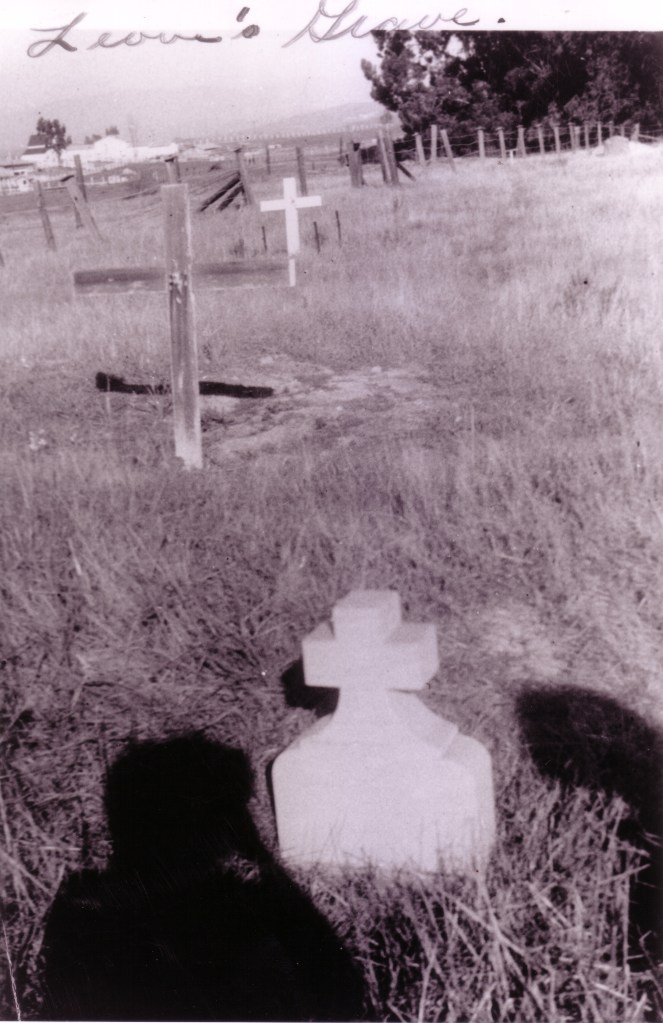
Photo of Leovi Cerda’s original headstone. Photo was provided by Cerda family and taken in about 1968.

Shortly after, it was discovered that headstones had been stolen. The markers of Leovi Cerda, Benjamin Neff, as well a “double” headstone for William E. and Catherine Libby.  A handmade marker for Frank Meza was destroyed. In addition, an attempt had been made to dig into three gravesites but did not get far due to the fact that the ground is hard clay.  

Handmade marker of Frank Meza, who died in 1937. Photo taken in 1989 before it was destroyed by vandals.

Also stolen was one of the oldest and most unique headstones, that of Steven D. Lanpher, who died in 1891. His granddaughter Betty Lanpher Kopcso filed a police report in January of 1996 after she had visited the cemetery and discovered his headstone was no longer there.

Unusual “tree stump” headstone of S. D. Lanpher, photo taken in 1989 before it was stolen and damaged.

This unusual theft was reported in the newspaper and one month later the Oceanside Historical Society was contacted by the Oceanside Police Department on December 2, 1996 informing us that the headstone had been dropped off at their station. An unidentified woman in Fallbrook had read about the missing Lanpher headstone and realized that it was the very one she had sitting in her front yard. She had the heavy granite stone loaded into a van, drove to the Police Station and told an officer that she wanted to turn it in.  She did not want to give any details, only that she had purchased the headstone for $100.  It took five police officers to remove the 400-pound marker from her van and place the headstone into “evidence”.

The headstone was then returned to its rightful place and although somewhat damaged, stands once again at the grave site of Steven Lanpher. The other headstones still remain missing, prompting the family of Leovi Cerda who died in 1934, to replace her headstone with a similar one.

In 1997 the unsightly chain link fence was removed and replaced with a barbed wire fence supported by wooden posts, which was more in keeping with the cemetery’s authenticity. Rancher Dave Jones donated a strand of barbed wire that had been saved from the original fence.

Near southwest corner of the cemetery in 1989, chain link fence in view. These wooden crosses were removed by vandals.

With a grant from the San Diego County Board of Supervisors, a sizeable donation from the Oceanside-Pacific Kiwanis Club, and generous donations from members and descendants, an archway and gate were erected providing a sense of dignity and history to the cemetery.

The Oceanside Historical Society placed a memorial headstone for both Sophia and Andrew Jackson Myers, founders of Oceanside, near where their two small children were buried, Maggie and Andrew, Jr.

On December 20, 2006 Oceanside Police Officer Daniel Bessant was killed while responding to a routine traffic stop. His family requested that a memorial marker be erected in his memory near the southeast corner of the cemetery so that his fellow officers would see it while driving on the 76 Expressway.  

Permission was given to erect this memoriam marker for fallen OPD officer Daniel Bessant

On April 27, 2013 a group of more than 100 people from the Carlsbad California Church Stake of the Church of Jesus Christ pf Latter Day Saints spent hours to clean headstones, trim, mow and upright fallen markers. The group also provided historical genealogies of many of the people buried there.

Volunteer cleaning headstone in 2013.

There are many who visit the cemetery and at times are alarmed at its appearance. In the summer there is little or no vegetation. During the rainy season the grass grows tall. It is important to note and remember that this cycle is the same as it has always been for over 150 years. It is not suitable to change this cemetery into a memorial park with a green lawn and landscaped shrubbery.
Looking northeast toward Ivey Ranch circa 1991

Currently the cemetery is being maintained by two dedicated volunteers who keep it mowed (after the rainy season), pick up trash and place flags on graves of veterans, most of which are from the Civil War and World War I.

In 2021 the Oceanside Unified School District transferred “ownership” to the Oceanside Historical Society as official trustees of the cemetery.

We encourage descendants and concerned citizens to donate to the Oceanside Society Historical, helping us maintain this precious historical cemetery and preserve the history of the people buried there.

Donate at https://oceansidehistoricalsociety.org/product/donations/

The History of the George P. McKay Building

George Parker McKay, a native of Oakland, California, and born in 1860, came to Oceanside in 1892 with his wife Mary Catherine. She was born in Germany, and was the daughter of Bernard Mebach, another early pioneer of Oceanside. The McKay, Mebach and Pieper families of Oceanside were intertwined in marriage and their German heritage kept them a tight-knit family.

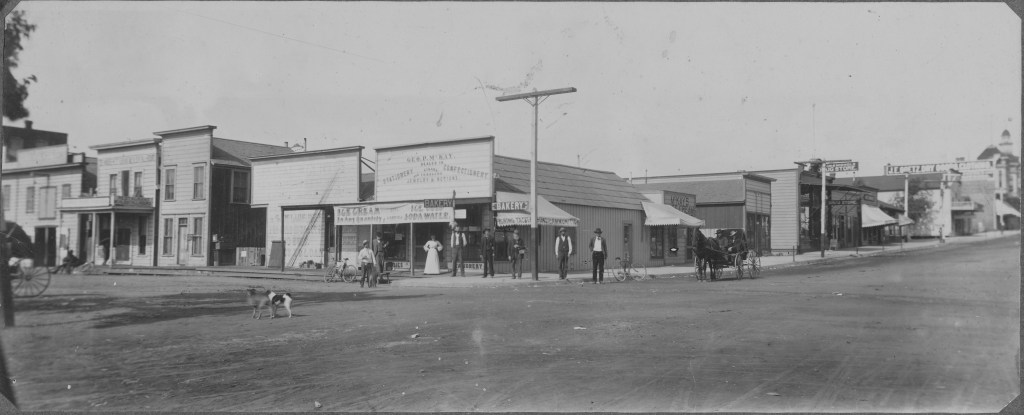
In 1893 the George and Mary McKay opened a store on the corner of Cleveland and Second Street (Mission Avenue) which they operated for nearly 15 years. Along with selling a variety of goods and sporting equipment, they offered cigars, tobacco and ice cream.

Mary and George McKay (center) stand at their original store located on the northeast corner of
Cleveland and Second Streets (Mission Avenue) in 1904

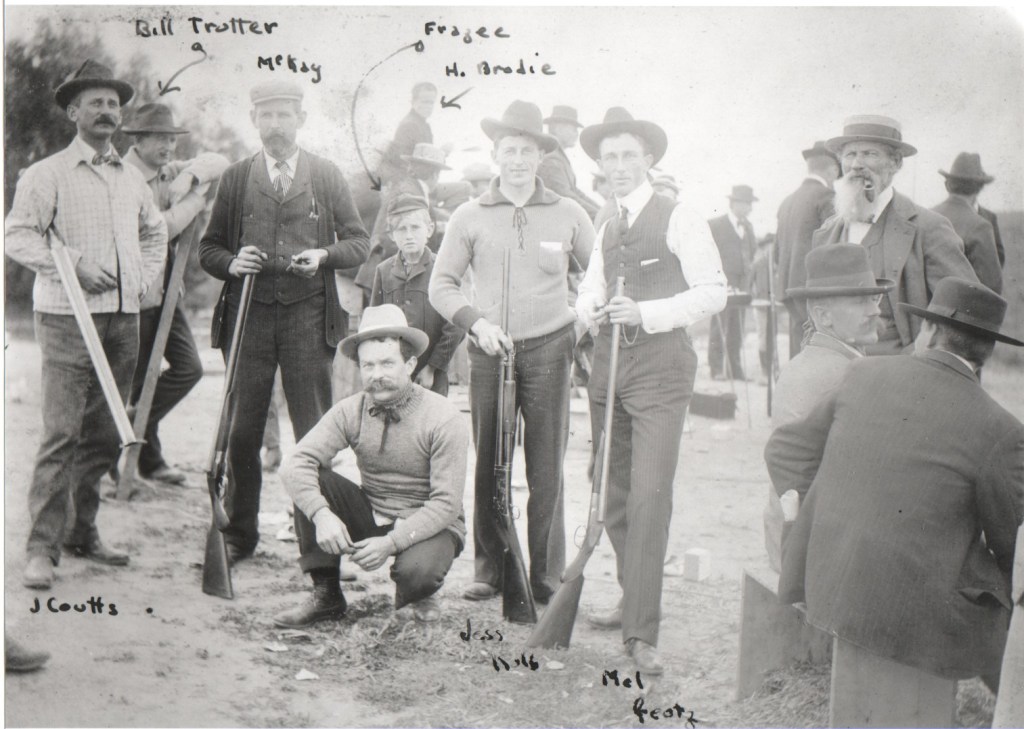
George was an avid hunter and sportsman and was appointed “Official Weigher for the Southern California Rod and Reel Club.”

George P. McKay, third from left, with others in a local shooting competition.

Active in the community, George McKay was a charter member of the Oceanside Chamber of Commerce which formed in 1896. Both he and his wife helped to promote and raise funds for Oceanside’s second pier. Mary McKay sold tickets to charity events at the Oceanside Opera House, the proceeds of which were donated to the pier fund.

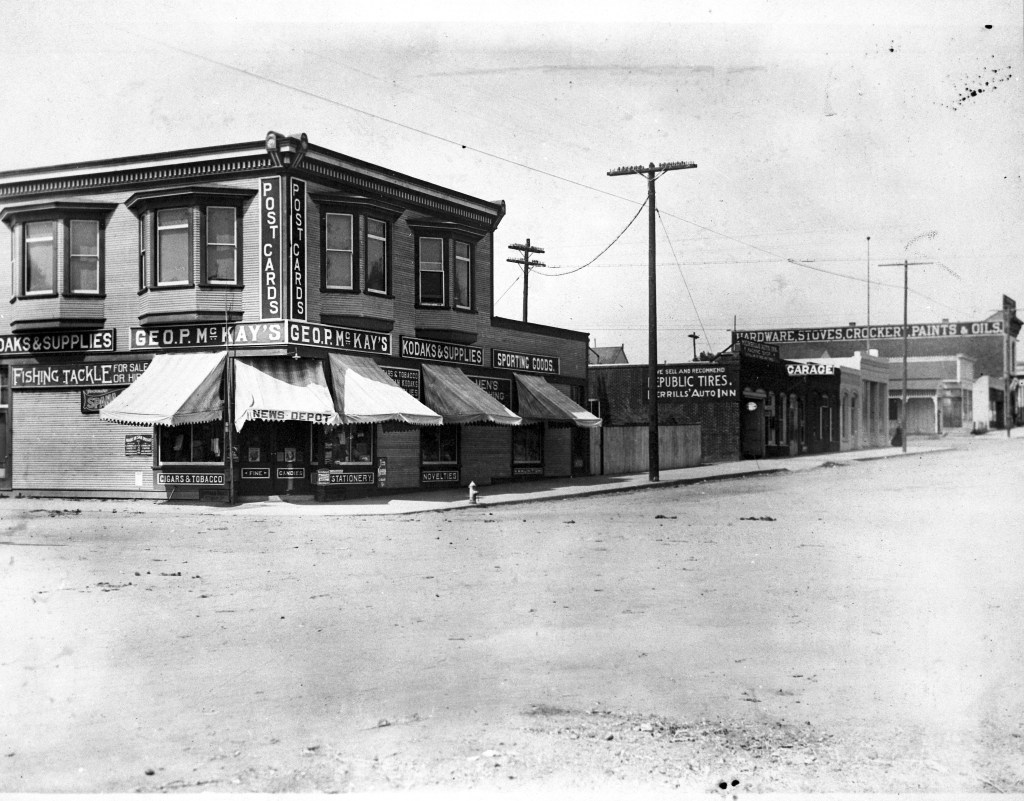
The couple purchased a lot on the northeast corner of Cleveland and Third Streets (renamed Pier View Way) in 1907. Frederick W. Rieke, a local contractor, was hired to begin construction of a two-story new building.

The September 7, 1907  OCEANSIDE BLADE reported: The foundation was laid this week for a store building which is to be built for Geo. P. McKay, on his property on the corner of Third and Cleveland streets.  The building will be of two stories with a frontage of 60 feet on Third and 34 on Cleveland.  The lower floor will consist of a large storeroom and a smaller room for a soda and ice cream parlor.  Above will be living apartments comprising four rooms and a bath.  The building will be a combination of frame and brick of solid construction and with an attractive front.  F. W. Rieke has the contract for the construction.

The George P. McKay building, opened in 1908, northeast corner of Cleveland and Third Streets (Pier View Way)

The following year George and Catherine McKay moved into their new building which they occupied for the next eleven years. They sold everything from firearms to cameras, candies, phonographs, dry goods and souvenirs. George P. McKay was also a photographer and took several images of Oceanside and the San Luis Rey Valley which were published as popular postcards.

Interior of the McKay Store, George and Mary to the right.

In 1919, the McKays sold their building and its stock to Grove S. and Catherine DeLine of Los Angeles.  The couple planned to vacation in the mountains “for the benefit of Mrs. McKay’s health” but she died just a few months later and was buried at the Mission San Luis Rey cemetery. George McKay died in 1937 and was buried in Oceanview Cemetery and his gravemarker denotes that he was a “Native Son of the Golden West.”

The McKay building was renamed DeLine’s Variety Store which sold household items including dishes, stationery, notions and small appliances and a portion of the building rented out as a shoe repair.

Ad for Deline’s Variety Store in 1923, Oceanside Blade

In 1925 Thomas M. Johnson of Pasadena purchased the Deline’s business, stock and fixtures and entered into “a long lease on the building.” Johnson announced that he would specialize in “fishing tackle, sporting goods and stationery lines.”

Grove DeLine and his family returned to Los Angeles in 1928 and sold the building in to Ernest J. Van Vleet. Van Vleet (sometimes misspelled as Van Fleet) had settled in Fresno, California where he made a living as a farmer. He and his wife Ione had four children.

The Van Vleet family moved to Oceanside and for a brief time lived on the second floor. While the VanVleet’s maintained ownership of the building, they rented it out and in 1932 and the building became the new location for the Oceanside Radio Service. In the mid 1930’s the building occupied a restaurant and later a dress shop.

Madame Marie, a fortune teller, rented a room or suite in the building and did readings every day, advertising in the local paper that she answered “all questions.” 

The building was used as a café in the 1930s.

In 1945 the Van Vleet’s transferred title to their daughter Georgia B. Recek. Recek maintained ownership of the building for five decades. Georgia was a member of the First Christian Church of Oceanside and lived on Mission Avenue. She was known for her generosity and opened her home to several people over the 35 years she lived in Oceanside.

By 1948 the building was occupied by City Cleaners, a dry-cleaning business, operated by Alonzo Adams. This long-running business continued through the 1980s. But by then the beauty and of George McKay’s building had long faded and along with many buildings in downtown Oceanside had become an eyesore.

The McKay building in about 1991.

However, the McKay building was purchased by a new owner and in 1994 underwent a renovation and restoration. For about a year it was occupied by the Waterman Surf Art Gallery co-owned by Tom Glenn and Marcie Hintz.

In about 1999 the building was used as a beauty shop called “Talk of the Town” which leased the building in the early 2000’s.

Pier View Coffee in 2019

For the past several years it has been a favorite spot for coffee lovers known as Pier View Coffee. The George P. McKay building has weathered a lot of change over its 114+ year history. Its in the heart of downtown Oceanside, surround by both old and new architecture, and has kept its historic look and feel.

The Story of the North Oceanside School, 1951-1968

For many years Oceanside’s early school system was a modest one, serving a population of just 3,500. In a ten year period the population increased by just 30 percent to 4,600 in 1940. But with the establishment of a large military training base to the north in 1942, Oceanside would face a population explosion that would take years to catch up in order to provide adequate housing and services.

With an estimated 5,000 civilians arriving to construct barracks, a hospital, and training facilities, and soon after 20,000 Marines to train at Camp Pendleton, Oceanside was inundated with people looking for housing. While most military personnel were being trained for war and being shipped off, many still came with their families. Oceanside was not prepared to meet such a large influx of people and with such an expansive military base to develop even after World War II, the population growth did not level off, but continued to increase.

In 1940 there was just over 600 students enrolled in Oceanside elementary schools, that number nearly doubled by 1946 and classrooms were bursting at the seams. By 1952, in six years time, the enrollment had grown nearly 200 percent with 3,602 students. The average annual increase was about 238 children per year.

Sterling Homes opened in 1945 on Mission Avenue, east of Archer Street.

Federal housing units, which opened in 1945 within city limits known as Sterling Homes, provided 668 housing units to military families. Schools classes had double sessions to accommodate children. That year the school district entered into an agreement to use buildings on Mission Avenue east of present day Canyon Drive, from a wartime Guayule project. For several years, this makeshift school known as Mission Road School was utilized for children living in Sterling Homes and the Eastside neighborhood.

A new school in South Oceanside and one on South Ditmar Street were built but more were needed. The district did not have the financial means to acquire land, hire architects and contracts for building.

In June of 1949 the school district received tentative approval of $253,614 for a building program, which was just a fraction of its $800,000 request to the State.

Portion of 1956 map, showing location of North Oceanside School off of North Ditmar Street.

That September planned construction of a new North Oceanside elementary school was announced. Land was located in the Clements Addition of Oceanside, at the 900 block of North Ditmar Street. The new school would have a kindergarten and six rooms and would serve the downtown population north of Mission Avenue, families living in North Oceanside Terrace, and the Homojo housing project near Camp Pendleton’s main gate. 

By January of 1950 the plans for the North Oceanside School were in the state architect’s office for approval. The City council closed parts of 9th street, 10th street, Ditmar and alleys “in order to make the site of the future North Oceanside School into one contiguous property.”

Kindergarten class at North Oceanside school, June 1951

Grading and construction took a little under a year and in March of 1951 an open house was held at the new school. Described as “airy” and the “best in modern schoolhouse planning” the North Oceanside School featured “large window areas and a rambling design”  which took “fullest advantage of California’s sunny climate and give the students a feeling of going to school outdoors rather than in the confines of a classroom.”

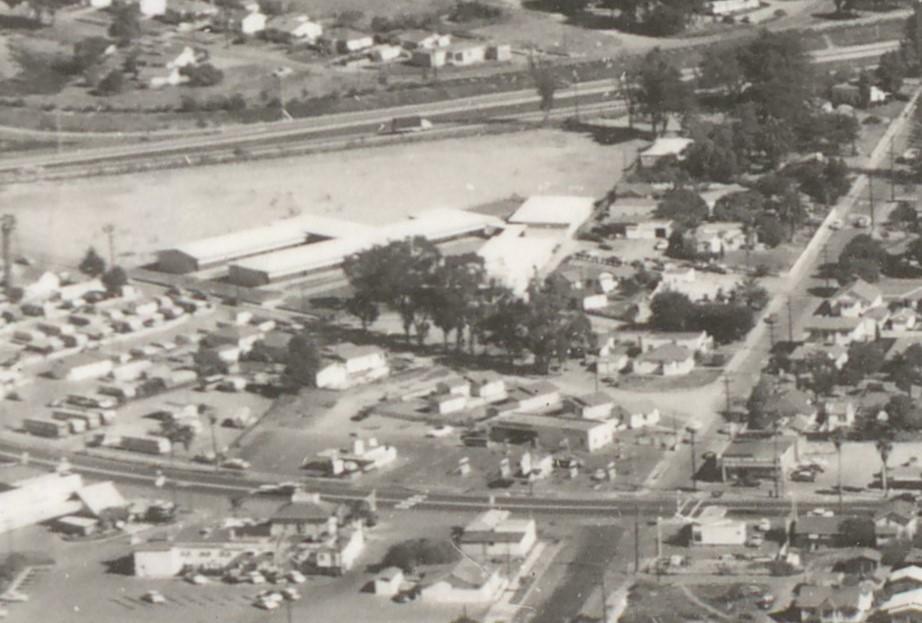
This aerial in 1965 captures just a glimpse of North Oceanside School in upper left hand corner.

“This new building in some ways is the finest of the group [of new schools],” Superintendent Stewart White stated in a letter to parents. One “innovation” was the classroom seating, “by grouping around tables rather than lining up in the traditional straight rows.”  

Even though the school year was nearly over, the need for additional classroom space was immediate. Students attending the overcrowded South Oceanside and Ditmar schools were sent to the North Oceanside School.

Delia Ernest, Principal of North Oceanside School from 1951 to 1957.

The principal of Oceanside’s newest school was Delia E. Ernst. Teachers were:  Mrs. Gladys Schrock, kindergarten; Miss Ernst, first grade; Mrs. Gladys Edwards, second grade; Mrs. Nancy McGlynn, third grade; Miss Catherine Cloyd, fourth grade; Mrs. Frances Houts, fifth grade, and Mrs. Irene Hill, sixth grade.

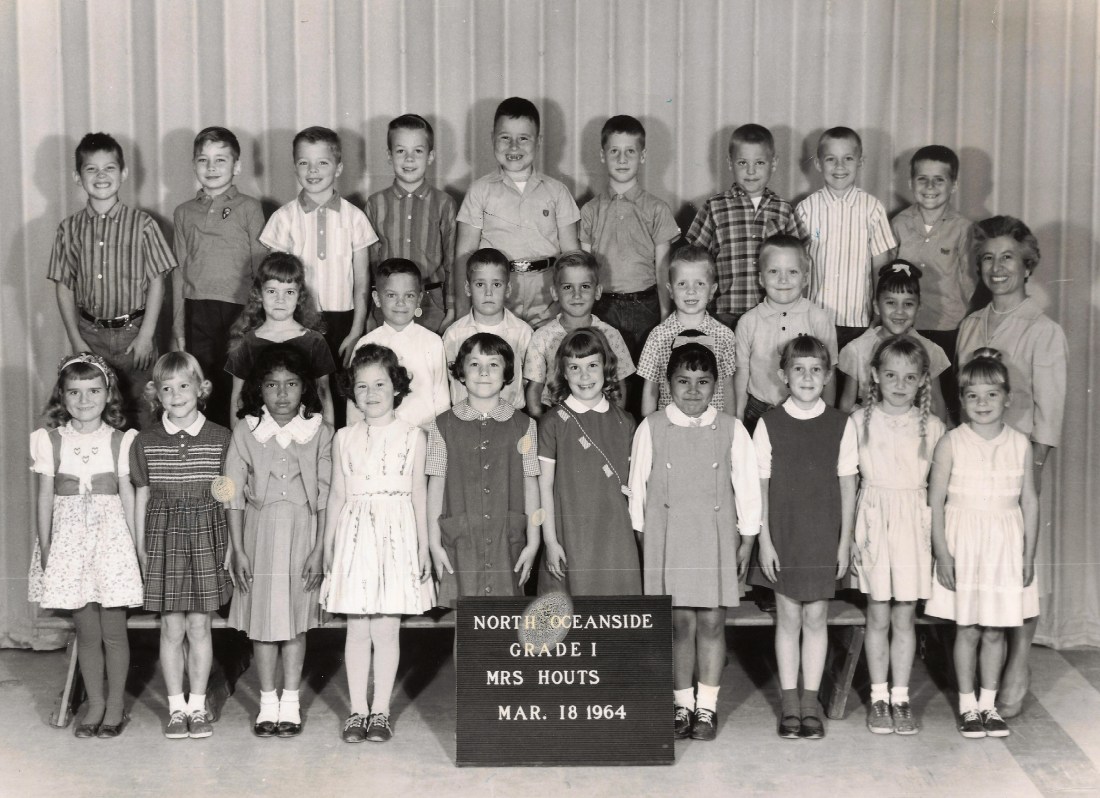
North Oceanside School’s 1st grade class in 1964

Just one month later the newly opened school was at capacity. Additional classrooms were to be added but funding was again the issue.

Due to the fact that so many of the students were from military families, the school district qualified for federal aid. In 1953 the then Oceanside-Libby School District received a whopping “7 percent of all federal funds allocated within the United States for school construction.’’

North Oceanside Kindergarten Classroom in 1959

By 1954 the North Oceanside School was so full that 6th graders were sent to the old Horne Street School near the high school. In June the district received funds needed to add another kindergarten, four classrooms and a multipurpose room to North Oceanside.

Expansion begun in September 1954 with the addition of four classrooms, one kindergarten room and a multipurpose room, which allowed for cafeteria service and “extra activities, indoor ‘rainy day’ playroom, assemblies and community functions after school hours.”

After completion, the North Oceanside School had a total of 10 classrooms and two kindergartens, which was reported to be “the maximum teaching space allowed for the 4.41 acre site.” Superintendent Ben F. Fugate said the expansion provided a capacity “of around 400 students, although the facilities could handle 450 if the need were urgent.”

That school year the district announced the school zones and bus schedules. The boundaries of each were listed as follows in the Oceanside Blade Tribune: 

  • South Oceanside School area includes all children south of the lagoon and of the Atchison, Topeka and Santa Fe Escondido Spur of the railroad (same as last fall).
  • All children living north of Second street; west of the freeway and south of the San Luis Rey River will attend North Oceanside School, except those in the new housing areas named above.
  • Mission Elementary School area will include all children living east of the freeway; north of the AT&SF Escondido Spur, and south of the San Luis Rey River.
  • Attending Horne Street School will be all children living south of Second Street; north of Elm, Washington and Minnesota (east of Grant Street) and west of the freeway.
  • Ditmar children will be all those living north of the lagoon and the AT&SF Escondido Spur; south of Elm, Washington and Minnesota (east of Grant Street) and west of the freeway.
  • The new Jefferson Junior High area will include all seventh and eighth graders of the district. Jefferson Junior High School is located at the corner of Acacia and Poplar Streets north of Mission Elementary School.
  • Children living in the Oceanside portion of Camp Joseph H. Pendleton should enroll at the Horne Street School, except seventh and eighth graders who will go to Jefferson Junior High.

In less than four years three additional schools had been built, but three older ones had been deemed unfit and were abandoned as instructional sites. Funds and resources were continually stretched to the limit and the Superintendent shared that “throughout the construction program the school district has been living on a hand-to-mouth, day-to-day basis” in order to serve the student population.  Rising enrollment resulted in the need for one new school each year. “We continue to hope for a leveling off in our rate of growth” the superintendent declared “but so far it hasn’t come.”

North Oceanside School Kindergarten Classroom 2, in 1963

Despite its additional classroom space, in 1955 the North Oceanside School had to send 38 6th graders to the Ditmar School. In addition, North Oceanside had 94 kindergartners divided between just two rooms; three 1st grade classes of 27 students; three 2nd grade classes of 30 students; and two 3rd grades with 36 students. One 4th grade class had 38 students and a 4th/5th combination of 36; lastly, the 5th grade class had a total of 38 students.  

In 1957 Joseph M. Trotter, Jr. was named the new principal for North Oceanside School, replacing Delia (Ernst) Larson. Trotter was a graduate of Oceanside-Carlsbad High School, studied at UCLA and San Diego State College, and had been a teacher in the Horne Street School.  

Aerial view of the North Oceanside School in 1962

School capacity was somewhat stabilizing with the continued building of new schools including what was then called the Laurel Street School, a new Mission Elementary and the North Terrace School. Homojo housing, which contained nearly 300 units near the Main Gate and relied heavily on the North Oceanside School, was removed altogether.

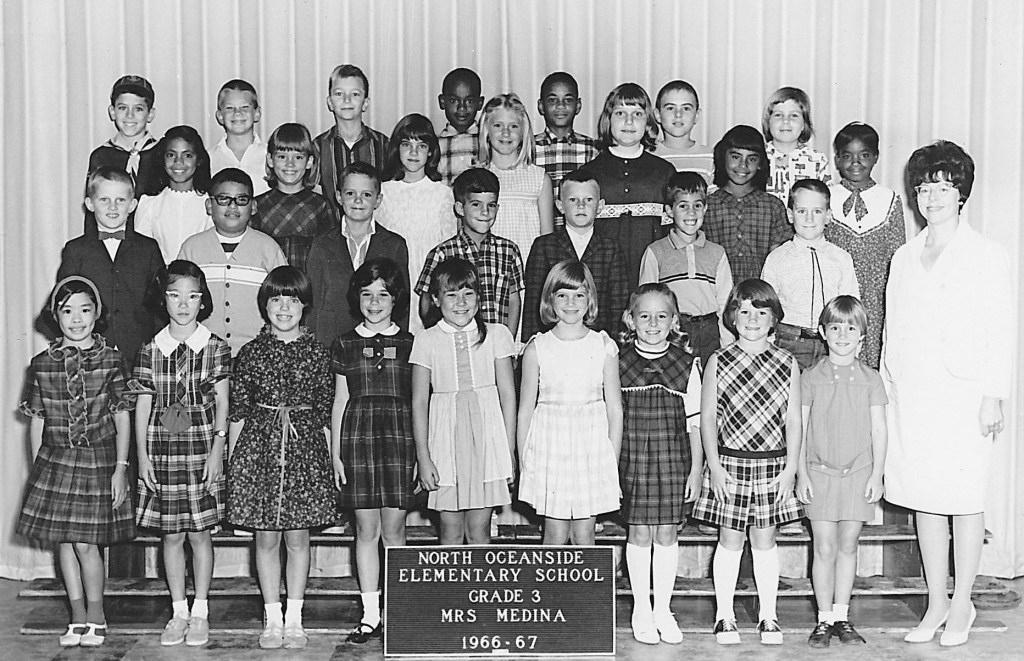
North Oceanside 3rd Grade class in 1966

But the school’s days were numbered. In 1965 it was announced that the property upon which the North Oceanside stood would soon be part of a “main interchange” connecting the I-5 with Hill Street (Coast Highway). The school district mourned the loss of the needed classrooms but remained hopeful that they could use the school through June of 1968.

From the Oceanside Blade Tribune in 1965

In 1966 a bleak outlook on the school was published, in contrast to just 15 years prior when the school was lauded. Larry Layton, North Oceanside’s last school principal, described his students as often neglected and that “they come to us with scratches” which was the startling headline in the Oceanside Blade Tribune.

The school of 422 students was a diverse one. “We have every color and race under the sun at our school and it is our source of strength, as well as a good lesson in democracy,” Layton said. But the turnover rate was unprecedented. “In one year there were only two of the original 33 left at the end of the semester in one class,” he remarked.

North Oceanside School, 5th Grade in 1967

Layton went on to list the challenges facing the students: “Eighty of the fathers of our children are in Vietnam. Four fathers have been killed. Many of the children come from broken homes. For one out of every four students at North Oceanside there is no father in the house. They come to us with scratches you can’t even see and we put bandages on them.”

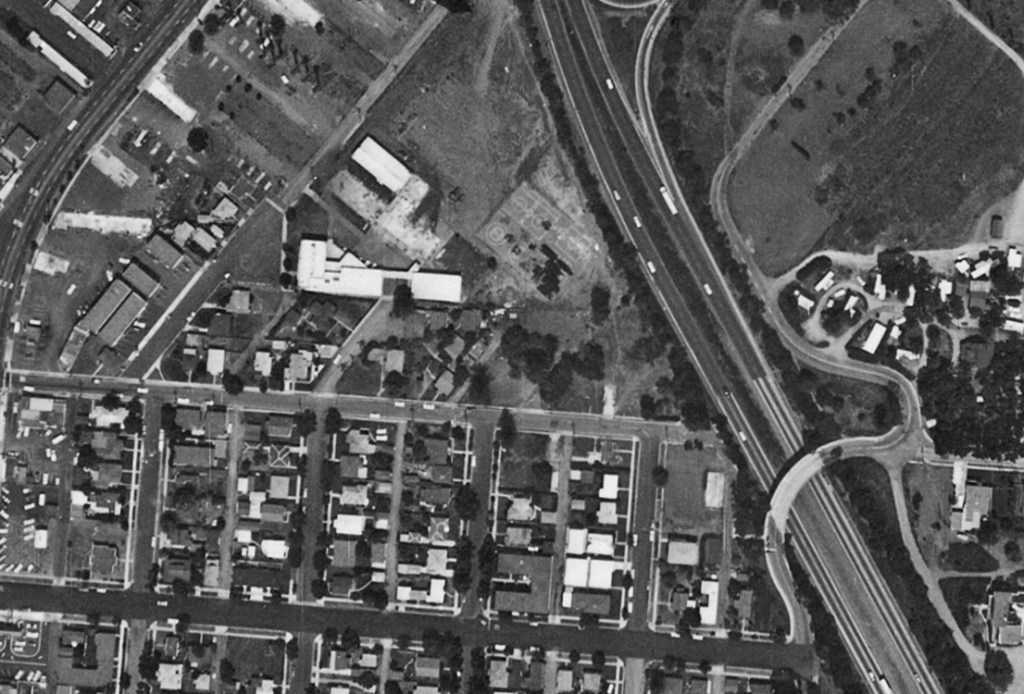
1969 aerial shows beginning of demolition of the school buildings

By 1968 the North Oceanside School was vacated and the following year the original building was removed. Freeway construction crews used a portion of the school that remained as offices.

In 1971 the State Division of Highways put the former school site up for auction. The minimum opening bid was $40,000 for the 41,818 square foot parcel. The Oceanside Blade Tribune reported that “the surplus land and several buildings are all that remain of the old school site after redesign and construction of the interchange at Hill Street and Interstate Five.”

Aerial photos reveal what was left of the school was gone by the mid 1970s.

The North Oceanside School was in use for just seventeen years, compared to several schools in the district which have been in use for 5 to 7 decades. With such a short lifespan, it is no wonder some are unaware of its existence but for those who attended North Oceanside, it is an indelible part of their childhood memories.

History of the First South Oceanside School

South Oceanside is a popular neighborhood referred by locals as “South O”, but more than just a neighborhood, it was once a township, separate from Oceanside. Annexed by the City of Oceanside in 1890, the boundaries are near Morse Street to the north and to the lagoon to the south, and goes as far east as Hunsaker Street. In 1949 two of the original street names were changed: Osuna to Nevada, and Estudillo to Clementine. Vista Way was originally named Wall Street which was changed in 1927.

Map of South Oceanside, 1887

In the 1880’s the unincorporated area was largely owned by John Chauncey Hayes. Born in Los Angeles in 1852, Hayes was the son of Benjamin R. Hayes, an attorney and noted California historian. J. Chauncey Hayes graduated from Santa Clara College, then studied law with his father, and was admitted to the bar in 1877.  He settled in the San Luis Rey Valley and served as justice of the peace.  

John Chauncey Hayes

In 1887 Hayes established South Oceanside which at one time had its own bank, depot, school, cemetery, and several buildings made of bricks at a brickyard near Kelly and Ditmar Streets. He also published his own newspaper, the South Oceanside Diamond.

Hayes petitioned the County Board of Supervisors in 1888 to form the South Oceanside School District, which was granted. The following year the district voted and approved a new $3,000 school building.

The South Oceanside School House, 1889

In August of 1889 the contract to build the school house was given to W. E. Damron to build a two story brick building at a cost of $1,600. The wood work and painting was given to R. C. Mills for $1,070. The South Oceanside Diamond reported that the work had already begun and that work would be completed in sixty day. The school was located on Block 41 near the southeast corner of Whaley and Ditmar Streets.

A census taken in 1891 reported that 43 children were living in the South Oceanside School District which would have included a portion of Carlsbad. One of the earliest teachers was a Mrs. Roberts, who resided in Los Angeles but would come down for the school year. Students were taught up to the 8th grade and then went on to high school in Oceanside.

T. V. Dodd, an educator at South Oceanside

Thomas V.  Dodd, also taught at South Oceanside in the 1890s. He was a superintendent of schools in Madison, Indiana for many years. After coming to Oceanside he taught at several schools in San Diego County and later taught science at the Oceanside high school.

Lillie V. Deering was then hired to teach at the South Oceanside School. But the school was open and closed during the school year at various times, likely due to lack of attendance. South Oceanside was not heavily populated and it is likely that families sent their children to the Oceanside grammar school on Horne Street. In September of 1900 it was announced that the school would close for a few months, with no explanation.

In 1901 Mrs. Clewett was announced as the new teacher, but was replaced by Miss Alice Martin two months later. In 1902 the Ocanside Blade reported the school had a “daily attendance of 18.” In 1904 the school reported 14 students.

Isabel S. Kennedy of Del Mar was hired as teacher of the school in 1906. At the time there were just 9 pupils. The following year Mary E. Clark was employed as teacher of the South Oceanside School.

In 1909 Joseph George Martin of Fallbrook was hired to teach at South Oceanside. A native of Ireland, Martin came to San Diego County in 1877 and had taught for nearly 30 years in and around Fallbrook. In June of that year one student, Nora Marron, graduated from the Eighth grade. The Blade reported that “Prof. Martin, who has had charge of the South Oceanside School, is a faithful and experienced teacher and the pupils do good work under his guidance.”

Martin continued to teach another four years at South Oceanside. In 1913 three students graduated from 8th grade: McKinley Hayes, May A. Birchley and Emma Billick.

However, the following school year the school was “suspended”. It seems there were just a handful of students and many area residents thought students should attend larger schools in Oceanside or Carlsbad. It is unknown if school resumed that year but it was opened again in 1914 with Josefa Elena Jascen as teacher. In February of 1915 the school was closed for one month due to a lack of funds.

Jascen retuned the following school year and the local paper reported “a good attendance” of pupils which included Teresa and Cecilia Marron, Victoria Murrietta, Margarita, Harvey and Herminia Jascen, Morea Foster, Edgar and Irma Spaulding, Thomas Warson, Barbara Libby, Clifford Cole and Madalera Foussat.

The South Oceanside School after it had been dismantled and rebuilt in 1916. Windows and appear to be the same as original schoolhouse. Students pose with teachers, one of whom is Josefa Elena Jacsen.

Irma Spaulding attended the school between 1915 and 1920. Her family moved to South Oceanside in 1912 and operated a dairy farm. Irma’s father, Warren E. Spaulding, along with Earl Frazee, were Trustees of the school at the time.

In 1916 the school needed repairs, and a tax was approved in which to raise $249 for repairs. By August of that year it was reported by the Oceanside Register that “the work of improvements on the South Oceanside school building has been completed and school will be opened by Miss Josephine Jascen in a few days.”

Irma Spaulding said in an interview decades later that her father had dismantled the second story of the school. So it was likely then the school went from a large two story building to a smaller single story one.

Students pose on steps of the South Oceanside School, circa 1919

The school was probably permanently closed by 1924 and what remained of the school building was either sold and moved, or dismantled altogether. 

Today the only South Oceanside School anyone remembers is the one located at Horne and Cassidy Streets. Construction began in 1947 and it opened the following year, initially only offering classes for kindergarten through the 3rd grade.

The corner lot where the original school sat at Ditmar and Whaley Streets remained vacant for years until 1949, when the South Oceanside Community Methodist Church began construction for their new church building. As work commenced the brick foundation for this historic school was discovered.                                                                               

Death of a Starlet – The Rise and Fall of Dariel Jean Johnson

In 1942 a 14-year-old girl made national entertainment news when she was discovered by actress Judy Garland during a performance at the Wilshire Ebell Club in Los Angeles.

According to the Los Angeles Times, Dariel Jean was performing in a production called “Cavalcade of Youth” when she caught the eye of Garland, who urged studio executives to sign her. In 8th grade, attending Bret Harte Junior High School in Los Angeles, Dariel’s seven year contract was approved on her 14th birthday by Judge Emmet H. Wilson.

From the Los Angeles Times Wed., November 11,1942

Dariel Jean Johnson was born November 10, 1928 in Minneapolis, Minnesota. She was the youngest child of Lee and Mabel Johnson. Lee Johnson worked as an accountant and by the late 1930s moved his family to Los Angeles.

Vivian Blaine’s column “Star Dust” noted Dariel Jean Johnson in newspapers around the country. February 19, 1943

She was signed with Metro-Goldwyn-Mayer, earning $75 a week, and it was reported that she was taking acting and ballet lessons to prepare for “important roles in forth coming pictures.” The “discovery” of Dariel Jean was featured in newspapers across the country in Virginia Vale’s column “Star Dust” regaling her contract with MGM.  Then in December of that year it was reported that she would appear in “Girl Crazy” staring Garland and Mickey Rooney. However, she did not appear in the film, or at least is not credited with any role.

Dariel Jean, age 16, poses while performing “Fellow on a Furlough”, 1944. Universal Pictures

In 1944 Dariel Jean did perform in “Fellow on a Furlough” directed by Vernon Keays and produced by Will Cowan of Universal Pictures. The musical short featured Bob Chester and His Orchestra and starred Hal Derwin and Rose Anne Stevens; other performers included the Les Paul Trio and the Nillson Sisters. It was released on March 1st in theaters and included as a bonus reel along with feature films.

Movie ad, with bonus feature, “Fellow on a Furlough”

It is unknown if Dariel was included in any other studio productions but she did attend a “legislative attaches’ dinner” in Sacramento in 1945 along with other performers including Vivian Blaine, Dorothy Lamour and Leo Carillo. The group of fourteen actors, singers and dancers then entertained patients in several hospitals, including military hospitals in the San Francisco area.

Nothing else is known of her contract with studios MGM or Universal, but it is likely they did not resign her. At the age of 18, with her short career as a starlet seemingly behind her, Dariel Jean married Alvin Thomas Budd on September 23, 1947. Budd was a California native, born in 1925, a veteran of World War II, and employed with the telephone company. One year after they were married Dariel gave birth to a baby girl.  

In 1950 the family of three had settled down to a domesticated life in Orange County and although Hollywood was less than 60 miles away, they were worlds apart.  On the surface, all must have seemed well for Dariel Jean, who had lived a semi-charmed life, transitioning from a brief time in the limelight into the routine of family life. But there was something amiss; something troubling.

Dariel Jean Budd with daughter. This photo may have been taken on the back lot of one of the movie studios.
USC DIGITAL LIBRARY, LOS ANGELES EXAMINER NEGATIVES COLLECTION, 1950-1961

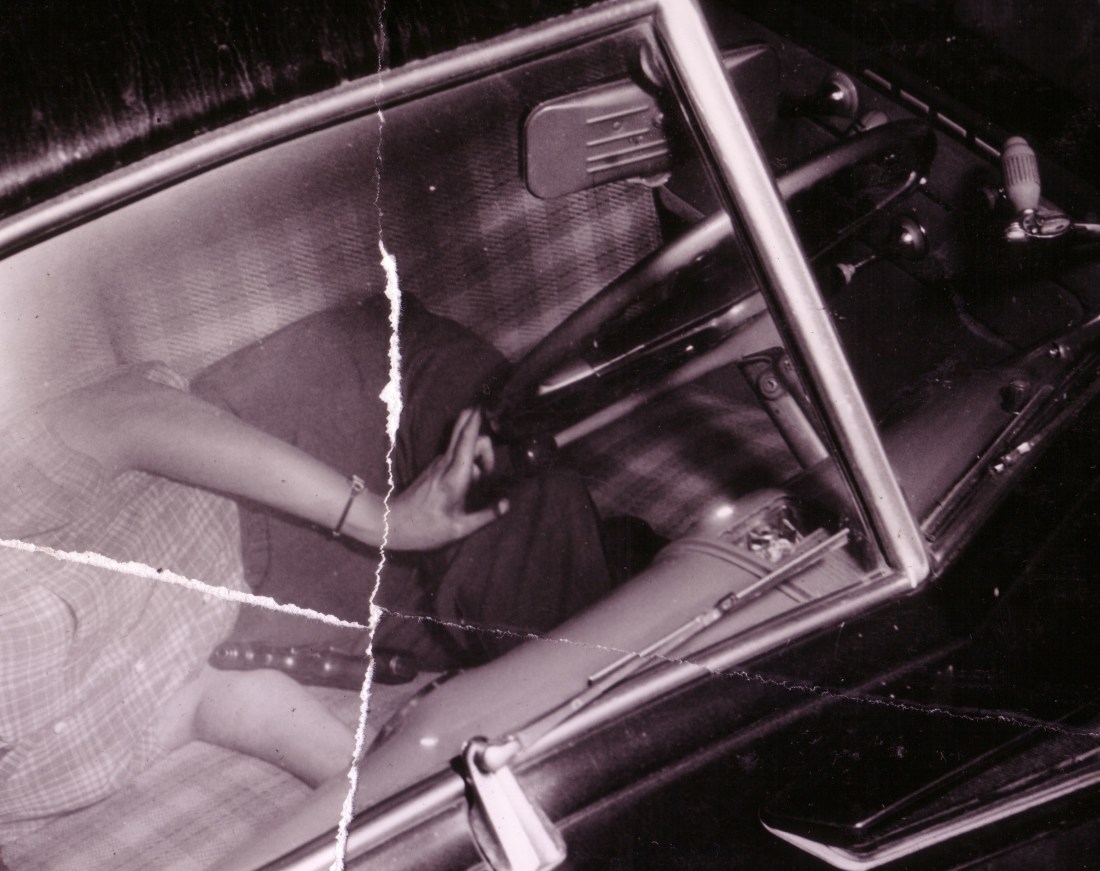
Alvin Budd left for a job in Hawaii as a radio operator, but Dariel and her young daughter stayed behind, living in Newport Beach with a roommate identified only as Mrs. Robert Shand. Mother and child were to eventually meet Alvin in Hawaii, but on Monday, August 13, 1951 Dariel Jean  drove south on Highway 101 through the Marine Corps Base Camp Pendleton and pulled off near Aliso Canyon, on a beach area five miles north of Oceanside. She was presumably there to meet a “friend.”

Whether she met that friend or not is unknown, but on August 16, 1951 a group of Camp Pendleton Marines would discover a grisly scene. Dariel Jean’s life had come to a sudden end.

The Oceanside Blade Tribune published the tragic story on August 17, 1951 with the headline “Discover Body Young Lady Aliso Canyon” with the sad details that Marines on maneuvers had “discovered the body of a 23-year-old woman in a car parked in Aliso Canyon, seven miles north of Oceanside on the Camp Pendleton reservation.  The woman identified as Dariel Jean Budd, of Newport Beach, had apparently been dead for several days. She was found slumped across the front seat of the car, a .32 caliber pistol clutched in her right hand. Upon examination it was found that a bullet had entered the right side of her head just above the ear and emerged a little higher above the left ear, lodging in the car top. The slug will be extracted from the automobile for examination. The young woman was clad in slacks and a blouse. She gripped the steering wheel of the car with her left hand.”

The FBI was called to investigate, likely because the death occurred on federal property. Investigators found the car doors locked and made entry by forcing a window open. An automatic pistol of “foreign make” was found lying on the seat. A small wicker purse was on the floor containing a makeup kit, along with a green wallet which revealed an identification card from the Pacific Telephone and Telegraph Company, and a driver’s license, identifying the lifeless body as Dariel Jean Budd. Authorities contacted her husband Alvin Budd, who made arrangements to quickly return to California.

The body of his wife was taken to Davis Mortuary in Oceanside and an autopsy performed. San Diego County Coroner A. E. Gallagher said “evidence indicated a suicide.” He reported that “the barrel of the gun had been placed close against the right side of the head, as there were powder burns at the entrance of the bullet wound.” He added there were “no other marks on or about the body to indicate that there had been any violence in connection with the death.”

Despite the finding of suicide, her roommate was interviewed and said that Dariel Jean did not know how to load or fire a gun and that she had planned to leave on August 30th to join her husband in Hawaii. One additional detail she provided was that Dariel had left Monday afternoon to meet a Camp Pendleton Marine by the name of Ernie. The two had met at a dance just four days prior on August 10th, but Mrs. Shand described the relationship as “casual.”

What led Dariel Jean to end her life? Was it an overwhelming disappointment of a failed movie contract? Did an unhappy marriage lead to a brief affair?  From whom and when did she acquire a gun?

As Dariel Jean viewed the waves of the Pacific Ocean crashing on the shoreline from her car window, was she waiting for a friend or a lover? It is unknown if investigators tried to determine the identity of Ernie. Did Dariel Jean ever meet up with him that day? If he existed, he never stepped forward.

In the scrapbooks of Captain Harold Davis of the Oceanside Police Department was a torn photograph of Dariel Jean. In the photo she is gripping the steering wheel with her left hand and a gun is resting in the crook of her right hand. It seems an odd position of each. But with the coroner’s ruling as suicide, the death of Dariel Jean no longer warranted further investigation.

Photo from the Captain Harold Davis Collection. Note Dariel’s hand gripping the steering wheel.

It was a sad ending for a young woman who appeared to have fame and stardom within reach, but it had slipped through her fingers. She was discovered by one of the biggest stars in Hollywood. Garland herself would die a lonely death years later despite the fame she had gained. She is quoted as saying, “If I am a legend, then why am I so lonely?”

Dariel Jean died alone in her car, either by her own hand or that of someone else. It wasn’t the “Hollywood ending” anyone expected.

End of an Era – The Flying Bridge (and Coffee Dan’s)

The Flying Bridge Restaurant at 1105 North Coast Highway (North Hill Street) is no more. Its unique “coffee shop architecture” and Googie stylings weren’t enough to save it from demolition. The prime location of the restaurant, providing panoramic views of the Pacific Ocean and San Luis Rey River, will be redeveloped. It will not be the first time.  

The Real Auto Camp at 1103 North Hill Street (Coast Highway) in the 1920s.

Before the Flying Bridge Restaurant (and Coffee Dan’s) was built, the expansive property was the site of an early auto camp owned by Frank and Anne Martin. The Martin Auto Camp was in an ideal location as it was the first travelers would encounter as they drove into the Oceanside city limits along the original Highway 101.

The auto camp was later sold to Tony Janek and Julia Ravast in 1924, who renamed it the Real Auto Camp. Sam Stock purchased the site in 1927 and continued ownership through 1944.

The original Bridge Motel owned by Frank and Dorothy Satten

Dorothy and Frank Satten subsequently purchased the property and in 1951, they built eight new room units along with an administration center and opened the Bridge Motel.  Although the property was jointly owned, Dorothy Satten is credited with the development and success of the motel, which continued to expand. A 1954 ad described the 18-unit motel as “one of the finest in the west” and offered wall to wall carpets, Beauty Rest mattresses, tubs and showers and “free” television.

By 1963 the motel had increased to 30 units and was renamed the Bridge Motor Inn of San Luis Rey with a large marquis sign erected at the motel site.

The addition coincided with the building of a new 8,500 square foot restaurant building that housed two separate restaurants: Coffee Dan’s was a casual diner operated by Joseph Bulasky, president of Coffee Dan’s, Inc. of Beverly Hills; the Flying Bridge Room was a formal dining eatery which jutted out over the San Luis Rey River and provided a view of the newly built harbor. 

The Flying Bridge Restaurant under construction

In lieu of a traditional groundbreaking ceremony, a unique “space breaking” event via helicopter was used to cut the ceremonial ribbon marking the restaurant’s opening. A wire connected to the building from the hovering aircraft was then cut by a pair of shears.

1962 ceremony for new restaurant

The local newspaper reported that “a marine décor is used in both dining places” and the Flying Bridge Room “has its walls decorated with wood carvings from old ships.”  The motel-restaurant complex was considered “the town showplace, frequented by movie stars” and even California governor, Ronald Reagan.

View of Coffee Dan’s

Although other Coffee Dan’s in Southern California were designed with a Polynesian theme, the subject resource which housed both Coffee Dan’s and the Flying Bridge, was designed to mimic a ship. This ship theme was the overall design element inside and out. Even the name of the restaurant “Flying Bridge” is a nautical term for the open area of a ship which provides unobstructed views.

The restaurant was designed by Tom Hayward, an architect of note. The zigzag wall and saw tooth roofline on the east facing façade were distinctive features in other similar coffee shops in the Los Angeles area and could also be attributed as “Googie.” Googie architecture can be recognized by several design elements, which include cantilevered roofs, sharp angular or eccentric shapes that are built to resemble a specific object like a space rocket, and in this building’s case, a ship. 

1963 ad for Coffee Dan’s depicting restaurant building

The Flying Bridge Restaurant was a trendy local spot for years. The banquet room hosted events for a variety of businesses and organizations. By the 1980s it was a popular spot for singles clubs.

The Bridge Motor Inn of San Luis Rey marquee and a view of the restaurant building in 1979.

In 1999 Jack McCabe gave the aging restaurant a $200,000 “facelift” reopening the coffee shop which had been temporarily closed and revamping the restaurant’s interior. For a brief time, it was even renamed McCabe’s Bridge Restaurant.

1999 ad McCabe’s “Bridge Restaurant

By 2001 the restaurant had changed hands to Patti and Dan Cannon and Jan and Ron DesRosier. The owners implemented “fundraising meals” which featured all-you-can-eat spaghetti and/or pizza for $8.50 to help non-profits and others with fundraisers. It was so successful the owners of the Flying Bridge were nominated and won KGTV Channel 10’s award for “Leaders of San Diego.”

In 2008 the restaurant closed, awaiting a new hotel development of the property which at the time seemed imminent. For the last fourteen years the restaurant at its prominent position near the north end of Oceanside was left to decay. Vandalized and boarded up the end was near, but it’s still a bit of shock to see a pile of rubble where once stood the Flying Bridge.

History of the “Top Gun” House

Oceanside has several notable landmarks including the Pier and the historic Mission San Luis Rey.  However, one of the most notable and beloved landmarks is what we know as the “Top Gun” House. It has been newly restored, in all its Victorian-detailed glory, nestled within a new oceanfront resort on North Pacific Street.  

Sarah and Henry Graves pose in front of their newly built cottage in 1888. Note the train depot to the left and the small house located behind the property to the right. (photo courtesy Save Our Heritage Organization)

To tell the story of the “Top Gun” house, we need to go back to the earliest days of Oceanside. Andrew Jackson Myers, a rancher in the San Luis Rey Valley, noted that a railroad line had just been completed Los Angeles to San Diego (by way of Riverside) along the Pacific coastline. Myers then applied for and received a land grant of 160 acres in 1883. The trains would travel directly over Myers’ new land grant making his property very valuable. 

That year, a town was surveyed, laid out and streets were named. Myers began advertising his new town in newspapers all over Southern California. This new town of Oceanside was touted as a new “resort city” and excursion trains brought prospective land buyers from the inland valleys.

The train stopped at a simple wooden platform to unload passengers. There wasn’t much to see in those very early years, but one of the first commercial blocks contained the Hayes Land Office, the Louis Billiard Hall and Mayroffer’s Saloon.

One of the earliest photos of Oceanside. Louis Billiard Hall and Hayes Land Office at Cleveland and Second Streets (present day Mission Avenue) circa 1885/86.

Visitors wishing to wade in the Pacific Oceanside could use the bathhouse built by Andrew Jackson Myers, just below the bluff on the beach (located where the current Beach Community Center now stands) which afforded beach goers the opportunity to change into their bathing attire.     

Andrew Jackson Myers’ bathhouse located on the beach north of the present day pier, 1880s

Described as a “seaside resort” in brochures and pamphlets, interest in the new town was great. With a name like “Oceanside” there was truth in advertising.  In August of 1886 the San Diego Union published a story about our development, “The location is a most desirable one, combining a magnificent beach, high and level ground for a town site, magnificent climate and charming scenery.

The trains came from Los Angeles to Oceanside via Colton and passengers came to Oceanside as early as 1883 and 1884 to inspect the burgeoning town and invest in ocean and beach front real estate. Many residents of Riverside, Redlands and San Bernardino purchased property in Oceanside and built vacation homes here. 

View of Oceanside, looking east. Circa 1889

In 1886 Dr. Henry Graves of Riverside came to Oceanside and while here bought a portion of a lot on North Pacific Street for just $1.00.  The following year Graves purchased two more lots, one of which was on the northwest corner of Pacific and First Streets (now Seagaze Drive). Lot 7 on Block 16 was purchased for $1050.00 and would be the site of new summer home for himself and his wife Sarah.

Henry Graves was born in Coshocton, Ohio on February 10, 1827. He attended medical school in Iowa, and later moved to Middleport, Illinois where he opened a practice in 1857. By 1860 Henry had married his wife Sarah, who was born in 1833, and was also a native of Ohio. The two were living in Hiawatha, Kansas and lived in house on Kickapoo Street. In 1868, Sarah Graves gave birth to a son, Henry E. Graves.

Graves was Post Surgeon at the Whetsone Indian Agency in 1871 as well as the Spotted Tail Agency in Sheridan County, Nebraska in 1871. The latter agency was the first to be constructed within the Great Sioux Reservation established by a treaty in 1868 and was named for Brule Sioux Chief Spotted Tail.

Returning to Hiawatha, Graves was appointed postmaster in1875 and operated a drugstore. In 1879 Henry Graves was elected to the city council there and was appointed chairman of the Republicans of Brown County committee. In 1883, Henry and Sarah Graves left Hiawatha, Kansas, and moved to Riverside, California where they purchased a ranch on Brockton Avenue. He continued his medical practice there but also engaged in citrus farming.

The Graves house was built in 1888. From the South Oceanside Diamond, November 2, 1888

Dr. Graves undoubtedly read of Oceanside in the local papers where the excursion trips were posted and after making a trip of his own, was sold on the newly established town. Several months after purchasing his oceanfront lot atop Pacific Street, Graves had a home built. The South Oceanside Diamond reported on November 2, 1888:  “Dr. Grave’s house, under the skillful management of Ed. Durgan is nearing completion.” (Note: It has been erroneously reported for a number of years that the house was built in 1887.)

The ornate Victorian cottage was built as a vacation home, Dr. and Mrs. Graves would “summer” in Oceanside and return to Riverside.  The local paper described it is “their annual vacation by the seaside.” The couple continued to visit Oceanside each year. In 1904 they had an extended stay as the Oceanside Blade reported on May 21, 1904: “Dr. and Mrs. Henry Graves [are] down from Riverside and will remain in their cottage by the seaside until October.”

The Graves’ cottage in about 1892

The Graves sold their Oceanside home in March of 1905 for $1800, to Charles H. and Lillian Burlock. Dr. Henry Graves died on October 20, 1905, in Riverside at the age of 78.

Charles Burlock was appointed deputy constable in 1897 by Benjamin Franklin Hubbert. Burlock married Lilian Wilcox in 1899 and moved to San Diego where he was the manager of the San Diego Gold Mining and Milling Company.  The Burlocks sold the house to J. F. Anderson, and it was then transferred to Southwestern Realty in 1910. But even as late as 1914, locals continued to refer to the house at the “Graves’ cottage” because of its longtime association with Dr. and Mrs. Graves.

In 1921 the home was purchased by F. C. Janssen who was active in Oceanside real estate. The cottage was sold in 1926 to B. C. and Margaret Beers, the former being the President of the First National Bank of Oceanside and the developer of the Plumosa Heights subdivision on Alberta, Leonard and West Streets.

The Graves house with enclosed side porch. Circa 1940s.

The cottage was sold again to Edward and Edith Deggendorf in 1928, who promptly sold it to Angeline G. Morgan who also purchased a house and lot behind the Graves house on Lot 6. Born Angeline Elizabeth Gregory in 1889, she was a native of Topeka Kansas. She moved to San Bernardino, California in about 1904 with her parents Merritt and Ruth Gregory. In 1917 Angelina was married to Alfred Powell Morgan of New York City, but the marriage was short-lived, although the union produced a son, William Merritt.

Angeline Morgan enlarged the former Graves cottage in 1929. She rented out the house until 1936 when she came to live there herself for a period of about five or six years until returning to San Bernardino to be nearer to her son. She relocated again by 1950 and her son, William M. Morgan, rented the house to the rear (112 First Street) for he and his family.

The house located at 112 First Street (Seagaze Drive) was enlarged by Angeline Morgan. She used it as a rental for years. It was used for many of the Oceanside scenes in the “Top Gun” movie. Photo taken in 1992.

By 1966 Morgan had moved to Encinitas and the cottage was purchased by the owner of the beach amusement park, Pacific Holidayland. That year, Oceanside’s only oceanfront hotel, the Colonial Inn, was torn down. It had been built as the El San Luis Rey in 1904. Plans were to build a new resort hotel which never came to fruition. For six decades Oceanside went without a resort property, although in 2007 the Wyndham (which is a timeshare) and in 2013 the Springhill Marriot were built. What is a resort city without a resort hotel?

The Graves house reverted again to a rental property and over the years became dilapidated. Lynn and William Rego of West Covina, however, saw a diamond in the rough, and purchased the house in December of 1975 for $75,000. Much like Dr. and Mrs. Graves, they spent their summers in Oceanside looking over the blue waters of the Pacific Ocean and renting it out the remainder of the year.

Top Gun house, 1992

For over 90 years the house had been painted in dark hues, which is discernible even when viewing the house in black and white photos. Years ago, the original brown color was revealed in paint scrapings.  It was the Regos who painted the house its signature blue color that most remember. Little did they know that Hollywood would notice their little blue Victorian cottage by the sea.

Actress Kelly McGillis far left, with Don Simpson, Jerry Bruckheimer and Tony Scott during filming of Top Gun June 27, 1985.

In 1985 the Regos were contacted by Paramount Pictures looking for a beach cottage for a film location. Paramount rented the house (including the property at 112 First Street) in June for two weeks. The crew prepped the perimeter of the property by removing parking and street signs and covering the curbs with sand.  The movie being filmed was “Top Gun”, which became a blockbuster upon its release in 1986.

A candid scene with Kelly McGillis and Tom Cruise, June 27, 1985 while filming at the Top Gun House

The movie made Tom Cruise a household name and the iconic scene of Maverick riding his motorcycle on palm-lined Pacific Street in Oceanside is every local’s favorite. Certainly, for Oceansiders some of the most memorable scenes of the movie “Top Gun” were filmed at the Victorian cottage, which was the featured as the home of Cruise’s love interest, flight instructor Charlie, played by Kelly McGillis.

The house at 112 First Street (Seagaze Drive) behind the Top Gun house being prepped for filming, June 1985.

Thereafter, it would forever be Oceanside’s “Top Gun” house. Fans of the movie from all over the world flocked to have their photo taken in front of the iconic house and stand on the porch.

In 1992 the Graves house was included in a Cultural Resource Survey prepared by S. Kathleen Flanigan along with Susan and Richard Carrico. This survey is an extensive list of homes and buildings eligible for historic register.  It was noted that the house at 102 North Pacific Street was “one of the few 1880s beach cottages remaining in near-pristine condition.”

Tom Cruise poses on motorcycle with member of the film crew, June 27, 1985

In 2001 the City of Oceanside acquired the Graves house through eminent domain to control future development of the oceanfront block in hopes of securing a resort project. Save Our Heritage Organization (SOHO) recognized the significance of the Graves house in 2001 and included it on their Most Endangered List of Historic Resources, saying: “This sweet Victorian era seaside cottage was built for Doctor Graves from Riverside. It is the oldest and last best beachfront cottage in Oceanside. Featured in the movie Top Gun, it has consequently been known as the Top Gun Cottage. The site is threatened by the huge hotel development proposed by Manchester Resort Hotels and the City of Oceanside. The cottage is on a corner of the property and could easily be integrated into the development and used as an adjunct facility to the hotel. Right now, it appears it will be moved off site, out of context, with its use yet to be determined.”

Top Gun House side view. Note addition to the house made by Angeline Morgan years ago. Photo taken 1998

The Manchester project, a twelve-story, 475 room hotel failed, leaving Oceanside without its desired resort hotel overlooking the Oceanside Pier. However, two blocks fronting Pacific Street were cleared in anticipation of a new hotel project. Block 16 on which the Top Gun house was located, had four other historic homes. The house known as the Pishon house, located on the southwest corner of Mission and Pacific Streets was moved to a location on Maxson Street. Three other historic houses were demolished, including the house behind the Graves house, at 112 First Street (now Seagaze) which was used in the “Top Gun” movie.

Original fireplace and mantel in the Graves’ cottage

By 2010 the “Top Gun” house was the only structure remaining on the block and seemed to be in the “Danger Zone.” With the house vacant, members of the Oceanside Historical Society kept an eye on it for several years, reporting break-ins and other issues. Twice the organization helped to hoist the sagging porches, had it painted and erected a large sign to inform passersby about the historical significance of the house and to assure those concerned that the house would be restored. In 2009 a fence was put up around the property, which was necessary to protect the house from further intentional damage.

John Daley, left, works to help level side porch of the house in December 2013.

In 2018 S. D. Malkin Properties, Inc. announced two new resort projects by developer Jeremy Cohen. Many wondered what would become of the “Top Gun” house. With the support and influence of Save Our Heritage Organization and the Oceanside Historical Society, the Graves house aka “Top Gun” house would be restored by S. D. Malkin and used as the “centerpiece of Oceanside’s much anticipated new oceanfront resort.”

Groundbreaking ceremonies for the new hotels were held in February of 2019. The cottage was relocated one block away for structural restoration. Curious residents peeked through fencing to view its progress.

Top Gun House under reconstruction, April 2020

Afterward much of the work had been completed, it was moved one block north of its original location in front of the beautiful new Mission Pacific Hotel. The cottage is still situated on North Pacific Street, facing the ocean, which was important in preserving its historical integrity and setting. There was still work to be down to the cottage at its new location, but brief glimpses made way to a “full reveal” as it reemerged to its adoring fans. Architectural Digest reported: “Among the projects were restoring the wood cladding and front windows, dismantling the original chimney, and rebuilding it with the same historic bricks, and bringing back gingerbread details. Both porches had also been damaged and were restored.” Beautifully painted the cottage has been reborn and to borrow from the movie’s famous love song, it’s sure to take your “breath away.”

The beautifully restored Victorian Cottage known as the Top Gun house in 2022. (photo by Visit Oceanside)

The beloved “Top Gun” House celebrated its much-anticipated grand opening on May 20, 2022, as the home of the High-Pie Shop, which is filled with memorabilia from the hit movie. Just days later was the release of the long-awaited sequel “Top Gun: Maverick” starring Tom Cruise. To the delight of movie fans, a replica motorcycle like the one Maverick rode on his iconic scene in Oceanside, was placed in front of the house Lines now form around the house to view the interior and purchase a pie. People pose on the front porch for selfies and group shots and pretend to be Maverick on his bike.

With two new beautiful hotels, Oceanside has regained or fulfilled its resort status, envisioned so many years ago by our founder Andrew Jackson Myers. The careful restoration of the historic Graves House, aka the “Top Gun” house is a crowning jewel on the oceanfront.  It is sure to hold a place in the hearts of locals as well as movie fans for many years to come.