
The Star Theater with its towering marquee captures the feel of the 1950s with its bright neon colors and flashing stars, embodying an era of fun and optimism. The year it opened Elvis Presley had five hit singles, The Platters crooned to young lovers while Fats Domino and Chuck Berry reigned at the sock hops.
In January of 1956 plans for the new theater on the northeast corner of Fourth and Hill Streets (Civic Center Drive and Coast Highway) were announced. It was reported that a hard top theater would be built at a cost of $200,000 (or $193 a seat) by Fred Siegel, owner of the Margo and Palomar Theaters. Fred William Siegel was described by the Oceanside Blade Tribune as a “builder, exploiter, exhibitor and financier” and that his life resembled a Horatio Alger tale, (a rags-to-riches story).

Born in Omaha, Nebraska in 1886, Siegel came to Los Angeles at the age of six with his mother and two sisters, Amelia and Anna. To help his family he sold newspapers for five cents at the corner of Second and Springs Streets in downtown LA. By 1910 Fred was working as a bookkeeper for a building and loan company.
The following year Siegel went to work as a general contractor building homes and apartments. In 1914 he married Jeannette Solomon; their engagement made the Los Angeles Times. The couple welcomed their first of three sons, Fred W. Siegel, Jr. born in 1918, followed by John M. in 1920 and Robert C. in 1924.
In late 1923 Fred was the owner and manager of the Hotel Ritz at Flower and Eighth Streets, a 250-room hotel he had built. If the hotel name sounds familiar, as in Ritz-Carlton, it was because Siegel thought nothing of “borrowing” names of popular establishments and attaching them to his projects.

Siegel ventured into the movie business when in 1929 he leased San Diego’s Spreckles Theater, converting it to a movie house. The following year he turned the Majestic Theatre in Los Angeles to a “talkie palace” shortly after establishing American Theaters, Ltd., of which he was the president. Months later Siegel leased the Dufwin Theatre in Oakland, California, also converting it and renaming it “The Roxie” after New York’s famous Roxy Theatre.
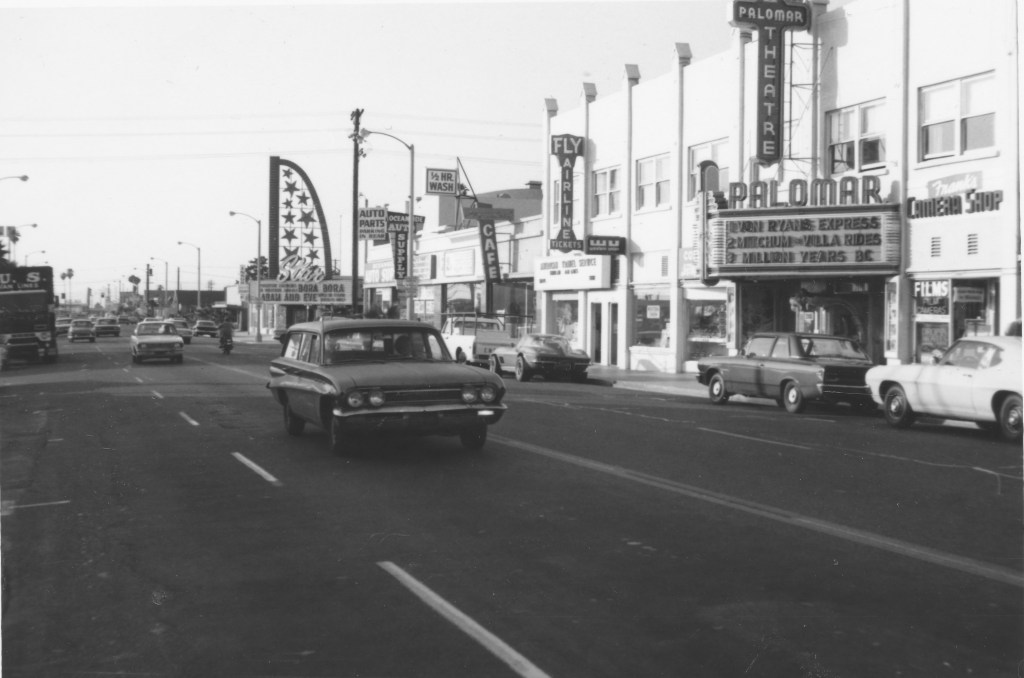
Siegel then made his way to Oceanside, leasing the Palomar Theater in downtown Oceanside in 1934, which he later purchased in 1952. He also operated the Margo Theater for several years, which was built in 1936 (later known as the Towne and now known as Sunshine Brooks). In 1937 Siegel announced that he had a ten year lease on a new theater under construction in Escondido, the Ritz, on the corner of Juniper and Grand.
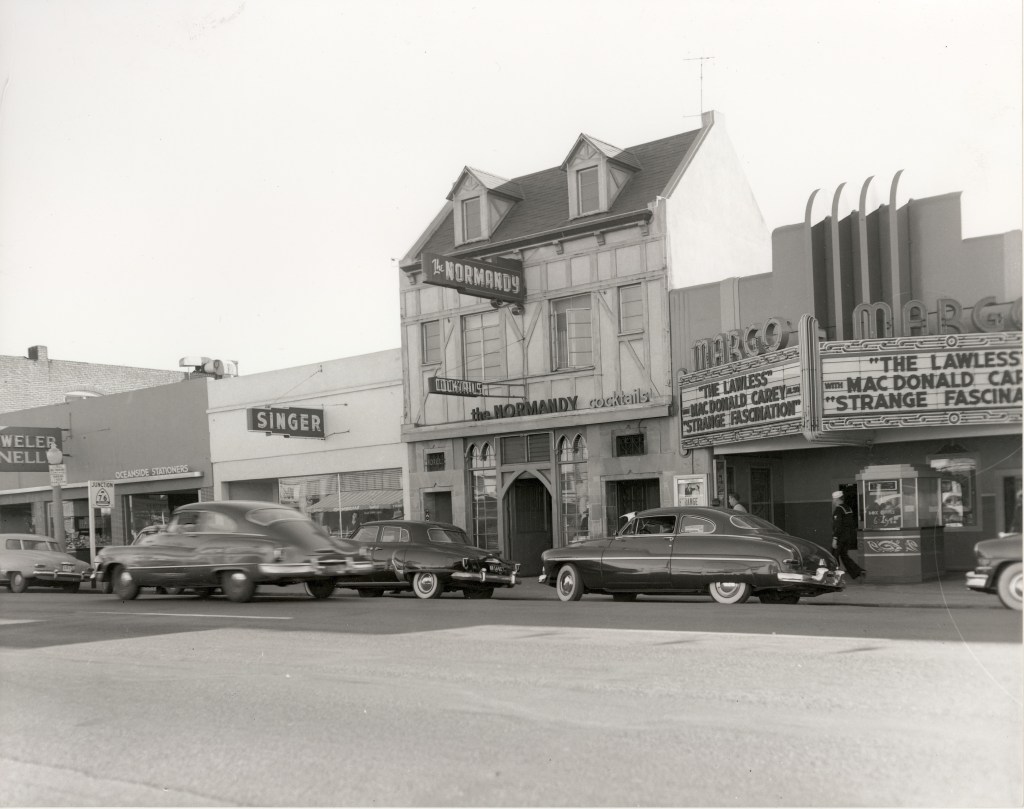
By the mid 1940’s Fred and Jeannette purchased a modest home at 140 South Pacific Street, which was later enlarged with a small apartment and garage.
In 1945 the Siegel’s purchased an empty lot vacated by the First Baptist Church of Oceanside. The small church building was moved one block to the east, its original location, because traffic on the Highway 101 was so noisy that the preacher could not be heard.

In 1952 Siegel acquired the adjacent lot, which contained the Sunshine Hotel, owned by Mr. and Mrs. Charles L. Martin. The small hotel was later moved to Short Street (Oceanside Boulevard) near Cleveland Street. Siegel announced his intention to build a new large theater on the site.

Fred petitioned the city to waive parking restrictions on a proposed new theater. The city required one parking space for every 10 theater seats. This was a newer requirement placed on new construction and Siegel balked at the idea of having to obtain land for a parking lot for over 100 cars. The process took over a year to resolve and a compromise was offered of one parking space for every five seats but Siegel still insisted the cost was prohibitive. Finally, the city agreed to allow the theater to be built with just 10 off-site parking spaces allocated to the theater that would seat nearly 1,000 people!
Siegel reported that his new theater was “destined to be the finest theater between Los Angeles and San Diego for years to come.” Designed by Los Angeles Architects William Glen Balch, Louis L, Bryan, John Loring Perkins and W. K. Hutchason, the stadium-type theater was built of reinforced concrete block. The contract was awarded to local contractors Richardson Brothers.

Details of the theaters progress were shared: “No expense has been spared to insure you’re having the most modern equipment, superb acoustics, comfortable seating, and the little conveniences that add to your pleasure. These will be backed by the best pictures that Hollywood produces. So have a little patience; you soon can make the Star Theater headquarters for your entertainment hours.” Siegel’s connections to movie studios facilitated his theaters to show movies the same day they opened in Los Angeles, when smaller markets would have to otherwise wait 2 to 4 weeks.
The Star, called “the theater of tomorrow” by projectionist Ray Dickson opened as one of the largest theaters in San Diego County at a reported total cost of $325,000. When the Star Theater was opened it boasted of the most modern design of its time, featuring “Stereophonic sound” with the system built “in the ceiling, permitting the sound to flow over and around you.” The first movie shown on August 18, 1956 was Moby Dick starring Gregory Peck.
The Blade-Tribune described the theater’s interior: “Audiences will move from the lobby into the theater over two semi-circular ramps leading to the cross-over aisle, which will separate the 440 loge seats in the rear from the rest of the house. The loges will have a rise as high as 15 feet, and will be equipped with the latest design reclining seats.”
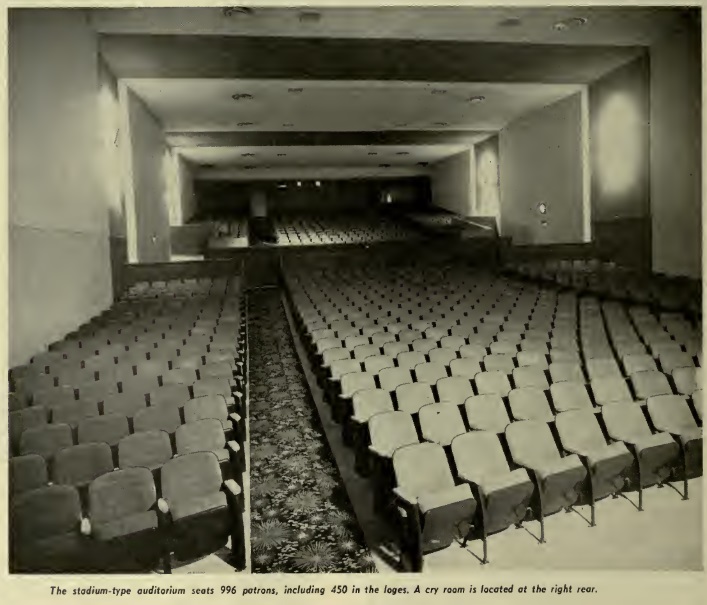
Jeannette Siegel pointed out, “These aren’t just another section of chairs with higher prices. These are real loges. The manufacturer calls them ‘relax recliners’ because of their comfort, and the fact that the backs recline in response to pressure against them. And you don’t have to draw up in a knot when another patron passes in front of you,” she added. “There’s lots of room between rows. You can smoke there, too.”
In back of the loge seating was “a crying room for youngsters fitted with electric outlets for bottle warmers. Ladies’ powder room and men’s room are off the lobby. A decorative theme based on the star motif adopted from the theater’s name is used throughout. Star patterns in five-colors are depicted in the terrazzo floor of the foyer, while overhead will be installed the largest marquee in the area. Lobby and foyer walls are in natural stone, except the interior walls of the lobby, where wood paneling is used for greater warmth. Auditorium walls and ceiling are of acoustic plaster. Special carpeting was designed by the architects to harmonize with the over-all color motif. An ornate, fully-equipped, refrigerated snack-bar will be installed in the foyer.”

The Star’s Googie-style marquee, at the time the largest in San Diego County was 65-foot wide, broken into three sections, with 35 feet across the front, 20 feet toward the north and 10 feet looking east. In addition, the marquee was said to have been unusual in that it was “one of very few over the nation with a yellow background, recently discovered by color experts to be superior to conventional white backgrounds since lettering thereon can be read much farther.” The stunning feature of the marquee was its theme, “a field of flashing and twinkling stars” and “an electrical waterfall cascading from 48 feet in the air.”
Fred Siegel died just two years later on July 23, 1958 and was buried in Forest Lawn Cemetery in Glendale. Fred Jr. died suddenly on January 12, 1959 and then Jeannette died May 22, 1959. They too are buried in Forest Lawn. Sons John and Robert Siegel took over the theater businesses, which would also came to include the Valley Drive-in.
As multiplexes became popular, older theaters struggled to find an audience. Mann’s Theater built an 8-screen multiplex on Vista Way in 1980. Eventually Oceanside’s downtown movie houses were regulated to playing “B” movies or “reruns” of older popular films.

The Star was purchased by Walnut Properties in 1982, along with other theaters in downtown Oceanside. Things changed abruptly when in 1987 Walnut changed the movie selection from popular films to adult films all accompanied by the triple X rating. The Palomar followed, then the Crest and for a brief time, the Towne Theater also went in the adult only genre. It did not help Oceanside’s already eroded image, which was once a family-friendly beach town.

In 1988 Deputy Mayor Sam Williamson suggested that Star Theater be turned in the city’s first cultural arts center. A new pier, Oceanside’s 6th had been recently completed, and construction for a new Civic Center was about to begin. The city council and residents alike wanted to improve downtown and its reputation.
That year, however, Terry Wiggins purchased the theater business and began needed renovations on the Star. At the time it was considered one of the last big screen movie houses still an operation in Southern California. He had re-carpeted, reupholstered and repainted the theater. Wiggins worked “to erase the negative image” of the once celebrated theater.
“We’re getting the families and couples back to see our movies. This theater is completely safe, there’s no violence of any kind and the on-street parking areas all around the theater are well lighted so people can feel safe coming and going,” Wiggins said. “Most of the movies I run are so-called sub run films, newly released movies that have run at the large chain theaters for nearly 3 or four weeks. I get them after they leave the major chain theaters.” Wiggins added, “We’ve got everything the big guys have got, only it’s better here because you can watch a movie the way it was meant to be watched, in a big theater on a big screen.”
In 1994 the IRS closed the Star because Wiggins owned back taxes of $56,000. While Wiggins owned the theater operation, the building was still owned by Walnut Properties.
The Star sat vacant for two years when Jim Heiser, owner of the Hill Street Blues clothing store at 205 N. Coast Highway, bought the theater building, which included three retail units in 1996 for $225,000 At that time, Heiser said he was considering converting the theater into an upscale billiards club which would include a restaurant and a venue for live entertainment.
The theater had been damaged because of a neglected roof leak. Heiser spent two years renovating and applied for a received $330,000 for exterior improvements from Oceanside’s Redevelopment Agency to restore the iconic marquee which had not been in use for several years. In November 1998 the historic Star Theater received two Orchid Awards, one for historic preservation and one for interior design from the San Diego Architects Association.

In 1999 the Star welcomed its biggest audience in decades when Star Wars: Episode I – The Phantom Menace was featured on one of the biggest screens in San Diego County, something the newer multiplexes couldn’t offer. The blockbuster hit was sold out for the first showing which began at 12:01 AM.
The renewed interest was short-lived, and the Star once again found itself competing with a multiplex when the Regal was built at 401 Mission Avenue in 2000.
Fred Siegel, who started off by converting stage theatres to movie theaters, might be amused that his beloved movie theater has been converted a popular and successful performing arts theater in 2001.

The Star’s large south facing wall was the perfect blank canvas for public art and in 2017 a mural entitled “The Beauty of the Sea Will Always Be With Me” was completed by Skye Walker. This mural design was selected by the Oceanside community with over 1,500 votes. “Art That Excites” helped to raise funds for the mural, with MainStreet Oceanside matching funds for the project. Also in 2017, Oceanside Cultural District became one of the first 14 inaugural districts designated by the California Arts Council for the State of California, within which the Star Theater, in all its neon glory, is situated.
The Star still shines brightly in downtown Oceanside …
 Histories and Mysteries
Thanks again for a great story. I remember when it was an X rated theatre. When I was first married we lived right behind it across the alley. Was just recently there for something to do with the Oceanside Film Festival.
LikeLiked by 1 person
In March 1980, John and Robert Siegel asked a judge to issue a stop work order to halt construction of the El Camino North shopping center; supposedly over concerns of runoff impacts to the Buena Vista Lagoon. However, many at the time believed that the action was really intended to stop the 8-screen Mann Oceanside 8 motion picture theater, which was planned for that center.
LikeLiked by 1 person
Yes! I found newspaper accounts concerning this while researching for this story and that was certainly my impression of their motivation!
LikeLike
My mother (Lou Jones) and I sat comfortably in the loge on opening night. What a magnificent movie to introduce a grand Star history. Noteworthy, Ray Bradbury write the screenplay for Moby Dick.
LikeLiked by 1 person
I remember.
LikeLiked by 1 person
Thank you for reading!
LikeLike
wow!! 70History of Oceanside Street Names
LikeLiked by 1 person