The Hill Top Motel at 1607 South Coast Highway in Oceanside, California has been described as an “okay place if you’re running out of options.” It has become sort of a fixture in the South Oceanside neighborhood. Far from a vacation destination resort, the Hill Top Motel is a low budget option for travelers and locals.
The Hill Top Motel, (Google view 2025)
Regardless of its less than stellar reputation, the Hill Top has a history dating back to 1948 and includes two tragic events, a suicide and an unsolved murder.
The first deadly incident was the suicide of Flora Dodson in 1954. She and her husband were the original owners of the motel property.
Forrest Leroy and Flora (Kettering) Dodson were both natives of Illinois, married in 1907. The couple had two daughters, Marie and Edith. In 1948 the Dodsons purchased property on the southwest corner of Morse and Hill Streets (Coast Highway) from Clifford Brodie. In June of that year a permit was issued to build a small motel called Dodson’s Motel at 1607 South Hill Street for a cost of $19,000. A neon sign was erected in December 1948 and the motel was completed and ready for guests.
Flora and Forrest led quiet lives on the busy Highway 101. They lived on the property while managing the auto court and visited often with their children and grandchildren.
Sadly, Forrest Dodson died suddenly on May 29, 1954. After 47 years of marriage, Flora was distraught and despondent with grief. She told her daughter Edith Lipman that she did not care to live any longer and that she had contemplated jumping off the end of the Oceanside pier.
On December 12th, just seven months after the death of her beloved husband, Flora ended her life. She was discovered by her son-in-law Othel Bert, who was visiting from the Midwest. He found her lifeless body lying on the floor in front of the kitchen gas range. Detectives from the Oceanside Police Department responded to the call and as they examined the scene, they noted that Flora had cut her left wrist with a safety razor blade, which was found on the floor near her right hand. A rifle and .22 cartridges were also found but unused. Instead, Flora had turned off the pilot lights in her wall heaters and stove, turned on the gas and positioned herself on a kitchen stool until she was overcome by fumes. The coroner ruled her death a suicide.
The Hill Top Motel, 1607 South Hill Street (Coast Highway) in early 1960s.
After her mother’s death, daughter Edith Lipman acquired the motel property which had since been renamed the Hill Top Motel. It was sold to Leonard and Bessie Robinson in 1957. The Robinsons lived on the property in the “owner apartment” and managed the 8-unit motel, which advertised “all the comforts at home” including carpet, kitchens and free TV.
By the mid 1960s the Hilltop Motel was expanded with a two-story unit on the north end of the property. The Robinsons sold the property to Mr. and Mrs. William and Virginia Giffin who sold it to Dwight M. Pankey in 1970.
The Hill Top Motel in the 1970s.
It was purchased by Larry and Twyla Shaffer in 1974 and by 1976 the Hilltop Motel was offering daily rates of $10 and a weekly rate of $63. In 1976, the property was purchased by Joe C. Iski and John Isky. They sold the property to Yee Chen Yeh of San Diego in 1979.
Aerial view of the Hill Top Motel, corner of Morse and Hill Streets (Coast Highway) upper right in the 1970s.
The clientele in the 1970s and 1980s were much different than the guests who stayed in the Dodson Motel in the 1940s and 1950s. Things were changing in Oceanside with a rising crime rate, even in South Oceanside, which is a vibrant and trendy neighborhood today. In 1988 the crime rate had increased 24 percent and it was reported that Oceanside had the biggest increase in violent crime in the entire state for the first six months of the year.
Violent crime which included Oceanside’s first reported homicide of the year – at the Hilltop Motel. On January 22, 1988 Rocco Anthony William Pittro, Jr. (aka Pietro) was found murdered in Room No. 8. Pittro had been discovered by the motel’s manager. Left in a pool of blood, he had been stabbed seven times.
The manager told police that Pittro and a man by the name of Carl had been seen together, and that Pittro had told him he would have a male friend visiting. Carl was described as a black male 25 to 30 years of age, 160 pounds 5’10“. The manager of the motel had gone to the room to check on him the following day, presumably after Pittro missed check out, entered the room with a pass key and discovered the dead guest. The Oceanside Police Department was notified and Officer P. Coppack arrived at 12:43 PM.
Pittro was born August 7, 1927 in Illinois. He was divorced and living in Mission Viejo. Differing reports list his occupation as an interior decorator to construction.
The coroner’s report stated that he was found in “a prone position on the bed and his body was cold to the touch.” There were three stab wounds to the back of his body and multiple stab wounds to his chest and abdomen, as well as a laceration to his left hand. The bedding under his body was blood soaked, and there was dried blood spattered on the wall opposite the foot of the bed and on the head of the bed. More specifically, Pittro was stabbed in the heart as well as in the lungs and suffered from multiple blunt injuries. The coroner also noted that no drugs were detected.
The murder weapon was not found but Homicide Detective Sheila Hancock reported “I think we’ve got some good physical evidence.” The victim’s 1985 Nissan pickup truck had been stolen and later recovered abandoned in central Los Angeles.
In March of that year, a 16-year-old Oceanside youth was arrested. He was booked into juvenile hall, but his name was withheld because of his age. Three days later, he was released. Detective Hancock said there was insufficient evidence to prosecute the teenager at the time. Police said the teen lived with his parents on nearby Marine Corps Base Camp Pendleton and they continued to look for information linking the teenager to the killing.
In September of 1988 Oceanside detectives released a crude sketch looking for someone by the name of Chris or Carl. But with no suspects in custody, the case eventually went cold and then forgotten.
However, with properly stored evidence, this case could likely be solved today with DNA or even fingerprinting.
The murder of Rocco Pittro is one of several unsolved cases in the files of the Oceanside Police Department, including Zelda Lamore found murdered in a downtown hotel in 1953, the murder of cab driver Ray Davis in 1962, the murder of Charlleen Saunders in 1986, the kidnapping and murder of 7-year-old Leticia Hernandez in 1989, the missing persons case of Mary Rico-Webber in 1992, the murder of retired school teacher Margaret Yossa in 1994, and the murder of Rachel Pauline Rivera found in the alley of the 600 block of South Coast Highway in 2001.
As each year passes these cases only grow colder, including Rocco Pittro’s murder in Room 8 at the Hill Top Motel. Is the DNA evidence just waiting to be tested? Is there anyone who remembers, or has information to help solve this case and others?
South Oceanside’s popular health food store “Cream of the Crop” has been around for nearly 40 years. But the history of the building is a colorful one beginning in the 1940s …. once occupied by a fish grotto, cocktail bar and later a gentlemen’s club called the “Man Trap.”
Built in 1944, the building was owned by Dr. Clifford and Cora Brodie and housed Brodie’s Fish Grotto which opened in the summer of 1945. The Brodies had an auto court-style motel on the southwest corner of Vista Way and Hill Street (Coast Highway) in South Oceanside. They also owned an apartment building at 2012 South Tremont.
The Ellis Motel was built in 1939 as the Brodie O Tel at 2001 South Hill Street (Coast Highway)
Clifford Brodie was married up to five times and Cora may have been wife number two. They were married in about 1930 and had one son, Elwood. The couple divorced and Cora remarried, her new married name was Shuey. Cora received the Tremont Street apartment building where she resided, along with the building located at 2009 South Hill Street a.k.a. Coast Highway, in the divorce settlement.
Dr. Clifford E. Brodie
Cora Shuey opened a new restaurant in her building on Hill Street called “The Port Hole.” It operated from 1947 to 1952. Athur Vitello then opened a restaurant and cocktail bar called Diana’s, in mid-1952, while Cora retained ownership of the building.
Diana’s was a popular hangout for several years along the historic Highway 101, on the outskirts of Oceanside. Clientele came from both Oceanside and Carlsbad and beyond.
In 1955 a shocking incident occurred there when a man shot his wife, killing her instantly, and then turned the gun on himself. James and Joyce Nolan were living in the motel next to Diana’s at 2001 South Hill (Coast Highway). The couple had entered the establishment and had a noticeable disagreement or fight then left. Joyce Nolan returned alone to the cocktail bar and her husband re-entered and asked her to come home. She refused saying she wanted to finish her drink. Soon after James Nolan approached his wife and without a word shot her in the throat with a 38-caliber pistol. He then shot himself in the head.
Detectives enter Diana’s restaurant and bar to investigate the murder-suicide.
Oceanside Police were summoned by shocked bar staff. In his pocket police found a tattered letter written by James Nolan to his parents. It read: “I can’t take it anymore. The only one I ever loved is Joyce and we just can’t seem to get along so I’m ready to call this life to a finish.” They had only been married a few months.
In June 1959, Cora Shuey had the building “completely redecorated” and opened “The Coral Reef, Oceanside’s newest restaurant and supper club.” Cora Shuey died in 1960 and was buried in Eternal Hills.
By 1961 the bar/restaurant was owned by Marvin Burke and for a time it was called “Marv’s Coral Reef.” It remained the Coral Reef through the mid-1960s when it was later renamed by owner Robert F. Blanas as the “Pink Kitten” from 1967 to 1968. The Pink Kitten was no supper club but an establishment known as a “go-go bar” featuring topless dancers.
The name “Pink Kitten” did not last long and the tamer, if not ambiguous name, “Coral Reef” was returned by 1970, but the topless dancers remained. Help wanted ads ran in the local paper offering $3.25 an hour for single or married go-go girls. (The state minimum wage was then just $1.60.) “Earn while you learn” was the headline, but it was unclear what the women would be learning.
But by 1972, the adult venue was renamed “The Man Trap” leaving little to the imagination. Its clientele were often rowdy marines, who would get into fights with each other and or the locals. On one occasion Marine officers were relieved of their commands because of a bar fight at the Man Trap.
In 1974 three Marine officers faced charges after a brawl that left a bouncer injured. Lt. Colonel Robert Hicketheir was charged with felony assault, while Major Patrick Collins and Col. John I. Hopkins were charged with battery and misdemeanor assault. The doorman of the Man Trap, James Weaver, was struck on the head with a drinking glass and suffered cuts and bruises.
Newspaper accounts reported that Hicketheir had taken a doorman’s flashlight and tried to shine it at a dancer. When Weaver attempted to retrieve the flashlight, he was struck in the head. Collins then allegedly struck Weaver continually with this fist “about the head and upper body while suspect number one held him.”
Hopkins was later acquitted by a judge after he determined the Marine officer had simply tried to intervene in the melee. In July 1974, Hicketheir and Collins were declared innocent on all counts by a jury of four women and eight men. Their accounts were vastly different from the original reports, and stated that Weaver was the aggressor.
Their testimony was that Hicketheir had used the flashlight to view a vending machine, when the doorman picked Hicketheir up and shoved him against the wall, which started the physical altercation. Collins testified that he was simply coming to the aid of Hicketheir. The newspaper noted that the prosecution witnesses were “flamboyantly dressed” with “contemporary hairstyles” and were bartenders and topless dancers.
There was considerable controversy of having a topless bar in quiet South Oceanside, and it turned even more controversial when the dancers went from topless to totally nude in 1978. Owners Herbert Lowe and Robert Gautereaux Sr., defied the City and offered total nudity, despite the fact that they were not licensed to do so.
The Man Trap was open 11 AM to 2 AM during the week and Saturday and Sunday from 2 PM to 2 AM. Starting pay for dancers was $5.00 an hour with the promise of “excellent tips and good working conditions.”
An employee of the Man Trop reported that two girls had been hired specifically to dance nude on Thursday nights, because the regular top topless dancers were reluctant to remove their G-strings.
A court case ensued and a hearing was held on October 14, 1978 in Superior Court where Judge Michael Greer ruled that the Man Trap “could continue to feature topless and bottomless female dancers” until December 4th of that year, but “called for changes.”
The bar was ordered to place the stage area 12 feet away from customer seating and to prohibit dancers from socializing with customers or serving them alcoholic beverages. Joshua Kaplan, attorney for the owners declared “we will remain totally nude until December 4 and then after that forever.” Oceanside Deputy City Attorney Warren Diven said that the Man Trap was in violation of a city ordinance that prohibits topless or nude dancing in bars.
Kaplan argued that the Man Trap was a “theater” and therefore exempt from the ordinance. He said owners Lowe and Gautereaux (who also owned the Playgirl Club in downtown Oceanside) had made improvements of more than $60,000 to assure that the established met the “legal definition of a theater.” But City Attorney Divon countered that “the primary purpose of the man trap was to serve alcoholic beverages and not to provide entertainment” and added that the type of entertainment offered by the Man Trap “does not rise to the dignity of a theatrical performance.”
The Playgirl Club on Third Street (now Pier View Way)
Mayor Pro-tem Bill Bell said, “We will pull out all the stops to close both of them, the Man Trap and the Playgirl. Enough is enough.” But both establishments continued operating. In 1979 the Man Trap Theater began to featured ladies’ night, Wednesday night with male dancers. Saturday was couples’ night with male and female dancers.
Skip Arthur, purchased the Man Trap, as well as the Playgirl. But the Man Trap was closed after the Alcohol Beverage Control board pulled its license for having nude dancers.
The 3,300 square foot building at 2009 South Hill Street (South Coast Highway) remained vacant while the owner offered it for rent. In June of 1980 the building was leased to the FVW Post 9747, a largely Black Veterans’ organization of 200 members, who had faced protests when trying to lease a different location on Mission Avenue. (FVW Post 9747 later merged with VFW Post 10577 to become Oceanside Memorial Post 10577.)
In March 1987 the building that had once housed restaurants, served cocktails and offered adult entertainment, became a health and gourmet food store called “Cream of the Crop.” For nearly four decades the health food store has flourished with a faithful clientele of its own, albeit a bit more “wholesome.”
Google Street View of Cream of the Crop at 2009 South Coast Highway in 2021
A small cottage home near downtown Oceanside, California was once the headquarters of an influential protest movement during the Vietnam War. Celebrities such as Jane Fonda and Elliott Gould made appearances at the house to encourage and show support to protest organizers and their followers.
519 South Freeman Street in about 1991
In June of 1969 an underground organization known as the “Green Machine” affiliated with the Movement for a Democratic Military (MDM) met in a small home near Vista, and encouraged planned demonstrations at both the Camp Pendleton military base and in the City of Oceanside.
The meetings were modest in size, attracting between 30 and 75 persons. The Oceanside Blade Tribune newspaper identified the local movement as an anti-war organization similar to other “coffee house groups across the nation” operating “under the guise of providing entertainment for servicemen while spreading an anti-war and anti-military message.”
Letter written by Kent Hudson in 1969 to Marine Blues
The group was headed by Kent Hudson and Pat Sumi, attracting a following of both military and civilians, mainly students.
Kent Leroy Hudson was born in 1944 in Riverside County, California. As a youth he attended Vista High School, graduating in 1962. Hudson was also a Stanford graduate and a Navy Reservist. In 1965, Hudson spoke at the Vista-San Marcos Democratic Club about his experiences in Louisiana and voter registration of Blacks that summer.
Kent Hudson at Vista High School in 1959
In July 1968, Hudson had joined what the San Luis Obispo Telegram-Tribune called a “16-person troupe” who had organized small campaigns to encourage protests of the draft and oppression. The newspaper described the group as “bone-tired” and that their two-week campaign had exhausted their funds with no great result.
Hudson would find the following he was seeking one year later when he relocated his efforts to the Vista and Oceanside area in San Diego County. He first applied for a permit to operate a coffee house in Oceanside but was met with resistance from the city council. The group settled on a small house at 2133 North Santa Fe Avenue and converted the garage into a meeting space.
Oceanside Police Sergeant John Key described the location: “The house in Vista was surrounded by slit trenches that had been dug all the way around the house. There had been concertina wire strung on barricades that could have been pulled across the access to the house. It was, for all intents and purposes, fortified.”
Sumi and Hudson held modest gatherings, looking for support. Folksinger Barbara Dane offered it in the way of a performance and held a concert at the Armed Services Center in Oceanside.
USO building, Southeast corner of Third (Pier View Way) and Tremont Streets.
Volunteer workers and staff at the center were “surprised” by the performance as they expected folk, not protests songs. It was reported that the largely military audience joined Dane in singing anti-war songs and shouting “Join the ASU”, short for the American Servicemen’s Union. Hudson himself reported that one person in the crowd stood up and shouted, “Shoot the Lifers!”
After her performance, group members held a party at the house in Vista and a movement was born. Meetings were announced through “handbills” which were passed out to Marines by Green Machine supporters on Camp Pendleton. Then members picked up the Marines, and others interested in the meetings, on Saturday nights at various pickup points.
The Oceanside Blade Tribune described a typical meeting: “There the audience gets a soft-sell anti-war take from Pat Sumi, an accomplished speaker. They are also served free coffee and beans, and often treated to folk-singing of anti-war and anti-military songs. Recent meetings have featured a Black Panther leader from San Francisco, and nationally known folk singer Phil Ochs, an avowed pacifist. The meeting featuring the Black Panther leader included “liberation” films and speeches threatening black insurrection.”
In perhaps to alienate white readers from the group, the newspaper described the attendees as predominantly Black: “Approximately two-thirds of the audience of about 65 was black, most were Marines, but there were also two black students from Oceanside attending.”
A list of “demands” was published and distributed by the group, which read in part:
We demand the right to collective bargaining
Extend all human and constitutional rights to military men and women
Stop all military censorship and intimidations
Abolish all mental and physical cruelty in military brigs
We demand the abolition of present court-martial and nonjudicial punishment systems
We demand wages equal to the minimum federal wage
We demand the abolition of the class structure of the military
End all racism, everywhere
Free all political prisoners
Stop all glorification of war now prevalent in all branches of the military
Abolish the draft and all involuntary enlistment
Pull out of Vietnam now
The immediate goals of the Green Machine were as follows:
Disturbances involving police were to be escalated by the military personnel
Military personnel were to wear black armbands while on liberty in civilian clothes
To have mass meetings in the Oceanside beach area on December 15, 1969
To have another mass meeting at Buddy Todd Park on March 15, 1970
To start a newspaper called the Attitude Check
Marines were to create problems aboard the base at Camp Pendleton
While similar groups were organizing all over the country, the Green Machine’s presence was an uneasy and unfamiliar one for Oceanside. For over two decades the city had embraced the military and their families since the base was established in 1942 during World War II. The population included many former military personnel who chose to make their home in Oceanside after their stint (long or short) in the Marines or Navy. Many residents and business owners were in angst over the anti-war messages the group espoused, because even if they themselves were not in favor of the war, they wanted to support the military.
It was clear that Hudson just wasn’t against the war, but against the Marine Corps as a military institution when he wrote the following statements:
“No clear-thinking man joins the Marine Corps, there are to (sic) many better alternatives.”
“I have yet to meet the marine who joined to serve his country. He certainly exists, but in a tiny majority.”
“The Force Reconnaissance trainees I have met are mostly acid heads.”
The Green Machine sponsored a bus trip to Los Angeles where members could meet with Black Panthers, and the group continued on to San Francisco to participate in a march. The trip was paid for by Green Machine “allies.”
The MDM held its first rally in Buddy Todd Park in September of 1969, where it first attracted the attention of local officials and police, and the FBI was kept advised of its activities. They began publishing an underground newspaper called “Attitude Check” which was offered to Marines in downtown Oceanside.
Theresa Cerda, a local resident recalled in a 1999 interview that she got involved in the group after attending a “love-in” in Cardiff. Kent Hudson spoke and asked if anyone was interested in “organizing the G.I.’s to resist the war” to meet with him afterwards.
A 17-year-old high school student at that time, Cerda explained that the movement was funded by “rich lawyers” who “were willing to fund us to be their mouthpiece, but they backed us with money and legal. They were more the fundraiser people, the glamour, the upper echelon, we were the grunts, and we went out and did all the work.”
Hudson and group members would take vans from their house in Vista and travel to downtown Oceanside and walk the streets passing out leaflets. Teresa remembered that they were met with both resistance and acceptance. “On Hill Street [or] Coast Highway — that was very scary because we had a mix of people. I remember several times when some of the Marines would get really upset and take stacks of stuff away from me and burn them. There were times when other Marines would gather around me and protect me and say, ‘this is freedom of speech and I want to hear what she has to say’. It was usually the Black Marines, the African American Marines that would protect me. And then soon, it started snowballing and then after that we had a good mix.”
Organizers planned a beach rally in Oceanside in November of 1969, an event that set many in Oceanside on edge. City officials attempted to block the organized march, appeals were filed, and protestors vowed to march with or without a permit. The Oceanside Blade Tribune urged residents to remain calm with an editorial entitled “Keep Cool Sunday”.
“The courts will decide today whether Sunday’s march and rally in Oceanside will be held with or without the sanction of a parade permit from Oceanside.The constitutional questions of right of free speech and assembly are the heart of the issue – and whether the city’s decision is a political one as charged or merely enforcement of city ordinances.
But the court decision is really secondary to the march for it will happen regardless of the court’s ruling.
March organizers have stated they plan to walk through the city on the sidewalks – rather than parade through the streets – to fulfill the march plans.
Organizers say it is too late to call off the march, and it is too late. Leaflets have been distributed to colleges in Southern California advertising the demonstration.
The spectre of violence, and that possibility is high in the minds of law enforcement officials charged with the responsibility of maintaining law and order Sunday, is a main overriding factor.
There are rumors of marines from Camp Pendleton staging a counterdemonstration to protest the anti-war and anti-military philosophies of the marchers.
There is also going to be a relatively large contingent of Black Panthers in the march and recent events involving the organization would indicate no love lost on their part for law officials.
Angela Davis, the communist college professor, is also scheduled to speak and the massive patriotism of the area may likely be sharply prodded by what she may say in her speech.
The potential for violence is high.
But if everyone – marchers, the speakers, the marines, the spectators, and those pro and con – will just cool it Sunday, everything will go off without a hitch.
Although there are always troublemakers in marches of this nature, the main body of the marchers are quit determined to keep things peaceful.
March leaders have informed The Blade-Tribune they intend to do all in their power to keep the peace and are bringing 200 monitors in to patrol the march.
There will be little sense in letting passions and tempers, however justified by philosophy and belief, flare into violence.
The only loser will be the city of Oceanside.
The march will only be a memory after Sunday, and it would be much better as a peaceful memory.”
The day of the march the Blade-Tribune minimized and mocked the organizers and persons expected to speak.
“There is a beautiful lineup of characters for the day:
– Former military officers who wouldn’t follow orders;
– Black Panthers who have preached hate and violence in this country since their organization was founded;
– A Communist teacher;
– Leftwing “peace-at-any-price” speakers;
– Unhappy military types who can’t take discipline and order;
– A full parade of fuzzy-thinking, fuzzy-looking creeps.
There is nothing good; you can say about this march, unless you espouse the thinking of those who support it.
So stay home today. There are very few area residents who will be supporting this march. Don’t be counted among them. Don’t help the Communist cause.”
In contrast the conservative stance the local newspaper took, John Richardson, a nephew of Oceanside Mayor Howard T. Richardson, was an avid supporter of the march and saw “the protest movement in this country as a means of solving problems.” An Oceanside High School math teacher, he encouraged his students to take part or at least an interest in the MDM’s message.
John Richardson, Teacher at Oceanside High School
The Blade Tribune reported a list Richardson’s views and remarks: “He views the reaction of Oceanside Police and town officials to both [the] march and the Green Machine as “in conflict with the Bill of Rights.”
“I get just as upset when I read of the reaction of most people to the Green Machine as I did when I heard President Agnew’s attack on the press,” said Richardson. “My own personal opinion is that there are many needs in this country which are just beginning to surface.”
The article continued saying “Richardson explained the presence of Black Panthers at Green Machine meetings by saying black servicemen aboard Camp Pendleton had “expressed a desire to find out what the Panthers is all about.” Richardson, who has attended “five or six” meetings of the Green Machine said however he had never been present at a meeting of that group when a Black Panther spoke. Yet, he criticized an eye-witness account of a Green Machine meeting at which Panthers did speak, published in the Blade Tribune.
“He explained that he had been at other meetings where the Panthers spoke and said he felt in sympathy with the reporter who attended the Green Machine meeting only because he knew it “must have been the first time he had heard the Panthers speak.”
“It can be scary,” said Richardson, “especially the first time someone is exposed to it. After that however you realize that they are speaking from their hearts and from the heart of the black ghetto,” said Richardson. “Their language is the language of the ghetto, and the ghetto is not a happy place.”
“We need change, and we need it fast,” he said. “This need for change…for good change in the American political systems is why I support the movement in general and why I support the Green Machine in Oceanside. The movement is where the demand for change if being generated. Fear of the movement and fear of change is the situation Oceanside is confronted with.” He cited Oceanside’s “over-reaction” to the Green Machine as a case in point.
Illustration of law enforcement by Frank Zincavage, Oceanside High School Yearbook, 1970
The Movement for a Democratic Military, along with Rev. William R. Coates of La Jolla, coordinated the planned march and rally which was sponsored by the Citizens Mobilization Committee (CMC), which secured a court order for the march permit when the city council refused to grant it.
The march began at Recreation Park, just east of Brooks Streets and made its way west to downtown. It was reported that 250 active-duty servicemen participated and that they represented “almost 40 per cent of ‘snuffies’ in the Southland who sympathize with the MDM.” Snuffies were Privates or low-ranking military members.
The vast majority of the marchers came from outside of Oceanside from other organizations and included the Peace Action Council of Los Angeles, the Socialist Workers Party of Los Angeles, the SDS of Los Angeles and San Diego, the Black Panther Party of Los Angeles and were joined by the Young Socialist Alliance, Student Mobilization Committee, the Clergy and Laymen Concerned and Medical Committee for Human Rights.
The Oceanside Blade Tribune described the scene: “Marchers carrying hundreds of signs, most calling for an end to the war in Vietnam. Many of the signs also urged support for various anti-war and anti-military groups. Most of the marchers were young, in their teens and twenties, but several middle-aged persons and a few elderly persons marched. The vast majority of the marchers wore hippie or mod clothes, but some of the marchers were dressed in business suits and fashionable clothing.
“Hippies” by Frank Zincavage, Oceanside High School Yearbook, 1970
“Marchers chanted, “One, two, three, four, we won’t fight your fascist war,” and “Peace, Now!” and “Two, four, six, eight, let’s destroy this fascist state,” and “Power to the People.”
“A march cheerleader atop a bus leading the parade kept up a continual banter of slogans, many in support of the Black Panthers. There were few Black Panthers present, despite a scheduled mass turnout.
“There were very few spectators along the mile-long march route until it reached the downtown business area. Most of the spectators were obviously against the march, but a few joined the march as it progressed downtown.
“A crowd of about 200 spectators, mostly Camp Pendleton marines, was gathered along Hill Street between Mission and Third Street. Some of the spectators jeered and booed the marchers.
“Just before the march reached the Beach Stadium, a brief scuffle broke out when an angry marine attempted to charge a marcher who was carrying a Viet Cong flag. His companions and police subdued him.”
A vehicle parked along the demonstration route greeted marchers with the slogan, “Better Dead Than Red” painted on its side. As the march continued on Hill Street to Third Street (Coast Highway to Pier View Way) a vocal gathering at the USO challenged the anti-war group with their own signs and slogans.
Counter-protestors “The American Machine” as opposed to the Green Machine, 1969, San Diego History Center photo
The march culminated at Oceanside’s beach amphitheater where the keynote speaker was Angela Davis. The local newspaper described her as tall and lanky and added she “could have passed for a high fashion model.”
It had been reported that an “armed pro-war marine” was “perched somewhere in the crowd with a rifle, ready to gun down Angela Davis, the Marxist UCLA assistant philosophy professor.” A request was made for members of the MDM to form a “human cordon” around Davis. The Blade Tribune reported that “at first, only black marines showed up but several white marines showed up when a call was issued, ‘Let’s see some whites up here too.’”
Protests coming down Mission Avenue, San Diego History Center
A group of 10 to 12 men accompanied Angela Davis and her sister Fanta to the stage at the Oceanside bandshell. It was noted that while surrounded by her protectors, Davis was “barely visible” while she spoke.
She began her speech by calling “Richard M. Nixon, our non-president, a hypocrite who is a killer, a pig and a murderer.” She called for an end to “genocide” and other “imperialist action” against the Vietnamese people and the black community, specifically the Black Panthers.”
Crowds filled the Oceanside Beach Stadium, 1969, San Diego History Center
“There are people who will be shocked about My Lai but they will do nothing more than sit back and say how outrageous it is. They don’t realize that My Lai is no exception. It is the essence of U.S. government policy in Vietnam, just like the Chicago and Los Angeles raids are the essence of policy toward the Black Panther Party.
“The Green Beret is trained to murder Vietnamese. In Los Angeles, the police pigs have a special squad rained to murder Panthers – SWATS, the Special Weapons and Tactical Squad who came to present the warrants to our 11 black sisters and brothers in the Panther office.
“Why are the Black Panthers the target of attack? J. Edgar Hoover said it is because the Panthers pose the greatest threat to national security.
“And we pose the greatest threat to the Nixons, the Reagans, the Yortys, the Kennedys, the defense industry, the ruling class of this country … because they have shown the masses that it is necessary for all oppressed people to unite.”
Davis went on to set the following demands:
– Immediate and unconditional withdrawal of all troops in Vietnam.
– Victory for the National Liberation Front, political speakers for the North Vietnamese.
– Recognition of the South Vietnam Provisional Revolutionary Government, set up for the Paris peace talks, as being the true representatives of the people.
– That the occupying force be withdrawn from the Black Community.
– That all political prisoners, including Panthers Bobby Seale, Huey Newton and Eldridge Cleaver, be freed.
– That the liberation movement be victorious for the oppressed peoples.
Davis was followed by Susan Schnall, a former Navy nurse who was court-martialed for participating in anti-war rallies. Other speakers were Captain Howards Levy, United States Army (Retired) and Don Duncan, an ex-Green Beret.
The protestors and demonstrators were observed by approximately 190 law enforcement officers, representing every agency in San Diego County. No arrests were made although there were skirmishes between Marines and demonstrators and varying factions amongst the gathered groups. Law enforcement “covered every intersection” and “monitored the parade route.”
After the speeches were over, demonstrators and spectators began leaving the beach stadium, but a group of angry Marines remained behind police lines. They eventually “dashed through the stadium and into the streets behind the dispersing demonstrators.”
The Marines, a group estimated at 75 “charged into the main body of demonstrators on Third Street (Pier View Way) near the Santa Fe Railroad tracks” and nearly two dozen people openly fought in the street. Marine PFC Merl Windsor, 18 years of age, suffered a laceration after he was struck in the head by a rock thrown by demonstrators.
Law enforcement separated the two groups which ran east toward Hill Street (Coast Highway) and stood on opposite corners. The Marines waved a large American flag, and “cheered their side of the issue” while the demonstrators hurled “an occasional taunt and threat.” There was no other violence reported.
To restore order, police dispersed the crowds and drew a “line of demarcation down the middle of Third Street, and attempted to keep traffic flowing on Hill Street. By 6:30 p.m. the situation was termed “secure” and by 7 p.m. downtown Oceanside was nearly deserted.
“It’s a tough job when you must provide protection for both sides the peace-marchers and the counter-demonstrators,” Police Chief Ward Ratcliff told the Oceanside Blade Tribune. He added that the rumor of an attempt to assassinate Angela Davis was unsubstantiated. Ratcliff noted that none of the “estimated 3,500 to 4,000 demonstrators were left stranded in town” and that he was “thankful for the community support the police department received.”
“There were times when they [police officers] were challenged and they remained calm. We could have very easily had a serious situation,” Ratcliff said.
Mayor Richardson said the march “Looked like an open sewer running through the streets.”
Mayor Howard Richardson, left; John Steiger, right.
A few months later, in March of 1970, the Movement for a Democratic Military opened a coffee house in the Eastside neighborhood of Oceanside at 418 San Diego Street. It was reported that Black residents clashed with members of the MDM and that one evening shots were fired but no one was injured.
Just days after the Eastside location was established, and perhaps because of the unexpected confrontations, it was announced that the “Green Machine,” would be headquartered at a small house at 519 South Freeman Street.
Purchased for $19,000, the two-bedroom house was obtained via a “double closing” which is the simultaneous purchase and sale involving three parties: the seller, a middleman and a final buyer. This double closing was likely done in order the conceal the identity of the purchaser(s).
The Oceanside Blade Tribune reported that the “purchase was handled by Strout Realty, who were unaware of the actual buyers of the house. A complicated chain of trustees and secondary brokers which winds back to a Beverly Hills-based broker and a Palo Alto resident purchased the house, telling agents of Strout Realty that the property would be used as ‘rental income.’ [The] actual owner of the house apparently is Paul Robert Moore, of Palo Alto, who purchased the house through the Lawrence Moore trust funds.”
After the house was purchased on South Freeman Street, Cerda recalled meeting celebrities like actress and activist Jane Fonda, her sister Lynn Redgrave, along with actors Donald Southland and Elliott Gould, who provided financial support to the movement. Katherine Cleaver, attorney, Black Panther activist and wife of Eldridge Cleaver provided political clout and legal support. While visiting the MDM headquarters celebrities and those with political status would build up the morale of members by visiting and eating “beans from a pot” with them.
A flyer was distributed that read: “The Green Machine Project and Movement for a Democratic Military invites you to an Open House and MDM Meeting.” It went on to say that “We are going to have political speakers Robert Bryan and others from the Southern California Black Panther Party, and special guest, Miss Jane Fonda.”
A leaflet was distributed in the downtown neighborhood which stated in part: “The Green Machine Project and Movement for a Democratic Military have moved into a staff house and meeting place at 519 S. Freeman. You have probably heard or read a great deal about us in the past few months, much of it negative. We would like to have a chance to counter many of the distortions and outright lies by opening our doors to you. We would be pleased if all our new neighbors would stop by and chat with us to find out what we are really all about. Our doors are usually open from noon until late in the evening every day except Monday.”
On Sunday March 22, Jane Fonda arrived at the small house on Freeman Street, accompanied by three members of the Black Panther Party. She met with approximately 30 guests at the MDM headquarters, stayed about two hours and then departed.
Jane Fonda at UCLA, Gary Leonard photographer
While the invitation passed around seemed welcoming, the house itself was fortified and its occupants armed. Sandbags had been stacked to create a barricade on the interior of the home. Gun ports made of bricks were spaced between the walls of sandbags. The attic contained a bell and a “light warning system.”
Six weeks later, on April 28th, the house and its occupants were fired upon by an unknown gunman in a car. Eleven rounds were fired, one striking and wounding Pvt. Jesse Woodward, Jr., of Support Company, H&S Battalion, Camp Pendleton. Woodward was struck in the shoulder and taken to the Naval Hospital aboard Camp Pendleton. Identified as a “deserter from the Marine Corps” Woodward, age 19, had been absent without leave for over 4 weeks, a base spokesman said.
The Oceanside Police Department were called and dispatched to the residence at 11:55 p.m. Upon their arrival they found “about a dozen rounds of ammunition, probably .45 caliber, had been fired into the front of the house.” Police confiscated eight to nine rifles and shotguns in the possession of the MDM group.
An unidentified woman at the house was shaken, “We’ve known something like [this] might happen for a long time and our first reaction was to hit the floor.” She pointed to a large cut on her knee saying, “this came from crawling through the glass.”
Thomas Hurwitz, one of the organizers of the MDM claimed that the group was unaware that Woodward was a deserter and responded to the shooting advocating for peace: “We are urging those who attend to adopt a non-violent attitude. We don’t scare easy. We are angered and feel it was a political action. This was meant to scare marines but all it will do is make them realize we are fighting for them. It didn’t scare them … people in the military are used to being shot at, but it did make them angry.” Hurwitz, who devoted several years to anti-war protests and activism would go on to be a notable documentary cinematographer, with two Emmy Awards and a host of other awards and accolades.
The Oceanside Blade Tribune condemned the shooting in an editorial that ran May 3, 1970, entitled “Dangerous Move.”
“The Movement for a Democratic military and its predecessor, the Green Machine, have raised a lot of hackles in the North County area since they were formed last year.
“The philosophy espoused by these anti-military, anti-war groups is a direct contradiction to the general philosophy of the average resident of North County. It is understandable that feelings are so firmly polarized about these two philosophies.
“Much of the North County is retired military men who believed in the Armed Services so strongly they made it their lives’ career. The small but determined group of people who compose the MDM and Green Machine have made themselves strongly felt in the area, while accomplishing little. Most people in the Tri-City area look upon the two groups as little more than troublemakers, and the two groups have done little to prove otherwise.
“The Blade-Tribune, which first brought the machinations of these groups to the public eye, questions the motivations and honesty of the MDM and Green Machine. They have publicly admitted that their intent is to tear down the military, the backbone of the nation’s defense. They hedge when asked where their funding comes from, and just who supports the non-working crew. They have done little but cause trouble in the community, from polarizing the dissident blacks at Camp Pendleton to attracting every unhappy “marine” who bit off more than he could chew when he enlisted. They stir up trouble, under the guise of “liberating the enlisted man.” They deserve all the public dislike and distrust they have generated.
“But no matter how vociferous the disagreement, the differences should never have come to the shooting which occurred on Tuesday night. That act is far more damaging to the situation in the north County than weeks of weak, ill-attended and poorly supported demonstrations by the MDM.
“The residents of this area should be relieved that no one died in that shooting of the MDM headquarters. The 25 or so persons in the home at the time miraculously escaped the 11 shots fired. Had one of those persons been killed, it would have polarized the forces supporting the MDM, given the group a martyr, and likely prompted an influx of national leftwing radicals into the area.
“The North County can live with the MDM, despite how strongly most of the area’s residents oppose the group’s philosophies. But it cannot live with what will result from any more of the idiocy which prompted the gang-style shooting attack on the MDM staff house on Tuesday.
“The Blade-Tribune recommends those who disagree with the MDM make their protests in the form of staunch patriotism, not in midnight sneak attacks.”
On April 30, 1970, just two days after the shooting, the MDM organized a demonstration at Santa Fe Park in Vista. Several people were arrested for “disturbing the peace, parading without a permit and unlawful assembly.” Pleading not guilty were Michael Anthony Lawrence, 25, disturbing the peace and unlawful assembly; Thomas Dudley Horowitz (sic), 23, disturbing the peace and parading without a permit; Pvt. Maurice Carl Durham, 20, disturbing the peace; LCpl. William Curtis Chatman III, 21, violating the parade ordinance; James Nelson Snyder, 22, disturbing the peace; and Teresa Cerda, 18, disturbing the peace and parading without a permit.
MDM march from Tyson Street across tracks May 1970 (photo by Nick Bihary)
Just weeks later city leaders and downtown business owners would brace themselves for another “anti-war march and rally” expected to draw a crowd of 20,000. The city again denied a parade permit which the MDM appealed. U. S. District Court Judge Howard B. Turrentine temporarily upheld the city’s denial but set a hearing on the matter. Leaders of the protest said they would go forward with their planned demonstrations with or without a permit.
MDM March across railroad tracks May 1970 (photo by Nick Bihary)
Governor Ronald Reagan’s office issued a statement saying that that “the governor will keep a close watch on the situation in Oceanside, since receiving a telegram Thursday from U. S. Senator Alan Cranston (D-Calif.) in which the senator declared the demonstration ‘Poses a serious threat of possible violence.’” Adding that “If mutual aid is requested, we are ready to supply whatever assistance is needed.”
Law enforcement both city and county met to assess the pending protest. It was reported that the National Guard would “be on an alert, if the situation should get out of control.”
Riot police ready for MDM march at Pacific Street May 1970 (photo by Nick Bihary)
Mayor Howard Richardson stated that, “Oceanside has no intention of providing demonstrators with reasons for violence. We shall do all within our power to assure the demonstration remains peaceful.”
An unidentified spokesperson for the MDM told the local newspaper that demonstrators would gather at the municipal parking lot at Third (Pier View Way) and Cleveland at 12:30 p.m. Saturday and that protestors would “march south to Tyson; west on Tyson to Pacific Street; South on Pacific to Wisconsin; West on Wisconsin to the Strand and north to the beach stadium.”
Tom Hurwitz stated that he was working with Oceanside police in an effort to keep the demonstration peaceful and added “we will have several hundred monitors to assist the police in controlling the march as it moves from the assembly area to the beach.”
Marchers at the intersection of Mission and Hill Street (Coast Highway) in 1970
On May 16, 1970 an organized march and protest was held but numbers were much lower than the 20,000 persons predicted. A reported 700 law enforcement officers and 200 monitors provided by the MDM watched as a crowd of 4,000 to 5,000 gathered on the streets of downtown Oceanside.
Kent Hudson declared the march a “tremendous success” and praised both the monitors and police for their handling of the situation. The march began with shouts of “Stop the War” and “Peace Now” as well as anti-Nixon, anti-war chants.
It was reported that some of the demonstrators lashed out at the military guards present, shouting obscenities, but the newspaper reported that they were, for the most part, “drowned out by anti-war chatter and hand-clapping by the protesters.”
Footage of 1970 protest from CBS 8 San Diego below:
As the march continued towards the beach, a Santa Fe freight train came into town, blocking the protesters from continuing on their route. After a disruption of ten minutes, the engineer was instructed to proceed south to San Diego without picking up his intended freight. Protesters then made their way south on Pacific Street to Wisconsin where they walked the Strand to the Beach Stadium.
March interrupted by Freight Train in downtown Oceanside, San Diego History Center photo
Tom Hayden, a founder of Students for a Democratic Society, who would later marry Jane Fonda, was the main speaker. There were a few clashes from counter protestors throughout a series of speeches but each were broken up by police.
It was noted that at the end of Hayden’s speech, several demonstrators raced from the stadium into Pacific Street when a small group of counter-demonstrators led by youths for American Freedom burned a Viet Cong flag” and that “during a brief melee between the counter demonstrators and MDM members, one protester was knocked to the ground.”
People’s Armed Forces Day, Oceanside Bandshell, May 1970 (photo by Nick Bihary)
The Oceanside Blade Tribune reported that near the end of the event “all servicemen were asked to stand and show their Military identification cards. Of those who rose to comply at least one burned his card, waving it in the air. Then he swallowed the ashes.”
The newspaper concluded its report that “Many of those present at the demonstration reeked of marijuana. Others were stone-faced apparently bored by the whole affair or under the influence of drugs. But, the demonstration was peaceful. There were no injuries and no arrests.”
The following day an editorial ran in the conservative leaning Oceanside Blade Tribune entitled “We Wonder.”
The Blade-Tribune wonders what makes a person like most of the 5,000 or so who marched in the anti-war march in Oceanside Saturday.
We wonder how far the rights of this small-minority of rabble-rousers extend.
We wonder where are the rights of the people who make this country work, who pay the bills, and protect the nation.
We wonder why there are so many leftwingers, communist sympathizers and communists involved in the “peace” movement.
We wonder where the money comes from to support these people who don’t work, but work at undermining our nation.
We wonder why these people are allowed to flaunt the law, marching without parade permits.
We wonder why we, the taxpayers, must foot the bill for their parades. If they want to march, let them pay the bills.
We wonder why the Movement for a Democratic Military, our local radical group, and sponsor of the Saturday “anti-war” march, is so closely allied with the Black Panthers.
We wonder why so many of our teachers, who are shaping the minds of our children, are actively involved in supporting this movement.
We wonder why our school boards, boards of trustees, and other educational panels, haven’t got the guts to kick campus radicals off campus.
We wonder when the courts are going to get tough and stop bending over backwards to please these idiots.
We wonder if the news media as a whole isn’t encouraging these groups by poking television cameras and microphones and news cameras into their faces every time three of them get together and hold up a sign.
Finally, we wonder when it became unpopular to be a good American, to operate a profitable business, to serve the country, protect the nation.
We don’t think it is unpopular to do these things, but there are too many young radicals undermining this nation by degrading these principals.
Good Americans can only wonder what makes a protestor. We’re getting a pretty good idea.
Artwork in Oceanside High School Yearbook, 1970
In the summer of 1970, cracks in the unity of the various groups began to show. In July of 1970 Pat Sumi left for North Korea with a group which included exiled Black Panther Leader Eldridge Cleaver. A spokesperson for the MDM said that Sumi’s trip was “financed by several liberal groups located in Southern California.” The group were guests of the Committee for Reunification of Korea.
Just one year later, in 1971, Pat Sumi did an interview and was asked about the Movement for a Democratic Military and if it still existed. She gave a rather defeated reply: “Well, MDM still exists in the minds of people—but that’s not an organization, we discovered. We discovered what the Black Panthers have since discovered—that mass sympathy does not at all mean mass organization. Mass sympathy does not give you the power to change anything. We didn’t understand what an organization was.”
She then offered a different perspective about the group’s efforts and its impact saying, “We really messed up some G.I.’s. A lot of them went to jail. Some had to go AWOL. A few went to Canada. We had no way really to organize power to protect G.I.’s when they were arrested or harassed.”
Of the shooting of the MDM headquarters at 519 South Freeman Street she said: “Finally, the thing that really broke us was in April of 1970, last year. Someone fired 12 rounds into the MDM house and nearly killed a G.I. That was when we discovered we had no organizational way to respond. That was it. That was the crisis. That was when the pigs decided to confront us. That was when we discovered we had no real power.
“After that, it was downhill for the organization. I didn’t understand all this. Last summer, I was running around in Asia telling everyone about MDM when, in fact, it was really falling to pieces. I came home and there was no MDM left.”
In 1972 Oceanside Police Chief Ward Ratcliff, along with Police Sergeant John Key, attended a hearing for the “Investigation of Attempts to Subvert the United States Armed Services” held by the Committee of Internal Security, House of Representatives.
At the hearing the two were called to testify about their knowledge of the Movement for a Democratic Military and its activities in and around Oceanside, along with its principals and the celebrities that supported their cause. By that time the MDM aka the Green Machine, was no longer in Oceanside. Key testified that problems amongst the group surfaced in June of 1970. The Black Unity Party, established by Black Marines, eventually split from the MDM.
In her 1971 Pat Sumi discussed the difficulties amongst the various groups and reflected upon the outcome of the group’s seemingly failed mission:
“I discovered that in relating to international revolutionary movements, you have to represent something. For most of us, except for the Panthers—and even now for the Panthers, it is a question of who do they really represent—you shouldn’t get a bunch of individuals to go. It’s not useful. I suppose what it did do was to heighten my consciousness of the real critical need in the American movement for a party; some kind of guiding force that can take leadership in struggle.
“We don’t have it yet. Everyone is floundering around, trying to find direction on their own. I suspect this period of pre-party struggle will last a great deal longer; in fact, too long. I think we’re going to find that we’ll have to have a party, because a whole lot of us are going to wind up in jail. There’s a good possibility in the next two, three, four years that there’s going to be a massive repression. I don’t think it’ll kill a whole lot of us—but it will put a whole lot of us away.
“People are going to understand what we understood when the pigs decide to confront us, that if you don’t have the organizational power to meet that crisis, then comes the question—’Can you make it, can you make an organization? Will you have that power?'”
In July of 1971 the Oceanside Blade Tribune reported that the “Last Combat Marines” were returning from Vietnam. Members of Support Company, 7th Communications Battalion and Forces Logistics Command aboard the USS St. Louis would arrive Monday, July 19th at Pier “E” at the Long Beach Naval Station. U.S. Military involvement in the Vietnam War continued until 1973.
519 South Freeman Street, 2020 Google view
Today the little house on South Freeman Street still stands. Its cottage-like architecture belies its role as headquarters of a war protest movement, which for a brief time was the gathering place for young activists, counter-culture revolutionaries and celebrity sympathizers.
A small cemetery sits on a knoll in the San Luis Rey Valley. From its vantage point it provides panoramic views and a direct view of the Mission San Luis Rey and grounds. It may go largely unnoticed by busy commuters driving past it while traveling on State Route 76 or Mission Avenue. Some of the earliest pioneer residents of the San Luis Rey Valley and Oceanside are buried there.
Decades before Oceanside was established, a small township was settled near the historic Mission San Luis Rey. The San Luis Rey Township was a vital, busy place with a post office, hotel, general store, and a newspaper called the “San Luis Rey Star. The township was also a stopping place for most travelers going to and from San Diego and Los Angeles before the railroad was built in 1881.
Simon Goldbaum’s store in San Luis Rey Township
Many families from various parts of the country (and even from abroad) came to settle in the area; families that included the Goldbaums, Lanphers, Libbys, Bordens, Hubberts, and Freemans. They raised cattle, sheep and engaged in farming.
At that time there was only one cemetery in the area, that belonging to the Mission San Luis Rey, but it was in ruins. At some point in the late 1860’s land was designated for a cemetery, just south of the Mission. The first known interment in this burial ground was that of one-year-old Catherine Foss, who died in 1869. A few years later David and Rebecca Foss would lost another child, a boy who lived just three days.
Residents gather around the creamery building located in the San Luis Rey Valley.
Perhaps because of this initial burial of baby Catherine, and the imminent need of a proper cemetery, Isaac Kolb donated the land in 1875 to “reserve for public burying ground or cemetery where the same is now used for that purpose”. The following year the cemetery was deeded to the San Luis Rey School District “to hold in trust for a public burying ground”.
Marker of Catherine Foss, along with her brother, father and mother. This headstone originally had an ornamental top which was likely stolen.
Among the arrivals to the valley were Andrew Jackson Myers and his wife Sophia, who settled there around 1875. In 1881, Maggie Myers, their infant daughter died and was buried at the cemetery.
In 1883 Myers received a land grant that would become the new town of Oceanside and Myers has his place in local history as the founder. But in 1886, tragedy struck the family again when another child died, his namesake, Andrew Jackson Myers, Jr.
The mortality rate for children in 1870 and 1880 was over 316 per thousand births, meaning over a third of children did not make it to their fifth birthday. Years later the Myers would lose two more older children to sickness, who also were laid to rest in the cemetery known simply as San Luis Rey.
When Sophia Myers died in 1906, she was buried near her children. A year later, in 1907, Andrew Jackson Myers, died and was buried there as well. However, only two markers remained, that of little Maggie and Andrew, Jr.
The list of those buried in the modest country graveyard continued to grow, but was not chronicled. Life without modern medical care and antibiotics was a difficult one and even the most common ailments could turn deadly.
Susan Elizabeth Latimer Libby died at the age of 32 in 1900. She was the wife of Charles S. Libby and the mother of four children. The newspaper reported that “A few weeks before her death she contracted a cold which resulted in pneumonia and a sudden turn for the worse caused her death.”
Death often comes suddenly and unexpectedly in tragic ways. In 1891 Dave Kitching was killed at the age of 22 in a farm accident. The Diamond newspaper reported that the details, “The hay press guillotine had crushed his leg three days previous, and the shock was more than his constitution could stand. The young man had developed into a most promising worker and citizen, although his pathway was not strewn with flowers by any means. A dependent mother and several disconsolate sisters have lost their mainstay and support; San Luis Rey is deprived of its most exemplary young man. Words cannot express the sorrow and grief of the community. The Diamond sheds tears with the mourners who are legion and stand askance at the sad havoc cruel death has wrought of a sudden like a flash of lightening from a clear sky.” The paper further noted that the “untimely death of Dave Kitching has cast a gloom over the whole community” and that Ida Rooker, his fiancée was “prostated with grief.”
Marker of David Kitching, photo taken in 1989
In 1898 Antonio Subish, a resident of Bonsall, accidentally shot and killed himself. It was reported that he had placed his gun, “a short-barreled breech loader, against a log and as he picked it up by the muzzle and drew it toward him the weapon was discharged, the load entering the unfortunate man’s right breast causing death almost instantly.” Subish was 47 years of age, leaving behind a wife and several children. He was buried in the San Luis Rey Cemetery.
Henry Lusardi, Jr. was buried in the hilltop cemetery, carried by his classmates after drowning in 1930. Henry drowned after swimming in what was described as a deep pool three miles below Lake Hodges dam. His lifeless body was submerged more than 24 hours while his family and friends waited frantically for crews to locate him. The Oceanside Blade reported that “efforts of officers to raise the body had been futile because Lusardi had taken off all of his clothes before stepping into the water, and grappling hooks failed to attach.” Finally, Lt. A. H. Brown, equipped in a diving suit, descended into the water and brought up the lifeless body. Thirty-three years later, his father Henry Lusardi, Sr. would be buried near his son.
Lucia Nares, who died in 1932 and Ramona Heredia, who died in 1934, were both buried in the San Luis Rey Cemetery after bouts will illnesses. The two young girls were buried next to each other as the families were very close.
Alford (Alfred) A. Freeman, the patriarch of the Freeman family who came to San Luis Rey from Texas in 1870, was buried there with his wife Permelia. Their graves are marked by two unusual handmade markers, fashioned by their son Almarine. Members of the Freeman family were buried in the southwest corner of the cemetery. At one time a row of wooden crosses (now since removed or eroded by weather and time) signified the burials of several individuals. Others have more traditional headstones and in recent years concrete crosses have been erected.
While no official list was kept, it seems that most families were given a specific row or area in the cemetery. Walking the cemetery, one can see a distinct row for the Lanpher, Woodruff, Libby, Hubbert, and other families like the Abilez (aka Avilez) were buried in groupings.
One notorious burial was that of John W. Murray, who gunned down Oceanside’s Marshal Charles C. Wilson in July of 1889. Wilson was in the process of arresting John W. Murray for disturbing the peace. Murray who, with another man by the name of Chavez, had consumed more than his share of alcohol at a nearby saloon, was still wanting “to paint the town” after the saloons closed. Marshal Wilson instructed Murray and Chavez to go home and behave themselves, according to newspaper accounts, but this only incited Murray. Wilson managed to arrest Murray’s cohort Chavez, and in the process, without warning, Murray rode up to Wilson and shot him in cold blood. J. Keno Wilson, a constable, watched in horror as his brother collapsed. He then fired after Murray, hitting his horse, but Murray escaped in the night. Charles Wilson died in his brother’s arms as Oceanside’s Dr. Stroud was called, but it was too late.
Murray fled to his uncle’s house, that of Benjamin F. Hubbert, a rancher in the San Luis Rey Valley. Unaware of the murder, Hubbert obliged his nephew breakfast and Murray went on his way. A reward for Murray “dead or alive” of $1300 was posted and he later surrendered to John Griffin, who with others, took him by wagon to the court in San Diego.
The twenty-three old Murray went to trial for murder and was found guilty. His conviction was appealed but his sentence of hanging upheld. Murray fell ill while awaiting both his appeal and pending death sentence and died April 13, 1892 in the county jail. He is buried at the cemetery along with his Uncle Ben Hubbert and other family members.
Murray’s death certificate
In 1947 Maria Susan Salgado died and was laid to rest in the cemetery. Her obituary stated that she was born on the Rancho Guajome and that “she could recount that her father worked in the San Luis Rey mission in the early days, and she could also recount many of the interesting early days of California, which was built around the old California ranchos.”
Marker of Maria Salgado, great granddaughter of Tomasa Huisch
Salgado was a direct descendant of Tomasa Huisch, a Native American woman born as early as 1796. Tomasa was the mother of Josephine Silvas, the grandmother of Gertrude Salgado and the great grandmother of Maria Salgado.
As one of four Luiseno Indian women who lived near the Mission San Luis Rey, Tomasa told visitors stories of how as children they helped to build the Mission. The Oceanside Blade featured three of the women in a story in 1895 and said of Tomasa, [She] “is known to be more than a hundred years old and is put by some above 130. She claims that she packed “dobes” when the mission was built, and, as its construction was begun the first decade of the present century, there is little ground for doubting that she is, at least, in her second century teens. She was the mother of a large progeny, some of whom lived to be very old, she surviving them all.”
Photo of three of the Luiseno Women, Rosaria, Tomasa and Vaselia circa 1892
Tomasa Huisch died on June 8, 1899, and was buried on June 10th in the Mission San Luis Rey Cemetery, her burial recorded on page 9, paragraph 38 in the cemetery records. The Oceanside Blade reported her death: “Tomasa the ancient Indian woman, one of the landmarks of San Luis Rey died Thursday night. She was said to be over one hundred years of age and as a little girl helped at the completion of the old Mission.”
There are several other Native Americans buried at this historic cemetery including Nick L. Beyota, Andrea O’Campo and Lee Duro.
It is not known if an actual burial map or even a burial list of the cemetery ever existed, but it seems unlikely, and none has ever been found. The San Luis Rey School District, although the legal owners of the cemetery, seem to have kept no official record of any kind. The San Luis Rey Township and surrounding ranches formed a tight-knit community, and the valley residents knew where their loved ones were placed (with or without a permanent marker) rested and must have assumed that someone would always know and remember. They likely never planned for what lay in store for the cemetery in later years, which came to be called the San Luis Rey Pioneer Cemetery.
View of the Mission San Luis Rey in about 1908. This rare image provides the only historic view of the Pioneer Cemetery.
Cropped view of previous image highlighting the cemetery. The two “white” headstones right of the center are that of Stephen Lanpher and the Foss family.
San Luis Rey School Trustee and valley resident Shirley Anson Woodruff was responsible for pointing out available burial sites to families looking to bury their dead. For years he was the cemetery’s only “caretaker” but apparently kept no record of burials or placements of graves. He filed the yearly tax exemptions for the cemetery with the county.
Shirley Anson Woodruff
Over the years attempts were made to document persons buried there and one list contained an estimated 84 burials. There were at least two partial lists done between 1960 and 1980, decades after most of the earliest burials. The persons collecting the information likely counted and chronicled existing headstones. A realistic number based on death certificates and obituaries place that number above 120.
When the Oceanside school district took over the San Luis Rey School District, it unknowingly acquired the cemetery as its trustee. Shirley Woodruff continued to file the annual tax forms for the cemetery until his death in 1989. He was buried in a plot reserved for him several decades ago, alongside family members.
As the population grew and construction increased in the valley, the San Luis Rey Cemetery seemed all but forgotten except for the descendants of those early citizens. By 1989 the entrance, which was originally located off the south side of Mission Avenue, was changed to Rancho Del Oro a newer road between Mission Avenue and the Expressway. The cemetery had long been enclosed by a simple barbed wire fence, which was replaced by a chain link one. Grass and vegetation grew around the cemetery making it nearly invisible. Vandals frequented the cemetery, leaving beer cans and litter strewn about. Weathered wooden crosses were taken out of the ground and tossed and headstones were pushed off their bases. By the late 1980s the cemetery was overgrown, grass was nearly waist high.
Volunteers at 1991 cleanup
The Oceanside Historical Society, which was organized in 1985, began researching and documenting the cemetery in 1989. In 1991 the Society formed a cleanup, calling on their members, descendants of the pioneers, and interested residents to help. A group of Marines from Camp Pendleton volunteered and after much effort many bags of trash were removed, including a mattress, along with an entire dumpster of brush and weeds. Several headstones which could be lifted by simple “manpower” were placed back on their bases.
Photo of Leovi Cerda’s original headstone. Photo was provided by Cerda family and taken in about 1968.
Shortly after, it was discovered that headstones had been stolen. The markers of Leovi Cerda, Benjamin Neff, as well a “double” headstone for William E. and Catherine Libby. A handmade marker for Frank Meza was destroyed. In addition, an attempt had been made to dig into three gravesites but did not get far due to the fact that the ground is hard clay.
Handmade marker of Frank Meza, who died in 1937. Photo taken in 1989 before it was destroyed by vandals.
Also stolen was one of the oldest and most unique headstones, that of Steven D. Lanpher, who died in 1891. His granddaughter Betty Lanpher Kopcso filed a police report in January of 1996 after she had visited the cemetery and discovered his headstone was no longer there.
Unusual “tree stump” headstone of S. D. Lanpher, photo taken in 1989 before it was stolen and damaged.
This unusual theft was reported in the newspaper and one month later the Oceanside Historical Society was contacted by the Oceanside Police Department on December 2, 1996 informing us that the headstone had been dropped off at their station. An unidentified woman in Fallbrook had read about the missing Lanpher headstone and realized that it was the very one she had sitting in her front yard. She had the heavy granite stone loaded into a van, drove to the Police Station and told an officer that she wanted to turn it in. She did not want to give any details, only that she had purchased the headstone for $100. It took five police officers to remove the 400-pound marker from her van and place the headstone into “evidence”.
The headstone was then returned to its rightful place and although somewhat damaged, stands once again at the grave site of Steven Lanpher. The other headstones still remain missing, prompting the family of Leovi Cerda who died in 1934, to replace her headstone with a similar one.
In 1997 the unsightly chain link fence was removed and replaced with a barbed wire fence supported by wooden posts, which was more in keeping with the cemetery’s authenticity. Rancher Dave Jones donated a strand of barbed wire that had been saved from the original fence.
Near southwest corner of the cemetery in 1989, chain link fence in view. These wooden crosses were removed by vandals.
With a grant from the San Diego County Board of Supervisors, a sizeable donation from the Oceanside-Pacific Kiwanis Club, and generous donations from members and descendants, an archway and gate were erected providing a sense of dignity and history to the cemetery.
The Oceanside Historical Society placed a memorial headstone for both Sophia and Andrew Jackson Myers, founders of Oceanside, near where their two small children were buried, Maggie and Andrew, Jr.
On December 20, 2006 Oceanside Police Officer Daniel Bessant was killed while responding to a routine traffic stop. His family requested that a memorial marker be erected in his memory near the southeast corner of the cemetery so that his fellow officers would see it while driving on the 76 Expressway.
Permission was given to erect this memoriam marker for fallen OPD officer Daniel Bessant
On April 27, 2013 a group of more than 100 people from the Carlsbad California Church Stake of the Church of Jesus Christ pf Latter Day Saints spent hours to clean headstones, trim, mow and upright fallen markers. The group also provided historical genealogies of many of the people buried there.
Volunteer cleaning headstone in 2013.
There are many who visit the cemetery and at times are alarmed at its appearance. In the summer there is little or no vegetation. During the rainy season the grass grows tall. It is important to note and remember that this cycle is the same as it has always been for over 150 years. It is not suitable to change this cemetery into a memorial park with a green lawn and landscaped shrubbery.
Looking northeast toward Ivey Ranch circa 1991
Currently the cemetery is being maintained by two dedicated volunteers who keep it mowed (after the rainy season), pick up trash and place flags on graves of veterans, most of which are from the Civil War and World War I.
In 2021 the Oceanside Unified School District transferred “ownership” to the Oceanside Historical Society as official trustees of the cemetery.
We encourage descendants and concerned citizens to donate to the Oceanside Society Historical, helping us maintain this precious historical cemetery and preserve the history of the people buried there.
The story of Sally McNeil and the murder of her husband Ray McNeil (sometimes spelled McNeill) has generated a lot of buzz. “Killer Sally” was in the top 10 of Netflix shows, both globally and in the US.
While watching and then re-watching the three part series, something didn’t sit well with me. There’s always more to the story and I always want to know more. I want to share a different perspective about the murder of Ray.
Ray and Sally McNeil (Netflix)
Sally repeatedly claimed in the series that her body building husband was an abuser and that she was a battered wife – and was left with no choice but to shoot her husband in self defense.
However, Sally’s testimony to the Parole Board in 2019 and 2020 refutes her own statements in the Netflix series. It offers a completely different version of events that led up to the shooting of her unarmed husband.
I’ve also obtained court documents from the trial, which included written statements and police reports that documented Sally’s long list of violence against teenagers, her husbands, neighbors, women and police officers.
Ira Kelly (USMC, Ret.) Sally’s Staff Sgt. in 1986-87
Both Ray and Sally were in the Marine Corps stationed at Marine Corps Base Camp Pendleton. When Sally started bodybuilding she said her Staff Sergeant Ira Kelly, told her “You know, the bodybuilding contest isn’t just a bikini contest.” She ended up placing 4th in the Armed Forces Bodybuilding Championship in 1987.
Ray and Sally lived in a home on South Freeman Street, in Oceanside, California, after they were married. They would eventually move to an apartment at 1802 South Tremont Street in South Oceanside. The couple both belonged to Gold’s Gym, which was located on South Hill Street (Coast Highway) and both pursued bodybuilding. Sally also wrestled various “clients” across the country, many of which were filmed.
1802 South Tremont Street, Oceanside, California. Google view 2009
Sally presented herself as an abused and battered wife. And I believe she was. But Sally also abused and battered. The list of violence perpetrated by Sally includes:
Hitting her first husband, John Anthony Lowden, in the head with a lead pipe, requiring 8 stitches.
Assaulting numerous officers in two different police departments.
The assault of two teenage female babysitters and two unrelated adults.
Dropping weights on Ray’s car, while he was in it.
Arrested for willful cruelty to a child in 1990.
Despite her history of violence, she has garnered the sympathy of many and headlines echo Sally’s claims of self defense. The Guardian is one example with a headline that reads: “This is still happening today: the story of an abused wife accused of murder.” The byline opens by saying “A sensitive new docuseries considers the case of Sally McNeil, a woman who killed her violent husband in self-defense.”
In the Netflix series Sally recounts the terrifying moments leading up to the shooting of Ray while her two children were home.
Ray Fitzgerald McNeill, Dunn High School, Dunn, North Carolina, 1983
“First, he hit me. ‘Cause I told him, I said, “Well, you look like sh–.” “You’re not gonna place at all.” “You’re not striated in the contest.”
“So then he hit me. And then he started choking me. I got scared, and I thought, “He’s gonna kill me, and I’m not gonna make it through this night.” I scrambled away. I ran to the bedroom and retrieved the weapon. I grabbed two, um… two rоսnds, and, um, walked out to the living room, and loaded the weapon as I was walking out to the living room. I didn’t know what he was capable of doing. He had five different steroids in him. He was superhuman. He was super strong and he was super fast in a small apartment.
“So I tell him to get out, and he says, “No,” so I shot him.. He’s on the ground, so I go out and I grab the blanket, and I came in and brought it and covered him, to prevent shock.”
Transcript of 911 Call
Sally called 911 and said: “I just shot my husband because he just bеɑt me up.” She would repeat this at least two more times to the operator.
Operator: You shot your husband?
Sally: Yes. I’m at 1802 South Tremont Street.
Operator: Who’s crying?
Sally: My daughter.
Operator: Okay, is he dead?
Sally: He’s shot.
Operator: Okay. What’s your name?
Sally: My name is Sally McNeil. Don’t touch the door, Shantina!
Operator: How old is he?
Sally: He might bеɑt me up!
Sally: Ma’am! I just got bеɑt up.
Sally’s daughter describes how she heard her mother choking before Ray was shot. Sally told police the scratches on her neck were from Ray choking her.
Parole Hearing
But at her parole hearing she revealed the real origin of those marks:
PRESIDING COMMISSIONER THORNTON: I was looking back over my notes and I wanted to ask you, this is kind of jumping back a bit, but back at the life crime, you did have some marks on your neck? And I wanted to ask you where those marks came from? Did you hear my question?
INMATE MCNEIL: No. Ma’am. Can you repeat it.
PRESIDING COMMISSIONER THORNTON: At the time of the life crime the record it’s showed something about you having marks on your neck. So, where did those marks come from?
INMATE MCNEIL: I was wrestling the day before. I had a client and it probably came from there. There were scratches on the back of my neck too. They noticed them, I let them believe what they wanted to believe.
PRESIDING COMMISSIONER THORNTON: So, you said the marks were on your neck from wrestling the day before?
INMATE MCNEIL: Yes, ma’am.
PRESIDING COMMISSIONER THORNTON: And you said you let them believe what they want to believe. Who is them? And they?
INMATE MCNEIL: The police noticed, they noted that I had marks on my neck.
PRESIDING COMMISSIONER THORNTON: Okay. Did you say anything to the police about where you got those marks?
INMATE MCNEIL: I said he was choking me and that’s probably how it happened. And I probably scratched myself when I tried to stop him from choking me. That’s what I told them.
PRESIDING COMMISSIONER THORNTON: So, you told the police, the victim was choking you and that you had scratched your neck?
INMATE MCNEIL: Yes, ma’am.
PRESIDING COMMISSIONER THORNTON: Was that true?
INMATE MCNEIL: No.
In another portion of the hearing Sally McNeil concedes that she shot her husband in anger, not self defense.
INMATE MCNEIL: I admit what the DA said, I don’t have any arguments with him. I accept responsibility.
PRESIDING COMMISSIONER THORNTON: Today, do you say that the victim abused you at all?
INMATE MCNEIL: No. The victim did not — the victim did not abuse me that day.
PRESIDING COMMISSIONER THORNTON: And was there any element of self-defense that day?
INMATE MCNEIL: No, ma’am.
This testimony to the Parole Board belies the story Sally now tells on the popular Netflix series.
Prior Marriage
Sally Marie Dempsey was born September 30, 1960 in Allentown Pennsylvania. After a brief time in college, she joined the Marine Corps in 1981. She was stationed at Quantico, Virginia, working as a food specialist. She met a fellow Marine, John Anthony Lowden, and they married on September 3, 1982. Their first child, Shantina, was born 8 months later. Another child, John, followed in 1985.
The couple moved to California, presumably a duty transfer to Camp Pendleton. The marriage lasted less than four years. During the marriage Sally gave birth to a third child in 1986, but the baby was not fathered by John Lowden. The home was so tumultuous that the children were in the custody of Juvenile Court when the infant was just 4 months old. The baby was given up for adoption and never mentioned in the Netflix series, although the adoptive mother was featured as a supporter of Sally’s.
Sally filed for divorce in January of 1987 and married Ray Fitzgerald McNeil that same year.
John Lowden stayed in the area and fought for custody of the children. It was a contentious situation between John and Sally, as well as Ray and Sally.
Child Neglect
In statement given to police, neighbors who lived in the same apartment building recalled their experience. “We started hearing physical fighting between Ray and Sally during late December 18, 1989. The second or third time that we knew of something such as the fighting going on, my wife was so afraid that we had to leave the house. Our other neighbor, former apartment assistant manager, had already called the police.
“My main concern during this period was the welfare of the kids. They were never dressed properly for the weather and always appeared dirty, primarily because of dirty clothing. Shortly thereafter, my wife started driving Shantina to the bus stop. She was never dressed for the weather, and could easily catch colds or worse.
“During the afternoons, Shantina would usually be alone and unsupervised. Her brother would be supervised by a babysitter. Shantina complained and cried a lot about her mother not being home. Sally and Ray worked out daily bodybuilding and kept late hours.
“On one instance, we had a power outage and Shantina asked if she could come into my house, because it was dark, and she was all by herself. She said she and her brother were left alone quite often.
“The police came to their apartment on more than one occasion primarily for the purpose of spouse abuse. Sally gives the impression of hostility and I believe that’s because of the environment that she has created for her family.
“During late June, Ray had not been at home for a while, maybe a week or two. Ray came home early one afternoon for the purpose of moving out. I did not witness the upcoming events but a police report was filed. Sally attacked Ray as he tried to move out. She ran out of the apartment and jumped on a guy’s truck that Ray was in. The guy was helping him move. Sally ran back up to the second floor apartment and threw an entire weight set over the balcony. She displayed no regard to safety of any individuals below her. Thank God no one was hurt. It was early afternoon and the only car that was hit by the flying weights was her husband’s.
“Sally was handed an eviction notice that day. The police and the social services department came by a couple of times after that last incident. The kids were placed in a home while Sally moved out on her own.“
A Call for Help
The Oceanside Police Department filed a Juvenile Contact Report on dated July 30, 1990 which is similar to the neighbor’s statement. In the report the office notes that a “child calling on 911, left home by Mother.” OPD arrived at the apartment of Sally McNeil at 3871 San Ramon in Oceanside.
Officer D. Cox wrote his “observations and actions” in the following narrative:
“Officer Young and I went to the door where we contacted Shantina Lowden, 7, and John Lowdon, 5. Their mother, Sally McNeil had just returned home. I noticed the apartment was dirty, unkempt with clothing and trash thrown all over in every room. There was no fresh food in the kitchen. I noticed that cookies and ice cream were out on the table and appeared to be the only food available.
“I explained to McNeil that we were there to investigate why her kids were left alone. She immediately became a defensive, grabbing both kids and attempting to take them down the hallway. I tried to explain to her that we were mandated by law to investigate any allegations of child abuse, or neglect. She begins screaming that we needed a search warrant. I asked her several times to calm down, that I wanted to talk with the kids alone. She screamed that I was not going to talk to them, then told the kids not to talk with me.
“I asked Shantina if she had been left alone tonight. She nodded her head yes, while looking at her mother. McNeil screamed at Shantina, “What are you saying again?”
“I explained to McNeil that we needed to talk to the kids. She refused by grabbing the kids and walking toward the bathroom. I told McNeil that if she didn’t allow me to talk with the kids, I would arrest her. She still continued toward the bathroom with the kids.
“I told McNeil that she was under arrest as she was delaying me in the performance of my duties. I attempted to handcuff her right arm. She began to violently resist or attempts to handcuff her. McNeil is a bodybuilder and is very strong. She violently turned towards me as officer Young attempted a carotid restraint hold on her neck. He could not apply the hold, and she violently bent over, attempting to throw Young over her shoulder. I could not overcome McNeil’s strength with wrist holds/twists. I applied chemical mace to McNeil‘s face which caused her to lose her balance. All three of us went to the floor. I was able to cuff one wrist as the mace took affect.
“McNeil was able to turn over with both Young and I on top of her. I applied mace again to McNeil’s face. She quit fighting and I was able to handcuff both wrists. McNeil was taken to OPD for booking. She was cited released to PMO.”
OPD included the Victim Statement: Shantina Lowdon told me that her mother frequently leaves her and her brother home alone. Tonight her mother left them both alone for about an hour. She said she phoned 911 because she was afraid to be alone. She also said she and her brother were placed in a foster home about a year ago when they lived on Camp Pendleton.
Sally McNeil’s statement: McNeil denied leaving her kids alone tonight. She said she was just out in the parking lot changing the tire on her truck. She denies leaving the kids alone frequently.
The report concluded: Shantina and John were taken into protective, custody and placed into Hillcrest Home.
Injuries: Officer Young sustained injury to his left wrist during the altercation. (Not treated.)
Apartments on San Ramon Drive where Sally and children were living in July 1990
OPD Responds Again
Just weeks later, at a new address, Oceanside Police were called by Sally’s ex-husband John A. Lowden to 1802 South Tremont Street. On August 12, 1990 the responding officer wrote his observations in a report:
“Upon arrival I met the victim, John Lowden and took his statements. The rear window and two side windows of his Honda Accord were smashed in. It appeared as if a heavy object was used to smash them as the window frame above the right rear window was dented in.
“I also met the suspect, Sally McNeil, and took her statements. Lowden and McNeil are divorced, but have two children who reside with McNeil at 1802 S. Tremont Street, apartment No. 5.
“After obtaining statements, Lowden signed a citizen arrest form against McNeil. I advised McNeil she was under arrest, but did not take her into custody. I issued her a citation number for 316914PC594 and PC242. Officer Schultz responded and took photos of the damage to Lowden’s car.“
Victim statement: Lowden essentially stated the following: At about 13:45 hrs. he arrived at McNeil‘s to visit his children. He and McNeil started arguing about the children’s welfare. Lowden went down to his car to leave. McNeil followed him. As he got in his car, McNeil hit him in the face with her closed fist. She then grabbed his necklace and ripped it from his neck. Lowden hit her back in defense and pushed her back. McNeil went to her truck and retrieved a long metal bar. She started smashing in Lowden‘s car windows. Lowden told her that he would call the police. McNeil retrieved a small handgun from her truck. Lowden saw the gun and ran away to call the police. Lowden stated that McNeil has a history of being violent and he desires prosecution for battery and vandalism.
Both parties were issued mutual restraining orders but Sally was required to be drug tested with results being sent to Family Court Services.
Roommate Witnesses Sally’s Jealous Rage
Court documents in Sally’s murder trial included the testimony of Lloyd Jenkins, who met Ray McNeil in 1986 while in the Marine Corps and met Sally one year later. The narrative from the Statement of Facts is as follows:
“Mr. Jenkins had lived with the couple at various times during their relationship. Mr. Jenkins has personally witnessed over 25 episodes of violence committed by the defendant against the victim. The witness has seen the defendant punch the victim numerous times, destroy property, and throw tantrums like a spoiled child. He describes the defendant as hostile jealous, and her moods cyclical.
“In 1988 while the couple lived on base at Camp Pendleton, the defendant, in a jealous rage, threw a video camera, VCR and CD player out a second story window at the victim as he attempted to leave their apartment.
“In 1990, Mr. Jenkins and the victim were leaving the couple’s apartment to go to a bar. As the victim told the defendant, the defendant started yelling and screaming at the victim. The defendant grabbed the victim around the legs and yelled at him to stay. The defendant yelled at Mr. Jenkins to make the victim stay.
“The defendant then went into the kitchen and swept all the dishes from the counter onto the floor. The victim went to see what it happened, and the defendant slapped him in the face. The victim slapped her back. Both the victim and Mr. Jenkins ran out of the apartment and got into the witness’s car. The defendant ran to Mr. Jenkins’ car and dove through the open driver side window into the car. The defendant was screaming, ‘Please don’t leave, make him stop.’ The victim exited the car and ran up the stairs. The defendant followed. The victim ran back to the car, where he was able to leave with the witness.
“The next morning, the defendant accused the victim of ‘screwing’ some girls. The defendant became violent and aggressive. The victim [Ray] and Mr. Jenkins went downstairs where the victim got into his car and attempted to leave. The defendant threw a 70 pound barbell from the second floor onto the victim’s car, nearly striking the victim. The victim was in the driver seat. The defendant then threw two 20 pound dumbbells onto the victim’s car. The Oceanside Police Department responded. Mr. Jenkins heard the defendant tell the police that the victim had hit her.
“Between 1990 and 1993, Mr. Jenkins saw the defendant hit the victim under the eye with a picture frame, lacerating the skin. Mr. Jenkins states the victim punched the defendant in the nose causing injury.
“Mr. Jenkins states during one incident in 1992, the defendant, angry because the victim was leaving to go to the gym, threw a TV set out of a window. The witness asked the defendant why she was doing that. The defendant replied the victim, had ‘screwed’ some girl. Mr. Jenkins asked how she knew, to which the defendant stated she just knows.
“In late December 1994 or early 1995, the defendant stopped at Mr. Jenkin’s house in Orange County to call home. After the call, the defendant [Sally] slammed down the phone. The defendant yelled at Mr. Jenkins, ‘I’m gonna make sure he doesn’t see her tonight.’ As she left, she knocked down Mr. Jenkin’s chairs.
“In late December 1994, Mr. Jenkins went to the victim’s home to take him to the gym. When [he] arrived at the couple’s apartment, defendant was in a rage. The defendant yelled at the victim and threw a glass at him. Defendant yelled at the victim not to go. The defendant jumped on the victim’s back and scratched his chest.
Wrestling Men
Sally could clearly hold her own with men, demonstrated by taking on police officers (more than once) and her two husbands. As featured in the Netflix series, Sally also wrestled men for money. One of her clients wrote a letter to the judge in support of Sally after her trial. He described Sally as easygoing and sweet and the experience of wrestling women as a sensual experience. While her clients supported her, Sally said the experience of wrestling them “disgusted” her.
September 26, 1996
To Honorable Laura Hamms, Superior Court, San Diego County
Your Honor,
I am a friend and wrestler wrestling client of Sally McNeil and I understand she is appealing her case, I would like to share some thoughts with you about Sally and her work. These dual relationships of friend and client did not begin until last year, while Sally was awaiting trial. I cannot speak about her from personal experience before the death of her husband. But I have known her since that time, and I think her my observations may be important to her case.
I met Sally last year when she came here to wrestle. She was in dire need of money. I remember thinking about, as I drove to the airport to pick her up, all I heard about her domestic life. In all honesty I was not sure what to expect. Because prior commitments prevented me from picking her up upon time, I had told her she would have to wait three hours at the airport. So I figured she would be in a nasty mood. I was not enthusiastic about meeting her.
I was surprised. The smallest woman, with the radiant face, sitting patiently on her luggage at the curb, and not the slightest complaint about the long wait. She appeared to me, in fact, to be one of the shyest, most undemanding innocent people I’ve ever met in bodybuilding, or anywhere else for that matter. And that impression was reinforced during the several days she was stayed with me by a disposition that was agreeable, easy-going, good humored, and downright sweet. Frankly, I was amazed!
Granted, I was providing an atmosphere for her that was stress-free more, vacation than work. And it is probable that given all that had happened, she was feeling chastened. And, I would have also expected that she would have been frightened at the prospect of going to prison. But at no time in her stay, or my conversation with her, did she ever express much concern for herself. She did, however, speak at length about her children. She seems to love them very deeply, and she worries about the effects of her absence on them. Most of the volume of very touching poetry that Sally has written is for her children. Whatever else you may find her, she is certainly a doting mother.
Then there is a matter of Sally’s wrestling. I hear a great deal about the activity being used to support the idea that she is a violent person outside her home life as well. One of the bodybuilding magazines did a short story recently on Sally and showed brochure marketing her with names like ‘Killer.’ Anyone who has watched professional wrestling on TV shows know that names like ‘Killer,’ ‘Strangler,’ ‘Destroyer,’ etc. are part of the trade. I understand some of the people who wrestle under those names are some of the most gentle people around. The names do not necessarily have anything to do with their nature.
But, perhaps it is the idea of a woman wrestling men for money that is least understood. As one of those men, I have some insights into what it is all about. And, I think the insights are important and understanding what Sally is, and is not about.
First, let me tell you why most of us wrestle women. Am I qualified to do so? I have had perhaps two dozen women stay with me through the years to wrestle me and other men in the area. I’ve come to count a few of these women among my close friends. I am also in regular contact with many of the video makers, who work professionally with the women. One of these videographers, a very bright articulate, and insightful man has been involved in the activity, since it began, and may have had more to do with its inception than anyone else. I have had extensive conversations with most of these people, including the clients about their own involvement. Their observations concerned my own.
In a word, we wrestle these women because most of them are very attractive. That is, we find their combination of physical beauty, athleticism and strength extremely compelling. There are many who would not agree with us. There are many more who I think would agree if they dared buck prevailing public sentiment. In truth, our tastes are no less, and no more valid than anyone else’s. Be that as it may, we truly appreciate these women, and know that, because most of us are not great looking athletes, the only contact we may ever have with them is through wrestling. It is a way to experience them.
‘So,’ you might well ask. ‘isn’t that a sex substitute?’ Absolutely. And a safe, legal, and healthy one at that. And we could probably think of several others in our society that are perfectly acceptable in most quarters. Do these women, then offer sex with wrestling used as a cover? Except in rare cases, no! There are always exceptions. But the women I have work with, and most of the others that I know of established very clear boundaries with their clients in terms of the physical contact that is to take place. And that physical contact is wrestling. Is there fantasy involved? Yes. Can it be sensual? Yes. Is there full body contact? Sure. And the prevailing atmosphere at many of these matches is of pure fun, laughter and mutual appreciation.
Yes, I said ‘mutual.’ These women have put on a staggering amount of time and discipline into their sport, in large part because they like the attention and admiration it can bring them. Wrestling achieves that in a very personal and satisfying way. It does so because, again, for most men the goal is not to win or lose necessarily but to experience and appreciate a person and a physique that are truly extraordinary. When the match is over, the woman often leaves with her need to be recognized, and appreciated met as well. And, this all happens in a way that is entirely within the law.
I know that this is very hard to accept for most of the American public. I would say an answer to that in a society where there are precious few acceptable ways to touch one another physically or emotionally (and given the establish view of the psychological community that touching is an important human need), this form of wrestling and is an innocent, playful and very healthy way to meet the legitimate needs of both men and women who enjoy it. There are enormous pressures acting on most of us. I wish more people would find their own way to releasing them. And, I hope these those ways are as healthy, satisfying and downright fun as the one we have found.
So, am I making Sally into a virtuous practitioner of some noble art? Heck no. She wrestled, I think, because it was fun, satisfying, and earned her badly needed money. And that is the point. Those who say she wrestled because she is vicious and violent tell me they know little of the sport, it’s practices it’s intent or its outcomes. Truth is, anyone who is violent is going to be very frustrated with the sport; it’s much too much fun. And, they will be weeded out very quickly; we all talk to each other. If Sally were taking out whatever violent tendencies she might have on her clients, she would’ve been gone from the scene long ago. Instead, she’s been around for years and has been one of the most respected, and sought after of any of the women.
Your Honor, it all comes down to this. I cannot tell you everything about Sally McNeil; I don’t know it all. If she is violent, maybe that violence died with the man who was beating her. Maybe not. She has certainly told me of her determination to get whatever therapy it takes to help her make better decisions about men. But, I cannot speak to any of this. What I can speak to you from my own experience with her, and that others, who I know, is very simple. She IS capable of controlling herself. She did it every time she wrestled us. If she had not, there would be a lot of a walking wounded out here and she would have been shunned by us years ago.
I look forward to a society that takes appropriate action with those who break its law. There are those that, at this point in our understanding of them anyway, are beyond our power to heal or alter them. They need to be away from those who would hurt. There are others who need and will respond to our benevolence, rather than our punishments. Punishment may leave us satisfied, but will make them worse instead of better. I believe Sally McNeil is one of those people. And I vote for better over worse any day.
Thank you for your attention your honor.
Sincerely,
[Name omitted for privacy]
The Murder of John Lowden, Jr.
Sadly, Sally’s son John Lowden, Jr. was murdered February 28, 2024 in Augusta, GA. He was 38 years old. Lowden was a special forces weapons sergeant in the Army and did six tours in Afghanistan. Robert Ward was arrested in Lowden’s death. He was charged with murder and possession of a firearm during the commission of a crime.
Incredibly Sally has started a GoFundMe to raise money for her son’s burial, although a burial and service with full military honors is supplied by the Army at no charge. While she remarried after she was released from prison, it is odd that she is going by Ray’s last name, the one who she said abused her and that she killed with two shotgun blasts.
She wrote: “Hi my name is Sally McNeil and I am trying to raise money to bury my American War Hero Son John Lowden Jr. with dignity and Honor he deserves just like in the Song The Green Beret. This was unexpected, he was shot down unarmed in the streets of Augusta, GA. He deserves a Viking funeral. I want to send him off with the full Honors he deserves. Semper Fidelis”
Captain Harold Davis of the Oceanside Police Department kept several scrapbooks in which he placed newspaper clippings, letters, and photographs, some of which were graphic in nature. Throughout these books, he wrote personal notes and memories about a particular crime or accident, or about a fellow officer he enjoyed working with in his long career.
Captain Harold B. Davis in 1955
Included in the many pages of one scrapbook were two mugshots of a Thomas Happel, along with two newspaper articles from the local newspaper. In his photos, Happel does not appear to be a hardened criminal, but he may just be one of the few, if not only person, to successfully escape from the Oceanside jail.
Mugshot of Thomas Happel
On September 25, 1951, Motorcycle Officer Hubert C. Russell spotted what he thought was a suspicious vehicle at a local service station. He noted a small corner window of the car was broken, and then noticed two teenage girls seated inside the vehicle while a young man talked outside with an attendant. A closer inspection of the car revealed keys that were broken off in the door locks and as the officer peered inside, “a jumble of blankets, clothing and other items.
With the likelihood of the car being stolen, Russell made contact with the driver, Thomas Happel, and instructed him to follow him to the police station. Happel seemingly complied and drove dutifully the few blocks to the Oceanside Police Department, then located at 305 North Nevada Street.
After pulling into the parking lot, Officer Russell waited for Happel to park, but instead Happel put his car into drive and sped away. Happel traveled north on Freeman Street with Russell in pursuit, joined by fellow Officer Paul Ricotta. As he attempted to make a left turn at Eighth Street (now Neptune) and make his way to Highway 101, Happel ran off the road and hit a house. Unhurt all three occupants of the car emerged and fled on foot. An unidentified Marine witnessed the trio running, followed by two uniformed officers, and took action, heading off Happel and bringing him down “with a flying tackle.”
Oceanside Motorcycle Officers Paul Ricotta and Hubert Russell
After taking Happel into custody, Oceanside Police discovered that Thomas Happel was an 18-year-old Air Force private who had gone “AWOL” from Lowery Fareli Field in Denver, Colorado. Walking away from his duty station, he stole a 1950 Ford and drove to his home state of Maryland, some nearly 1700 miles away. In Brooklyn, Maryland Happel picked up the two girls, ages 15 and 16, and obtained Maryland license plates for the stolen car, using a “phony registration slip.” Then the trio drove headed west, driving across the country while Happel cashed or wrote bad checks to pay for gas and food. Just before coming to California, Happel stole two wheels and tires in Arizona.
The girls were never publicly identified because of their age, and were taken to the Anthony House in San Diego and then returned to their parents in Maryland.
Happel was booked and placed into a cell in the Oceanside jail, which was located on the second floor of the police station. That same night Happel escaped from his cell by breaking a bar off the grating of a roof ventilator and squeezing through a narrow opening. The Oceanside Blade Tribune described the scene: “The opening he made at one end of the grating was about seven inches wide and 10 inches long. Happel is about 5 feet 5 inches tall and weighs 130 pounds. The bar which he broke was not one of the original ones in the grating but had been welded on the cross-pieces after a similar escape attempt was once made through the opening.”
The account went on to say that “Happel must have had help from other prisoners in the cell block in order to get up to the ceiling and work the bar loose. When he had the piece of steel free, he used it to force the next bar over enough to get through.”
With Happel’s escape his list of charges continued to grow and the F.B.I. were now involved. On the run, Happel stole another car, a Cadillac, which he abandoned in Fontana, California. He apparently stole yet a third vehicle and made his way east.
Mugshot, right profile, Thomas Happel
Three weeks later the Oceanside Police Department received word that Happel had been apprehended by the Oklahoma Highway Patrol and was in custody in Oklahoma City. The fugitive was caught after a traffic accident at Woodward, Oklahoma and apparently tired of running, admitted his identity to law enforcement.
It was reported that Happel would be made to return to Oceanside to face charges, including felony escape, but it seems he managed to “escape” extradition and perhaps served his time elsewhere. Thomas Happel, it appears, gave up his brief stint as an outlaw and went on to live a presumably quiet life in south Florida.
The scrapbooks of Harold Davis hold many more stories waiting to be told…
On a quiet summer night off a dirt road in northeast Oceanside, California laid the body of Marine Staff Sergeant Carlo G. Troiani. He had been shot twice, once in the back and once in the neck. As he lay dead or dying, tire marks on his lower legs suggest he had been run over by a vehicle.
Troiani, who served his country in Vietnam, was killed, not by a foreign enemy but by one he would have considered a brother, a fellow Marine. The Marine Corps motto is Semper Fidelis or Semper Fi for short, Latin for “always faithful”. But unfaithfulness would result in Carlo Troiani’s death. His murder was orchestrated by his wife of five years.
On August 10, 1984, Laura Troiani had lured her husband to a remote area under the pretense of car trouble. When her husband dutifully came to her aid in the middle of the night, she waited for her plan to unfold. As Carlo pulled off North River Road to help his wife, Laura tapped her brake lights. This was a prompt that signaled two Marines who were in hiding to step out and to ambush Carlo. One of the Marines, later identified as Mark J. Schulz, shot the defenseless man in the back.
After being shot Carlo cried out to his wife, “Laura, I’ve been hit!” Laura watched impassively from her car as the scene played out. There was no attempt to save her husband, no attempt to help or abort the mission. She watched the Marines grab Carlo as he instinctively tried to find cover and crawl under the vehicle. They pulled him by his legs and shot Carlo again, this time in the neck with the bullet exiting his face as he collapsed. Laura watched it all. Her husband, the father of her children, was dead.
Turn off North River Road where Carlo Troiani was murdered
Laura and the two Marines, Russell Harrison and Mark Schulz then drove to a 7-11 convenience store on Vandegrift Boulevard where three other Marines, Russell Sanders, Kevin Watkins and Jeffrey Mizner, were waiting with Laura’s two small children. This woman who had coldly masterminded the murder of her own husband and watched him die, had left her two young children, ages 5 and 2, in the care of two men who had helped plan the murder of their father. Two little ones any caring mother would have safely tucked in bed hours ago, were instead left with strangers at midnight standing in front of a convenience store. The children, too young to know what was happening, had no idea they would never see their daddy again.
After her murderous plot was accomplished Laura took her children to a friend’s house to spend the night — instead of taking them home where they belonged. It was just before 1 am in the morning. She told Annabelle Thompson that she was coming home from a Tupperware party and had a flat tire. This story is simply inconceivable — what was she doing at a Tupperware party in the middle of the night with her children? But lies came easy to Laura Troiani. It did not matter to her that the story made no sense. It only mattered to her that she was free to do as she pleased. By dropping her children off, she was free of her children, and free of Carlo forever.
Annabelle watched as Laura hopped on the back of a motorcycle driven by a “Marine-type.” They took the same dark and winding route on North River Road where the murder occurred. On the way to Vista they passed by the lifeless body of Carlo Troiani. Another route could have been taken but the two callously drove past the murder scene, perhaps satisfied with their deed.
After Laura returned to her apartment she picked up the phone and called police, feigning concern for her husband who she claimed did not come home as expected. She would call the police department twice more. Then Laura called her husband’s friend, Marty Gunter, saying that she had a premonition that Carlo was in danger. She called him three additional times in less than an hour.
Meanwhile, the Oceanside Police Department had been alerted by a passerby who had discovered the body of Carlo Troiani. John Brohamer, Jr. was the first Oceanside Police Officer to arrive at the murder scene at 3 am. He found Carlo Troiani face down in the dirt in a pool of blood. The engine of his Ford Mustang was still running with the headlights on, piercing through the darkness. Detective Ed Jacobs was notified and upon arrival he initiated the criminal investigation.
Detective Jacobs said in an interview that it was a “good crime scene” because it was done in a remote area and had therefore been left in pristine condition. As they waited for the sun to rise, nothing had been disturbed. Shoe prints left in the dirt, along with tire tracks were noted. These matched Laura’s 1968 Ford Galaxy which had been found by police. It had a flat tire after being hit by a bullet from the same gun that killed Carlo.
It did not take long for Laura to be visited by Detectives Jacobs and Bob George. They went to her Vista apartment at 8 am. When advised of Carlo’s death, Laura did not seem at all surprised, nor did she exhibit any grief or sadness. She was taken to the police station for questioning and she would never leave their custody.
After a lengthy interrogation and numerous false stories, Laura Troiani would eventually confess and name her co-conspirators.
The Detectives also conducted interviews of the neighbors in the apartment complex where the Troiani’s lived, who confirmed Laura’s plan was to have her husband killed. They reported to police that she had solicited a number of men in recent weeks to accomplish the deadly task and that there were at least two failed prior attempts.
Oceanside Police Sergeant Ron Call drove to Camp Margarita aboard the military base. The Marines were in formation, then identified one by one, and eventually taken into police custody.
Police apprehended and arrested five young Marines, all under the age of 21, for the murder of Staff Sergeant Carlo Troiani. They were with H&S Company, 1st Battalion, 5th Marines, Camp Pendleton: Russell E. Sanders, 20, Kevin W. Watkins, 18, Mark J. Schulz, 19, Jeffrey T. Mizner, 20, and Russell A. Harrison, 19.
These Marines called themselves “The Gremlins,” after the movie Gremlins, which had just been released that summer, two months before the murder, about creatures that “transform into small, destructive, evil monsters.”
Laura
Laura Ann Cox was born in Los Angeles, California in the summer of 1961. By all accounts hers was not a happy childhood. She was a neglected child, raised by a mother who was described as self-involved and slovenly, spending hours watching daytime television and reading romance novels rather than tending to her three children. Without the love and proper care of a mother, the children were left to themselves, and as a result, were poorly dressed, disheveled and dirty. Due to a lack of proper personal hygiene, Laura and her siblings were seen as outcasts at both school and church.
The family moved to Washington State where Laura would grow up. Laura’s parents separated when she was seven years old and divorced about three years later. She remembered it as a turning point in her life. Just two years after the divorce, Laura’s mother Catherine remarried in 1973. The marriage offered little stability in Laura’s life. Her mother was inattentive and labeled as a hypochondriac, caring more for herself than her family.
If her mother was a poor example of a parental figure, Laura’s biological father was no better. Lawrence J. Cox was described as angry and had a drinking problem. He was sent to prison for attempted murder after he shot at a neighbor.
Laura had a brief relationship with an unnamed man and became pregnant at the age of 17. Apparently the biological father was quickly out of the picture and Laura found herself alone. She met and married Carlo Troiani who told her he was willing to raise her unborn baby as his own. In Carlo, Laura found the security she never had.
Laura and Carlo Troiani with son Chris (photo courtesy of Chris Cox)
Carlo
Carlo Grant Troiani was 15 years older than Laura, born in 1947 in Seattle, Washington. His marriage to Laura was his third, and he had two children, one from each of his previous marriages.
Carlo was in the Navy, serving in Viet Nam in the late 1960s. He was released from the Navy and joined the Marine Reserves and later enlisted in the Marine Corps. Carlo was a Marine Recruiter in Tacoma, Washington from 1976 to 1979. His supervisor recalled that he was one of the “proudest individuals in the Marine Corps” he had ever met, he loved being a Marine and worked “aggressively” as a recruiter to meet his quota and prove his worth.
Only published photo of Carlo Troiani
Carlo and Laura were married August 3, 1979 in Pierce, Washington. It was a Marine Corps “full dress” wedding with Marines in their dress blues. After the ceremony, Laura and Carlo walked underneath an arch of swords, where a group of six to eight Marines stand on either side to create an arch as if to “shelter the bride” as she and the groom walk out.
Laura gave birth to a son and shortly thereafter, Carlo Troiani was sent to Orange County, California as a Marine Corps Recruiter. In 1982 Laura gave birth to another child, a daughter.
Eventually Carlo Troiani was stationed at Marine Corps Base Camp Pendleton. Assigned to H&S Battalion, 1st Force Service Support Group (1st FSSG), he was a military police or “MP”. The couple got an apartment in Vista on Foothill Drive.
Foothill Apartment Complex where the Troiani’s lived
Infidelity and Murder Plots
Laura Troiani may have found security in her marriage to Carlo but she did not find happiness. She was continually unfaithful. It was even reported that she had slept with her husband’s best man (before or after) their wedding. Carlo knew of her infidelities and was angry. However, he sought to salvage his marriage and the two attended marriage counseling in the spring and summer of 1984.
James Bondell, family and marriage counselor, would later describe Laura Troiani as a manipulator and a “hard person” who “tormented” her husband. The Troiani’s attended 20 sessions from April through July, wherein Bondell also noted that “Laura Troiani teased her husband by withholding sex from him, was the dominant force in their relationship and was otherwise ‘ambivalent’ about marital problems the couple was experiencing.” He also noted that Laura complained that Carlo wanted her to “stay home and be with him.” This statement would suggest that Carlo was aware, at least to some extent, of Laura’s extracurricular activities.
Despite Carlo’s attempts to save his marriage, Laura’s presence at the sessions seemed disingenuous at best.
Carlo was sent to Korea and while gone, Laura threw a party over Memorial Day weekend. There she met Darryl Nelson and was intimate with him that very day. During the two month affair, she asked Nelson if he knew anyone that could “do a hit” on her husband. When he asked Laura about simply getting a divorce instead, she replied in the negative, complaining that she would then have to get a job and take care of her children, which was apparently out of the question.
Jessie Montgomery, a Gunnery Sergeant in the Marine Corps, attended a party thrown by Laura and noticed that Laura Troiani and a man emerged from her bedroom. Montgomery was then informed that Laura only married Carlo for security and that “the marriage was one of convenience.” Laura spoke to Montgomery about getting rid of Carlo and even stated that she knew someone who would “put a contract out on him.”
Over this same weekend Laura talked to Kevin Manwarren and Bill Fenley, unambiguously telling them she wanted her husband dead. Manwarren, who would later claim to be joking, offered to kill Carlo Troiani for $5,000, to which Laura quickly offered: “Well, I can take care of it out of the insurance proceeds.” (Carlo had two policies that totaled $95,000.)
Laura then followed up their conversation with several phone calls to Manwarren, anxious to devise a plan to have her husband killed. He demurred.
Annabelle Thompson recalled that Laura had also told her that she knew a person in Tustin, California who would “take care” of Carlo and that he was “worth more dead.”
It appears that many of the men Laura encountered thought that she was joking and did not take her seriously, but she continued searching and sleeping with potential would-be assassins. None seemed willing to commit murder for her.
In July of 1984, Kim Hartmann moved into the apartment complex in which the Troiani’s lived. The two women met and Laura wasted no time by complaining to Hartmann about Carlo and that she wanted him killed. Hartmann said Laura talked about it constantly. Laura also told Hartmann that Carlo, keenly aware of her unhappiness, offered Laura a divorce, a way out, and said that he would pay her rent and child support. But Laura would not be dissuaded. She wanted Carlo’s insurance money and for that he had to die.
On July 19th Hartmann went with Laura to an E-club (Enlisted club) on Camp Pendleton. There Laura met Jeffrey Mizner for the first time and was introduced to the other Marines who eventually would be the accomplices to Carlo’s murder, including the triggerman Mark Schulz. Hartmann would later testify that Laura kept bringing up the subject of having her husband killed, even though she had just met them. Laura was unapologetically, unabashedly, out to have Carlo murdered and she apparently did care about first impressions.
It is significant to point out that in conversations with Kim Hartmann, someone she felt close enough to tell about wanting her husband murdered, Laura Troiani did not allege or assert to her that she was being abused by Carlo. Hate and money were her given motives. In marriage counseling, even when she attended one-on-one sessions without Carlo, she never complained of abuse of any kind, only that Carlo had a “yelling problem.”
Laura, was not one to be weighed down by marriage vows or motherhood. Her own son related his memories about their relationship: “I do remember a lot of her, actually, even at a young age. I remember she had Carlo crying one night in the bedroom. I remember she would just take off with whoever the boyfriend was at the time.”
When asked if he remembered any abuse between his mother and stepfather, Chris replied: “As far as the abuse, no, none, not that I can remember. Honestly, seemed like they were never together, very rarely.” He added, “The abuse was more about neglect, [leaving] a 5 year-old to fend for himself. She was at the clubs doing it up. In no way was she a mother.”
The Marines began to plot with Laura Troiani, as the ringleader, the killing of Carlo Troiani. Mark Schulz told other Marines in his company that he had been “hired to waste someone” and was recruiting anyone else that might be interested in helping with the deed, adding their cut would be $500 to $600. Schulz along with Russell Harrison, Jeff Mizner, and Russell Sanders began to solicit information on how to kill someone, which including poison, making a bomb and using a firearm.
For several days in a row, Laura would take her two children and drive 35 miles each way to the remote base camp to visit with the Marines at Camp Margarita so that they could discuss their “options.”
August 3, 1984 was the occasion of the Troiani’s fifth wedding anniversary. Carlo, oblivious to the fact that his bride was planning to have him killed, toasted his wife that evening.
The First Attempt
On the night of August 6, 1984, Laura and Kim Hartmann went to the E-Club at Camp Margarita aboard the military base. There Laura again plotted with the Marines to kill Carlo (This group included Kevin Watkins). All were excited and eager to carry out the plot.
Harrison and Schulz had weapons, a knife and a gun, which they put into Laura’s car. They then traveled to the Del Mar Club, located near the beach of Camp Pendleton. At the club the conversation of killing Carlo continued. This was no fantasy talk or mere joking. The group planned to carry out the plot that night. Harrison suggested that the Marines “jump” Carlo at his car, attack and kill him with a knife, rather than attract attention with a gunshot.
Laura and Kim Hartmann were dropped off at a market in order to call Carlo and tell him that Laura’s car had broken down. She told Carlo that she was stranded in Carlsbad with their children. But exactly where were the children on a Monday evening, if not with her or Carlo? Like her own mother, it seemed she had no instinctual love and care for her children.
Hartmann claims that she tried to keep Laura from going through with her plans, saying it wasn’t too late and that she could still call Carlo back to keep him from being murdered by the Marines who were lying in wait. Laura’s reply was, “Nope, I got to get it over with.”
The Marines then hid in an area near Carlo’s vehicle, waiting for him to come out of his apartment. However, because his car was nearly out of gas, Carlo had called his friend Corporal Marty Gunter, to come and take him to look for Laura. Ambushing Carlo alone was not feasible and the group was unable to fulfill their deadly plan.
Carlo and Marty diligently searched for Laura and the children for four hours, to no avail. (This was before the convenience of cell phones.) Unsuccessful in their search, Marty dropped Carlo back at his apartment building.
When Laura discovered the plan to kill her husband did not go through, she was furious. She told the Marines that she “couldn’t stand it” and that it had to be done that night. Russell Harrison then volunteered to go up to the Troiani apartment and slit Carlo’s throat. Laura gave him the key.
However sinister and bloody this particular scenario would have been, it is believed it was abandoned altogether as the group was spotted, likely by an apartment resident.
The Second Attempt
While the group did not want to be seen that night by outsiders, it was an open secret that Laura and the Marines were seeking to murder Carlo as they spoke about it openly to several people.
The following day, Jeffrey Mizner told Robert Guerrero, a fellow Marine, about his “girlfriend Laura”, and that she was trying to get someone to kill her husband. Mizner asked his roommate “how to blow up a car by running a wire from the sparkplug to the carburetor.”
Apparently, this was now the chosen method of murder. Russell Sanders shared a story with yet another Marine how they had “practiced” by attaching a wire to the sparkplug of Kevin Watkin’s motorcycle and hooked the other to a mouse to electrocute it. They watched it die.
Satisfied that a similar technique would also kill Carlo, his vehicle was rigged with the wire from the sparkplug placed into the gas tank of his truck. The attempt failed and did not detonate. In fact, Carlo found the device and removed it. Marines in his unit remembered him laughing about it, thinking it was a harmless prank by one of them.
Jeff Mizner then complained to Marine Joseph Hickman that the sparkplug scheme did not work. Mizner even said that he had lost sleep over the failure and the plan was now just to shoot Carlo Troiani.
Mission Accomplished
After at least two thwarted murder attempts, on August 9, 1984, Laura Troiani would not be denied. Mark Schulz borrowed a .357 pistol from David Schenne on the pretense of doing some target practice. That same day Laura went to the local Kmart (at the time located next to the Oceanside Police Station) to purchase bullets for the weapon and the group laid out their final lethal plan.
That evening between 8 and 9 pm, Laura went to the apartment of Diane and Randy Gray with her two children. Soon after Mizner, Harrison, Sanders, Schulz and Watkins arrived. The group huddled together, whispering their plots and because the Gray’s were concerned about the secretive behavior, asked what was going on. Sanders replied, “Never mind, we don’t want you to get involved further.”
The group left the apartment with Jeffrey Mizner riding on the back of Watkins’ motorcycle and Laura, Schulz, Harrison and Sanders, along with Laura’s two children, drove away in her car. The group pulled up to a 7-11 on Vandegrift Boulevard (which leads to the rear gate of Camp Pendleton).
Sanders and Watkins called Carlo Troiani, presumably as “good Samaritans”, to tell him that his wife’s car was broken down and they directed Carlo to a remote location on North River Road.
Meanwhile, Carlo had called Stephanie Howard, a friend of Laura’s, to ask if she knew where Laura and the children were. He was genuinely concerned for his wife, while she was getting ready to have him killed.
Laura, along with Russell Harrison and Mark Schulz, drove to the location they had chosen for their ambush to wait for Carlo, a dirt turnoff on North River Road, three miles east of Vandegrift Boulevard.
A clerk back at the 7-11 would later report seeing two small children with at least one Marine (Jeffrey Mizner) standing outside near the ice machine. They were there for 45 minutes. Waiting … in the middle of the night …. while Laura completed her plan to have her husband killed.
Laura Troiani would later describe herself as helpless to stop the murder of her husband, an event she had longed for, recruited for, and set in motion. As he was shot by Mark Schulz with bullets purchased by Laura, Carlo’s last words were to her, a cry for help. But rather than help him, she left her husband for dead by the side of that dark road.
After the murder, the trio drove west on North River Road back to the 7-11. The clerk reported seeing a vehicle drive up with a flat tire. One of the men came into the store to buy a can of tire inflator and once the tire was sufficiently inflated the group departed.
7-11 on Vandegrift Boulevard where Laura’s children waited while their father was being murdered.
The Arrest
The murder of Carlo Troiani was the last case Detective Ed Jacobs worked on before he retired from the Oceanside Police Department. After investigating the murder scene, he and his partner Bob George went to the Troiani apartment to speak with Laura the morning that Carlo’s body was discovered.
Detective George went through Laura’s car which had been impounded. He found evidence that Laura had purchased bullets at Kmart and interviewed the store clerk, who specifically remembered Laura because he had given her wad-cutter bullets, commonly used for target shooting, and she had insisted on lead caliber bullets.
Laura Troiani was taken to the police station for “routine questioning.” During the interview Jacobs said that Laura remained calm and was not visibly upset when told about her husband’s murder.
One of the first stories Laura Troiani told investigators was that she and her two children were abducted by three men who forced her to call her husband to lure him out to North River Road. She said she was separated from her children, and after Carlo was murdered, was taken to be reunited with them and warned not to tell anyone or that she would be killed.
Detective Jacobs and George listened as Laura then changed her story and said that she was at Kmart when five men on two motorcycles abducted her. When detectives questioned the veracity of that story and asked how five men were on just two motorcycles, Laura simply said, “I don’t know.”
Detective Ed Jacobs, Oceanside Police Department
Yet another story that Laura offered was that she and the children were driving around all day after Carlo said he wanted a divorce. She then ran out of gas and then discovered she had a flat tire. Two strangers on motorcycles came to her rescue, one drove her and the children to the babysitter’s house (Anna Thompson), and then one took her to her Vista apartment. When asked by detectives if she was worried at all by these strangers giving her a ride in the middle of the night, Laura replied, “No”, because she was “a good judge of character.”
Laura’s next defense strategy was her unfaithfulness. “Why would I want to have my husband shot? Sure, we had marital problems. Sure, I was having affairs on the side,” Laura told investigators. “I was having a ball, being married and fooling around.”
Detective Jacobs said that Laura Troiani never mentioned any abuse by her husband in the lengthy interrogation that spanned over nearly 12 hours. She eventually confessed and gave up the names of the Marines, who were all stationed in the same unit.
During a phone call while Laura was being held in jail, she told Marty Gunter that her husband had “suffered not more than two to three minutes” the night he was murdered. She thought her comments would come across as reassuring and compassionate but they only served to further expose her lack of remorse and coldness.
Meanwhile Laura’s co-conspirators were bragging about Carlo’s murder to their fellow Marines on base. After taken into custody at the Vista Detention Center, Mark Schulz told a fellow cellmate about the murder, including that Carlo Troiani had begged for his life before being fatally shot.
The Trial
Three years after Carlo’s murder, the murder trial of Laura Troiani began in the San Diego Superior Court, North County, located in Vista. She was the first woman in San Diego County to face the death penalty in California in 25 years.
Laura Troiani at her trial Bob Ivins San Diego UT photo
Laura not only succeeded in having her husband murdered, her attorneys now went about destroying his character. Her defense team would portray Carlo Troiani as controlling, angry, having a drinking problem and being physically abusive.
But before the defense had its turn, District Attorney Paul Pfingst would send a myriad of witnesses to the stand, including the Troiani’s marriage counselor, who would testify that it was Laura, not Carlo, who controlled the family.
Far from being fearful of an abusive husband, it was Carlo who “was in fear of [Laura’s] moods.” The counselor added, that Carlo “walked on eggshells most of the time, not wanting to upset her [because] she would become very mean to him.” While Laura gave her affections away to numerous men, Carlo was ignored. “He had a wonderful day if he got a kiss or she put her arm around him,” the counselor testified.
When asked if Laura Troiani was a “fragile” woman desperate for her husband’s approval for her self-worth, the counselor replied, “No. She didn’t need it because she was pretty much in control of the relationship.”
Stephanie Howard, who knew Laura since 1981, testified that Carlo Troiani loved his wife and was trying to improve his marriage. She went on to testify that Laura had Carlo “wrapped around her little finger. She’d be a cold fish one minute, and then when she wanted something (from him), she’d warm up.”
Howard also told the jury that Laura openly admitted to her that she “had more than one boyfriend.” More damningly, Laura told her “she wanted to hire someone to kill” Carlo and that “she wanted to make sure he was not in her life again.” In response, Howard said she tried to talk Laura out of it and suggested a divorce, but Laura would hear none of it.
Leeca Smardon, manager of the Foothills apartment complex, testified that Laura expressed to her that was not happy about Carlo returning from Korea. She reported that Laura told her, “I wish he’d never come back. That would make me happier.” Smardon added, “When Carlo was home, I never heard any screaming, shouting or disputes from their apartment. When he went to Korea, there was a lot of traffic into the apartment, and it was mainly males.”
Kmart employee Richard Deem testified to the fact that it was Laura, accompanied by a male, who purchased the bullets that killed Carlo. He remembered the event because there was a “price mix-up” and particularly noted Laura’s demeanor that day. “She was forceful and rude.” He said, “I was behind the counter, and the male asked for ammo, I believe for a .38 special. I was uncertain about what they wanted because there are different types of ammo.” Laura told the young clerk, “I want 158 grain (the weight of the bullets).”
The Kmart store on Mission Avenue where Laura Troiani purchased ammunition to kill her husband was next to the Oceanside Police Department.
“She was very specific about it,” Deem testified. “She knew what she wanted. I felt it wasn’t good to make her wait. I thought she was in a hurry and didn’t want to waste time.” The bullets that Laura demanded were high-powered ammunition, rather than something typically used for target practice.
Despite the testimony of others to the contrary, Laura’s defense attorney, Geraldine Russell described her as an “impressionable, simple young girl who was used by others looking for thrills.” She contended Laura was being abused by Carlo and had no way of escape. The defense portrayed Carlo Troiani as an “overbearing and obnoxious husband who cowed his wife into submission.”
Catherine Lewtas, Laura’s mother, testified for the defense and stated that while she witnessed Carlo being verbally abusive to Laura, she did not witness any physical abuse.
But even when interrogated for hours by police, Laura did not claim Carlo abused her. Instead Laura said she was perfectly happy being married to Carlo, all the while being unfaithful to him. She gave several scenarios as to how she was a kidnapping victim, but none on how she was the victim of domestic abuse.
Sergeant Ron Call was the supervisor on the Troiani case and he said that at no time during questioning did Laura Troaini bring up spousal abuse. He also said that Laura was neither upset nor emotional over the death of her husband.
A psychiatrist hired by the defense said that Laura was not capable of being manipulative and that rather than being a neglectful mother, Laura was so depressed that she had “trouble getting up and getting dressed and caring for her children.” Another expert witness dismissed the idea that Laura was a so-called “black widow” and put all the blame on the men, arguing that “organized violence is virtually a male monopoly.”
Anna Thompson, Laura’s friend who often watched her children, testified that she witnessed Carlo kick Laura when she did not change one of the children’s diapers. But she also said she had seen Laura hit her husband, and said that Laura would refuse to cook or clean and gave Carlo the “silent treatment” when she didn’t get her way. “Laura had control,” Thompson insisted.
The prosecution called over 45 witnesses, most of whom testified that Laura Troiani did not want to be married and that she “openly plotted” in the “company of others” to have her husband killed.
While presenting their defense, and closing arguments, the defense team claimed that Carlo’s murder was not orchestrated by Laura, but the Marines themselves. Laura was depicted as abused, vulnerable and helpless and that Laura’s codefendants alone were responsible for killing Carlo Troiani.
One of the last things presented to the jury by the prosecutor was the recording made by the Oceanside Police Department. The jury listened intently to the recording, as Laura concocted story after story, variations of different scenarios. And then finally, after hours of interrogation, Laura told detectives that she had in fact plotted, planned and agreed to pay at least two of the Marines to kill Carlo. As the courtroom listened to the recording, Laura Troiani sat emotionless at her own word as she described the murder of her husband, “half crawling, half staggering” before he was shot a second time, in the back of the head.
On August 26, 1987 Laura Troiani was found guilty of first degree murder after the jury deliberated over a two day period. Her trial was one of the longest and most expensive court cases in San Diego County history. She would now face the death penalty.
At her sentencing hearing, Laura’s father testified on her behalf. Lawrence Cox said that Laura was raised in a filthy home by a neglectful mother who had “the mentality of a six year old.” In some respects he could have been describing Laura, who reflected many of the same character flaws, especially when it came to motherhood. Cox said that while he was in the military he always worried that his children were not getting fed or clothed properly and that his wife “couldn’t cope with responsibility.”
After he and his wife separated he helped to move them into a new apartment. He said he had to hose out the refrigerator that it stunk so bad. He added that the apartment was filled with both human and animal waste.
Others took the stand to testify to the fact that Laura’s childhood was horrible, as if that were the cause or justification for Carlo’s murder. Laura cried for herself as she listened to their testimony, but she did not shed tears for Carlo.
In the end Laura Troiani was spared the death penalty and sentenced to life without parole. She was sent to the California Institute for Women in Chino, California.
The Marines
On December 17, 1987 Jeffrey Thomas Mizner pled guilty to first-degree murder. In doing so he avoided the possibility of a death sentence or life in prison without parole.
Twenty year old Jeffrey Mizner knew Laura Troiani just three weeks, and yet he was willing to plot to have her husband killed. Laura told him that Carlo was molesting their two children. There was never any evidence to suggest such a thing and likely Laura made the statement solely to gain sympathy and then outrage, hoping to garner Mizner’s support and cause him to act on her behalf. When asked why he or Laura did not simply report the alleged abuse to authorities, Mizner answered, “She wanted him dead, and we went with it.” Laura also told Jeffrey that her two children were not Carlo’s biologically. Was her second child a result of an affair, or was Laura lying? It is anyone’s guess because she did both prolifically.
Jeffrey Mizner would later tell the parole board in his case that he never slept with Laura Troiani, and that his sole motive in the killing of Carlo was to protect the children from his alleged abuse. Shortly before the murder, Mizner found out that Laura had turned her affections to Russell Harrison, and was sleeping with him instead.
Russell Sanders pled guilty to murder in 1988 and was sentenced to 25 years.
Russell Harrison pled guilty to first degree murder and conspiracy to commit murder in 1988 and was sentenced to 26 years. He was paroled in 2011.
Kevin Watkins, whose trial was moved to Ventura County, was acquitted.
Mark James Schulz (sometimes spelled Schultz) was sentenced to life without the possibility of parole. He was in Folsom Prison before being transferred out of state.
A Second Chance
In December of 2018, California Governor Jerry Brown commuted Laura Troiani’s life sentence, saying that she had been rehabilitated. While this commutation did not release her, it gave her the chance for parole.
During a hearing held on June 21, 2019, Laura was asked what exactly she did that landed her in prison. Her response: “Prior to the actual brutal murder of Carlo Troiani, my spouse, I had put into motion several incidences leading up to Carlo being murdered. I was the mastermind. I was the one who utilized by codefendants as a tool and a means to, um, to, um, to murder Carlo.”
While she was willing to admit to being the mastermind of her husband’s murder, Laura seemed to shirk responsibility as her hearing continued. When asked about details and organizing discussions of Carlo murder, she started to backtrack and minimize her role as “mastermind” saying, “I did not organize [them], sir. They were — they — we were at a club or in a parking lot and discussion would — would come about. We’d go from normal discussion and that — and that would come about. Did I bring that up? I did not always bring it up. No sir.”
When asked about purchasing bullets at Kmart, she referred to the shooting of Carlo as “target practice” saying, “Initially it was to — to use the bullets for target practice, but in essence it was to use Carlo as the target. In other words, to murder him.”
In describing the murder, she placed responsibility on the Marines rather than her role: “They, uh, form — a plan was formulated that we would — we ended up leaving the children and three of the codefendants down at a 7-11, the car — three of us went up on a deserted rural road where a phone call from below had been made letting Carlo know that I was in distress and that I would be found in this area.“
Presiding Commissioner Castro: And did you drive up to that area?
Inmate Troiani: I did not drive. No sir. Nor did I drive leaving. I was not the one driving that night.
Presiding Commissioner Castro: Did you go voluntarily?
Inmate Troiani: Yes, sir, I did.
Presiding Commissioner Castro: And did you remain in the car?
Inmate Troiani: Yes, sir, I did.
Presiding Commissioner Castro: How long did you remain there until Carlo got there?
Inmate Troiani: I honestly don’t know how long it was while I sat in the —
Presiding Commissioner Castro: Can you give me an estimate?
Inmate Troiani: Um, no more than twenty minutes.
Presiding Commissioner Castro: What happened when Carlo got there?
Inmate Troiani: Carlo left his car running. He walked over to where I was sitting in the passenger’s side, tapped on the window, and asked me if I was okay and then the bullets started flying.
When asked what happened next, Laura describes the shooter as a stranger in hiding, rather than a person she planned the murder with and drove her to the scene: “I witnessed what looked like a very large man running out of a bush toward Carlo firing a gun. Carlo went down and within 20 seconds we were leaving the — you know, we were leaving where Carlo was.” (She couldn’t bring herself to say the crime or murder scene.)
Laura was asked if she did anything else to accomplish the murder and only stated, “I was physically there.”
The parole commissioner continued to press her: “Okay. How did you convince them? You said you hit upon their training, but usually they’re trained to kill other combatants. This is very different than what they’re trained for. How did you convince them to participate in a murder?”
Inmate Troiani: “I was seen as a damsel in distress,” Laura answered, “And I played upon — I played upon that.”
Presiding Commissioner Castro: That’s why you think they got involved?
Inmate Troiani: I’m not sure why they got involved. I only know that they did.
Presiding Commissioner Castro: Just helping you out?
Inmate Troiani: Yes, sir.
Presiding Commissioner Castro: So what’s in it for them? Anything?
Inmate Troiani: I didn’t recall this at the time, but I know it happened that they had hopes of receiving insurance money?
Presiding Commissioner Castro: How would they know about insurance money?
Inmate Troiani: Being in the military, you automatically sign up for a policy.
When asked why the Marines would think they were entitled to Carlo’s life insurance proceeds, Laura denied she offered insurance proceeds, but only agreed to pay them when they asked, saying, “Because I was asked to give them some money from the insurance policy.“
Laura then went on to deflect responsibility of Carlo’s murder by saying that she was in a disassociated state.
The Mayo Clinic describe this disorder: Dissociative disorders are mental disorders that involve experiencing a disconnection and lack of continuity between thoughts, memories, surroundings, actions and identity. People with dissociative disorders escape reality in ways that are involuntary and unhealthy and cause problems with functioning in everyday life. Dissociative disorders usually develop as a reaction to trauma and help keep difficult memories at bay. Symptoms — ranging from amnesia to alternate identities — depend in part on the type of dissociative disorder you have. Times of stress can temporarily worsen symptoms, making them more obvious.
Inmate Troiani: I continue to remove myself by going into my head when the consequences were too great. I had distorted thinking and then there was the childhood abuse, which brought about the distorted thinking and the disassociation.
Presiding Commissioner Castro asked, “What do you mean by disassociation?
Inmate Troiani: I would go into my head and come up with a different fantasy type scenario.
Presiding Commissioner Castro: What was the role in your — in your crime specifically?
Inmate Troiani: In the crime itself?
Presiding Commissioner Castro: Yeah.
Inmate Troiani: While I was sitting there waiting in the car for Carlo, that’s exactly what I did. I put myself in a whole different scenario.
Presiding Commissioner Castro: Okay, when you’re having the conversations, planning these different plans, were you in a disa — dissociative state at this point?
Inmate Troiani: At times, yes, sir.
Presiding Commissioner Castro: When you called Carlo asking him to come help you, so that he would leave the apartment, when you made that call, where you in a disassociated state?
Inmate Troiani: No until after I made the phone call, sir.
Presiding Commissioner Castro: Report says that you gave keys to Mr. Harrison.
Inmate Troiani: Yes, sir. I did.
Presiding Commissioner Castro: Were you in a disassociated state when you gave him the keys?
Inmate Troiani: No, sir. I was not.
Presiding Commissioner Castro: You made admissions to the police, correct?
Inmate Troiani: I do not recall exactly what I said because I said so many different stories.
Presiding Commissioner Castro: There were different versions and they said that you had made some admissions about being involved in the murder. Were you in a dissociative state when you talked to the police after the crime?
Inmate Troiani: Yes, I was.
Presiding Commissioner Castro: When you’re buying the bullets are you in a dissociative state?
Inmate Troiani: I was in denial.
Presiding Commissioner Castro: When you’re being driven up to the location where he was killed, were you in a disassociated state?
Inmate Troiani: No, sir. I was not thinking about what was going on. I was actually not thinking at all.
Presiding Commissioner Castro: Okay. So you said the abuse, domestic violence, hopelessness, disassociation, distorted thinking, your childhood trauma. Any other reason why you decided to kill Carlo?
Inmate Troiani: I wanted the abuse to stop.
Presiding Commissioner Castro: Okay. Was the insurance money part of your motivation?
Inmate Troiani: Initially, no.
When questioned by Deputy Commissioner Lam, he asked why she didn’t try to stop the Marines from murdering her husband.
Laura answered, “When Carlo tapped on the window, before I could have even said anything, the bullets began to fly. There was not any time to say anything, think or anything else. So had the opportunity been there, I would’ve said something.”
Of course, Laura had time to say something. On the way to Kmart she could have aborted the plan and not purchased the bullets used to kill Carlo. She was the only one old enough to purchase them. On the way to 7-11 to drop off her children, she could have turned around. While on the five minute drive to the scene of the ambush she could have called it off.
For the twenty minutes it took Carlo to arrive, she could have stopped it. Even if the two Marines who were with her were hell-bent on executing their plan, when they exited her vehicle, she could have driven away, leaving them there. Carlo, looking for Laura’s car, would have driven by instead of being ambushed.
Certainly, she might have even been able to warn Carlo before he opened his car door. Lastly, she could have called the police to report the murder of her husband, if in fact she was a pawn in a murder scheme.
But she did none of those things.
Incredulous to her answers, Deputy Commissioner Lam asked, “May I ask why your version of what happened to the clinician only two months ago was so vastly different from the version today?”
Laura answered, “At the time I spoke with the psychologist, I was still in denial. I was not seeing my — how my actions were the — what led — what was — what was feeding this. How — how I was the one who was the mastermind and I was unable to say that and acknowledge to myself. Therefore I wasn’t able to even speak about it at that time. Since then I have been looking within myself and in my denial management class I am able to see that I — I was in complete denial. I rationalized, I minimized and I blamed.“
Then, just moments later, Laura again denied any knowledge about the murder plot saying, “I may have been the one that initiated it. I do not recall.“
The panel was not swayed by her insincerity and empty words. After listening to Laura fail to take responsibility for her role in Carlo Troiani’s death, the Parole Board denied her release.
However, on July 10, 2020, the prison’s Administrative Review Board approved an advancement of Troiani’s next parole suitability hearing date (at her request). Rather than having to wait three years, her next hearing is scheduled for January 22, 2021.
Rehabilitated?
While Laura sits in prison, Jeffrey Mizner was released in 2013 at the age of 50. Russell Sanders and Russell Harrison have presumably been released as well as there is no record of them in the California Department of Corrections. Mark Schulz, who shot Carlo Troiani, is currently serving life in a private prison in Arizona.
Some may question why Laura Troiani would serve life without parole when she did not even pull the trigger. But it should be remembered that while these Marines helped plan, plot and carry out the murder of Carlo Troiani, it was Laura Ann Troiani who went looking for an assassin. It was she who solicited a number of men to kill her husband even before she met Jeffrey Mizner and his friends.
It was Laura Troiani who brought up the killing of her husband to the group — they were not looking for someone to murder — it was Laura who was looking for a killer.
It was Laura Troiani who gave an apartment key to Russell Harrison so that he could enter the apartment with the intent to kill Carlo.
It was Laura Troiani who purchased the bullets used to kill her husband. She even demanded the type of bullets with which he would be killed.
It was Laura Troiani who tapped the brake lights when Carlo pulled up on the place of his execution. Tragically it was for Laura her husband called out to when he was shot.
It was Laura Troiani who pretended concern for her husband and called police but who could not conjure up grief or remorse when told he was dead.
Laura Troiani, who only cried for herself, now presents herself as an abused wife and has fully embraced that role. While there was no testimony or evidence presented to suggest that she was ever abused by Carlo Troiani, she has continued to assassinate his character even while he has been dead for over 35 years.
And just like the Marines who she was able to persuade and manipulate, she successfully convinced the Governor of California that she was “a damsel in distress” (her words) and to commute her life sentence, declaring her “rehabilitated.”
In January of 2021 Laura Troiani faced the parole board but she again skirted responsibility for Carlo’s murder and continued the alleged abuse stories by her husband, as if to say Carlo deserved to be killed on that dark desolate road.
The panel was not persuaded and manipulated, as were her co-conspirators. She was denied parole based on her lack of insight, minimization of her role in the crime, and denial of certain aspects of the crime. She would not be eligible for parole for another three years, although she petitioned the parole board for advancement of hearing.
Laura Troiani never truly accepted responsibility for the brutal, cold and calculating murder of Carlo Troiani. Presenting herself as the victim of abuse finally won her release.
The gravesite of Carlo G. Troiani, the true victim.
Kristi S. Hawthorne, historiesandmysteries.blog “Unfaithful, The Murder of Staff Sergeant Carlo Troiani”, 2020. Unauthorized use and/or duplication of this material without express consent and written permission from the author and owner is strictly prohibited. Links may be used, provided that full and clear credit is given to the author Kristi S. Hawthorne and historiesandmysteries.blog “Unfaithful, The Murder of Staff Sergeant Carlo Troiani”, with appropriate and specific direction to the original content.
Harold Davis joined the Oceanside Police Department in 1930. His law enforcement career spanned over two decades. Davis was acting Police Chief six times before retiring in 1955 as Captain.
Officer Harold Davis in 1937.
Davis was a collector of all types of memorabilia. Some of his most important and valuable items were three scrapbooks that he compiled of photos and articles of incidents, accidents and arrests during his time with the Oceanside Police Department. He chronicled his career, as well as those of his fellow officers. The newspaper articles he clipped and pasted in his books ranged from petty theft to murder. The numerous photos Davis saved were mostly traffic accidents, but also included graphic crime scenes.
In one of the scrapbooks, Davis cut and pasted a mugshot of Billy Blake Johnson along with a newspaper article and a typewritten index card with some details about Johnson’s criminal exploits. Just who was Billy Blake Johnson and why did Captain Davis include him in his collection? I wanted to find out…
Mugshot of Billy Blake Johnson, 1952
Billy Blake Johnson was born December 3, 1933 in Ladonia, Texas. He was the son of Emmett and Edna Jewel Johnson. Emmett and Edna divorced when Billy was a young boy. By 1940 his father remarried and the family moved to Kern County, California where Emmett worked as a truck driver.
Nothing further is known about Billy’s growing up years, but in 1951 he joined the Marine Corps and was stationed at Camp Pendleton. His military career would be short-lived. In January of 1952, PFC Billy Blake Johnson was being held in the Camp Pendleton Brig for robbery.
On January 18, 1952 Johnson was able to open his cell door with the aid of a screwdriver he had somehow acquired. He then overtook a guard along with his firearm. Now armed with a weapon Johnson commandeered a car belonging to Captain George Atkin and made his way off the military base, headed to Los Angeles.
An “All Points Bulletin” was released and eventually two LAPD officers, L. K. Waggoner and G. L. Ward spotted the stolen vehicle occupied by Johnson. The Los Angeles Mirror reported that when ordered out of the car Johnson came out shooting, and shouted “This is it!” Officers returned fire but Johnson was able to escape injury and he jumped several fences before he was eventually taken into custody.
After his capture in Los Angeles, Johnson was returned to the brig at Camp Pendleton. He was sentenced to five years for burglary and theft, among other charges. He sat in his cell for several months likely contemplating his next move, when on a Saturday in late June of 1952 he escaped once again.
This time he had an accomplice, Bobby G. Davis, who had enlisted in the Marine Corps a year prior. The two made their getaway at 3:30 am in a green 1952 Chevrolet convertible with Texas plates. It was reported that the two were “armed and known to be dangerous.” No details were given as to how they had managed to escape the military brig, but they were apprehended a week later in Ehrenberg, Arizona.
After yet a third escape, and subsequent capture, Billy Blake Johnson eventually served his time and was paroled. But his years in lock up did nothing to rehabilitate him.
In January 1962 Johnson went to a service station in Haltom City, Texas, a suburb of Fort Worth. He bought $3.43 worth of gas and then pulled a gun on the attendant and said, “Act right or I’ll kill you.” Johnson then took $100 from the cash register and forced Hilleary Beck into the car with him. Beck tried to fight off Johnson in the vehicle but was further threatened with the firearm.
After driving about a mile, Johnson ordered Beck out of the car and into a ditch and told him to lie down. Johnson drove away while Beck went to call authorities.
Law enforcement spotted Johnson and pursued him, with both parties firing wildly. Police set up a barricade on Highway 377 and while Johnson approached Denton, Texas Patrolman A. C. Ballard “leveled down on it with a sawed-off shotgun and blew off one of its tires.”
The car went out of control, rolled over and landed upright in a ditch. Johnson somehow managed to escape serious injury and the scene, which resulted in a large manhunt. He was eventually captured on a ranch in Denton County, Texas. While in custody Billy told the arresting officers that he had “escaped three times from military prisons and had served time in four civilian prisons.”
He was treated at a hospital for minor injuries and taken to jail in Tarrant County. Johnson went to trial for his criminal escapades but was found to be insane by a jury. (There was no explanation provided as to their conclusion.)
Billy’s criminal career did not end there. In 1964 Johnson went to the Bonham, Texas jail for the sole purpose of breaking out inmate Walter Ray Crews. The federal parolee was armed with a gun and overtook a guard. He forced the jailer Ed Fulcher to release Crews and the two men fled.
The pair made their way some 35 miles southeast to Commerce, Texas where they stole a car. They then drove over 300 miles to Fort Polk, Louisiana. While stopped on the side of the road, a state trooper pulled over to check on the two. Johnson robbed the trooper, Jerry E. Raines, at gunpoint and handcuffed him to a tree with his own handcuffs. Crews and Johnson returned to their stolen car and sped off headed north. The trooper was able to free himself with a spare key and alerted authorities. The duo was caught by an armed roadblock near Leesville, Louisiana.
Johnson was sentenced fifteen years and sent to the notorious Angola Prison in Louisiana, sometimes referred to as the “Alcatraz of the South”. The prison is bordered on three sides by swamp land and the Mississippi River. Conditions were so harsh and inmates so violent that that it had the reputation as “the bloodiest prison in the South”.
However, even a formidable institution such as Angola could not contain Billy Blake Johnson.
On February 22, 1969, Johnson and two other inmates armed with knives and a pistol, overpowered guards in two separate dormitories. The guards were locked in a closet while the escapees cut the power of the main prison.
Kester Lee Hall, serving 189 years for murder, was captured just outside the prison. But Johnson, along with Philip Hudgins, had managed to avoid capture … but they did not make it far. Authorities closed in on the two fugitives who were found in the swamp that surrounded the prison.
Swamp around Angola Prison. Photo by Giles Clarke
Billy Blake Johnson, however, had made his last escape. Overtaken by the waters of the “backed up” Mississippi, Johnson could not battle his way through the swamp. Hudgins tried to assist him and even carried Johnson for several hundred yards until he realized Billy was no longer breathing. He propped up the body of his fellow inmate against a fence and waited while guards closed in. Exhausted, Hudgins surrendered to law enforcement. (Hudgins would be released from prison in 1981. In 1983 he took a butcher knife and slashed the throat of his wife and stabbed two others.)
Billy Blake Johnson was buried in the Oak Ridge Cemetery in Ladonia, Texas. Although a cold, calculating and elusive criminal, his mother still loved him. His headstone was engraved with the simple epitaph “Son.”
Headstone of Billy Blake Johnson. Photo by John Armstrong
One quiet night in Oceanside, California a senseless murder was committed with no apparent motive or suspects. Days after the murder, someone claiming to be the killer called local police with an ominous threat that resulted in armed gunmen protecting city busses for several nights in anticipation of another death. But as shocking as it was, the incident slowly faded into obscurity and the murder went unsolved. The case was in fact forgotten about altogether until in 2017 when I stumbled upon a newspaper article while doing research on an unrelated subject. As I continued research on the murder I collected dozens of newspaper articles and discovered that the case had never been solved. I then contacted the Oceanside Police Department who directed me to their Cold Case Detective.
The Murder of Ray Davis
On the evening of April 9, 1962, the Oceanside Police Department received an anonymous telephone call. The unidentified caller stated cryptically: “I am going to pull something here in Oceanside and you will never be able to figure it out.” The call was likely dismissed…until two nights later on April 11th, when a body was discovered and the caller contacted the police again.
Patrolman Terry Stephens discovered the lifeless body of Ray Davis in an alley in the upscale beachside neighborhood of St. Malo at 1:45 am. The night of the murder, Stephens had not yet turned 28 years old, but was already a seasoned police officer. Born in 1934 in Escondido Stephens was raised in Oceanside where he lived nearly all of his life. At the age of 21 he joined the Oceanside Police Department and served on the force for 31 years before he retired.
The victim, Ray Davis was just 29 years old, a native of Michigan, born in 1933 to Glen and Virginia Davis. His parents separated when he was a young boy. In 1950 his mother was working as a dispatcher for a taxi company and at age 17 Ray was working as a waiter in a local restaurant.
Home at 616 E. Mason Street in Owosso, Michigan, where Ray Davis lived with his mother in 1950. They lived in the rear unit.
Ray married Marion Lois Solomon in 1953 in Owosso, Michigan. It was Marion’s second marriage and she had two children with her first husband, Julius Poullion.
Ray and his brother older brother Jack had moved to Oceanside in January of 1962. Oceanside had a population of less than 25,000. Jack got a job working at Marine Corps Base Camp Pendleton and Ray as a cabdriver for the Checker Cab Company. The brothers were renting a house at 525 South Tremont Street. Ray and his wife were living separately, with Marion residing in Pomona, California.
Ray Davis was working an evening shift, his cab parked on Mission Avenue in downtown. At 11:10 pm he reported to his dispatcher Lowell Sikes that he was driving a fare to South Oceanside. He never returned or responded to subsequent radio calls.
Police inspect the cab in which Ray Davis was murdered
Ray’s body had been dumped in the alley behind 1926 South Pacific Street, the home of Oceanside’s former Mayor Joe MacDonald. Across the street was the home of Oceanside’s current Mayor Erwin Sklar. This was not a neighborhood familiar with violent crime, let alone murder. (Note: Few people realize that St. Malo does not begin behind its iconic gated archway, but also includes the 1900 block of South Pacific Street.)
Davis had been shot once in the back, through the driver’s seat, and once in the back of the head. His assailant unceremoniously pulled him out of the cab and drove away. Robbery did not appear to be a motive as Davis had a modest amount of cash in both his wallet and shirt pocket.
The bloodied cab was discovered at 6:30 am, left in the alley of the 400 block of South Pacific Street with its meter showing a $2.20 fare. On scene Detective Don Brown found a third shot had been fired through the windshield of the taxi.
On the front seat of the abandoned cab was a paperback novel, “Dance With the Dead.” Written in 1960 by Richard S. Prather, it featured a private detective who solved crimes, all the while encountering scantily clad women…very campy stuff.
Davis was taken to the Seaside Mortuary at 802 South Pacific Street where an autopsy was performed by L. H. Fairchild of the San Diego County Coroner’s Office. Two .22 caliber bullets were removed and given to Oceanside Police Detective Floyd R. Flowers.
The following day, April 12th, both the Oceanside Blade Tribune and San Diego Union Tribune newspapers reported the murder along with the fact that police had no motive or suspect. The story of Ray’s murder was also published in several Southern California newspapers, including the Los Angeles Times. In Ray’s home state of Michigan, at least three newspapers reported the murder of Ray Davis. No mention was made of the mysterious phone call of April 9 as the Oceanside Police Department had not released that information.
Funeral services for Ray Davis were held at the Oceanside Church of God on April 13th. He was buried in a plot located in the “Sunset Slope” at Eternal Hills Memorial Park. Virginia Davis, his bereaved mother, flew from Michigan to Oceanside for the services.
Headstone of Ray Davis in Eternal Hills Memorial Park, Oceanside, California
On April 16th the Oceanside Police Department disclosed to the public that an unknown person had called them on April 9th with a veiled threat that they now linked to the murder of Ray Davis. The second phone call came with a frightening warning.
Police Chief William H. Wingard described the caller as a possible “deranged killer” and released the contents of the call: “Do you remember me calling you last week and telling you that I was going to pull a real baffling crime? I killed the cab driver and I am going to get me a bus driver next.”
Who, but the original caller, would have known about the initial message? Who would taunt the police in such a way?
This threat was not taken lightly, considering the unknown caller seemed to have made good on his last one. Chief Wingard stated: “We have no reason to disbelieve the calls.”
In response to the threat, the Oceanside Police Department took measures to protect all city busses and armed military police were put on each bus going aboard Marine Corps Base Camp Pendleton. The newspaper reported that Frank Lilly, Oceanside’s City Manager gave Oscar Hatle, Bus Superintendent “blanket authority to take whatever steps necessary.” The unusual aspects of the murder and the unprecedented response of armed guards were big news. The story was widely distributed by the Associated Press and United Press International.
Three days passed without incident. Guards were removed from the busses, but on so-called “lonely routes” the bus company assigned two drivers. Oscar Hatle commented: “The situation still exists. We are taking no unnecessary chances.”
The police had no motive and scant evidence. They were desperate to solve the murder. Several people were questioned and released. One reported suspect was a fellow cabdriver, Charles Schofield, but the accusation had no foundation.
On May of 1962 an arrest was made of four Marines for armed robbery, but neither their prints nor ballistics matched. Another armed robbery suspect was arrested in November but again, the fingerprints were not a match.
The murder was all but forgotten about except for the Davis family. Years passed, then decades. Ray’s brother Jack died in 1990. Ray’s mother died in 1995 and was buried at Eternal Hills Memorial Park. Ray had no biological children. After the death of his brother and mother there was no one left to remember.
Headstones of Ray and Jack Davis with their mother Virginia Davis at Eternal Hills Memorial Park
Work of the Zodiac?
It is only speculative, but it is still worth noting that seven years after Ray Davis’s murder, a killer known as the Zodiac would mimic the same deadly scenario. In 1969 he shot and killed a taxi driver in San Francisco, contacted police taking credit for it and then threatened to target a bus, in this instance one full of children.
The Zodiac killed his victims in a variety of ways and weapons, including a .22 caliber gun (as in the murder of Ray Davis). It is believed that the Zodiac may have been in the military. It is now surmised that one of his first victims may have been Cheri Jo Bates, who was murdered in Riverside, California in 1966. While there are several theories surrounding Zodiac, is it too far-fetched to believe that perhaps he started his killing spree in Oceanside?
Many serial killers are known to taunt or toy with police and certainly this was the case with Ray’s murderer. Serial killers taunt because they crave the attention, they want the notoriety and many times they are convinced of their own superiority over law enforcement.
Theories and conjecture aside, to this day the murder of Ray Davis remains unsolved. It is likely the killer is dead … even if he was just 25 years of age in 1962, he would be 83 years old in 2020. Many of the police officers and detectives who worked so diligently to try to solve the case and protect the residents of Oceanside have passed. However, Roy K. Smith, a retired police captain, remembers the case as he was working the morning watch the night of the murder.
I first brought this case to the attention of Tom Heritage, a semi-retired law enforcement officer working part time in the Oceanside Police Department’s Cold Case files. Soon after his brief review of the file, Heritage permanently retired and moved out of the area. Detective Sylvia Guzman O’Brien then headed the department and she took a more thorough look into the unsolved murder.
In December of 2019 Detective O’Brien sent the latent fingerprint cards collected at the scene for entry into the Automated Fingerprint Identification System (AFIS). The Oceanside Police Department has kept silent about those results.
There may be DNA evidence. The murderer pulled Davis’ lifeless body out of the front seat of the cab by his belt loop but it is unknown if the evidence is sufficient to create a profile.
Detective O’Brien retired in 2021 and it is unclear if anyone is actively working this murder which is now 62 years old. The Oceanside Police Department solved a 27-year-old case in February of 2022, the stabbing death of Dolores Rabaya in 1994.
Regardless if there is a tie or link to the Zodiac killings, Ray Davis still deserves justice. Even if the killer has since died, perhaps this case could be solved through ancestral DNA forensics.
Kristi S. Hawthorne, historiesandmysteries.blog “The Murder of Ray Davis”, 2020. Unauthorized use and/or duplication of this material without express consent and written permission from the author and owner is strictly prohibited. Links may be used, provided that full and clear credit is given to the author Kristi S. Hawthorne and historiesandmysteries.blog “The Murder of Ray Davis”, with appropriate and specific direction to the original content.
The Bunker House located at 322 North Cleveland Street was first owned in 1886 by Theodore C. Bunker. This two-story building is one of the first brick buildings in Oceanside and one of three brick buildings built in the 1880’s which are still standing.
The Bunker Family at their store and boarding house on North Cleveland Street, circa 1888
The
Bunker family arrived from Los Angeles and operated a store on the first floor and
a boarding house on the second. Bunker also owned a single-story wooden
structure next door, which served as a meat market. The Bunker House was used
as a meeting hall as well as for dances and church services.
After
Bunker’s death in 1892, Ysidora Bandini Couts, wife of Col. Cave J. Couts, held
the mortgage on the building and retained ownership. The local newspaper reported that Katherine
Mebach purchased the building in 1896.
Frederick
Rieke bought the brick building in 1904. Rieke was a general contractor and
built many homes and buildings in Oceanside, including the house located on the
same block at 312 North Cleveland Street.
In 1923 the building was sold to by H. J. Crawford and it was subsequently deeded to two other members of his family: Thomas J. Crawford, and then to Samuel J. Crawford, a prominent attorney in Los Angeles who maintained ownership until 1945 when it was sold to George Edmond Haddox of Los Angeles.
The building in the 1940s
Renamed the American Hotel in 1943, the building, which continued to serve as a boarding house, developed a rather “seedy reputation”. Longtime residents recalled as children they were forbidden to visit or linger near the building and its use by prostitutes rampantly rumored.
Those rumors were in fact true. Audrey Wetta, a 36 year old married woman from Louisiana, became the manager of the American Hotel in about 1945. She was arrested in December of 1946 for operating “a house of ill fame, and with prostitution.” During her trial Helen E. Shepherd was called to the stand and testified that she arrived in Oceanside in June of 1946 to visit her husband who was apparently stationed at Marine Corps Base Camp Pendleton. She returned to Oceanside “at the suggestion of Mrs. Wetta in December, where she entertained men for pay at the American Hotel, and part of the pay went to Mrs. Wetta.”
Adeline Vincenzo also testified, stating that she too worked at the hotel “entertaining men” until late December of 1946, when the Oceanside Police Department arrested Audrey Wetta.
Police Captain Harold Davis testified that they had been notified from the Marine MP station in regard to the activities at the hotel. Captain Guy Woodward then submitted reports to the court from the San Diego county health department, “which showed they had on file two reports of VD infection, alleged to have originated from the hotel.”
Harold Davis and Guy Woodward of the Oceanside Police Department (1940)
Audrey Wetta did not deny her role as a Madam or even as a prostitute herself. She testified that “she believed correctly managed ‘houses’ were a service to men, as she had noted when she was employed in a hospital that 84 percent of the girls men picked up for immoral purposes transmitted a social disease to the men, while only four percent of the cases came from girls who were recognized prostitutes.”
Wetta told Judge D. A. Parson, “the first time she allowed her hotel to be used for illegal purposes was when a young Marine returned from a year and a half overseas to find the girl to whom he was engaged was going to marry someone else. In remorse he approached Mrs. Wetta and she arranged for a young wife in the hotel, who was in need of $10, to ‘entertain’ the remorseful Marine.”
She went on to say that after military personnel at Camp Pendleton diminished, so did her income. Wetta was $20 short in her monthly rent, and had “decided to entertain two men at $15 each, $10 of which was to go to a marine bringing the men to her, in order to raise the $20.”
After hearing her testimony, Judge Parsons sentenced Audrey Wetta to a year in the county jail.
Owner George Edward Haddox sold the hotel one week later to Ralph and Ella Rogers who promptly renamed their establishment the Traveler’s Hotel (as listed in phone directories) or Hotel Travelers (painted on building).
Rogers opened Rogers Music Co., also known as Rogers Phonograph Service, on the lower level and maintained the boarding house on the second floor.
1968 Ad for Rogers’ Phonograph Service
In 1959, Ella Rogers operated Gale’s Café near the Oceanside Pier at 300 1/2 North Strand, and in addition to his record store, Ralph Ross Rogers ran the Silver Dollar Tavern located at 312 Third Street (now Pier View Way). Rogers was described as “a goodhearted man who loved his parents dearly and was respected by many.”
Ralph Ross Rogers courtesy Ruby Rogers McCormick
True
to its reputation, in 1962, there was a very public arrest at the Traveler’s, which
made local papers and only solidified its reputation. A young woman from Ohio, who had recently arrived
in Oceanside, brought two 15 year old runaways from San Diego to the boarding
house to exploit for prostitution. The girls told Oceanside Police Detective Floyd
Flowers that they were to work in exchange for lodging, food and clothing.
Ella
Rogers died in 1973, as Ralph continued to operate his music business while living
in his building on Cleveland Street. On September 26, 1976 Ralph Rogers was
found murdered at the Traveler’s Hotel, stabbed multiple times and strangled.
Hotel Travelers in 1981
One
month later an arrest was made. Joseph Shavon Whitaker, age 21, was arrested
for not only Rogers’ murder, but that of William O. Clark’s in a San Diego
hotel. Whitaker went to trial in 1977, was found guilty and sentenced to life
in prison.
After
Rogers’ death the building was vacated and left to deteriorate. It seemed
destined for the wrecking ball until it was purchased by realtor Chris Parsons
in 1982. Parsons saw the potential in the weathered building and began its
restoration.
Chris Parsons on balcony during restorationAfter restoration
While its reputation has been tainted with scandal, the building itself is nearly unchanged from when the Bunkers owned it over 130 years and provides historic charm and character to Downtown Oceanside.


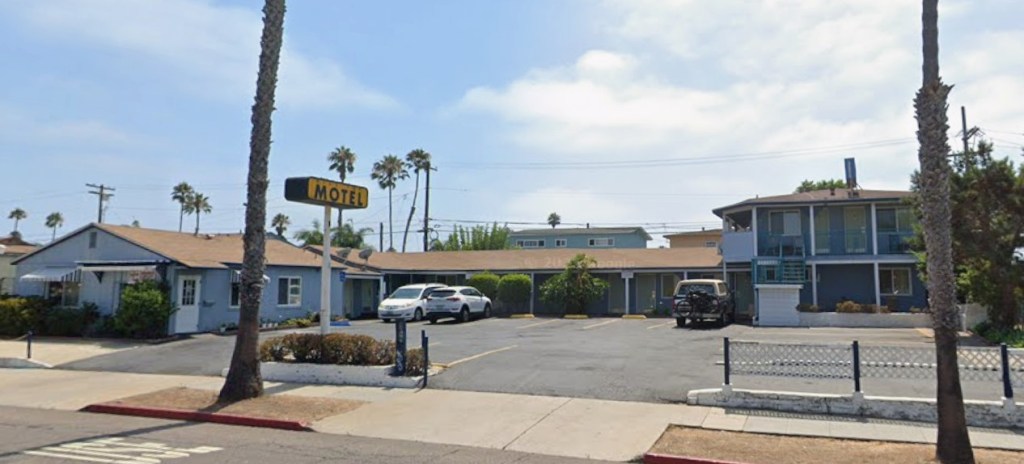
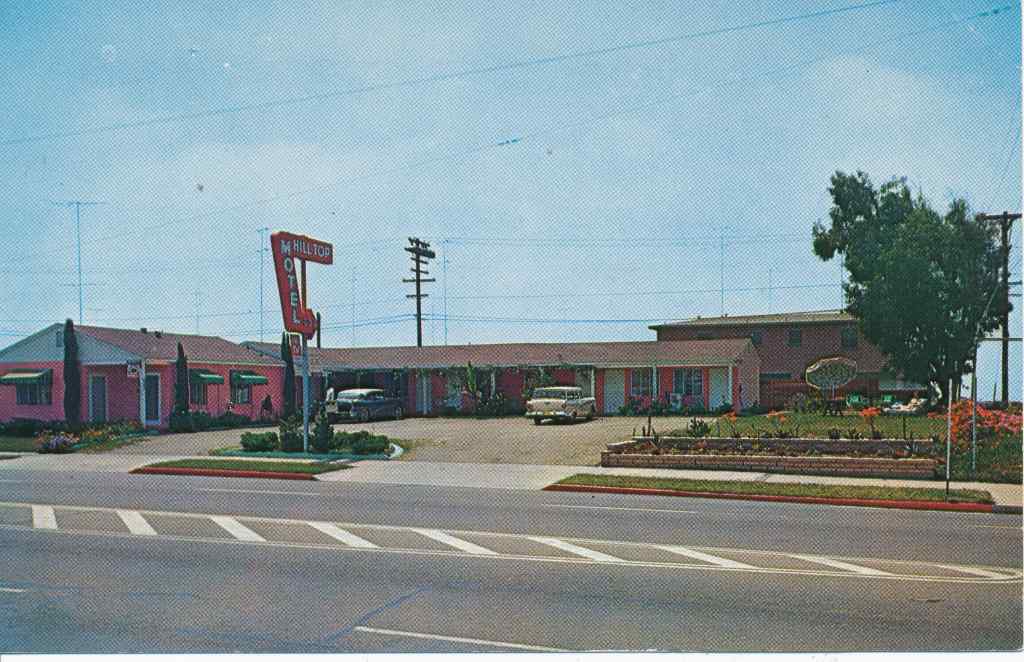
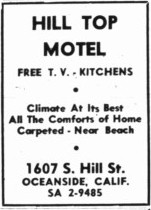


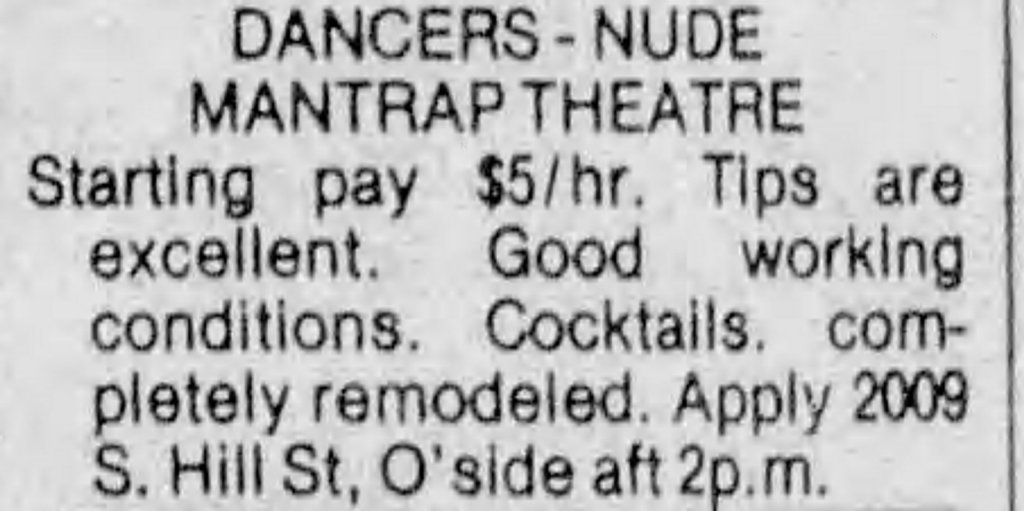
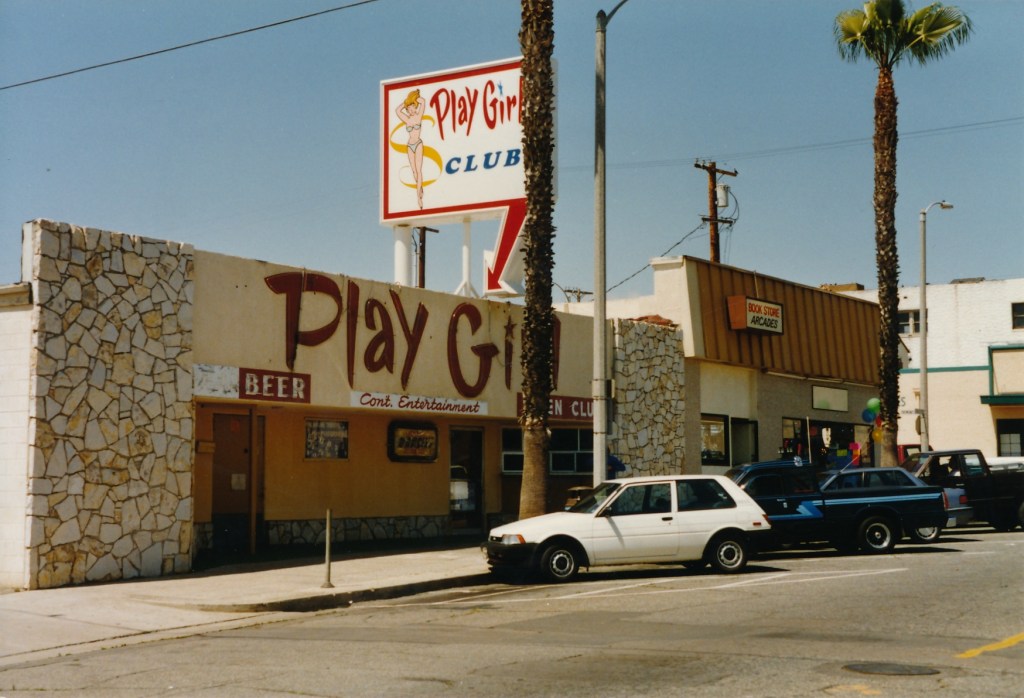


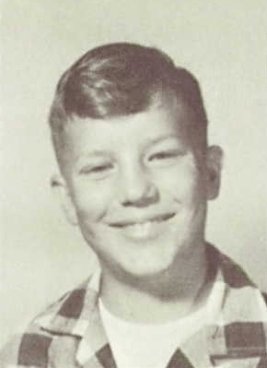


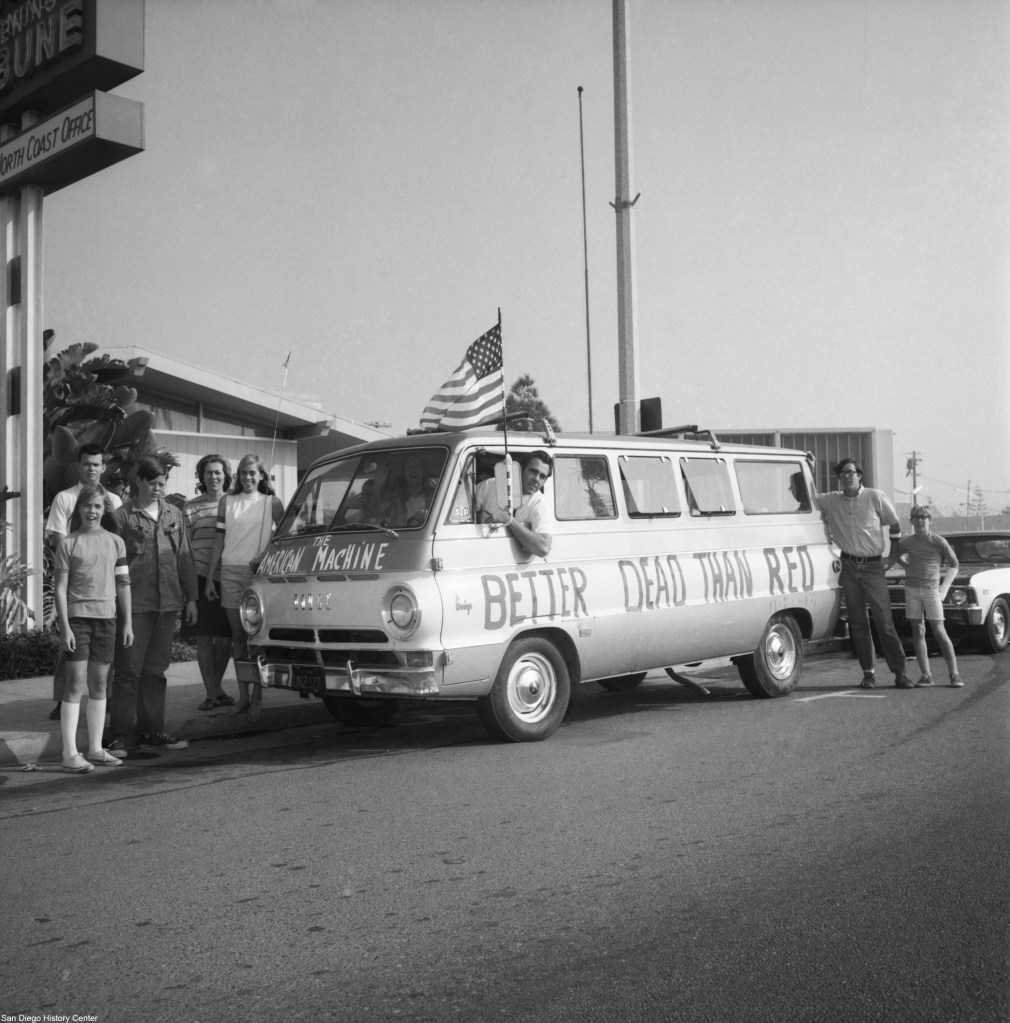


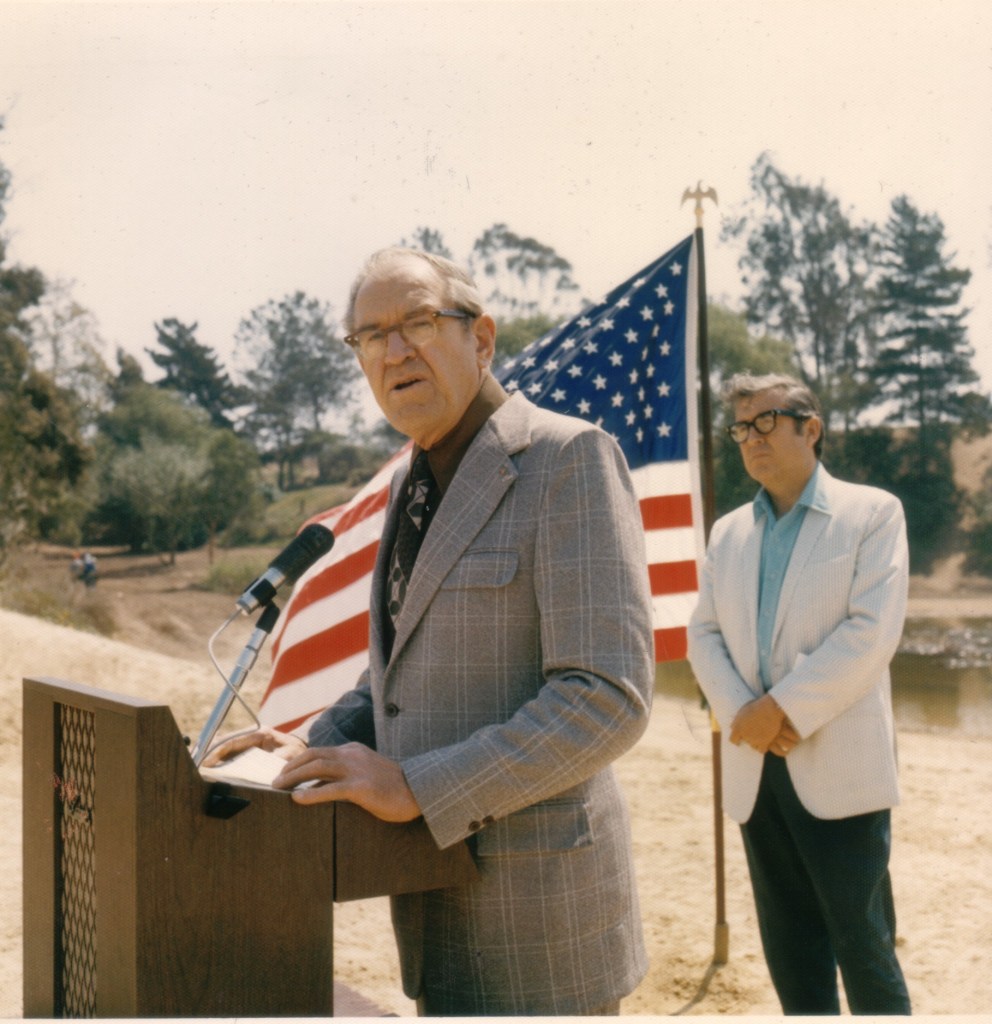

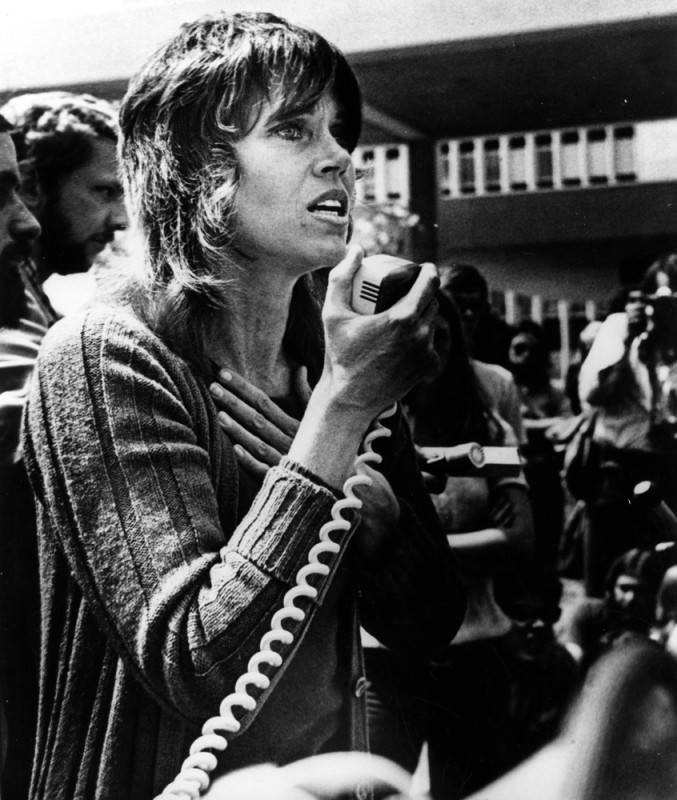
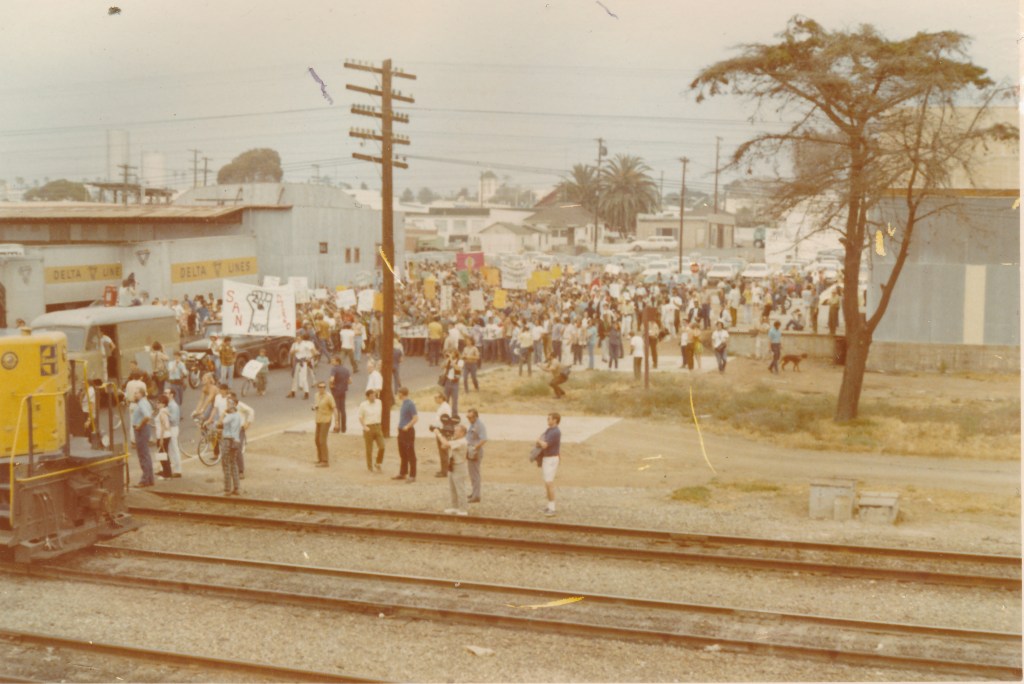
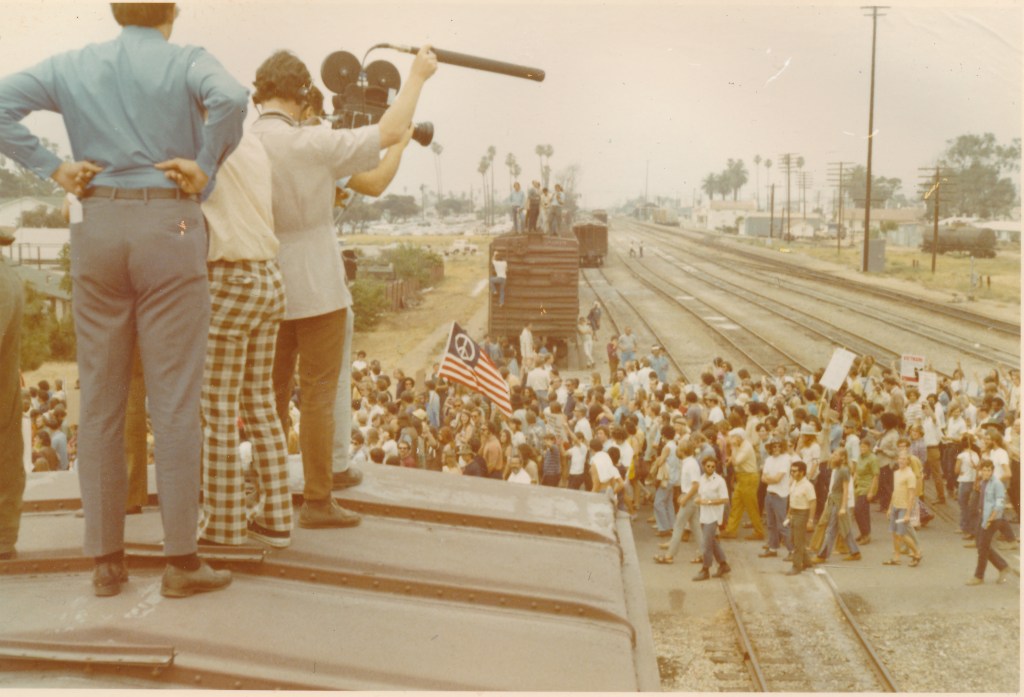


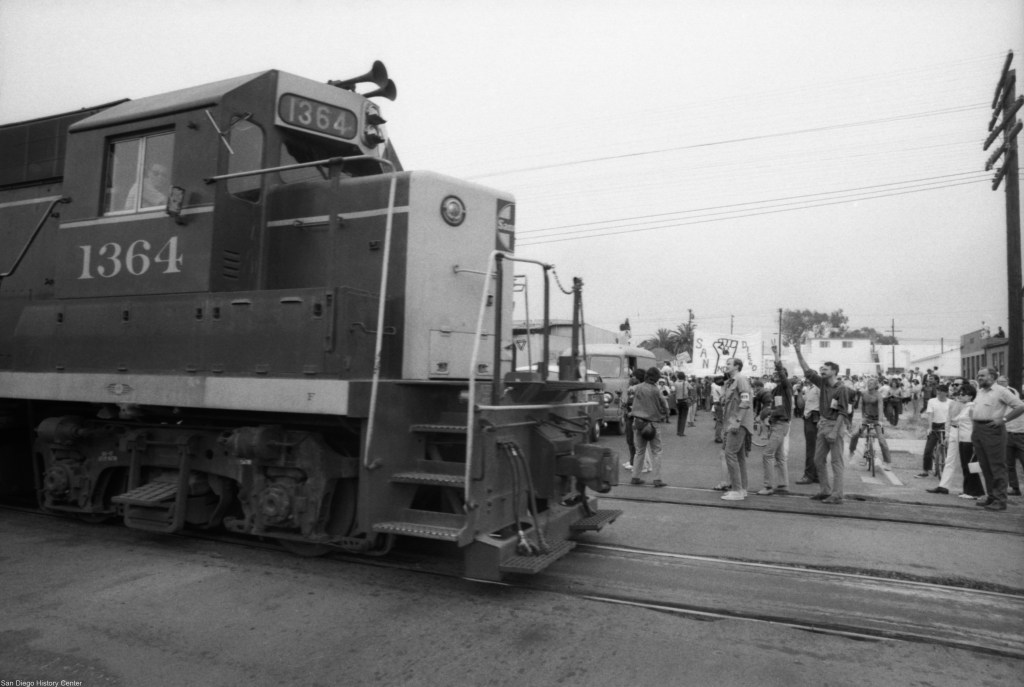


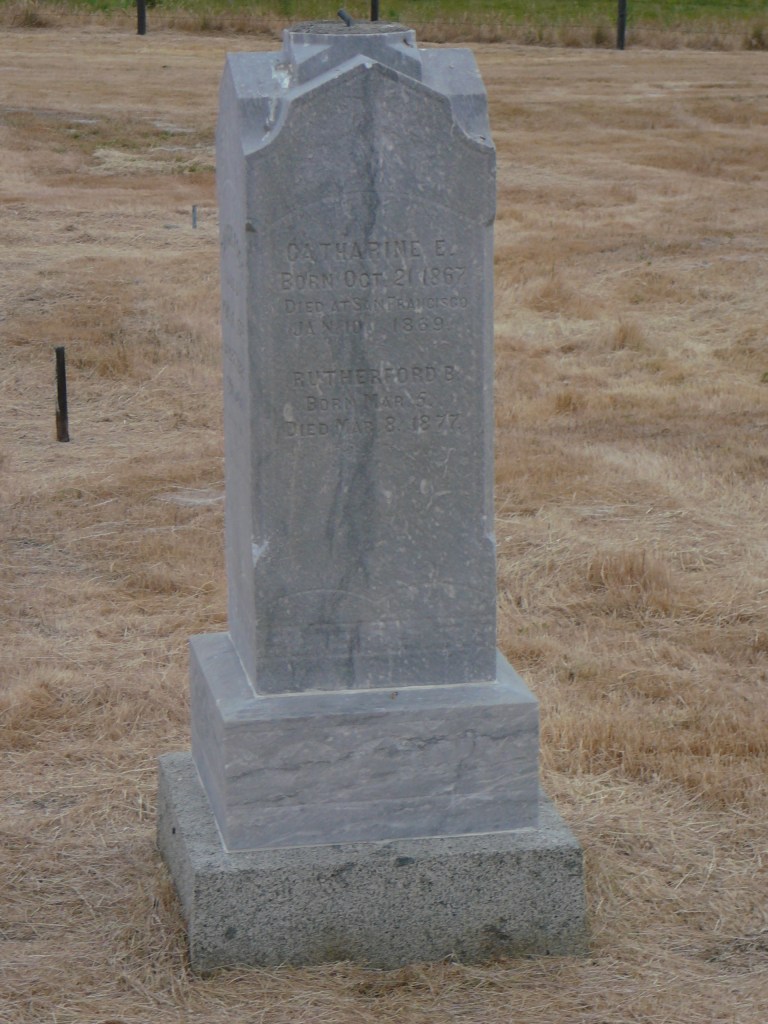


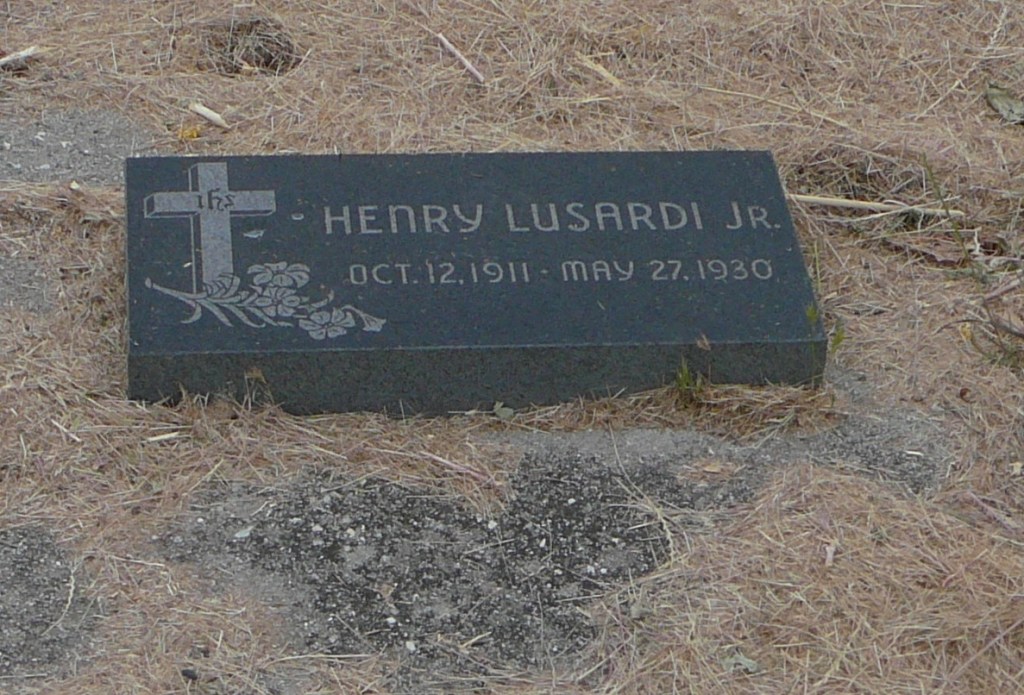
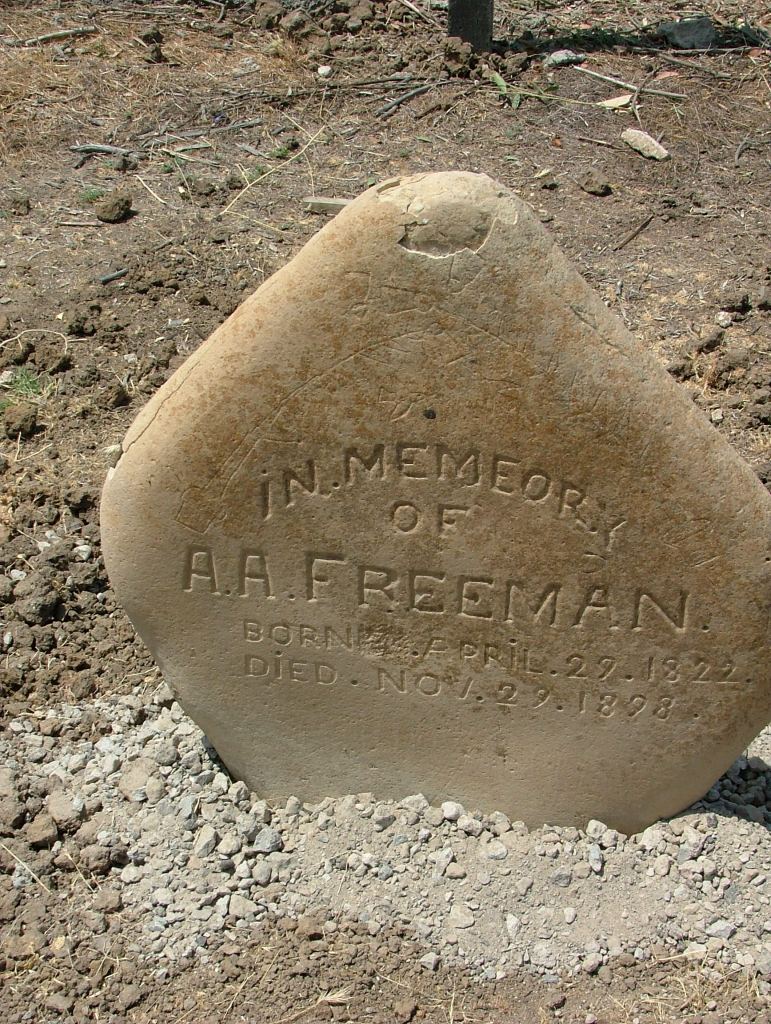

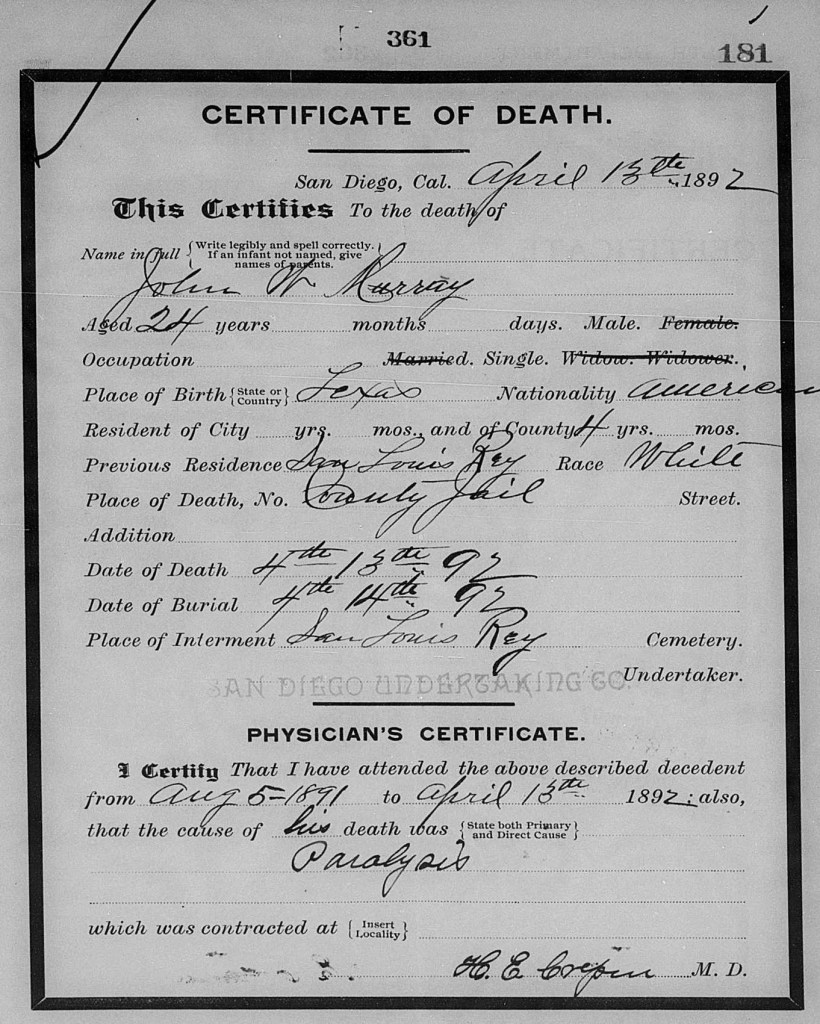
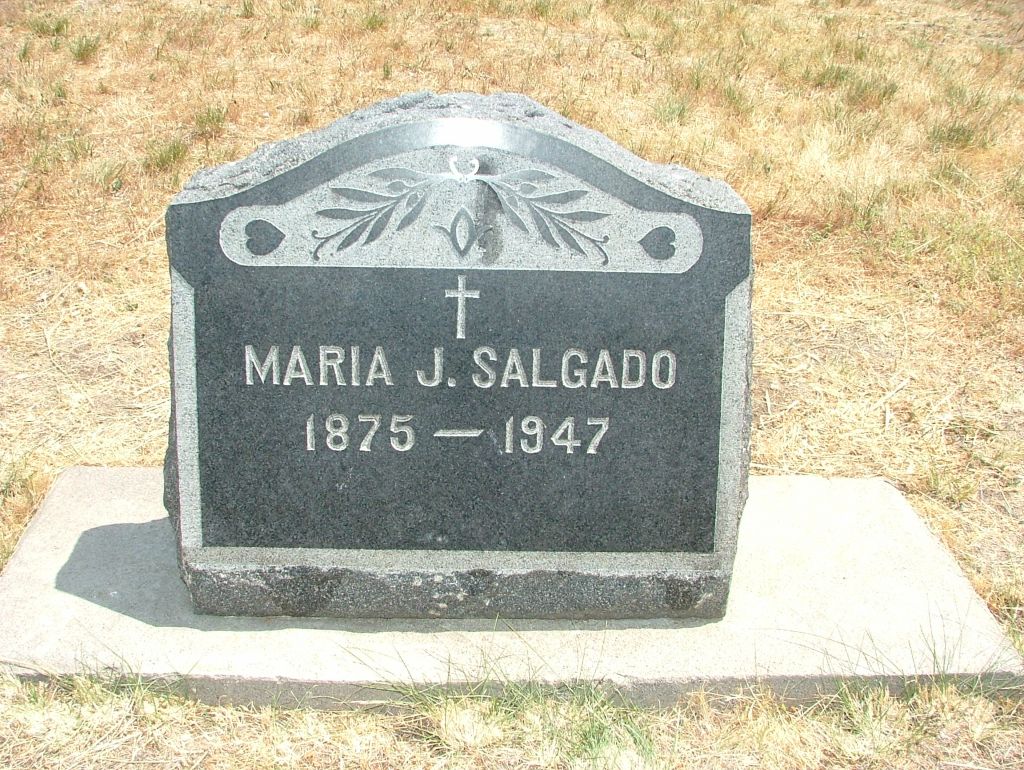



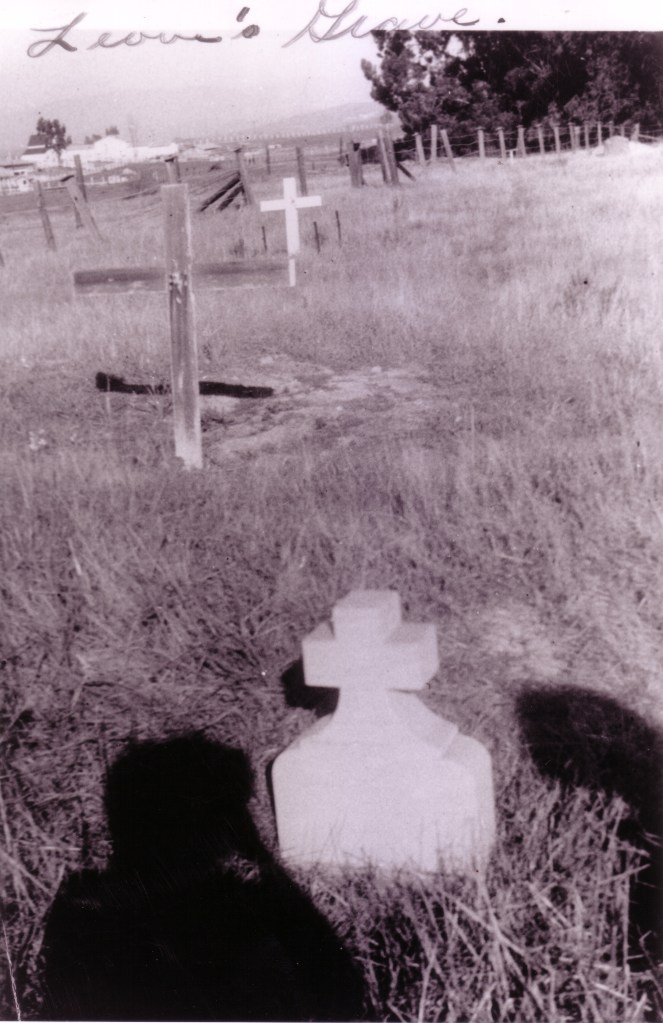


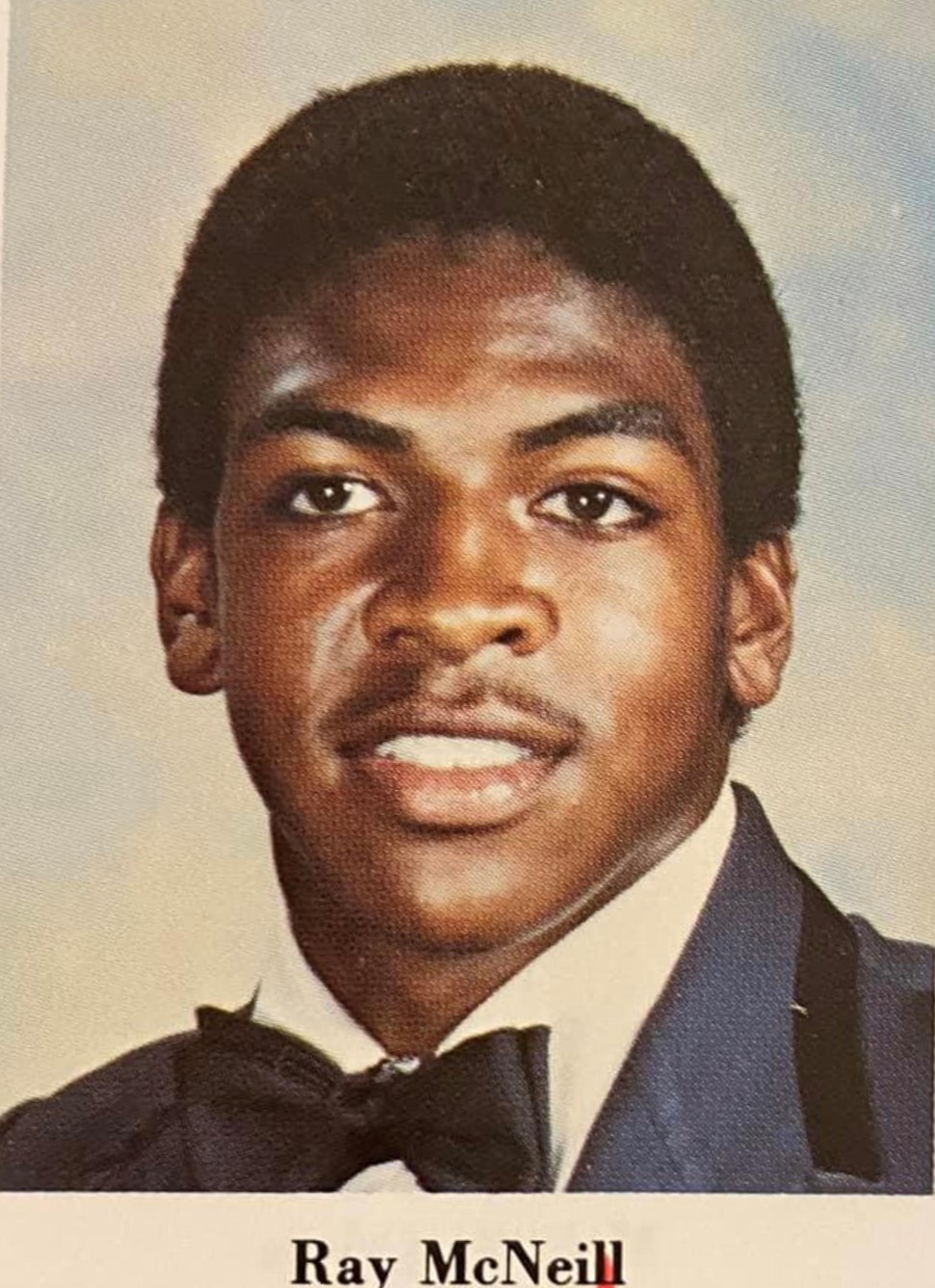


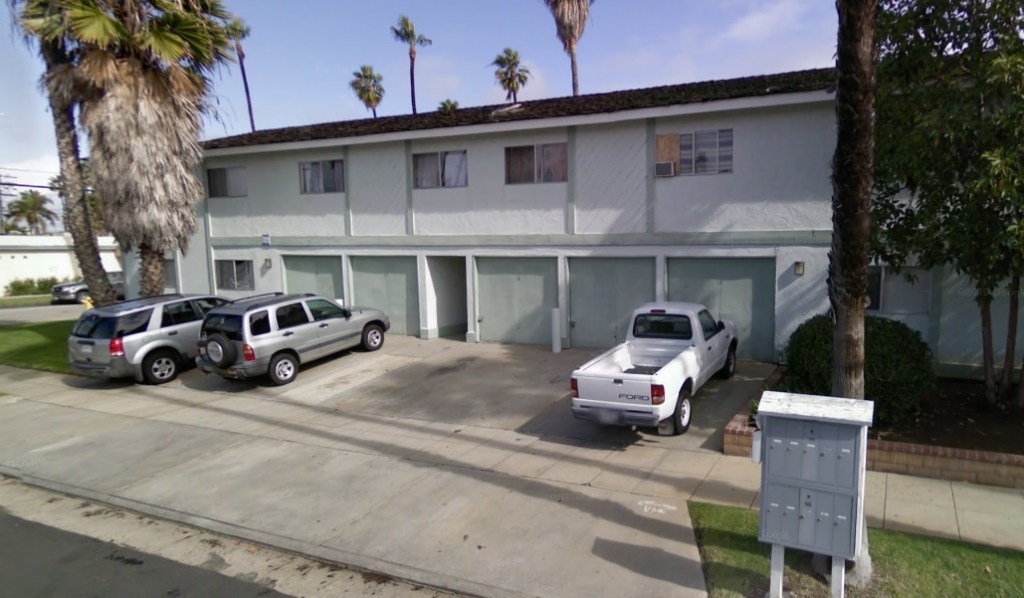



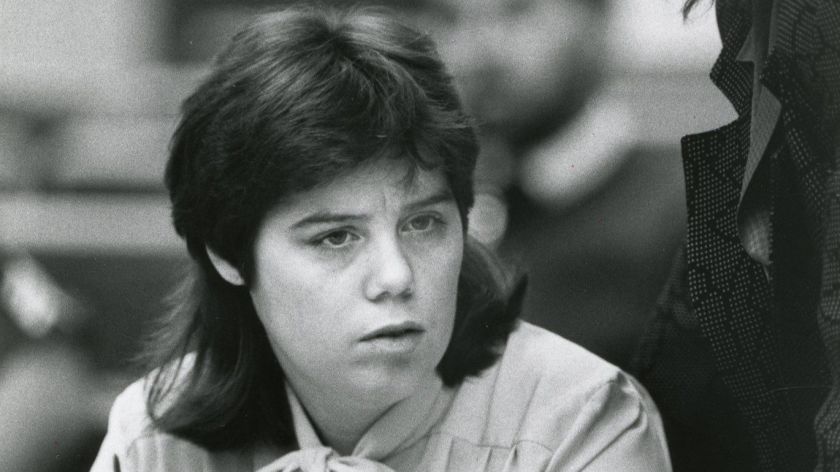

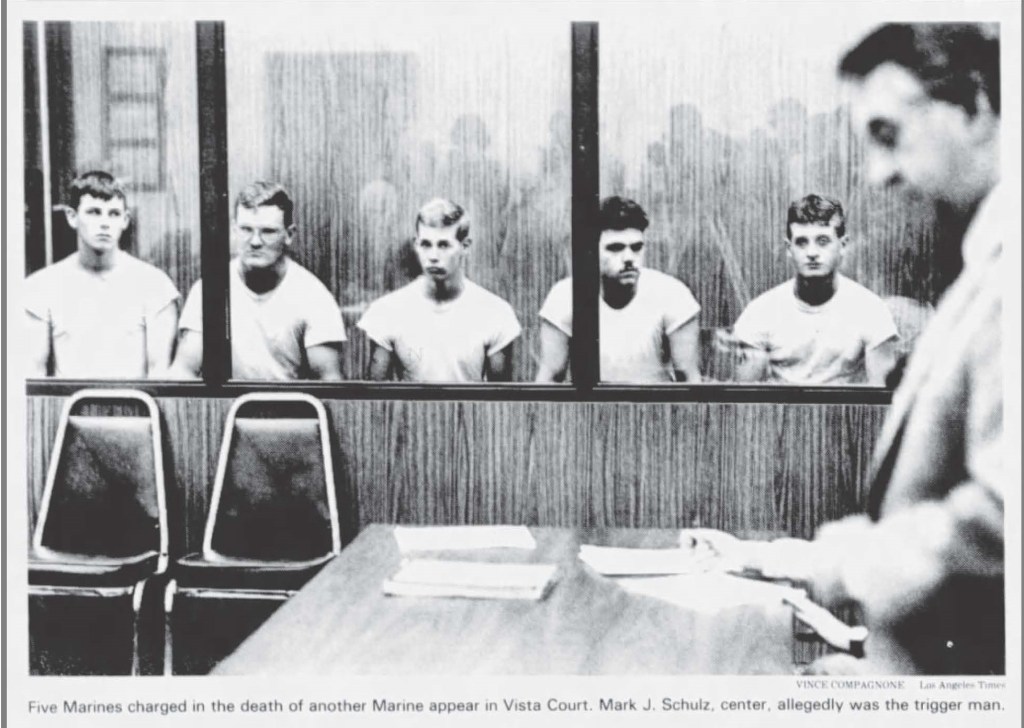







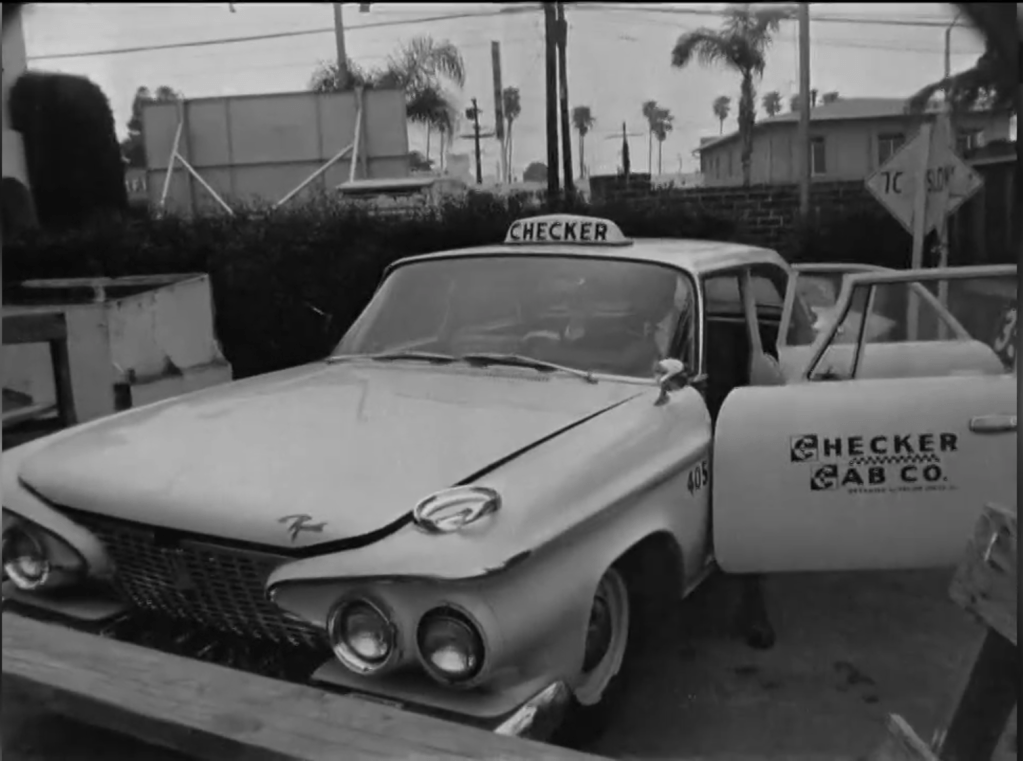




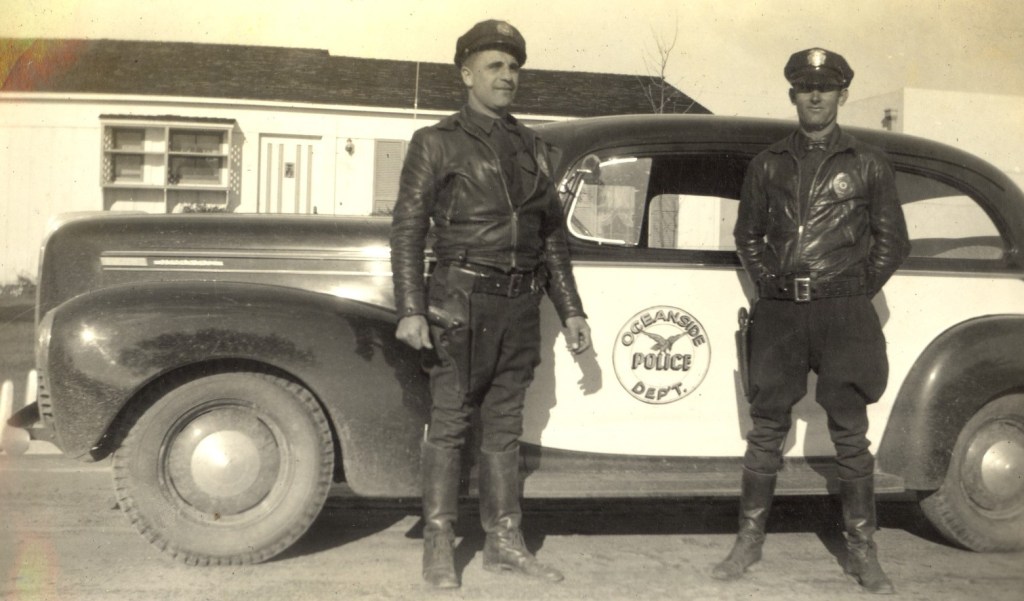



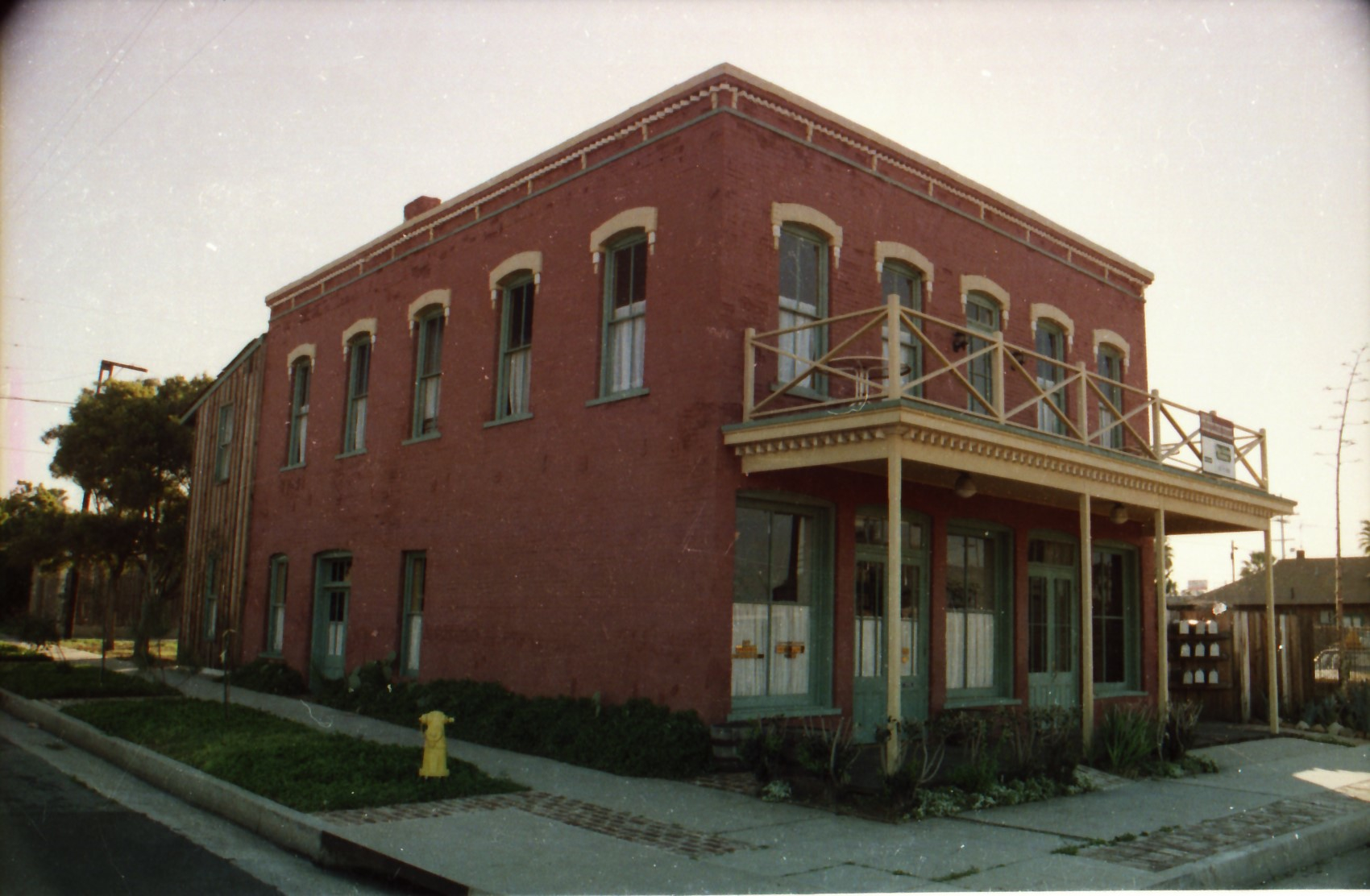
 Histories and Mysteries