The Bunker House – A Building With a Past

The Bunker House located at 322 North Cleveland Street was first owned in 1886 by Theodore C. Bunker. This two-story building is one of the first brick buildings in Oceanside and one of three brick buildings built in the 1880’s which are still standing.

The Bunker family arrived from Los Angeles and operated a store on the first floor and a boarding house on the second. Bunker also owned a single-story wooden structure next door, which served as a meat market. The Bunker House was used as a meeting hall as well as for dances and church services. 

After Bunker’s death in 1892, Ysidora Bandini Couts, wife of Col. Cave J. Couts, held the mortgage on the building and retained ownership.  The local newspaper reported that Katherine Mebach purchased the building in 1896. 

Frederick Rieke bought the brick building in 1904. Rieke was a general contractor and built many homes and buildings in Oceanside, including the house located on the same block at 312 North Cleveland Street. 

In 1923 the building was sold to by H. J. Crawford and it was subsequently deeded to two other members of his family: Thomas J. Crawford, and then to Samuel J. Crawford, a prominent attorney in Los Angeles who maintained ownership until 1945 when it was sold to George Edmond Haddox of Los Angeles. 

Renamed the American Hotel in 1943, the building, which continued to serve as a boarding house, developed a rather “seedy reputation”. Longtime residents recalled as children they were forbidden to visit or linger near the building and its use by prostitutes rampantly rumored.

Those rumors were in fact true. Audrey Wetta, a 36 year old married woman from Louisiana, became the manager of the American Hotel in about 1945. She was arrested in December of 1946 for operating “a house of ill fame, and with prostitution.” During her trial Helen E. Shepherd was called to the stand and testified that she arrived in Oceanside in June of 1946 to visit her husband who was apparently stationed at Marine Corps Base Camp Pendleton. She returned to Oceanside “at the suggestion of Mrs. Wetta in December, where she entertained men for pay at the American Hotel, and part of the pay went to Mrs. Wetta.”

Adeline Vincenzo also testified, stating that she too worked at the hotel “entertaining men” until late December of 1946, when the Oceanside Police Department arrested Audrey Wetta.

Police Captain Harold Davis testified that they had been notified from the Marine MP station in regard to the activities at the hotel. Captain Guy Woodward then submitted reports to the court from the San Diego county health department, “which showed they had on file two reports of VD infection, alleged to have originated from the hotel.”
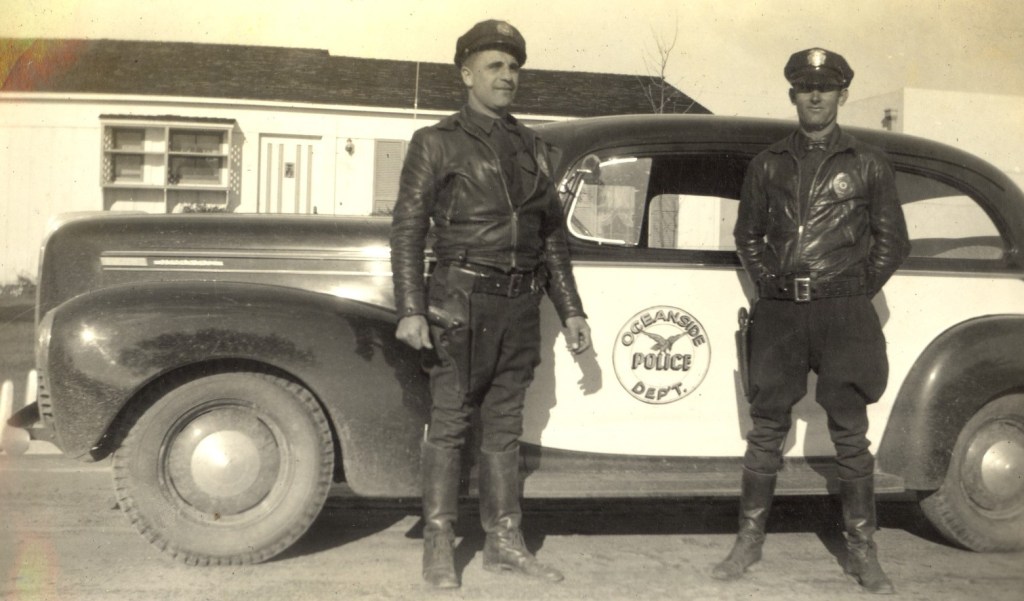
Harold Davis and Guy Woodward of the Oceanside Police Department (1940)

Audrey Wetta did not deny her role as a Madam or even as a prostitute herself. She testified that “she believed correctly managed ‘houses’ were a service to men, as she had noted when she was employed in a hospital that 84 percent of the girls men picked up for immoral purposes transmitted a social disease to the men, while only four percent of the cases came from girls who were recognized prostitutes.”

Wetta told Judge D. A. Parson, “the first time she allowed her hotel to be used for illegal purposes was when a young Marine returned from a year and a half overseas to find the girl to whom he was engaged was going to marry someone else. In remorse he approached Mrs. Wetta and she arranged for a young wife in the hotel, who was in need of $10, to ‘entertain’ the remorseful Marine.”

She went on to say that after military personnel at Camp Pendleton diminished, so did her income. Wetta was $20 short in her monthly rent, and had “decided to entertain two men at $15 each, $10 of which was to go to a marine bringing the men to her, in order to raise the $20.”

After hearing her testimony, Judge Parsons sentenced Audrey Wetta to a year in the county jail.

Owner George Edward Haddox sold the hotel one week later to Ralph and Ella Rogers who promptly renamed their establishment the Traveler’s Hotel (as listed in phone directories) or Hotel Travelers (painted on building).

Rogers opened Rogers Music Co., also known as Rogers Phonograph Service, on the lower level and maintained the boarding house on the second floor.

1968 Ad for Rogers’ Phonograph Service

In 1959, Ella Rogers operated Gale’s Café near the Oceanside Pier at 300 1/2 North Strand, and in addition to his record store, Ralph Ross Rogers ran the Silver Dollar Tavern located at 312 Third Street (now Pier View Way). Rogers was described as “a goodhearted man who loved his parents dearly and was respected by many.”
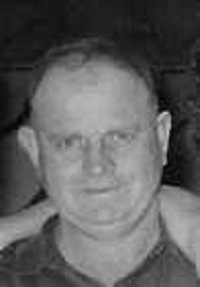
Ralph Ross Rogers courtesy Ruby Rogers McCormick

True to its reputation, in 1962, there was a very public arrest at the Traveler’s, which made local papers and only solidified its reputation.  A young woman from Ohio, who had recently arrived in Oceanside, brought two 15 year old runaways from San Diego to the boarding house to exploit for prostitution. The girls told Oceanside Police Detective Floyd Flowers that they were to work in exchange for lodging, food and clothing.

Ella Rogers died in 1973, as Ralph continued to operate his music business while living in his building on Cleveland Street. On September 26, 1976 Ralph Rogers was found murdered at the Traveler’s Hotel, stabbed multiple times and strangled.

One month later an arrest was made. Joseph Shavon Whitaker, age 21, was arrested for not only Rogers’ murder, but that of William O. Clark’s in a San Diego hotel. Whitaker went to trial in 1977, was found guilty and sentenced to life in prison.

After Rogers’ death the building was vacated and left to deteriorate. It seemed destined for the wrecking ball until it was purchased by realtor Chris Parsons in 1982. Parsons saw the potential in the weathered building and began its restoration.

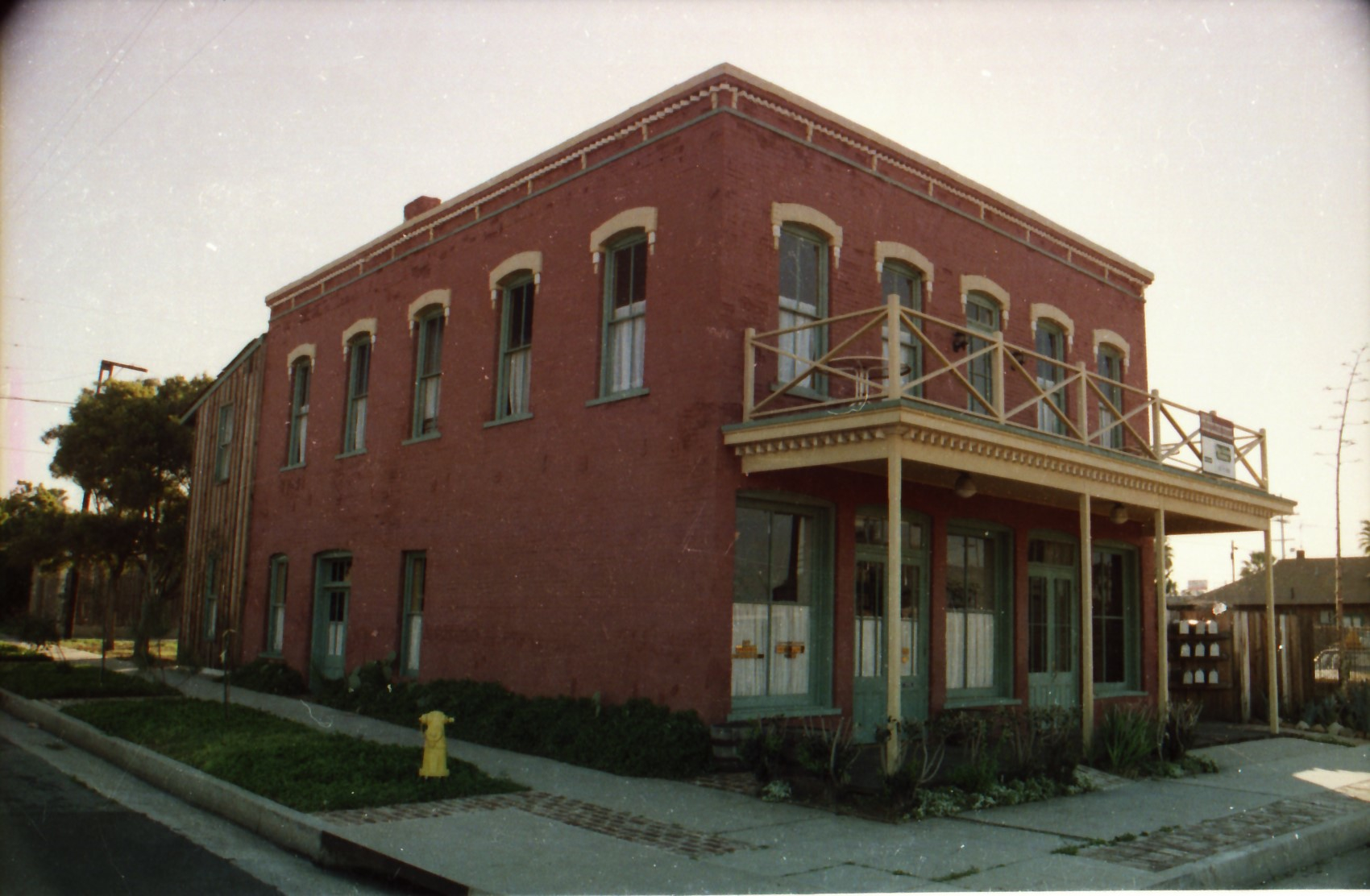
While its reputation has been tainted with scandal, the building itself is nearly unchanged from when the Bunkers owned it over 130 years and provides historic charm and character to Downtown Oceanside.
By Reason of Insanity – The Murder of Marine Corporal Erwin Koch

“WAS HE INSANE, IS HE INSANE NOW?”  That was the actual headline of a print ad for Curran Real Estate in the 1920s. This unconventional advertisement was written by William Edward Curran, a local Oceanside businessman with an uncontrollable temper, who would do the unthinkable: commit murder.

Curran’s curious and odd newspaper ad went on to say: “I was called insane by some of the Oceanside mossbanks when I started to improve the James property. Take a look at it now. A few more green spots like this will make our city. Come one and all, it’s great to be crazy”. 

Years later his attorney would argue in court that Curran was indeed insane.

Curran’s advertisement as it appeared in the Oceanside Blade

William Edward Curran came to Oceanside from Ohio in 1919. A married man and father of two sons, he had a junk business. Soon afterwards he ventured into real estate, which by all appearances was a successful enterprise.

Born May 26, 1886, in Pocahontas, Virginia, Curran’s parents moved to Cleveland, Ohio by 1900. William E. Curran’s earliest occupation was that of a decorator or wall paper hanger. William Edward married Anna Hayer in Cleveland in 1911 and their sons Richard and Frank were both born in Ohio.

Shortly after the Curran family settled in Oceanside, William purchased three lots near the corner of Third and Myers Streets (Third is now Pier View Way). He later acquired a business located at the corner of Third and Pacific Street called the “Fox Den” which was a lucrative beach concession during the summer months because of its proximity to the Oceanside Pier.

Curran joined the local Chamber of Commerce but soon found himself at odds with one of the directors. In June of 1922 he wrote an editorial calling out Secretary Thomas Bakewell, saying “I think you are a joke” because Bakewell did not endorse Curran’s idea of promoting Oceanside as an area rich with oil deposits. He was later involved in a lawsuit regarding such claims.

Curran’s unorthodox ideas and self-promotion might have been successful in getting a dig in at his critics’ expense, it was apparent that his arrogance did not win him friends or supporters. In July of 1922 Curran unsuccessfully ran for city constable.

However eccentric Curran appeared to be, he soon proved to be volatile as well. In 1923 he was arrested and placed in jail after being charged with battery against Vere Scheunemann, a 16-year-old local boy. Curran was 37 years old at the time of the assault. He was a large man standing 6 feet tall and weighing 200 pounds, and at one time was an amateur boxer by the name of “Red Kenney”. On the day of the vicious attack, William Curran knocked out three of the young man’s front teeth, but after hiring an attorney was able to get out of jail on bail. His attorney petitioned the court to have the trial moved because Curran said that he couldn’t get a fair trial in Oceanside “owing to a prejudice in the community against him.” One month later Curran was arrested again for disturbing the peace. He again asked for a change of venue because of “prejudice against him.”

Another ad published by Curran in the Oceanside Blade

Despite his erratic and violent behavior, Curran ran for city council in 1924. Not surprisingly, he lost the election. He was a regular attendee at council meetings, at which he voiced his concerns over competition from other beach concessionaires. He was also a proponent of building a new pier made entirely of concrete. The city council balked at the suggestion because of the “prohibitive cost.”  The newspaper reported that W. E. Curran was undaunted and “advocated this type of construction regardless of the cost and addressed the board to that effect, but his suggestion met with no favor.”

Curran’s unstable behavior continued when in 1925 Curran found himself again in court as a defendant after he assaulted Frank Graff, in a dispute over a fish business near the pier.

Even though his reputation appeared to be ruined, Curran unapologetically ran again for city council in 1930 stating: “My platform is reduction of taxes and to halt further improvements for the present. I also am strongly in favor of home labor. Being a large property owner in Oceanside, and always a staunch booster for the welfare of the City, my interests are yours.”  He was not elected.

Nothing is known of the outcomes of Curran’s previous run-ins with the law or any particular consequence he faced except for being ostracized. However, one encounter with Curran years later would have a deadly outcome.

One summer evening in 1944, two Marines stationed at Camp Pendleton stopped or walked through Curran’s property at 107 Third Street (Pier View Way) where Curran was living in a two-story building, which served both as a storefront as well as his home.

The two men were on the way to view a side-show of sorts, where a two-headed cow was on display inside a tent, just east of Curran’s home and vacant lot. Curran spotted the Marines and believed that they were going to siphon his gasoline. Fuel was a hot commodity because gasoline and other items were rationed and in short supply during World War II.

Third Street at the corner of Myers. Note the tent which featured the two-headed cow the Marines were on their way to see. To the right, is an empty lot, and then Curran’s home and office.

According to Curran’s account, he ordered the men off of his property and they became combative. Curran then went inside his home to retrieve an unloaded gun and confronted the Marines again. Despite being armed with a gun, the Marines became more aggressive and came after him, according to Curran. He then ran back into the home, threw down the gun and grabbed “some object”.  That object was a “commando style” knife, with a brass knuckle handle which Curran took with him to challenge the men. He ran back to the Marines, “a scuffle ensued” and Corporal Erwin E. Koch was stabbed three times, including a fatal blow straight to the heart. Koch fell to the ground, bleeding profusely while his fellow Marine, Corporal August N. Heveker, tried to render aid.

Before police arrived, Curran hid the weapon in a pile of boxes and empty bottles behind his home. He later produced a small knife to the police but it was apparent that the deadly wound had been made by a much larger knife. The police on the scene included Police Chief William L. Coyle and Captain Harold B. Davis, who found the bloodied murder weapon after a 30 minute search, where Curran had stashed it.

Police Captain Harold B. Davis searched through this pile of junk and bottles to find the murder weapon

Koch died of his wounds and was taken to the Oceanside Mortuary at 602 South Hill Street (now Coast Highway). There the police discovered a letter Koch had written to his wife in Nebraska soaked in blood. Koch was just 29 years old, and in addition to his grieving wife, left behind two small children. Family back in his home town of Eustis, Nebraska were stunned and left to wonder of the circumstances that took the life of their beloved son, husband and brother. Erwin’s widow, Otalee Elizabeth, would later remarry.

William Curran was arrested by local police and questioned, when he then claimed that the Marines had followed him into his home, pushed him down and struck him in the head. He was taken down to San Diego for an inquest just days later at which Corporal August Heveker testified to the details leading up to the murder.

“We had been out on the Oceanside pier and had come up Third Street preparatory to entering a side show to see a two-headed cow. Wishing to urinate before entering the show, we went back along a building about 20 feet. As we did so, a man yelled to us from the rear doorway, ordering us off. We left the place where we were standing and went to the sidewalk toward the tent, going back again on the vacant lot just west of the tent, believing we were off this man’s property. The man came out again, this time with a gun in his hands. We started off again, and as we neared the sidewalk, I happened to look back and saw this man coming toward us with a shining instrument in his hand. I called for Koch to duck, and I ran forward to the walk. Koch was between the man and me, and did not have time to even turn around. As he fell, he yelled he had been stabbed.”

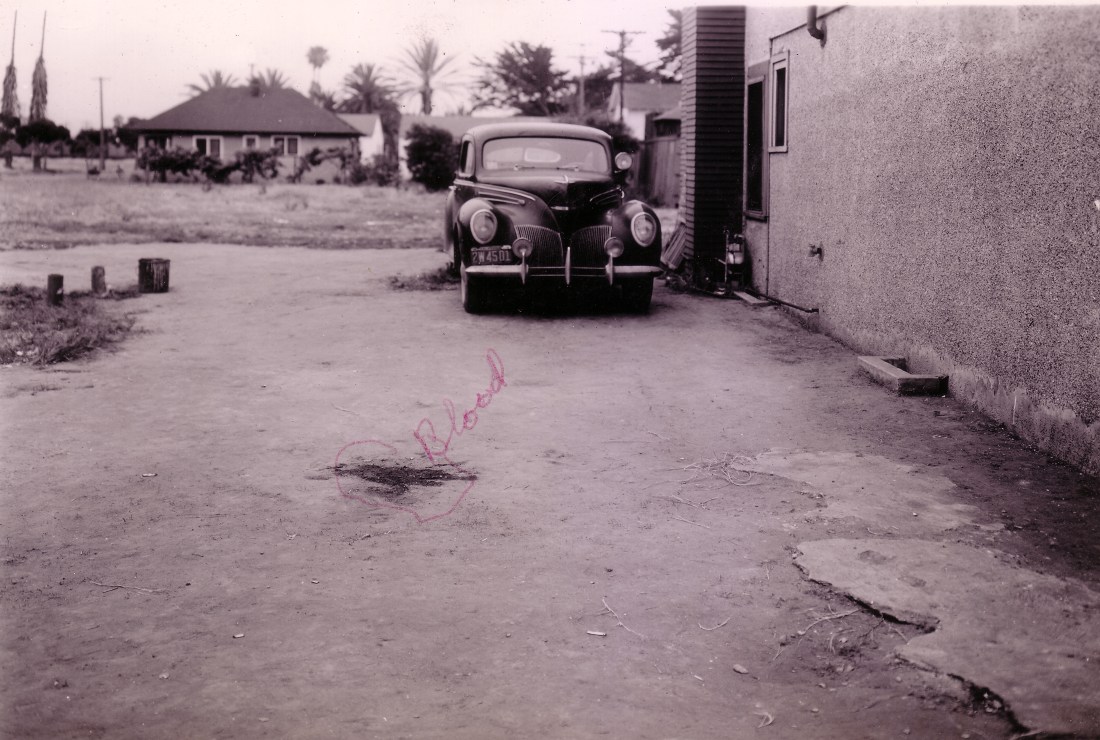
Heveker went on to testify that the two had never followed after Curran, entered his home or struck him. Police testified at the inquest saying that Curran had no marks or cuts on him, although he did hold his head as though he were injured. There was no evidence of a scuffle, as Curran had claimed, only a pool of blood on the vacant lot where Koch was attacked.

This crime scene photo indicates the location of the stabbing.

The jury at the inquest found Curran responsible for the death of Koch. The murder trial was held the following month in July and Curran testified in his own defense. Inexplicably, Curran left the stand, walked up to August Heveker and shouted: “That man lied about me. Anyone could look at his face and tell that he was lying. He pushed Koch towards me and incited him to attack me. He is responsible for Koch being stabbed. After I struck Koch, he took two steps away from me and sagged to his knees. After he fell, this man Heveker tried to drag his body off my property.”

Curran was found guilty of second-degree murder. Defense witnesses included Curran’s brothers Frank and Clarence, his wife Annie and his sister Mary. Oceanside’s Mayor Ted Holden, Curran’s attorney James B. Abbey, along with the County Psychiatrist, also testified that Curran was insane. The witnesses provided a number of incidents to prove up their allegations that the Curran was “mentally unbalanced.” The very next day the same jury that found him guilty of murder, determined that Curran was insane. The newspaper reported that Curran would be sent to a “state asylum for the criminally insane.”

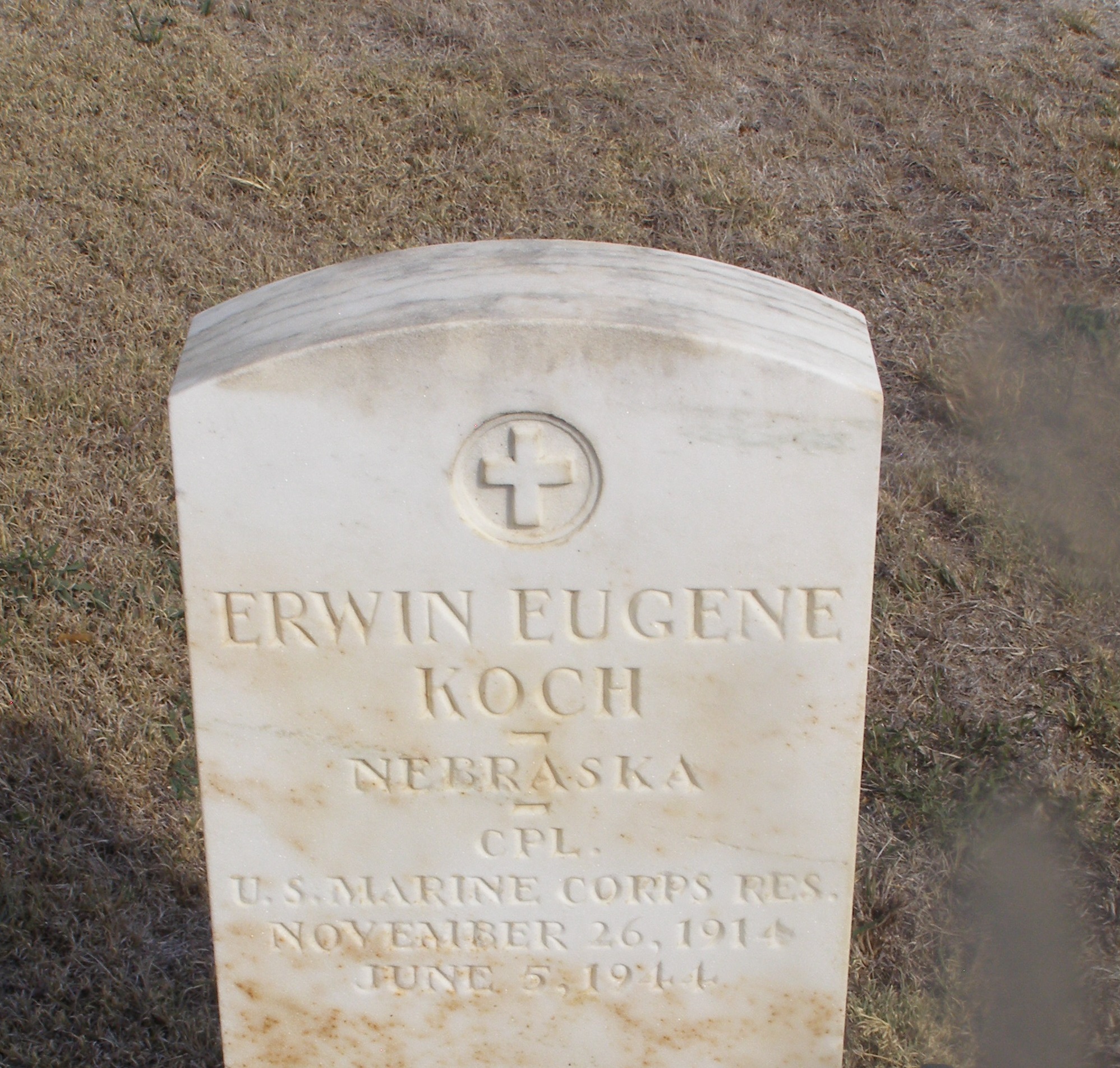
Erwin Eugene Koch was laid to rest in the Eustis East Cemetery, in Eustis, Nebraska, a small town of 600, settled by German immigrants. A military headstone marks his grave. When Koch went in the Marine Corps during wartime, his family might have worried about the dangers that might befall him. He wasn’t killed in war by a foreign enemy, but by a fellow countryman.

It is unknown how long William Curran was actually confined and when or if he was deemed “sane”. But by by March of 1950 he was back in Oceanside and still owned the property where the murder occurred. Curran’s son, Frank Earl Curran, was elected as Mayor of San Diego, serving from 1963 and 1971. William Edward Curran died on July 19, 1963. He was interred at Eternal Hills Memorial Park, in Oceanside, along with his wife who later died in 1989.