Captain Harold Davis of the Oceanside Police Department kept several scrapbooks in which he placed newspaper clippings, letters, and photographs, some of which were graphic in nature. Throughout these books, he wrote personal notes and memories about a particular crime or accident, or about a fellow officer he enjoyed working with in his long career.
Captain Harold B. Davis in 1955
Included in the many pages of one scrapbook were two mugshots of a Thomas Happel, along with two newspaper articles from the local newspaper. In his photos, Happel does not appear to be a hardened criminal, but he may just be one of the few, if not only person, to successfully escape from the Oceanside jail.
Mugshot of Thomas Happel
On September 25, 1951, Motorcycle Officer Hubert C. Russell spotted what he thought was a suspicious vehicle at a local service station. He noted a small corner window of the car was broken, and then noticed two teenage girls seated inside the vehicle while a young man talked outside with an attendant. A closer inspection of the car revealed keys that were broken off in the door locks and as the officer peered inside, “a jumble of blankets, clothing and other items.
With the likelihood of the car being stolen, Russell made contact with the driver, Thomas Happel, and instructed him to follow him to the police station. Happel seemingly complied and drove dutifully the few blocks to the Oceanside Police Department, then located at 305 North Nevada Street.
After pulling into the parking lot, Officer Russell waited for Happel to park, but instead Happel put his car into drive and sped away. Happel traveled north on Freeman Street with Russell in pursuit, joined by fellow Officer Paul Ricotta. As he attempted to make a left turn at Eighth Street (now Neptune) and make his way to Highway 101, Happel ran off the road and hit a house. Unhurt all three occupants of the car emerged and fled on foot. An unidentified Marine witnessed the trio running, followed by two uniformed officers, and took action, heading off Happel and bringing him down “with a flying tackle.”
Oceanside Motorcycle Officers Paul Ricotta and Hubert Russell
After taking Happel into custody, Oceanside Police discovered that Thomas Happel was an 18-year-old Air Force private who had gone “AWOL” from Lowery Fareli Field in Denver, Colorado. Walking away from his duty station, he stole a 1950 Ford and drove to his home state of Maryland, some nearly 1700 miles away. In Brooklyn, Maryland Happel picked up the two girls, ages 15 and 16, and obtained Maryland license plates for the stolen car, using a “phony registration slip.” Then the trio drove headed west, driving across the country while Happel cashed or wrote bad checks to pay for gas and food. Just before coming to California, Happel stole two wheels and tires in Arizona.
The girls were never publicly identified because of their age, and were taken to the Anthony House in San Diego and then returned to their parents in Maryland.
Happel was booked and placed into a cell in the Oceanside jail, which was located on the second floor of the police station. That same night Happel escaped from his cell by breaking a bar off the grating of a roof ventilator and squeezing through a narrow opening. The Oceanside Blade Tribune described the scene: “The opening he made at one end of the grating was about seven inches wide and 10 inches long. Happel is about 5 feet 5 inches tall and weighs 130 pounds. The bar which he broke was not one of the original ones in the grating but had been welded on the cross-pieces after a similar escape attempt was once made through the opening.”
The account went on to say that “Happel must have had help from other prisoners in the cell block in order to get up to the ceiling and work the bar loose. When he had the piece of steel free, he used it to force the next bar over enough to get through.”
With Happel’s escape his list of charges continued to grow and the F.B.I. were now involved. On the run, Happel stole another car, a Cadillac, which he abandoned in Fontana, California. He apparently stole yet a third vehicle and made his way east.
Mugshot, right profile, Thomas Happel
Three weeks later the Oceanside Police Department received word that Happel had been apprehended by the Oklahoma Highway Patrol and was in custody in Oklahoma City. The fugitive was caught after a traffic accident at Woodward, Oklahoma and apparently tired of running, admitted his identity to law enforcement.
It was reported that Happel would be made to return to Oceanside to face charges, including felony escape, but it seems he managed to “escape” extradition and perhaps served his time elsewhere. Thomas Happel, it appears, gave up his brief stint as an outlaw and went on to live a presumably quiet life in south Florida.
The scrapbooks of Harold Davis hold many more stories waiting to be told…
Boxing fans may be interested to learn about the history of the sport and the stories of two early boxers in Oceanside.
Fighters in the early 20th century like Jim Jeffries, Gene Tunney and Jack Dempsey ignited interest around the country and filled arenas for both amateur and professional bouts. But shortly after organized matches were brought to Oceanside, boxing was banned here for two decades.
John L. Sullivan, a bareknuckle fighter who became the first American heavyweight champion in 1882, may have been the inspiration for Oceanside’s founder Andrew Jackson Myers. Myers, who was known to race a horse or two, was once featured in a local bout. The South Oceanside Diamond announced on August 10, 1888, that Myers would face the “Great Unknown” in a “grand slugging exhibition at the old Pavilion.” Spectators had to pay 50 cents to view the event, which also featured Myers’ son Joseph Myers and Charles Kolb in a bare-knuckle contest.
Andrew Jackson Myers, Oceanside’s Founder
Local boxing enthusiasts were likely pleased when in 1908 the Oceanside Blade reported that the “Blake brothers have fitted up a gymnasium at the Mira Mar hotel for the free use of the young men of the town. The outfit is composed of a turning pole, swinging rings and trapeze. Some of the citizens intend adding a punching bag, boxing gloves, etc., which will make it very complete. The hall room is used for the purpose.”
Aloysius Cloud Thill, known as “Allie”, was one of the first local boxers to box professionally. He was the son of Andrew and Clara Thill who relocated to Southern California, along with younger son Francis around 1910.
Born October 29, 1898, in Buffalo, Minnesota, Allie Thill was both studious and athletic. He was the Vice President of the Freshmen Society at the Oceanside-Carlsbad High School and played on the school baseball team.
The elder Thill owned a popular barber shop for years and both he and his son Allie shared the occupation. The Oceanside Blade commented on Thill’s barbershop in 1914: “A. Thill recently placed in front of his tonsorial parlor on Cleveland Street one of the niftiest barber poles ever seen in these parts, it is of the rotary kind and when lighted up at night makes a fellow want to get shaved whether he needs it or not.”
Andrew Thill, father of Aloysius Thill, at his barber shop. Edwin W. Everett seated.
In 1914 a group of Oceanside businessmen formed the California Social Club. Founding members included Hale Backensto and Andrew Thill. The club was formed for “educational and amusement purposes”. The source of amusement it seems was found in alcohol, which would find the club embroiled in controversy. But one other purpose of the organization was to hold boxing matches in Oceanside.
Hale Backensto, president of the Social Club, was in trouble for operating a “blind pig” or selling liquor without a license. He was arrested three times, and twice acquitted. He filed a $5,000 lawsuit against L. W. Stump, justice of the peace, and G. D. Love, constable for damages. Backensto’s arrests and subsequent lawsuit did not make him friends with the Oceanside City Council and Andrew Thill resigned from the social club.
Just before his 18th birthday, Allie Thill stepped into the boxing ring. He went by the name of Al Barber. The Oceanside Register shared some of the highlights of Al’s first fight against Fred Fadley on September 29, 1915: “Al Thill Wednesday night won an honor for himself and for Oceanside when be fought Fred Fadley in a four round go at the Field rink in San Diego. Although the fight was a draw Thill did splendid work and had fearful odds, his opponent being a trained fighter. Thill was supported by a score of local fans, whose voices were heard above the other 800 members of the audience. He won the favor of the whole crowd when he started the bout with an aggressive campaign against his opponent, giving him three punches for every one he received in the first round. In the second. Thill easily doubled the points over Fadley, but owing to lack of training, he tired out before the finish. With remarkable cleverness the local champ held off the well figured out blows of the San Diego fighter, but at two or three occasions failed to grasp opportunities to lay his opponent on his back. Had it not been for this, he would doubtlessly have been given the decision.”
Thill certainly made an impression, especially since he had started boxing only a week prior to his first match! Given direction by W. A. Roche, a member of the notorious California Social Club, Al Thill quickly became a local favorite, known for his heavy punch.
The excitement of Thill’s prowess and future success brought boxing to Oceanside when the following month several bouts were held at Mildred Hall on North Tremont Street. The Oceanside Blade reported that “Frank Fields of San Diego, outboxed Charlie Tapsico, an Oceanside product, for three rounds of what was to have been a four-round bout.” (Charles Tapsico was an amateur boxer only and a mechanic by trade.)
Oceanside resident Charles Tapsico was featured in a local bout
Summaries of the other bouts were as follows: “Red Gardner stopped Blacky Sandow in two rounds while Billy Howard performed the same service for Billy Patton in the third. Al Barber secured the decision over Shano Rodriguez of Tia Juana, the contest going four rounds in one of the bouts.” The article concluded with the sensationalized detail that “there was a satisfactory amount of gore visible to satisfy the fans and the crowd seemed to have obtained the worth of the fifty and seventy-five cents charged for the seats.”
Despite the previous lawsuits and scandals, in November of 1915 the California Social Club held a subsequent boxing match in Oceanside promoted by Frank Fields, former boxing champion and promotor of San Diego.
Mildred Hall (arrow) where early boxing matches were held
In March of 1916 Allie Thill began training with Frank Fields. Thill and Fred Fadley fought again the following month at Oceanside’s Mildred Hall but once again the bout ended in a draw. The fight drew over 100 attendees who also saw other matches, one with locals Frank Mebach and William Patton, followed by Joe Lopez who outboxed the Oklahoma Kid, and then another draw between Windy Briley and Shining Oscar.
Al Thill would finally get his first winning decision on April 29th in a four-round match against “Young Sandy.”
Al Barber vs Joe Berry ad, courtesy of John Thill
On June 10, 1916 Thill as “Al Barber” faced Joe Berry, known as the “Italian Crackerjack” in Oceanside. The Oceanside Register announced the bout touting both fighters: “Berry has a knock-out punch that has set many other fighters to flee and young Barber’s courage in taking him on will win still higher praise among his many local admirers.”
At the height of enthusiasm and growing excitement of boxing matches, sanctioned or hosted by members of the now defunct California Social Club, the Oceanside City Council put an end to any and all future bouts. In July of 1916 they passed Ordinance No. 226 “Prohibiting the Holding of Sparring or Boxing Exhibition for Profit.” The ordinance read “Any person, who, within the corporate limits of the City of Oceanside, California, engages in or instigates, aids, abets or does any act to further any contest, sparring or boxing exhibition between two or more persons, with or without gloves, for prizes, reward or compensation, directly or indirectly, or who charges, receives, accepts, gives or takes any ticket, token, prize money, or thing of value from any person or persons for the purpose of seeing or witnessing any such contest, sparring or boxing exhibition —- shall be guilty of a misdemeanor, and upon conviction thereof, shall be fined not more than $300.00 and be imprisoned for a period not to exceed three months or both such fine and imprisonment.”
Nonetheless, the Oceanside Register announced on October 20, 1916, that “Thill the Barber here, is soon to return to the boxing game. He is known as Al Barber and will meet Sandy from ‘Frisco. They are both said to be in first class condition and are about equally matched, so it ought to be a good fight.” Due to the ban, this fight was likely not held in Oceanside.
Thill’s professional boxing career was interrupted in 1917 when he entered the Navy during world War I. Stationed in San Francisco, he met and married Cecilia Goodwin of Napa. (This marriage ended in divorce, but Allie married again in 1926 to Ethel T. Vesely by whom he had two children.)
Oceanside’s early bandshell and arena where Al Barber boxed Kid Dillon
Although it appears his boxing career was well behind him, in July of 1919, Thill took to the ring again to entertain spectators in an exhibition held at the Oceanside Beach. The Oceanside Blade reported: “Saturday’s amusements under the supervision of W. H. Trotter were enjoyed by a crowd almost as large as that of the day before and consisted of music, dancing, sparring matches, rodeo, ball game and other sports.The boxing took place at the new band stand on the beach. Al Barber, the “Pride of Oceanside,” sparred four rounds to a draw with Kid Dillon of San Diego. Frank Fields and Battling Clark went four fast rounds, also to a draw.”
In 1924 Thill took over his father’s barbershop which had relocated to the basement of the Palace Hotel on North Hill Street (which his father built). He and his wife Ethel raised their two children, LaGloria and John (known to friends as Gloria and Jack), in a home located at 801 Alberta Street. Thill remained a sports enthusiast, hunting, golfing, playing billiards, and was one of the founders of Oceanside’s annual rough water swim. Active in a variety of local organizations, he served as commander of the Disabled American Veterans.
Al Thill died in 1962 and was laid to rest in Eternal Hills Memorial Park. His son Jack was proud of the fact that his dad never lost a professional fight.
Another Oceanside resident who stepped in the ring and went professional was George Webler, better known to boxing fans as “Battling Doty.”
Battling Doty’s “calling card”
The son of Thomas and Mary Webler, George Napoleon Webler, born in Kankakee, Illinois in 1903, was one of six children, and the oldest of three sons. George was named after his paternal grandfather, George A. Webler, who arrived in Oceanside in 1904 and operated a restaurant in downtown Oceanside.
Thomas Webler supported his large family by working at the Oceanside-Carlsbad High School as a custodian and groundskeeper. The Webler children all attended Oceanside schools, both grammar and high school. The boys were athletic and known for the prowess in foot racing and particularly baseball.
Although George Webler was skilled with a bat, he was just as well known for his fists. William Reid Couts remembered him all too well. “I remember George Webler; [he] was two grades ahead of me. He used to beat me up pretty nearly every day. I always had a girl, you know, and Doty would want to take her away from me. I remember one time he was on top of me, beating the hell out of me, one of the teachers took him off of me.
“Doty was just a nickname they gave him; George was his first name. If you looked up his records for his fight, it was Battling Doty. He was a middleweight, I think he was a welterweight to start, but he wound up a middleweight.”
George Webler did not graduate high school but instead, at the age of 17, joined the Navy. The Oceanside Blade reported on July 24, 1920, that, “George Webler has signed up as a jacktar in Uncle Sam’s Navy.” A jack tar was a term used to refer to seamen of Britain’s Merchant or Royal Navy, but by World War I it was also used for those in the U.S. Navy. The following week Webler left for training at Goat Island, San Francisco.
Webler’s time in the Navy was short because by 1921 he was back on the local Oceanside baseball team, where he played off and on for three more years.
By 1922 Webler went from a street fighter to a professional one, using the name of “Battling Doty”. In November of that year the Santa Ana newspaper reported that Battling Doty of Wintersburg was scheduled to fight Joe Riley. (Wintersburg is a small area or neighborhood near Huntington Beach, established largely by Japanese. It is unknown how or why Webler became associated with Wintersburg, he possibly lived there for a brief time.) In Oceanside he was a local favorite and by all accounts he was a powerful puncher.
Battling Doty in boxing pose
Webler lost his debut match with Riley on a technical knockout on November 15th but came back two weeks later in a rematch and won. A bout with Kid Tex ended in a win for Webler but he lost to Babe Orton in San Bernardino on March 1, 1923. Webler’s boxing career seesawed, with 28 wins, 26 losses and 7 draws. (Stats from boxerlist.com)
William Reid Couts, who spoke at length with his run-ins with Webler recounted vividly: “Man, that guy was ornery, even when he grew up he was ornery. Mean! I went to Escondido to see him fight one time, that’s when he was on his way down –when booze and women got him. He was a good fighter, Doty was. I seen him fight a couple of times. He fought everything in the west coast, the middle west. He was big time. But you just can’t battle that booze.
William Reid Couts in 1996.
Webler was in Escondido for a scheduled fight in 1924. Couts recalled an encounter with Doty before the match: “I went over to Escondido and I walked in his dressing room, before Doty had this fight and he shook hands, ‘How are you?’ and all that and all of a sudden, WHAM, took me in the kidney, just WHAM. No reason, absolutely no reason at all. A professional fighter whacking you in the kidneys, they know where to hit, you know. So I picked up something, I think it was a chair. ‘I’m going to brain you, you son of a bitch.’ He said, ‘Come on, can’t you take anymore?’ ‘You watch your step,’ I said. I always told him, ‘Someday I’m going to kill ya.’
From January to April of 1925 Doty dominated in the ring. He won seven consecutive bouts, two by knock out.
In March of that year Webler married Ruth Chambers of San Diego. The marriage however was short-lived. Ruth filed for annulment on the grounds that she was underage when the two married. She was just 16 ½ years old at the time of their nuptials. A judge granted the annulment in June 1925.
That year Doty fought seventeen matches professional matches, winning eleven, five of them consecutively; two ended in a draw. He fought three opponents in just as many days in exhibition fights, which were just as long and grueling. In 1926 his win record was eight out of fifteen, with two draws. In 1927 Webler won just three out of eleven matches and was knocked out twice. His boxing career ended just after five years but his sixty-one professional fights, and numerous exhibitions took a toll.
Webler was working as a taxi driver in San Diego in 1928 and 1929. Perhaps his hard drinking caught up with him, along with the many hard punches his embattled body would have taken. Local newspapers circulated the sad story that he attempted to take his life by “inhaling gas in his room at 1334 Front Street.” He was taken by police ambulance and transported to the “psychopathic ward.”
He recovered and was released from the hospital but his life continued in a downward spiral. In 1930 he was arrested and found guilty of first-degree burglary while in Los Angeles. He was sentenced to 1 to 5 years and sent to San Quentin Prison on November 22nd. Paroled in 1934 and discharged from supervision in 1936, Webler stayed in Northern California after his release. He worked as a shoe shiner along the Embarcadero in the 1940s.
George Webler’s mugshot, San Quentin
Unaware from his fall from grace, William Reid Couts, who had been the target of Webler as a young man, was still confounded by his assaults. “The last time I ever saw Doty I told him, ‘The day will come when I’m going to knock you from here to yesterday.’ Last I heard he was a merchant sailor.”
Then perhaps thinking of George’s probable age in 1987 (the year of his interview) added: “But he’d be 82, so I might not do it! But believe me, I might think about it if I see him!”
Couts was unaware of Battling Doty’s fall from grace, and his death which had occurred two decades previous. George Webler died May 31, 1966 in his hotel room at the Lincoln Hotel at 115 Market Street in San Francisco. Records indicate his cause of death was fatty degeneration of the liver, perhaps due to long term drinking. His sister Lillian Webler Newton paid his funeral and cremation expenses.
The City of Oceanside repealed the ban on boxing in June of 1938. The small town of Encinitas was featuring boxing every Thursday night and proved to be quite popular. Subsequently Councilmember Ted Holden stated at meeting that he had been approached by a “responsible party” about holding boxing matches of a “professional character”.
City Clerk John Landes informed him of the 1916 ordinance and an additional 1930 ordinance banning matches except those under the auspices of the American Amateur Union. Rather than amend the previous ordinance it was suggested a new one altogether and to update others as it was pointed out that there was an ordinance forbidding “a speed of more than 8 miles an hour for motor vehicles.”
Later that summer Jim “Dynamite” Dawson and Herb ‘‘Dangerous” Dunham faced each other in a three-round boxing bout at the beach.
In 1941 Oceanside’s Recreation Park hosted exhibition boxing. On August 29th the main event featured a three-round battle between locals Johnnie Dominic “The Vegetable King” and “Hit ’Um” Eddie Hubbard.
Amateur boxing matches were featured at the Oceanside Athletic Club shortly after it opened in 1949. (Wrestling, however, proved much more popular.)
Joe Louis and Lee Ramage match up before match in 1934.
Lee Ramage, a native of San Diego, moved to Oceanside in 1950. In 1931 he was the Light Heavyweight Champion of California and fought 105 fights over his nine-year profession career. At the peak of his career, he was ranked in the top five of heavyweight boxers. Most notably he fought Joe Louis, the Brown Bomber, TWICE. In his first meeting with Louis in Chicago in 1934, Ramage held his own for seven rounds, but Louis won by TKO. Three months later they fought again in Los Angeles with the same result. Ramage operated a gas station/grocery store and trailer camp at 1624 South Hill Street (Coast Highway) in the 1950s.
Lee Ramage
Oceanside was thrilled to host Heavyweight Champion Floyd Patterson in 1958. Patterson stayed at a local hotel and trained at the Beach Community Center for his title bout against Roy Harris. Patterson was accompanied by his trainer and manager, the legendary Cus D’Amato who would train boxer Mike Tyson years later.
The Schuyler Building at 408 Pier View Way in downtown Oceanside is just one of a three surviving brick buildings erected in the 1880s. It was built a 133 years ago in 1888, likely with bricks made from the local brickyard in South Oceanside.
The building was originally owned by John Franklin Schuyler, who was born in Cuyahoga County, Ohio, July 2, 1836. According to a biography, Schuyler “received a common-school education” and “when sixteen years of age he went to learn the tinner’s trade, after which he worked as a journeyman in several of the western States. In 1858 he came to California, where he worked in several places, and returned to New York City in 1864.”
Schuyler married Ann Frances Barlow in 1864 and they had three children: Mary, Frank B., and Wilton S., all born in Nebraska, where they resided until 1884, when the family moved to San Bernardino, California.
The Schuyler Building on Third Street (Pier View Way) in 1888
John and Ann Schuyler moved to Oceanside in 1887 and opened his first hardware business on Second Street (now Mission Avenue) which he purchased from Oceanside’s founder Andrew Jackson Myers. In 1888 Schuyler constructed the two-story brick building at 408 Third Street (now Pier View Way). The South Oceanside Diamond newspaper reported on March 30, 1888 that Schuyler was moving “into his new building on Third Street.” Canvas awnings were added to the building in October.
Originally built with just two stories, the first floor contained a hardware store, which sold “general hardware, cutlery, stoves and tinware, water pipes, water tanks, pumps, gasoline stoves, crockery, and glassware,” as well as plumbing. The second floor was used for a fraternal lodge as well as a community meeting room, and one time even housed Oceanside’s early library.
Advertisement in 1888 in the South Oceanside Diamond Newspaper
A prominent and active citizen, Schuyler served on the first board of trustees when Oceanside incorporated, as well as President, a mayoral position in today’s terms. He also served on the Oceanside’s volunteer Fire Department and erected a small building to store the city’s fire equipment. Schuyler was the founding member of the Odd Fellows Lodge in Oceanside and his storefront also bore the lodge emblem which hosted the lodge meetings on the second floor.
Schuyler building, far right circa 1900
John Schuyler died in 1907 and his death was announced in the Oceanside Blade: Word was received on Friday, by the local Odd Fellow lodge, of the death of John Schuyler, a former well known resident of Oceanside and the organizer of the Oceanside I. O. O. F. Lodge. Mr. Schuyler was one of the prominent businessmen of Oceanside about twenty years ago, being the pioneer hardware merchant in this city, and active in the civic life of the town during his residence here. For the past ten years or so he had been making his home in Berkeley with his older son, Frank. He is survived by two sons. F. B. Schuyler of Berkeley, and Wilton S. Schuyler of St. Joseph Mo., and one daughter, Mrs. John Bond of Berkeley. The body will be brought to Oceanside, arriving Sunday, and interment will be made in the Odd Fellow cemetery beside Mrs. Schuyler who died about fifteen years ago. Services will be held under the auspices of the local lodge and will take place at the grave at noon, proceeding directly to the cemetery from the depot.”
Years before his death the Schuyler building was sold to John H. Buchanan, who in turn sold the property later that year to Peter J. Brannen. Brannen came from Los Angeles to Oceanside and continued operation of the hardware business. In 1905 he helped to form the First National Bank of Oceanside along with D. G. Harrington, C. J. Walker, and others. That year he remodeled the interior portions of the former Schuyler building and opened it as a boarding house.
The building was sold in 1913 to Oceanside resident Mary J. Walbridge. She leased the ground floor to Jack Taylor and Refugio Romo who opened a café. The second floor was leased to Refugio and his wife Madge Romo, and together they operated the “Romo boarding house” for several years.
In 1920, it was sold to James B. and Ella Kolb in 1920. James Kolb was the son of Jonathon and Frances Kolb, who first settled in Pala and later Fallbrook. The Kolb family had ties to Oceanside as early as 1884 and son Jesse Kolb established the Oceanside Garage on Hill Street. James and Ella Kolb sold the property to Thomas Russell Harriman of Pasadena in 1923.
The faded advertisement of Contreras & Gelpi grocery store was exposed after the stucco was removed
In late November of 1924 local grocers William Contreras and Carlos Gelpi rented the first-floor storeroom of the building. The Blade reported that the two businessmen had “bought the grocery line of L. W. Stump and will move the stock to the Romo building on Third street, where they will be open for business the first of the week. Mr. Contreras is well and popularly known as an employee of the Stump store for several years past and he and Mr. Gelpi are prepared to carry on the business in a manner that will win the approval of the public of Oceanside and this part of the county.” Contreras & Gelpi painted their names on the east side of the building, facing the alley.
Harriman dramatically altered the building in 1927 by lowering the ceiling to create a third floor as the Oceanside News reported:
The Harriman building, adjoining The News office, an old landmark in the city, will soon be a modern building. The contract for remodeling the building was let to a contracting firm in Pasadena, where Mr. Harriman resides, and work was started with a vim Monday morning.
The brick building, which is now two-stories, will be made into a three-story building. The two upper floors will be made into a rooming and apartment house and will contain 22 rooms. The ground floor occupied by Contreras & Gelpi, grocers, will be lowered to the street level and the old wooden floor will be replaced by a cement floor. A handsome and modern front will be installed.
The grocery is doing business under difficulties during reconstruction. They have removed their stock of groceries, vegetables, etc. to the rear of the building and are using the alley entrance for their customers. When the cement floor is placed in the front part, the stock will be moved back, while the rear part of the building is being reconstructed. When completed this will be one of the handsomest groceries in the Southland and the firm is more than glad to undergo grief to have a new storeroom.
A stairway leading to the upper floors will be constructed leading from the front on Third street. The cost of reconstruction is said to be $15,000. This building was one of the first brick blocks constructed in the city. It was a beauty in its day but is now hopelessly out of date. When reconstructed it will be one of the handsomest buildings in the city and one of the few three-story buildings.
View looking west on Third Street (Pier View Way) Hotel Tours to the right, circa 1930
After the building’s third story was added, the 2nd and 3rd floors became a 20-room hotel. In 1928 the Hotel Tours was managed by Joseph and Julia Liggett. The Oceanside Blade made the announcement:
Mr. and Mrs. J. W. Liggett have furnished their new hotel Tours in a very attractive manner. By the help of Clyde Mullen of the Borden Furniture Store, the furniture of the twenty rooms is complete in every detail. The rooms are finished in green enamel prettily decorated and other rooms are furnished in walnut, making in all a pleasing homelike apartment. Mr. and Mrs. Leggett, who recently arrived from Denver, Colorado, were looking for a place in Southern California in which to go into business and selected Oceanside as it seemed a thriving growing town with an especially enjoyable climate. As another inducement, Mr. and Mrs. Liggett found old friends from Missouri, Mr. and Mrs. A. L. Davis, owners of the Davis garage on Hill Street. The name Hotel Tours is the same as the hotel that the Liggett’s owned in Denver. Some of their guests were friends from Denver who stopped upon seeing a hotel with a familiar name and were surprised to greet old friends in the proprietors.
Dr. J. J. Willis, a chiropractor from Santa Ana, took over the management of the Hotel Tours in 1931. He also set up an office at the hotel to see patients, but his stay in Oceanside was a brief one.
In 1932 Robert and Jessie Dewitt briefly ran the hotel for two years, but then went on to open the DeWitt Hotel at 133 South Hill Street (Coast Highway), which was formerly the Keisker Hotel. It is likely that in the early to mid 1930s the brick exterior was covered in a block-patterned stucco, which dramatically changed the look of the building. In addition a fire escape was added to the front and rear of the building.
1934 advertisement from the Oceanside Blade Tribune
Oceanside jewelers Clay and Emma Jolliff moved their jewelry business from 511 Second Street (Mission Avenue) to 408 Third Street (Pier View Way). This too was a short-term venture, when in 1933, Harry and Pearl Crutcher leased the first floor, which was used a heating and sheet metal business. The Crutcher’s assumed the management of the hotel in 1934, advertising the rate of 75 cents and up for a “modern, clean, and refined” establishment near the beach.
Later that year the Hotel Tours was leased to Charles and Luella Cundiff, with Minnie Eckert as “hostess-manager.” An ad was placed in the Oceanside Blade Tribune in October which read:
“WANTED GUESTS – Economize in comfort in a modem, comfortable room with free use of community kitchen and sun parlor; rates as low as 75 cents day, $3 week; room and private bath, $1.50. Hotel Tours, opp. Post office.”
View of second story hall and stairway in 2017
Harriman’s widow, Josephine, sold the building in 1941 to Berta Witzemann who in turn leased the hotel to sisters Teva and Katherine Ward and the name was changed was to the Avon Hotel. Many of the guests and long-term tenants included military couples newly stationed at nearby Camp Pendleton.
The building with the stucco finish and fire escape, circa 1960s
W. Frank Richardson, a local commercial photographer, set up shop on the ground floor of the building for just over a decade. In 1952 the first floor of the Schuyler building was leased to Bill’s Military Store and later Big 7 Military Store, while the upper floors continued to operate as the Avon Hotel.
At least three fires were reported over a ten-year period, which were the result of a hotel guest or resident falling asleep while smoking. No injuries were reported as a result of these fires.
Saul and Sophie Collen purchased the brick building in 1970. Saul Collen operated a number of hamburger stands, amusements and other businesses in town. He raised eyebrows and made headlines in 1955 when he added a dancer at Archie’s Burgers at 211 North Tremont Street. The Oceanside Blade Tribune reported: “Something new in the technique of hamburger merchandising was inaugurated last night at Archie’s Burgers. The innovation was in the person of Jeanne Ford, a close-cropped blonde strip-tease who put on two shows on a small stage at the rear of the establishment for the benefit of the ground beef patrons. Oceanside police and Marine MPs were on hand to shoo the under-age leathernecks away and to see just how far Miss Ford went with her uncovering act. Officers reported that the management had the front window screened with canvas so that the floor show couldn’t be seen from the street.”
In 1975 the property was foreclosed upon. It appears that a retail or surplus store continued operation on the first floor, while the hotel ceased operations. Much of downtown Oceanside had become a blighted area and the Oceanside Planning Commission had noted in a 1977 report that “high and increased incidence of vice and violent crime in a concentrated section of approximately four square blocks bounded by First, Tremont, Third and Freeman Streets.” The Schuyler building was in the heart of this concentrated area.
View of the Schuyler building from the M. P. Station corner of North Tremont and Third (Pier View Way) 1985
In 1979 the building was sold to Edmond William Dominguez of Encinitas. Dominguez made alterations to the building in 1981, removing the fire escape, and changing out the windows of the front façade on the second and third floors. The building was painted in garish vertical stripes. In 1994 the property was conveyed to his niece, Marie Davies, owner of Pollos Maria restaurants in Oceanside and Carlsbad. The first floor operated as Jeanette’s Dry Cleaning and the second floor was used largely for storage.
The Schuyler building as Jeanette’s Dry Cleaning. Note covered windows.
The building seemed little more than an eyesore to many in the downtown area but in 2017 the Aldrich family purchased the former hotel with eyes to refurbishing and repurposing it as a boutique hotel. Thomas Aldrich, project manager and his sister Lauren Sweeton, hotel manager, are the great-great grandchildren of John and Jeanie Aldrich who came to Oceanside in 1926 from Connecticut. The early Aldrich’s purchased a large two-story house at 615 Second Street (now Mission Avenue), and opened a boarding house referred to as Aldrich Manor.
The Aldrich Boarding House at 615 Second Street (Mission Avenue)
As renovation of the Schuyler building began, the stucco was painstakingly removed, slowly exposing the original brick exterior which had been hidden for decades. Emerging was the painted ad of grocers Contreras & Gelpi on the eastside of the building, along the roofline the faded words “Rooms”, harkening back to its day as a boarding house and hotel.
The Schuyler building in 2017
Historic names were considered but it seemed fitting to give it its own identity and the decision was made to call it “The Brick Hotel.” The restoration became a rebuilding project that spanned a five-year period and included earthquake retrofitting which required building a modern steel structure inside of the existing brick walls. This was accomplished by hand digging underneath the brick in small sections to ensure the building wouldn’t collapse, then pouring concrete footings to attach the steel to support the brick wall from earthquakes.
The Aldrich family, in Oceanside nearly 100 years, continues their legacy and early roots in the hospitality business. Their collective vision for this building has transformed and revitalized the block on which it sits. When completed, it will be modernly updated, both inside and out while retaining much of its historic charm and character. The Brick Hotel will offer ten beautifully appointed suites, as well as a restaurant and oyster bar on the ground floor, and a rooftop bar providing panoramic views of the city.
Rebuilding from the inside out
John Schuyler would be pleased that his building has not only endured but has been reborn. As The Brick Hotel it will create its own history and leave its mark on Downtown Oceanside.
Newly retrofitted, The Brick Hotel will open in early 2022. Note the restored “Contreras and Gelpi” ad on the east side of building
Ham Ging Lung was born in Canton, China in about 1855 and was known by the more “Americanized” name of Sam Wing. He came to this country with his cousin Ah Quin sometime between 1874 and 1879. According to newspaper reports both Ham Ging Lung (“Sam”) and his cousin “performed manual labor for many years before getting ahead in this world.”
Photo of Ham Ging Lung (name listed incorrectly here) aka Sam Wing in 1914
It wasn’t an easy road to success. There was a real anger and hatred of Chinese, particularly in California. Even though the Chinese played an enormous role in building the Transcontinental Railroad, they were considered “undesirable” and viewed with disdain. Although useful for hard labor, working arduous hours for little pay, Chinese immigrants were seen as a threat. Because they were paid lower wages than their white counterparts (through no fault of their own) they were accused of taking jobs from whites. In response to what was perceived as a growing problem, President Chester A. Arthur signed into law the Chinese Exclusion Act of 1882. It halted Chinese immigration for a ten-year period and prohibited Chinese immigrants to apply for naturalization.
Then in 1892, California Congressman Thomas Geary introduced The Geary Act which extended the Chinese Exclusion Act for an additional ten years. In addition, it required Chinese residents to carry documentation, “certificates of residence”. If caught without this documentation, Chinese immigrants could be sentenced to hard labor and/or deportation.
Because of these laws, Chinese had to be smuggled into the country. (Chinese women had been banned in 1874). The Chinese were looking for work and their counterparts were looking for cheap labor.
Despite the unfavorable social climate, Ham Ging Lung (sometimes misspelled as Hong Gim Lung) immigrated to the United States, but nothing is known of his early years or his journey here. He first “settled” in San Diego and eventually made his way to the new town of Oceanside, which was established in 1883. In 1885 Wing purchased four lots on North Myers Street from Oceanside founder Andrew Jackson Myers. He eventually purchased a “truck garden” and sold his produce to locals. Wing also operated a laundry business on North Cleveland Street and offered Chinese merchandise including children’s toys.
Sam did well enough to regularly advertise in the local paper. An ad from 1888 in the South Oceanside Diamond contained the following text: “Help of all kinds constantly on hand. Officeof Employment and Information Bureau. Will contract to furnish any number of men, for all kinds of work.“
Intelligent and industrious, Wing was so successful that he was included on a list of the top taxpayers in the city. He was also one of the stockholders of Oceanside’s first pier (called a wharf). In December of 1888 Wing purchased a $400 lot near the Oceanside wharf and from there continued to buy other lots. He owned a home on the 700 block of North Tremont Street. Wing expanded his real estate holdings in 1907 by leasing 100 acres with a well from the South Coast Land Co. The Oceanside Blade reported that Wing would install a 24-horse power gasoline engine “and the land planted to potatoes and cabbages.”
Sam Wing owned lots on Block 26 on the 700 block of North Tremont Street.
However successful Sam Wing appeared to be, it was clear to many that he made more money smuggling men and opium. He was on the radar of local law enforcement and was suspected of running an “opium den”. In March of 1888 Marshal Charles C. Wilson raided Wing’s establishment and “arrested three Chinamen in a stupid condition.” Ironically, two white men were said to have “escaped in the darkness.”
Someone allegedly tried to murder the wealthy “Laundry Magnate” by poisoning him with strychnine in 1906. According to the Blade newspaper, after smoking his pipe one evening, Sam “took a few swallows from a bottle of Chinese gin” which he kept on a table by his bed. He noticed the intensely bitter taste and beginning to feel badly sent for Dr. Wall.” According to the doctor, the bottle contained enough strychnine crystals to kill 150 people. Wing was treated and made a full recovery, but he was robbed of $8.50, and his watch was stolen.
Wing attended a meeting of the city trustees in March of 1909 wherein he petitioned a reduction in his water bill, asking for the same courtesy extended to another resident, and none other than a city trustee. Sam’s appearance before the council was newsworthy and used as an opportunity to mock his English, with the headline “Pidgin English in Copious Flow, Trustees Addressed by Sam Wing, Eloquent Grower of Vegetables.”
Then the newspaper recounted the story in detail, taking the opportunity to hold Wing in esteem and ridicule him at the same time.
“Sam was paying more taxes than any man in Oceanside and the board could not refuse him a hearing. Sam paid his taxes regularly, never being delinquent a cent, but he learned that in several instances water taxes had been rebated to favorites of the council. An Englishman had induced the council to return to him half the water taxes he had put up. A trio of citizens who didn’t like the way the council was running things, took Sam in hand and rehearsed him for the part he was to play.
“On the night of the meeting, for the first time in his life, Sam wore a white, stiff collar and necktie. He was attired in a long black coat and his shoes were polished. The Chinaman, abashed for a few minutes, soon recovered himself and the criticism he hurled at that council made the ears of the members uncomfortably warm.
“Big high-tone Englishman,” shouted the Oriental, “he come to see ’bout water tax. He give you nodding an’ you give him half back! My same as cooley me pay eve’y cent. You dam’ fools you fool you-se’f.”
“One member suggested that Sam be ejected, whereupon Sam pointed an accusing finger at him. “How much you pay?” Sam demanded. “How much watah tax you pay? Let me see in book how much you pay.”
It is unknown if the council relented to Sam Wing’s passioned appeal.
Likely due to his notable wealth, Wing was robbed again in November of 1909 when Albert Page, a fisherman working for the McGarvin brothers, entered his house and stole two tourmaline gemstones or crystals, and an “opium smoking outfit.” When arrested and charged, Page confessed to the theft. They recovered one of the stones and Wing’s opium pipe along with two bowls which were turned over to the constable.
That same week Oceanside resident A. M. Matthews complained to the city the Wing’s dogs were a menace to public safety and the Marshal was ordered to have the dogs chained or destroyed.
Then in 1911 the Oceanside Blade reported that “Ham Ging Lung, locally known as Sam Wing, is being sought by the officers in connection with the seizure of ten cans of opium in Los Angeles Thursday of last week. The opium was concealed in a box of clams shipped to Yee Sing & Co., Chinese merchants of the Angel City and a letter captured by the officers with the box is said to have connected Sam Wing with the shipment.”
Headline from the Los Angeles Herald in 1911
Newspapers in Los Angeles later announced charges of smuggling opium against Wing, and of his arraignment in the United States District Court. The Herald also noted that Wing conducted a “laundry at Oceanside” and that the “goods which he is alleged to have handled was seized at the Yee Sing company, 322 Marchessault Street (which was in Los Angeles’ Chinatown).
Sam was sentenced to a four-month jail term and given the notorious title of “King of Opium Smugglers” in the Los Angeles Herald. The article went on to say that Wing had confessed to officials and implicated others in the smuggling ring.
After Wing’s release from jail in February of 1912, another smuggling arrest was made and this time the newspapers reported that an unnamed law enforcement officer was involved in smuggling of “coolies”, saying the “possibility that more than one of the San Diego officials may be mixed up in the business is strongly hinted at by the local Immigration inspectors, who intimate that arrests may be expected at any time.”
Despite his arrests, Sam Wing was still highly thought of by many and in some regards well respected.
Chinese immigrants were sometimes buried in temporary graves due in part because they had intended one day to return to China and reunite with family members. However, if they died in the States (and abroad) many wanted their remains returned and buried in their homeland China. Even after several years, the remains would be exhumed, the bones cleaned and packaged, and then shipped to China. Because of his renown and status in the county, in 1913 Sam Wing supervised this careful and solemn ritual, tasked with the disinterment of three of his fellow countrymen who had been buried in an Escondido cemetery.
In January of 1914 Wing, who was well known throughout San Diego County by friends, customers and law enforcement, was featured in the San Diego Union along with his likeness. The inclusion of a photograph was not a common one, and this rare image was proof of Sam’s renown. However, while regaling his accomplishments and his net worth of $250,000 (touting him as the richest man in Oceanside), the article included derogatory slurs and made fun of his broken English. When the article was published in the Oceanside Blade, the headline read: “Alle Same Sam Wing Rich Man”.
The article provided Wing’s Chinese name of Hong Gim Lung, and noted his status as “pioneer Chinaman of Oceanside.” It went on to say that after arriving in San Diego forty years ago, Wing was “the owner of lands and ranches, town lots and other property, besides being heavily interested in Chinese mercantile houses in various coast cities.” And then, “He is nearly 70 years of age and still is a hustler.” It is assumed this is meant as a compliment. The article goes on to say, “He ascribes his financial success to his accumulation of land, together with his abstinence from the use of opium. His first savings went to buy an interest in a truck garden and he has been purchasing lands ever since. He has a fine sense of humor and likes to be in the company of white men. Of his deeds of charity hundreds of stories have been told, and it has been said that no person in need ever left Sam’s house without being given relief.”
The short-lived newspaper the Oceanside Record published what they touted as Sam Wing’s “orphic sayings” which included the following:
“Me just Chink, that’s all —all same coolie, but pay my debt to ev’ybody. Some high tone people no pay ’em’ up debt.’’ “When I live in China I got no shoe on foot —poor all time. Come to Oceanside an’ make ’em money. I no go back to China.”
Just days after the articles on Sam Wing appeared in the local papers, he reported to City Marshal Love “that a man on a white horse (another account said it was gray) shot and killed his favorite dog.” Included in the brief article was the following statement: “The Blade considers this a shame. It is known who the man is, but it is difficult to convict without more absolute proof.” Was this in retaliation of some sorts? Out of resentment? Was it A. M. Mathews who had complained just a few years earlier?
Ah Quin, Wing’s beloved cousin, died in February of 1914. Quin’s obituary stated that he was a “wealthy pioneer merchant of San Diego’s Chinese quarter.” The San Diego Union reported that Sam Wing brought a car load of carnations and other flowers from Oceanside for the funeral.
Then in March of 1914 Sam Wing was arrested by Immigration and Government officers and taken to Los Angeles by train after a prisoner turned state’s evidence against Sam. The Blade reported “unauthenticated rumors of a rancher, while carrying a lantern at night, being fired at by a boat at sea” and “a number of Chinamen being landed near here on Monday night.”
A month later Sam Wing along with Oceanside residents Clinton Culver and William E. Freeman, were indicted by a Federal grand jury. Culver and Freeman were accused of being in charge of the Chinese during the smuggling operation and Sam Wing was described as “the Oceanside Chinese who has been a thorn in the flesh of the immigration authorities for years.” While awaiting trial in Los Angeles, it was reported that Sam was doing laundry in jail and making $48 a month.
McNeil Island Prison in 1909
Both Sam Wing and Clinton Culver, a former deputy constable, were convicted of smuggling and sentenced to 18 months at McNeil’s Island in Washington. It was known as the Alcatraz of Puget Sound. Due to Wing’s then failing health, a petition for pardon signed by numerous residents of Oceanside was sent to President Woodrow Wilson but never acted upon. The harsh conditions of prison life took its toll and Sam Wing died in prison on May 30, 1915. His accomplice Clinton Culver had been paroled just 15 days earlier.
Sam willed his Oceanside property consisting of eights lots and his house on Tremont Street to his cousin Hom Ging Choy. His laundry business was sold.
One wonders if the remains of Ham Ging Lung aka Sam Wing were sent back to his homeland by his countrymen where he could be buried there and reunited with his family members.
Oceanside’s infamous adult club at 939 North Coast Highway (Hill Street) is only a memory. Demolition crews tore down the Main Attraction and surrounding buildings in 2021.
While a strip club and its clientele may be a loss to some, an eyesore to most, and a curiosity to others, the building dated back to the early 1940s and was once associated with some of the biggest acts in Country and Western music.
At one time owned by notable resident David Rorick, the two acre parcel of land had a small building fronting the west side of the coast highway. This building was leased or rented to William L. D. Hamilton and George A. Strahan, who operated Red and Bill’s Café. (Behind their café was a large vacant lot which was used for several years as a baseball field. It also served as the location for a traveling circus in the 1940s.)
“Bill” Hamilton and his wife Minnie lived in Los Angeles during the early years of the Depression, where Bill worked on the California Aqueduct as a cook. In 1935, Minnie Hamilton moved to Carlsbad to help take care of her ailing grandfather. Bill soon followed and began working as a cook at the Bridge Café, located near the San Luis Rey River Bridge on Highway 101 north of Oceanside.
Mary and George “Red” Strahan at the Red & Bill’s Cafe, 1940s
While Bill Hamilton was working at the Bridge Café, he met George “Red” Strahan. The two decided to go into business together and opened a café of their own. In 1946 Hamilton and Strahan purchased the land on which their restaurant stood at 939 North Hill Street. Their café was so successful, they opened another in Solana Beach.
In July of 1948, the partners sold their café property to John and Mary Vieszt, who just three years later, sold the property to R. G. Hunter, a resident of Vista. It was likely at this time the building at 939 North Hill/Coast Highway was substantially enlarged. On May 1, 1952, with George Duros as the new proprietor, “The Wheel” held its grand opening featuring The Valentines, an “all girl orchestra” as entertainment. The Wheel, soon to be renamed the “Wheel Club” served food and cocktails with live entertainment and dancing. No longer just a small café, it became a popular night spot on the Highway 101.
Newspaper ad from 1953
The nightclub was not without scandal. In 1956 its then manager Jerome Apelby was arrested for showing obscene material. Described in local newspapers as a coin-operated “peep hole moving picture machine featuring five pornographic movies”, it was confiscated by police on November 2nd. At a hearing the films were shown on a screen in a courtroom and deemed “not decent by any stretch of the imagination.” Apelby was found guilty, fined and given a suspended jail sentence. In response, the club was declared “out of bounds” by military personnel at Camp Pendleton. The Alcohol Beverage Control department revoked the alcohol license due to the conviction and owner R. G. Hunter foreclosed for failure to pay rent.
In 1957 Jimmie (sometimes spelled Jimmy) Brogdon began operating the Club. Jimmie Clarence Brogdon was born in 1929 in Hornersville, Missouri. He was the third child of Clarence and Mary Irene Brogdon. Jimmie’s father, a piano salesman, was murdered over a heated business dispute in 1933 when Jimmie was just 4 years old. Mary Irene Brogdon moved her four children to Southern California in the mid 1940’s, and Jimmie attended his senior year of high school in South Pasadena in 1947.
1954 ad
Brogdon was living in Escondido in 1954 and it was there he played piano for the band “Hidden Valley Boys” at the Squeaky’s El Patio. The band played at the Wheel Club in September of 1954 and by 1957 Brogdon was managing the Wheel Club along with Milton Forester. Brogdon was successful in bringing notable acts to Oceanside, including Freddie Hart, who appeared on a weekly television program, along with Merle Haggard, Little Jimmy Dickens, Johnny Cash and the Maddox Brothers and Rose.
Times Advocate, Nov 26 1965
Known as “America’s Most Colorful Hillbilly Band” the group consisted of four brothers, Fred, Cal, Cliff, and Don, along with their sister Rose. After leaving Alabama during the Depression, the Maddox family settled in Central California. Tired of endless hours of picking cotton to make ends meet, the Maddox siblings tried their hand at singing and by 1937 made their live radio debut when Rose was just 11 years old.
In the 1950s and 1960s Rose Maddox had over a dozen hits as a solo artist and four solid hits with legendary Buck Owens. She is considered one of the “grand dames” of traditional country music.
Rose Maddox and Buck Owens record cover Used with permission and courtesy of the Arhoolie Foundation
On December 7, 1959 Brogdon married country western star Roselea Maddox Hale in Las Vegas, Nevada. Lyle Duplessie wrote in 2015 biography of Rose Maddox: “Rose had met Jimmy Brogdon, owner of the Wheel Club in Oceanside. Brogdon was well connected in the music industry and his club regularly hosted such luminaries as George Jones, Johnny Cash, Willie Nelson, Roger Miller, and the up-and-coming Merle Haggard. Brogdon would now host another star: Rose. It didn’t take long before Brogdon and Rose were in love.”
Maddox Brothers and Rose, used with permission and courtesy of the Arhoolie Foundation
In an interview before her death Maddox said of her career in the late 1960s, “Times were changing. Nightclubs were using house bands instead of guest stars. We weren’t working as much. I found out I could make as much money as the whole family by myself. I had a son to support. I got married to a man in Oceanside. Jimmy Brogdon. He still lives in Oceanside. When I married him he was a nightclub owner. Now he owns half of Oceanside.”
101 Club Matchbook Cover
Despite these claims, in 1959 Brogdon was living in a modest 700 square foot home at 410 Grant Street, behind Oceanside High School. However, by 1970, in addition to owning and managing the 101 Club, he was the general manager and owner of the Oceanside Ice Company on South Cleveland Street. In 1986 Brogdon stated that his company handled “between 50 percent and 75 percent of the cube ice delivery business in San Diego and Orange counties, providing 200 tons of block and cube ice per day to more than 1,500 convenience stores, markets and produce companies.”
Aerial of the 101 Club at 939 North Hill Street, circa 1967
Another star who performed at the 101 Club was Barbara Mandrell, a local girl who graduated from Oceanside High School in 1967. She performed with her family, The Mandrell Family Band, at various local nightspots and one of their first records was recorded in Oceanside. Barbara Mandrell would go on to be a huge star with several hits and a variety television show.
The Mandrells recorded their first record in Oceanside, Barbara Mandrell is far right
In 1971 Cpl Garry Lee Hanson was murdered outside the 101 Club after an altercation inside the bar. The City of Oceanside noted in a study that in a one year period a number of felonies had been committed at the Club, along with a dozen misdemeanors, a variety of reported crimes and an equal number of citations and violations.
View of Wheel Club (Center) in 1977.
But the City Council and planners were more concerned with the high concentration of crime in the downtown area, particularly what they termed “the honky tonk area”, establishments which were seen as “major deterrents to the revitalization of the downtown area, attracting prostitutes, drug peddlers, transients and other negative elements which produce a climate that seems to encourage crime.” The study presented in 1977, reported that in 1973, 47% of felonies and 51% of misdemeanors were reported in downtown Oceanside within a four to six block radius and arrests for felonies had increased 80 percent. So despite the declining reputation of the 101 Club, because it was outside of this “zone” it was not considered a public nuisance.
First Edition Disco in 1979
By 1979 the roadside club went from a Country & Western bar and restaurant to a disco called “First Edition”. An ad that ran in the Los Angeles Times that year seeking a part-time disc jockey and a fulltime promoter which went on to say “promotion [is] very important, unless experienced in promoting successful disco do not apply.”
Two years later the establishment was changed to “Francine’s” and advertised dancing and cocktails to “Top Forty” hits. One year later Francine’s introduced “Tuesday Night Ladies Only” which featured adult male entertainers, which was considered a novelty act at the time. Performers known as the Lone Ranger, Macho Man and Indian Jim were “regulars.”
Soon after its foray into adult entertainment, the club was renamed Pure Platinum, and featured female semi-nude dancers. Another name change occurred in the late 1980s when the club went by Dirty Dan’s, and lastly, in 1990 it was renamed The Main Attraction. Jimmy Brogdon dissolved his management company in 1987 and died ten years later on November 18, 1997.
939 North Coast Highway, February 2020 Google view
For years people mocked Oceanside for having such an establishment on Hill Street (aka the historic Highway 101) across from the Chamber of Commerce, no less. Ironically many lamented its demise. Regardless of its reputation, its association with country music is worth remembering.
If you’ve ever driven down South Freeman Street near Godfrey, which borders the Oceanview Cemetery, you might have seen and been curious about this vintage neon sign. It does seem an odd place for an electric sign. How did it get there and who is Ray?
Raymond (Ramon) H. Nolasco was born in 1918 in Brawley, California. He was the youngest child of Pedro and Barbara (Ayala) Nolasco, who immigrated from Mexico in 1913. By 1920, the Nolasco’s were living in Oceanside on South Hill Street, near Short Street (now known as Oceanside Boulevard). Pedro was supporting his wife and three small children working as a truck driver.
When Ramon was just three years old, his father died and his mother was left to care for and support her children. However, the family received assistance from local community leaders, and in particular four Oceanside women: Mrs. J. E. Jones, Julia Scott, Mrs. W. M. Spencer and Anna Bearhope all petitioned the county welfare office to have a small house built for the widow at 508 Godfrey Street.
Ramon and his siblings attended Oceanside schools and more than once he was noted in the local newspaper as being a good student, receiving “honorable mention” for his grades.
In about 1939 Ramon, now known as Raymond, married Barbara Arebalas. In 1940 he was employed doing roadwork and living at the same tiny house on Godfrey Street in which he was raised. That same year they welcomed the birth of their daughter Barbara.
Raymond later went to work for George Yasukochi, who was a “tenant farmer” on the Rancho Santa Margarita. In 1945 Raymond enlisted in the Army and was sent briefly to Fort MacArthur in San Pedro, California. He was discharged in 1946.
Two years after his discharge, Raymond began working for the new Eternal Memorial Park Cemetery which opened in 1947. As a former servicemember, Raymond likely took the advantage of the VA home loan program, when in 1951 he built a house (directly behind his childhood home) on the corner of Freeman and Godfrey Streets.
Original location of Ray’s Radio & Television Service at 108 South Hill, 1956
While continuing to work for Eternal Hills, Ray apparently ventured into his own business and around 1956 opened Ray’s Radio & Television Service, which was located at 108 South Hill Street (Coast Highway). He was at the location just one year, when he moved his business next door to his home at 1217 South Freeman Street. It was likely at that time he erected the neon sign at his store front, which at that time could be seen by vehicles traveling on Hill Street (Coast Highway). While the business is no longer open, the sign remains at this location.
Ray’s Radio & Television Service at 1217 South Freeman Street
Ray continued operating his service repair store until the early or mid 1960’s, all the while maintaining his job as groundskeeper at Eternal Hills, then as Cemetery Superintendent, until his death in 1982. So beloved was Raymond Nolasco by the cemetery, that a water feature, “Nolasco Falls” bears his name.
Courtesy Findagrave.com
For nearly all of his life, over six decades, Ray lived on the same “corner”; first on Godfrey Street and then on South Freeman. But from a humble beginning, Ray Nolasco made his mark on the history of Oceanside, both in neon and in bronze.
Brothers Paul and Harold Beck arrived in Oceanside in 1929 from Iowa. Their father had arranged to purchase the local newspaper and eventually merged it with a weekly publication, the Oceanside News, creating the Oceanside Daily Blade Tribune. With this purchase, they became the youngest newspaper publishers in the State of California. Paul Beck was just 24 years old, Harold 26.
Harold Beck
Paul wrote about himself: “[I] as a young man, with a degree in Journalism from Stanford University, barely three months experience as a cub reporter on the “San Jose News,” and with an ardent desire to make a success of my first business venture. It had long been my desire to become a newspaper publisher. A desire that had been instilled in me by my Dad, who published the “Centerville, Iowa Daily Iowegian” since 1903, and by my Mother, from a famous Iowa newspaper family with all four of her brothers publishers of different newspapers in that state.”
Paul Beck
Their newspaper office was located on Second Street (Mission Avenue) and Tremont Street in a building that used to house the Ladies Emporium. In a 1977 article Paul wrote: “The staff of the “Blade-Tribune” consisted of Harold as editor, myself as business-advertising manager, Stuart Langford, shop foreman, Ken Stanley, linotype operator, Ora Magee, society editor, Betty Maxwell, office clerk, Bill Spencer, who formerly published the “Blade,” office manager, a part time high school boy as press room helper and about 12 carrier boys. High schooler, Lionel Van Deerlin, now a U. S. Congressman, sports editor was a “stringer,” which means he was paid 5c a column inch for published material.”
Oceanside Daily Blade Tribune newspaper office at Mission and Tremont Streets in 1931
Both Harold and Paul were actively involved in the community. Harold served as President of Oceanside Chamber of Commerce in 1931 and Paul in 1934.
As Oceanside grew, so did the newspaper and soon the building they occupied was too small to accommodate a growing operation. In 1936 the brothers hired architect Irving Gill to design a new building for their newspaper plant at Tremont and First Street (now Seagaze).
Irving Gill was born in New York in 1871. He came to San Diego in 1893 where he practiced his field. He designed homes and buildings in San Diego as well as Los Angeles, where he later relocated. Gill’s architectural style evolved to eliminate ornamentation, with a decidedly modern style. In fact he was considered “one of the first of the moderns” and combined modern with Spanish architecture. Gill biographer Thomas S. Hines wrote: “In his own lifetime, Gill saw himself and was seen by others as a maverick, an innovator, and a modernist.”
Architect Irving Gill
His modern and simple designs fell out of favor in the 1920s when the Spanish Revivalist style became popular. Under appreciated and with little work, Gill left Los Angeles and resided in Carlsbad by 1930. However, Los Angeles’ loss was Oceanside’s gain, as Gill would go on to design a total of five buildings in Oceanside.
The first Gill designed was Oceanside’s Fire and Police Station in 1929. Originally, plans were for a larger civic center complex. But due to lack of funding, only a portion of it was built. Located on the corner of Pier View Way and Nevada Street, the Fire Station is still in use today, but the building has been modified several times to accommodate the growing Fire Department and to house larger equipment and engines .
Gill’s second work in Oceanside was the Americanization School on Division Street, completed in 1931. The school was built at a cost of $4,400 and featured a domed rotunda. Gill took advantage of the southeast exposure giving the building large windows providing natural light. The building was saved from the wrecking ball and restored. It is presently used as a neighborhood community center. Also built that year and designed by Gill was the Nevada Street School, located on the 500 block of South Nevada Street. It was dismantled in the 1970s.
The Americanization School designed by Irving Gill
Gill’s fourth project in Oceanside was in 1934, that of a new city hall building. While Oceanside Councilman Charles Hoegerman prepared preliminary plans for an addition to the civic center, (which comprised the fire and police station), they apparently were similar to Gill’s earlier design from 1929. Gill then changed and revised them to conform to earthquake standards. The new city hall was located at 704 Third Street (Pier View Way) and dedicated December 19, 1934. This building is now the home of the Oceanside Museum of Art.
Gill’s last project was the Blade-Tribune Building at 401 First Street Street (Seagaze Drive). Designed in 1936, the building is a mix of Modern and Art Deco. Designed to look both modern and glamorous, Art Deco architecture features rectangular, or block forms often arranged in geometric fashion with curved ornamental elements. Building materials include smooth exteriors made of stucco, concrete or stone, with flat roofs adorned with parapets or spires. Gill died just one month before the building’s grand opening.
Construction of new building in 1936
Louis Gill wrote of his uncle: “To my mind Irving Gill was much more than a pioneer architect in California. He was an innovator, constantly devising new ideas, not only in exterior design, but in hundreds of details, always considering such fundamental things as cost and materials and methods of construction, and always abhorring anything done for show. An indefatigable worker, never satisfied and quite willing to sacrifice anything to his art. In fact, to me, he seemed obsessed with the idea.”
Congratulatory flowers filled the newspaper building for its grand opening. Note view of second floor offices.
Built at a cost of $10,000, when the Blade-Tribune building was formally opened on November 24, 1936, it was flooded with telegrams and congratulatory flower arrangements which lined the counters, stairway and desks. Among the many dignitaries and public officials which sent their regards, none was higher than President Roosevelt who sent a message to the Beck Brothers: “I am glad to learn that the Daily Blade-Tribune and the weekly Oceanside News have shared in the return of prosperity as evidenced in your acquisition of a new building. Please accept my hearty congratulations and extend to all of your readers my hearty felicitations.”
Completed building in December 1936
The San Diego Union Tribune newspaper described the building: “The new building is situated at the corner of First and Tremont Streets. It is of reinforced concrete and fire and quake proof. The editorial, news, business and circulation offices are on the main floor. The second floor contains an auditorium suitable for civic gatherings. The composing room, metal and stereotyping room are so situated as to make them easily accessible to the news room.”
The building was expanded in 1953 and the Becks sold the Oceanside Blade-Tribune newspaper in 1954 to Tom Braden, due to Harold Beck’s failing health. However, Paul and Harold maintained ownership of the building. Harold Beck retired to Palm Springs and later died at the age of 58 in 1963.
Paul remained active in civic and business affairs as a member of the Oceanside Elks Lodge, supporter and benefactor of the Oceanside Boys Club and chairman of the board of the Oceanside Federal Savings and Loan. In a 1986 interview Paul said, “I would like to think I helped make the city what it is.” He died in 1991 at the age 84.
In 1978 the building was purchased by Roosevelt Campbell, Jr. and Oscar and Ruth Culp. They together, with George Mitchell, formed CMC Furniture and for over three decades the former newspaper building was used as a furniture store and warehouse. In addition, a portion of the upstairs was made or converted into apartments.
Building at 401 Seagaze Dr (formerly First Street) when it was CMC Furniture in 1991
It is worth noting that both George Mitchell and Oscar Culp, upon joining the United States Marine Corps in 1943, were assigned to the Montford Point Marines, an all-Black division of the Marine Corps. Both men were recognized for their service when Congress bestowed our nation’s highest civilian award, the Congressional Gold Medal, along with more than three hundred other Montford Point Marines.
Master Sergeant Oscar Culp
George Mitchell, USMC
One of the most notable features of this historic building is a stepped motif parapet upon which is “engraved” the name of the two newspapers owned by the Beck Brothers in the smooth cement finish. This, however, had been covered for decades in a blocky (or even splotchy) stucco pattern. When the building was being remodeled and restored just a few years ago, that stucco finished was removed revealing Gill’s original design and the name of Oceanside’s longest published newspaper, the Blade Tribune.
Today the building is the home of the Blade 1936 restaurant, a name given as an ode to its history.
Shortly after the turn of the century, a large section of Oceanside’s Strand (once called Paseo Del Mar) was owned by the Oceanside Development Co., headed by C. J. Walker as President. This group of investors was from Long Beach and they held interest in Oceanside real estate, owning many lots throughout town, including several blocks of oceanfront land. The Strand Tract addition was recorded in 1904 and soon after the Oceanside Development Co. set about an advertising campaign throughout Southern California.
Advertising excursion to Oceanside by the Oceanside Development Co., The Los Angeles Times, July 31, 1904
Trainloads of potential buyers and investors made their way to Oceanside. The December 17, 1904 Oceanside Blade reported: “About 600 excursionists from Los Angeles and Long Bench came down Wednesday on a train of seven coaches arriving about 11 o’clock am and leaving at 3 in the afternoon. The excursion was arranged by the Oceanside Development Co. to open the sale of their Strand tract on the beach, and many lots were sold there, though there were also sales in other portions of town. In the Strand Tract thirty-three lots were sold, including all of blocks 1 and 9, and lots in 4, 5, and 6.“
The 700 block of North Strand remained unimproved (or vacant) and in the possession of Charles J. Walker until 1924 when it was purchased by A. J. Clark.
Alfred J. Clark arrived in Oceanside in 1924 from Idaho, and subsequently purchased the Oceanside Bath House just north of the Oceanside Pier. Clark was also the manager of the “Fun Zone” a concession area near the Pier, as well as the manager of Oceanside’s newest and grandest theater, The Palomar, which was located on the 300 block of North Hill (Coast Highway).
Fun Zone north of the pier once operated by A. J. Clark
In January 1928 it was reported that Clark had received a permit to build beach cottages on his property on The Strand at a cost of $25,000 by the Whiting-Mead Company. A row of twelve small cottages were built which the fronted The Strand and eleven identical cottages were built behind them, staggered and situated to afford ocean views. A larger cottage was built on the south end of the property and was used as both a dwelling and office. A structure to house automobiles was perpendicular to the office, and another similar structure was located on the north end of the property (but no longer exists). The name of these new cottages were “Clark’s Cottage DeLuxe” (or a variation of such) and were available for vacationers by the summer of 1928. Rental fees were as little as $3.00 a day.
Auto camps were established before modern motels. Municipal camp sites operated by cities, chambers of commerce or individuals allowed travelers a place to park their car, perhaps set up a campsite, for a small fee, and were offered basic amenities such as outhouses and running water. With a growing population on the move, a demand for better services made way for more traveler-friendly sites.
Leland Bibb and Kathy Flanigan wrote in the Role of Transportation in the Growth of the City of Oceanside (1997): “Camping [became] a popular recreational experience for many motorists in the 1920s. The Oceanside Chamber of Commerce, desirous of capitalizing on this activity, proposed the establishment of a municipal camp ground on its property located on Ditmar, Nevada, Third and Fourth in September 1920. By May 1921, with the City in possession of the block, work began on improvements necessary for vacationers. Water was piped into the area, and a fence and hedge surrounded it. A building, constructed in the center of the lot, provided toilets, lavatories and shower baths for men and women. The remainder of the land was divided into camping spaces with simple brick and concrete stoves placed along the tier of spaces on the west side of the block. Electric light was furnished. An existing house on the property underwent renovation for a caretaker. A small charge was to be collected for use of the park and its conveniences by autoists, basically to keep indigents away.”
Cottage City was located south of Clark’s Cottages on the Strand
Oceanside had several auto courts in the 1920s and 1930s. At least three survive today, one on South Coast Highway and another on South Cleveland Street. Roberts Cottages is the only surviving beachfront auto court. Cottage City (which was also located on the Strand) was first established as “Tent City” in about 1919 and offered few amenities to campers. In response to demands of the traveling public and long term vacationers, in 1925 Cottage City underwent extensive renovations and improvements. Ten two-room cottages were added, which featured kitchenettes, along with garages for automobiles. Cottage City was torn down prior to 1972.
Clark’s Cottages DeLuxe, 704 The Strand North, circa 1929
Clark sold the cottages to A. S. and Pearlie Gholson in June of 1929, but before year’s end they had sold it Doren Perrine of Encinitas. Perrine and his wife Ella occupied the larger cottage while managing the cottage rentals. However, the Perrrine’s may have defaulted on the mortgage as Oceanside Lot Books still record Clark as the owner in 1930.
Later that year William Wallace Roblee of Riverside purchased the property and the name was modified to the “DeLuxe Cottages”. Roblee’s son Hewitt and his wife managed the property during the summer months. The June 29, 1934 Blade reported: “Mrs. M H. Roblee has arrived from Riverside to take over the DeLuxe Cottages on the north Strand.”
One Los Angeles newspaper described the beach cottages in 1934: “The Bungalows DeLux (successors to Clark’s Cottages) at Oceanside are as modern as your home. The bungalows of English style stucco are furnished most complete. Every bungalow has a picturesque ocean view from the Paseo Del Mar Drive” (The Strand).
The beach cottages under the name of Surf Motor Court, circa 1938
In 1937 Marion and Margie Arbogast purchased the cottage property and it was during their brief ownership that the cottages were named “Surf Motor Court.” Unfortunately, the Arbogast’s defaulted on their loan and lost the property.
The Mutual Building and Loan Association of Long Beach sold the beach cottages to Harry and Virginia Roberts in January 1941. The Oceanside Blade Tribune announced on June 11, 1941 that the cottages were being remodeled and renamed:
An improvement along North Strand that is attracting attention is renovation of Roberts Cottages. Mr. and Mrs. Harry Roberts, for five years associated with Cottage City, purchased what were known as the Surf Motor Cottages in January, and have been remodeling ever since. This week the exterior of the 23 cottages are being painted. Woodwork is being painted a bright red and black trim to set off new concrete porches with a black railing.
Brilliantly colored beach umbrellas and bright colored beach chairs will be in front of each cottage. To complete the colorful effect red geraniums have been planted in containers in front of each cottage.
The interior of each cottage has been refinished. Walls have been plastered and all woodwork is in an antique finish. New showers, new furniture, new mattresses, new cooking utensils have been installed to make the cottage a cozy home that will appeal to the vacationer.
Mr. and Mrs. Roberts are enthusiastic over the future of Oceanside, and are pleased to contribute their beautification of North Strand to the progress being made in the community as a whole.
Harry Roberts was a native of Columbus, Mississippi and Virginia hailed from Texas. The two were living in Denver, Colorado before coming to Oceanside. They first purchased and managed Cottage City, a row of beach cottages on the south corner of the Strand and Sixth Street (Surfrider Way).
As their predecessors, the Roberts owned the cottages a relatively short period of time, but their name has been attached to the property to this day.
The cottages were sold to Reginald Willhoyt Hampton and his wife Mary in 1944. Hampton was a native of San Luis Obispo and a contractor by trade. The Hamptons owned the subject property just two years when it was sold to Ervin [misspelled as Irving] and Vera Willems.
In 1952 the cottages were sold to William B. Settle III, and his wife Gladys. Settle served on the Oceanside Planning Commission for nearly two years, and also owned the El Sereno Apartments at 835 South Pacific Street. The Settles relocated to Bakersfield in 1954 after selling the beach cottages to Harvey Olen and Ruth (Settle) Forquer the prior year.
The Forquers lived on the property while Harvey worked as a detention officer for the department of U. S. Immigration. Ruth Forquer was a sister of William B. Settle, the prior owner. The Forquers entered into a partnership with George and Zelda Henry, of Hollywood, to own and manage Roberts Cottages.
After an unsuccessful attempt to sell the cottage property, in 1956 it was suggested to break up the property and sell the cottages individually to separate owners. It has been proposed that this may have been “the first time someone had used the ‘own-your-own’ condo concept in California.”
Oceanside Realtor Tom Harrington had the listing to sell the cottages, with Wilma Stakich working as his sales agent. Harrington ran an ad in the local paper that there were “only 20 left”. The advertisement which first ran June 29, 1956, read: “Own Your Own Beach Cottage only $5,250 total. Completely furnished. Only $1,150 down. Tom Harrington Realtors, 1213 So. Hill St.” (now Coast Highway).
Just one month later Harrington announced that there were just 12 units remaining and by September 1956, just two cottages were left unsold. It was advertised that each cottage could be rented for $60 and that owners could “gross from $l40 to $175 per month in summer.”
Dean R. Hansberry and Jean B. Hansberry acquired Unit 24 in October of 1956. Dean Hansberry was a Captain the United States Marine Corps stationed at Marine Corps Base Camp Pendleton. Jean Hansberry was a real estate agent. However, in 1958 it was discovered that Captain Hansberry, a disbursing officer had embezzled $63,000 “between December 1955 and June 24, 1957.” During the criminal investigation and trial, the couple had spent nearly $30,000 over their income in a two year period. It was also discovered that Hansberry had used $2,000 of the absconded monies as a “down payment on the 704 Strand Street property.” He was convicted and sentenced to six years in Federal prison.
Roberts Cottages in early 1990s
In 1961 Wilma Stakich and her sister Grace Baker shared an interest in Unit 24 and managed the cottages for some of the owners many years, up through the 1980s.
Today many of the cottages are still owned individually and several rented out for vacation rentals. In recent years owners took to painting the cottages in different colors rather than the traditional pink they have been known for many decades. However, today the cottages are once again their customary color, while some trims vary slightly.
San Diego’s Save Our Heritage Organization (SOHO) has Roberts Cottages on their list of “Most Endangered List of Historic Resources.” They describe the 24 units as “a rare and finite collection of historic buildings” and “are the best surviving examples of auto-court beach cottages.”
SOHO goes on to note: “When leisure travel by auto became all the rage, convenient lodging along the way became necessary. The first generation of these auto-courts, built in the late 1920s, 30s and 40s, were known as cottage courts or traveler’s courts. Roberts Cottages is one of the first. These unique beach buildings represent an important part of Oceanside’s early tourism industry.”
Roberts Cottages today, photo courtesy of Visit Oceanside
Today Roberts Cottages are part of Oceanside’s wonderful beach landscape, an iconic feature that captures the attention and imagination of residents and visitors alike.
Before Julius E. Keisker purchased the property on the northwest corner of Topeka and Hill Streets (Coast Highway), Edward and Mamie Fairchild had hiredC. G. Rieke to build a new home at the site. But just two years after their home was built, a real estate deal was made and the Fairchild residence was moved to the corner of Ditmar and Michigan Streets, where it remains today. With the lot cleared, Keisker was ready to build a new hotel which would bear his name.
The Fairchild Home which formerly occupied the hotel site now at 239 South Ditmar Street
The Blade newspaper described the proposed hotel in 1926: “Plans are now being drawn for Mr. Keisker for a stucco building of two stories 66×100 feet in dimensions, with thirty-two sleeping rooms above, and a lobby and two store rooms on the first floor. It is the expectation that very shortly bids can be asked for the erection of the new building, which the owner plans to make an attractive addition to the hotel buildings of the city. The approximate cost the improvement is stated to be about $140,000.”
In January of 1927 the newspaper reported that: “Work is now going on for the foundation of a hotel building which is to be erected by J. E. Keisker on Hill street near California. The building will be 70 x 100 and of two stories. The lower floor will be divided into a large store room and a lobby. Upstairs will be 26 sleeping rooms. The building is to be of heavy frame and stucco and will be heated by steam, a very necessary convenience demanded by the traveling public. The construction work is being done by O. M. Wallace.”
No known photos exist when the Hotel was first built. Here it is as the Hotel Dewitt
When the hotel opened in June of 1927 a grand opening was held and headlines read: “Keisker Hotel Open to Guests”. The Oceanside Blade announced:
With a public reception Friday evening the fine new Keisker hotel on Hill Street near California formally opened its doors for guests. A large crowd of well-wishers from this entire section attended the opening. Dancing was enjoyed until a late hour and punch and wafers were served.
The new hostelry contains twenty-six rooms all handsomely furnished, comfortable and home-like. The rooms are quite large averaging 180 square feet and many are provided with private baths, several being ensuite. Downstairs is a spacious lobby with large plate glass windows on two sides and handsomely finished in brown jazz plaster. The lobby is furnished in wicker and a handsome writing desk and other furnishing add to the provision for the comfort and convenience of guests.
Steam heat, and hot and cold water in every room is provided for with a hot water plant and automatic distillate furnace located in the basement. A call system and other modern equipment are installed and every convenience provided for the proper operation of the hotel.
Adjoining the lobby downstairs is a large store room which will be leased. The outside appearance of the building is enhanced by Moorish awnings over the upstairs windows and a handsome glass marquee over the front entrance bearing the name of the hotel. An electric sign on the roof is visible at a long distance and the hotel building makes a handsome addition to that section of the city.
In the construction and furnishing of the hotel some of the local firms participating were the Berg Electric Co.; Oceanside Furniture & Hardware Co.; A. E. Franklin, plumber; H. W. Maddux, Rock Gas; Glen Titrell, plastering; R. H. Simmons, cement contractor; O. M. Wallace, general contractor; James H. Campbell, lathing; Hayward Lumber Co., lumber; Fred Franks, painting; and Central Roofing Co., roofing.
In 1930 the hotel’s flooring was replaced by multi-colored tile, “almost exactly like the flooring in the Agua Caliente Hotel, Agua Caliente, Mexico.” The Oceanside Blade stated that this new feature proved “that Agua Caliente has nothing on Oceanside in the way of hotels, at least.”
As the hotel was located on the 101 Highway between Los Angeles and San Diego, (and all the way to Mexico), it was a popular spot for the traveling public. Well to do clientele, including notables associated with Hollywood and the movie industry frequented the hotel, especially those on their way down to enjoy, purchase and even transport alcohol during the Prohibition years.
In 1934 the hotel was purchased by Robert and Jessie DeWitt, who in turn renamed the building as the Hotel DeWitt. Jessie DeWitt was a noted artist and a member of the San Diego Artists Association, Women Painters of the West, Laguna Beach Artists Association, La Jolla Artist Guild and the Carlsbad-Oceanside Art League.
Hotel Dewitt in the 1940s. Note Master Automotive Supply in its original storefront.
With the establishment of Marine Corps Base Camp Pendleton in 1942, Oceanside grew dramatically. With thousands of Marines arriving to train and 5,000 civilians to aid in construction and support, Oceanside was the nearest town to accommodate the great influx of people. The City was hard pressed to meet the essentials the military and civilian personnel demanded with restaurants, schools and hotels bursting at the seams. The Southern California Telephone Company had to enlarge 4 times in four years to keep pace with the mounting demands. The business office was moved to the DeWitt Hotel to accommodate workers.
The hotel was sold in 1950 to Mr. and Mrs. Orville T. Schwarz of San Marino. The hotel was managed by their son Elman. Soon after, the hotel’s name was changed to the Dolphin Hotel. In 1953, the S&S Cafeteria opened hotel building, operated by George H. Swain and Robert H. Stevens.
A new highway was built in 1954 diverting traffic from downtown Oceanside. Newer motels with parking and more complete amenities were in demand. Because of its antiquated features, namely its lack of ensuite bathroom facilities, it fell out of favor with tourists and eventually the condition of the hotel deteriorated.
Hotel DeWitt ad in 1950
In the late 1970s the hotel was purchased and renovated by a trio of enthusiastic owners, Richard Rogers, Barbara Werle Rogers (movie, television and stage actress) and Paul Griesgraber. They filled the rooms with antiques and gave them names such as the Polynesian Room, the Hollywood Room and the Bridal Suite.
The Dolphin Hotel, far left in 1984 as Hill Street (Coast Highway was being resurfaced
But by the 1980s the hotel was renting for $22.95 a day or $115 a week. Its clientele were not tourists and its reputation was “seedy.” The hotel’s glory days seemed a distant memory, and there was no one left to remember when it was a gem on the Highway 101.
The Dolphin Hotel entrance in 2017
Everyone loves a great comeback story and the Dolphin Hotel has been reborn –from the inside out. Rooms have been completely reconfigured and rebuilt, not just refurbished, giving guests the hotel experience they expect and demand with a downtown vibe only Oceanside can give.
The Fin, a nod to the Dolphin, has made this vintage hotel building retro cool. Its back with style, flavor and a cool new mural. Julius Keisker would be proud to see his hotel still serving the traveling public, vibrant and alive. The Switchboard Restaurant and Bar is a popular eatery housed in the same building. Its name pays homage to the telephone workers who occupied the hotel in the 1940s. What’s old is new again!
The Fin Hotel and Mural (courtesy Visit Oceanside)
John Franklin and Henry B. Martin arrived in Oceanside around 1900 and opened Martin Brothers’ Meat Market on Second Street (Mission Avenue). They leased 1,700 acres on the Kelley ranch and raised cattle.
From 1900 to 1983 the Martin family operated a meat market in Oceanside, one of the oldest family operated businesses. The Martins were known for their fine meats but also for their work ethic and integrity. Many were staunch members of the First Baptist Church and active in civic affairs.
Martin Brothers’ original Meat Market on Second Street (Mission Avenue)
John F. Martin served several terms on the Oceanside city council and was appointed mayor in 1931. He also served on the Oceanside school board, was elected President of the Oceanside Chamber of Commerce and was a charter member of the Oceanside Elks, Mason and Kiwanis Clubs.
John Franklin Martin
Resident Helen Beegle Osuna remembered that “Frank Martin’s Meat Market was the only meat market in town. He also ran a meat wagon delivery, house to house in the San Luis Rey Valley once a week. His brother was driver and butcher of the one horse wagon.”
In 1903 J. F. Martin purchased property at the northwest corner of Tremont and Second Streets (now Mission Avenue), just east of the tiny, modest market he operated with his brother.
As Oceanside grew, so did a demand for larger store to accommodate a growing customer base. Construction of a new store building began in 1923. The headline in the Oceanside Blade newspaper for January 20, 1923 read: “J. F. Martin Prepares to Start Work of $17,000 Structure on 2nd Street.”
The new Martin building, housed not just the Meat Market but a storefront for other businesses.
“Arrangements are being completed and it is expected that the contract will be let in a few days for a fine business block which J. F. Martin is planning to build on his property at the west corner of Second and Tremont streets on the site now occupied by Martin’s Market and the offices of the Pacific Telephone company.
“The building is to be a fireproof structure of reinforced concrete throughout. It will be 50 x 100 feet in dimensions and of one story with a basement 30 x 70 feet under the east portion of the building. There are to be two storerooms fronting on Second street and one of Tremont street. One of the former will be occupied by the Martin Market with new and attractively arranged equipment and it is expected that the room on Tremont street will be occupied by the other present tenants.
“There will be lavish use of plate glass on both fronts with recessed doors and other features to make the building an attractive and sightly addition to that section of town.
“It is hoped to begin work within two or three weeks. It is likely that because of the need to provide accommodations for present tenants the rear portion of the building will first be completed and this with the time required to remove the other buildings will make the period for completion at least six months.”
On December 23, 1923 the Oceanside Blade published an article featuring the new Martin’s Meat Market and storefront.
“The last word in modern equipment best describes the modern meat market now building by J.F. Martin, and located at Second and Tremont streets. This market will be one of the most up-to-date establishments of its kind in this section. It was established by Mr. Martin in 1900 and has been under his personal and successful management since that year. But since the early years in business and the present time, wonderful changes have taken place and a modern refrigerating plant now takes the place of the old-fashioned, unsanitary ice box of years gone by, the equipment providing every advantage for the proper care of meats and other products.
“In the old days meat was served to the patrons within a few hours after the animal was killed, but the present day plan is entirely different, the meat being first being allowed to thoroughly cool in the cold storage department, thus increasing its value as food.
“With nearly a quarter of a century in business in Oceanside, Mr. Martin naturally is greatly interested in everything helping to upbuild his town and community and when called upon he may be counted to do his part in all movements that spell progress.”
In 1952 the Martins built a new building at Ditmar and First Streets (now Seagaze) to house their meat shop. The building downtown then became the home of Harry Turk Men’s Clothing. At that time it appears that the building was “modernized” and additional store windows were added along Tremont Street.
This photo shows the vacated storefront but still bearing the name of Mr. D’s, circa 1979
In the early 1970’s a business named “Mr. D’s Service Center” occupied the building. In 1980 the building was renovated by developer A. Marco Turk, son of Harry Turk, and Carlsbad architect John Landry. American Travel Service occupied the building in the 1990s, and it has served as real estate sales offices. It is currently a retail and souvenir shop.


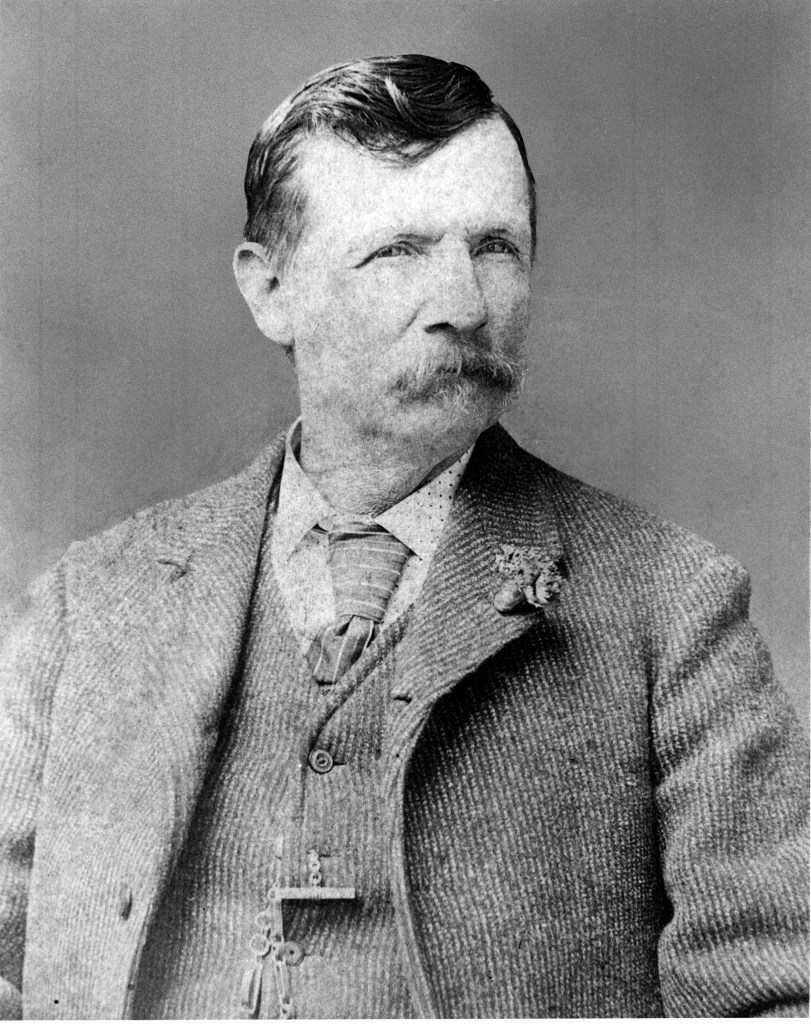


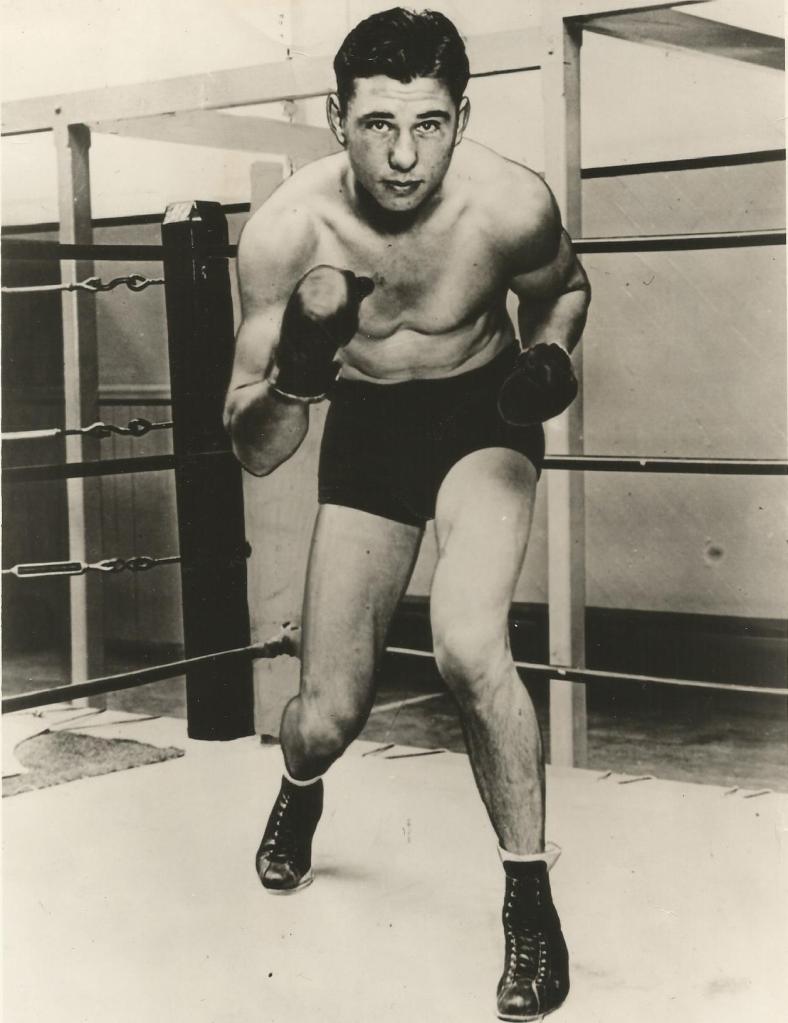

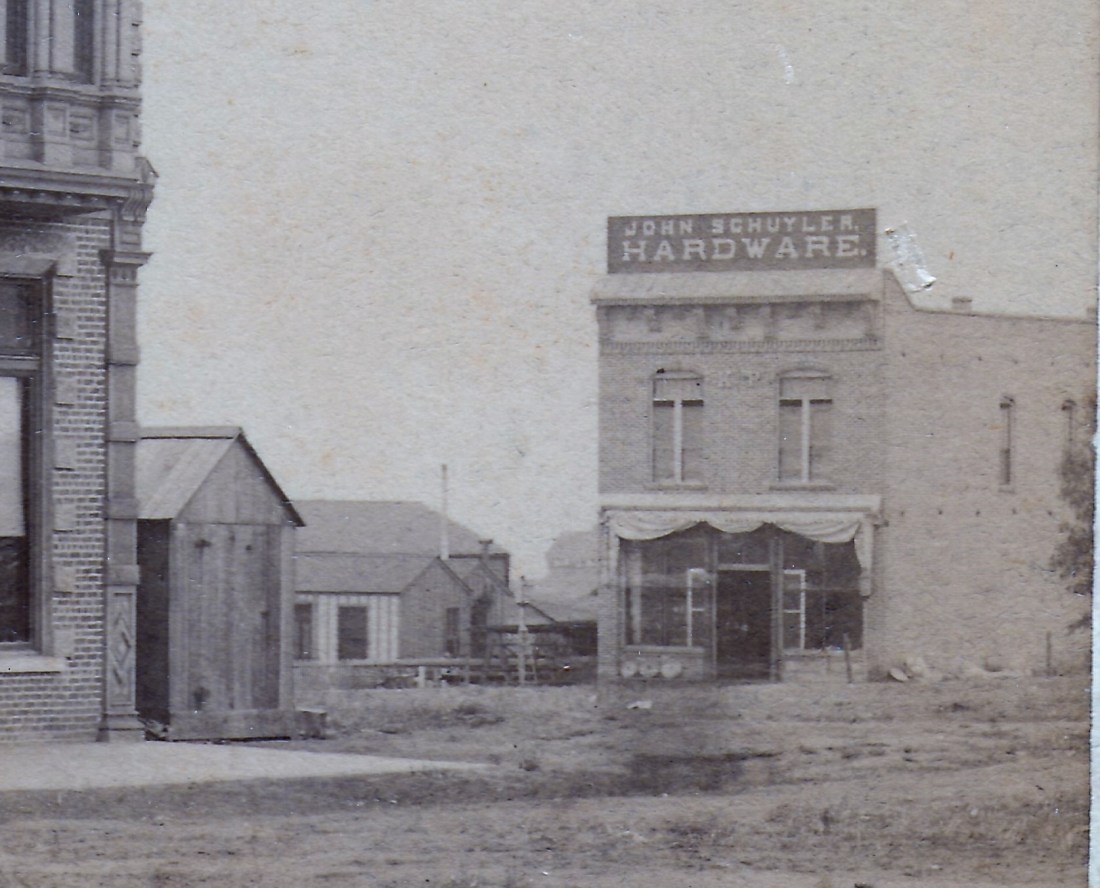

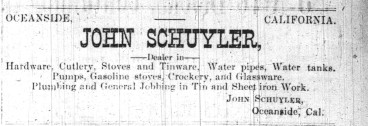

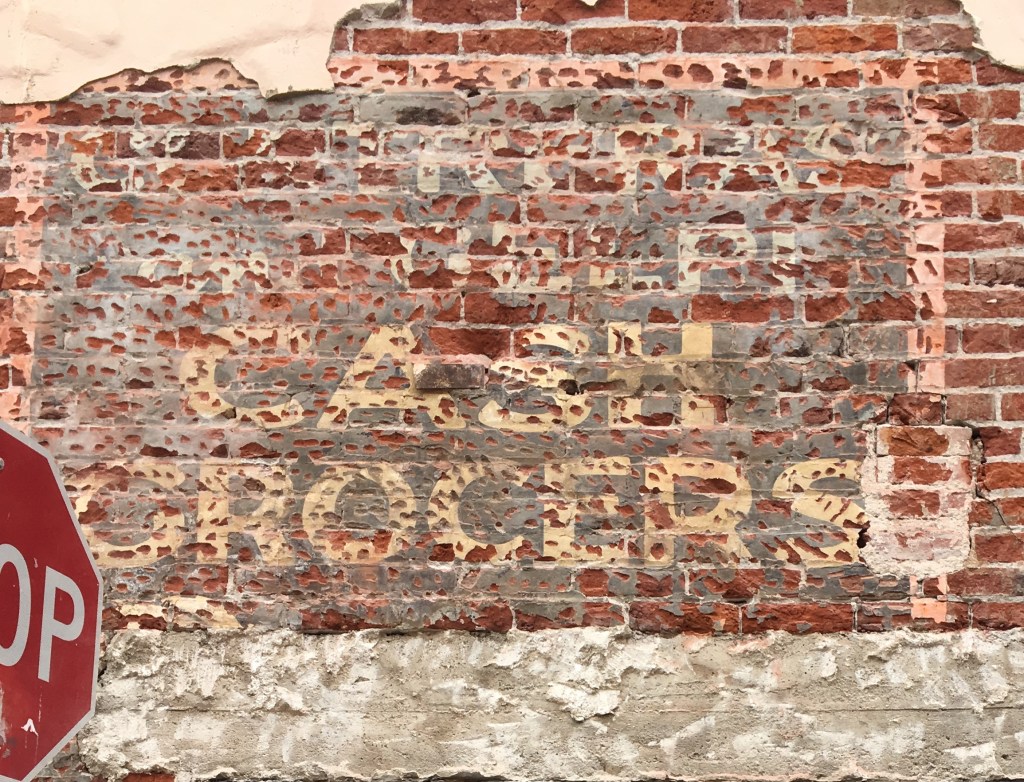


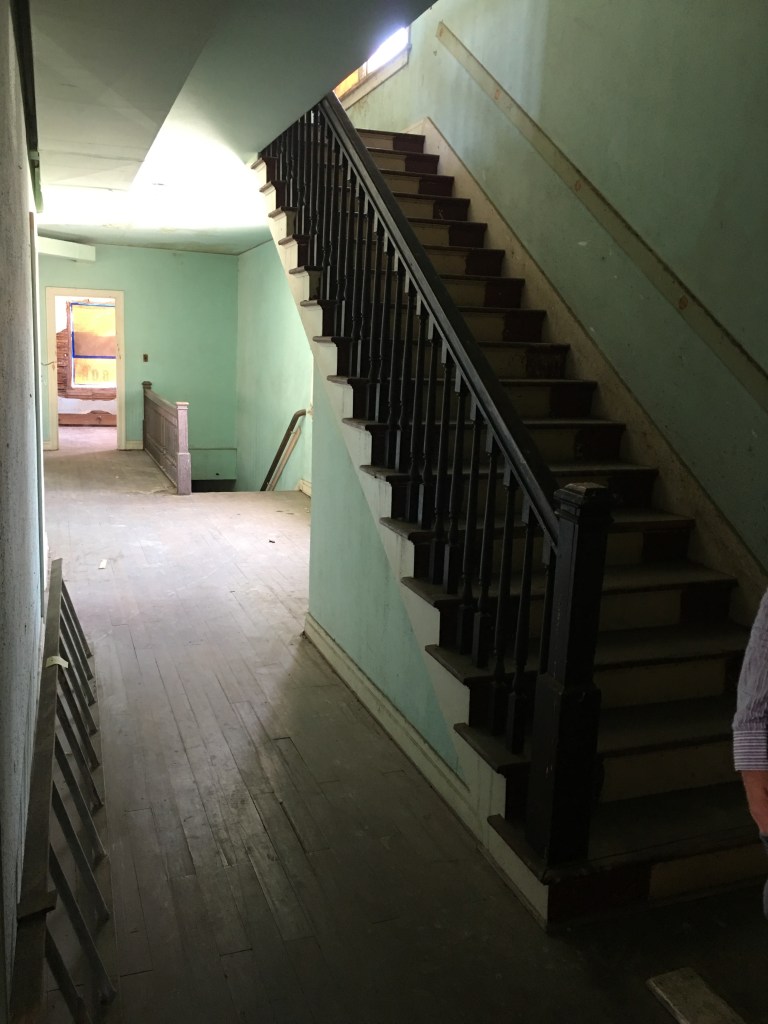


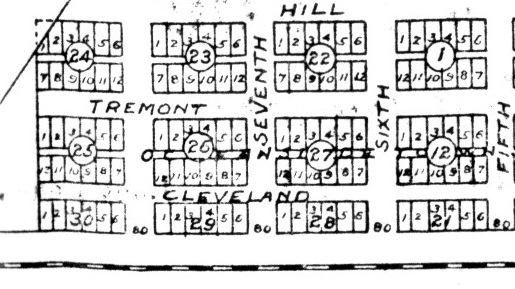

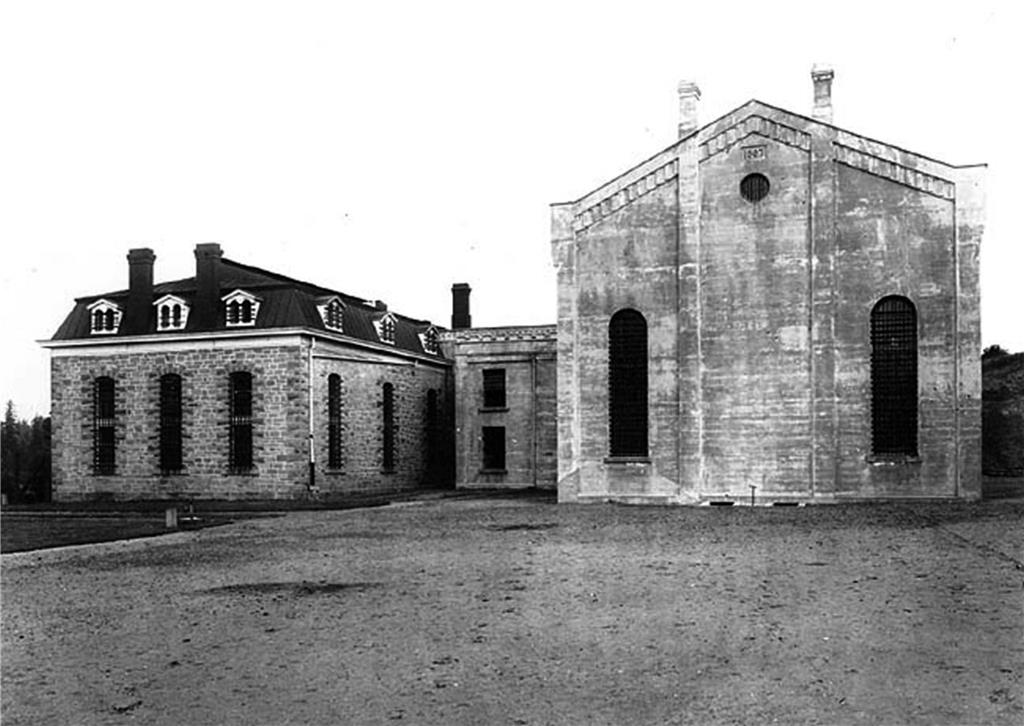


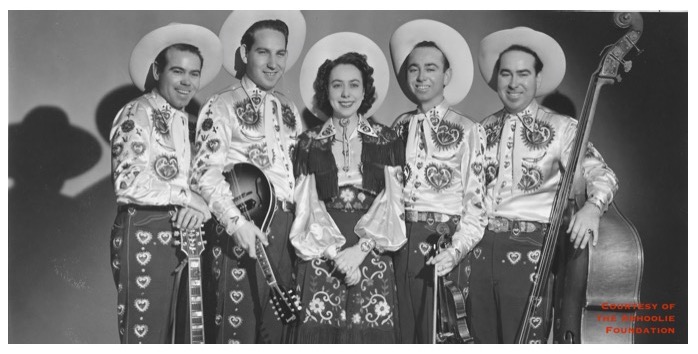


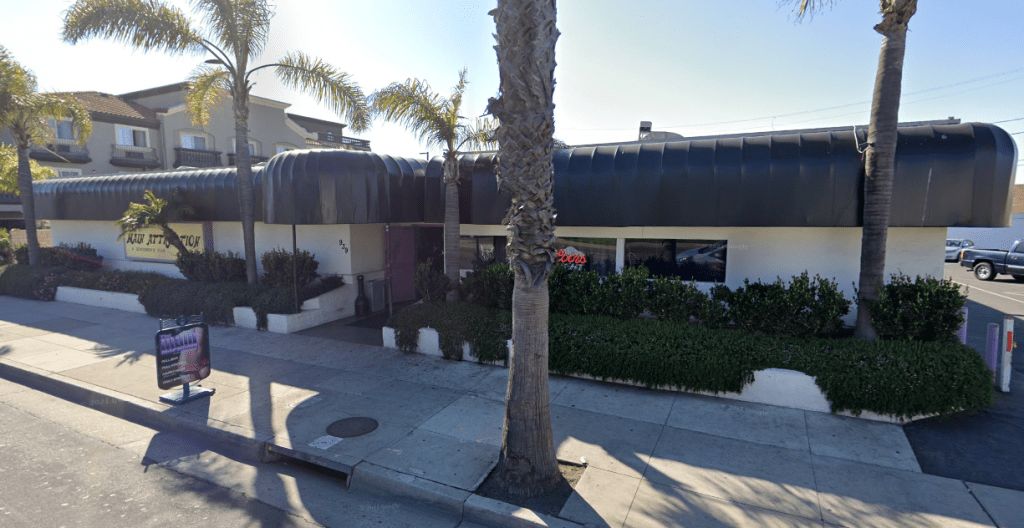

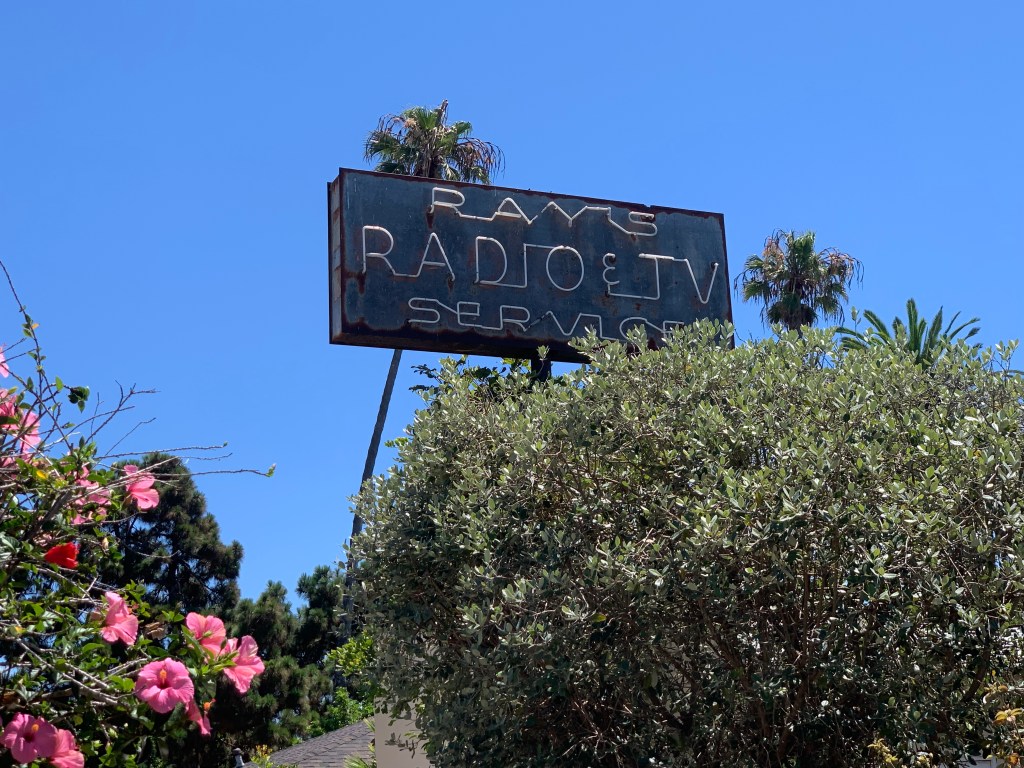


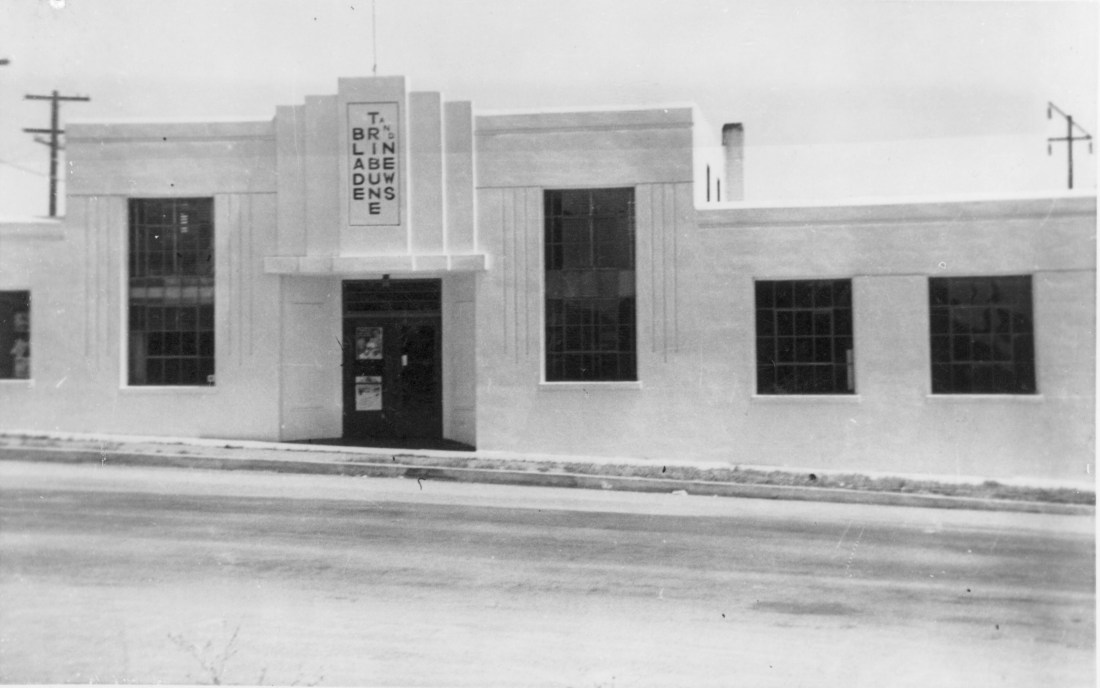

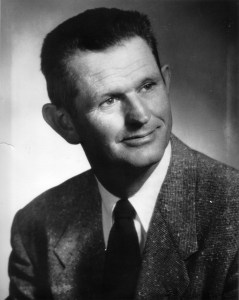
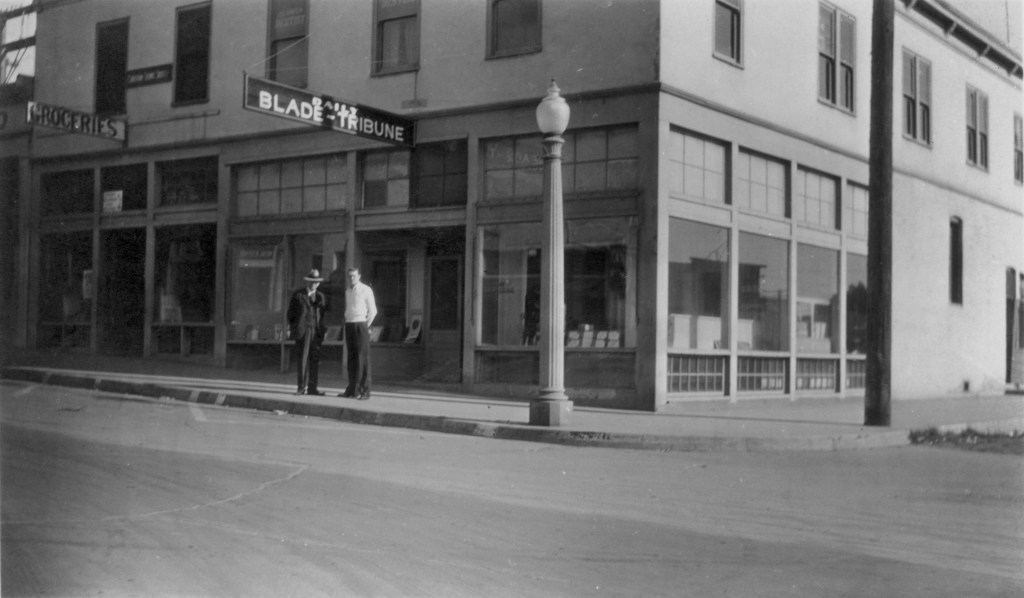
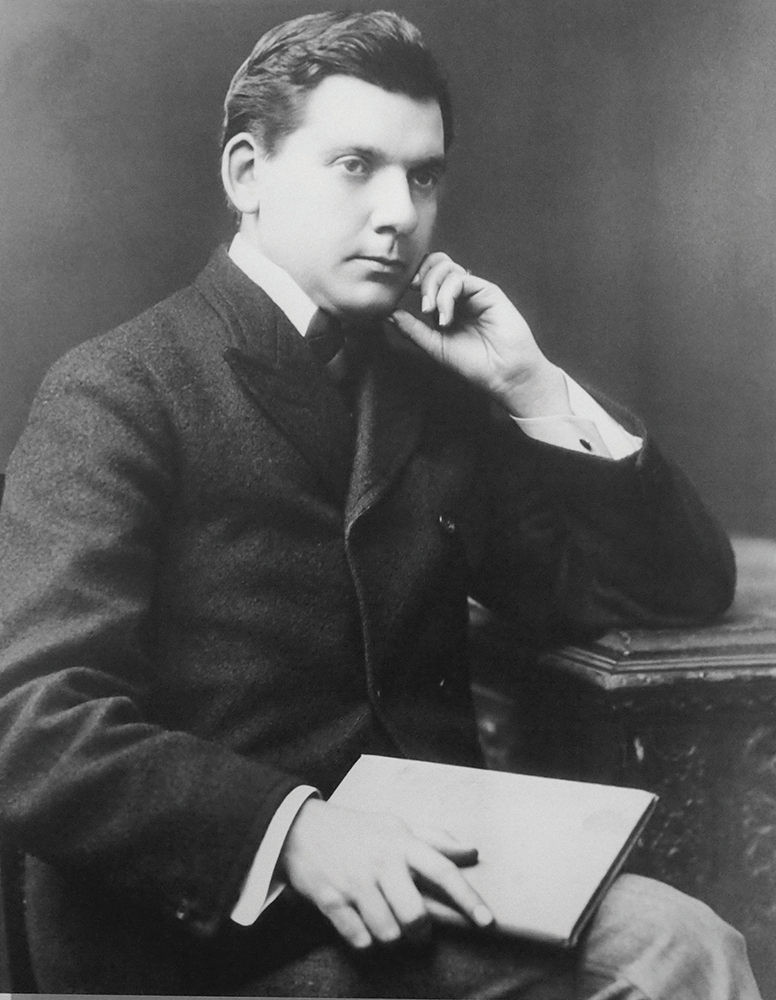


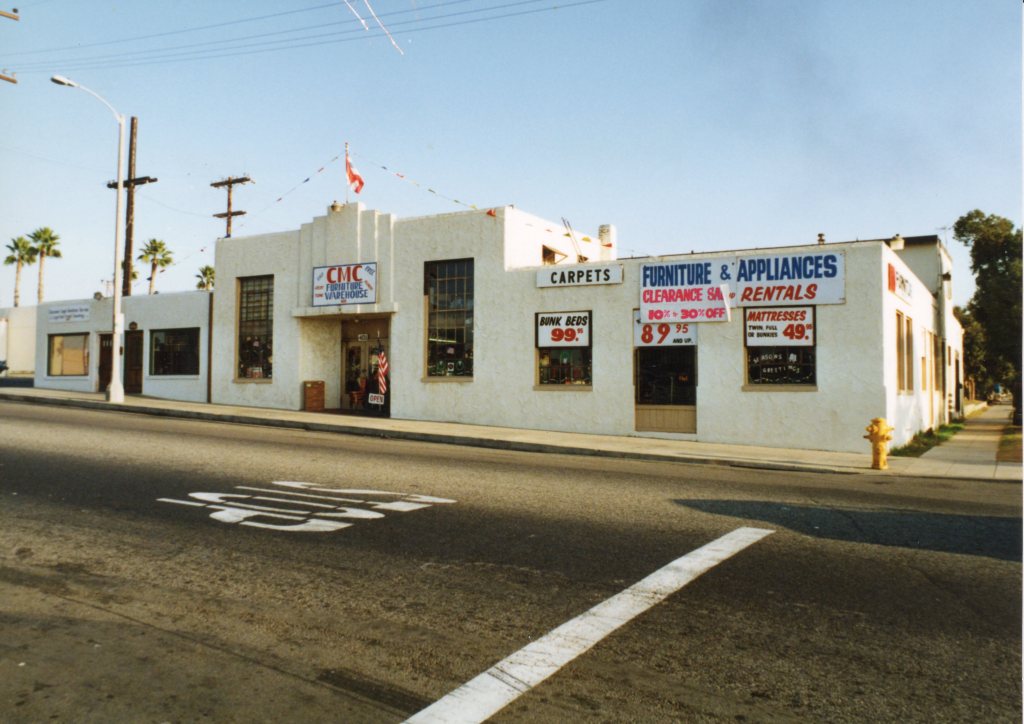

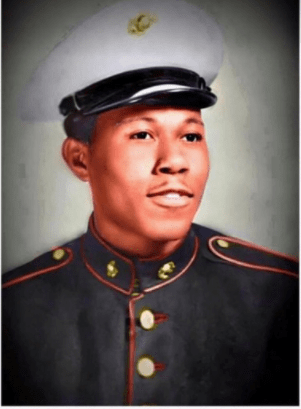
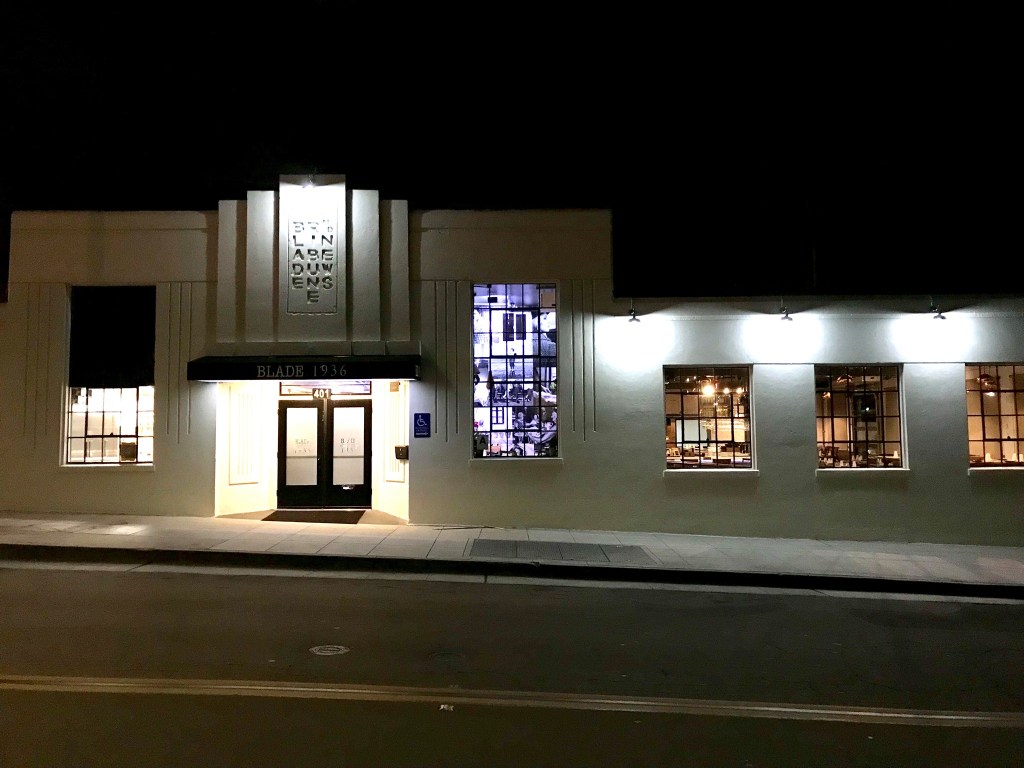

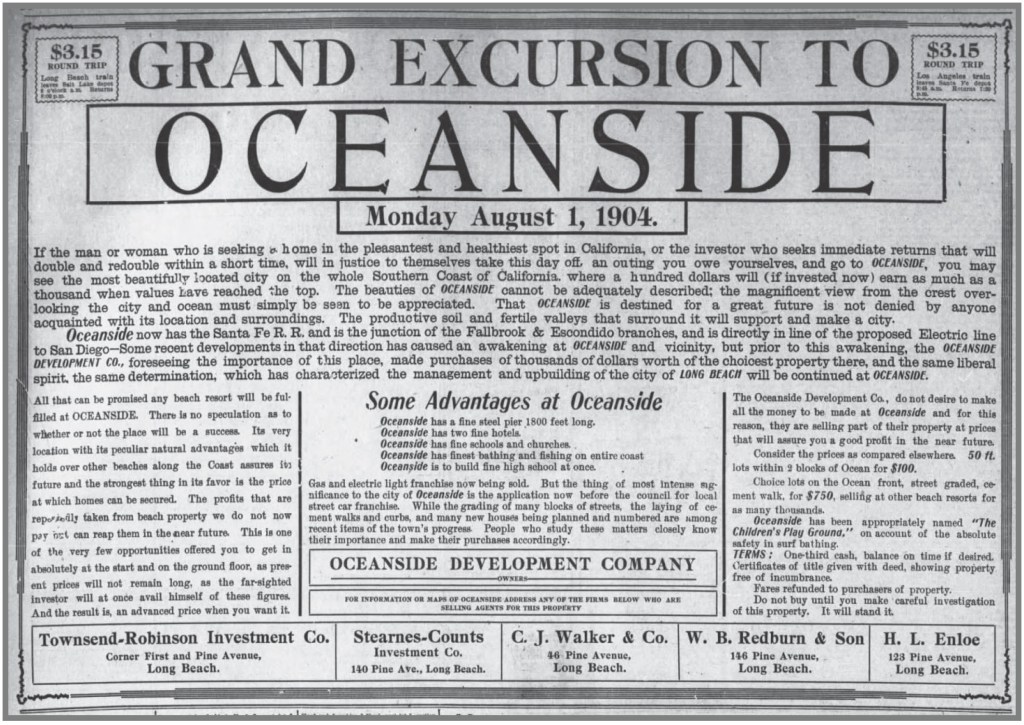


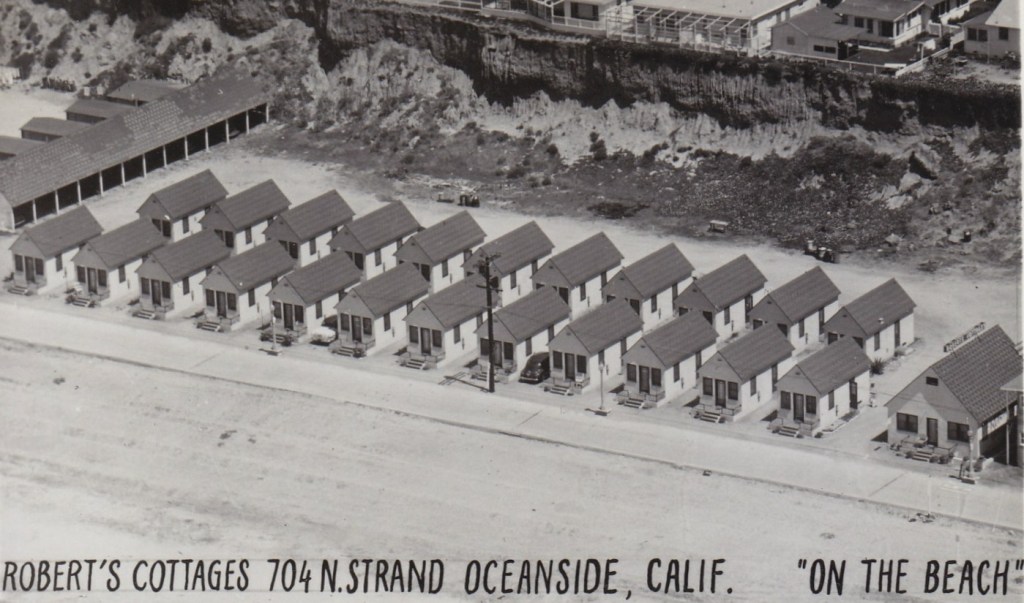




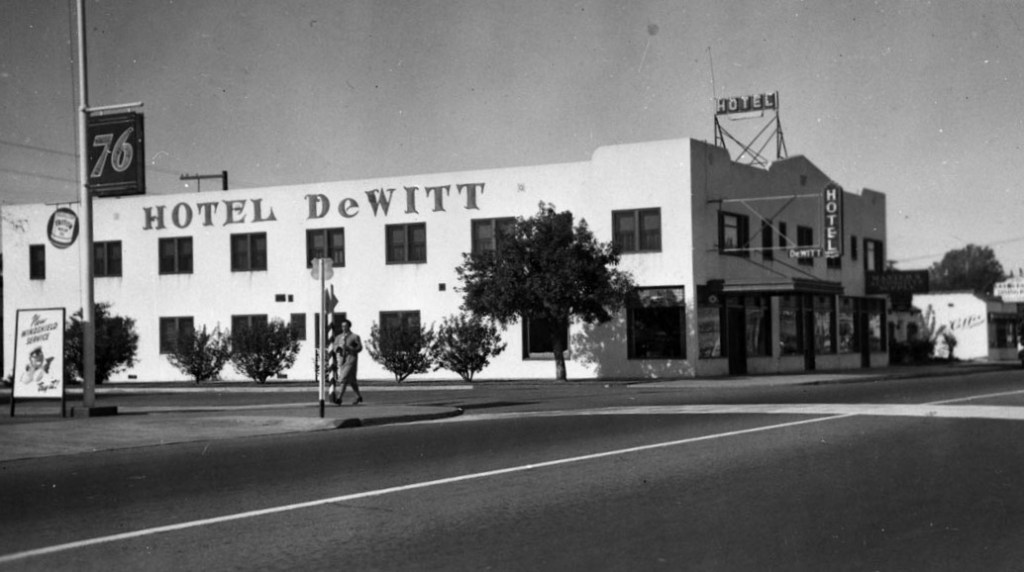

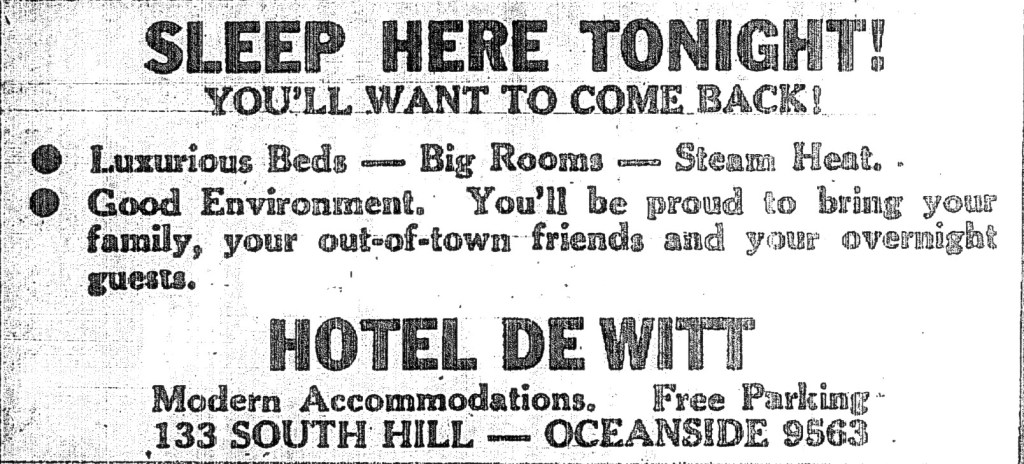
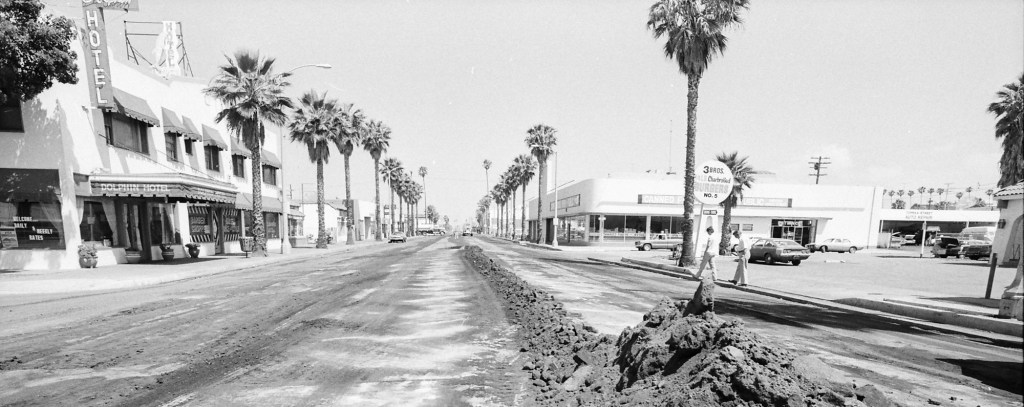

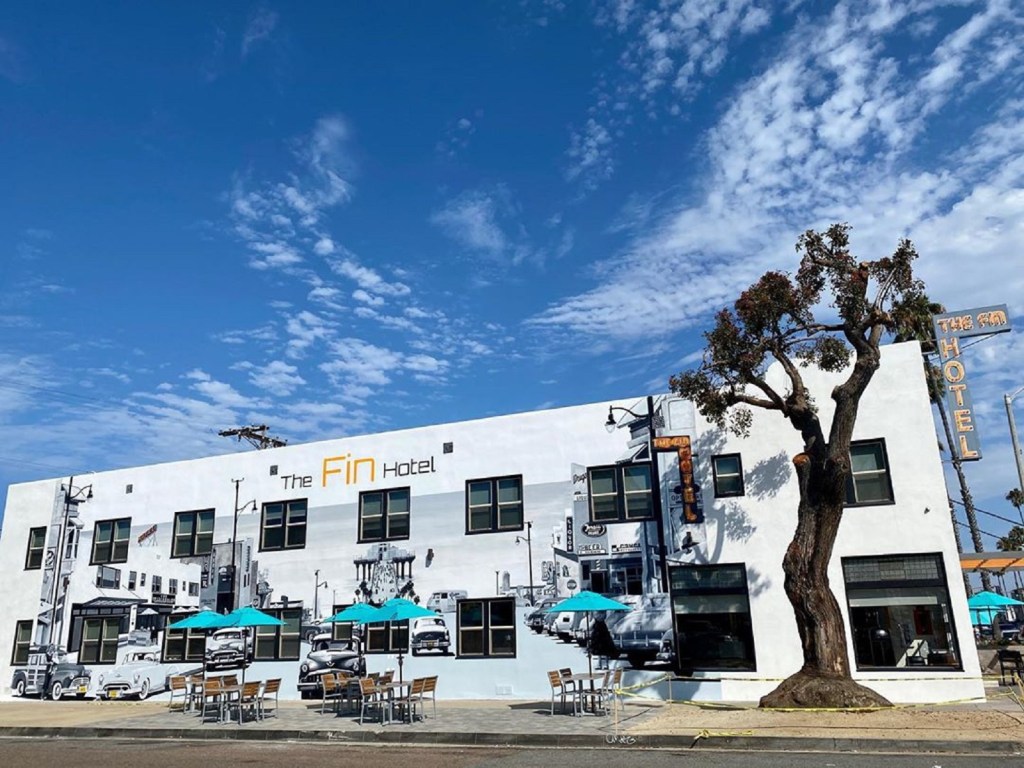
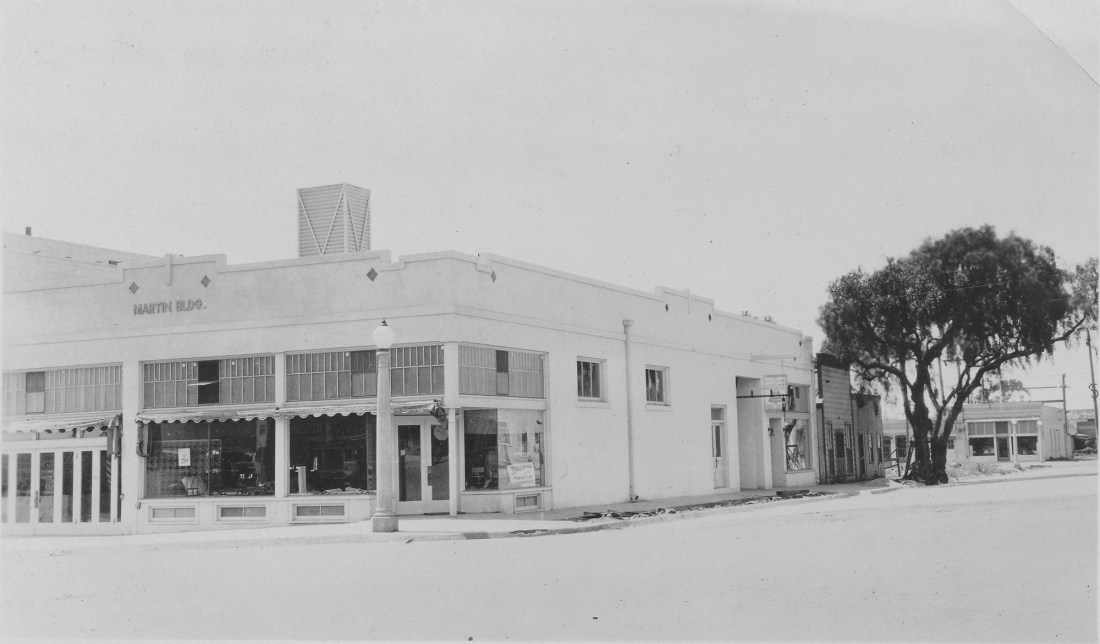
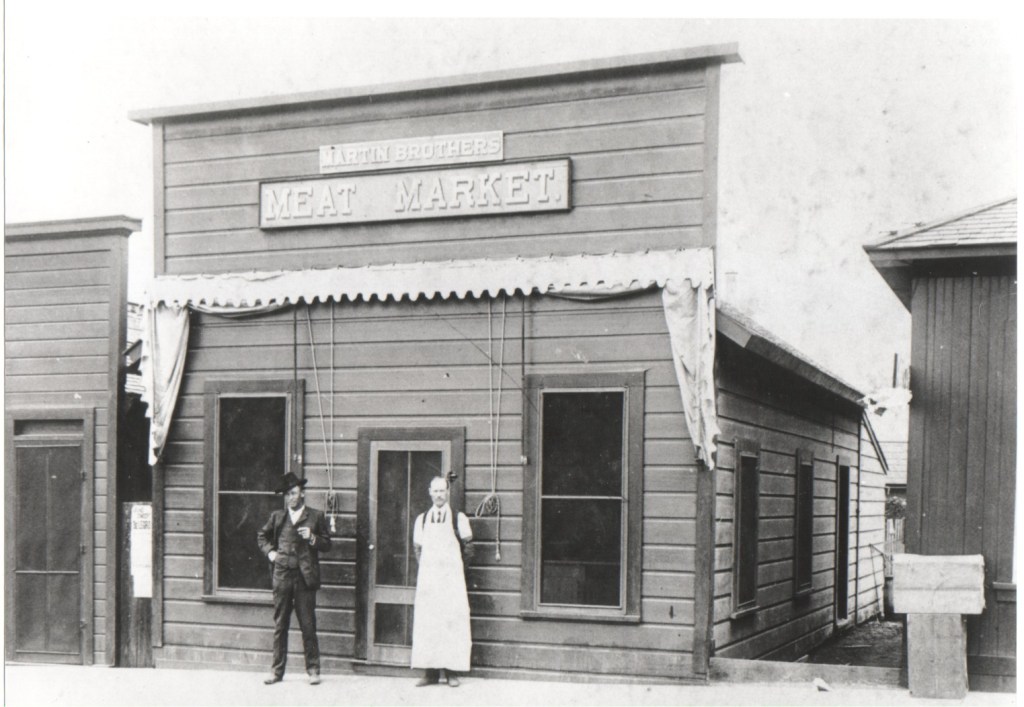
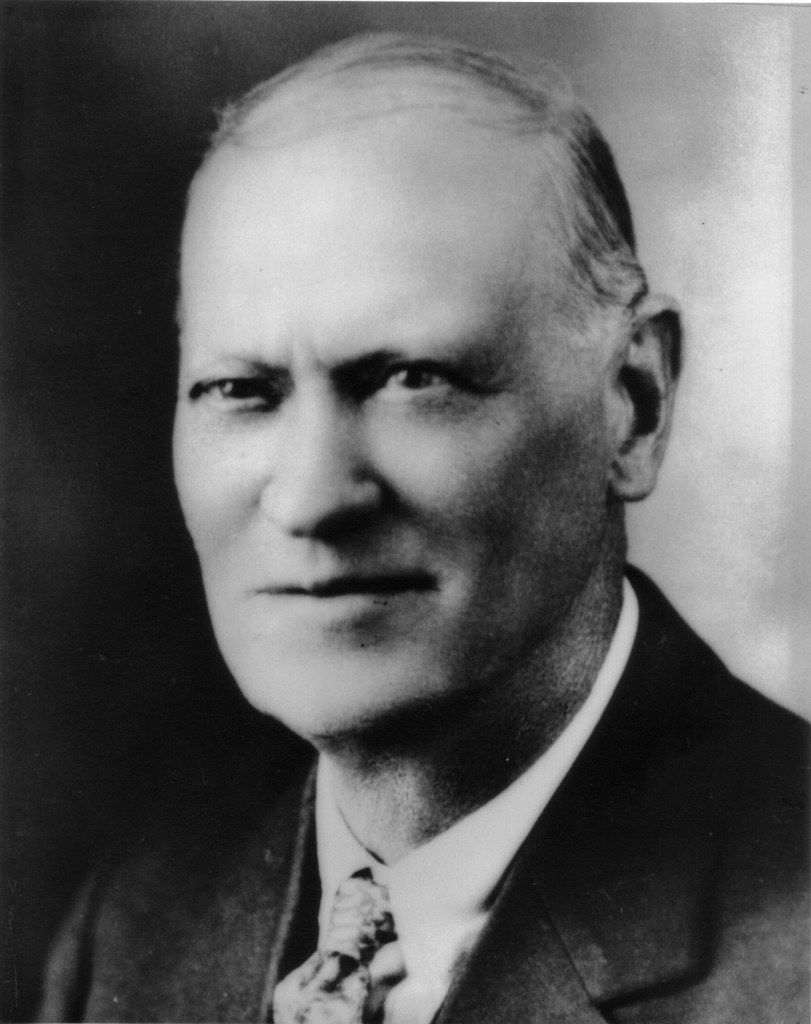



 Histories and Mysteries