
The large brick building at 1722 South Coast Highway is going over extensive changes and a “new transformation” but here’s a brief history of the building and some of the newspaper’s owners and publishers.
The building was built to house the Oceanside Blade-Tribune newspaper, which originated as the Oceanside Blade in 1892. It was a small but important weekly newspaper which provided world and local news to the residents of Oceanside.

Brothers Paul and Harold Beck, brothers who hailed from Iowa arrived in Oceanside in the late 1920s. They purchased the Oceanside Blade along with with another newspaper, the Oceanside News, and created the Oceanside Daily Blade Tribune and the paper went from a weekly publication to a daily one.
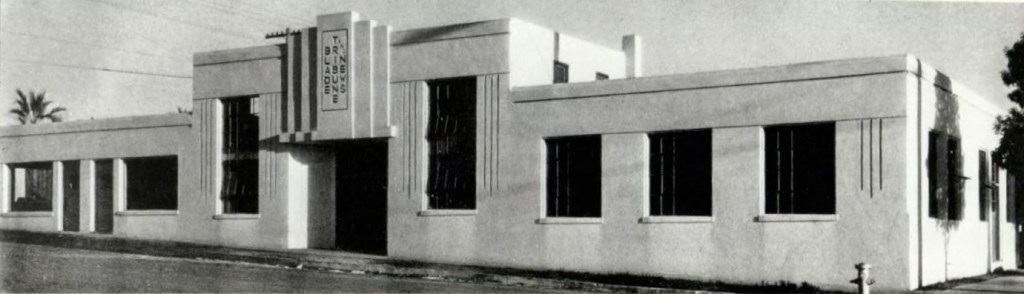
In 1936 the Becks hired architect Irving Gill to design a new building for their growing business. Located at 401 First Street (now Seagaze Drive) it was Gill’s last design, which was restored in 2019.
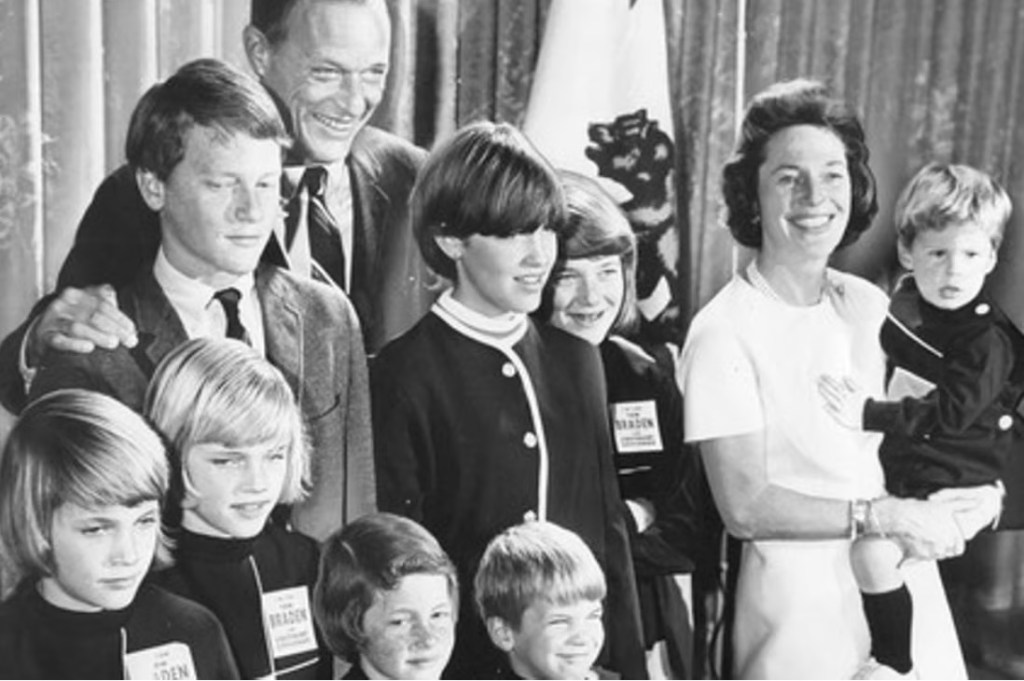
The Becks sold the Blade-Tribune newspaper in 1954, to Thomas W. Braden. Braden was at one time an official at the Central Intelligence Agency, and his wife Joan worked for Nelson Rockefeller. Rockefeller loaned Braden the money to purchase the Oceanside Blade-Tribune.
The Bradens were connected in both political and social circles. Joan was a close friend of Jacqueline Kennedy. Tom Braden was a regular on “Meet the Press” and was appointed president of the California State Board of Education.
In 1975 Braden authored a book about his family which became a popular television series under the same name: “Eight is Enough.” The Braden family lived on South Pacific Street near the gated entrance of St. Malo.

Braden sold the newspaper to Robert S. Howard of Naples, Florida in 1967. Howard founded Howard Publications in 1961 which eventually included 19 newspapers from around the country.
Howard was the son of a small weekly newspaper publisher in Wheaton, Minnesota. Born October 23, 1924, he was the third of three children. During World War II Howard left the University of Minnesota to join the military. As a Second Lieutenant in the Army Air Corp he was a navigator and nose gunner in bombers over the South Pacific. He served valiantly, earning a Purple Heart after being shot down in the Battle of Leyte in 1944.
After his return to Wheaton, he took over the family newspaper and over his lifetime amassed 18 newspapers as Howard Publications, with over 2,000 employees and nearly a half million circulation.

In August of 1967 construction began of 11,500 square foot “modern printing plant” at 1722 South Hill Street (Coast Highway) at an estimated cost of $700,000. That same year, Thomas Missett became the general manager and publisher. The new publishing plant was built by local contractors, Richardson Brothers, and completed in 1968.

A large two-story addition was made years later. In 1989 the Blade-Tribune was changed to The Blade-Citizen and then again in 1995, renamed the North County Times, which ceased publication by 2013. After 120 years of a hometown newspaper, the Oceanside Blade was no more.
The building has had several tenants over the years, including a vintage market. While Oceanside’s newspaper days may have ended, the two buildings built by the publishers are still standing, one repurposed as a restaurant, the Blade 1936, and the other in South O, in the process of being reinvented.
 Histories and Mysteries
Any idea about the Reno goin on at the S. 101 location over the last couple of months?
LikeLike
According to a business journal –
LikeLike
Sorry –
The former North County Times building in Oceanside is about to undergo $11.4 million in renovations by HP Investors to transform the former newspaper building into a mix of retail and office space
LikeLike
In the 50s, I had a “walking” paper route through downtown Oceanside, which I’d inherited from my older brother. This involved going to the Blade building grabbing a handful of papers fresh off the press, and going door-to-door along Mission and Hill, selling papers for a dime. I was excited because I got to keep five cents from every sale. Later, when I had a “bicycle” route of my own, I’d still pick up my papers from the Blade building because they had a machine that pre-folded every paper in half, in a matter of seconds. That greatly enhanced my rolling speed, and off I’d be off to deliver on Weitzel, Horne, Clementine, Wisconsin, and Nevada streets. As much as I loved the sound of the massive printing press and the huge rolls of blank paper, I relished the rich smell of the newly inked prints, marching relentlessly from the press. Oh, but I hated getting all that ink off my hands and clothes at the end of a run.
One of my greatest memories was descending into a “grotto” on the west side of Hill. There was simply a door and a staircase leading down to a smoke-filled poker room. The owner allowed me inside, even though I was definitely underage. One gentlemen there ALWAYS purchased a paper from me — it was the one sale I could always count on.
LikeLike