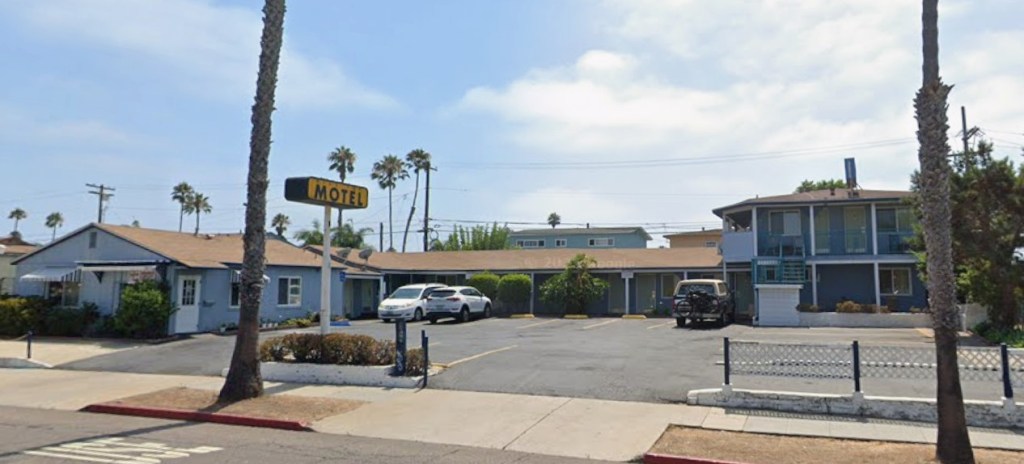
The Hill Top Motel at 1607 South Coast Highway in Oceanside, California has been described as an “okay place if you’re running out of options.” It has become sort of a fixture in the South Oceanside neighborhood. Far from a vacation destination resort, the Hill Top Motel is a low budget option for travelers and locals.
The Hill Top Motel, (Google view 2025)
Regardless of its less than stellar reputation, the Hill Top has a history dating back to 1948 and includes two tragic events, a suicide and an unsolved murder.
The first deadly incident was the suicide of Flora Dodson in 1954. She and her husband were the original owners of the motel property.
Forrest Leroy and Flora (Kettering) Dodson were both natives of Illinois, married in 1907. The couple had two daughters, Marie and Edith. In 1948 the Dodsons purchased property on the southwest corner of Morse and Hill Streets (Coast Highway) from Clifford Brodie. In June of that year a permit was issued to build a small motel called Dodson’s Motel at 1607 South Hill Street for a cost of $19,000. A neon sign was erected in December 1948 and the motel was completed and ready for guests.
Flora and Forrest led quiet lives on the busy Highway 101. They lived on the property while managing the auto court and visited often with their children and grandchildren.
Sadly, Forrest Dodson died suddenly on May 29, 1954. After 47 years of marriage, Flora was distraught and despondent with grief. She told her daughter Edith Lipman that she did not care to live any longer and that she had contemplated jumping off the end of the Oceanside pier.
On December 12th, just seven months after the death of her beloved husband, Flora ended her life. She was discovered by her son-in-law Othel Bert, who was visiting from the Midwest. He found her lifeless body lying on the floor in front of the kitchen gas range. Detectives from the Oceanside Police Department responded to the call and as they examined the scene, they noted that Flora had cut her left wrist with a safety razor blade, which was found on the floor near her right hand. A rifle and .22 cartridges were also found but unused. Instead, Flora had turned off the pilot lights in her wall heaters and stove, turned on the gas and positioned herself on a kitchen stool until she was overcome by fumes. The coroner ruled her death a suicide.
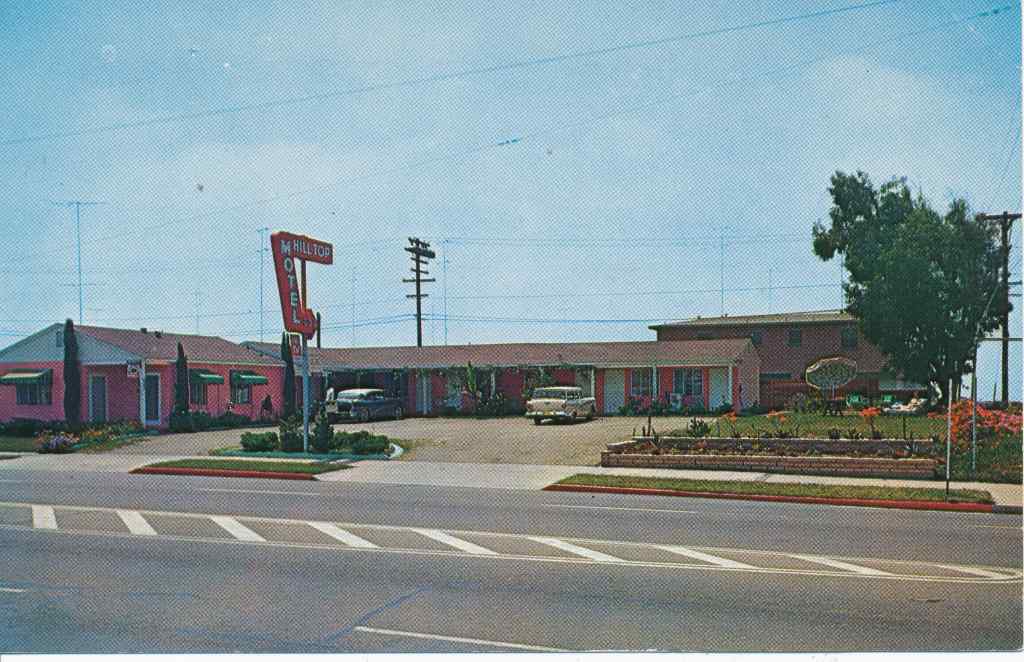
The Hill Top Motel, 1607 South Hill Street (Coast Highway) in early 1960s.
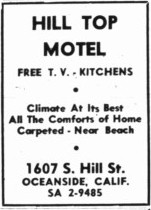
After her mother’s death, daughter Edith Lipman acquired the motel property which had since been renamed the Hill Top Motel. It was sold to Leonard and Bessie Robinson in 1957. The Robinsons lived on the property in the “owner apartment” and managed the 8-unit motel, which advertised “all the comforts at home” including carpet, kitchens and free TV.
By the mid 1960s the Hilltop Motel was expanded with a two-story unit on the north end of the property. The Robinsons sold the property to Mr. and Mrs. William and Virginia Giffin who sold it to Dwight M. Pankey in 1970.
The Hill Top Motel in the 1970s.
It was purchased by Larry and Twyla Shaffer in 1974 and by 1976 the Hilltop Motel was offering daily rates of $10 and a weekly rate of $63. In 1976, the property was purchased by Joe C. Iski and John Isky. They sold the property to Yee Chen Yeh of San Diego in 1979.
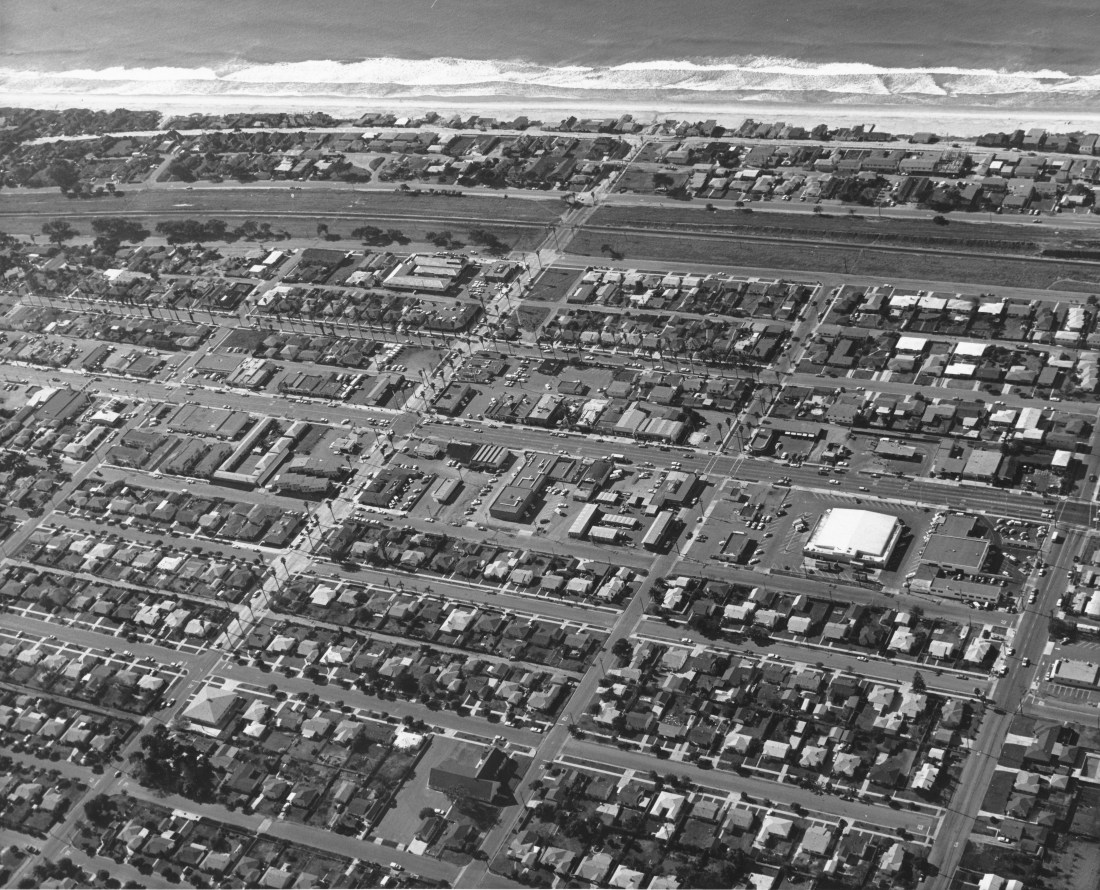
Aerial view of the Hill Top Motel, corner of Morse and Hill Streets (Coast Highway) upper right in the 1970s.
The clientele in the 1970s and 1980s were much different than the guests who stayed in the Dodson Motel in the 1940s and 1950s. Things were changing in Oceanside with a rising crime rate, even in South Oceanside, which is a vibrant and trendy neighborhood today. In 1988 the crime rate had increased 24 percent and it was reported that Oceanside had the biggest increase in violent crime in the entire state for the first six months of the year.
Violent crime which included Oceanside’s first reported homicide of the year – at the Hilltop Motel. On January 22, 1988 Rocco Anthony William Pittro, Jr. (aka Pietro) was found murdered in Room No. 8. Pittro had been discovered by the motel’s manager. Left in a pool of blood, he had been stabbed seven times.
The manager told police that Pittro and a man by the name of Carl had been seen together, and that Pittro had told him he would have a male friend visiting. Carl was described as a black male 25 to 30 years of age, 160 pounds 5’10“. The manager of the motel had gone to the room to check on him the following day, presumably after Pittro missed check out, entered the room with a pass key and discovered the dead guest. The Oceanside Police Department was notified and Officer P. Coppack arrived at 12:43 PM.
Pittro was born August 7, 1927 in Illinois. He was divorced and living in Mission Viejo. Differing reports list his occupation as an interior decorator to construction.
The coroner’s report stated that he was found in “a prone position on the bed and his body was cold to the touch.” There were three stab wounds to the back of his body and multiple stab wounds to his chest and abdomen, as well as a laceration to his left hand. The bedding under his body was blood soaked, and there was dried blood spattered on the wall opposite the foot of the bed and on the head of the bed. More specifically, Pittro was stabbed in the heart as well as in the lungs and suffered from multiple blunt injuries. The coroner also noted that no drugs were detected.
The murder weapon was not found but Homicide Detective Sheila Hancock reported “I think we’ve got some good physical evidence.” The victim’s 1985 Nissan pickup truck had been stolen and later recovered abandoned in central Los Angeles.
In March of that year, a 16-year-old Oceanside youth was arrested. He was booked into juvenile hall, but his name was withheld because of his age. Three days later, he was released. Detective Hancock said there was insufficient evidence to prosecute the teenager at the time. Police said the teen lived with his parents on nearby Marine Corps Base Camp Pendleton and they continued to look for information linking the teenager to the killing.
In September of 1988 Oceanside detectives released a crude sketch looking for someone by the name of Chris or Carl. But with no suspects in custody, the case eventually went cold and then forgotten.
However, with properly stored evidence, this case could likely be solved today with DNA or even fingerprinting.
The murder of Rocco Pittro is one of several unsolved cases in the files of the Oceanside Police Department, including Zelda Lamore found murdered in a downtown hotel in 1953, the murder of cab driver Ray Davis in 1962, the murder of Charlleen Saunders in 1986, the kidnapping and murder of 7-year-old Leticia Hernandez in 1989, the missing persons case of Mary Rico-Webber in 1992, the murder of retired school teacher Margaret Yossa in 1994, and the murder of Rachel Pauline Rivera found in the alley of the 600 block of South Coast Highway in 2001.
As each year passes these cases only grow colder, including Rocco Pittro’s murder in Room 8 at the Hill Top Motel. Is the DNA evidence just waiting to be tested? Is there anyone who remembers, or has information to help solve this case and others?
Our City is made up of many different neighborhoods, often with their own unique characteristics, history and even architecture. As Oceanside’s population grew, its borders expanded with various subdivisions and new housing developments. From the exclusive enclave of St. Malo to Potter homes in South Oceanside and Francine Villa in North Oceanside, Oceanside neighborhoods are as diverse as the people who live here. Here are a few neighborhoods, some forgotten and others well remembered.
Guidottiville
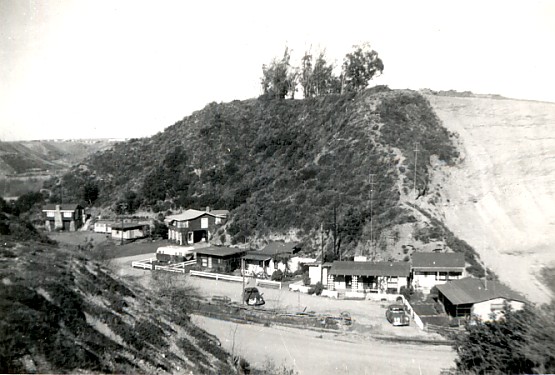
Guidottiville was named by and after Amerigo Edwardo Guidotti. The area was near what is referred to as Lawrence Canyon just south of present Highway 76. Guidotti built his residence there along with several rentals and lived there for many years. The homes were removed by the 1980s to make way for the Highway construction.
Guidottiville in Lawrence Canyon, south of present day Highway 76
Pine Heights
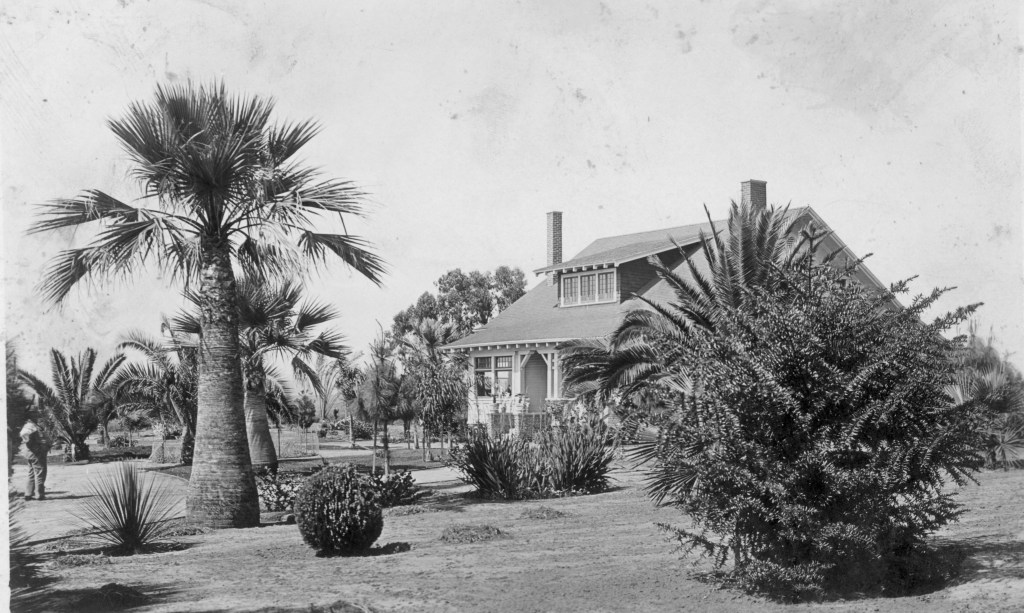
Pine Heights was a rather remote area of Oceanside, accessible only via Eighth Street, now called Neptune Way. Pine Heights provided expansive view of Oceanside and panoramic view of the Pacific Ocean. Niels Hansen, a local grocer, built a large Craftsman style home designed by noted architects the Quale Brothers in 1908. Also that year, Attorney John Johnston hired prominent Chicago and San Diego architect Henry Lord Gay, to design his $10,000 home in Pine Heights. The Hansen house was later moved to North Clementine Street but the Johnston home was demolished. Pine Heights is now the location of a 15-acre condo development by Evening Star Development.
The Hansen Home in Pine Heights.
North Oceanside Terrace
A new subdivision established in the late 1940s was situated along the northern most border of Oceanside along Camp Pendleton. North Oceanside Terrace includes Capistrano Drive, San Luis Rey Drive, Monterey and Sunset and other streets. Many of the homes built there were built in the early to mid 1950s and purchased by the military families that were stationed at Camp Pendleton. In 1953 the City approved Francine Villas to the east, adding over 300 homes. These homes were introduced as rentals to military and civilians with a two bedroom home renting for $72.75 and a three bedroom for $82.75. Because of the growing density and traffic, an additional entry into the neighborhood was provided, initially called “River Road”. Later Loretta Street from the Eastside neighborhood would be built across the San Luis Rey River to provide residents access. In 1955, construction of North Terrace Elementary School began, opening the following year. Today the area is more commonly referred to as Capistrano because of the area park.
1974 aerial of a portion of North Terrace neighborhood, school and Loretta Street crossing.
South Oceanside
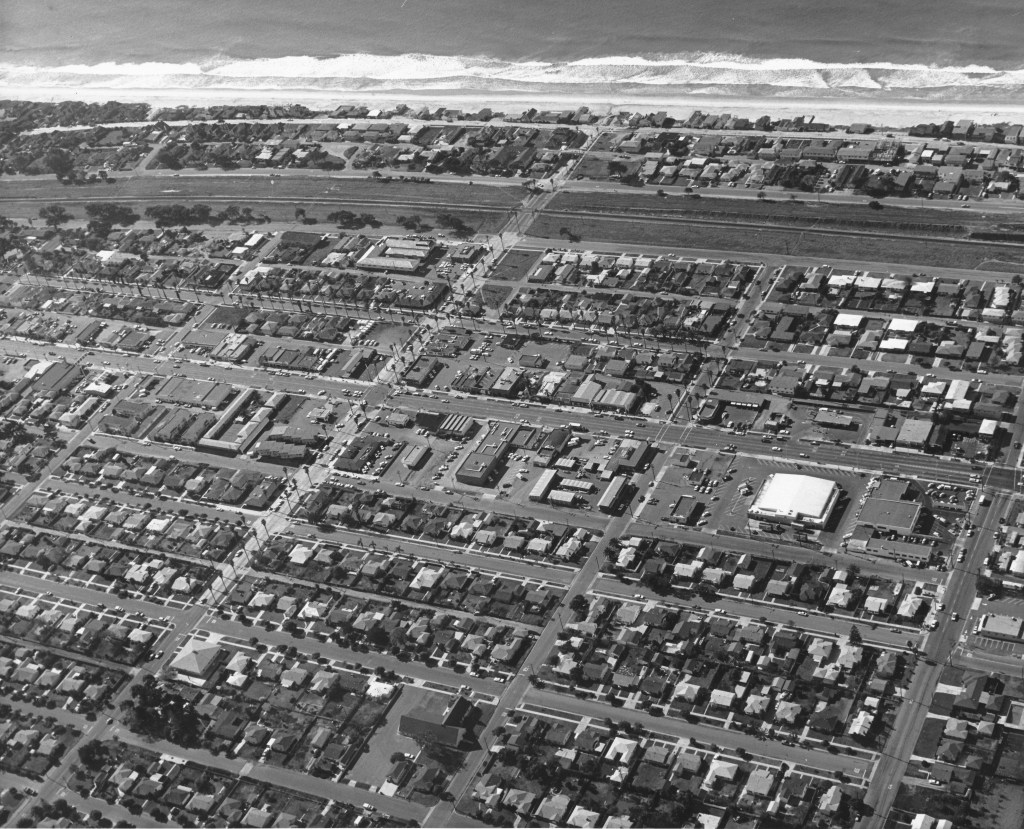
John Chauncey Hayes established South Oceanside, a small township just south of the City of Oceanside in the 1880s. In the earliest days it had its own bank, a school building, cemetery, several brick residences and a newspaper, the South Oceanside Diamond. This largely rural area included the Spaulding Dairy (established about 1913) and was home to acres of flower fields owned by the Frazee family and others. It turned residential when Walter H. Potter, “the man who built South Oceanside” began building dozens of small homes in 1947 that stretched from Morse Street to Vista Way.
Aerial view of South Oceanside looking west, circa 1970
Eastside
The Eastside neighborhood is just east of Interstate 5 and north of Mission Avenue, with entrance by Bush or San Diego Streets. The subdivisions of Mingus & Overman, Reece, Spencer, Higgins & Puls, which encompass the area, were mostly farmland when families from Mexico began settling there in the 1910s and 1920s. Most of the early residents were laborers who worked in the fields of the San Luis Rey Valley and the Rancho Santa Margarita (now Camp Pendleton). Many of the homes were built between 1920 and 1940 by the hardworking fathers and grandfathers of the families that still call Eastside their home. This neighborhood was referred to as “Mexican Village” by local officials but residents called it Posole. It was last neighborhood to have paved streets and a sewer system, which were not added until the late 1940s! Eastside was also the home of Oceanside’s first growing Black population in the 1940s and 1950s, along with Samoan and Filipino families.
Higgins and Santa Barbara Streets in Eastside shows dirt streets and houses on blocks because of the lack of sewer system.
Mesa Margarita
As Oceanside’s population grew at steady pace in the 1950s and 1960s, its borders continued to extend eastward. New housing was always in demand. Sproul Homes developed many new neighborhoods including Mesa Margarita, which is often referred as the “Back Gate” area because of its proximity to northeast entrance to Camp Pendleton. In 1965, 62 acres along North River Road were purchased by Fred C. Sproul Homes, Inc., a residential development firm, from Harold Stokes and Joe Higley. The Stokes and Higley families were long time dairy farmers in the San Luis Rey Valley. With the plan to build 275 new homes on the property it was one of several developments that changed the landscape of rural to suburban.
Sproul Homes ad in 1963
Oceana
One of the first adult only communities built in Southern California was that of Oceana. Situated east of El Camino Real and south of Mission Avenue, this planned community was built in 1964 at a cost of $25 million. It was touted as being “a city within a city” built on 180 acres with 1,500 lanai cottages and 300 apartments. At the time it was built it required that at least one adult be age 40 or over. A two bedroom, two bath model was listed at $16,995 and the community offered a variety of amenities which included a pool, golfing, library and restaurant.
Oceana development in 1960s
Henie Hills
Henie Hills was owned by figure-skater Sonja Henie. Sonja and her brother Lief purchased 1,600 acres of ranch land in about 1941 which included the present day El Camino Country Club. In the early 1950’s the Henies began subdividing part of the land near El Camino Real at which time some of the first custom homes were built. A portion of this land was sold to Tri-City Hospital and eventually acquired by MiraCosta College. Miss Henie built a large house on Oceanview Drive, which she used during her visits here from her native Norway. She continued ownership of 350 acres until 1968. In the 1974 Henie Hills opened as one of the nation’s first planned residential estates community, offering homes on estate-size lots averaging one-half acre with views of the sea, mountains and golf fairways in the valley below. Home prices ranged from $54,000 to $81,000.
Driving Range at golf course, Henie Hills sign in background
Fire Mountain
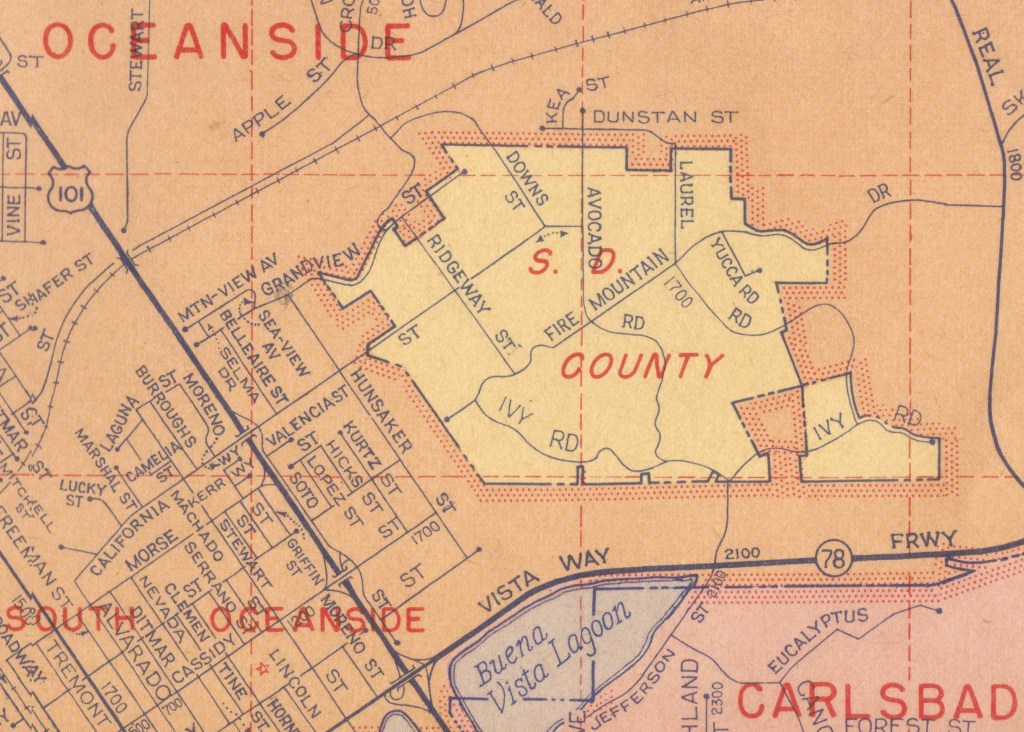
Fire Mountain was at one time called “North Carlsbad”. It was a largely rural area planted with avocado and citrus groves, consisting of approximately 338 acres. While the town of Carlsbad eventually grew and incorporated, North Carlsbad remained an unincorporated area of San Diego County, an island surrounded by the city limits of Oceanside. The City of Oceanside annexed the area in the 1960s. It has developed into a desirable neighborhood simply named after the road traveling through it, consisting of middle-class homes, tract and custom homes, many of which sit on large lots, some offering views of the Pacific Ocean.
1956 Thomas Guide of Fire Mountain area before annexed to Oceanside.
St. Malo
A group of twelve homes was built by 1934 in an exclusive enclave in South Oceanside at the end of Pacific Street. Pasadena resident Kenyon A. Keith purchased 28 acres of oceanfront property and contained homes resembling a French fishing village that was known as St. Malo. Well-to-do property owners used St. Malo for vacation and summer homes. Early film director Jason S. Joy’s home was identified as “La Garde Joyeuse” and included an outdoor bowling alley and volley ball court. Author Ben Hecht was another resident, as well as Frank Butler, who co-wrote “Going My Way”. The beautiful community of St. Malo remains one of Oceanside’s best kept secret and continues to serve as summer homes and getaways for the rich and famous.
St. Malo homes fronting the Pacific Oceanside. Jason Joy house far right.
Plumosa Heights
Banker B.C. Beers established a new subdivision in the 1920s called Plumosa Heights, named for the plumosa palms lining the streets. This once exclusive neighborhood includes West and Shafer Streets, two of the street names are named for his children, Alberta and Leonard. The Plumosa Subdivision required at least a $4000 structure on the property to be set back at least twenty feet from the street. Plumosa Heights continues to be a desirable neighborhood with concrete streets and original cement light posts. Although it was the home of many affluent Oceanside residents, it was also inhabited by Oceanside’s middle class.
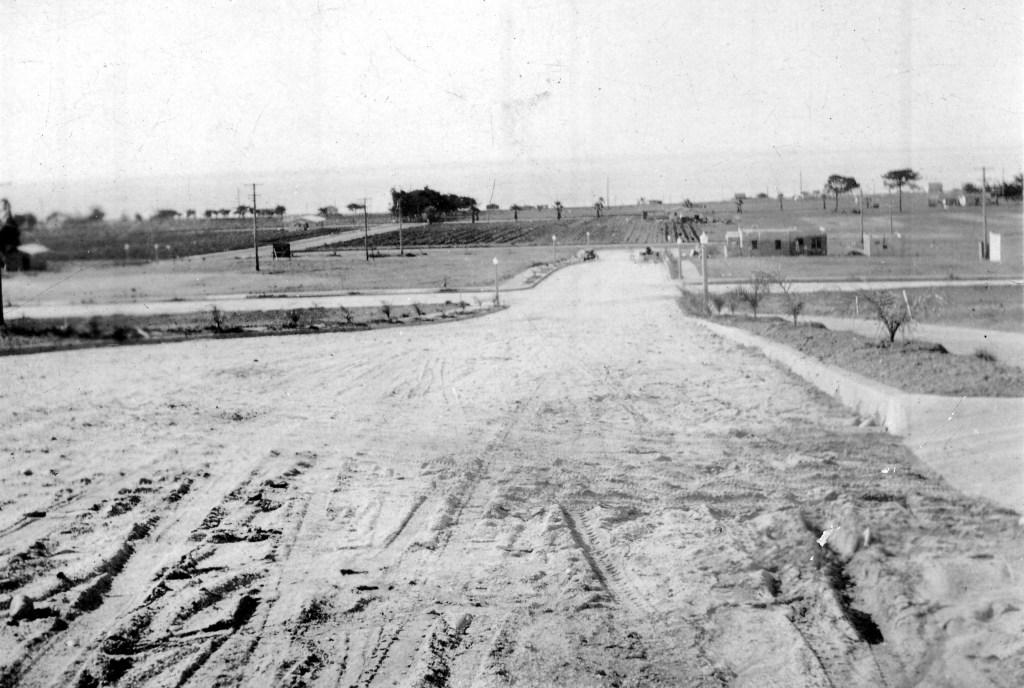
Leonard Street looking west at South Clementine and South Ditmar Streets, circa 1925
Along Oceanside’s Coast Highway you can drive, walk and bike past buildings that are 75 to 100 years old from the north end of town through South Oceanside. Because the façades have changed over the years, it is sometimes hard to distinguish a historic building from a newer one.
A building located at 1821 South Coast Highway is a good example. It is over 75 years old and built in 1948. It was the home of Hampshire House Candies and owned by Glen and Wilma Hampshire. The Hampshires came to Oceanside in 1946 and first opened a candy store at 1811 South Hill Street (now Coast Highway).
Hampshire House Candies at 1821 South Hill Street/Coast Highway in 1948
George “Glenn’ Hampshire was a native of Utah born in 1907. He married Wilma A. Dooley in about 1943 and the couple had two daughters: Glendelin and Charlotte Jane, both born in California.
The Hampshires were so successful with their home-made candies, their chocolates, nuts and peanut brittle were sold in other stores throughout San Diego County including Encinitas, Chula Vista and Fallbrook. The demand necessitated a larger storefront and a move from 1811 to 1821 South Hill Street (Coast Highway) which was built at a cost of $12,000 by local contractor Malcolm Smith.
Its newly built “factory and salesroom” was over four times larger than original store. As reported in the Oceanside Blade Tribune: “The new building which is of a very attractive English style, features in addition to its modern sales room and business office a specially designed kitchen containing over 900 square feet of space. Adjacent to the kitchen is a refrigerated chocolate room in which a constant temperature of 65 degrees is maintained. The firm which makes under the Hampshire House label hand-dipped chocolates, fudges, hard candles, caramels and specialties, does a brisk wholesale and retail business throughout this area.”
Sadly, it seems that the Hampshire marriage was not as successful as their candies. The couple split in the late 1950s. Glen relocated to Los Angeles where he died at the age of 59 in 1966.
Wilma continued operation of the candy store and living in South Oceanside, but then sold the business in October 1960. For a number of years, the former candy store was used as a real estate office, occupied by Century 21 in the 1970s. By 1994 it housed a temp agency.
1821 South Coast Highway, 2020 Google view
The building has been remodeled over the years but still resembles its original design. Although it is one of the oldest buildings of its era still standing along Coast Highway in South O, the Hampshire House Candies shop is only a sweet memory for some.
Many Oceanside residents, and perhaps many people in Southern California, will remember the giant Santa Claus erected each year at a home in South Oceanside. To the delight of children and the young at heart, the home at 1741 South Clementine was arrayed in what could be described as Christmas Spirit “overload”. But this abundance of holiday joy came from the mind, heart and creativity of one man: Oceanside resident George Carpenter.
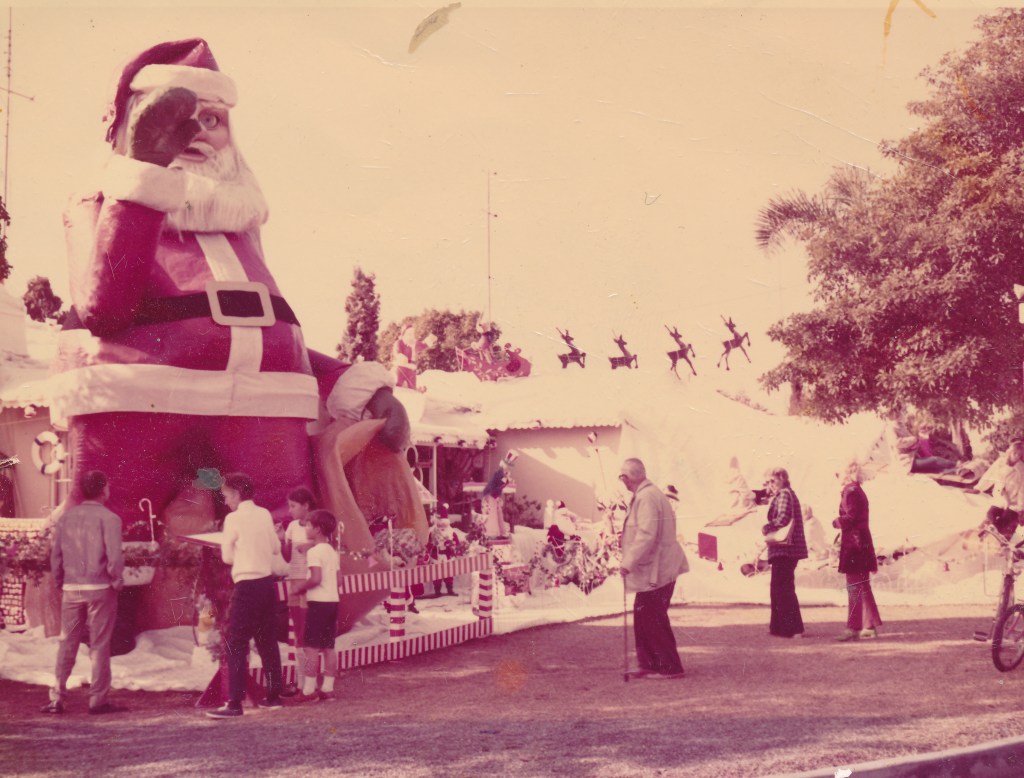
People lining up to see Santa during the day; at night the display brought crowds. Carpenter Family Collection
George Carpenter and his wife Gladys came from Pennsylvania where they owned a donut shop. The couple had five daughters, Georgina, Pamela, Yvonne, Robin and Jodie. George, a civil service employee at Camp Pendleton, was inspired to purchase his home on South Clementine Street because of its large yard. He had already imagined a “grandiose” display that he planned to set up that Christmas.
George Carpenter proudly stands with his giant Santa. Carpenter Family Collection
George began in about 1968, with a rather modest display. He purchased what was described as a “dilapidated” wooden Nativity scene with a choir, along with Santa and his reindeer. He spent a great deal of time carefully refurbishing, repairing and painting each figure. The Carpenter’s Christmas exhibit was admired by the neighborhood but George wanted to go bigger. Each year he added not one, but several items. He captured the imagination and attention of hundreds and then thousands of people as the menagerie of characters and scenes exploded in his front and backyard. The inside of the Carpenter home was just as filled with holiday spirit and there was no denying George’s love of everything Christmas.
The Carpenter’s front yard. Carpenter Family Collection
In 1972 George had to have the power company put in a special line to handle all the extra voltage for his ever-growing display which included a life-size ice skater, a snow skier, and a quacking duck in an ice pond. The rear of the house featured several large religious scenes beginning with the birth of Jesus, a host of angels and other Christian symbols. The house was decorated front to back, from the rooftop to nearly every available space in the surrounding yard. When he purchased a boat for his display, the salesman asked him if he was going fishing. George responded, “No, it’s for Santa Claus.”
Santa in a fishing boat being pulled by a dolphin. Carpenter Family Collection
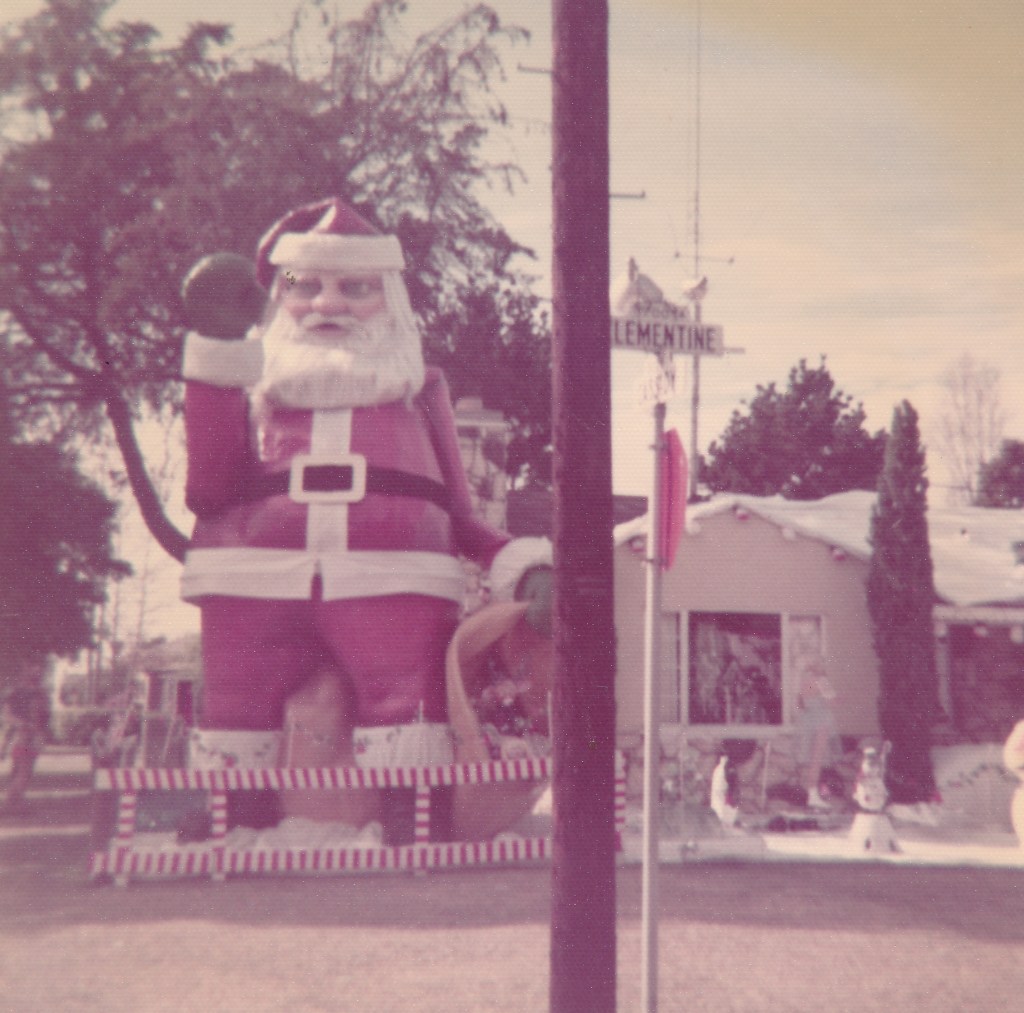
George outdid himself in 1973 with a 22-foot, 1200-pound motorized Santa Claus on his front lawn. It was an unbelievable sight and created so much traffic that an Oceanside police officer had to be assigned to the corner of Whaley and South Clementine Streets. It took nearly 10 months to construct the giant Santa which could wink, nod and wave. “Super Santa” was constructed by Larry Hill of Carlsbad. It was made of fiberglass, wood and papier-mâché. George got the idea for the giant Chris Kringle just after Christmas in 1972, and began looking for someone to build it. The local newspaper reported that “Carpenter didn’t disclose what it cost” but it was noted he couldn’t do “another one for less than $4000.” (He later had another Santa built, but it was thinner. His daughters protested “skinny Santa” in favor of the original.)
Larry Hill making George’s Giant Santa in his workshop. Carpenter Family Collection
“Skinny” Santa is pictured here, but the rounder Santa was the real crowd pleaser. Carpenter Family Collection
The country was going through an energy crisis in 1973 and citizens were asked to conserve energy, which included no erection of outdoor Christmas lights. The electricity that it took to light and animate the Carpenter display was more than the average household used on a normal day or week.
Display at night. Carpenter Family Collection
George wrote an editorial in the Oceanside Blade Tribune newspaper, asking residents to call him with their opinion as to if he should continue his Christmas exhibition in light of the energy shortage. He received about 50 telephone calls, along with a few visits, all of whom said they approved of his display and urged him to continue. “Some said they couldn’t wait,” Carpenter reported. However, there was one grinch, an elderly woman while out walking her dog past the Carpenter home told George she was against turning on the lights.
Christmas was everywhere at the Carpenter house! Carpenter Family Collection
One of the local firemen, who helped to erect George’s giant Santa, voiced his support saying, “I’m really glad he’s doing this. I think it’s ridiculous that no one is supposed to have Christmas lights outside anymore when there’s used car lots and supermarket parking lots are all lit up over town.”
Guestbook entry 1976
With the ratio of one objection to 50 in favor, Carpenter went forward but not before writing to President Richard M. Nixon, sending photos and asking for “permission” to continue his display, along a personal invitation for the President to visit. He actually received a response from the President’s Special Assistant, David N. Parker politely sending his regrets. George noted that the President did not discourage him, so in spite of the call to conserve energy went ahead with his display but restricted the hours of operation to do his part in conservation.
Letter to George Carpenter from the White House, 1973. Carpenter Family Collection
In addition to the giant Santa Claus, who could be seen for blocks, Carpenter erected other animated scenes which included life-size skiers and skaters; a 6-foot boat towed by dolphins (which spouted water!); and Snoopy on a surfboard. While the images now seem a bit “unsophisticated”, today we can purchase pre-made items for our yards, or simply shop online. Manufactured figures and reindeer are available in nearly every retail store, but this was long before such things were mass produced. George Carpenter’s display was largely built by hand and there was nothing else like it. It was described by many as “Disneyland.” In 1974 the attraction brought over 5000 viewers in two weeks.
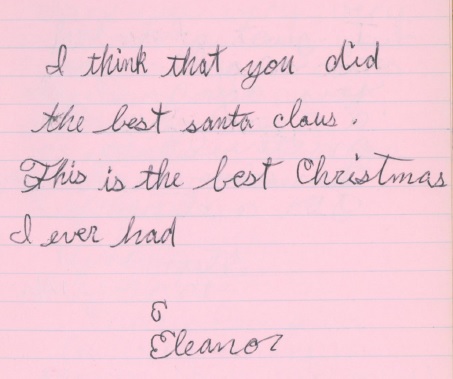
A child’s glowing endorsement written in one of the many guestbooks.
George added more to his holiday wonderland in 1975, including a Ferris wheel, a moving train and toboggan riders. Gladys Carpenter told the Pendleton Scout that year, “It’s a 365 day a year project” and a “labor of love.” “Labor because it is so much work to do it and love because he loves doing it.” George did it all to delight his children and the people who lined the streets to see it.
George’s Santa weighed 1200 pounds and was 22 feet high. Carpenter Family Collection
The Carpenter daughters can attest to how much work it was because each year, beginning in October, they were enlisted to help. As their father dug post holes, set up fencing and planned layouts for his elaborate scenes, they began rolling out miles of polyester batting that served as snow covering the roof, yards and walkways. Boyfriends were also expected to help with the setting up of the many pieces in the ever-growing Christmas collection. Firemen from the South Oceanside’s Fire Station on South Ditmar Street came over to help hoist up the 1200-pound giant Santa Claus.
Neighbors and Oceanside Firemen assist in putting Santa in place. Carpenter Family Collection
George would talk to children through his giant Santa by a speaker he had hidden, asking them what they wanted for Christmas. It was all so magical and the crowds grew. People came from all over as newspapers carried the story of the 22-foot Santa and the wonderful Christmas house.
One of the many newspaper articles featuring the 22-foot Santa Claus
The family started a series of guestbooks, asking visitors to sign in, giving their address and/or city and any comments they would like to add which included El Cajon, San Clemente, Leucadia, Los Angeles, San Diego, Riverside and Poway. There were others from out of state including Oregon, Florida, New York and Utah. In 1976 Ethel Pierson wrote, “Worthwhile coming out from Ohio to see this marvelous display.” Another wrote, “What a lovely Christmas gift. We all, young and old, alike, enjoy this wonderland.” Someone added, “So there really is a Santa Claus!!” Some children took to writing their Christmas wish lists in the guest books for Santa to read.
One of the many requests from children to Santa written in the guestbooks.
Sometimes visitors felt compelled to donate after viewing the grand exhibit; a kind gesture for sure, but it amounted to a nominal amount each year. George didn’t do it for money, but he once won $50 for “the best decorated lawn” which didn’t begin to cover his electricity bill. He did mention he would love to receive a trophy, but said, “The real enjoyment I get out of it is sitting in the house and watching the people’s reactions, young and old. They love it and for at least a few moments, their lives are a lot happier.”
Onlookers marvel at Santa and Christmas display. Carpenter Family Collection
George continued his oversized Santa display through 1977. He had run out of room (and perhaps energy) to store it all. In 1978 the huge Santa was set up at the Mission San Luis Rey where it was all but destroyed by a heavy storm. That might have been the end of George’s Santa, but the memories remain.
George Carpenter’s Santa could wave, blink and talk. Carpenter Family Collection
The Carpenter daughters still reminisce of their beloved father and his devotion to Christmas. Even though they tired of the weekends they had to spend setting up the lights, fake snow and figures, it was time well spent with their dad whom they adored.
By sharing their photos and memories with the Oceanside Historical Society they are keeping their father’s love for Christmas alive.
As a lasting tribune, the daughters erected a stone plaque in their father’s memory where the Carpenter house and the giant Santa once stood, with the permission of a good-hearted homeowner.
Plaque installed by George Carpenter’s daughters at corner of Clementine and Cassidy Streets.
“I will honor Christmas in my heart, and try to keep it all the year.” Charles Dickens
The large brick building at 1722 South Coast Highway is going over extensive changes and a “new transformation” but here’s a brief history of the building and some of the newspaper’s owners and publishers.
The building was built to house the Oceanside Blade-Tribune newspaper, which originated as the Oceanside Blade in 1892. It was a small but important weekly newspaper which provided world and local news to the residents of Oceanside.
Paul Beck, co-owner of the Oceanside Blade Tribune
Brothers Paul and Harold Beck, brothers who hailed from Iowa arrived in Oceanside in the late 1920s. They purchased the Oceanside Blade along with with another newspaper, the Oceanside News, and created the Oceanside Daily Blade Tribune and the paper went from a weekly publication to a daily one.
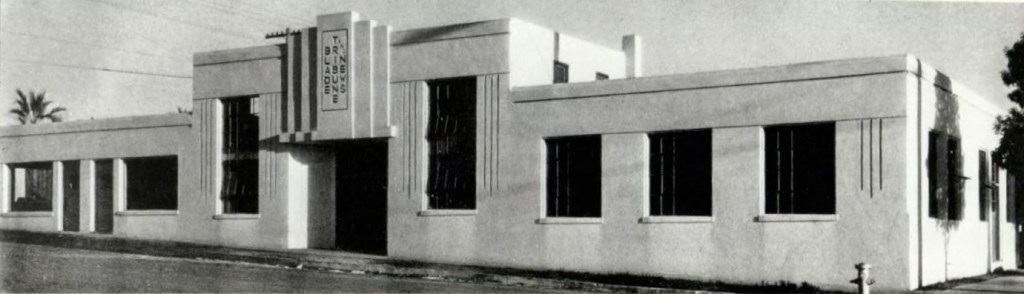
The Blade Tribune building at 401 First Street (Seagaze Drive) in 1936
In 1936 the Becks hired architect Irving Gill to design a new building for their growing business. Located at 401 First Street (now Seagaze Drive) it was Gill’s last design, which was restored in 2019.
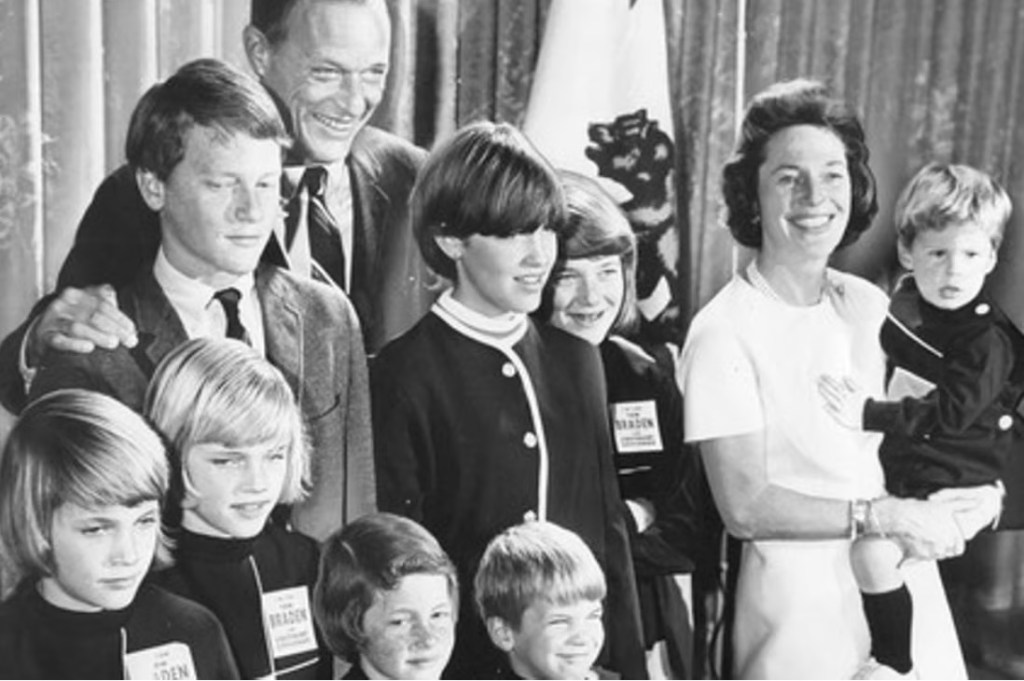
Tom Braden with wife Joan and their 8 children.
The Becks sold the Blade-Tribune newspaper in 1954, to Thomas W. Braden. Braden was at one time an official at the Central Intelligence Agency, and his wife Joan worked for Nelson Rockefeller. Rockefeller loaned Braden the money to purchase the Oceanside Blade-Tribune.
The Bradens were connected in both political and social circles. Joan was a close friend of Jacqueline Kennedy. Tom Braden was a regular on “Meet the Press” and was appointed president of the California State Board of Education.
In 1975 Braden authored a book about his family which became a popular television series under the same name: “Eight is Enough.” The Braden family lived on South Pacific Street near the gated entrance of St. Malo.
Braden’s book inspired a television series in the 1980s.
Braden sold the newspaper to Robert S. Howard of Naples, Florida in 1967. Howard founded Howard Publications in 1961 which eventually included 19 newspapers from around the country.
Howard was the son of a small weekly newspaper publisher in Wheaton, Minnesota. Born October 23, 1924, he was the third of three children. During World War II Howard left the University of Minnesota to join the military. As a Second Lieutenant in the Army Air Corp he was a navigator and nose gunner in bombers over the South Pacific. He served valiantly, earning a Purple Heart after being shot down in the Battle of Leyte in 1944.
After his return to Wheaton, he took over the family newspaper and over his lifetime amassed 18 newspapers as Howard Publications, with over 2,000 employees and nearly a half million circulation.
The Blade Tribune Building, 1722 South Hill Street (Coast Highway) circa 1980s.
In August of 1967 construction began of 11,500 square foot “modern printing plant” at 1722 South Hill Street (Coast Highway) at an estimated cost of $700,000. That same year, Thomas Missett became the general manager and publisher. The new publishing plant was built by local contractors, Richardson Brothers, and completed in 1968.
Tom Missett, publisher of the Oceanside Blade Tribune
A large two-story addition was made years later. In 1989 the Blade-Tribune was changed to The Blade-Citizen and then again in 1995, renamed the North County Times, which ceased publication by 2013. After 120 years of a hometown newspaper, the Oceanside Blade was no more.
The building has had several tenants over the years, including a vintage market. While Oceanside’s newspaper days may have ended, the two buildings built by the publishers are still standing, one repurposed as a restaurant, the Blade 1936, and the other in South O, in the process of being reinvented.
South Oceanside, a popular (and some would say “trendy”) neighborhood, was once a separate township of its own. Situated between the town sites of Oceanside and Carlsbad, it was established by John Chauncey Hayes, who was also heavily intertwined with the establishment of the City of Oceanside.
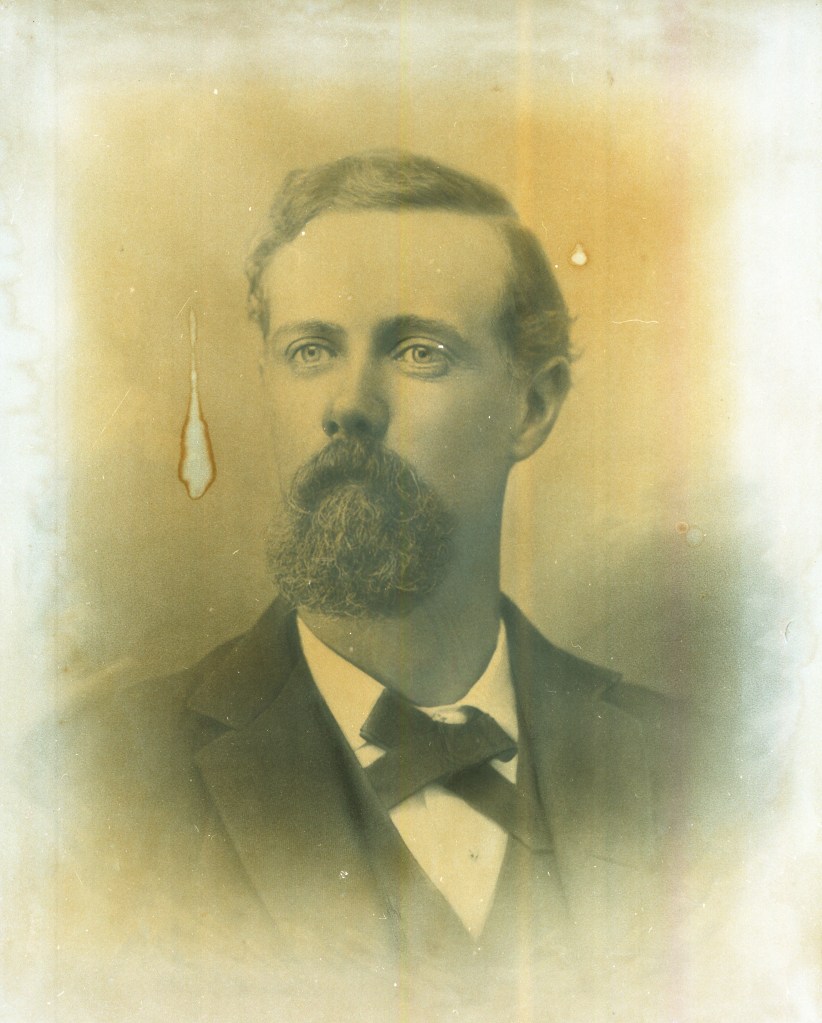
John Chauncey Hayes, founder of South Oceanside
Born in Los Angeles in 1852, he was the son of Judge Benjamin I. Hayes and Emily Chauncey. His father was the first judge of the district court to serve Los Angeles, San Diego and San Bernardino counties. The Hayes family moved to San Diego and the younger Hayes studied law in his father’s office until 1875, when he married Felipe Marron, daughter of Silvestre Marron. The newlywed couple moved to San Luis Rey, where Hayes “engaged in locating government and state lands” along with farming and delivering mail.
In the early 1880s Hayes bought 1200 acres of coastal land between Oceanside and Carlsbad. Even when he became the exclusive real estate agent for Andrew Jackson Myers, Oceanside’s founder, he also served as Justice of the Peace and postmaster. If that wasn’t enough for an enterprising, ambitious businessman, Hayes began to develop his new township of South Oceanside which included a depot, hotel, cemetery, a two-story brick schoolhouse and its own newspaper, The South Oceanside Diamond, of which he was the editor.
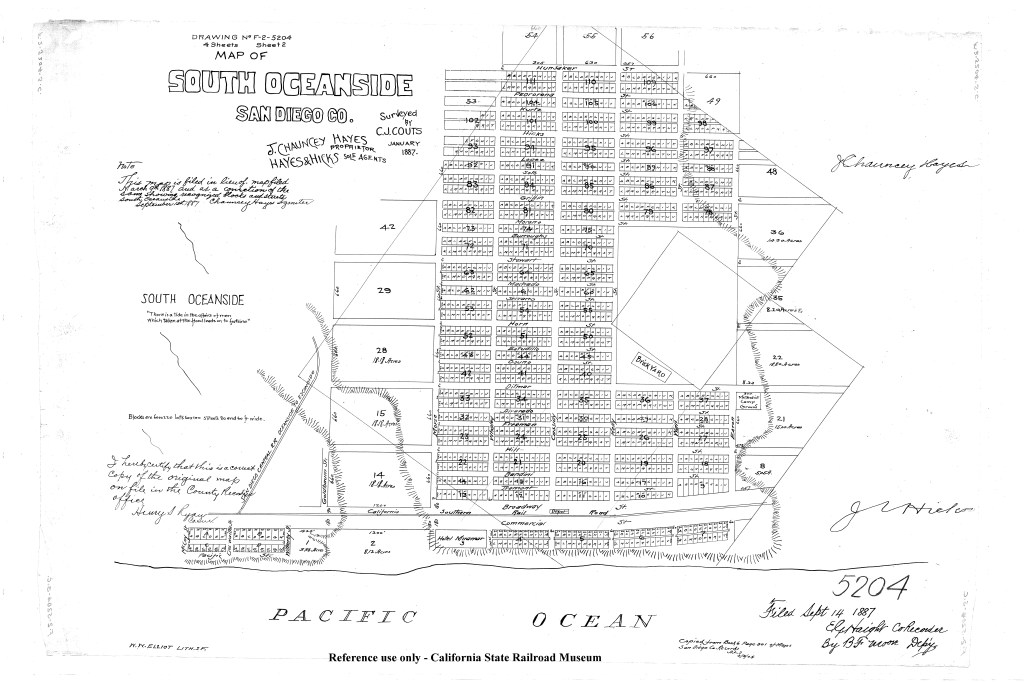
Map of South Oceanside, California State Railroad Museum
South Oceanside also had a brickyard just south of Kelly Street between Ditmar and Moreno Streets. The muddy clay from the nearby lagoon was used to fashion and fire bricks used to build buildings and no less than 10 homes. Hayes had a brick building erected to house his newspaper printing and real estate office.
Ad for South Oceanside in the South Oceanside Diamond Newspaper
In addition to these amenities, South Oceanside also offered a hotel for visitors. Located on the corner of Kelly and Tremont Streets (the exact location is unknown), Hannah Trotter operated The Diamond House. The name of Trotter’s establishment went along with the theme of South Oceanside, with its newspaper, the Diamond, and Hayes’ hyperbolic advertisement of “buying and wearing diamonds.”
Hannah Bell Trotter was born in 1836 in Pennsylvania. She married Thomas Trotter, a coal miner, in about 1866 and the couple had five children. After her husband’s death, Hannah and her children came to the new township of Oceanside as early as 1886. In 1887 Trotter acquired and filed her own addition to the town of Oceanside, a five acre tract in the northern part of town. It would be the first addition/subdivision in Oceanside established by a woman.
Hannah Trotter Addition, 1887
In March of 1888 it was first announced that the “foundations are being laid for Mrs. Trotter’s boarding house. It will be a brick building, costing $3000.” (The foundation was brick, but the house was actually made of wood.) The house would be finished by May 1st and it was noted that Mrs. Trotter would “keep a first class place.”
Ad for the The Diamond Hotel in the South Oceanside Diamond Newspaper, 1889
The South Oceanside Diamond reported on May 18, 1888 that “The Diamond House, built and to be conducted as a hotel by Mrs. Hannah Trotter, is almost completed, and will be of great benefit to this community. The grounds surrounding the hotel will be highly ornamental, choice trees, flowers, grass, etc., having already been selected by the proprietress, who is adept in the art of floriculture.” The following month, the Diamond reported that “Hannah Trotter has opened her boarding, house and is ready to accommodate boarders.” Weekly advertisements were included in each edition stating that the Diamond House was “first class in every respect” and the “best table set on the coast.”
Hannah Trotter died in 1911 at the age of 76. Prior to her death the property upon which her boarding house was sold to Augusta Dickson Garden in about 1896 and the two-story home was featured in a grainy photo in the Oceanside Blade newspaper.
In 1913 Belle McWilliams bought what was then called the “South Oceanside Hotel” from Mrs. Garden. It was noted that Hannah Trotter had operated the hotel “in early days.” Belle McWilliams was said to have plans to make “considerable improvements to the property” which included an “amusement pavilion” and “facilities provided for catering to automobile parties.” It is likely that the building had been moved to front South Hill Street, or what was known as the Coast Route or Highway 101, as the hotel was referenced as “being on the auto route.”
Emma “Belle” Mitchell McWilliams was a native of Arkansas, born in 1863. She married Hugh Harris McWilliams in 1900 in Texas. Hugh McWilliams had a daughter, Murrie, from a previous marriage. The trio arrived in Oceanside from Texas in 1913.
On July 5th of that year, an opening celebration and dance was held at the former boarding house and hotel, renamed the “Ye Wayside Inn.” Admission to the dance was 75 cents but spectators were welcomed “free of charge.” It was announced that “parents can be sure that their daughters will be carefully chaperoned and no rowdyism permitted.” Perhaps there was concern by locals because Belle McWilliams had petitioned the county supervisors for a liquor license.
Belle operated her Wayside Inn with little incident but in 1915 a bizarre and tragic event unfolded there.
George Melvin Slobohm, superintendent of the state highway, overseeing road work on the Highway 101, had been staying at the Wayside Inn. Belle McWilliams would later state that the Slobohm “had been acting oddly for several days.”
On Sunday, August 8th, Slobohm, approached McWilliam’s 24-year-old daughter Murrie and asked to speak with her privately. While in the house, he proceeded to confess his love for her, but told Murrie that because he was already married he had decided to kill her and then himself, as a future together was not possible.
In spite of this terrifying news, Murrie McWilliams kept her wits about her, and convinced Slobohm that they should leave the house and walk down to the beach. As they walked out of the Inn, Slobohm was armed with a shotgun.
Murrie spotted her father and instinctively ran to him for help. The crazed man shot at her as she ran, but missed. Miraculously, just at that time Belle arrived at the property in a buggy, and witnessed the fearful scene. Father and daughter climbed into the buggy as Belle drove hard and fast to the home of Warren E. Spaulding, a dairy farmer, just to the east near Cassidy and Stewart Streets, to call for help on the telephone.
Warren E. Spaulding at his dairy ranch in South Oceanside
George Slobohm remained on the property and did not give chase. When local Constable DeBord, along with M. J. Maxey, George and Robert Borden responded to the emergency, they found Slobohm dead on the porch with a self-inflicted gunshot wound to the head.
But before he turned the gun on himself, Slobohm had set fire to the McWilliams’ house in several places, pouring gasoline on the floor in four of the rooms and setting it ablaze. The officers managed to put out the fire and “save the house without much damage except in the laundry room which was pretty badly scorched.”
San Diego County Coroner Marsh came up that evening and a jury was summoned consisting of George A. Lane, Ben Higgins, John Osuna, D. A. Ellis, A. B. Curtis, and Josephine Jascen. They listened to the testimony of Murrie, Belle and Hugh McWilliams, viewed the scene and a verdict of suicide “was rendered accordingly.”
The Oceanside Blade stated that “Slobohm, who was about fifty years old, was a quiet man who bore a good reputation and was well liked by those who have had occasion to do business with him since he has been connected with the highway work here. He leaves a son, Henry, who has been living here, and two daughters and a widow in Los Angeles.” The next day George Slobohm’s wife and son came down from Los Angeles Monday and made arrangements for the removal of the body.
By the 1920s, Hugh and Belle McWilliams sold their Wayside Inn and moved closer to downtown Oceanside. Hugh McWilliams died in 1928 and Belle one year later.
1932 aerial of South Oceanside and Hill Street/Coast Highway (UCSB Library)
What became of the Wayside Inn, formerly the Diamond House and South Oceanside Hotel, is unknown. South Oceanside was annexed years prior and became part of the City of Oceanside. But it would stay a largely rural area for several years. Even as late as 1930 there were less than 10 homes or buildings fronting the coast highway. It wasn’t until the post war years when tracts of homes replaced the dairy cows, fields of crops and eventually the acres of flowers planted by the Frazee family.
South Oceanside is a popular neighborhood referred by locals as “South O”, but more than just a neighborhood, it was once a township, separate from Oceanside. Annexed by the City of Oceanside in 1890, the boundaries are near Morse Street to the north and to the lagoon to the south, and goes as far east as Hunsaker Street. In 1949 two of the original street names were changed: Osuna to Nevada, and Estudillo to Clementine. Vista Way was originally named Wall Street which was changed in 1927.
Map of South Oceanside, 1887
In the 1880’s the unincorporated area was largely owned by John Chauncey Hayes. Born in Los Angeles in 1852, Hayes was the son of Benjamin R. Hayes, an attorney and noted California historian. J. Chauncey Hayes graduated from Santa Clara College, then studied law with his father, and was admitted to the bar in 1877. He settled in the San Luis Rey Valley and served as justice of the peace.
John Chauncey Hayes
In 1887 Hayes established South Oceanside which at one time had its own bank, depot, school, cemetery, and several buildings made of bricks at a brickyard near Kelly and Ditmar Streets. He also published his own newspaper, the South Oceanside Diamond.
Hayes petitioned the County Board of Supervisors in 1888 to form the South Oceanside School District, which was granted. The following year the district voted and approved a new $3,000 school building.
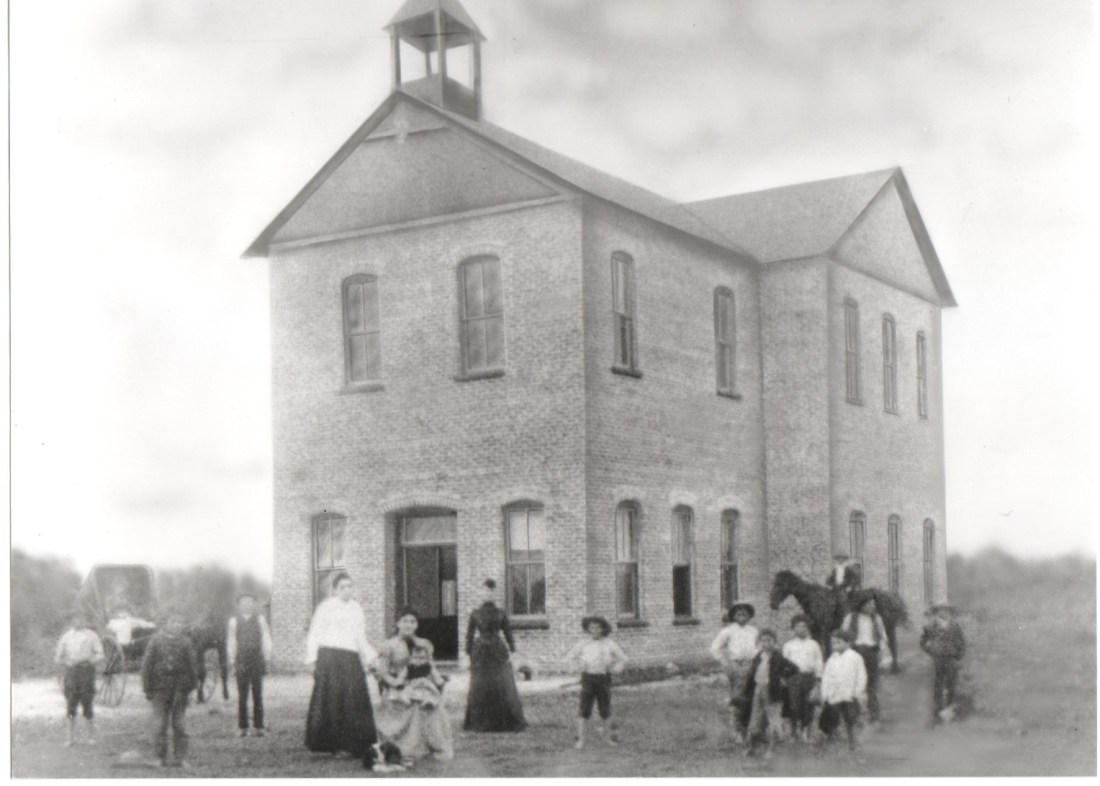
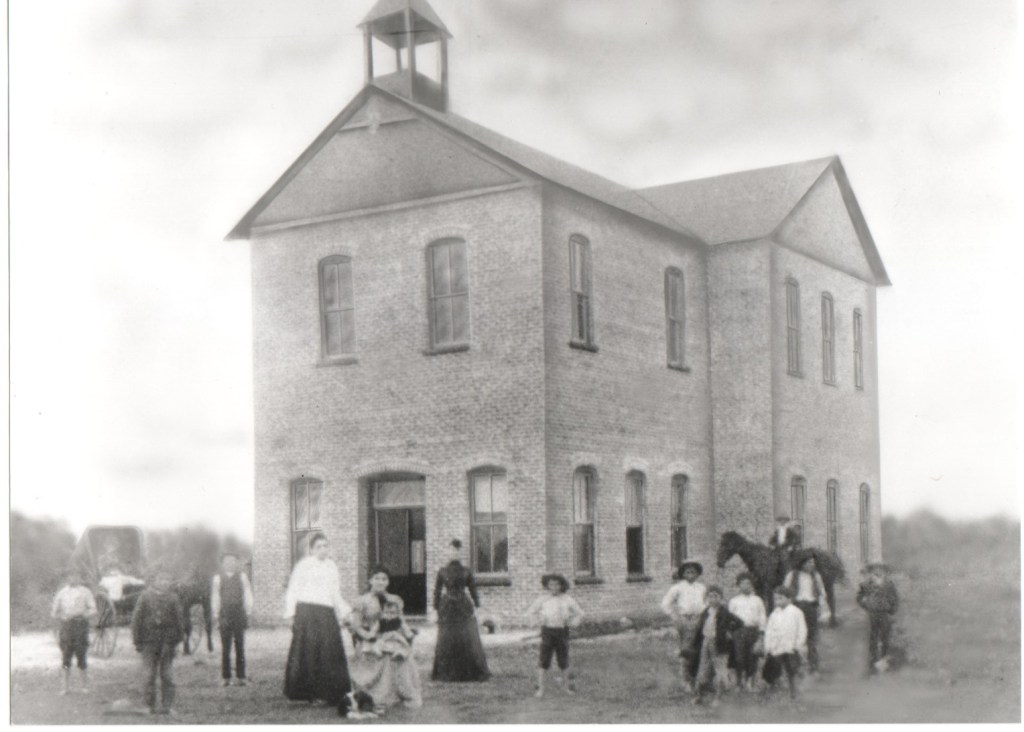
The South Oceanside School House, 1889
In August of 1889 the contract to build the school house was given to W. E. Damron to build a two story brick building at a cost of $1,600. The wood work and painting was given to R. C. Mills for $1,070. The South Oceanside Diamond reported that the work had already begun and that work would be completed in sixty day. The school was located on Block 41 near the southeast corner of Whaley and Ditmar Streets.
A census taken in 1891 reported that 43 children were living in the South Oceanside School District which would have included a portion of Carlsbad. One of the earliest teachers was a Mrs. Roberts, who resided in Los Angeles but would come down for the school year. Students were taught up to the 8th grade and then went on to high school in Oceanside.
T. V. Dodd, an educator at South Oceanside
Thomas V. Dodd, also taught at South Oceanside in the 1890s. He was a superintendent of schools in Madison, Indiana for many years. After coming to Oceanside he taught at several schools in San Diego County and later taught science at the Oceanside high school.
Lillie V. Deering was then hired to teach at the South Oceanside School. But the school was open and closed during the school year at various times, likely due to lack of attendance. South Oceanside was not heavily populated and it is likely that families sent their children to the Oceanside grammar school on Horne Street. In September of 1900 it was announced that the school would close for a few months, with no explanation.
In 1901 Mrs. Clewett was announced as the new teacher, but was replaced by Miss Alice Martin two months later. In 1902 the Ocanside Blade reported the school had a “daily attendance of 18.” In 1904 the school reported 14 students.
Isabel S. Kennedy of Del Mar was hired as teacher of the school in 1906. At the time there were just 9 pupils. The following year Mary E. Clark was employed as teacher of the South Oceanside School.
In 1909 Joseph George Martin of Fallbrook was hired to teach at South Oceanside. A native of Ireland, Martin came to San Diego County in 1877 and had taught for nearly 30 years in and around Fallbrook. In June of that year one student, Nora Marron, graduated from the Eighth grade. The Blade reported that “Prof. Martin, who has had charge of the South Oceanside School, is a faithful and experienced teacher and the pupils do good work under his guidance.”
Martin continued to teach another four years at South Oceanside. In 1913 three students graduated from 8th grade: McKinley Hayes, May A. Birchley and Emma Billick.
However, the following school year the school was “suspended”. It seems there were just a handful of students and many area residents thought students should attend larger schools in Oceanside or Carlsbad. It is unknown if school resumed that year but it was opened again in 1914 with Josefa Elena Jascen as teacher. In February of 1915 the school was closed for one month due to a lack of funds.
Jascen retuned the following school year and the local paper reported “a good attendance” of pupils which included Teresa and Cecilia Marron, Victoria Murrietta, Margarita, Harvey and Herminia Jascen, Morea Foster, Edgar and Irma Spaulding, Thomas Warson, Barbara Libby, Clifford Cole and Madalera Foussat.
The South Oceanside School after it had been dismantled and rebuilt in 1916. Windows and appear to be the same as original schoolhouse. Students pose with teachers, one of whom is Josefa Elena Jacsen.
Irma Spaulding attended the school between 1915 and 1920. Her family moved to South Oceanside in 1912 and operated a dairy farm. Irma’s father, Warren E. Spaulding, along with Earl Frazee, were Trustees of the school at the time.
In 1916 the school needed repairs, and a tax was approved in which to raise $249 for repairs. By August of that year it was reported by the Oceanside Register that “the work of improvements on the South Oceanside school building has been completed and school will be opened by Miss Josephine Jascen in a few days.”
Irma Spaulding said in an interview decades later that her father had dismantled the second story of the school. So it was likely then the school went from a large two story building to a smaller single story one.
Students pose on steps of the South Oceanside School, circa 1919
The school was probably permanently closed by 1924 and what remained of the school building was either sold and moved, or dismantled altogether.
Today the only South Oceanside School anyone remembers is the one located at Horne and Cassidy Streets. Construction began in 1947 and it opened the following year, initially only offering classes for kindergarten through the 3rd grade.
The corner lot where the original school sat at Ditmar and Whaley Streets remained vacant for years until 1949, when the South Oceanside Community Methodist Church began construction for their new church building. As work commenced the brick foundation for this historic school was discovered.
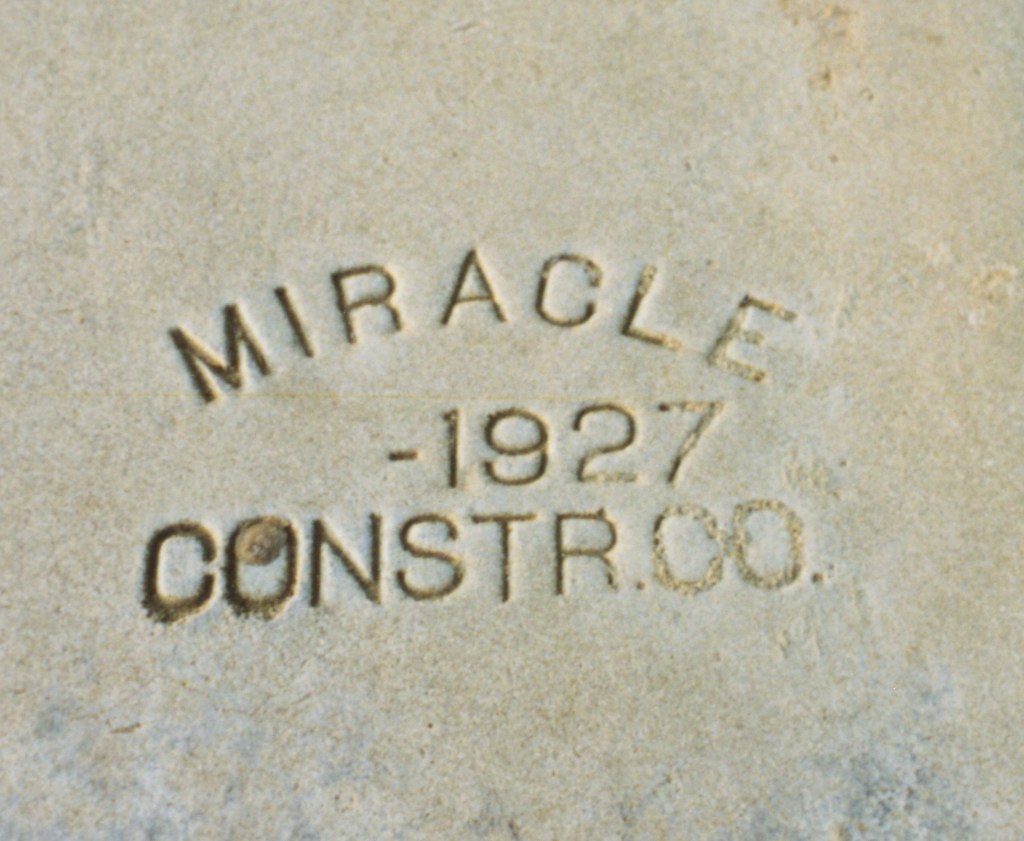
Walk the neighborhoods of Oceanside and you will find the sidewalks marked with the curious name “O.U. Miracle”. Many downtown sidewalks and curbs are engraved with this interesting name and many people may wonder what, if any meaning it holds, or who is this Miracle.
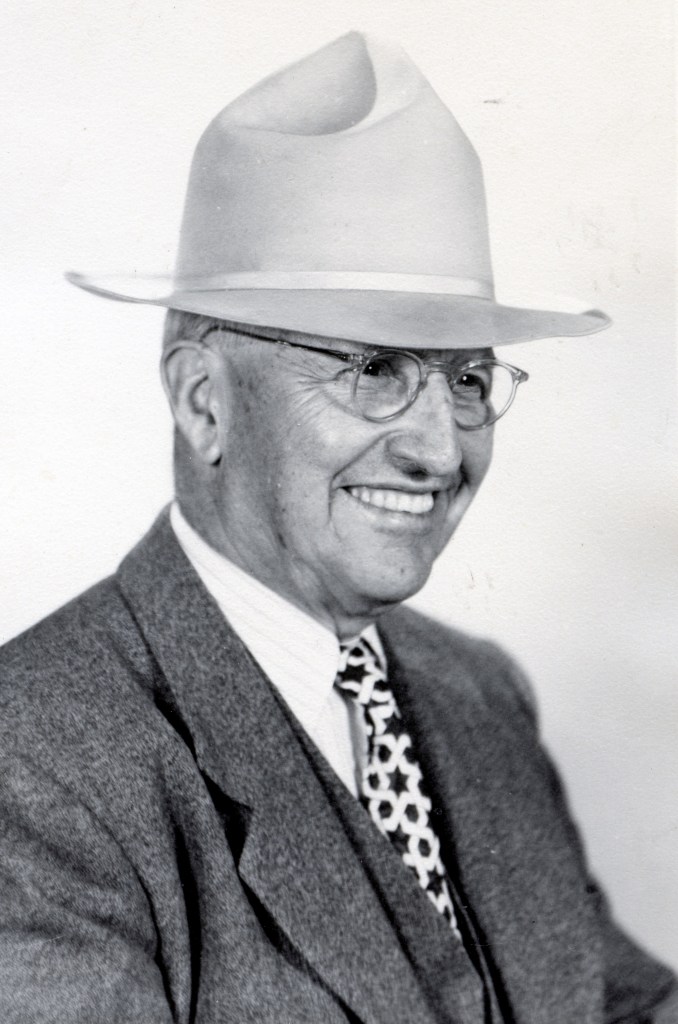
Orville Ullman Miracle’s parents were creative in thinking up their son’s name. Their beloved son’s initials lovingly proclaimed his birth to the world … and I can’t help but think Mrs. Miracle must have held her precious baby and whispered in his ear, “Oh You Miracle!” Little did they know but that this name would be used as a marketing tool second to none.
Born in 1871 in Neenah, Winnebago County, Wisconsin to James and Mary Miracle, Orville began a career in the cement business in about 1901. He later established the Miracle Pressed Stone Company, manufacturing and selling “Miracle Concrete Blocks” across the upper Midwest.
Orville Ullman Miracle (courtesy Richard Miracle Willets)
However, it was his cement business that brought him the most success. He traveled from Iowa to South Dakota, Minnesota, Nebraska and even Montana, pouring cement for roads, sidewalks and curbing for cities and townships.
Left to right: Barry Derrer, O.U. Miracle, and two unidentified workers (courtesy Richard Miracle Willets)
Miracle’s association with Oceanside began in 1927 when he was the low bidder on the contracts to improve streets throughout downtown and the ocean front. He laid miles of concrete sidewalks throughout Oceanside that have long outlasted other cement walks poured decades after.
Office of O.U. Miracle at 1933 South Hill Street (now Coast Highway)
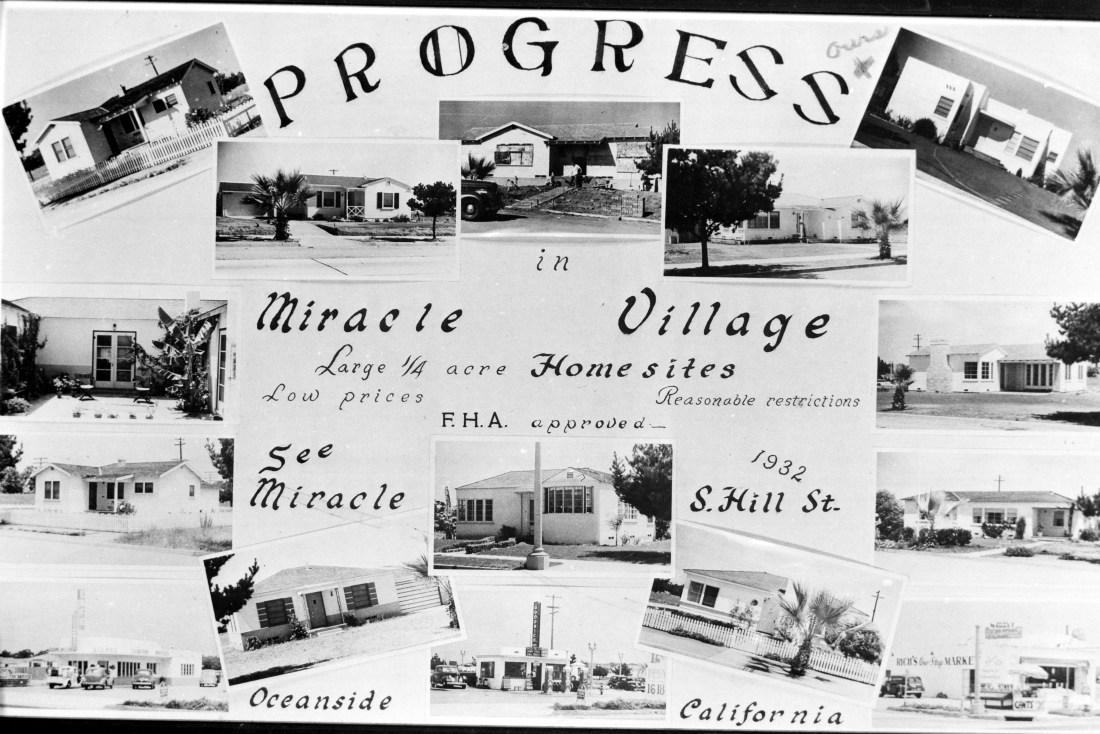
In 1938 South Oceanside became the home of “Miracle Village”. Miracle purchased nearly all of the Tolle Tract in South Oceanside, along with other lots which included either side of Vista Way from Hill Street to east of Moreno Street. He advertised his “Oh You Miracle Tract” around the southland and began building single family homes and selling them from his office at 1932 South Hill Street. The San Diego Union reported that Miracle sold lots “cafeteria style” – prices were placed on the lots, no middlemen, and buyers simply picked out their lot and brought the price tag to his office to complete the purchase.
Postcard advertisement for Miracle Village
Miracle built a house at 2022 South Freeman Street where he and his wife Grace made their home. Growing up, Robert Morton, lived next door to Mr. and Mrs. Miracle. He shared with me that Miracle built the home for his mother Charlotte Morton and it was the last empty lot on the block at the time. Other neighbors included Dr. and Mrs. George Totlon, Bob and Johnson, Rudy and Jane Sonneman, and Harold and Alma Davis.
Charlotte Morton and children in front of their home at 2018 South Freeman Street in “Miracle Village” South Oceanside
O. U. Miracle grew fields of gladiolus on parcels he owned to the east of his home. One block west he planted tomatoes and lima beans. His grandson Richard Miracle Willets wrote in his recollections: “During harvest I was put to work picking lima beans and also tomatoes. I loved picking tomatoes because tomatoes must still have some green on top to be marketable so the really delicious fully ripe ones we could eat in the field. I wasn’t really on the payroll but one evening ‘GG and GPOP’ and I were sitting in the living room listening to the radio when ‘GPOP’ said he had a surprise for me and gave me $14 which I thought was a lot of money.”
He added that his time with his grandfather “was very precious” which included waking up in the morning and having breakfast that his ‘GPOP’ made for him – “wonderful eggs bacon and pancake breakfasts.” They would often go out in the garden and pick ripe figs and peaches to have with our breakfast.”
Looking east at Hill Street (Coast Highway) and Vista Way. (Richard Miracle Willets photo)
Willets would also recall trips to the land office with his grandfather. “I would tag along with him when he went over the Miracle Village office. Grandpop chewed tobacco and beside his desk be had a brass spittoon. His aim wasn’t that great so the the air in the office had a distinct smell of chewing tobacco.” During the Depression years he also noted that “selling a lot for $400 at that time was a pretty big deal as money was pretty scarce.”
(photo courtesy Richard Miracle Willets)
O. U. Miracle’s unusual name brought attention from many columnists across the country, including “Ripley’s Believe It or Not” in 1934. In fact, O. U. Miracle appeared in a feature or advertisement in newspapers in nearly every state of the US between 1901 and 1949. His name was so familiar that a letter from South Africa simply addressed to “O.U. Miracle, USA” was delivered to him.
Ad in The Los Angeles Times, Sunday, June 19, 1938
Willets remembered that his grandfather worked out a deal with the Standard Oil Company, who built a gas station on the Northeast corner of Hill Street (Coast Highway) and Vista Way. The company paid him a few cents for every gallon of gas that was sold, which provided him (and later his daughters Margaret and Elinor) a steady stream of retirement income for many years. (The site is now the home of Valvoline, 1942 South Coast Highway.)
Described as an “ardent civic worker”, Miracle was also politically involved in the City and community affairs. He was involved in the Elks and Rotary clubs as well as the South Oceanside Improvement Club. Miracle served as the game warden for the Buena Vista Lagoon, which was a bird sanctuary. His grandson remembers that Orville had to tell people they were not allowed to shoot the ducks at the lagoon!
O.U. died October 9, 1949 at the Oceanside Hospital at the age of 78. Up until his death he remained interested in the development of Oceanside.
Next time you walk through downtown, pause at each “little Miracle” you pass. It is a unique reminder of an Oceanside entrepreneur who left his mark on Oceanside in a very permanent way (and in the heart of his grandson Richard Miracle Willets).
The True Story of the Buena Vista Cemetery in South Oceanside – Adding to the Burial List
Editor’s Note (Oct 10, 2025): With continued research the body count at the Buena Vista Cemetery continues to grow, bringing the total to known burials to 52. As the number of burials rise so does the unsettling feeling that more have been left behind, on the site of the Hunter Steakhouse and the next door business (now a coffee shop).
Two previous unknown persons were Comfort Spencer who died in 1890 in Encinitas and Albert Vail who died in 1893. Both were buried in the South Oceanside Cemetery.
In 2020 death notices of three additional people who were buried in the Buena Vista Cemetery were discovered. Brothers Percy and Albert Laughlin, died in 1888 and 1895, their obituaries published in Kansas newspapers indicate they were buried at South Oceanside. Then, it was In addition, the Escondido newspaper reported that John Goss died in 1908 and was buried at Buena Vista Cemetery (and even at that time reported the sorry state of the cemetery…just 20 years after it was established).
History of the Buena Vista Cemetery
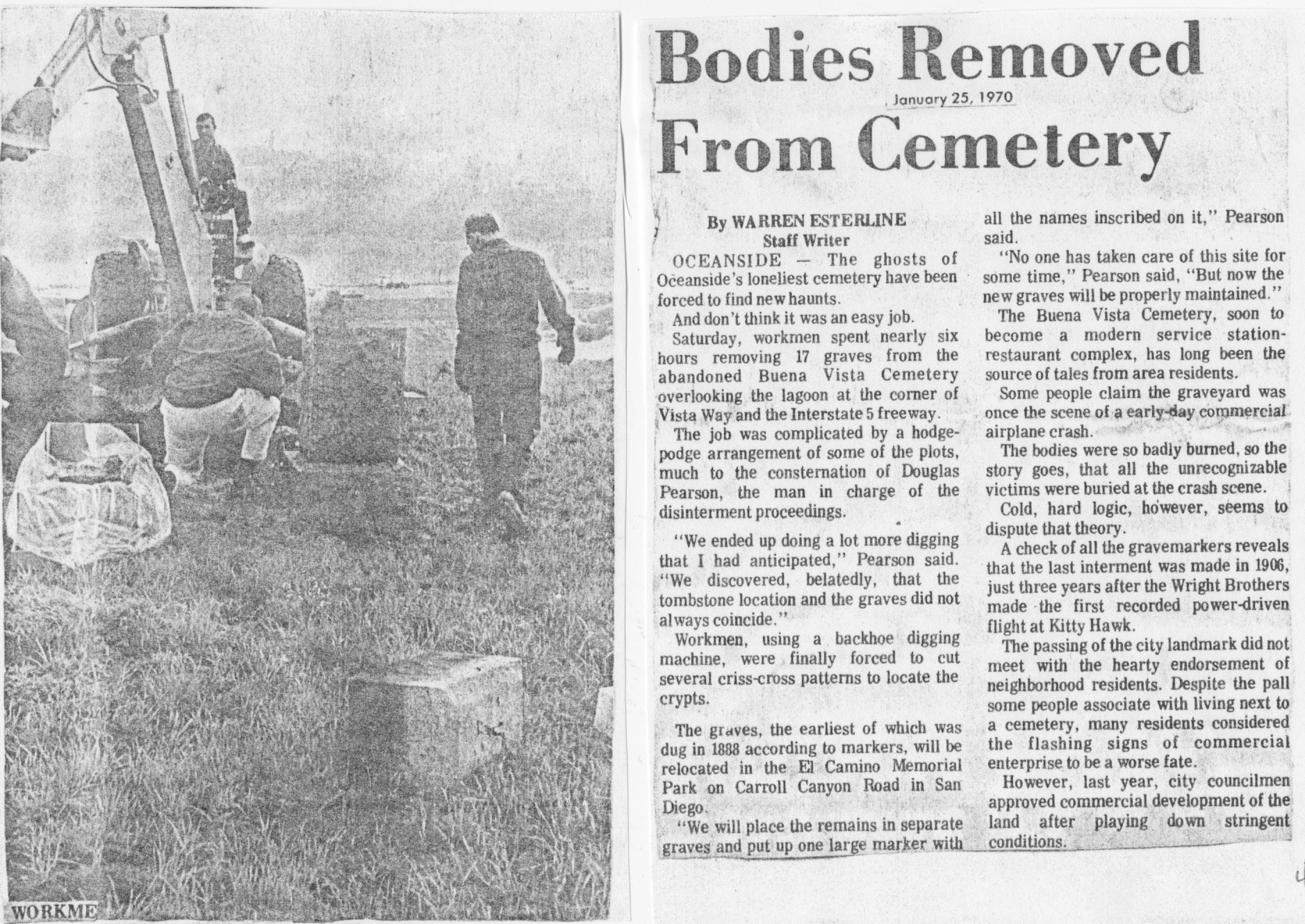
On Saturday, January 24, 1970, workmen began the task of removing graves from the Buena Vista Cemetery in South Oceanside. It took six hours to locate and remove 17 remains of the dead on the 2 acre site. People who had been buried there between 1888 and about 1916. The unidentified remains were removed to El Camino Memorial Park in Sorrento Valley.
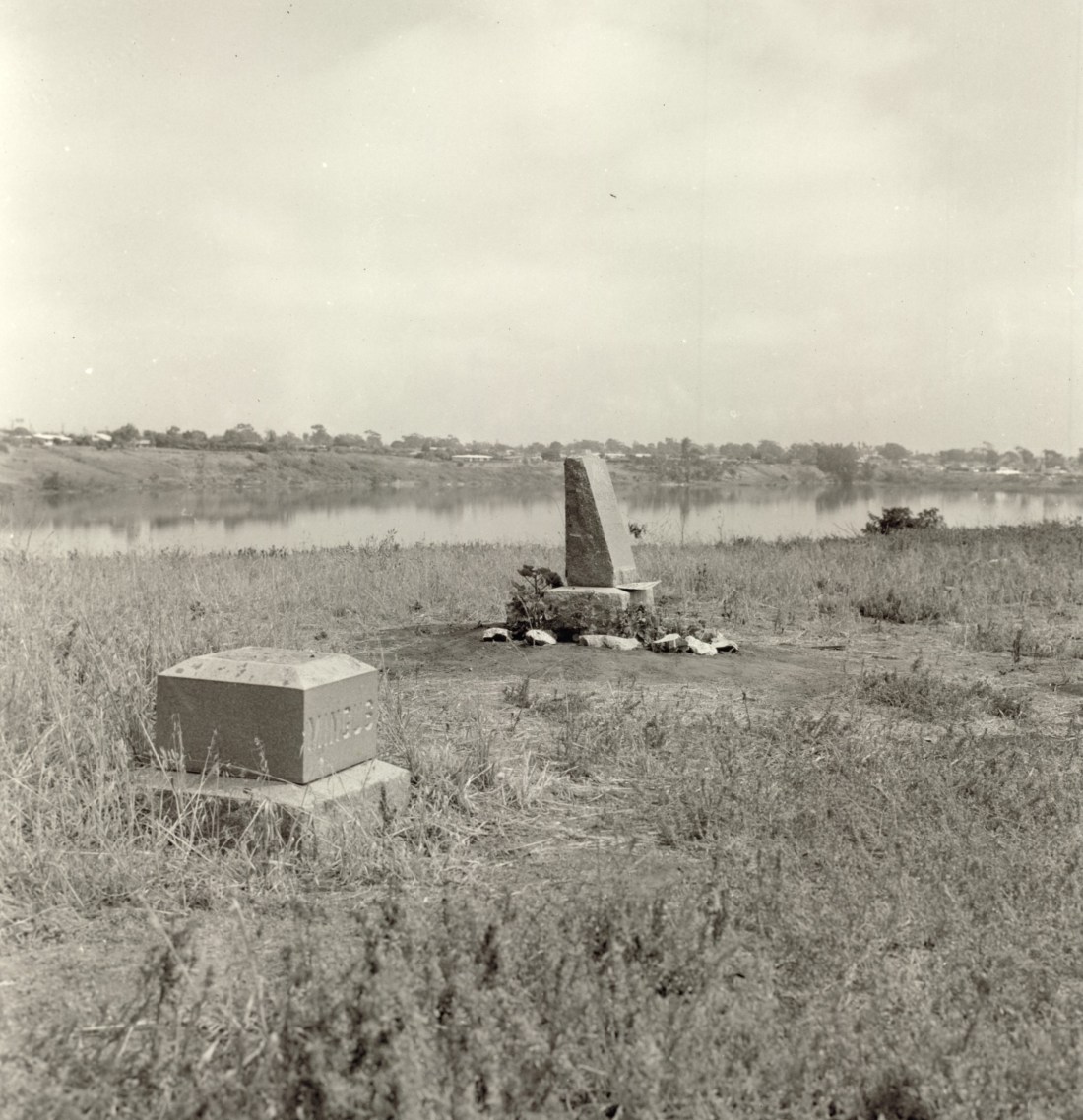
The cemetery had been neglected for several decades. It was privately owned, not associated with any church or organization. Thus, there was no “perpetual care”. There was no official burial list or caretaker. Over the years, headstones had been likely stolen, wooden crosses removed, and memories faded as to who was buried there, and the cemetery became an overgrown field with a handful of toppled headstones.
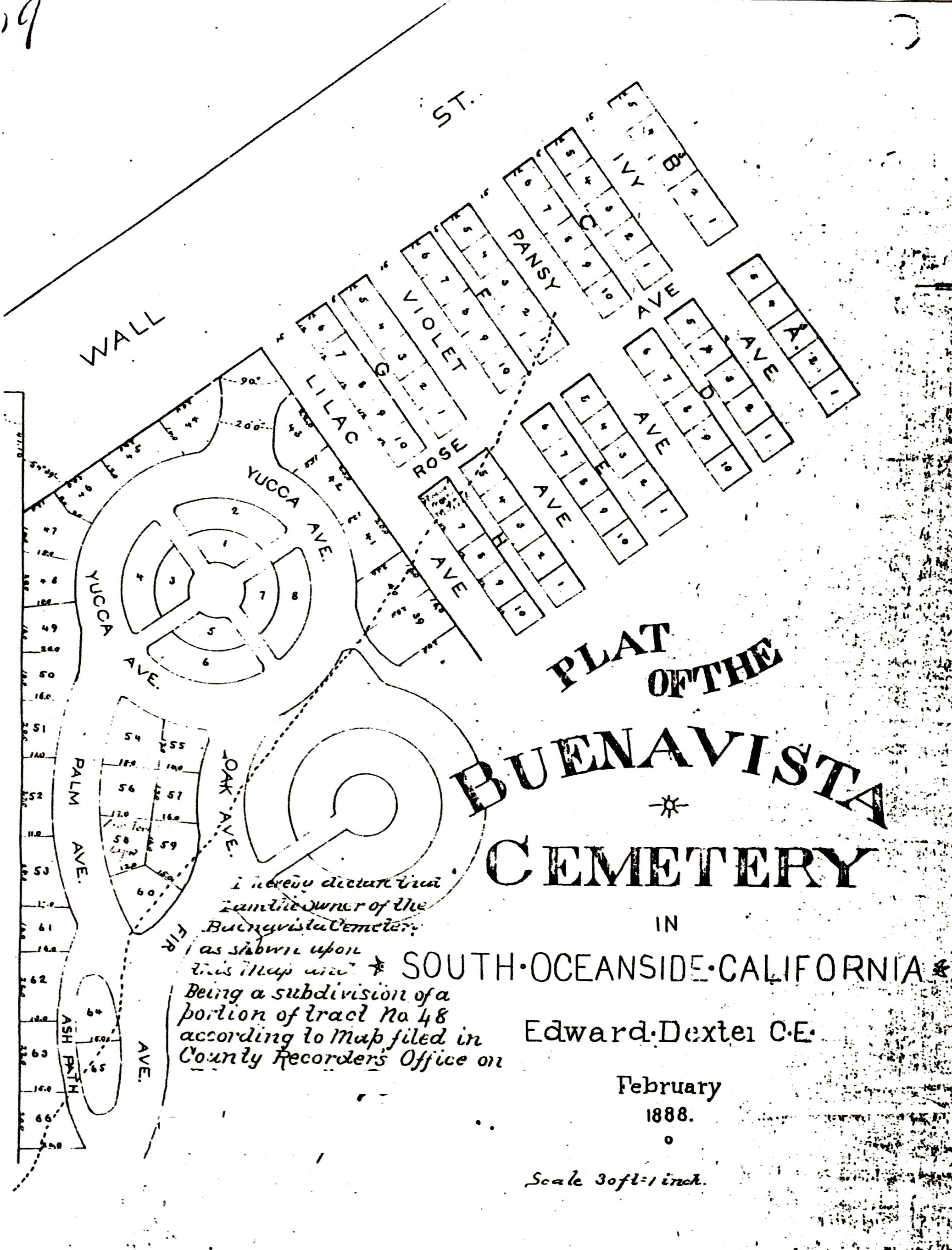
Despite the neglect, most of the people interred at Buena Vista Cemetery had families that attended their funerals, mourned their passing, and placed markers on their final resting place, whether wooden or stone. They were just not nameless, unfortunate souls who died alone. The dead were laid to rest in a peaceful, picturesque cemetery overlooking the Buena Vista Lagoon, which also provided expansive views of the Pacific Ocean. Lanes within the graveyard bore the names of trees and flowers: Fir, Oak,Yucca, Palm, Ivy, Lilac, Pansy, Rose and Violet.
The Buena Vista Cemetery was located in South Oceanside, a separate township of its own between Oceanside and Carlsbad. It was established by John Chauncey Hayes who was also heavily intertwined with the establishment of the City of Oceanside. Hayes became the exclusive real estate agent for Andrew Jackson Myers, Oceanside’s founder, and he also served as Justice of the Peace and postmaster.
John Chauncey Hayes, established the township of South Oceanside and owned the Buena Vista Cemetery in South Oceanside
Hayes began to develop his new township of South Oceanside which included a train depot, hotel and its own newspaper, The South Oceanside Diamond, of which Hayes was the editor.
Hayes hired Edward Dexter, a local engineer, to lay out the cemetery for him, which contained 106 burial plots. The earliest map of the cemetery gives credit to Dexter and is dated February 1888. However the cemetery was not officially recorded until 1893.
The cemetery was located along Wall Street, which is now called Vista Way. At the time Hayes established the cemetery there was no other burial ground for area residents, including Carlsbad, Oceanside and even Vista. The closest cemetery would be that of the Mission San Luis Rey, for Catholics; or a small public graveyard called the San Luis Rey Cemetery (known now as the Pioneer Cemetery). Both of these burial grounds were at least four miles away from downtown Oceanside and were likely considered inconvenient for coastal residents.
It did not take long for the new cemetery to be utilized, as perhaps one or two infants were laid to rest shortly by mid-March 1888. Sarah Perry may have been among the first few known adults to be buried at Buena Vista. She died of dropsy of the heart, an old fashioned term for congestive heart failure, at the age of 50 on March 27, 1888.
In June of that year, a Mr. P. Morton, a railroad laborer, died and was buried there. Ione Layne and her infant daughter Edith died tragically and were buried there in 1888 as well.
George Bronson, who was buried elsewhere, and had died in 1885, was moved to Buena Vista Cemetery by his wife Mary in December of 1888. She had a monument maker from San Diego place a new headstone for her husband.
Headstone of George Bronson, moved from the Buena Vista Cemetery to the Oceanview Cemetery
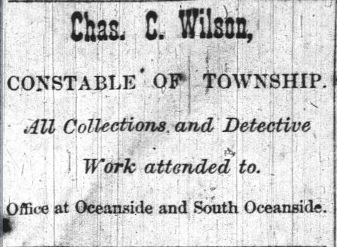
Charles C. Wilson was also buried at Buena Vista. He was the first Oceanside law officer to die in the line of duty in 1889. Wilson was gunned down on the streets of Oceanside by John Murray, a nephew of San Luis Rey pioneer Benjamin F. Hubbert. The City of Oceanside, set to celebrate the 4th of July, instead gathered to mourn the loss of their marshal.
!888 Advertisement for Charles C. Wilson
Five children all died in 1893 and were buried at the cemetery: Zoe Holman, her sibling, Johnnie Hunting, Lois Hunting and Henry Irwin.
Between 1888 and 1900, at least 38 persons were buried at Buena Vista Cemetery, and it is believed that 51 (or more) people were buried there, evidenced by death certificates, remaining headstones and published obituaries through 1916. Notable pioneers include John Henry Myers, the brother of Oceanside’s founder Andrew Jackson Myers, and members of the Weitzel, Frazee families.
John Henry Myers, brother of Oceanside’s founder, Andrew Jackson Myers, was buried at South Oceanside in 1894
The last known burial was in 1916. Meta Spaulding was just ten days old when she died on December 31, 1916. She had been adopted by the Warren Spaulding family, owners of a dairy in South Oceanside. Irma Spaulding Ratcliff said that she remembered walking to the cemetery as a little girl after the funeral for Meta’s burial.
Burials were probably discontinued due to a new and much closer cemetery in Oceanside, the I.O.O.F. Cemetery (now known as Oceanview Cemetery) that was established in 1894.
In 1929 Wall Street (aka Vista Way) was being widened, which necessitated the removal of several of the buried. It is unknown if there were any protests from family members but the cemetery by that time was considered “abandoned”. Eight remains of the dead were disinterred and removed to the I.O.O.F. Cemetery, (aka the Oceanview Cemetery) on Hill Street (Coast Highway). They included George Bronson (his second reburial), little Meta Spaulding, India D. Goetz, siblings Johnnie and Lois Hunting, Fred T. Walker, and James McCrea. The Weitzel family moved the bodies of their loved ones, Laura and Dr. Martin Weitzel, to Mt. Hope Cemetery in San Diego. Ida Squires was moved to the San Marcos Cemetery.
The Frazee family removed their family member, Don Blair Frazee to the I.O.O.F Cemetery on Hill Street. The Oceanside Blade newspaper reported the unusual circumstances regarding his disinterment with the headline: Body of Early Pioneer in Perfect Condition. It went on to say: In a state of almost perfect preservation, apparently from some mineral component of the soil, the body of Don Frazee, early Oceanside pioneer, has been exhumed after having been interred over 30 years, the casket and the clothing showing almost no signs of decay and a flower held in the hand of the dead man even retaining much of its color. The body was taken from its original resting place in the South Oceanside cemetery which is being abandoned in the course of street improvement work in the Tolle tract, on the east side of which the old cemetery was located, and was the first burial place after the settlement of Oceanside and Carlsbad.
With 51 known burials, and eleven known removals in 1929, that would have left a total of 40 remaining at the Buena Vista Cemetery, an important number to consider.
If the cemetery was abandoned by 1929, it is unknown how long Hayes owned the property. The land on which the cemetery was located was eventually sold to Carlsbad resident Harold Baumgartner. He sold the property in 1958/59 to an Oceanside school teacher, Beth Harris French, who acquired the Buena Vista Cemetery along with another portion of land to “preserve her view” of the lagoon from her home at 2020 Stewart Street.
While French was left wondering who was responsible for the care of the cemetery, she attempted to find an organization to take over the care and upkeep. Perhaps once a year, an occasional youth group or Boy Scout troop would tend to the headstones, at which time totaled twenty. Despite her concern, French asked the city to rezone her property and then sold it to a developer, who then petitioned the City of Oceanside to rezone the property for commercial use.
A clean up of the cemetery in 1968 shows several of the headstones
At the time James Swartz, of Encino, argued that the number of dead remaining in this abandoned cemetery was just nine. When asked by City officials what would happen if there were more than eleven remaining, Swartz said that if there were as many as forty or people buried there, he would abandon the project. (There may have been as many as 42 remaining burials as previously noted.)
A few dozen local residents signed letters of protests, most of which were residents of South Oceanside and not related to the buried. Some attempt was made to find descendants of the dead but it appears none came forward.
A lot of misinformation was floated around. Some people insisted that there just three people buried (despite over a dozen headstones); others suggested that the people buried all died in a plane crash (quite impossible as most people buried there died before the Wright Brothers historic flight in 1903).
Ultimately the decision was made to allow development of the property and to disinter the bodies, the cost of which was borne by the developer.
When excavation began, seventeen remains were discovered, not eleven as Swartz claimed. It turns out that Swartz may have simply counted the existing headstones, and did not consider there were more people than markers. The remaining headstones did not make their way to El Camino Memorial Park with the disinterred remains. They had been moved and no longer coincided with the proper burial location. Instead the grave markers were used as fill and are ‘buried’ under the onramp to Highway 78, just east of the cemetery location. Perhaps one day they will be discovered by a Caltrans crew who will have no idea as to their origin or rightful place.
It is well within reason to assume that as many as 42 set of remains were still buried at the cemetery before the project began. If 17 sets of remains were removed at the developer’s cost, that may have left 25 behind (or more).
Grading began on the property to ready it for development. Soon after which several remains, unceremoniously left behind, were discovered. This was confirmed by two reputable people. One such account was from Manny Mancillas, who worked for North County Soils Testing Laboratory in Escondido in 1969. His company was hired by an oil company, as a service station was to be built on the eastern portion of the former burial site, and the western half a restaurant, The Hungry Hunter.
Mancillas remembered that the gravestones had been gathered in a pile before they were used as fill on the I-5 offramp. He noted that some of headstones were “beautiful” and some were about four feet high.
After a couple of days on the job site, the front loader hit remains of one or two coffins. According to Mancillas, the City was called and an employee from the Engineering Department came out with a burlap bag and took the bones. The crew was told to continue their work. This “transaction” happened at least one other time, when an additional grave was discovered. And as digging continued, outlines of other coffins appeared.
One particular coffin the crew uncovered had a lead glass top, revealing a body of a woman with red hair in almost perfect condition. Her coffin was found near Vista Way towards the entrance of the present day Hunter Restaurant. He said that she was dressed in attire from the late 1800’s; a black buttoned dress with a high white collar. This mirrors the disinterment of Don Frazee in 1929, who was found “preserved.”
Work stopped after the discovery of the woman and the men were unnerved. The men were afraid she would be taken away in a burlap bag and not given a proper burial, so they made the decision to use the front loader to rebury her. Her discovery was kept secret and she was quietly buried down the slope of the lagoon. The construction crew felt that re-interment in the slope was a more decent and dignified burial for the “Lady in Black.”
Aerial of property containing restaurant and current bike shop
Mancillas said that at least six bodies were found during the time he was on site. Bill Hitt, who worked for K L Redfern out of Orange County, did the excavating for the gas station and his memories are similar to that of Mancillas, although Hitt felt more than six remains were found after the official removal; he remembered as many as 12.
Depending upon which numbers are used, that would still leave either 13 or 19 possible remains left at the cemetery.
While some might scoff at the idea that any other bodies or remains were left behind, consider this: In October of 1991, Texaco was on site of the former service station (now a bike shop) perhaps doing soils testing and they discovered an additional five sets of remains. There was no way to identify them, and the company paid to have them removed to Eternal Hills Memorial Park in Oceanside.
Even with the removal of 5 additional remains in 1991, there are likely still remains at the site to this day, perhaps 8 or as many as 14. (Depending on how many remains were actually removed by the two different grading companies).
There are some who believe the Hunter Restaurant is now haunted. Whether you believe in spirits or not, it is still an unsettling situation.
With the removal of Buena Vista Cemetery, Oceanside lost a part of its history. When those early pioneer families laid their loved ones to rest they never could have imagined they would suffer such indignities.
In the 1990’s the Oceanside Historical Society placed a granite marker on the sidewalk on Vista Way in front of the Hunter Restaurant, listing the known persons that were buried there at the time. (The plaque does not include persons found with additional research in recent years). It stands as the only reminder of the Buena Vista Cemetery and the pioneers buried there.
Kristi S. Hawthorne, historiesandmysteries.blog “Death of a Cemetery”, 2019. Unauthorized use and/or duplication of this material without express consent and written permission from the author and owner is strictly prohibited. Links may be used, provided that full and clear credit is given to the author Kristi S. Hawthorne and historiesandmysteries.blog “Death of a Cemetery”, with appropriate and specific direction to the original content.































 Histories and Mysteries