

South Oceanside’s popular health food store “Cream of the Crop” has been around for nearly 40 years. But the history of the building is a colorful one beginning in the 1940s …. once occupied by a fish grotto, cocktail bar and later a gentlemen’s club called the “Man Trap.”

Built in 1944, the building was owned by Dr. Clifford and Cora Brodie and housed Brodie’s Fish Grotto which opened in the summer of 1945. The Brodies had an auto court-style motel on the southwest corner of Vista Way and Hill Street (Coast Highway) in South Oceanside. They also owned an apartment building at 2012 South Tremont.

Clifford Brodie was married up to five times and Cora may have been wife number two. They were married in about 1930 and had one son, Elwood. The couple divorced and Cora remarried, her new married name was Shuey. Cora received the Tremont Street apartment building where she resided, along with the building located at 2009 South Hill Street a.k.a. Coast Highway, in the divorce settlement.

Cora Shuey opened a new restaurant in her building on Hill Street called “The Port Hole.” It operated from 1947 to 1952. Athur Vitello then opened a restaurant and cocktail bar called Diana’s, in mid-1952, while Cora retained ownership of the building.
Diana’s was a popular hangout for several years along the historic Highway 101, on the outskirts of Oceanside. Clientele came from both Oceanside and Carlsbad and beyond.
In 1955 a shocking incident occurred there when a man shot his wife, killing her instantly, and then turned the gun on himself. James and Joyce Nolan were living in the motel next to Diana’s at 2001 South Hill (Coast Highway). The couple had entered the establishment and had a noticeable disagreement or fight then left. Joyce Nolan returned alone to the cocktail bar and her husband re-entered and asked her to come home. She refused saying she wanted to finish her drink. Soon after James Nolan approached his wife and without a word shot her in the throat with a 38-caliber pistol. He then shot himself in the head.

Oceanside Police were summoned by shocked bar staff. In his pocket police found a tattered letter written by James Nolan to his parents. It read: “I can’t take it anymore. The only one I ever loved is Joyce and we just can’t seem to get along so I’m ready to call this life to a finish.” They had only been married a few months.
In June 1959, Cora Shuey had the building “completely redecorated” and opened “The Coral Reef, Oceanside’s newest restaurant and supper club.” Cora Shuey died in 1960 and was buried in Eternal Hills.
By 1961 the bar/restaurant was owned by Marvin Burke and for a time it was called “Marv’s Coral Reef.” It remained the Coral Reef through the mid-1960s when it was later renamed by owner Robert F. Blanas as the “Pink Kitten” from 1967 to 1968. The Pink Kitten was no supper club but an establishment known as a “go-go bar” featuring topless dancers.
The name “Pink Kitten” did not last long and the tamer, if not ambiguous name, “Coral Reef” was returned by 1970, but the topless dancers remained. Help wanted ads ran in the local paper offering $3.25 an hour for single or married go-go girls. (The state minimum wage was then just $1.60.) “Earn while you learn” was the headline, but it was unclear what the women would be learning.

But by 1972, the adult venue was renamed “The Man Trap” leaving little to the imagination. Its clientele were often rowdy marines, who would get into fights with each other and or the locals. On one occasion Marine officers were relieved of their commands because of a bar fight at the Man Trap.
In 1974 three Marine officers faced charges after a brawl that left a bouncer injured. Lt. Colonel Robert Hicketheir was charged with felony assault, while Major Patrick Collins and Col. John I. Hopkins were charged with battery and misdemeanor assault. The doorman of the Man Trap, James Weaver, was struck on the head with a drinking glass and suffered cuts and bruises.
Newspaper accounts reported that Hicketheir had taken a doorman’s flashlight and tried to shine it at a dancer. When Weaver attempted to retrieve the flashlight, he was struck in the head. Collins then allegedly struck Weaver continually with this fist “about the head and upper body while suspect number one held him.”
Hopkins was later acquitted by a judge after he determined the Marine officer had simply tried to intervene in the melee. In July 1974, Hicketheir and Collins were declared innocent on all counts by a jury of four women and eight men. Their accounts were vastly different from the original reports, and stated that Weaver was the aggressor.
Their testimony was that Hicketheir had used the flashlight to view a vending machine, when the doorman picked Hicketheir up and shoved him against the wall, which started the physical altercation. Collins testified that he was simply coming to the aid of Hicketheir. The newspaper noted that the prosecution witnesses were “flamboyantly dressed” with “contemporary hairstyles” and were bartenders and topless dancers.
There was considerable controversy of having a topless bar in quiet South Oceanside, and it turned even more controversial when the dancers went from topless to totally nude in 1978. Owners Herbert Lowe and Robert Gautereaux Sr., defied the City and offered total nudity, despite the fact that they were not licensed to do so.
The Man Trap was open 11 AM to 2 AM during the week and Saturday and Sunday from 2 PM to 2 AM. Starting pay for dancers was $5.00 an hour with the promise of “excellent tips and good working conditions.”
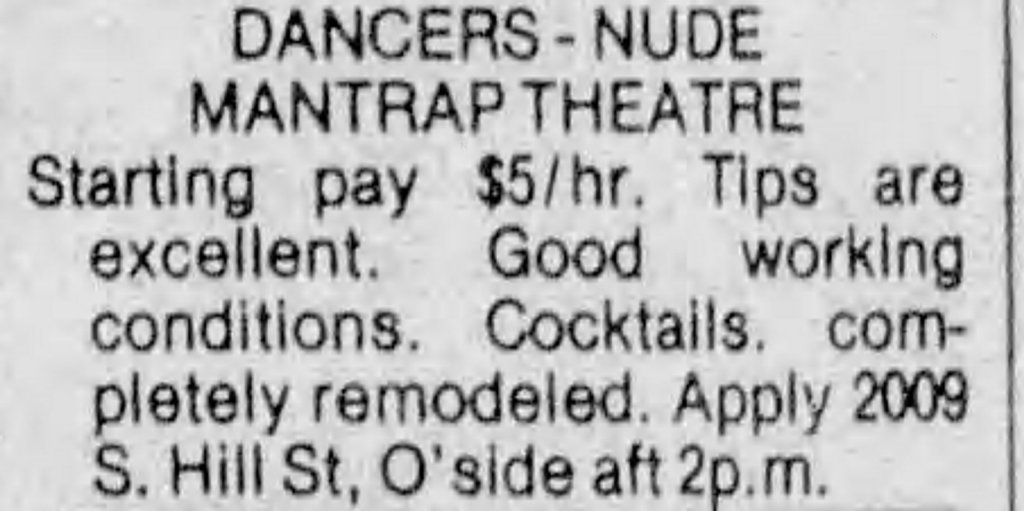
An employee of the Man Trop reported that two girls had been hired specifically to dance nude on Thursday nights, because the regular top topless dancers were reluctant to remove their G-strings.
A court case ensued and a hearing was held on October 14, 1978 in Superior Court where Judge Michael Greer ruled that the Man Trap “could continue to feature topless and bottomless female dancers” until December 4th of that year, but “called for changes.”
The bar was ordered to place the stage area 12 feet away from customer seating and to prohibit dancers from socializing with customers or serving them alcoholic beverages. Joshua Kaplan, attorney for the owners declared “we will remain totally nude until December 4 and then after that forever.” Oceanside Deputy City Attorney Warren Diven said that the Man Trap was in violation of a city ordinance that prohibits topless or nude dancing in bars.
Kaplan argued that the Man Trap was a “theater” and therefore exempt from the ordinance. He said owners Lowe and Gautereaux (who also owned the Playgirl Club in downtown Oceanside) had made improvements of more than $60,000 to assure that the established met the “legal definition of a theater.” But City Attorney Divon countered that “the primary purpose of the man trap was to serve alcoholic beverages and not to provide entertainment” and added that the type of entertainment offered by the Man Trap “does not rise to the dignity of a theatrical performance.”
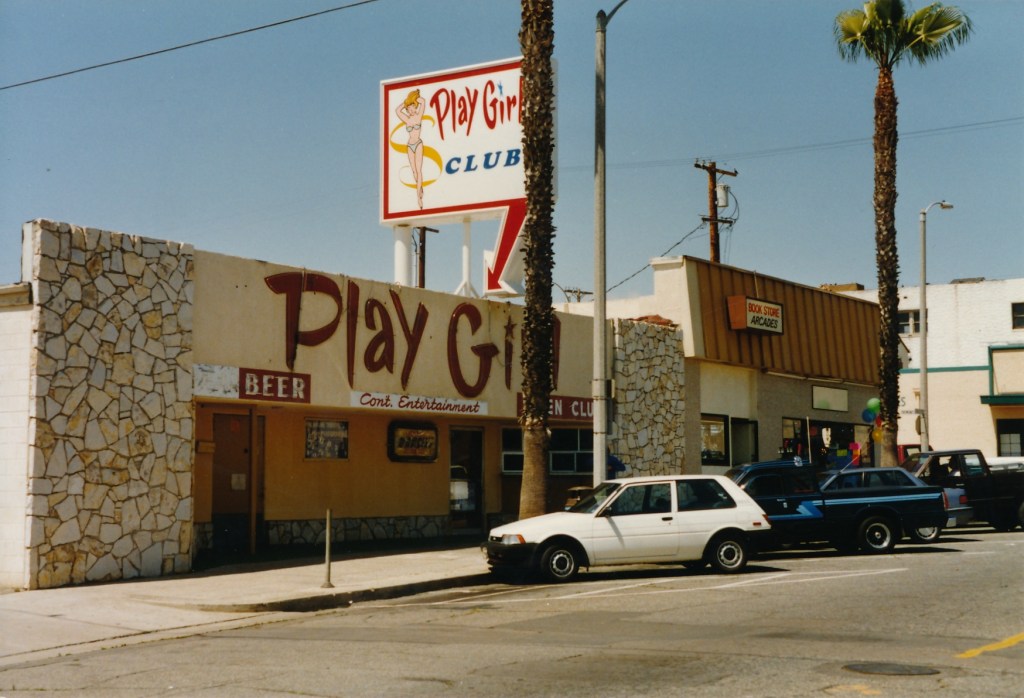
Mayor Pro-tem Bill Bell said, “We will pull out all the stops to close both of them, the Man Trap and the Playgirl. Enough is enough.” But both establishments continued operating. In 1979 the Man Trap Theater began to featured ladies’ night, Wednesday night with male dancers. Saturday was couples’ night with male and female dancers.
Skip Arthur, purchased the Man Trap, as well as the Playgirl. But the Man Trap was closed after the Alcohol Beverage Control board pulled its license for having nude dancers.
The 3,300 square foot building at 2009 South Hill Street (South Coast Highway) remained vacant while the owner offered it for rent. In June of 1980 the building was leased to the FVW Post 9747, a largely Black Veterans’ organization of 200 members, who had faced protests when trying to lease a different location on Mission Avenue. (FVW Post 9747 later merged with VFW Post 10577 to become Oceanside Memorial Post 10577.)
In March 1987 the building that had once housed restaurants, served cocktails and offered adult entertainment, became a health and gourmet food store called “Cream of the Crop.” For nearly four decades the health food store has flourished with a faithful clientele of its own, albeit a bit more “wholesome.”

 Histories and Mysteries