

Whether a hangout for Marines, Bikers, or thirsty locals in general, the Riverbottom Bar in the San Luis Rey Valley may have dated back to the 1870s. The bar was located in what was once the San Luis Rey Township, a rural but well established community by the 1860s.
Named because of its proximity to the Mission San Luis Rey, the township existed nearly two decades before the city of Oceanside was established in 1883. Residents in the valley came to the small village area because it offered a stage stop, Freeman’s blacksmith shop, Simon Goldbaum’s store, a post office and a school. San Luis Rey was featured in its own column in the San Diego Union newspaper, providing information on weather, crops and local happenings. Frank Whaley of San Diego’s Old Town eventually published a small newspaper called the San Luis Rey Star.
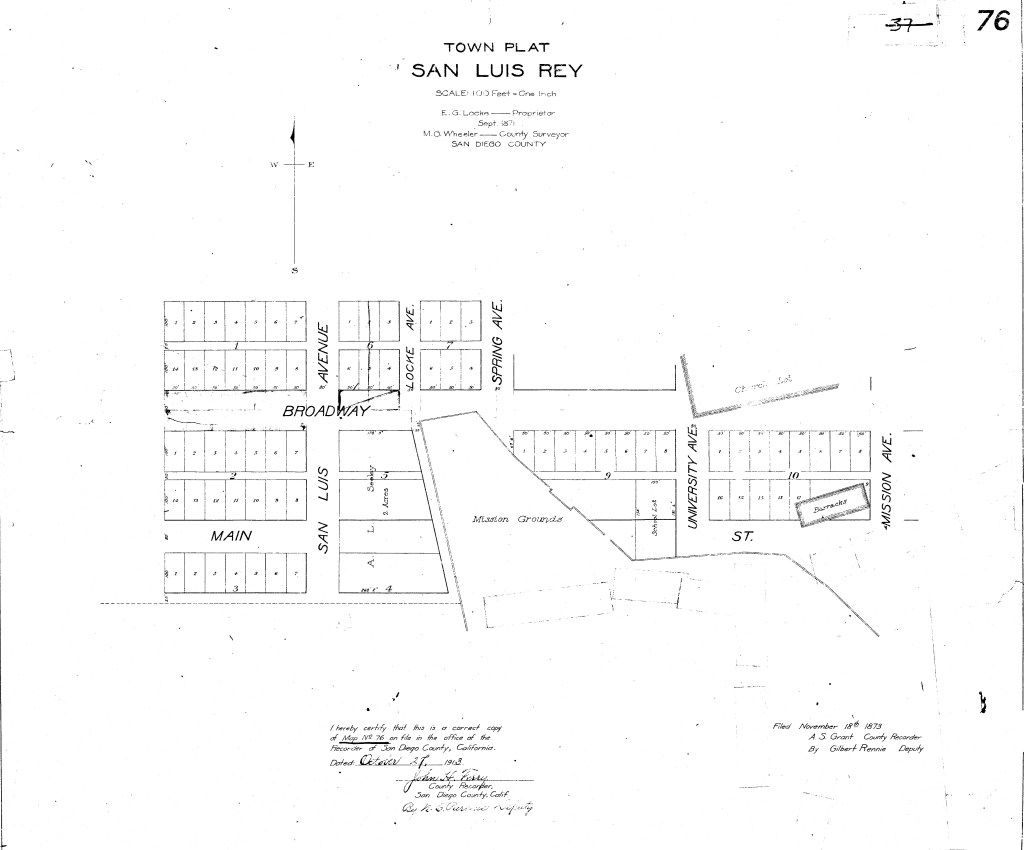
In 1920 the County would build a road through the north half of Block 2, eliminating lots 1 through 7.
In 1873 E. G. Locke, who had been appointed postmaster in 1870, filed an official map of the township, of which he was listed as the proprietor. The township of San Luis Rey consisted of ten blocks and 7 streets. The street names no longer exist but were as follows: Main Street, San Luis Avenue, Broadway, Spring Avenue, University, Mission Avenue (not to be confused with the present-day road) and Locke Avenue, named after Elbridge G. Locke himself.
Locke partnered with local rancher William Wallace, operating a store as well as a hotel together. Wallace married Locke’s daughter, Alice on July 9, 1874.
In 1876 Locke erected a new hotel at San Luis Rey, which he named the Locke Hotel. After the new town of Oceanside was established, several businesses in San Luis Rey relocated there, including the San Luis Rey Star newspaper which then became the Oceanside Star. The Locke Hotel was to Oceanside and became one of its earliest hotels.
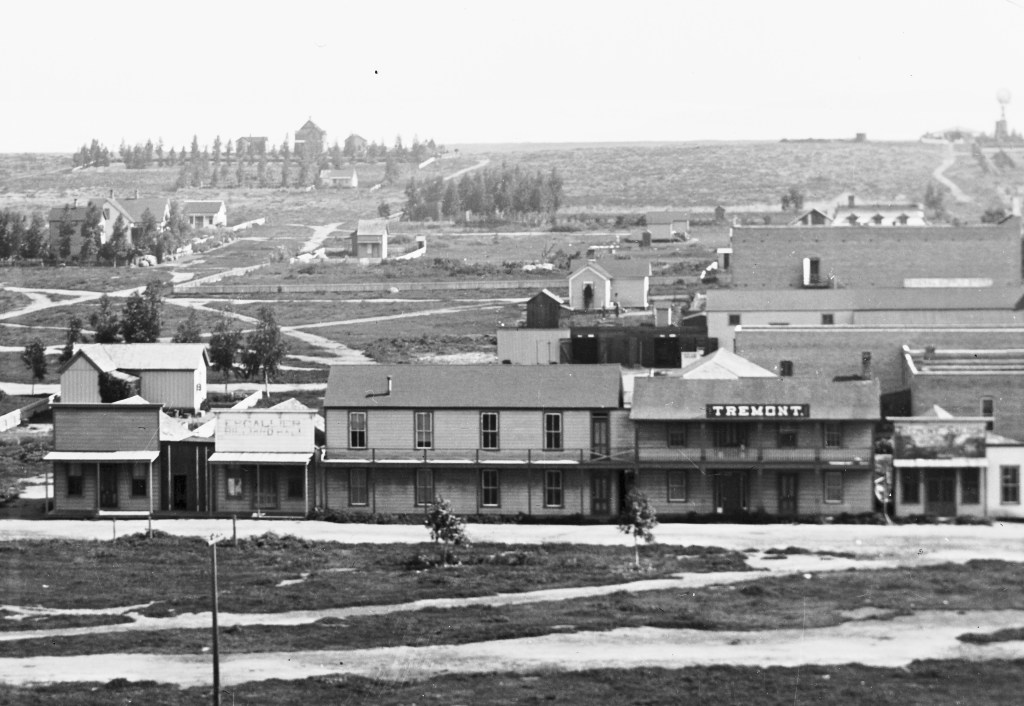
William Wallace, Locke’s one time partner, died in 1892. His widow Alice Locke Wallace owned a strip of land which is present day North El Camino Real (east of Douglas Drive). She served as postmistress in San Luis Rey from 1893 to 1908 and her son Lee Wallace followed her in the position until 1912.
On January 13, 1912 it was announced that “Lee Wallace has resigned as postmaster at San Luis Rey, and a petition is being circulated for the appointment of John W. Bradley.”
John Bradley then became postmaster, and the new owner of the Mission Store where the post office was located. In 1915 Crutcher Morris purchased the Mission Store and was subsequently appointed postmaster in 1916. William P. Jensen acquired the Mission Store and served as the postmaster of San Luis Rey from 1917 to 1932.
In 1932 Roy and Marian Sager purchased several lots in the township including Lots 8 through 13 in Block 2 from William Jensen. In 1933 Marian Sager was confirmed as postmistress of San Luis Rey. She then applied for a new location for the post office, just across the street.
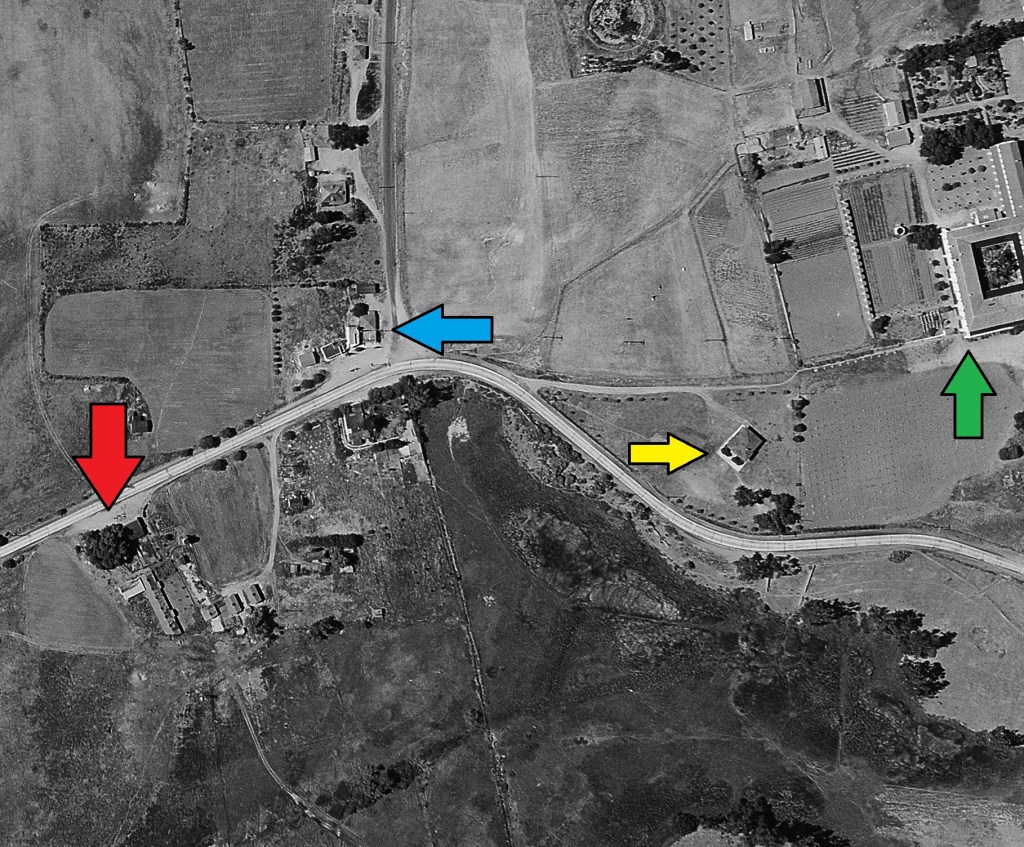
In 1942 Roy and Marion Sager, father and son, announced their intention to sell their interest in their “grocery and meat market business consisting of merchandise and stock in trade known as the Mission store” which was “situated” on Lots 11, 12 and 13 of Block 2. While the Sagers maintained ownership of the real property, they sold the Mission Store business to Phyllis Goggin and C. Shaw.
Phyllis Mary Goggin was the widow of Daryl Henry Goggin, who was killed during the bombing of Pearl Harbor December 7, 1941. His is listed as one of the approximately 390 “unknowns” from the USS Oklahoma at the National Memorial Cemetery of the Pacific. Phyllis Goggin died just two years later at the age of 38 in 1943.

By 1946/47 the building owned by the Sagers was leased to Andrew and Marguerite Weir and would become a restaurant called the San Luis Rey Inn.
The San Luis Rey Inn had a flat roof, but the front façade and a portion of the west elevation featured a shed roof covered in clay tile. The front of building included five arched bays that resembled garage doors (an additional “bay” was also on the west end.)

A closer look at the building in several photos reveals a house on the west end, its sunken roof exposed to the elements, which was sometimes obscured from view by the leaves of the large Pepper Tree planted next door. (This structure is also clearly visible in Google Maps View from 2008 to 2019).
The San Luis Rey Inn building is similar in size and length to that of the Goldbaum Store and Hotel, once located in the San Luis Rey Township. A photo of Goldbaum’s store clearly depicts a house behind what is a “western store front”. This storefront could have easily been removed, along with the wooden parapet and then the porch enclosed. Even the name “San Luis Rey Inn” appears to be homage to Goldbaum’s San Luis Rey Hotel. As late as 1919 the building was used as polling place and believed to be used as the post office and store in the township in the 1920s.

Simon Goldbaum was born in 1848 in Grabow, Prussia (now Germany). As a young man of about 18 he came to America. By 1868 he was living in San Francisco, but soon after moved to Los Angeles where he clerked at a general store.
Goldbaum became a Naturalized Citizen in 1871 and that year purchased a general store at Monserate (near Fallbrook). By 1873 Goldbaum moved to the San Luis Rey Township where he purchased a store and hotel building.

Simon had four brothers, William, Louis, Max and Albert who would all settle in San Diego County, namely San Luis Rey and the new town of Oceanside.
The Goldbaum his hotel and store was a social gathering spot with dances and other events held there. 1878 Simon Goldbaum was appointed postmaster of San Luis Rey and his hotel/general store would have housed the post office as was customary. He was appointed postmaster again in 1883 and 1885. He was so well known and liked, Goldbaum was called the Mayor of San Luis Rey.
He married Margaret Marks in 1886 and they had two daughters, Pearl and Helen. Pearl died in 1904 at the age of 16 due to pneumonia.
In 1901 Goldbaum was granted a license to sell alcohol at this San Luis Rey Store. He sold his business in 1907 and moved to San Diego. However, he still maintained ownership of nearly 1,000 acres of farmland in the San Luis Rey Valley. Simon Goldbaum died in 1915 at the age of 69.
If the Riverbottom Bar building was in fact the Goldbaum building, it certainly followed the historical trend as store, post office, hotel (of sorts) and saloon remodeled and transformed as the San Luis Rey Inn.
In 1947 the San Luis Rey Inn was owned by Andrew Weir and his wife Marguerite, who provided patrons food and drinks along with the opportunity to join in a community dance at what was referred to as a “Hoedown”. An ad from the 1947 Oceanside Blade Tribune read:
“Big Okie Hoedown at the San Luis Rey Inn. Dance to the music of the Okie Hoedown. Hours from six to midnight.”

The San Luis Rey Inn was frequented by both locals and Marines from the nearby military base, Camp Pendleton, established in 1942. Although it was considered “out of the way” for Oceanside residents, it was a popular nightspot beckoning customers with the romance of “Mission Days”….
“Tonight and every night in old Spanish settings, dining and dance at San Luis Rey” … “All lit up in neon and next to the large Texaco station.”

Betty Lanpher Miranda, born and raised in the San Luis Rey Valley, remembers as a child that the owner of the restaurant kept a monkey in the large, old Pepper Tree. It startled her one day as she was standing outside, but she also recalled it was tethered in some manner so as not to run away.
Owner Andrew Weir died suddenly of a heart attack in 1948, however, and wife Marguerite put the establishment up for sale by placing a classified ad in the local newspaper:
“Must be sold San Luis Rey Inn. Beer, Cafe, party or club room. Living quarters, lease and equipment. Best offer takes.” (It is noteworthy that “living quarters” is mentioned in this ad, in what may have been the Goldbaum hotel.)
The following year the San Luis Rey Inn was under new management. New owners “Johnny and Nell” (Doris M. Danforth and Nellie Burdick) offered their clientele “home-cooked foods and Coors beer on tap.”

Richard Miranda, who came to Oceanside at a young age in the 1930s, remembered that he and his friends were sold beers by the bartender when they were still in high school. However, they were not allowed to stay and had to take their beers outside and drink elsewhere as they were underage!

Photo courtesy Tom Burgess
Helen Burgess worked at the bar/restaurant in the early 1950s. A “Spanish plate” was just 95 cents and chili beans were 35 cents. Her four children attended school at the one-room schoolhouse located nearby on the grounds of the San Luis Ret Mission. Tom Burgess and his siblings remember the establishment as “Mom’s Place.”
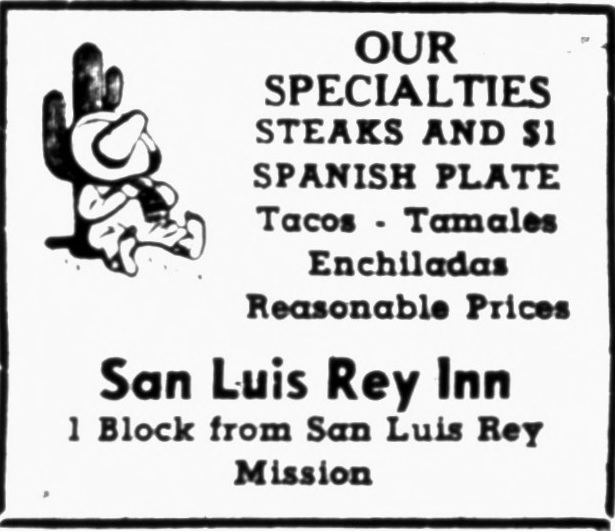
The San Luis Rey Inn remained a popular eatery in the 1950s offering customers “specialty steak and one dollar Spanish plates” of “tacos, tamales enchiladas at reasonable prices.”
The small township benefited from increased traffic from the “Camp Pendleton Road” as Marines and farm workers traveled through. Its small business “district” expanded including Webster & Light Radiator Repair, Brandt’s Cut Rate Rocket Station and Rudy’s Auto Wrecking.

In 1958 Nellie Burdick sold the San Luis Rey Inn to Gene and Ethel Weaver. A legal notice read:
“All stock in trade, fixtures, equipment and good will of a certain cafe business known as SAN LUIS REY INN and located at across from the Post Office, Mission Road street, in the City of San Luis Rey, County of San Diego.”
The Weavers also owned the Base Café on North Hill Street (Coast Highway). They renamed their newly acquired establishment “Ethel’s Bar & Grill.” On February 13 1959, Tommy Duncan, a well known Western singer/songwriter performed at Ethel’s.

But the following month, in March 1959, a shooting occurred at Ethel’s and may have been the beginning of the establishment’s “reputation.”
Robert Abilez, a resident of Vista, entered the bar and asked fellow patrons to help him engage in a fight. When they refused Abilez pulled a .38 caliber revolver from his pocket but then dropped it on the floor. After picking up his weapon he sat next to two men, Almarez Vidales and Contreras Sanchez. As they drank their beers, Abilez insisted that the men go with him to fight. When they refused he drew the revolver again and fired. Sanchez stepped back and the bullet grazed his heavy leather jacket, and hit Vidales in the forearm. Lawrence Harris, the bartender, disarmed Abilez and held him while Ethel Weaver called the sheriff’s office.

Later Ethel’s would move to a location closer to the “back gate” of Camp Pendleton, and what was once known as the San Luis Rey Inn was renamed the Riverbottom Bar.
Even as Oceanside city limits expanded eastward, San Luis Rey remained a separate township, although the city of Oceanside limits surrounded it by the 1960s. It was even given its own zip code – 92068. By the 1970s it was annexed to the City. The Riverbottom Bar was given a new address of 473 North El Camino Real.
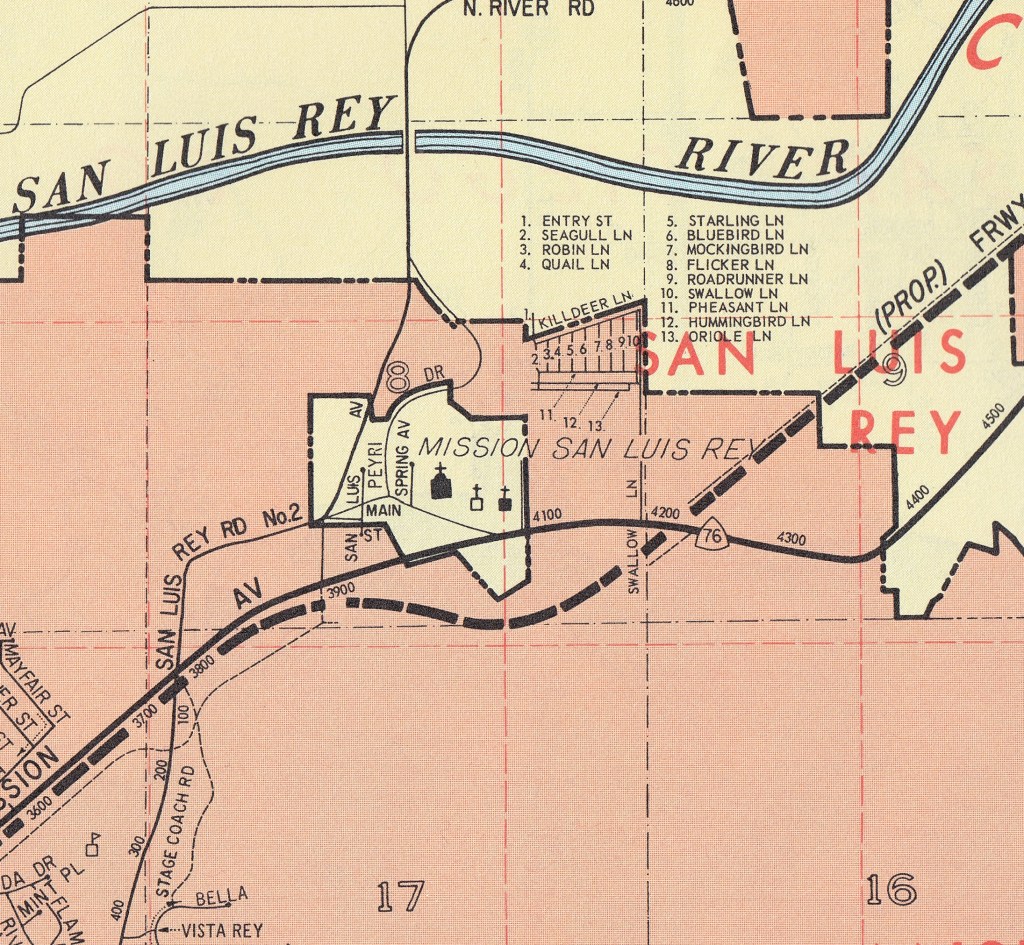
Roy Sager maintained ownership of the land that the Riverbottom and other businesses were located upon, (a total of 3 and half acres). In 1970 he sold Lots 8 through 13 in Block 2 and lots 1 through 7 in Block 3 to Roland House.
Bob Olsen, a resident of San Luis Rey, operated the bar in the early 1970’s, but records are not easy to find or determine.

In 1976 William and Donna Justus, owners of Auto Parts and Salvage Inc. purchased the 3.5 acre property but continued to lease the building to various bar owners. In the 1980s Suzanne Ochoa owned the Riverbottom Bar. Her mother Eunice Walker ran the Long Branch Saloon in downtown Oceanside before it was demolished in 1982.
In July 1997 Charles and Patricia Baker became owners of the Riverbottom and ran it for several years.
It was both a favorite “hole in the wall” to some and a dump to others. One loyal customer wrote a review in 2013 and shared its long association with Marines:
“Yes, it’s a dive bar. [It] has been here since roughly 1927. You grunts in Horno, cannon cockers in Las Pulgas, and grunts in San Mateo, ever heard of Iron Mike Hill? Well, he is real and he drinks here STILL! If you want off mainstream to have a blast come here!”

Another reviewer in 2014 did their best in describing the Riverbottom Bar, while trying to keep expectations low:
“This place is good. This place is a true dive. Dives aren’t glitzy, cutesy or thematic, despite what hipsters like to think. You don’t hang out there to pick up women; it’s not where the “crowd” hangs out. Your standard clientele are older Marines; you’ll get some Bikers and off duty Law Enforcement on some nights. It’s one of the older buildings in the area; it was built in the 1920s as a post office. It serves beer and bar snacks, nothing too special. I used to drink here with my grandpa (retired Marine). I always had a nice time there. If you behave yourself and keep your standards and expectations low you’ll have a nice time.”

The Riverbottom Bar with its uneven floors, crumbling walls, aging booths and bar remained “unremarkable” and “unpretentious.” It was described as a hideaway, a low-budget watering hole and a “local artifact.” (Perhaps over 140 years old!)
Eventually the Riverbottom closed its doors. There were plans to reopen but it never happened. One day in 2020, the old building and its Pepper Tree were bulldozed. No one noticed as it happened during the pandemic, but a piece of history, perhaps dating back to the 1870s in the small Township of San Luis Rey, quietly disappeared.




 Histories and Mysteries