Murder at the Hill Top Motel – The Unsolved Murder of Rocco Pittro

The Hill Top Motel at 1607 South Coast Highway in Oceanside, California has been described as an “okay place if you’re running out of options.” It has become sort of a fixture in the South Oceanside neighborhood. Far from a vacation destination resort, the Hill Top Motel is a low budget option for travelers and locals.
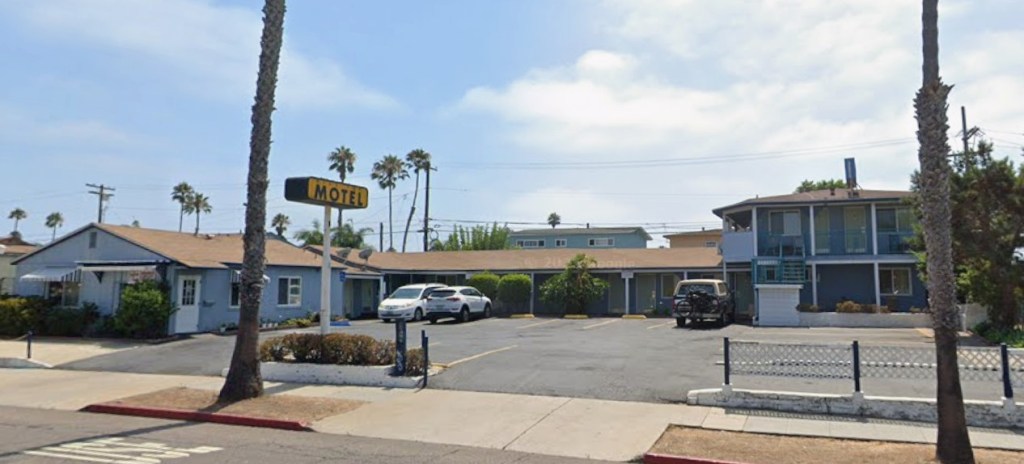
The Hill Top Motel, (Google view 2025)

Regardless of its less than stellar reputation, the Hill Top has a history dating back to 1948 and includes two tragic events, a suicide and an unsolved murder.

The first deadly incident was the suicide of Flora Dodson in 1954. She and her husband were the original owners of the motel property.

Forrest Leroy and Flora (Kettering) Dodson were both natives of Illinois, married in 1907. The couple had two daughters, Marie and Edith. In 1948 the Dodsons purchased property on the southwest corner of Morse and Hill Streets (Coast Highway) from Clifford Brodie. In June of that year a permit was issued to build a small motel called Dodson’s Motel at 1607 South Hill Street for a cost of $19,000. A neon sign was erected in December 1948 and the motel was completed and ready for guests.

Flora and Forrest led quiet lives on the busy Highway 101. They lived on the property while managing the auto court and visited often with their children and grandchildren.

Sadly, Forrest Dodson died suddenly on May 29, 1954. After 47 years of marriage, Flora was distraught and despondent with grief. She told her daughter Edith Lipman that she did not care to live any longer and that she had contemplated jumping off the end of the Oceanside pier.

On December 12th, just seven months after the death of her beloved husband, Flora ended her life. She was discovered by her son-in-law Othel Bert, who was visiting from the Midwest. He found her lifeless body lying on the floor in front of the kitchen gas range. Detectives from the Oceanside Police Department responded to the call and as they examined the scene, they noted that Flora had cut her left wrist with a safety razor blade, which was found on the floor near her right hand. A rifle and .22 cartridges were also found but unused. Instead, Flora had turned off the pilot lights in her wall heaters and stove, turned on the gas and positioned herself on a kitchen stool until she was overcome by fumes. The coroner ruled her death a suicide.
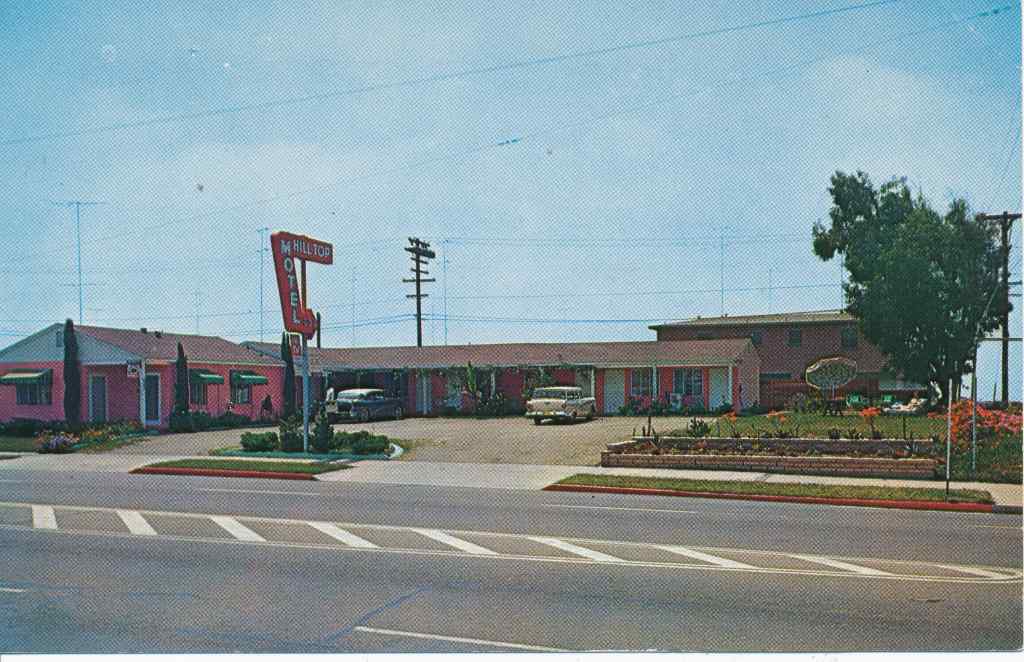
The Hill Top Motel, 1607 South Hill Street (Coast Highway) in early 1960s.

After her mother’s death, daughter Edith Lipman acquired the motel property which had since been renamed the Hill Top Motel. It was sold to Leonard and Bessie Robinson in 1957. The Robinsons lived on the property in the “owner apartment” and managed the 8-unit motel, which advertised “all the comforts at home” including carpet, kitchens and free TV.
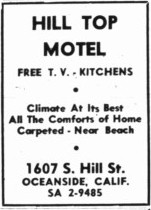
By the mid 1960s the Hilltop Motel was expanded with a two-story unit on the north end of the property. The Robinsons sold the property to Mr. and Mrs. William and Virginia Giffin who sold it to Dwight M. Pankey in 1970.

The Hill Top Motel in the 1970s.

It was purchased by Larry and Twyla Shaffer in 1974 and by 1976 the Hilltop Motel was offering daily rates of $10 and a weekly rate of $63. In 1976, the property was purchased by Joe C. Iski and John Isky. They sold the property to Yee Chen Yeh of San Diego in 1979.

Aerial view of the Hill Top Motel, corner of Morse and Hill Streets (Coast Highway) upper right in the 1970s.

The clientele in the 1970s and 1980s were much different than the guests who stayed in the Dodson Motel in the 1940s and 1950s. Things were changing in Oceanside with a rising crime rate, even in South Oceanside, which is a vibrant and trendy neighborhood today. In 1988 the crime rate had increased 24 percent and it was reported that Oceanside had the biggest increase in violent crime in the entire state for the first six months of the year.

Violent crime which included Oceanside’s first reported homicide of the year – at the Hilltop Motel. On January 22, 1988 Rocco Anthony William Pittro, Jr. (aka Pietro) was found murdered in Room No. 8. Pittro had been discovered by the motel’s manager. Left in a pool of blood, he had been stabbed seven times.

The manager told police that Pittro and a man by the name of Carl had been seen together, and that Pittro had told him he would have a male friend visiting. Carl was described as a black male 25 to 30 years of age, 160 pounds 5’10“. The manager of the motel had gone to the room to check on him the following day, presumably after Pittro missed check out, entered the room with a pass key and discovered the dead guest. The Oceanside Police Department was notified and Officer P. Coppack arrived at 12:43 PM.

Pittro was born August 7, 1927 in Illinois. He was divorced and living in Mission Viejo. Differing reports list his occupation as an interior decorator to construction.

The coroner’s report stated that he was found in “a prone position on the bed and his body was cold to the touch.” There were three stab wounds to the back of his body and multiple stab wounds to his chest and abdomen, as well as a laceration to his left hand. The bedding under his body was blood soaked, and there was dried blood spattered on the wall opposite the foot of the bed and on the head of the bed. More specifically, Pittro was stabbed in the heart as well as in the lungs and suffered from multiple blunt injuries. The coroner also noted that no drugs were detected.

The murder weapon was not found but Homicide Detective Sheila Hancock reported “I think we’ve got some good physical evidence.” The victim’s 1985 Nissan pickup truck had been stolen and later recovered abandoned in central Los Angeles.

In March of that year, a 16-year-old Oceanside youth was arrested. He was booked into juvenile hall, but his name was withheld because of his age. Three days later, he was released. Detective Hancock said there was insufficient evidence to prosecute the teenager at the time. Police said the teen lived with his parents on nearby Marine Corps Base Camp Pendleton and they continued to look for information linking the teenager to the killing.

In September of 1988 Oceanside detectives released a crude sketch looking for someone by the name of Chris or Carl. But with no suspects in custody, the case eventually went cold and then forgotten.

However, with properly stored evidence, this case could likely be solved today with DNA or even fingerprinting.

The murder of Rocco Pittro is one of several unsolved cases in the files of the Oceanside Police Department, including Zelda Lamore found murdered in a downtown hotel in 1953, the murder of cab driver Ray Davis in 1962, the murder of Charlleen Saunders in 1986, the kidnapping and murder of 7-year-old Leticia Hernandez in 1989, the missing persons case of Mary Rico-Webber in 1992, the murder of retired school teacher Margaret Yossa in 1994, and the murder of Rachel Pauline Rivera found in the alley of the 600 block of South Coast Highway in 2001.

As each year passes these cases only grow colder, including Rocco Pittro’s murder in Room 8 at the Hill Top Motel. Is the DNA evidence just waiting to be tested? Is there anyone who remembers, or has information to help solve this case and others?

Cold Case – The Murder of Ray Davis – Shades of the Zodiac

Featured

One quiet night in Oceanside, California a senseless murder was committed with no apparent motive or suspects. Days after the murder, someone claiming to be the killer called local police with an ominous threat that resulted in armed gunmen protecting city busses for several nights in anticipation of another death. But as shocking as it was, the incident slowly faded into obscurity and the murder went unsolved. The case was in fact forgotten about altogether until in 2017 when I stumbled upon a newspaper article while doing research on an unrelated subject. As I continued research on the murder I collected dozens of newspaper articles and discovered that the case had never been solved. I then contacted the Oceanside Police Department who directed me to their Cold Case Detective.

The Murder of Ray Davis

On the evening of April 9, 1962, the Oceanside Police Department received an anonymous telephone call. The unidentified caller stated cryptically: “I am going to pull something here in Oceanside and you will never be able to figure it out.” The call was likely dismissed…until two nights later on April 11th, when a body was discovered and the caller contacted the police again.

Patrolman Terry Stephens discovered the lifeless body of Ray Davis in an alley in the upscale beachside neighborhood of St. Malo at 1:45 am.  The night of the murder, Stephens had not yet turned 28 years old, but was already a seasoned police officer. Born in 1934 in Escondido Stephens was raised in Oceanside where he lived nearly all of his life. At the age of 21 he joined the Oceanside Police Department and served on the force for 31 years before he retired.

The victim, Ray Davis was just 29 years old, a native of Michigan, born in 1933 to Glen and Virginia Davis. His parents separated when he was a young boy. In 1950 his mother was working as a dispatcher for a taxi company and at age 17 Ray was working as a waiter in a local restaurant.

Home at 616 E. Mason Street in Owosso, Michigan, where Ray Davis lived with his mother in 1950. They lived in the rear unit.

Ray married Marion Lois Solomon in 1953 in Owosso, Michigan. It was Marion’s second marriage and she had two children with her first husband, Julius Poullion.

Ray and his brother older brother Jack had moved to Oceanside in January of 1962. Oceanside had a population of less than 25,000. Jack got a job working at Marine Corps Base Camp Pendleton and Ray as a cabdriver for the Checker Cab Company. The brothers were renting a house at 525 South Tremont Street. Ray and his wife were living separately, with Marion residing in Pomona, California.

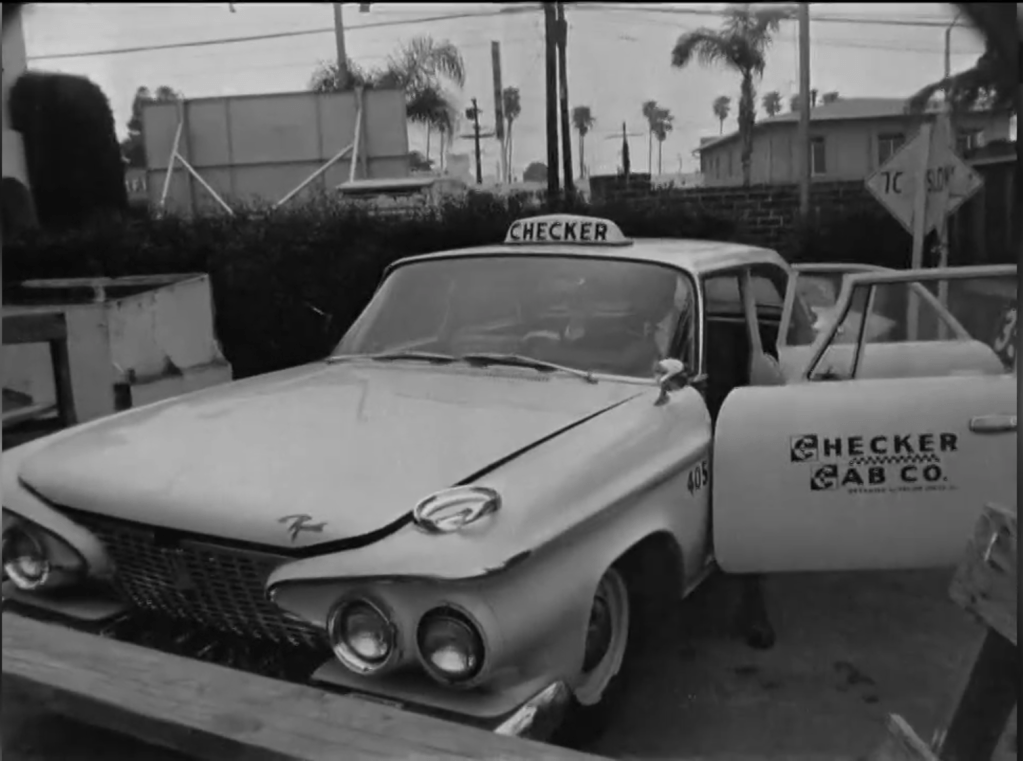
Ray Davis was working an evening shift, his cab parked on Mission Avenue in downtown. At 11:10 pm he reported to his dispatcher Lowell Sikes that he was driving a fare to South Oceanside. He never returned or responded to subsequent radio calls.

Police inspect the cab in which Ray Davis was murdered

Ray’s body had been dumped in the alley behind 1926 South Pacific Street, the home of Oceanside’s former Mayor Joe MacDonald. Across the street was the home of Oceanside’s current Mayor Erwin Sklar. This was not a neighborhood familiar with violent crime, let alone murder. (Note: Few people realize that St. Malo does not begin behind its iconic gated archway, but also includes the 1900 block of South Pacific Street.)

Davis had been shot once in the back, through the driver’s seat, and once in the back of the head. His assailant unceremoniously pulled him out of the cab and drove away. Robbery did not appear to be a motive as Davis had a modest amount of cash in both his wallet and shirt pocket.

The bloodied cab was discovered at 6:30 am, left in the alley of the 400 block of South Pacific Street with its meter showing a $2.20 fare. On scene Detective Don Brown found a third shot had been fired through the windshield of the taxi.

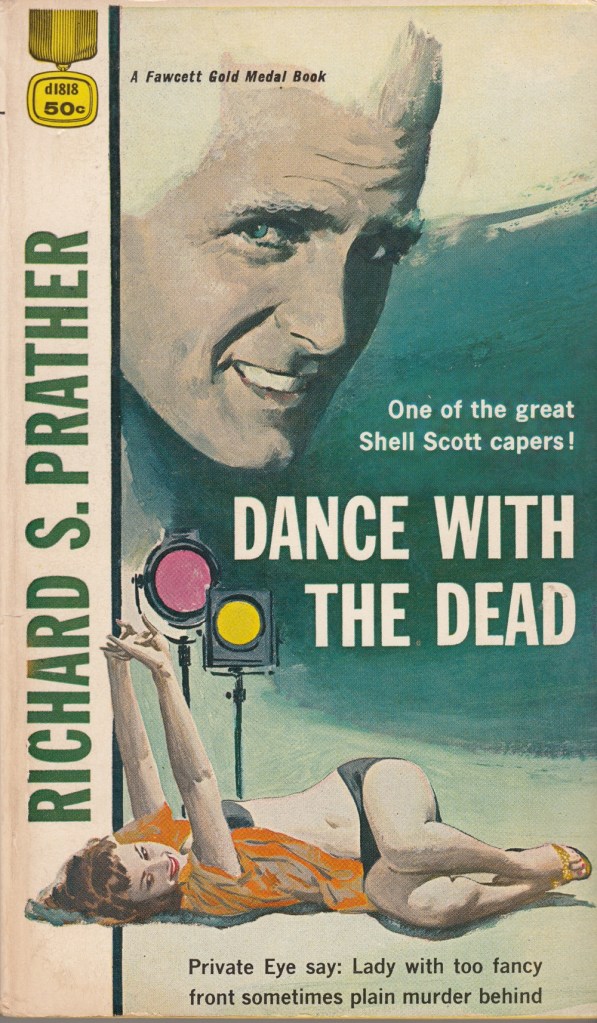
On the front seat of the abandoned cab was a paperback novel, “Dance With the Dead.” Written in 1960 by Richard S. Prather, it featured a private detective who solved crimes, all the while encountering scantily clad women…very campy stuff.

Davis was taken to the Seaside Mortuary at 802 South Pacific Street where an autopsy was performed by L. H. Fairchild of the San Diego County Coroner’s Office. Two .22 caliber bullets were removed and given to Oceanside Police Detective Floyd R. Flowers.

The following day, April 12th, both the Oceanside Blade Tribune and San Diego Union Tribune newspapers reported the murder along with the fact that police had no motive or suspect. The story of Ray’s murder was also published in several Southern California newspapers, including the Los Angeles Times. In Ray’s home state of Michigan, at least three newspapers reported the murder of Ray Davis. No mention was made of the mysterious phone call of April 9 as the Oceanside Police Department had not released that information.

Funeral services for Ray Davis were held at the Oceanside Church of God on April 13th. He was buried in a plot located in the “Sunset Slope” at Eternal Hills Memorial Park. Virginia Davis, his bereaved mother, flew from Michigan to Oceanside for the services.

Headstone of Ray Davis in Eternal Hills Memorial Park, Oceanside, California

On April 16th the Oceanside Police Department disclosed to the public that an unknown person had called them on April 9th with a veiled threat that they now linked to the murder of Ray Davis. The second phone call came with a frightening warning.

Police Chief William H. Wingard described the caller as a possible “deranged killer” and released the contents of the call:  “Do you remember me calling you last week and telling you that I was going to pull a real baffling crime? I killed the cab driver and I am going to get me a bus driver next.”

Who, but the original caller, would have known about the initial message? Who would taunt the police in such a way?

This threat was not taken lightly, considering the unknown caller seemed to have made good on his last one. Chief Wingard stated: “We have no reason to disbelieve the calls.”

In response to the threat, the Oceanside Police Department took measures to protect all city busses and armed military police were put on each bus going aboard Marine Corps Base Camp Pendleton. The newspaper reported that Frank Lilly, Oceanside’s City Manager gave Oscar Hatle, Bus Superintendent “blanket authority to take whatever steps necessary.” The unusual aspects of the murder and the unprecedented response of armed guards were big news. The story was widely distributed by the Associated Press and United Press International.

Three days passed without incident. Guards were removed from the busses, but on so-called “lonely routes” the bus company assigned two drivers. Oscar Hatle commented: “The situation still exists. We are taking no unnecessary chances.”

The police had no motive and scant evidence. They were desperate to solve the murder. Several people were questioned and released. One reported suspect was a fellow cabdriver, Charles Schofield, but the accusation had no foundation.

On May of 1962 an arrest was made of four Marines for armed robbery, but neither their prints nor ballistics matched.  Another armed robbery suspect was arrested in November but again, the fingerprints were not a match.

The murder was all but forgotten about except for the Davis family. Years passed, then decades. Ray’s brother Jack died in 1990. Ray’s mother died in 1995 and was buried at Eternal Hills Memorial Park. Ray had no biological children. After the death of his brother and mother there was no one left to remember.

Headstones of Ray and Jack Davis with their mother Virginia Davis at Eternal Hills Memorial Park

Work of the Zodiac?

It is only speculative, but it is still worth noting that seven years after Ray Davis’s murder, a killer known as the Zodiac would mimic the same deadly scenario. In 1969 he shot and killed a taxi driver in San Francisco, contacted police taking credit for it and then threatened to target a bus, in this instance one full of children.

The Zodiac killed his victims in a variety of ways and weapons, including a .22 caliber gun (as in the murder of Ray Davis). It is believed that the Zodiac may have been in the military. It is now surmised that one of his first victims may have been Cheri Jo Bates, who was murdered in Riverside, California in 1966. While there are several theories surrounding Zodiac, is it too far-fetched to believe that perhaps he started his killing spree in Oceanside?

Many serial killers are known to taunt or toy with police and certainly this was the case with Ray’s murderer. Serial killers taunt because they crave the attention, they want the notoriety and many times they are convinced of their own superiority over law enforcement.

Theories and conjecture aside, to this day the murder of Ray Davis remains unsolved. It is likely the killer is dead … even if he was just 25 years of age in 1962, he would be 83 years old in 2020.  Many of the police officers and detectives who worked so diligently to try to solve the case and protect the residents of Oceanside have passed. However, Roy K. Smith, a retired police captain, remembers the case as he was working the morning watch the night of the murder.

I first brought this case to the attention of Tom Heritage, a semi-retired law enforcement officer working part time in the Oceanside Police Department’s Cold Case files. Soon after his brief review of the file, Heritage permanently retired and moved out of the area. Detective Sylvia Guzman O’Brien then headed the department and she took a more thorough look into the unsolved murder.

In December of 2019 Detective O’Brien sent the latent fingerprint cards collected at the scene for entry into the Automated Fingerprint Identification System (AFIS). The Oceanside Police Department has kept silent about those results.

There may be DNA evidence. The murderer pulled Davis’ lifeless body out of the front seat of the cab by his belt loop but it is unknown if the evidence is sufficient to create a profile.

Detective O’Brien retired in 2021 and it is unclear if anyone is actively working this murder which is now 62 years old. The Oceanside Police Department solved a 27-year-old case in February of 2022, the stabbing death of Dolores Rabaya in 1994.

Regardless if there is a tie or link to the Zodiac killings, Ray Davis still deserves justice. Even if the killer has since died, perhaps this case could be solved through ancestral DNA forensics.

View local news reports on the links below:

https://www.10news.com/news/local-news/did-the-zodiac-kill-in-oceanside-police-re-test-evidence-in-cold-case

https://www.cbs8.com/article/news/crime/police-looking-into-claims-by-historian-that-zodiac-killer-may-be-responsible-for-1962-oceanside-murder/509-06453d97-3244-478f-9160-3cd499ce2ec0

Listen to this “Vanished” podcast about the infamous Zodiac Killer: https://audioboom.com/posts/8266146-vanished-zodiac-sick-of-living-unwilling-to-die

https://podcasts.apple.com/us/podcast/kristi-hawthorne-the-zodiac-killer-the-unsolved/id1572325461?i=1000532770818

Kristi S. Hawthorne, historiesandmysteries.blog “The Murder of Ray Davis”, 2020. Unauthorized use and/or duplication of this material without express consent and written permission from the author and owner is strictly prohibited. Links may be used, provided that full and clear credit is given to the author Kristi S. Hawthorne and historiesandmysteries.blog “The Murder of Ray Davis”, with appropriate and specific direction to the original content.