History of the Oceanside Harbor

For decades, it was the hope and dream of many in Oceanside to have a recreational harbor. Even as early as 1949 a development and study of a proposed harbor was made by Leeds, Hill and Jewett for the City of Oceanside.  However, a major roadblock to those plans was the military “top brass” at Marine Corps Base Camp Pendleton. Opposition to all harbor proposals and plans was because land, as well as access, was needed from the military base.

Oceanside Harbor circa 1965

But in 1958 General Reginald Heber Ridgely Jr. stated he would “interpose no objection to the concept” of the Oceanside Harbor constructed on Camp Pendleton property.  That year the Corps of Army Engineers requested a feasibility study of the proposed harbor.  A delegation of Oceanside officials visited Washington D.C. to discuss details with U.S. Marine Corps, the Bureau of Yards & Docks and the Secretary of the Navy.

The city delegation met with Camp Pendleton officials in March of 1959 regarding a lease of 68 acres upon which the harbor would be partially located.  Later that year City Attorney Dale Austin and Mayor Erwin Sklar were authorized to meet with congressional representatives and the following month Camp Pendleton transferred the needed 68 acres to the City for one-half of appraised value.

Many recognize Erwin Sklar as instrumental in the development of Oceanside’s Small Craft Harbor.  Sklar served on the City Council for twelve years from 1956 to 1968, during which time he also served as Oceanside’s mayor and deputy mayor.  Erwin Sklar has been touted as someone who “did more for the city personally, than anybody else we ever had in the council.” It was Sklar’s ability to persuade and negotiate that helped bring the Harbor from a dream into a reality.   
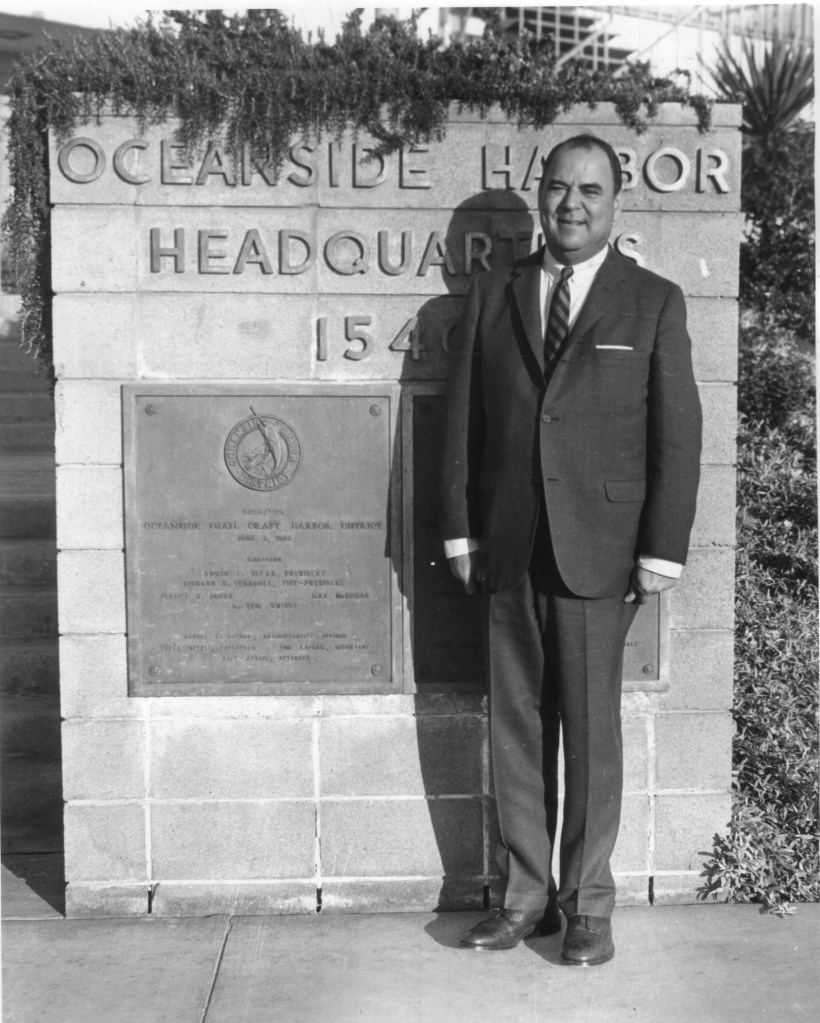
Erwin Sklar at the Oceanside Harbor Headquarters

Additional land for the Harbor was also needed from the Beachlake Trailer Park.  Beachlake was a popular recreation and camping spot since the 1930s and owned by developer and former city councilman Albert Zaiser.  To acquire land for its new harbor the city made a deal with Zaiser, essentially exchanging land for the needed property immediately north of the San Luis Rey river mouth.

View of Beachlake Trailer Park before Harbor Construction

With the gaining momentum, Oceanside voters overwhelmingly approved formation of a Harbor District in 1960.  The Board of Directors of the Oceanside Small Craft Harbor held their first meeting on February 11, 1960.   With enthusiasm running high, the first Harbor Days was held that year at the Del Mar Boat Basin before the harbor was even built! The Mayflower II, owned by the Goodyear Company, flew over Oceanside the evening before the Harbor Days celebration carrying an illuminated 10-foot high message publicizing the event. Oceanside Harbor Days is the City’s longest running event.

In 1961 the Oceanside Press Courier proclaimed that “Monday, February 6th will be a great day in Oceanside.”  That day marked ground breaking ceremonies for the Oceanside Harbor and was touted as the “most historic event in the history of Oceanside.”  The groundbreaking ceremonies were held at 10:30 a.m. marking “A Day of Hope and Promise” according to then Mayor Jerome Jones.

 Cox Brothers Construction was awarded the contract for the first phase of construction and the contract to clear away land for a 300-foot groin and floodwall at a cost of $396,400.  The Oceanside Harbor was dedicated and formally opened in June of 1963.  The Oceanside Harbor cost approximately $7,000,000, and originally contained just 520 slips.

View of Oceanside Harbor before Harbor Village was built

The Oceanside Yacht Club was founded in 1963 shortly after the harbor opened.  The founders met in a small rented office until the present building was completed in 1965.  The first Commodore of the Yacht Club was Robert Welden, then after John Steiger, Byron Jessup and Monte Yearley.

Left to Right: John Steiger, Max McComas, Byron Jessup and unidentified man at the Oceanside Yacht Club.

Monte Yearley was a fixture at the Oceanside Harbor. His sailboat shop was one of the longest running businesses, established the same year the Harbor. Monte could be found most any day on a sailboat or in his shop visiting with friends until his death at the age of 90.
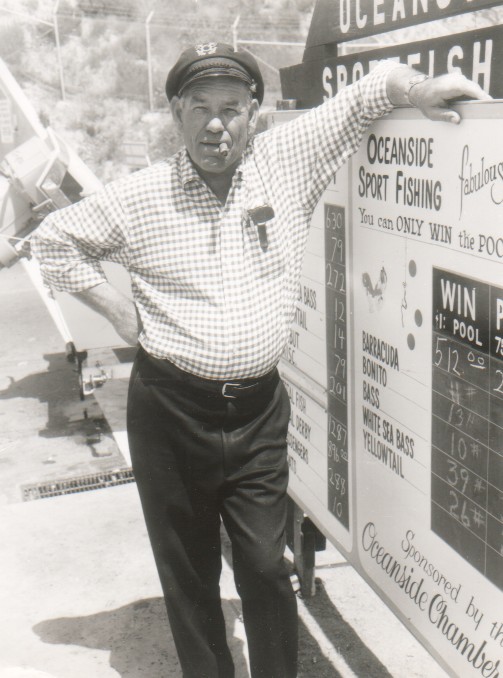
Ray McCullah, owner of Oceanside Sport Fishing at the Harbor

The McCullah Brothers operated Oceanside Sportfishing, Inc. at the Harbor. They had previously operated from the Oceanside Pier for close to twenty years before moving their enterprise to the harbor shortly after its opening. They used the Dolphin Inn and Sportfishing building near the southeast corner of the harbor until they sold the business in 1973.
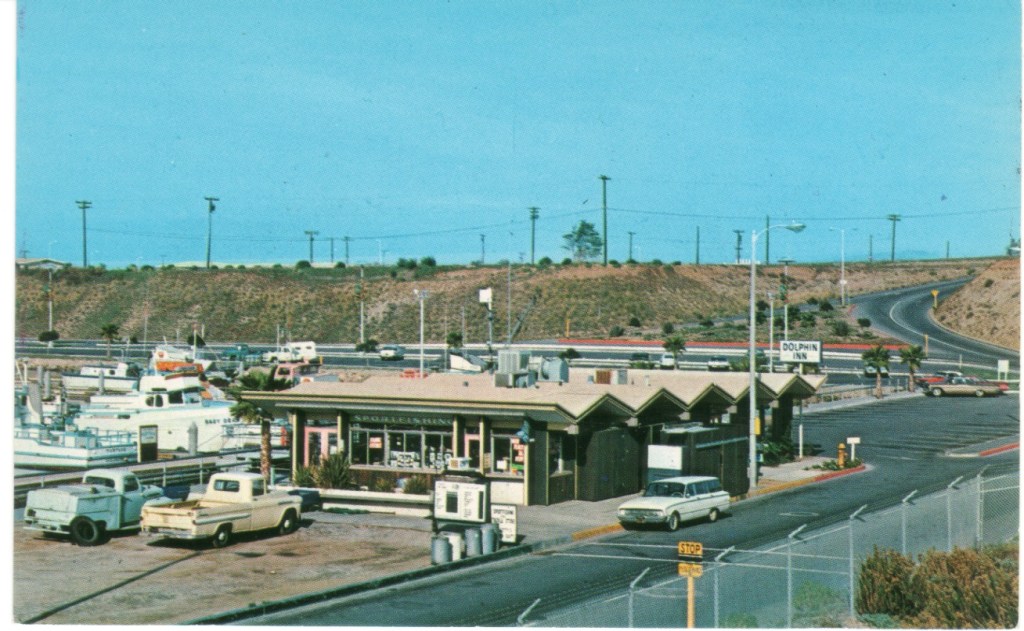
The Dolphin Inn and Sportfishing Building before it was moved.

The Dolphin Inn building was moved in 1976 to what is now the Oceanside Municipal Golf Course to make way for the construction of Charthouse Restaurant. Today this building is occupied by Joe’s Crab Shack.

A large lot just east of the railroad tracks was paved but in order to accommodate direct access from the harbor, a vehicle tunnel was made under the train bridge. In recent years this tunnel has been closed to all but pedestrian traffic for safety issues.

Harbor Tunnel to parking lot

On January 16, 1964, ground was broken for a $300,000 fishing village-style shopping center with a six-story lighthouse to be called “Lighthouse Village.” City officials along with the developer, Isaco Inc. of Beverly Hills, participated in the ceremony.  The center has been known as “Cape Cod Village” or simply Harbor Village.  

The Oceanside Lighthouse has become an iconic landmark but is more decorative than functional. It has an interior spiral staircase which leads to an observation deck. This was a popular attraction for years but access was closed by the city for liability reasons.

One of the earliest and most successful establishments at the new village was the Harbor Light Restaurant owned in part by Erskine Johnson. According to IMDb, “Johnson was a Hollywood gossip columnist who worked for the Hearst newspaper chain and appeared on the radio and in motion pictures, including his own newsreel productions. His syndicated column was called “Hollywood” and “Hollywood Notes”. Between 1937 and 1960, Johnson appeared in eight movies and two TV series, mostly as himself or as a reporter.” With his connection to Hollywood, many celebrities frequented the Harbor Light including Jimmy Durante and Preston Foster, and its walls were filled with autographed photos of notable and famous guests.
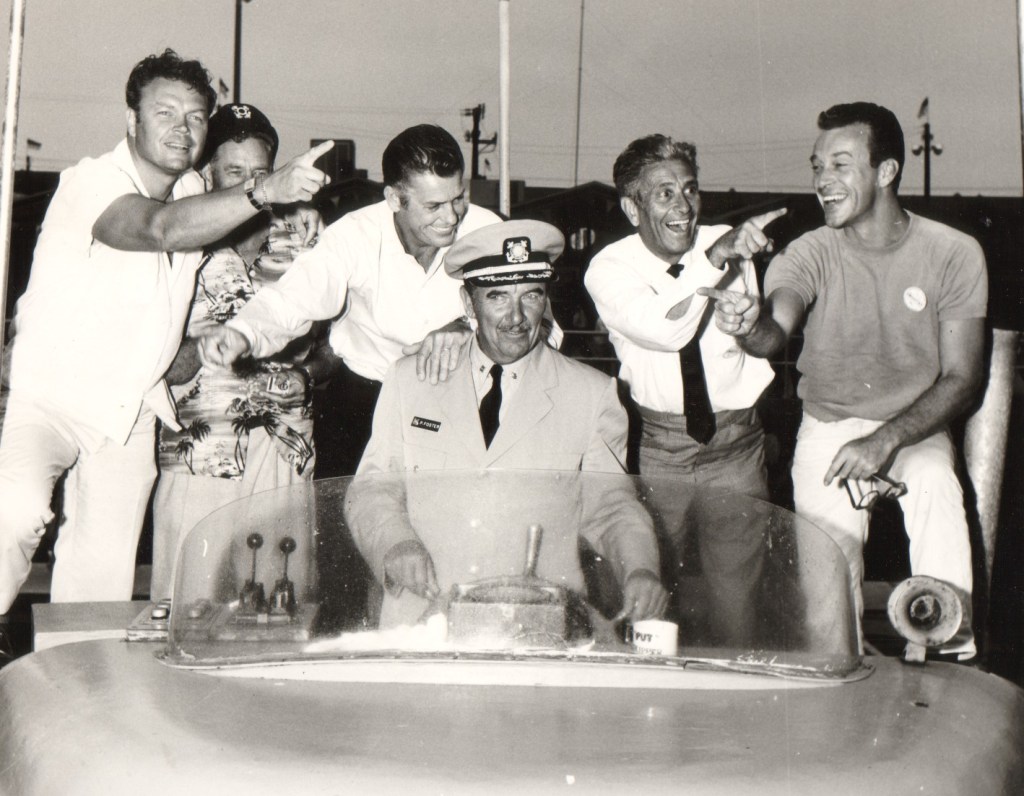
Actor Preston Foster, in uniform, pals around with his Hollywood buddies at the Oceanside Harbor

On March 27, 1964 the largest earthquake in North America’s recorded history hit Alaska. This 9.2 earthquake lasted just over four and half minutes and while it devastated Anchorage and surrounding area, loss of life was minimal in comparison to the subsequent tsunamis that it created.  A tsunami eventually reached as far south as Oceanside but rather than a surge of ocean water or tidal wave as many expected, the water instead was sucked out of the harbor. Two harbor docks were damaged when they came into contact with  submerged rocks after the water level dipped dramatically and rapidly.
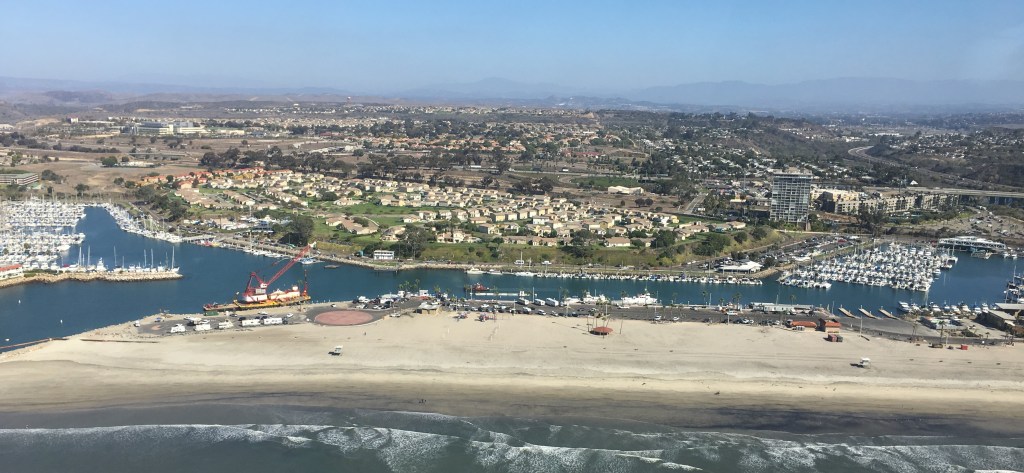
Aerial view of dredging in Harbor in 2018

Dredging of the harbor entrance has been an ongoing necessity. The channel becomes full of sand and silt-clogged, making it hazardous to boaters. Dredging is therefore necessary. Just one year after the Harbor opened, emergency dredging was urged because both the Harbor’s entrance and the military’s boat basin at Camp Delmar were too dangerous to maneuver. The annual dredging of the Harbor mouth is used to help replenish the beach at the Oceanside Municipal Pier.

View of the Jolly Roger Restaurant

In 1973 the Jolly Roger Restaurant opened on North Harbor Drive and on October 3, 1984 Monterey Bay Canners opened its doors. One of the longest running restaurants is that of Harbor Fish and Chips. Owner Terry Cross was born and raised in Oceanside and this family owned and operated business has been a mainstay at the Harbor for over fifty years and continues to be a favorite of locals.           

Ladies dressed for Harbor Days at Harbor Fish and Chips

The Oceanside Harbor was the home port of the United States Coast Guard Point Hobart from 1969 to 1999. Its primary purpose was to provide additional security for President Nixon when he visited the ‘Western White House’ near San Mateo Point.  The Point Hobart also provided search and rescue services.  
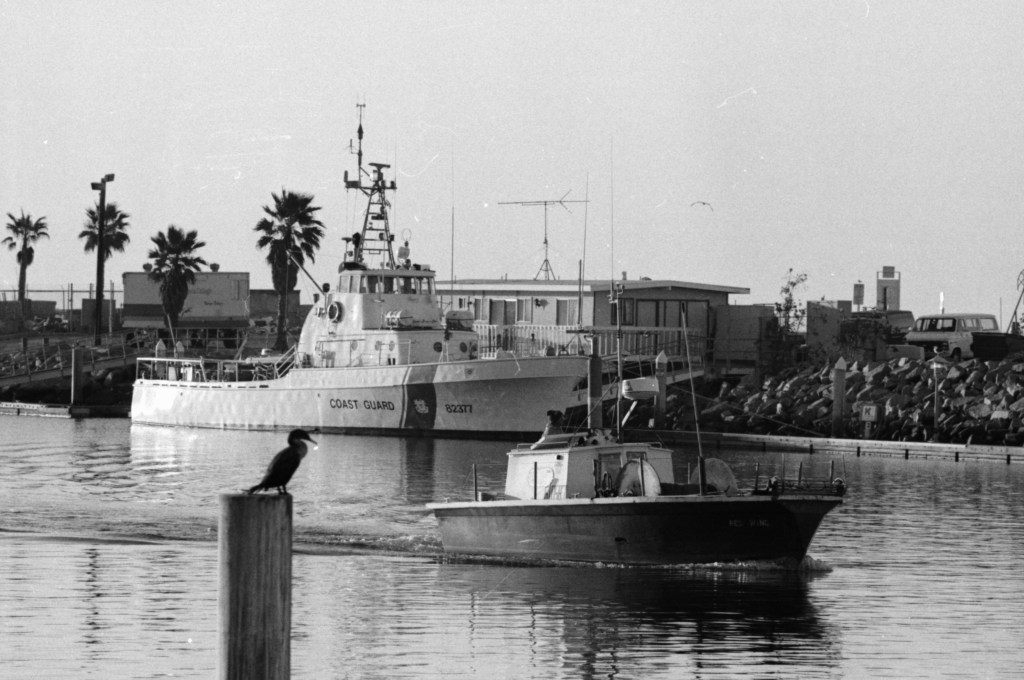
Coast Guard Cutter Point Hobart at Coast Guard Dock

In November of 1978 Oceanside’s City Council approved the building of a fishing pier at the Harbor at a cost of $50,000 with State funding.

In the early 1990s the Oceanside Harbor District was annexed by the City of Oceanside and all District employees became City employees, including the Oceanside Harbor Police.  In 1999, Point Hobart was decommissioned and the Oceanside Harbor Police became the only rescue vessels between Dana Point Harbor and Mission Bay.  Currently, the Oceanside Police Harbor Unit remains the primary response vessel for over 37 miles of coastline, assisting in mutual aid calls for service from San Mateo Point to Del Mar.
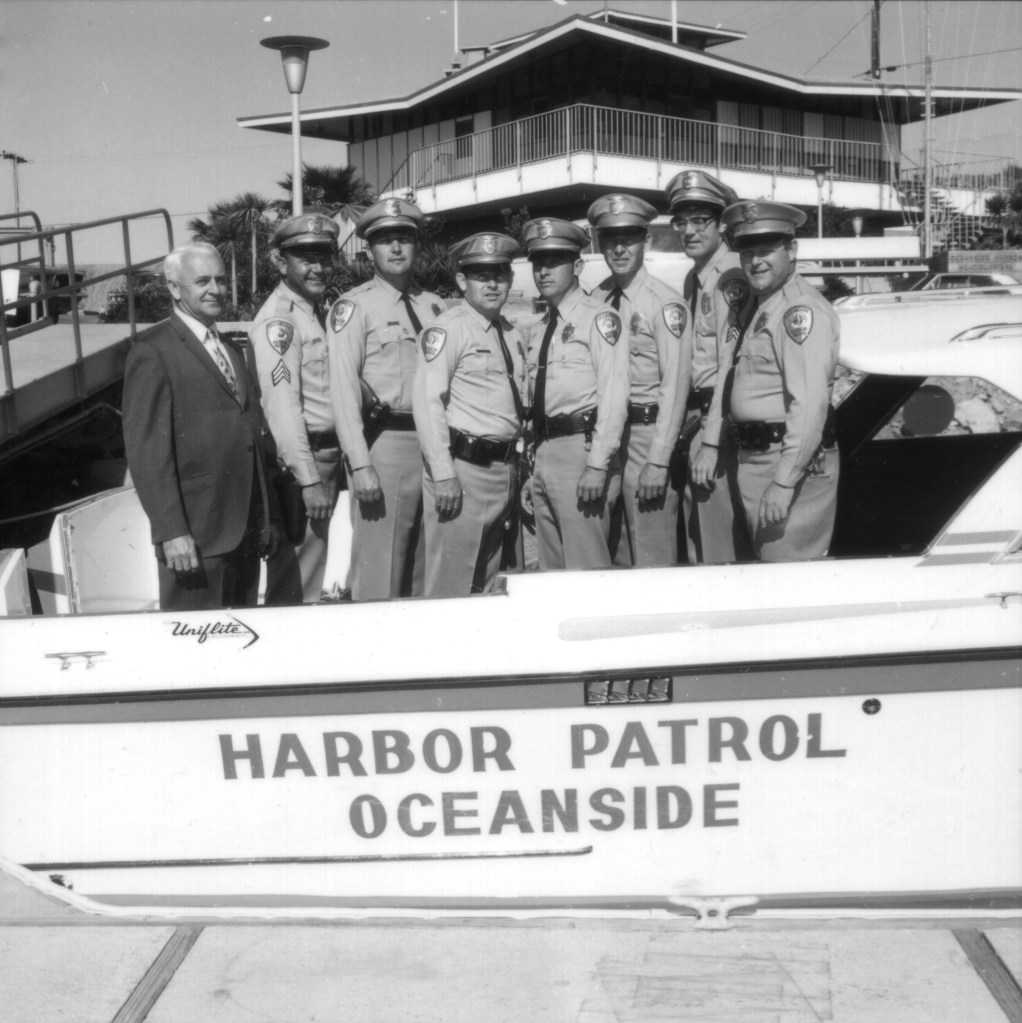
Oceanside Harbor Patrol in 1970

Today the Oceanside Harbor is more popular than ever before. It is a favorite for surfers of all ages and the home to surf competitions. Over the years docks and slips have been added and the Harbor can now accommodate over 900 vessels.

People watching, dog walking, and biking are favorite past times. There’s no shortage of food choices and gift shopping or beach essentials can be found at the Harbor Village Shops. Many people come to view the sea lions that swim around the harbor looking for a fish dinner. Sea lions congregate on a floating dock near the Harbor’s fishing pier, laze in the sun and bark at one another. Whale watching and Dolphin tours are available, along with deep sea fishing. Visitors can also rent boats and paddleboard to get an ocean level experience. The Harbor beach is wide with no shortage of sand. RV camping is available.

Oceanside Harbor (photo courtesy Visit Oceanside)

Since its opening over 50 years ago, the Oceanside Harbor is one of Oceanside’s most popular spots with tourists and residents alike. Locals might like to hear that the Harbor’s beach fire rings are back, so bring on the weenie roasts and s’mores!

Cold Case – The Murder of Ray Davis – Shades of the Zodiac

Featured

One quiet night in Oceanside, California a senseless murder was committed with no apparent motive or suspects. Days after the murder, someone claiming to be the killer called local police with an ominous threat that resulted in armed gunmen protecting city busses for several nights in anticipation of another death. But as shocking as it was, the incident slowly faded into obscurity and the murder went unsolved. The case was in fact forgotten about altogether until in 2017 when I stumbled upon a newspaper article while doing research on an unrelated subject. As I continued research on the murder I collected dozens of newspaper articles and discovered that the case had never been solved. I then contacted the Oceanside Police Department who directed me to their Cold Case Detective.

The Murder of Ray Davis

On the evening of April 9, 1962, the Oceanside Police Department received an anonymous telephone call. The unidentified caller stated cryptically: “I am going to pull something here in Oceanside and you will never be able to figure it out.” The call was likely dismissed…until two nights later on April 11th, when a body was discovered and the caller contacted the police again.

Patrolman Terry Stephens discovered the lifeless body of Ray Davis in an alley in the upscale beachside neighborhood of St. Malo at 1:45 am.  The night of the murder, Stephens had not yet turned 28 years old, but was already a seasoned police officer. Born in 1934 in Escondido Stephens was raised in Oceanside where he lived nearly all of his life. At the age of 21 he joined the Oceanside Police Department and served on the force for 31 years before he retired.

The victim, Ray Davis was just 29 years old, a native of Michigan, born in 1933 to Glen and Virginia Davis. His parents separated when he was a young boy. In 1950 his mother was working as a dispatcher for a taxi company and at age 17 Ray was working as a waiter in a local restaurant.

Home at 616 E. Mason Street in Owosso, Michigan, where Ray Davis lived with his mother in 1950. They lived in the rear unit.

Ray married Marion Lois Solomon in 1953 in Owosso, Michigan. It was Marion’s second marriage and she had two children with her first husband, Julius Poullion.

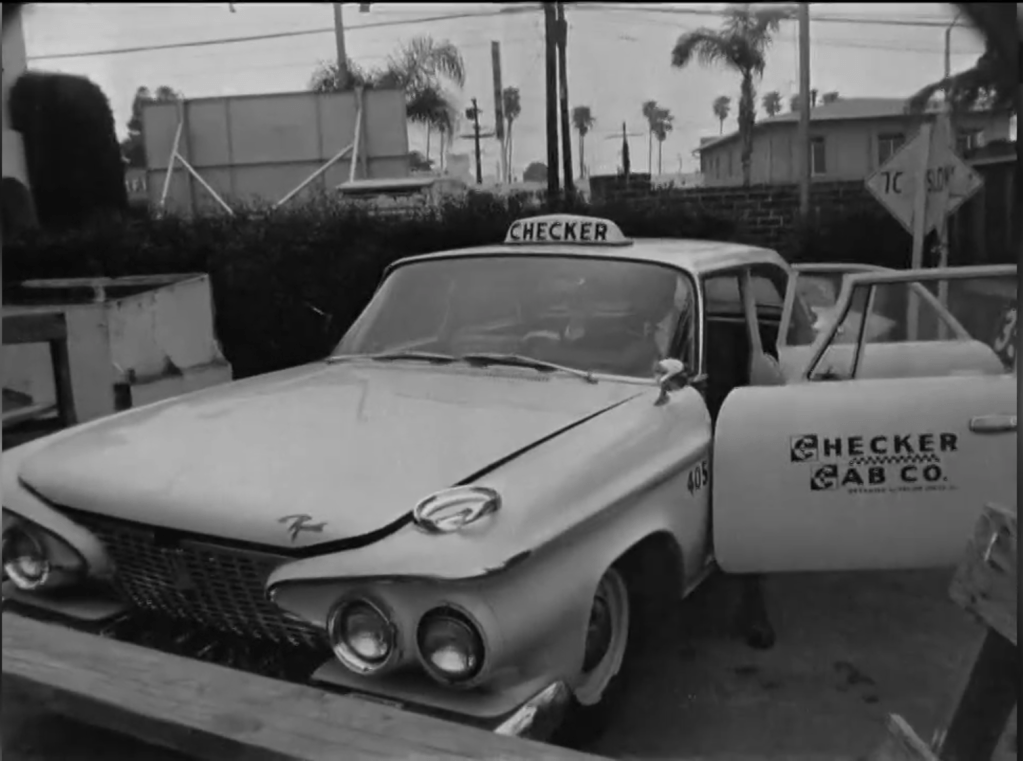
Ray and his brother older brother Jack had moved to Oceanside in January of 1962. Oceanside had a population of less than 25,000. Jack got a job working at Marine Corps Base Camp Pendleton and Ray as a cabdriver for the Checker Cab Company. The brothers were renting a house at 525 South Tremont Street. Ray and his wife were living separately, with Marion residing in Pomona, California.

Ray Davis was working an evening shift, his cab parked on Mission Avenue in downtown. At 11:10 pm he reported to his dispatcher Lowell Sikes that he was driving a fare to South Oceanside. He never returned or responded to subsequent radio calls.

Police inspect the cab in which Ray Davis was murdered

Ray’s body had been dumped in the alley behind 1926 South Pacific Street, the home of Oceanside’s former Mayor Joe MacDonald. Across the street was the home of Oceanside’s current Mayor Erwin Sklar. This was not a neighborhood familiar with violent crime, let alone murder. (Note: Few people realize that St. Malo does not begin behind its iconic gated archway, but also includes the 1900 block of South Pacific Street.)

Davis had been shot once in the back, through the driver’s seat, and once in the back of the head. His assailant unceremoniously pulled him out of the cab and drove away. Robbery did not appear to be a motive as Davis had a modest amount of cash in both his wallet and shirt pocket.

The bloodied cab was discovered at 6:30 am, left in the alley of the 400 block of South Pacific Street with its meter showing a $2.20 fare. On scene Detective Don Brown found a third shot had been fired through the windshield of the taxi.

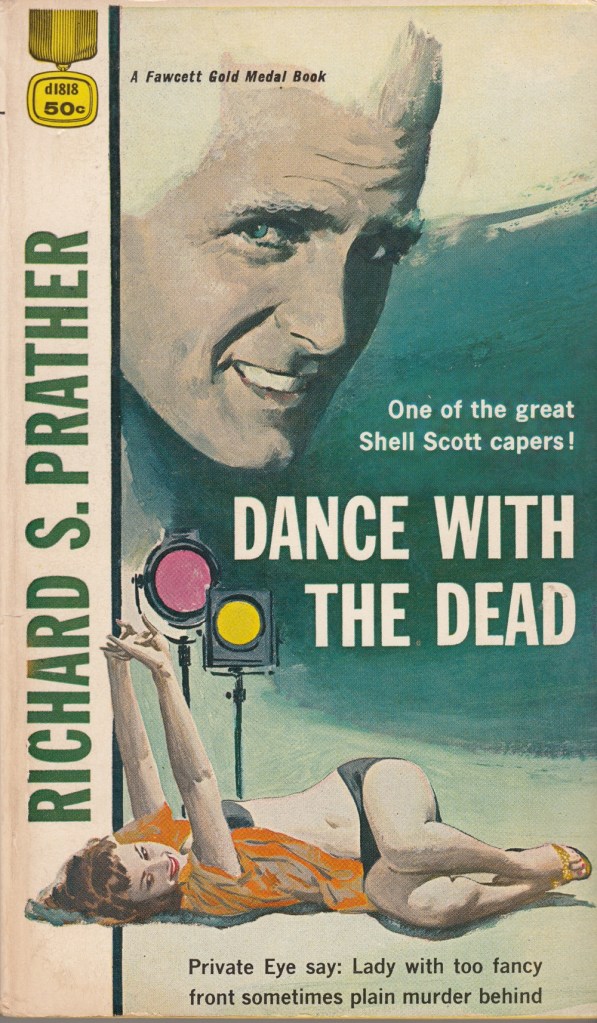
On the front seat of the abandoned cab was a paperback novel, “Dance With the Dead.” Written in 1960 by Richard S. Prather, it featured a private detective who solved crimes, all the while encountering scantily clad women…very campy stuff.

Davis was taken to the Seaside Mortuary at 802 South Pacific Street where an autopsy was performed by L. H. Fairchild of the San Diego County Coroner’s Office. Two .22 caliber bullets were removed and given to Oceanside Police Detective Floyd R. Flowers.

The following day, April 12th, both the Oceanside Blade Tribune and San Diego Union Tribune newspapers reported the murder along with the fact that police had no motive or suspect. The story of Ray’s murder was also published in several Southern California newspapers, including the Los Angeles Times. In Ray’s home state of Michigan, at least three newspapers reported the murder of Ray Davis. No mention was made of the mysterious phone call of April 9 as the Oceanside Police Department had not released that information.

Funeral services for Ray Davis were held at the Oceanside Church of God on April 13th. He was buried in a plot located in the “Sunset Slope” at Eternal Hills Memorial Park. Virginia Davis, his bereaved mother, flew from Michigan to Oceanside for the services.

Headstone of Ray Davis in Eternal Hills Memorial Park, Oceanside, California

On April 16th the Oceanside Police Department disclosed to the public that an unknown person had called them on April 9th with a veiled threat that they now linked to the murder of Ray Davis. The second phone call came with a frightening warning.

Police Chief William H. Wingard described the caller as a possible “deranged killer” and released the contents of the call:  “Do you remember me calling you last week and telling you that I was going to pull a real baffling crime? I killed the cab driver and I am going to get me a bus driver next.”

Who, but the original caller, would have known about the initial message? Who would taunt the police in such a way?

This threat was not taken lightly, considering the unknown caller seemed to have made good on his last one. Chief Wingard stated: “We have no reason to disbelieve the calls.”

In response to the threat, the Oceanside Police Department took measures to protect all city busses and armed military police were put on each bus going aboard Marine Corps Base Camp Pendleton. The newspaper reported that Frank Lilly, Oceanside’s City Manager gave Oscar Hatle, Bus Superintendent “blanket authority to take whatever steps necessary.” The unusual aspects of the murder and the unprecedented response of armed guards were big news. The story was widely distributed by the Associated Press and United Press International.

Three days passed without incident. Guards were removed from the busses, but on so-called “lonely routes” the bus company assigned two drivers. Oscar Hatle commented: “The situation still exists. We are taking no unnecessary chances.”

The police had no motive and scant evidence. They were desperate to solve the murder. Several people were questioned and released. One reported suspect was a fellow cabdriver, Charles Schofield, but the accusation had no foundation.

On May of 1962 an arrest was made of four Marines for armed robbery, but neither their prints nor ballistics matched.  Another armed robbery suspect was arrested in November but again, the fingerprints were not a match.

The murder was all but forgotten about except for the Davis family. Years passed, then decades. Ray’s brother Jack died in 1990. Ray’s mother died in 1995 and was buried at Eternal Hills Memorial Park. Ray had no biological children. After the death of his brother and mother there was no one left to remember.

Headstones of Ray and Jack Davis with their mother Virginia Davis at Eternal Hills Memorial Park

Work of the Zodiac?

It is only speculative, but it is still worth noting that seven years after Ray Davis’s murder, a killer known as the Zodiac would mimic the same deadly scenario. In 1969 he shot and killed a taxi driver in San Francisco, contacted police taking credit for it and then threatened to target a bus, in this instance one full of children.

The Zodiac killed his victims in a variety of ways and weapons, including a .22 caliber gun (as in the murder of Ray Davis). It is believed that the Zodiac may have been in the military. It is now surmised that one of his first victims may have been Cheri Jo Bates, who was murdered in Riverside, California in 1966. While there are several theories surrounding Zodiac, is it too far-fetched to believe that perhaps he started his killing spree in Oceanside?

Many serial killers are known to taunt or toy with police and certainly this was the case with Ray’s murderer. Serial killers taunt because they crave the attention, they want the notoriety and many times they are convinced of their own superiority over law enforcement.

Theories and conjecture aside, to this day the murder of Ray Davis remains unsolved. It is likely the killer is dead … even if he was just 25 years of age in 1962, he would be 83 years old in 2020.  Many of the police officers and detectives who worked so diligently to try to solve the case and protect the residents of Oceanside have passed. However, Roy K. Smith, a retired police captain, remembers the case as he was working the morning watch the night of the murder.

I first brought this case to the attention of Tom Heritage, a semi-retired law enforcement officer working part time in the Oceanside Police Department’s Cold Case files. Soon after his brief review of the file, Heritage permanently retired and moved out of the area. Detective Sylvia Guzman O’Brien then headed the department and she took a more thorough look into the unsolved murder.

In December of 2019 Detective O’Brien sent the latent fingerprint cards collected at the scene for entry into the Automated Fingerprint Identification System (AFIS). The Oceanside Police Department has kept silent about those results.

There may be DNA evidence. The murderer pulled Davis’ lifeless body out of the front seat of the cab by his belt loop but it is unknown if the evidence is sufficient to create a profile.

Detective O’Brien retired in 2021 and it is unclear if anyone is actively working this murder which is now 62 years old. The Oceanside Police Department solved a 27-year-old case in February of 2022, the stabbing death of Dolores Rabaya in 1994.

Regardless if there is a tie or link to the Zodiac killings, Ray Davis still deserves justice. Even if the killer has since died, perhaps this case could be solved through ancestral DNA forensics.

View local news reports on the links below:

https://www.10news.com/news/local-news/did-the-zodiac-kill-in-oceanside-police-re-test-evidence-in-cold-case

https://www.cbs8.com/article/news/crime/police-looking-into-claims-by-historian-that-zodiac-killer-may-be-responsible-for-1962-oceanside-murder/509-06453d97-3244-478f-9160-3cd499ce2ec0

Listen to this “Vanished” podcast about the infamous Zodiac Killer: https://audioboom.com/posts/8266146-vanished-zodiac-sick-of-living-unwilling-to-die

https://podcasts.apple.com/us/podcast/kristi-hawthorne-the-zodiac-killer-the-unsolved/id1572325461?i=1000532770818

Kristi S. Hawthorne, historiesandmysteries.blog “The Murder of Ray Davis”, 2020. Unauthorized use and/or duplication of this material without express consent and written permission from the author and owner is strictly prohibited. Links may be used, provided that full and clear credit is given to the author Kristi S. Hawthorne and historiesandmysteries.blog “The Murder of Ray Davis”, with appropriate and specific direction to the original content.