Oceanside Neighborhoods

Our City is made up of many different neighborhoods, often with their own unique characteristics, history and even architecture. As Oceanside’s population grew, its borders expanded with various subdivisions and new housing developments. From the exclusive enclave of St. Malo to Potter homes in South Oceanside and Francine Villa in North Oceanside, Oceanside neighborhoods are as diverse as the people who live here. Here are a few neighborhoods, some forgotten and others well remembered.

Guidottiville

Guidottiville was named by and after Amerigo Edwardo Guidotti. The area was near what is referred to as Lawrence Canyon just south of present Highway 76.  Guidotti built his residence there along with several rentals and lived there for many years. The homes were removed by the 1980s to make way for the Highway construction.
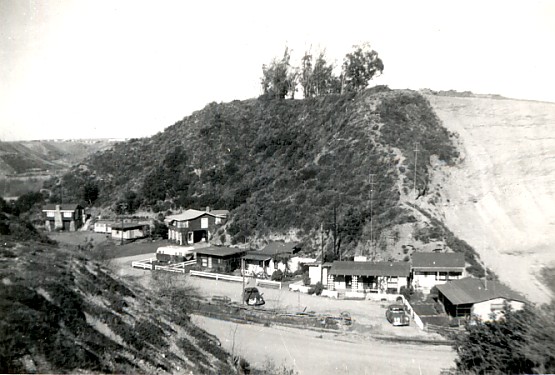
Guidottiville in Lawrence Canyon, south of present day Highway 76

Pine Heights

Pine Heights was a rather remote area of Oceanside, accessible only via Eighth Street, now called Neptune Way. Pine Heights provided expansive view of Oceanside and panoramic view of the Pacific Ocean.  Niels Hansen, a local grocer, built a large Craftsman style home designed by noted architects the Quale Brothers in 1908.  Also that year, Attorney John Johnston hired prominent Chicago and San Diego architect Henry Lord Gay, to design his $10,000 home in Pine Heights.  The Hansen house was later moved to North Clementine Street but the Johnston home was demolished. Pine Heights is now the location of a 15-acre condo development by Evening Star Development.
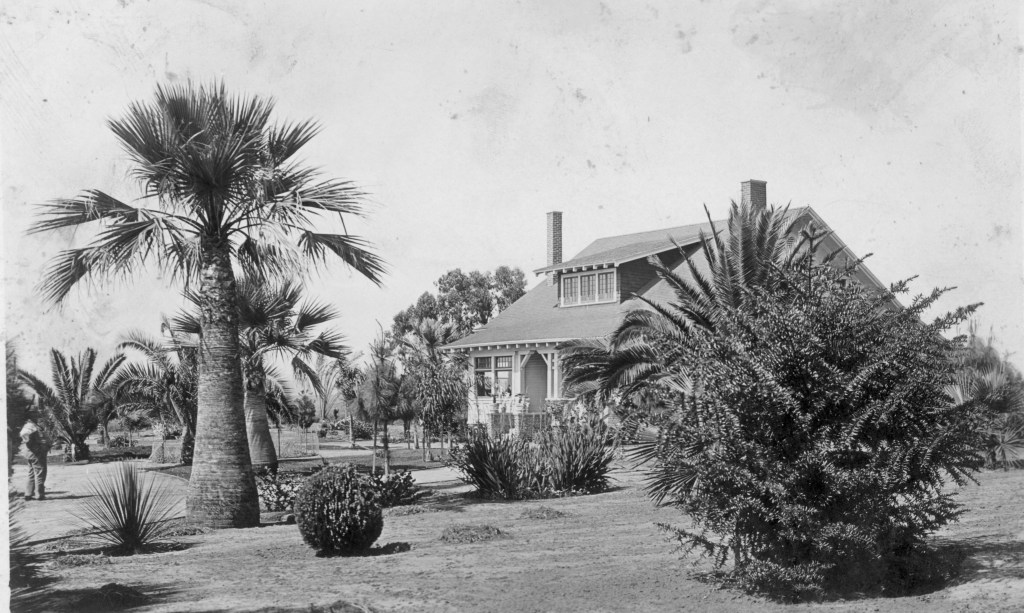
The Hansen Home in Pine Heights.

North Oceanside Terrace

A new subdivision established in the late 1940s was situated along the northern most border of Oceanside along Camp Pendleton. North Oceanside Terrace includes Capistrano Drive, San Luis Rey Drive, Monterey and Sunset and other streets. Many of the homes built there were built in the early to mid 1950s and purchased by the military families that were stationed at Camp Pendleton. In 1953 the City approved Francine Villas to the east, adding over 300 homes. These homes were introduced as rentals to military and civilians with a two bedroom home renting for $72.75 and a three bedroom for $82.75. Because of the growing density and traffic, an additional entry into the neighborhood was provided, initially called “River Road”. Later Loretta Street from the Eastside neighborhood would be built across the San Luis Rey River to provide residents access. In 1955, construction of North Terrace Elementary School began, opening the following year. Today the area is more commonly referred to as Capistrano because of the area park.

1974 aerial of a portion of North Terrace neighborhood, school and Loretta Street crossing.

South Oceanside

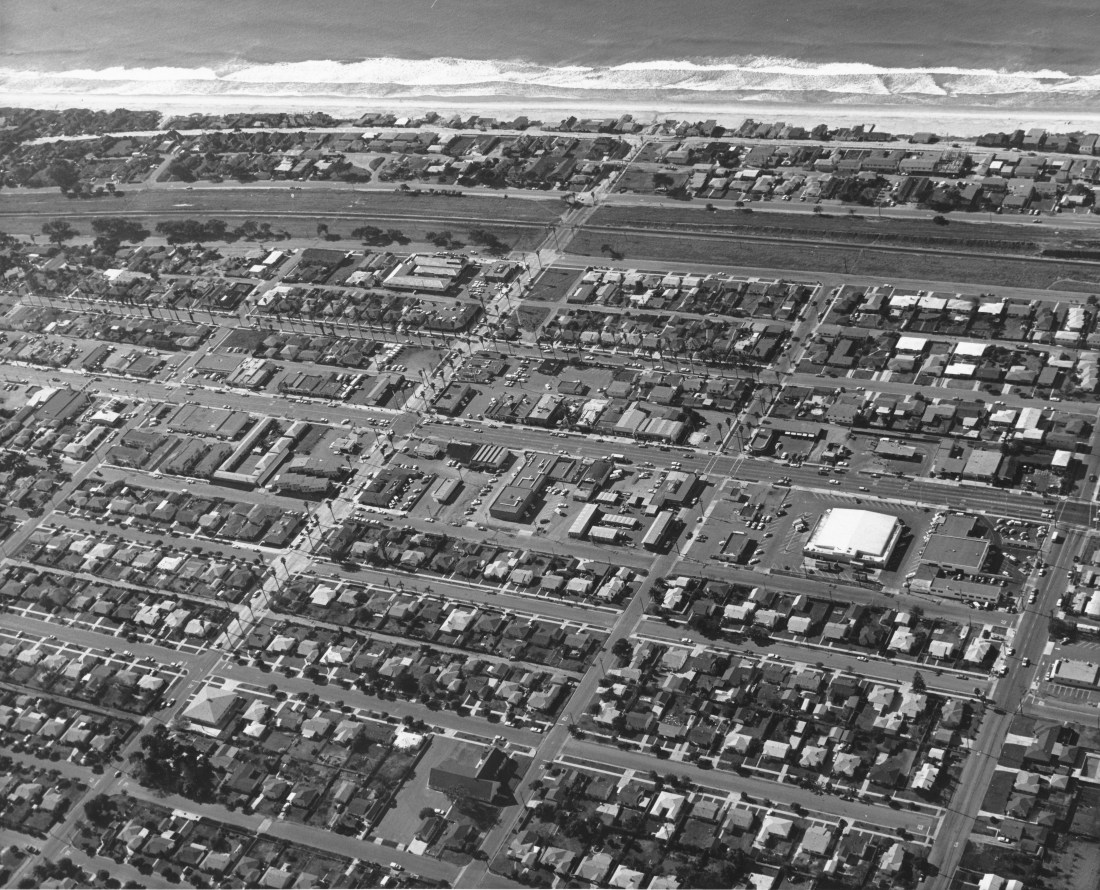
John Chauncey Hayes established South Oceanside, a small township just south of the City of Oceanside in the 1880s.  In the earliest days it had its own bank, a school building, cemetery, several brick residences and a newspaper, the South Oceanside Diamond.  This largely rural area included the Spaulding Dairy (established about 1913) and was home to acres of flower fields owned by the Frazee family and others. It turned residential when Walter H. Potter, “the man who built South Oceanside” began building dozens of small homes in 1947 that stretched from Morse Street to Vista Way.
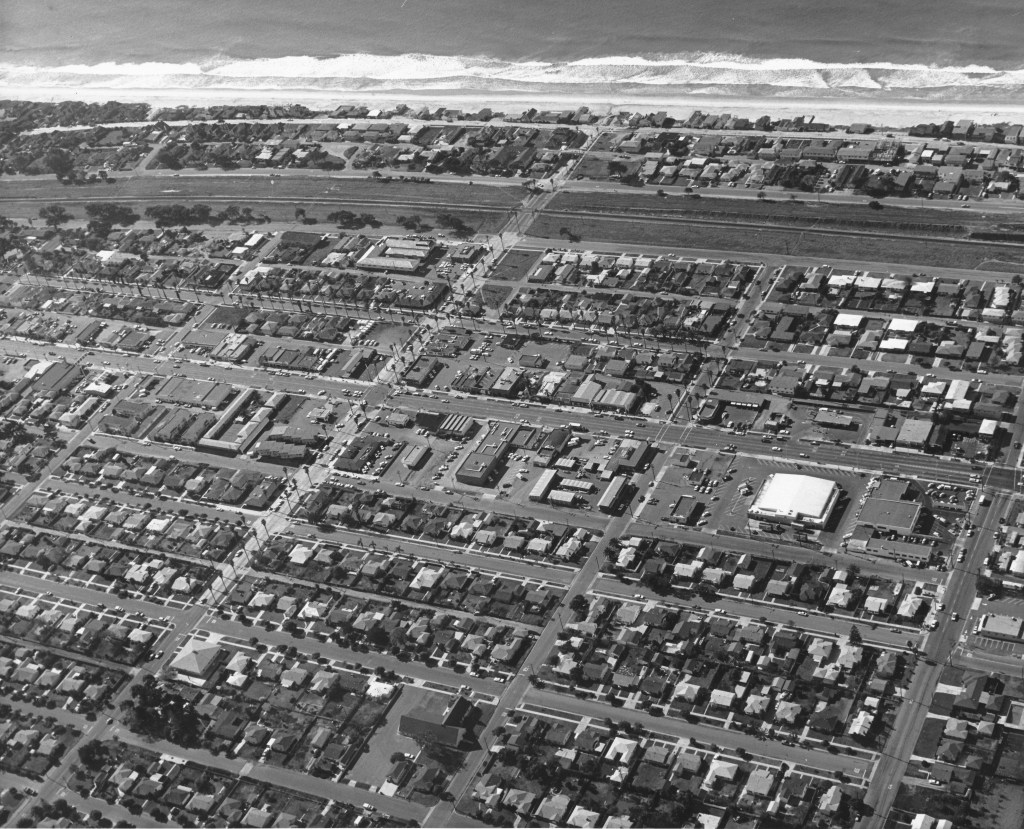
Aerial view of South Oceanside looking west, circa 1970

Eastside

The Eastside neighborhood is just east of Interstate 5 and north of Mission Avenue, with entrance by Bush or San Diego Streets. The subdivisions of Mingus & Overman, Reece, Spencer, Higgins & Puls, which encompass the area, were mostly farmland when families from Mexico began settling there in the 1910s and 1920s.  Most of the early residents were laborers who worked in the fields of the San Luis Rey Valley and the Rancho Santa Margarita (now Camp Pendleton). Many of the homes were built between 1920 and 1940 by the hardworking fathers and grandfathers of the families that still call Eastside their home. This neighborhood was referred to as “Mexican Village” by local officials but residents called it Posole. It was last neighborhood to have paved streets and a sewer system, which were not added until the late 1940s! Eastside was also the home of Oceanside’s first growing Black population in the 1940s and 1950s, along with Samoan and Filipino families.

Higgins and Santa Barbara Streets in Eastside shows dirt streets and houses on blocks because of the lack of sewer system.

Mesa Margarita

As Oceanside’s population grew at steady pace in the 1950s and 1960s, its borders continued to extend eastward. New housing was always in demand. Sproul Homes developed many new neighborhoods including Mesa Margarita, which is often referred as the “Back Gate” area because of its proximity to northeast entrance to Camp Pendleton.   In 1965, 62 acres along North River Road were purchased by Fred C. Sproul Homes, Inc., a residential development firm, from Harold Stokes and Joe Higley.  The Stokes and Higley families were long time dairy farmers in the San Luis Rey Valley. With the plan to build 275 new homes on the property it was one of several developments that changed the landscape of rural to suburban.

Sproul Homes ad in 1963

Oceana

One of the first adult only communities built in Southern California was that of Oceana. Situated east of El Camino Real and south of Mission Avenue, this planned community was built in 1964 at a cost of $25 million.  It was touted as being “a city within a city” built on 180 acres with 1,500 lanai cottages and 300 apartments.  At the time it was built it required that at least one adult be age 40 or over. A two bedroom, two bath model was listed at $16,995 and the community offered a variety of amenities which included a pool, golfing, library and restaurant.

Oceana development in 1960s

Henie Hills

Henie Hills was owned by figure-skater Sonja Henie. Sonja and her brother Lief purchased 1,600 acres of ranch land in about 1941 which included the present day El Camino Country Club. In the early 1950’s the Henies began subdividing part of the land near El Camino Real at which time some of the first custom homes were built. A portion of this land was sold to Tri-City Hospital and eventually acquired by MiraCosta College. Miss Henie built a large house on Oceanview Drive, which she used during her visits here from her native Norway.  She continued ownership of 350 acres until 1968.  In the 1974 Henie Hills opened as one of the nation’s first planned residential estates community, offering homes on estate-size lots averaging one-half acre with views of the sea, mountains and golf fairways in the valley below. Home prices ranged from $54,000 to $81,000.

Driving Range at golf course, Henie Hills sign in background

Fire Mountain

Fire Mountain was at one time called “North Carlsbad”.  It was a largely rural area planted with avocado and citrus groves, consisting of approximately 338 acres. While the town of Carlsbad eventually grew and incorporated, North Carlsbad remained an unincorporated area of San Diego County, an island surrounded by the city limits of Oceanside. The City of Oceanside annexed the area in the 1960s. It has developed into a desirable neighborhood simply named after the road traveling through it, consisting of middle-class homes, tract and custom homes, many of which sit on large lots, some offering views of the Pacific Ocean.
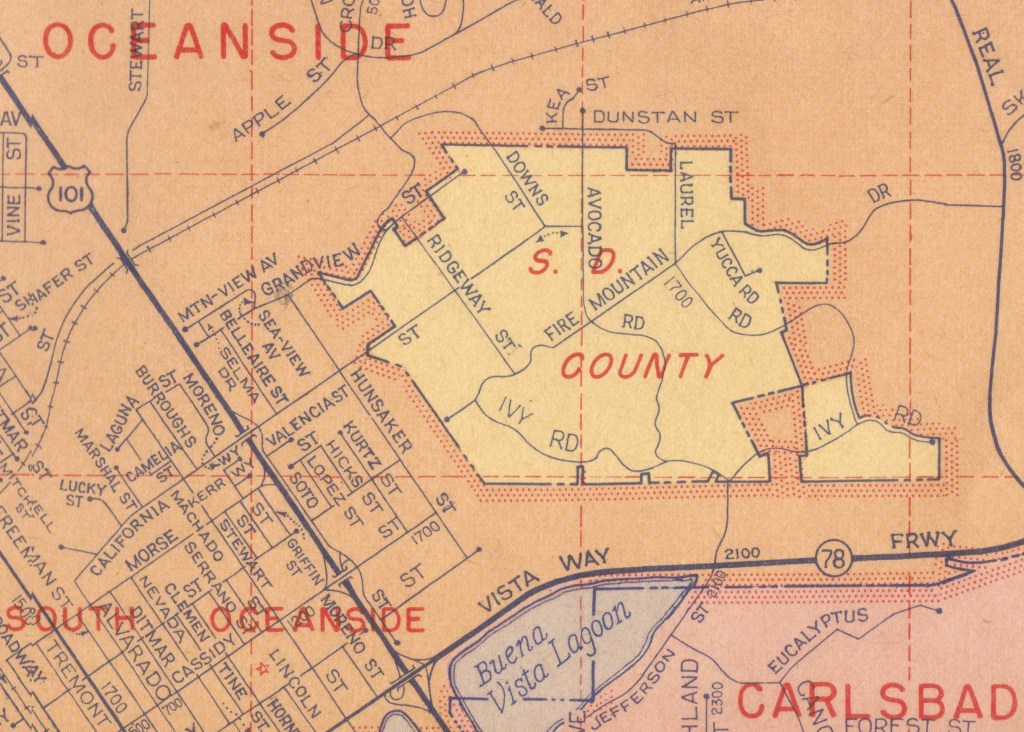
1956 Thomas Guide of Fire Mountain area before annexed to Oceanside.

St. Malo

A group of twelve homes was built by 1934 in an exclusive enclave in South Oceanside at the end of Pacific Street. Pasadena resident Kenyon A. Keith purchased 28 acres of oceanfront property and contained homes resembling a French fishing village that was known as St. Malo. Well-to-do property owners used St. Malo for vacation and summer homes.  Early film director Jason S. Joy’s home was identified as “La Garde Joyeuse” and included an outdoor bowling alley and volley ball court.  Author Ben Hecht was another resident, as well as Frank Butler, who co-wrote “Going My Way”.  The beautiful community of St. Malo remains one of Oceanside’s best kept secret and continues to serve as summer homes and getaways for the rich and famous. 

St. Malo homes fronting the Pacific Oceanside. Jason Joy house far right.

Plumosa Heights

Banker B.C. Beers established a new subdivision in the 1920s called Plumosa Heights, named for the plumosa palms lining the streets.  This once exclusive neighborhood includes West and Shafer Streets, two of the street names are named for his children, Alberta and Leonard.  The Plumosa Subdivision required at least a $4000 structure on the property to be set back at least twenty feet from the street.  Plumosa Heights continues to be a desirable neighborhood with concrete streets and original cement light posts.  Although it was the home of many affluent Oceanside residents, it was also inhabited by Oceanside’s middle class.
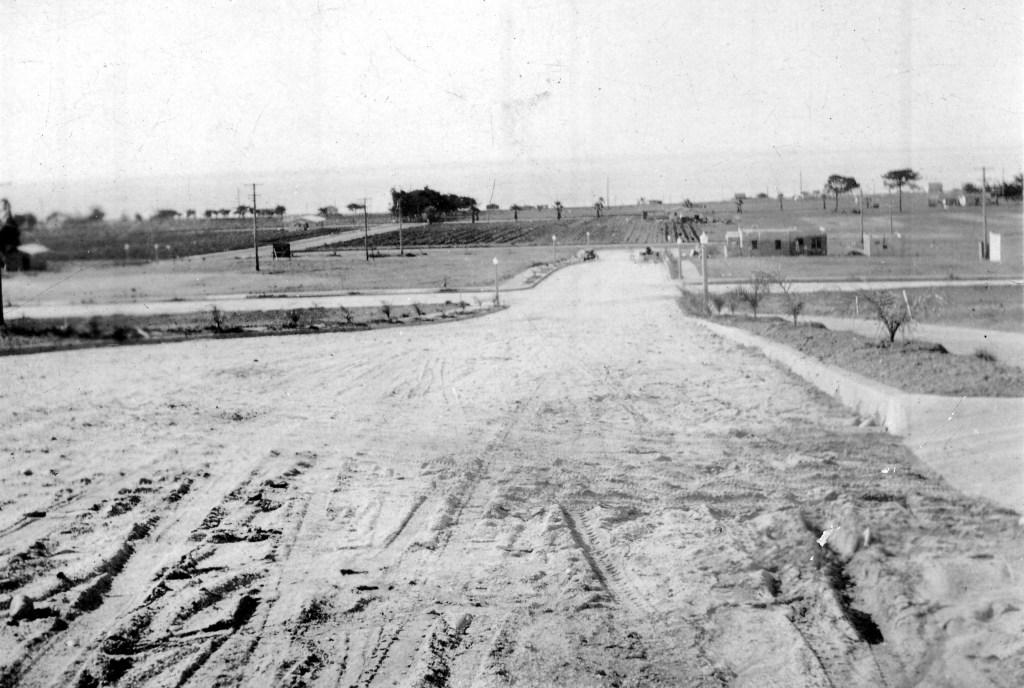
Leonard Street looking west at South Clementine and South Ditmar Streets, circa 1925

The House on Shoshone Street and the Story of Frankie Elda Kidd

I want to thank Michelle Foster for contacting me about Frankie. Her quest for information became mine and I am grateful for the personal stories and photos she shared to bring this story to life.

In a rather remote area of Oceanside, tucked away in the northwest section of the Eastside neighborhood, was a small house on a dead end dirt road near Lawrence Canyon.

The house was built in 1944 and owned by Anna Curran, who owned no less than sixteen lots throughout Eastside, several of which had small houses that she rented out. The rent she collected was likely her only source of income as her husband William Curran had been arrested for the murder of a Marine in downtown Oceanside that same year. After a lengthy trial, Curran was found guilty, but deemed insane and sent to an asylum to serve out his sentence.

Residents of Eastside were largely Mexican immigrants, many of whom were laborers who worked in the fields of the San Luis Rey Valley and the Rancho Santa Margarita (now Camp Pendleton). The neighborhood was segregated and separated in four ways: Geographically it was separated from “downtown Oceanside” by Lawrence Canyon; Children of immigrants were separated from other students and sent to the Americanization School on Division Street where they were immersed in English; The neighborhood had dirt streets while most of Oceanside enjoyed paved ones; Eastside had no sewer system.

1946 aerial view of Shoshone Street

Although some referred to Eastside as “Mexican Town”, more than a dozen African-American families settled in the neighborhood in the 1940s.

Frankie Elda Kidd occupied one of Anna Curran’s tiny rental homes, at 1420 Shoshone Street. Frankie’s birth name was Alta (perhaps a variation of Elda) and “Frankie” may have been a nickname that she acquired. She was born in 1920 in Imperial County, California and as best as can be determined, she was the daughter of John Zainina and Martha Bartley.

In 1930 Frankie and her family were living in Merced, California, where her father was working as a dairy farmer. By around 1935 she was living with extended family in San Bernardino, California, where she attended high school.

While attending San Bernardino High School, Frankie met James Scott, a handsome young man from Tulsa, Oklahoma. The two married in 1938 but the marriage was short lived as they were living separately just two years later. In 1940 Frankie was living with cousins and working as a housekeeper for a private home.  

James Scott, Frankie Elda’s first husband

In about 1943 Frankie embarked on her second nuptials to Alfred Selester Kidd. It would be her second of six marriages. She was likely introduced to Alfred by her older brother Vernon, as the two men were rooming together while living in Oakland. Alfred Kidd, a native of Louisiana, was working at the Navy Yard at Mare Island.

Frankie arrived in Oceanside by 1945. Did Alfred Kidd accompany her? There is no record of him leaving the Oakland area. Perhaps this marriage was just as brief as the first. What brought Frankie to Oceanside is unknown, but perhaps she came because of job opportunities. Due to the establishment of Camp Joseph H. Pendleton shortly after World War II began, Oceanside was expanding at a rapid rate.

Because of the remote location of Frankie’s home on Shoshone Street, any traffic (pedestrian or otherwise) would have been largely limited to residents who lived on the dead end street. However, apparently Shoshone Street was getting a steady stream of traffic, so much so that area residents took notice and began to complain, which prompted an investigation by the Oceanside Police Department.

The Oceanside Blade Tribune newspaper reported that Frankie Kidd was arrested on February 4, 1945 for operating an “illegitimate business” along with another woman, Mildred Clark. Later this particular business was classified as a “disorderly house” which is a polite term for a brothel.

It seems that Frankie’s “visitors” were mostly servicemen, many of whom resided at Sterling Homes, federal housing built for the military just east of Holly Street. (Sterling Homes had paved streets, curbing and sewers for its occupants in contrast to the neighboring Eastside community.)

Sterling Housing just east of the Eastside Neighborhood

What brought Frankie to this profession is anyone’s guess, but despite her occupation she was remembered by local residents as being friendly, beautiful and “could hold her own against any situation that could come up.”

After her arrest, Frankie asked for a jury trial and the case was heard on March 7th. The jury of five women and three men listened to what must have been riveting testimony which lasted all the way up until 10 pm. (However, many of the witnesses were servicemen and reluctant to testify.) The jury deliberated for two hours and found Frankie Kidd guilty as charged. Judge Parsons fined her $300, with $100 suspended. But even a $200 fine was a hefty amount, equivalent to over $2500 today). She also received 150 days of probation. Initially appealing the case, Frankie paid the fine a few days later.

While Frankie continued to live on Shoshone Street, she was known to frequent a small establishment which was located just steps from the back of her home. It was called “the Hangout”.  Situated at the back end of 1415 Laurel Street, was a small trailer that was frequented by many of the local residents and was a popular spot for military men. Charles C. Jones applied to the city for a permit to operate a café “specializing in barbecue and chicken sandwiches” but it was denied. Despite the city’s rejection, the Hangout operated without a permit and was a popular spot offering food, drink and dancing, with a little bit of gambling thrown in. Frankie was a regular and it was there she attracted her “customers.”

Frankie Elda in later years at the Hangout (photo courtesy of Michelle Foster)

Although Frankie avoided any additional attention from law enforcement for several years, in 1949 she was arrested again — this time for a scuffle with another woman. On June 26th, Mary Morgan filed a complaint against Frankie for threatening her with a knife and a razor. Apparently Frankie had gotten too friendly with Mary’s husband George Morgan, and a heated argument ensued. After being taken into custody, Frankie requested a jury trial which was set for July, but on the day of trial, she pled guilty and was fined $100.

Mary Morgan playing cards at the Hangout (photo courtesy of Michelle Foster)

While the Hangout continued in popularity, as did Frankie, the raucous nature of this corner of Eastside changed when families began to populate the remote area of Laurel and Shoshone streets.  Gilbert Woods purchased a lot just a few doors down from Frankie. In 1948 he had built a small home at 1430 Shoshone, where he and his wife raised their family. A cook in the Navy during WWII, his granddaughter Michelle remembers that he prepared and shared food with his neighbors, including Frankie, who was grateful for the kindness.

Gilbert Woods holding son (photo courtesy of Michelle Foster)

Another substantial change to the immediate area came when the Walker Chapel African Methodist Episcopal Church was built in 1949, one of the first Black Churches in Oceanside. The church was established at the behest of Johnny and Easter Foster, prior residents of Blythe, California. They wrote to the Church Bishop asking for an AME church to be established in Oceanside. Walker Chapel was built on the very lot that the Hangout was located, which remained standing and was still frequented by residents, even while parishioners attended services.  

Original Church building of Walker Chapel AME in 1949 at 1415 Laurel Street. To the left is Easter Foster and the Rev. Jessie B. Browning; Far right Johnny Foster (photo courtesy of Michelle Foster)

Rev. Jessie B. Browning was the first pastor of Walker Chapel AME. Shortly after her arrival to Oceanside the local newspaper announced the following:  “Rev. Jessie Browning, a lady preacher of the colored Methodist church and her colored singers will appear at the Nazarene Church Sunday evening at 7:30, in the Woman’s Club house, corner of Tremont and Third streets.” 

While the Eastside neighborhood was within city limits by 1887 and a residential neighborhood since about 1910, it took decades for the City to pave the streets and to add a sewer system, well after other residential sections had these same “amenities”. But even when a sewer project was approved in 1948, Shoshone Street and the 1400 block of Marquette Street were left out. Gilbert Woods worked for a needed sewer system for this “forgotten” area and he distributed a petition which was presented to the City Council, who initially rebuffed his efforts. Finally in September of 1954, Gilbert’s efforts were rewarded when the City Council finally approved plans for the Shoshone Street Sewer project.

In 1954 Edward Anderson purchased the home at 1420 Shoshone Street in which Frankie had lived for several years, and built an additional home on the lot, situated behind the original house. It is likely that Frankie resorted to living in the Hangout.

Construction began for a new elementary school on Laurel Street, just northeast of Walker Chapel, which opened for students in 1955. The area once known for a “disorderly and illegal business” was now gentrified. Eventually even the Hangout would be reformed, or shall we say “redeemed” altogether when the Walker Chapel AME church included the small building into its own when they enlarged their church years later.

The little house that Frankie once lived in at 1420 Shoshone Street was destroyed in a fire in 1982. The fire was so hot it reached upwards of 400 degrees and melted the Plexiglass face shields of the responding firefighters. Smoke inhalation took the life of an elderly blind woman, Mildred Taylor, who could not make her way out. Owners Ed and Margarethea Anderson, who lived next door said they had no insurance on the structure as it “was too old.”

Edward Anderson and the Oceanside Fire Department at 1420 Shoshone Street.
The house where Frankie Elda once lived.

Frankie Elda married a man by the last name of Marshall but nothing is known of this marriage. She relocated to Klamath Falls, Oregon and married Eugene James Witherspoon in Reno, Nevada on January 10, 1953. The two divorced and in 1967 Frankie married Ezelle Spoon, a native of Texas.

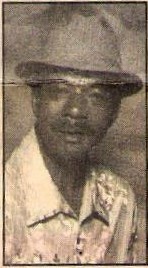
Ezelle Spoon, Frankie’s 4th husband

After the death of Ezelle in 1992, she married Arlet Green two years later in 1994, in Reno, Nevada.

Frankie Elda

Frankie died June 17, 2002, but was not forgotten. Michelle Foster still remembers the stories her mother, Alberta Woods Foster, shared with her of Eastside, the Hangout, and Frankie. Perhaps Frankie walked in the path of sinners, but her neighbors, like the Good Samaritan, showed her grace and compassion.