Marion Brashears Gill

Marion Brashears Gill has long been relegated to a footnote in the history of her famous husband, acclaimed California architect Irving J. Gill. Little has been written about her and even then it is often repeated misinformation. I sought to find all I could about this woman who captivated Irving’s heart, his one and only marriage in the later years of his life. Although I have spent over a year and gathered nearly a thousand pages of documents about her life, her marriages, her varied occupations, Marion, once described as an enigma, remains mysterious.

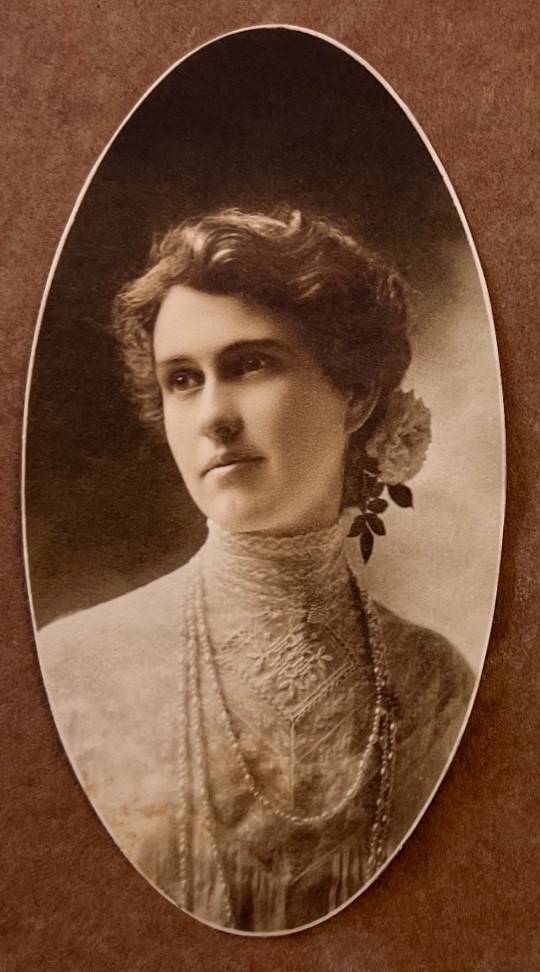
Marion A. Waugh Brashears, undated (University of California, Santa Barbara)

Marion Agnes Waugh was born May 31, 1870 in Apple River, Illinois. She was the only child of Charles J. and Jean (Sutherland) Waugh. The Waugh family moved to Peabody, Kansas, located in Marion County, about 45 miles northeast of Wichita. The town of Peabody had a population of just over 1,000 people in 1880.

In her younger days, she went by the name of “Mary” and attended the Peabody grammar school. In 1882 she was listed in the roll of students with her teacher noted as Mr. R. M. Williams.

Her father Charles owned and managed the Little Giant Custom Mill in 1885 which was located “at the foot of Walnut Street” near the bridge. Waugh owned a substantial farm four miles south of Peabody which he owned for decades even after he left town. He was also a building contractor, erecting several early homes in Peabody including the homes of “Senator Potter” and C. E. Westbrook.

When Marion was just 13 years old, Marion’s parents divorced in 1883, with her mother citing “extreme cruelty” by her husband. Mrs. Waugh and daughter Marion left to live in Chicago.

The Peabody Gazette, Peabody, Kansas, Thursday, May 24th, 1883

In 1889 mother and daughter were living at 377 Winchester Avenue and Marion was working as a clerk in the Pullman Building in downtown Chicago. In the directory of that year, Jean Waugh’s marital status was listed as “widow of C. J. Waugh.” This was a common practice used by many women, because of the stigma of divorce.

Marion made annual visits to Peabody, Kansas to visit friends as noted in the Peabody Gazette, particularly visits in October 1889, October 1890 and July 1891. She traveled the 675 miles by train. Her father moved to Mullinville, a small town in southeastern Kansas, but he still retained property in Peabody.

In 1892 Marion was listed in the Chicago directory working as a bookkeeper and living in an apartment at 180 Wabash Avenue. The Gibson Art Galleries, a photography studio where Marion had her photo taken, was on the same block at 190 Wabash Avenue. It is more than likely she visited the studio because of its proximity.  Marion may have been around 22 years old at the time the photo was taken. In it she is wearing a striped blouse, silk scarf and a large hat. She gives the camera only a hint of smile.

Marion A. Waugh, circa 1892, (University of California, Santa Barbara)

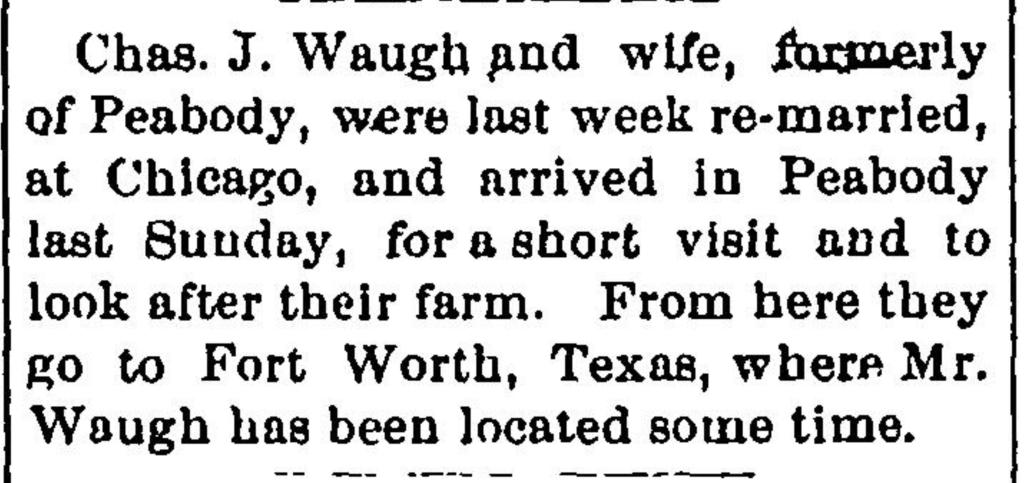
On September 26, 1893 Charles and Jean Waugh reconciled and were remarried in Chicago. The couple then moved to Fort Worth, Texas, where Charles Waugh had relocated earlier.

Peabody Gazette, Peabody, Kansas November 16th, 1893

Marion remained in Chicago and that year filed a lawsuit against banker Frank R. Meadowcroft for $500. Meadowcroft’s bank failed and he and his brother were arrested for embezzlement six months later, charged with mishandling and spending thousands of dollars belonging to their customers. The pair were eventually sentenced to one year in prison but Marion, along with others, was out her monies.
Marriage to Brashears

In spite of the financial loss, Marion celebrated her nuptials on August 15, 1894 when she married James Bradley Brashears in Chicago. Brashears was a clerk and traveling auditor for the Chicago North Western railway company and the nephew of John Charles Shaffer, a major newspaper publisher who made his fortune in railroad investments. Years later Shaffer would be misidentified as Marion’s uncle, but it is likely she that provided that information.

Amanda Brashears with her children – Edgar, James, Sue, Amanda, John, and Maude (courtesy Robin Kaspar)

The newlyweds made their home at 525 Marion Street in Oak Park, Illinois in a large Victorian home. The following year the couple relocated to Evanston, Illinois to a home at 1305 Judson Street. While in Evanston, Marion opened a “hair salon” at the corner of Davis Street and Chicago Avenue in 1895. An advertisement she ran in the local paper indicated she was formerly with E. Burnham, a popular salon owner with two locations in Chicago.

Ad for Marion’s Hair Salon, 1895, Evanston, Illinois (courtesy Robin Kaspar)

James and Marion Brashears resided at their home on Judson Street through or up until 1904 when the couple may have separated for a time. James was traveling to Michigan for the railroad company, as noted by various newspaper reports. Marion went to Portland, Oregon and rented a room at Mrs. Gertrude Denny’s boarding house, 375 16th Street, long enough to be included in the residential directory of that city. 

1305 Judson Street apartment home in Evanston, Illinois where Marion and James Brashears resided.

The following year Marion’s parents moved from Texas to Highland Park, California, a suburb of Los Angeles. There Charles purchased several lots in the city, built homes and sold them.

Marion apparently returned to Chicago from Portland in or around 1906 where she and James resided at 2000 Kenmore Avenue. Marion would later claim to have lived continuously in the Chicago area until 1908 but neither she nor James could be located in any directory published around that time.

Ethelbert Favary

By the summer of 1908 Marion had again left Chicago, traveling once more to Portland, Oregon. By 1909 she was selling shares for the Favary Tire and Cushion Company, and was presumably there to conduct business. Just how and when Marion entered into this business venture and met the company’s owner Ethelbert Favary is unknown, but it certainly changed the trajectory of her life.  

Ethelbert Favary Passport photo 1920

Ethelbert Favary was a native of Hungary, born in 1879, immigrating to the US in 1902. One of the first records of him is from the Wall Street Journal on March 2, 1909 announcing the incorporation of the Favary Tire & Cushion Co. in New York with “a capital of $1,000,000” and listing the directors: Ethelburg [sic] Favary, Joseph Nordenschild, and C. S. Block.

In spite of his New York connection, Ethelbert Favary was a resident of Portland, Oregon as he was listed in the 1909 Portland directory as an electrician and renting a room at 741 Washington Street. On March 7, 1909, the Oregon Daily Journal published an article entitled “An Automobile Tire Without Rubber” in which it briefly introduces Favary: “A new automobile tire, which its promoters claim will revolutionize the entire automobile industry, has been invented by E. Favary, a young Portland inventor. The tire contains no rubber, no air and no springs and is more resilient than the present pneumatic tire.”

Undated advertisement for Favary Tire Company

Back in Portland, Marion returned to the Denny Boarding house she had resided years earlier. It was during this second Portland residency that Marion became involved in a scandal or series thereof that would later result in a lawsuit.

Denny Boarding House

While at the boarding house Marion met and became acquainted with Reverend Nehemiah Addison Baker, a young preacher of the First Unitarian Church in Portland. The Reverend and Marion both rented rooms on the third floor, but another room separated them. The two were friendly enough that Marion visited Baker’s room on several occasions, many of them considered “after hours” visits. Baker would later insist that the visits were innocent and that the two simply talked and sometimes read passages from “Dante’s Inferno.”

Their friendship did not go unnoticed by other tenants, especially the late-night visits. It was reported to the landlord that Rev. Baker asked Marion to leave his room in a loud and abrupt manner. Baker would later deny that he had ever asked Marion to leave his room and that nothing inappropriate happened between them.

The Oregon Daily Journal May 9, 1914

While at the Denny boarding house, Marion was visited by Ethelbert Favary. Marion was selling shares of the Favary Tire Company and was said to have been his personal secretary.  Favary conducted business or met with Marion there somewhat regularly. Curiously, he kept a typewriter in the room of Rev. Baker.

The relationship between Marion and Ethelbert raised eyebrows as the two locked themselves in the parlor of the boarding house on more than one occasion. Marion would insist they needed privacy to attend to business matters. Tongues wagged when they were seen on a street car together on Christmas morning. Perhaps this behavior would hardly be noticed today, if at all, but this was just a few years after the Victorian era, where there were certain protocols of acceptable behavior between the two sexes.

In addition to what was viewed as unsuitable behavior, Marion was accused of being forward and overly flirtatious with other men involved in the Favary Tire Company. On one occasion Marion came in briskly to an office and asked the wife to leave as she needed privacy…with the woman’s husband.

Marion would claim that the gossip about her alleged behavior caused her great distress, causing her to lose sleep and have what we would term a nervous breakdown. A doctor was called, as was her husband, James Brashears, who traveled to see her when notified of her condition.

However, this distress could have been brought on by the departure of Ethelbert Favary, who left Portland to marry Victoria Morton. Favary relocated, at least briefly to Boston, giving his address as 10 Cumberland Street on a marriage application. The couple married in New York on April 9, 1909 by a rabbi at 265 West 90th Street.

The marriage was brief. Victoria claimed that her husband abandoned her shortly after the marriage. While separated Ethelbert apparently paid a sum of support to Victoria, which amount was soon reduced and then ceased altogether. He traveled to London in 1911 and upon his return Victoria had him jailed in the Ludlow Street Jail for not paying her financial support. Ethelbert refused to pay and spent at least four weeks in jail.

Ludlow Street Jail in New York City

Favary would marry another four times but he somehow remained a connection with Marion for decades and one that would take them across the country and back again.

Rumors among the boarding house residents, Marion’s business associates and others, suggested that Marion was distraught and physically ill after an abortion. Because of their intimate walks and talks, Reverend Addison Baker was thought to have been the father.

Gertrude Denny, owner of the Denny Boarding House where Marion lived (courtesy of Oregon Historical Society)

Whatever the reason of Marion’s distress, Mrs. Gertrude Denny did not want the gossip, the scandal or the hysterics in her dignified boarding house. She raised Marion’s rent so high that in response Marion left, although she remained in Portland for a brief amount of time.
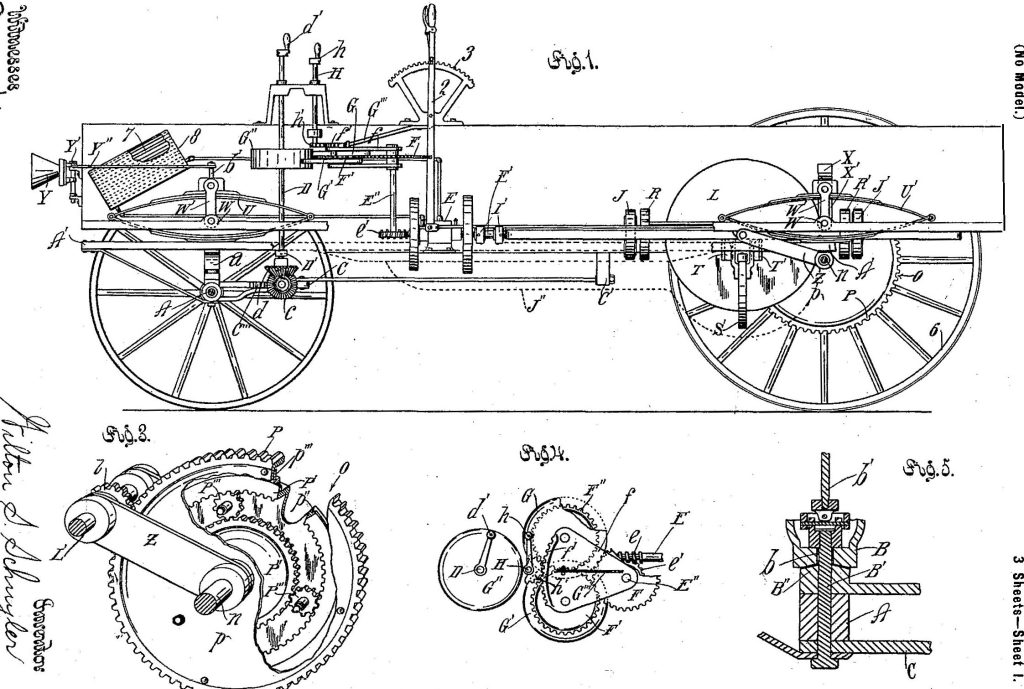
It is unknown where Marion traveled next. She may have gone back to Chicago, although no record for her could be found. However, in 1912 Marion is found living in New York City and she is also listed as one of the incorporators of the Favary Tire Company!

It was reported that a plant located in Middletown, New York would soon begin producing tires. It is unknown if the plant ever produced a single tire and the company was sold or liquidated by 1915.

Slander Lawsuit

Months later, in April 1913, Marion filed a $50,000 slander lawsuit in New York District Court against Susan W. Smith, a former “partner” in the Favary Tire Company.  Smith was a native of Alabama, born in 1855, and the widow of Preston C. Smith. The women met while in Portland selling shares of stock. There may have been some competitiveness between the women as Marion let it be known that she had sold 1,000 shares of Favary stock but Smith, with her “reputed business acumen” had sold only 137 1/2 shares.

While Marion’s original complaint was not available for review, Susan Smith’s answer was and in it detailed the conversation that culminated in litigation:

In the spring of 1909, at the corner of Clay and 13th St., in Portland, Oregon, Marion Brashears told Susan Smith that a certain George K. Rogers, a promoter of the Favary Tire and Cushion Company, by which said company Marion Brashears was then employed, had insulted her by saying “Don’t you come so near me. My wife does not like it and neither do I.” Whereupon Susan Smith said to Marion “Well, I would never enter his office again.” Whereupon Marion replied, “What? Give up my business career because that man insulted me? Never.” Susan Smith then learned from further conversation with Marion Brashears that she did not resent or feel shamed at being so addressed, and did not seek to avoid further similar insults.

However, Marion did in fact resent that conversation but she waited four years before filing suit against the woman she deemed solely responsible for spreading rumors about her. The lawsuit and subsequent trial made headlines from coast to coast, including Portland, Chicago, New York, Los Angeles and everywhere in between.

Before the case was publicized, however, on June 9, 1913 Marion’s mother Jean Waugh died at the age of 71 in Los Angeles. Two published obituaries of Mrs. Waugh do not mention her daughter.

A myriad of depositions were taken before Marion’s case went to trial. Marion was described as a “wealthy widow” in newspaper accounts. Marion described her once former friend and partner, Susan W. Smith, as the “Hetty Green of Portland, Oregon,” a very wealthy New York businesswoman said to have lived miserly.

When Smith testified, she said that her comments were private ones concerning Marion and that she had simply warned a younger woman “not to be too chummy” with Mrs. Brashears, “lest her reputation be impaired.”

The gossip also seemed to be second hand. “I told her,’ sobbed Mrs. Smith, “that Mrs. Denny told me that Mrs. Taylor told her she had overheard the Rev. Mr. Baker exclaim to Mrs. Brashears, ‘For God’s sake, leave my room!'”

If Marion wanted to save face and protect her dignity, the suit had the opposite effect. Details of the accusations and testimony of dozens of witnesses were published on the front pages of numerous newspapers across the country. Salacious selections of testimony and contents of depositions were printed about Marion and what was seen as her forward behavior toward men, including Rev. Baker, Ethelbert Favary, and a married man under the disapproving eye of his wife.

Testimony of George K. Rogers

George K. Rogers, a witness for the defendant, was asked what occupation Marion may have held before she began selling shares in the wheel company. He answered: “Well, I don’t just exactly know. I understood when I first became acquainted with her that her occupation was an interior house decorator, or something of that kind, artwork, or something. She became interested in the device I was handling and aided considerably with my work in connection with the inventor. I might almost say she changed her occupation for that work.”

He spoke about Marion’s unwanted behavior that he considered inappropriate and that he felt strongly that Marion wanted to have sex with him. “On some occasions in the office, she would want to emphasize some remark she wanted to make, and she would come up and tap me on the breast. I told her at one time we could do business without such familiarity and I thought it better she keep a little distance.

Rogers also mentioned that Marion would stand very close, or even against him when signing company documents. His wife would testify that in her presence Marion would “corner” her husband, “standing against” to speak with him.

Susan W. Smith

While it seems that several people had very strong opinions about Marion Brashears, she only sought out to sue Susan W. Smith. The slanderous statements Marion claimed that Susan Smith repeated about her were as follows (per the deposition transcripts):

  • Mrs. Brashears had been forced to leave the boarding house in Portland and that she was not a fit associate for anyone; and was an immoral character.
  • Marion further alleged in her complaint that her former business associate Susan W. Smith said, “I will make it so hot for her, that she will be obliged to leave Portland. I will make it my business to ruin her reputation with anyone she knows.”
  • She (Marion) goes into the room of Dr. N. A. Baker, a clergyman, at night, and you know there is only one reason for a woman to go into a man’s room at night, an immoral one. I know she is criminally intimate with this young man. I want you to know I am a southerner and I can hate. She (Marion) was a bad woman. She was Mr. Favary’s mistress. She had tried to tempt Mr. Rogers.

The most scandalous remark Marion alleged Smith said was that Marion “had been guilty of intimacy with this minister, Rev. N. A. Baker and had had an abortion which was the cause of her sickness.”

Testimony of Reverend Baker

In his testimony Rev. Nehemiah Addison Baker recalled meeting Marion Brashears in July of 1908 and that while residing at the boarding house, Marion would come to his room at night and stay as late as 11 o’clock, sometimes till midnight. When questioned about their activities, Baker said they would read together.

Baker said that Marion would come in his room when he returned from meetings or appointments. “I got home at 9 perhaps 9:30 and she might get home at 9:30 or 10 and she would come in; and there has been some reference to midnight, and I doubt if that was more than once or twice.” He was asked if he had ever asked Marion to leave his room and he said no.

When asked how old Mrs. Brashears was, the much younger Baker answered, “Did she seem to be to me? It was an enigma.  I never attempted to surmise. It was immaterial to the situation.

When asked about Ethelbert Favary, the minister said that he knew Favary had visited Brashears while she was at the boarding house. He said, “I know he came to the house and visited her in the parlor of the house. I believe I did hear some comment, I cannot tell you where it came from now, that the door was locked.”

When asked if Mrs. Brashears ever made any advances toward him, Baker said no. But when he was then more pointedly asked, “Did she make any advances when you and she were together?” He answered, “Well, my understanding of advances might be different from what would generally be accepted.” He then went on to describe an occasion where they went for a walk. “I think she took my arm, in such way to escort herself, or help herself on the path.”

He was questioned: “Did her action at that time impress you as being a little improper?” Baker answered “I don’t know, as there was any impropriety in it, in taking a gentleman’s arm, but it surprised me, that is all.”

His response brought the next question: “Why did it surprise you?” To which he replied, “Because I thought it might’ve been more my place to have taken the lady’s arm, if there were any need of such an escort.”

Further questioning continued: “Did she at any time embrace or attempt to embrace you?” He answered. “Well, only this occasion I speak of, I might have interpreted that.” Baker went on to say that Brashears “bore herself as a perfect lady in every way, or otherwise I would not have been comfortable under such association.”

When asked, “Was there anything intimate or caressing in the manner in which she took your arm?” Mr. Baker replied, “I thought so at the time.”

In what way did you think it was particularly caressing?” Baker answered, “Well, I suppose by intensity.”

Because she held your arm tight; was that the reason?”

Yes sir.”

When it came to relinquishing that hold, you were the active factor?”

I believe I was.”

You withdrew your arm?”

Yes sir.

Under cross examination Baker was asked if he and Marion “ever spoke of personal love” between them and he answered, “Never.”

Did you ever discuss that topic generally?”

Baker replied, “I discussed what I would call the larger social relations.”

And that included matters of affection, matters of sex, and matters of family life?”

Baker responded, “Yes sir.”

Did Mrs. Brashears ever speak to you of her husband?”

Yes sir.”

Did you ever caution her that her husband might possibly misinterpret her conduct?”

No sir.”

Baker also added that he had no other association with other women in the house.

What did Marion hope to achieve by her lawsuit? Did she know or realize that the trial would be so sensational? Was she humiliated or delighted?

Marion, who was described in newspaper reports as “pretty” and “willowy” defended her late night visits to the minister’s room, saying, “Rev. Mr. Baker is a most devout and sincere man. Many of the other boarders went to his room just to be cozy when their own apartments were not warm enough.”

The trial came to an end on November 12, 1914 with Marion Brashears losing her lawsuit and having to pay attorney fees for the defense of Susan W. Smith.

Divorced

Marion was back in court in May of 1916 when she filed for divorce from her husband James Bradley Brashears, claiming he had abandoned her. Marion hired attorney Alice Thompson, a progressive choice for the time. Thompson was co-owner of a woman-owned law firm, Bates & Thompson, in Chicago, Illinois.

James Bradley Brashears, 1924 passport photo

James Brashears claimed in his answer that he had never left Marion. He traveled in his work for the railroad, and newspapers reported some of his trips on behalf of the railroad.

In the divorce papers Marion claimed that she had been a faithful and loving wife and had maintained her home in Chicago until 1908 (although she was living in Portland, Oregon in 1905) and that she herself traveled for business purposes. She was granted the divorce.

In August of 1916 Marion was staying in Beachwood, New Jersey, a “summer colony” near the metropolitan area of New York City where she was elected publicity chairman for the Beachwood Property Owners Association. The following month she was elected President of the Beachwood Women’s Club.

Marion purchased a summer home at 424 Beacon Avenue in Beachwood in about 1919 but in early 1920 she was in California where she purchased property in Highland Park, where her father resided and sold her Beachwood cottage a year later.

New Era Expression Society

In July and August of 1920 Marion conducted lectures in San Francisco on “worry” and “personality” for the New Era Expressions Society. The New Era Expression Society provided a forum for followers or members to “express ideas on personality, inspiration, psychology, Raja yoga, ethics, philosophy, elocution, poetry, public speaking, music, drama, self-culture, short talks, and exchange of ideas.”

San Francisco Chronicle July 22,1920

Marion was touted as a psychologist in one of the ads and it is likely her association with the New Era Expression Society that she took on her role as a “vocational analyst.” This appears to be a “gift” rather than a science, determining a job or career for clients. At times these analysts also ran ads for palm and character readings.   

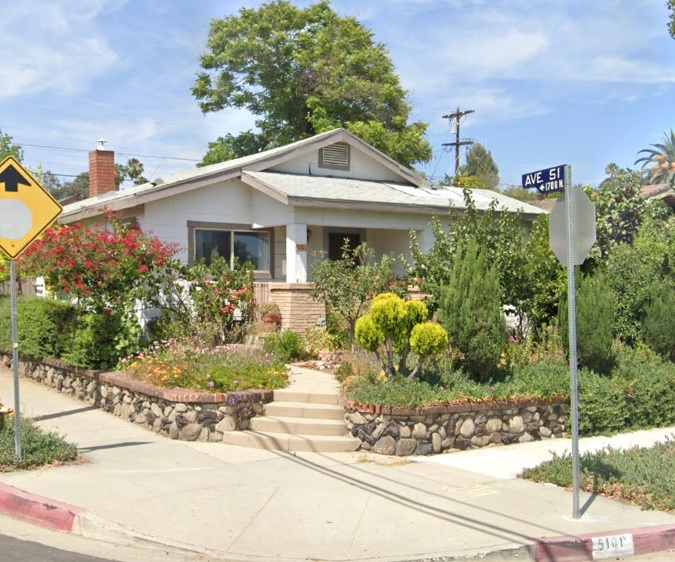
5101 Alamden Drive, Highland Park where Marion lived in 1921 (Google view)

In 1921 Marion was living at 5101 Almaden Drive in Highland Park, California, along with a local teacher and private tutor, Edith E. Beamer, who was likely renting a room from her. Two years later Marion was residing at 4620 Fifth Avenue in Los Angeles, again with Edith Beamer.

Death of Charles Waugh

Marion’s father, Charles Waugh, died October 15, 1923 at the age of 84. Charles had been living with Alva and Daisy Bahen at 5127 Range View Avenue in Highland Park, California. The couple had been caring for Marion’s ailing father and Daisy had been his housekeeper for several years up until he moved in with the Bahen family.

Likely the sole heir to her father’s estate, the following year Marion was sued by Daisy Bahen for $10,000. Daisy claimed that Charles Waugh had promised her this sum for her services and long term care. It is unknown how this lawsuit was resolved. [The court case was unavailable from the Los Angeles County Superior Court Archives, along with the probate case of Charles J. Waugh.] Marion was also sued by attorney L. T. Mayhew, who handled her father’s estate, for the sum of $458.52 for nonpayment of services.

One month after her father’s death, Ethelbert Favary, Marion’s alleged lover and business associate, moved from the east coast to Southern California. Is this merely coincidence?  Did Ethelbert come to Los Angeles to woo Marion? Did she refuse him or did he refuse her?

In 1924 Marion moved into a home at 2325 Via Panale in Palos Verdes Estates, designed by architects David Witmer and Loyall Watson. The beautiful home was built in the Mediterranean Revival style. Marion hired renowned architect Irving J. Gill to design the home’s landscape.

Marion’s home 2323 Via Panale, Palos Verdes Estates, May 2024 (Courtesy Palos Verdes Historical Society)

While it is unknown how much money or property Marion inherited from her father’s estate at this time (while waiting on records to become available) she was said to have invested money in the Julian Petroleum Company. It collapsed in 1927 after it was discovered the owner, Courtney Chauncey Pete, defrauded local investors of $100 to $200 million. It was the second time Marion had lost money by fraud, and this may have been a substantial sum.

Favary Marriages

If Favary was only interested in Marion’s money now she suddenly had none or a lot less. (Of course, this is only speculation.) While Favary’s company was once valued at $1 million, it is unknown if the tires were ever mass produced.

On January 8, 1928 Ethelbert married his second wife, Mary, in Tijuana, México. While the marriage lasted nearly six years, in 1934 he petitioned the court for an annulment of the marriage. The reasons listed for his request for an annulment was that “the parties were not acquainted with the witnesses to the purported marriage for a period of two years or at any time at all” and that neither Ethelbert nor Mary had “submitted to a physical examination by a physician or anybody purporting to be a physician.”

Apparently, this flimsy argument after a six-year marriage was sufficient and Favary was granted the annulment in 1934.  

Favary then married Edith L. Bowslaugh on March 30, 1935 but this time it was Edith who filed for divorce or annulment that same year. Edith said the couple separated after just four months after Ethelbert treated her “in an extremely cruel and inhuman manner“, and “inflicted cruel and mental suffering” upon her.

Edith Lillian Bowslaugh, Ethelbert Favary’s third wife

Edith alleged that her husband had misled her about both his occupation and income. Before their marriage, Ethelbert told Edith that “he had sought the world over for a mate and felt that he had found her.” After the marriage Edith had deposited “all of her income in a joint bank account” and gave Favary access to the same, which he spent for his “own personal gain.”

On top of that, the couple lived in a small three-room apartment at 453 1/2 Tujunga, in Burbank, California, occupied by 3 dogs, 20 lovebirds, 20 canaries and one parrot. Ethelbert told Edith it was “her duty as his wife to look after the care, maintenance and comfort of the animals; that were his real love motive in life that they were his children and that she should be satisfied looking after the animals and birds” and willing to help pay for their “maintenance.”

If that wasn’t enough humiliation, and most telling, Ethelbert told Edith, before they were married that “he could have married a woman who had $1 million” and by “innuendo made her feel that he had made a mistake by doing so.”

Who, other than Marion, could Ethelbert be referring to?

Edith was granted her request for annulment on October 9, 1935 by Judge Clarence L Kincaid. Ethelbert then married Bertha Hirson in Ventura in 1936, who died in 1945. His fifth marriage was to Sadie Lang Gross in 1950.

Marriage to Gill

On May 28, 1928, Marion and Irving J. Gill were married at her home in Palos Verdes.  The marriage announcement was published in Time Magazine, which stated that Marion was a “vocational analyst” and “the niece of potent Publisher John C. Shaffer (Chicago Post).”

Irving J. Gill

This occupation and her supposed relationship to Shaffer would be repeated in other newspapers, and then later, biographies written about Gill and his marriage to Marion. Again, it was her ex-husband who was the nephew of Shaffer. It stands to reason Marion herself would have provided this information for reasons unknown. Also misleading, on the marriage license to Gill, Marion indicates that she is a widow, rather than her actual marriage status as divorced.

San Diego Union, May 28, 1928

The San Diego Union reported that the marriage was the “culmination of a 10-year romance.” Several writers/historians have suggested the couple may have met while living in Chicago decades earlier. It is more likely that Marion and Irving met some time after she moved to California between 1920 and 1924, or when he designed the landscape for her Palos Verdes home.

Carlsbad

Two weeks before their marriage, Marion purchased property in Carlsbad. The Oceanside Blade Tribune reported that: “Mr. and Mrs. Edward Glasscock have sold their acre home site in the Carlsbad Palisades for $13,500. The purchaser is a Los Angeles woman, and announces her intention of building one of the most beautiful homes in Carlsbad.” The property was located on the southeast corner of Pine and Lincoln Streets.

Tract Map of Carlsbad, Tract 218 corner of Pine and Lincoln is the location of the avocado ranch Marion purchased in 1928

While writers have speculated that it was Marion’s family who owned property in Carlsbad that she in turn inherited, nothing could be found to substantiate this after a search through recorded deeds in the San Diego County Recorder’s Office. What was discovered is that Marion herself purchased properties in Carlsbad and they were recorded as her sole property.

Irving Gill was in Carlsbad two weeks before the nuptials, along with John S. Siebert, another San Diego architect. The two men were making a survey of the Newberry Mineral Spring property to design a new “Health Hotel.”

The Carlsbad Journal reported: “Mr. Gill, who is the originator in San Diego of a plain, practical and dignified style of architecture, is enthusiastic over the opportunity on the Spring property for producing a group of buildings with landscaped surroundings that will command the admiration of all lovers of architectural beauty.

It is expected that he will be retained for other work in prospect for Carlsbad, and it is his purpose to create a particular design which he will christen ‘Carlsbad architecture,’  one that will set this city out as one of the most attractive communities on the Broadway of the Pacific.”

The following week it was announced that Gill had plans to move to Carlsbad: “Irving J. Gill, San Diego architect, who is drawing tentative designs for the new Carlsbad Mineral Spring health hotel, was in the city yesterday, and attended the noon luncheon of the Chamber of Commerce. In a brief talk to the club Mr. Gill intimated that his future plans contemplated a home in Carlsbad, and in that connection proceeded to say that he considered Carlsbad as offering the greatest opportunity for the development of a new architectural fashion of any place on the coast.”

Again, Gill remarked that he had conceived an “entirely new type of architecture designed with its future program in view and one that will command the attention and respect of culture and wealth” to be known as “Carlsbad architecture.”

Marion and Irving were living in San Diego just after their marriage. Marion gave a San Diego address on the deed for the Glasscock property, when it was recorded June 2, 1928.

In July of 1928 the Carlsbad Journal reported: “Mr. and Mrs. Irving Gill of San Diego were in Carlsbad Monday looking after their property interest and calling on friends.”

Unfortunately for Irving Gill, he was not selected to design what would become the Carlsbad Hotel on Carlsbad Boulevard and Gill’s “Carlsbad architecture” never came to fruition.

The Gills then lived in Palos Verdes for a time but visited Carlsbad frequently. Their visits were included in the local paper. The September 28, 1928 issue of the Carlsbad Journal reported: “Mrs. Irving J. Gill of Palos Verdes spent today at her Carlsbad avocado ranch, and had as her guests, Mrs. Joseph Bushnell of Chicago, Chicago, Mrs. Edgar Brashears of Walnut Park, and Mrs. Charles Blodgett of Huntington Park.

Mrs. Edgar Brashears was Marion’s former sister-in-law. Edgar was the brother of her ex-husband James Bradley Brashears! Edgar K. and Virginia Brashears moved to Southern California in about 1925. (Certainly they knew Marion was not a widow!)

In November of that year, another visit was noted in the Journal: “Mr. and Mrs. Irving Gill of Palos Verdes, accompanied by their friends, Mr. and Mrs. Snyder, visited their avocado ranch at Carlsbad Saturday.” The avocado ranch was on the one acre “home site” Marion purchased in May. The 1929 Sanborn maps show a small house near the corner of that property.

The article went on to say that “Mrs. Gill is much interested in the civic welfare of Carlsbad and has presented a silver loving cup to be awarded to the individual or organization performing the most practical and outstanding civic act in 1928. The cup is on display in the Journal office.” (If the silver trophy was actually awarded to anyone, no mention of it could be found.)

Other visits memorialized in the Carlsbad Journal were as follows:

January 11, 1929: “Mrs. J. Irving Gill of Palos Verdes was here over the weekend looking after her property interests and was a guest in the home of Mr. and Mrs. J. W. Armstrong.”

January 25, 1929: “Mr. and Mrs. J. Irving Gill of Palos Verdes Estates were weekend guests of J. W. Armstrong and family going from here to San Diego. Mrs. Gill was looking after her avocado grove on the Palisades.”

March 1, 1929: “Mr. and Mrs. J. Irving Gill of Palos Verdes Estates, who have been spending a week on their Carlsbad Ranch, had as their guests over the weekend, Mrs. John W. Mitchell, proprietor of the Mitchell art galleries at Coronado.”

March 22, 1929: “J. Irving Gill of Palos Verdes Estates spent several days this week in Carlsbad personally supervising his avocado ranches here.”

March 29, 1929: “Miss Edith Beamer of Palos Verdes Estates accompanied her friend Mrs. Irving Gill to Carlsbad the first of the week for a short visit. Mr. and Mrs. Gill are spending some time here superintending their avocado lands.”

Living Separately

By the summer of 1929 Irving Gill was spending “the summer” in Carlsbad. Had Marion and Irving legally separated? It is likely Gill wanted to remain in Carlsbad to work on a variety of projects, including the fire and police station in Oceanside, built that year. He would later design the Americanization School, Oceanside City Hall building, the Nevada Street School, a private home at 1619 Laurel Street in what was then referred to as North Carlsbad (now Oceanside) and his last work, the Blade Tribune newspaper building.

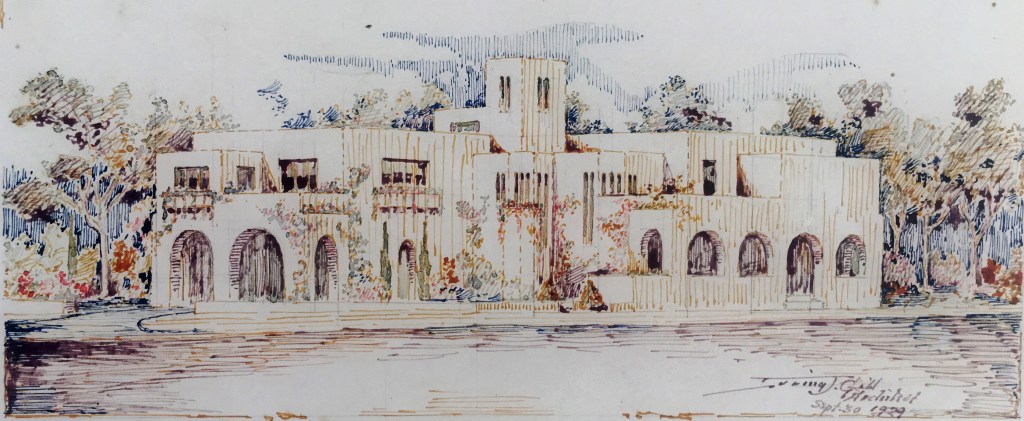
Gill drawing of the Oceanside Fire and Police Station, corner of Third and Nevada Streets, 1929 (University of California, Santa Barbara)

In June of 1929 the Carlsbad Journal reported that he was “preparing the plans for the new W. F. Oakes residence in Paradise Valley.” Paradise Valley was a neighborhood near or around Valley Street in Carlsbad.

The home’s description was as follows: “The house will have 10 rooms, including six bedrooms, with four baths, sunrooms, living rooms, done in the Gillesque style of architecture, buff, stucco, plastered roof, and build adapted for extensive landscaping. It will be one of the most beautiful homes in Carlsbad and will introduce the new architecture into this district.” (Whether or not Gill designed the Oakes home, the family lived at 1281 Magnolia Avenue. A house located there, in a Spanish eclectic style, has been extensively remodeled.)

Undated photo of Marion Brashears Gill (University of California, Santa Barbara)

After one year of marriage, it was reported that Irving “went to Palos Verdes Estates last week to be with Mrs. Gill on their first wedding anniversary.”  In July Marion visited Irving twice, however she stayed at Carlsbad’s Los Diego Hotel rather than the modest house located on her property.

In August of 1929 the Carlsbad Journal announced that “Irving J. Gill, who has been resuscitating on his Carlsbad avocado ranch the past two months, has opened an office in the Scheunemann building on First Street (State Street) to resume intensive work on architectural maps and drawings. Mr. Gill, who enjoys national fame as one of the leading American architects, has a number of commissions to execute, and has equipped his commodious office space with the necessary paraphernalia for the work.”

Later that month announcement was made that Gill would help form and instruct an architects’ club for local students, but it is unknown whether this club was actually formed.

In early September a visit from Marion was noted, but on September 27, 1929 the Carlsbad Journal reported that Gill had been seriously ill. “Architect Irving J. Gill has almost completely recovered from a sudden and severe attack of illness last week.”

Gill’s “summer” residency in Carlsbad continued to the fall and winter. In December of 1929 he was one of several men who were vying for a spot on the Carlsbad Chamber of Commerce. Gill was not selected, however, which seems a missed opportunity for the town of Carlsbad.

Irving spent the holidays with Marion in Palos Verdes. Her visits to Carlsbad seemed to wane. Although E. P. Zimmerman, a Gladiola grower in Carlsbad, named a gladiola for Marion in early 1930, another visit was not reported until the May of that year. The 1930 census records indicate that Marion was still living with or renting a room to Edith Beamer.

Irving visited Marion in June of 1930, the couple attended the dedication of the new Palos Verdes Library.

In September of 1931 Marion bought Lot 7 and 8 in the Optimo Tract, and then Lot 11 of the same Tract. The lots were located on Eureka Street, with Lot 7 being on the corner of Eureka and Chestnut Streets, which borders the southeast corner of Carlsbad’s Holiday Park east of Interstate 5.

Optimo Tract where Marion purchased Lots 7, 8 and 11 (near present day Holiday Park)

One year later Marion sold or transferred these lots to her friend Edith Beamer. Edith would later sell or transfer them back to Marion and they exchanged ownership again at least twice.

Wine Lawsuit

While researching Marion in a variety of newspapers and publications, it was discovered that a lawsuit had been filed by a “Mrs. M. W. Brashears” in or around October 1931 in Visalia, California. This lawsuit involved a “woman from Los Angeles” who was a school teacher. In the 1930 census Marion Gill’s occupation is listed as a private teacher.

Editor’s Note: It is my belief that Mrs. M. W. Brashears is Marion Waugh Brashears Gill, who was living in the Los Angeles area and was purportedly a teacher, private or otherwise. There were no other women (or men) found in Los Angeles County with those same initials and last name. In a tax delinquency report in 1929 in Palos Verdes, her name is given as M. W. Brashears Gill.

Why would Marion use her former married name instead of her current one? It could because she had attempted to purchase 30,000 gallons of wine during the Prohibition era for resale and distribution.

Two years earlier, on December 14, 1929 Marion entered into a contract with Frank Giannini, a Tulare County rancher. In the lawsuit that precipitated, Mrs. Brashears aka Marion Gill, told the court that Giannini agreed “to sell her the wine at about $.55 a gallon, assuring her that she could dispose of it to rabbis, priests and ministers who needed it for sacramental purposes at the rate of $1.50 a gallon.”

She also alleged that Giannini told her that she could sell the wine without violating the law when signing the contract involving 30,000 gallons, making a down payment of $6000. Newspapers reported that the wine purchased included 9000 gallons of port, 9000 gallons of Muscat, 6000 gallons of Sherry and 6000 gallons of Angelica.

After unsuccessfully attempting to sell the wine in California to said clergy, Marion hired an agent “who said he knew rabbis in Chicago” but alas, those rabbis had their own sacramental supply of wine. It is pure conjecture on my part, but could it be that the agent was one Ethelbert Favary?

Giannini contended that “Mrs. Brashears was aware of the situation when she signed the contract” and maintained that if their deal was in violation of the Prohibition laws, the court was not in a position to give relief to either side.

Judge J. A. Allen awarded “Mrs. M. W. Brashears” $5,600 with interest dating back to December of 1929. Giannini appealed all the way to the United States Supreme Court who refused to hear the case. The story is just another interesting chapter in Marion’s already interesting life.

In January of 1935 it was announced that Marion had sold her Palos Verdes home to Mr. and Mrs. James P. McDonnell. However, a 1936 directory lists Marion still living there with guests or boarders, Adolfo and Clara Di Segui, while her husband remained in Carlsbad. Perhaps the sale of the home fell threw or Marion demurred.

Death of Irving J. Gill

It has been assumed by some that Marion and Irving divorced, but no such action could be found in San Diego County Superior Court records, or in Los Angeles. (Reno, Nevada, “the divorce capital of the world” was also checked for divorce records and none were found.) It could be that the two remained friends, or were amicable with their separate living arrangements or that there was some estrangement. It is often noted, however, that Gill wrote loving letters to Marion while they were apart.

On October 7, 1936 Irving J. Gill died in a San Diego hospital after a long illness. It was reported that his wife Marion and a nephew, Louis J. Gill were at his bedside.

Irving was cremated but no one knew what became of his ashes. There has been speculation that Marion received and then scattered them. But Marion never took possession of her husband’s cremains. In 2023 the Irving J. Gill Foundation reported “Gill’s ashes have been sitting in a tin box, on a shelf, in a closet at the Cypress View mortuary in San Diego. The mortuary paperwork states that they are to be held until ‘family comes to pick them up.'” The IJG Foundation plans to provide Gill a proper burial and resting place in October 2024.

Marion remained in her Palos Verdes home as late as 1938, sharing or renting rooms to Jenny Mills, James and Frances McDonald, and Virginia Randall. (She was not found in the 1940 census, but in 1943 she sold the lots in Carlsbad’s Optimo Tract and was listed as living in Laguna Beach.)

Death of Marion and Fight for Her Estate

Marion’s first husband, James Bradley Brashears died in Indiana on January 30, 1944. He had moved from Chicago to Indianapolis in about 1935.

By 1946 Marion had moved to a home at 223 Avenue F in Redondo Beach. In the 1950 census she was living alone and her occupation was given as interior decorator.

On December 1, 1952, at the age of 82, Marion died; just weeks earlier she had been declared mentally incompetent due to senility. Thus began a fight for her estate, valued at $25,000 that would be drawn out for years. Those who claimed a part of her estate included none other than Ethelbert Favary, who claimed to be Marion’s legal guardian.

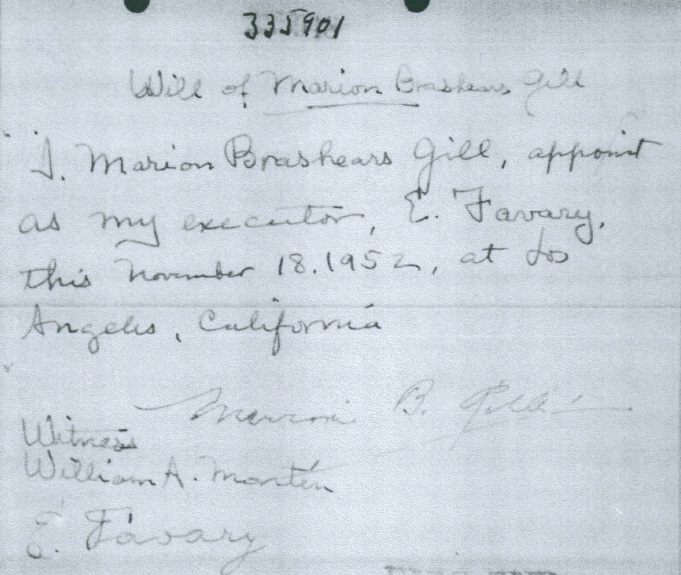
Ethelbert had hand written a statement entitled “Will of Marion Brashears Gill” in which stated: “I, Marion Brashears Gill, appoint as my executor, E. Favary, this November 18, 1952, at Los Angeles, California.” The statement was purportedly signed by Marion and the witnesses were William A. Monten and E. Favary himself.”

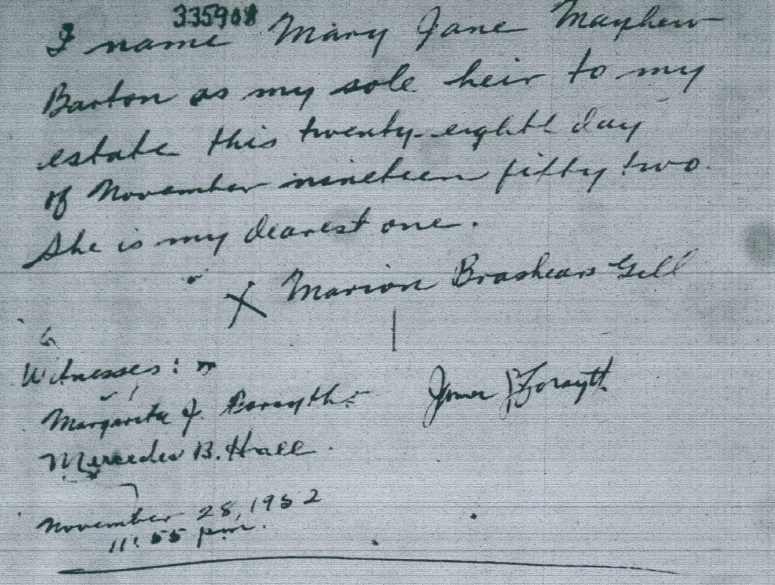
Ten days later, however, and three days before her death, Mary Jane Mayhew Barton drew up her own handwritten statement which read: “I name Mary Jane Mayhew Barton as my sole heir to my estate this twenty-eighth day of November nineteen fifty-two. She is my dearest one.”

Court Exhibit, copy of Mary Jane Barton’s handwritten will, signed by “X”

Next to Marion’s name was an “X” as Marion was too physically frail (and likely incapacitated) to write at all. This statement was witnessed by Margaret and James Forsyth and Mercedes B. Hall. The Forsyths ran a nursing or convalescent home where Marion spent her last days.

It is inconceivable that neither party were thrown of court entirely for elder abuse for undue influence.

Mary Jane Mayhew Barton was a renowned harpist once under contract with Universal Studios and a member of the 20th Century Fox Orchestra, who played in several movie scores. Her relationship with or how she met Marion is unknown.

Barton claimed that Ethelbert and his wife Sadie had already gone through Marion’s house and taken away items in bags. Mary Jane claimed that she had her own money and income, insinuating that she did not need to go after Marion’s estate, but that it was rightfully hers because Marion had willed it to her.

A long-lost cousin from Canada was found by attorneys who claimed she was Marion’s closest living relative and therefore should be the rightful heir.

Marion’s probate case was discharged on January 27, 1959. The file contained over 400 pages.  In the end, after the State of California, creditors and various attorneys got their share, Mary Jane Barton received what was left, but perhaps the most valuable, four lots in Palos Verdes Estates.

Marion was buried in Pacific Crest Cemetery in Redondo Beach. Her gravesite is unmarked. She was placed in a section designated for “unclaimed” or “unpaid” for people.

It seems Ethelbert Favary, whom she knew for over four decades, her supposed “legal guardian” and claimant to her estate, did not care to make sure Marion had a proper burial or marker. Certainly, Mary Jane Barton, who was the recipient of what was left of Marion’s estate and named herself to be Marion’s “dearest one,” could have seen to her burial.

No, Marion was forgotten, ironically like she “forgot” her husband Irving Gill; his ashes never claimed by Marion, sitting in a box for nearly 90 years.

The story of Marion has nearly been forgotten as well…but she was there waiting to be discovered. Scattered pieces of her life in newspapers, directories, lawsuits and other documents, all waiting to be gathered and assembled to tell her story.

While her marriage to Irving J. Gill made her notable, Marion Waugh Brashears Gill made her own headlines. She lived a fascinating, unconventional life on her own terms.

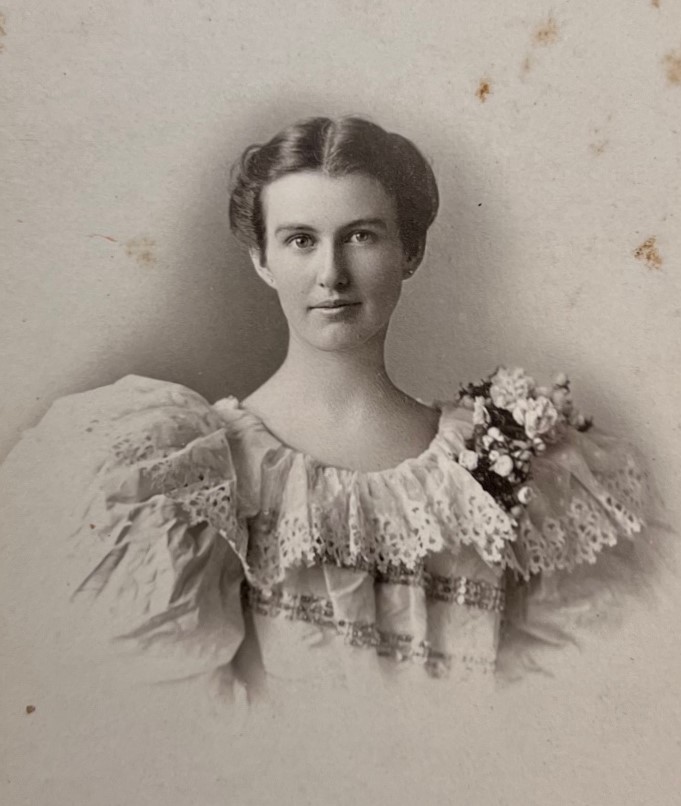
Mary Agnes Waugh. This may be a graduation photo, circa 1888 (University of California, Santa Barbara)

I want to thank Robin Kaspar for providing photos and information, along with the Oregon Historical Society, Julius J. Machnikowski, Clerk of the Circuit Court of Cook County, the Peabody Township Library in Peabody Kansas, the National Archives and Records Administration, Los Angeles County Superior Court Archives, John Sheehan, FAIA Principal, Irving J. Gill Foundation. Research included documents obtained from the NARA, San Diego County Recorder’s Office, Los Angeles County Recorder’s Office, Circuit Court of Cook County, Los Angeles County Superior Court Archives, and more.

The Rise and Fall and Rise Again of the Oceanside Pier

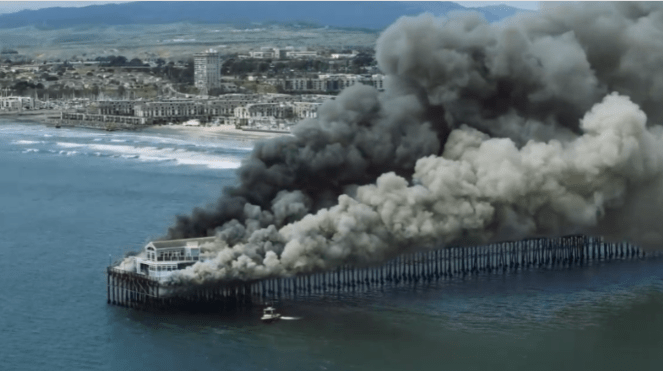
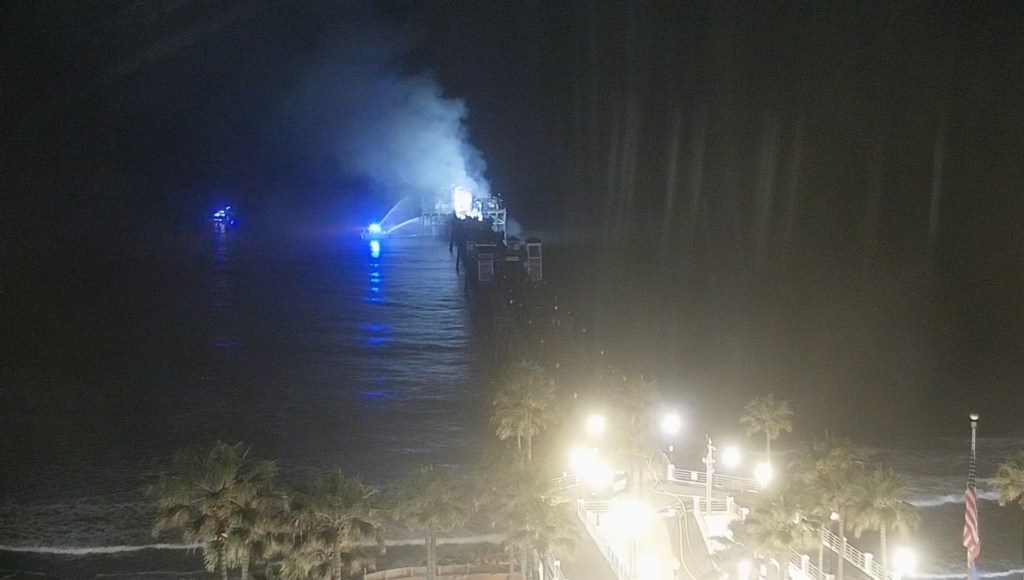
The pier fire on April 25, 2024 shocked residents of Oceanside, stunned to see clouds of black smoke covering the pier, and blanketing downtown.  People lined Pacific Street, streaming live on social media as they watched the pier burn and firefighters battle the blaze. Scores of fire trucks, boats and air support were assembled as the black smoke billowed over downtown. As the fire raged on it seemed the pier would be lost. Smoke and flames continued through the night and daybreak. Emerging from the flames the Oceanside pier stands heavily damaged on the west end. But it still stands.

Oceanside Pier Fire April 24, 2024 (Fox 5 San Diego)

The Oceanside Pier has been built and rebuilt six times. It has become a part of our identity as a city. It is part of who we are and we feel emotionally connected to it.  

Pier smoldering into the night and next morning

One hundred thirty-six years ago, our first pier was built in 1888 at the end of Wisconsin Street (formerly Couts Street). That same year Oceanside incorporated as a city. The first pier was called a wharf and it was hoped that Oceanside would become a shipping port. Built by the American Bridge Company of San Francisco, by August the wharf was built to an impressive length of 1200 feet. But the first pier was damaged by storms in December of 1890 and reduced to 940 feet.  By January 1891 a larger stormed finished what was left and swept away all but 300 feet of Oceanside’s first pier and the beach was covered with its debris.

Only known photo of Oceanside’s first pier (in the far distance) taken 1890 (Oceanside Historical Society, Carpenter collection)

While short-lived, Oceanside was invested in having another wharf or pier. Melchior Pieper, manager of the South Pacific Hotel, initiated the idea of rebuilding as he gathered lumber from the first pier that had washed to shore and stored it behind his hotel on Pacific Street.

Pieper suggested that the pier be built at the foot of its present location, Third Street (now Pier View Way).  There was some resistance against the Third Street location, a site between Second and Third was favored, but A. P. Hotaling, the hotel owner, agreed to donate $350 so city officials relented. Pieper donated an additional $100 and offered to house the workmen for free.

The building of Oceanside’s second pier in 1894 (Oceanside Historical Society)

Oceanside’s second pier was completed in 1894. It was small, just initially 400 feet into the ocean, and braced with iron pilings, giving it the name of “the little iron wharf.” It was later extended a few hundred feet, but by 1902 it was damaged severely by heavy storms.

Residents were resolved to have a pier, however, and in 1903 Oceanside’s third pier was built. Supported by steel railway rails purchased from the Southern California Railway Co., it was nearly 1300 feet, later extended to 1400 feet.  It was hailed as Oceanside’s “steel pier.”

Oceanside’s third pier built in 1903 (Oceanside Historical Society)

Again, storms took a toll on our pier when in 1912 supports were swept away from the end of the structure, leaving the stumps of railway steel exposed. Since diving from the pier was allowed, this posed a danger.  A warning sign was put in place to prevent divers from diving from the extreme end. By 1915 the steel pier which once seemed almost invincible, was down to a little more than 800 feet. 

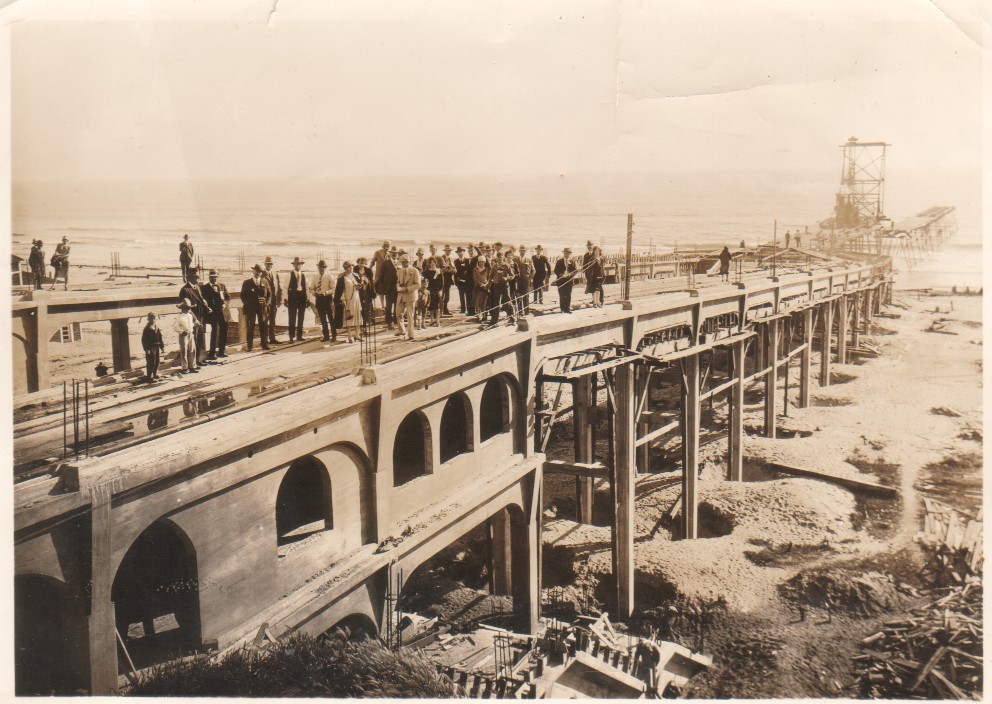
Voters approved a $100,000 bond issue in 1926 to build a fourth pier. In December of that year a single bid of $93,900 from Sidney Smith of Los Angeles was accepted and work began the same month.  Compromises were made as to the construction of the pier as many had called for a concrete pier but the cost was prohibitive. Instead, a concrete approach was built, 300 feet long, with the remaining 1,300 feet built of wood. ( That same concrete portion is still used today, but it now needs to be rebuilt.)

Oceanside’s 4th pier built in 1927 (Oceanside Historical Society)

When the 1600-foot pier was dedicated on July 4, 1927 Oceanside threw a three-day celebration that drew an estimated crowd of 15,000-20,000 to participate in the weekend of festivities.

Pier celebration 1927 (Oceanside Historical Society)

By the 1940s it was evident that the fourth pier would have to be replaced.  The pier that celebrated the roaring ’20s, and survived the Depression, had also aided in World War II. A lookout tower was erected on the end to aid in the search for enemy aircraft and submarines. The added weight of this tower left the pier weakened to a point where its safety was questioned.

Resident E.C. Wickerd, described as a “pier enthusiast”, circulated petitions in favor of saving the pier. He stated, “The pier has been one of Oceanside’s biggest advertising and tourist assets, and should be protected.” But with continuing heavy storms in 1945 and 1946, the pier was closed after being deemed unsafe by deep sea divers and engineers. 

In late February 1946 the proposal was made for a bond election to reconstruct the Oceanside pier.  Three hundred signatures were needed to get on the April 9th ballot.  The needed signatures were collected and the bond election passed. The $200,000 bond would build Oceanside next pier in 1947 to a length of 1,900 feet –the longest on the West Coast.

Fifth Pier built 1947 (Oceanside Historical Society)

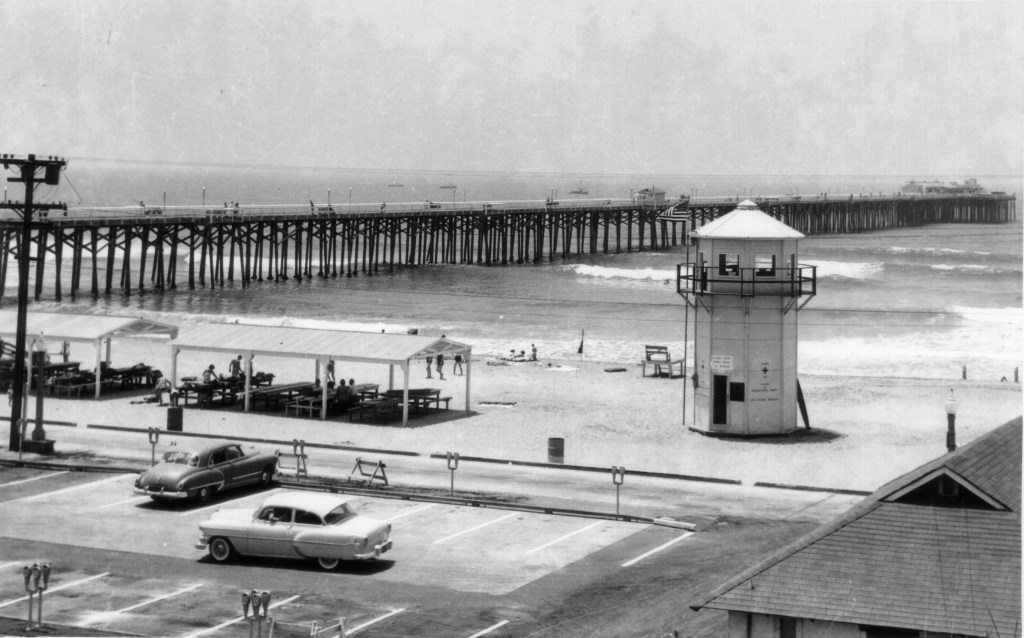
The white-railed pier could take fisherman and pedestrians out farther than any of its predecessors.  A 28-passenger tram operated by the city could take guests out to the end of the pier and have room enough to turn around.  McCullah sportfishing took enthusiasts out to fishing barges anchored over the kelp beds a mile out. For years this pier stood longer than any other pier the city had built previous. 

California Dreamin’ … Oceanside’s beautiful 5th Pier (Oceanside Historical Society)

But piers do not last forever and after nearly 30 years, it was showing its age. In 1975 the pier was faced with closures after severe storm damage and in October, Public Works Director, Alton L. Ruden said that the “pier could collapse at any time, and it would cost more than $1.4 million to replace it.  Some morning we’re going to wake up and there won’t be a pier.  It can go in an hour.  It’s like a string of dominoes.  But it’s only during storms that it is dangerous and that’s why it’s closed, when necessary.”           

After nearly 30 years, it fell victim to the relentless storms. It was damaged in 1976 by heavy surf and then a fire at the Pier Cafe caused further damage. The end of the pier was open, vulnerable, angled to the north and had to be amputated.

The Oceanside Pier damaged by storms in 1978 (Oceanside Historical Society)

The pier was placed as “No. 1 priority in the redevelopment plans for downtown” but it would be over a decade before a sixth pier was built.

Funding of the pier came from the Wildlife Conservation Board, State Emergency Assistance, Community development, the State Coastal Conservancy and the Federal Emergency Management Agency.  The new pier proposed would be nearly 1,500 feet long and would include a restaurant, tackle shop, lifeguard tower and restrooms.  The total cost, including the demolition of the 1947 pier, was then estimated at $3 million dollars.

Oceanside’s Sixth Pier in 1988, photo by Lu DeLucy

In August of 1985 Good & Roberts, Inc. of Carlsbad was awarded the contract to restore the concrete portion from the 1927 pier. In early 1986 the construction contract was awarded to Crowely International of San Francisco, the same city that built our first wharf in 1888. The new pier was built 3 feet higher at the end than the previous piers.  This was because the waves do their greatest damage there.  By raising the end, the life of the pier could be extended.

Oceanside’s sixth and present pier was dedicated and formally opened September 29, 1987.  At a cost of $5 million dollars the pier was 1942 feet long and deemed the longest wooden pier on the west coast. Engineers said it could last 50 years.

Our pier is a beloved landmark. A wooden promenade out to the ocean that hundreds walk every day, thousands each year.  While there are other piers in a handful of coastal cities, our pier has been a testament to our resilience and determination.

The pier is synonymous with Oceanside. If history tells us anything, we can and will rebuild again. Will we see our seventh pier sooner than expected? If repairable, we will enjoy and appreciate this one for years to come. This isn’t the end, it’s only a new chapter in Oceanside Pier history.

Hidden Beauty, The History of the Mason Building (301 North Hill Street aka Coast Hwy)

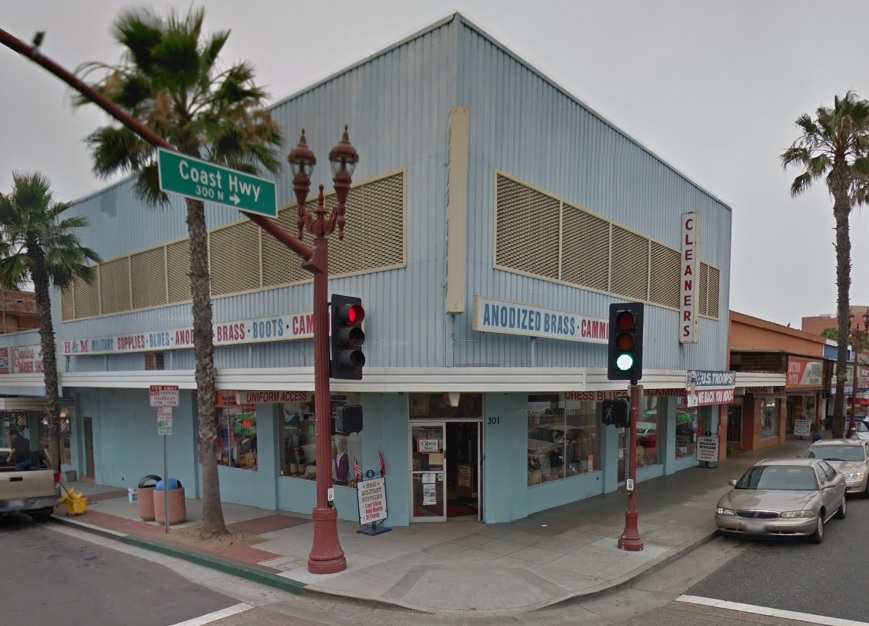
On the northwest corner of Third and Hill Streets (Pier View Way and North Coast Highway) sits an empty building that has seen better days, with its exterior scraped away, windows broken and metal awning left to rust. No one can remember the building in its glory days but many will remember the H&M Military store owned by Harry and Mary Cathey, a popular destination for Marines needing essential gear. It was the largest of the many military stores that once filled Oceanside’s downtown business district.

Mason building, aka H&M Military Store at 301 North Hill Street/Coast Highway. (Photo taken March 8, 2024)

But the building pre-dates Oceanside’s relationship with Camp Pendleton and its Marines. Nine decades ago this was once a beautiful art deco style building. Modernization may hide its original exterior but perhaps one day it will be restored.

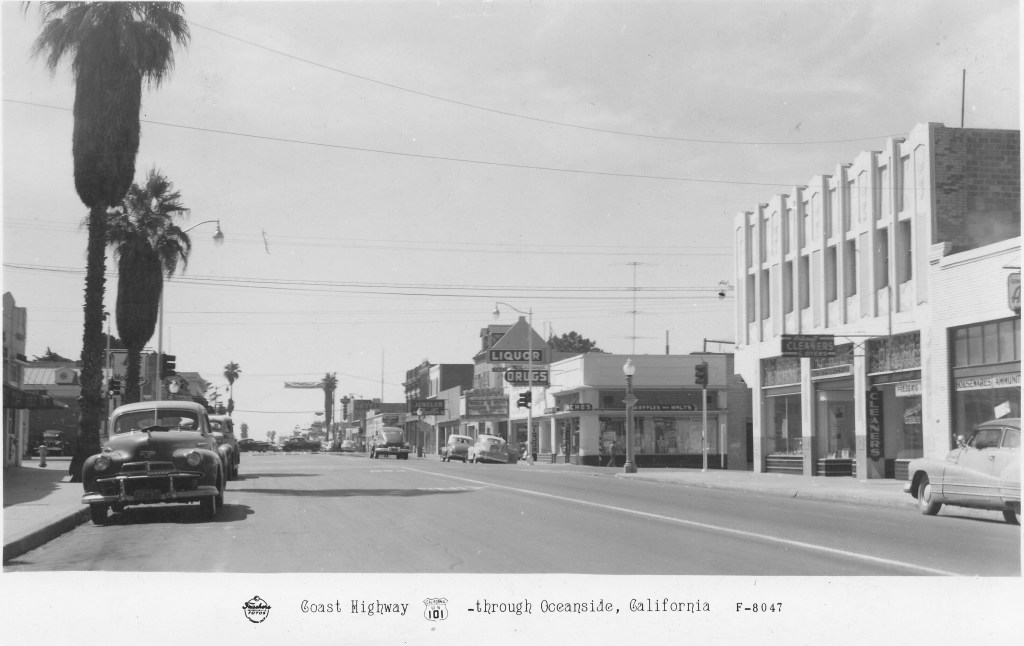
Prior to the present building, Charles D. Merrill and his brother William owned the property. They were the first licensed Ford dealership in Oceanside and in 1920 built a new building on the prominent corner in downtown Oceanside and further expanded it after 1925.

Merrill’s Garage was a Ford dealership, located at Third and Hill Streets in the 1920s. Note the historic Schuyler building to the left. Oceanside Historical Society

Paul Beck, co-owner of the Oceanside Blade Tribune newspaper recalled the Merrill’s dealership when he arrived in Oceanside in 1927: “Across the street to the West was the Merrill Brothers Ford Agency.  Having no transportation upon arrival in Oceanside, one of the first deals that the young Becks made was for a Model A Ford.  As I recall, the total price was $475, and we talked the Merrill’s into a “due bill”, which meant $400 cash and $75 in advertising.”

The Merrill building included a storefront that was situated on Third Street (Pier View Way). In 1929 Ed Wolmer leased that space, at 410 Third Street, to open a music store.

The February 5, 1929 Oceanside Blade reported:  Rebuilding of the lower floor of the building at 410 Third Street to be occupied by the Ed Wolmer Music House is well along and Mr. Wolmer states that he is expecting to be in his store by the last of the month.  The front has been modernized and the interior handsomely refinished and when completed the store will be a most attractive salesroom for the display of the extensive line of pianos, radios, panatropes, and musical merchandise which will be carried.

Two years later the Merrill Bros. moved their Ford dealership just to the north, near the center of the block, and sold the property to B. A. and Marian Mason in 1931.  Despite the fact that a Depression was gripping the country, the Masons began construction of a two-story brick building on the property.

The November 19, 1931 Oceanside Blade Tribune reported the following: Operations on the new Mason building, being erected at Third and Hill Streets, will be resumed tomorrow, according to a statement from Omer Nelson, superintendent in charge. Delay in the erection of the building was brought about by negotiations regarding the expansion of the building to take in another story. “We are resuming operations,” said Nelson, “while the parties continue their negotiations toward the expansion of the building.  We are holding things open so that if necessary, we can make a third story to the build.” Work on the building has been at a standstill for the last few days, with part of the brick walls erected.  Nelson is on the job today, preparatory to getting the full construction crew back on the job again tomorrow.

The third story was not added and the building was completed in early 1932. The lessee was Wolmer’s Music House who moved from their former location fronting Third Street into the new Mason building fronting Hill Street.

Ed Wolmer’s Music House on the northwest corner of Third and Hill Streets, 1932. Oceanside Historical Society

Oceanside resident Ernest Carpenter remembered in an interview: “It was a music store, sheet music and all that kind of stuff. They had a big statute and I can’t remember, a dog, a big statue of a Dalmatian in the front. When I was a little kid I didn’t want to walk on that side of the street because I was afraid of that dog!” 

Mason building to the right, looking west on Third Street (Pier View Way). Note the dog statute. Oceanside Historical Society

Wolmer’s Music Store, remained at 301 North Hill Street for several years, and also sold appliances. In 1946 Bob Shaffer and Gordon Duff purchased the appliance business and moved it to Third and Freeman Streets.

In 1940, Henry and Lina Howe bought the Mason building at 301 North Hill Street and owned it for several years, later deeding the property to their son and his wife, Tracy and Ethel Howe. The Howe’s owned a hardware store on Mission Avenue in downtown Oceanside.

Motorcycle office Guy Woodward stands on the center line of the 300 block North Hill Street (Coast Highway) in 1949. Mason building is to the center right, with a portion of the original brick exposed. Oceanside Historical Society

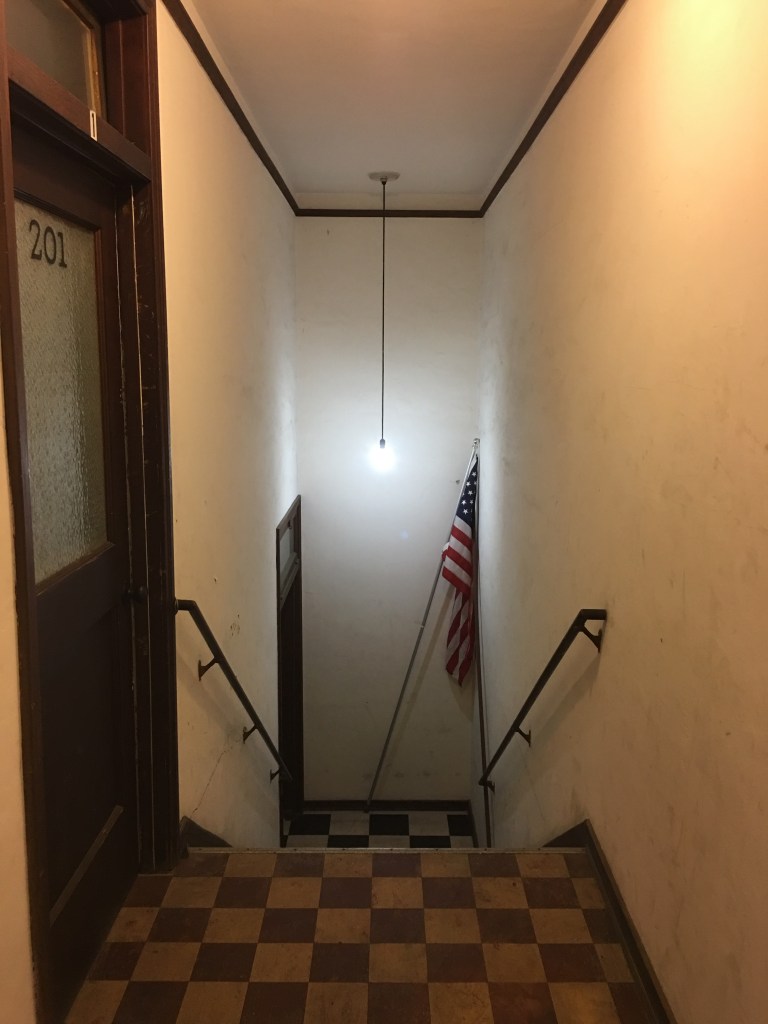
Harold C. Cross, attorney rented an office upstairs in the 1940s, along with a variety of other businesses in the 1950s, including the Merchants Credit Association, and attorneys Daubney & Stevens.

View of stairway leading from first floor to the second level (photo taken in 2017)

By the mid to late 1940’s the building was divided into three suites fronting Hill Street or Coast Highway, to include 301, 303 and 305. The Fun Shop, a novelty store occupied one suite at 301 North Hill from 1948 to at least 1963, which was operated by T. L. O’Farrell and L. K. Broadman. Swanson’s Service Studio occupied the storefront at 303 North Hill Street from about 1948 to 1959, which was later occupied by Marine Tailors in the 1970s and 1980s. Artcraft Cleaners occupied the third suite at 305 North Hill from the mid 1940’s to about 1981.   

300 block of North Hill Street/Coast Highway circa 1948. To the right is the Mason Building with Swanson’s Studio and Artcraft Cleaners signage. Oceanside Historical Society

Years before Room 204 was used for polygraph exams (curiously), the office suite was used for a tailor’s shop in the mid 1940s, then rented out to Lorraine Nelson, a public stenographer.

One of the upstairs suites used for at one for polygraph exams (photo taken in 2017)

In or about 1965, the owners “modernized” the exterior of the building, placing the metal screening along the upper portion and adding the large awning which changed the whole look of the building. Ceramic tiling was added to the exterior and the beautiful grating above the windows was either removed or covered as well.

Mason Building/H&M Military Store, 1979 Oceanside Historical Society

In 1973 Harry and Mary Cathey purchased the building at 301 North Hill/Coast Highway. Prior to that they had been tenants operating H&M Military Store which became a very successful business for decades. The Cathey’s and their store were fixtures in downtown Oceanside, supporting the military and their community. They sponsoring the local parades for many years.

301 North Hill aka Coast Highway (google view 2017)

Harry Eugene Cathey was born in Arkansas in 1928. He served in the United States Marine Corps and was stationed at Camp Pendleton. After he got out of the service, he and his wife Mary made their home in Oceanside. Harry operated Harry’s Shoe Repair store at 304 Third Street in 1954, and later moved into the Mason Building at 410 Third Street (Pier View Way) opening the Square Deal Shoe Repair store.

John Gomez with patron in the Esquire Barber Shop, 412 Third Street/Pier View Way, circa 1970s. Oceanside Historical Society

In 1954 Jack Noble operated Noble’s Barber Shop at 412 Third Street which later became the Esquire Barber Shop by 1959 and still operates under the same name today and owned by John Gomez.

410 and 412 Pier View Way (photo taken in 2019)

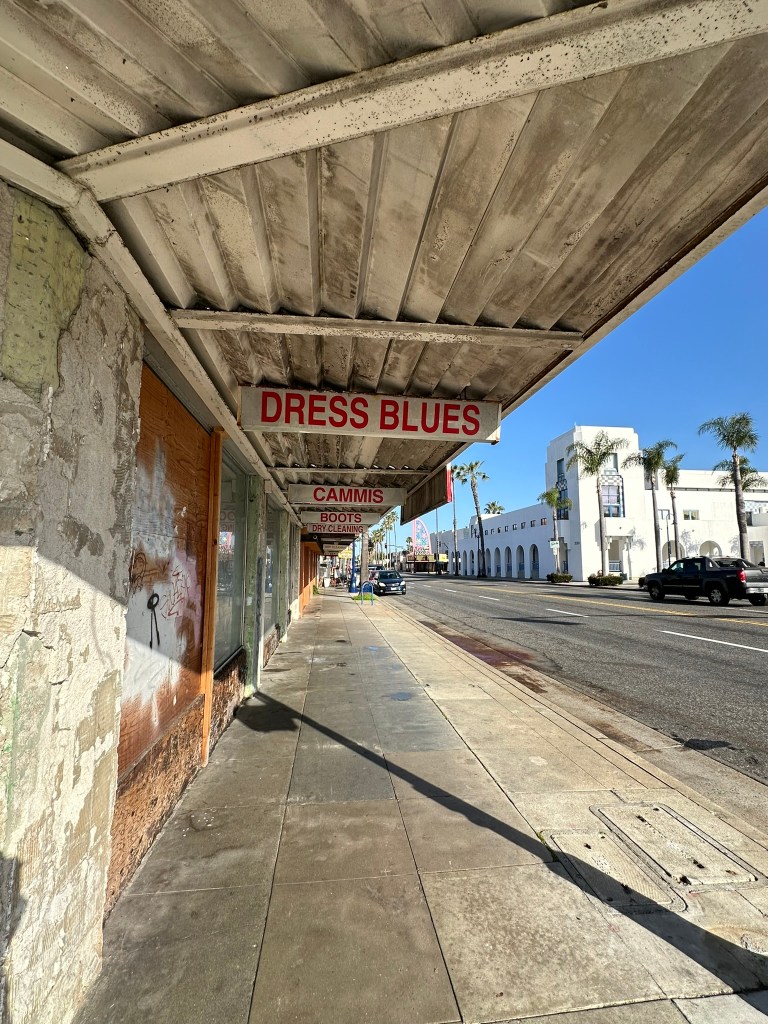
While the barber shop and another storefront continues to operate at 410 and 412 Pier View, the majority of the building sits empty. Its exterior has been marred by the removal of ceramic tiling (not original to the building) with boarded windows.

Damage to exterior with the removal of the ceramic tile. (photo taken March 8, 2024)

There is hope for the building. The large, corrugated metal façade which wraps around the upper portion of the building could be removed and the original exterior on the second story appears largely, if not completely, intact and would reveal its original cement finish in art deco style.

View of metal façade from interior second floor (photo taken in 2017)

Just what will become of the building is unknown but certainly its history is worth knowing and the building worth preserving. The potential for exposing the beautiful Art Deco façade and beautifying this downtown corner is just waiting to happen.

Historic homes and buildings provide character and a sense of place. “How will we know it’s us without our past?” – John Steinbeck, Grapes of Wrath

Dr. Joseph J. Markey, Man of Myths, Legends (and Lies)

For nearly 70 years the story of a sunken ship laden with gold off the coast of Oceanside has persisted and the details, told by a master storyteller, have become urban legend.

Dr. Joseph James Markey, who told these stories with great and ever changing detail, was once described as “the real life model to Steven Spielberg’s ‘Indiana Jones’ of ‘Raiders of the Lost Ark’.”

Dr. Joseph James Markey

For two decades Dr. Markey and his wife Helen lived a rather quiet life in Oceanside. They lived in a modest home on Hoover Street in the Loma Alta neighborhood before moving to a palatial one on South Pacific Street near the exclusive St. Malo enclave.  Markey had a small office on South Hill Street.

Helen and Joseph Markey. Helen was an avid painter and her work was lauded by many.

One June 13, 1947 Joseph Markey traveled to Paris. The Oceanside newspaper reported that his plane had engine trouble but that he had landed safely. Markey was on “a month’s business trip to Paris and other cities.” He returned about five weeks later and his comments about his trip were published, stating that communism “in France and other European countries is gaining ground in many ways” in large part due to organized strikes.

The following year, Markey was under a bit of scrutiny for supporting and advising embattled councilmember Russell A. Allhouse who was facing a recall for disparaging and slanderous statements he made about other councilmembers and in his own publication entitled “Veterans’ Advocate”, alleging that he “printed false, misleading, and scurrilous statements tending to pit class against class, individual against individual, and to create distrust, dissention, and a lack of unity.”

It is telling that Markey would support such a divisive person and one who printed “false and misleading statements.”

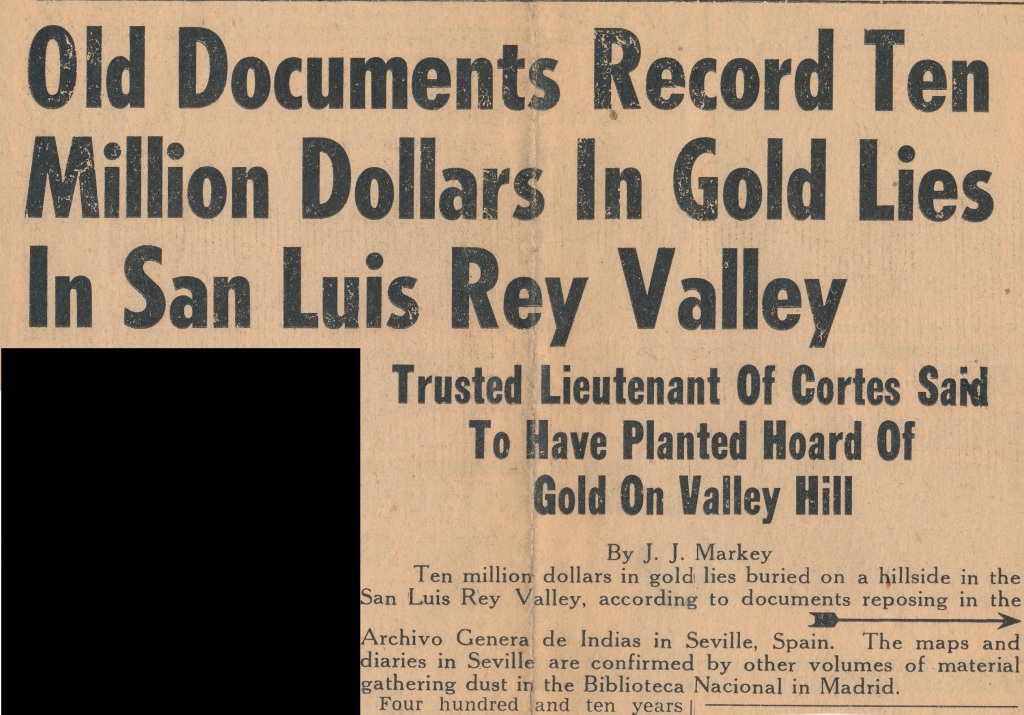
February 3, 1950, Oceanside Blade-Tribune (Oceanside, California)

It must have come as quite a surprise for Oceanside residents on February 3, 1950 when they unfolded their daily paper to read the front page headline in large block letters: “Old Documents Record Ten Million Dollars in Gold Lies in San Luis Rey Valley.”

In an article written by Dr. J. J. Markey himself (rather than a reporter), he claimed to have traveled to Spain in 1947, presumably on his Paris trip, and discovered that “ten million dollars in gold [was] buried on a hillside in the San Luis Rey Valley.” Markey said that he had discovered documents “reposing in the Archivo General de Indias in Seville, Spain.” These long-lost papers were simply “gathering dust” waiting for Markey to bring them to light.

The story Markey wrote involved one Francisco de Ulloa, “a trusted lieutenant” of Spanish conquistador Hernán Cortés. It was Ulloa that buried “this hoard of gold” and it was somewhere in the hills of the San Luis Rey Valley. Markey had a map which was provided to him by a descendant of Ulloa, drawn in “meticulous detail.” He told the story of this mysterious map and the stranger who brought it to him like a narrative from a cheesy pulp fiction novel:

“First,” he said, “I show you the map.”  His English was not bad.  A caressing accent.  “You have regarded many maps in your eventful life,” he went on, understandingly.  “And most of them–all of them–were frivolous.  But this one, Monsieur,” and he was genuinely serious.  “Is what you call the McCoy.”

One could question, if a man was in the possession of this map which pinpointed supposed locations of gold caches, why didn’t this person come and claim the gold for himself?!

Here are the “facts” that Markey presented in the local newspapers that would be repeated in hundreds of newspapers across the country…sometime more embellished by the discoverer as he saw fit:

  • Francisco de Ulloa died on the banks of what we now call the San Luis Rey River.
  • Before dying he directed his “loot from Mexico” to be buried in 3 caches.
  • Maps with meticulous detail would determine the location of any of the three was found.
  • A member of his party, one Pablo Salvador Hernandez, returned to Mexico in 1541 and provided details of Ulloa’s fate and the buried gold in a diary.

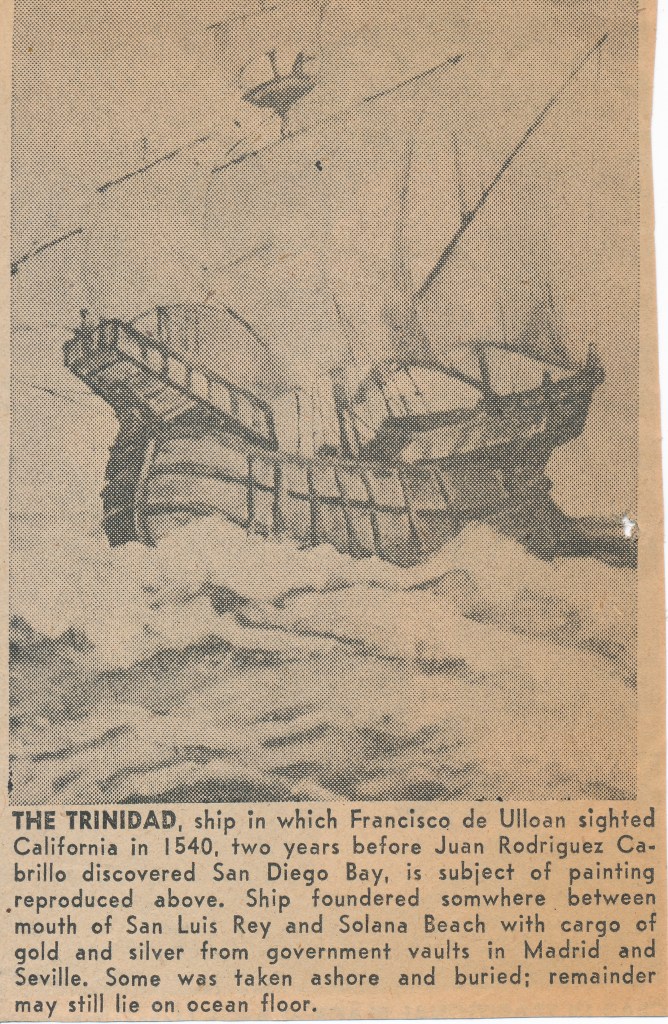
In spite of the long-established story of Juan Rodriguez Cabrillo discovering California, Markey insisted he alone had found the true explorer: It was Francisco de Ulloa who discovered and then traveled past the San Diego Bay on the Trinidad, a 35-ton caravel. On June 30, 1540, he reached the mouth of the San Luis Rey River where for “two days the ship lay at anchor while the vessel’s casks were filled with fresh water.” According to Markey, Ulloa and his men offloaded $10 million worth of gold which would be buried and hidden for 400 years.

Dr. Markey examining coins with portrait of Ulloa behind him.

As incredible as Markey’s story was, soon regional and then national newspapers picked up the story which gained considerable interest including the San Diego Union and the Los Angeles Times. Nearly every week Markey fed the newspaper another story, or detail about Ulloa and his treasure. On February 13, 1950 the Blade Tribune published another story, again written by Markey with the opening paragraphs:

History abounds with dramatic narratives of explorers setting out to discover new trade routes, northwest passages or shorter water-ways.  And, as in the case of Columbus and countless others, history records that more often than not the adventurer discovered something better than his original objective.

That’s the way it was with Francisco de Ulloa, the first white man to visit Oceanside and our nearby San Luis Rey valley.  When Ulloa started out from Mexico in 1539 he was looking for a city as large as Mexico City.  A city so extravagantly wealthy that its buildings were made of silver. One of the seven cities of Cibola. But as I said, he discovered Oceanside instead.  And stayed here.

Although Paul Beck, publisher of the Oceanside Blade Tribune, printed Markey’s stories on his front page, (because they sold newspapers) he did write in an editorial stating that “John Davidson, San Diego Historical Society director, has taken issue with Dr. Markey.  He says the treasure is not in San Luis Rey valley … or anywhere near it.”

Davidson further refuted Markey’s claims, saying that “According to all known historical data, Ulloa was sent out in 1540 to resupply the expedition of Coronado.  He never got north of the Gulf of Mexico. It was not until two years later that Cabrillo sailed up the West Coast, the first navigator in history to make the trip. If he named the rivers and landmarks, we don’t know. His log has never been discovered.

Portrait of Francisco de Ulloa

Not to be outdone, Markey wrote another account the following day with more details, which again read like a novel:

Late in the year 1539, Francisco de Ulloa, the first white man to set foot on the territory now occupied by the city of Oceanside, set sail from Cedros Island, a bare rock protuberance in the Pacific, off the coast of Mexico.  He headed the prow northward.  The wind was favorable at that time of the year.  He was able to keep his 35-ton vessel within sight of land most of the time.

He mapped the coast with commendable accuracy, noting Point Loma and the two islands off Mexico, within sight of San Diego.  He rounded the point on which La Jolla now reposes and moved into the concavity formed by the land at Encinitas.

At the mouth of the San Luis Rey river his lookout perceived the first movement on shore since he had left Mexico.  The purposeful movements of the figures on the beach forced him to conclude they were human.

He ordered his ship to stand off.  Oarsmen eagerly volunteered to man a boat.  Long before they approached the surf they could make out the fresh water river that cut through the sand and flattened the surf out to a degree that afforded an easy passage through the combers rolling in from the open sea.

Ulloa, himself, accompanied this first boat.  The brown Indians gathered in cautious knots on the beach.  Not retreating. Nor yet moving forward inquisitively.

‘The men were naked,’ the diarist of the landing party wrote, ‘and the women wore short aprons or skirts of woven grass.  These extended from the waist to the knees.  Some few had skins and furs incorporated in the weaving.’

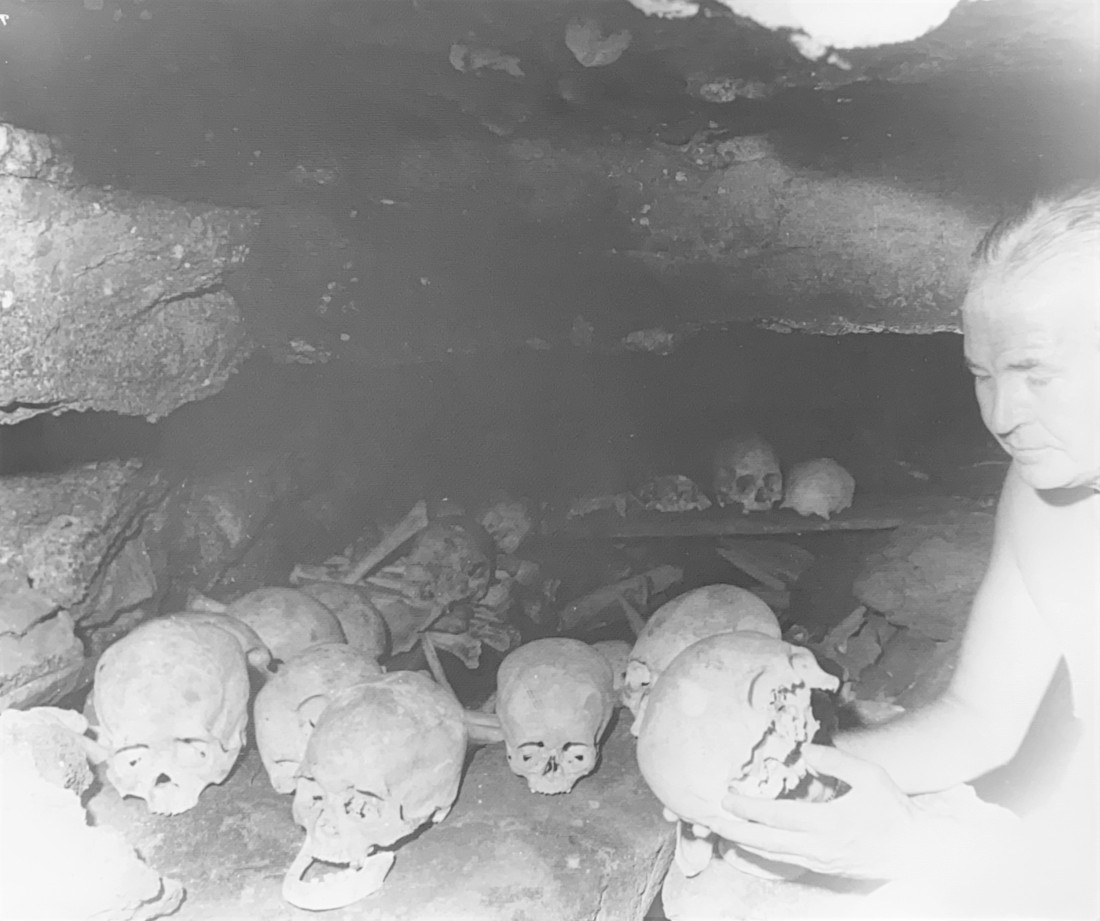
Markey’s incredible claims were not done because just days later he “discovered” what he called the “San Luis Rey Man,” a skull of a man found less than a mile from the Mission San Luis Rey. It was reported (by Markey) that “anthropologists” estimated the skull to be from 10,000 to 20,000 years old. In newspaper articles printing his claims, Markey is described as physician, author and scientist, and in which he declared: “Excavation of this skull may prove this valley the greatest hunting grounds in the world for prehistoric-man fossils of Pliocene and Pleistocene periods.

As proof of his assertions, Markey wrote that an unnamed “anthropologist” visited his home on South Pacific Street and it was during this visit that Markey took the alleged opportunity for the skull to be examined. The melodramatic conversation Markey published is below:

At the dinner table, at the conclusion of his first meal, I presented him with a human skull and jawbone for an expert appraisal.

‘Probably an Indian,’ I told him.  And I’m hoping he’s about 400 years dead.  That would place him in the valley just where we wanted him, at the same time as Francisco de Ulloa who, I understand, buried a lot of gold down there in 1540.’

My guest pushed back his chair a little and inspected the relics without enthusiasm.  It was a long head.  ‘Dolichocephalic,’ he pronounced.  ‘A chinless, prognathous jaw like a chimpanzee.  Big canine teeth.’  Only there were no teeth.  They had rotted away before the man died.  ‘Not much of a supraorbital ridge,’ he went on reciting.  ‘A male.  About 30 years old.  Yet, an old man.  Probably died of old age and deficiency diseases at 30.’ 

I was fascinated not only by his recital, but by the fact that he took his pipe out of his mouth and used it as a pointer, shoving it into eye sockets and nasal passages, and rattling it on the bone for emphasis, then putting it back in his mouth.

‘This boy had a small brain,’ he went on.  ‘Smaller than the aboriginal Australian’s.’  As he spoke, he grew more thoughtful.  And finally stopped his narrative to examine detail of the ancient bone with close attention.

After a long moment he regarded me alertly.  ‘It’s just possible you’ve got more here than you bargained for,’ he said.  ‘Let’s go out and look at the place you found it.’

Markey came to the conclusion that “a cautious scientist giving his first estimate could say with safety than San Luis Rey Man is more than 10,000 years old.”

Years later, in 1958, Markey left for Europe with “fossils of San Luis Rey Man” to be “examined by experts.”  But nothing was ever mentioned again of San Luis Rey Man.

Detailed stories continued to pour in weekly, sometimes daily from Markey. While he claimed ownership of what he described as a detailed map, the gold could not be found. But that did not stop Markey from continuing his stories as his notoriety grew across the country. Markey said he was in possession of the diary written by Pablo Hernandez, (seen only by Markey).

Questions arose such as to why the men removed the gold from the ship? According to Markey, Hernandez wrote that the men took the gold with them because they were “inveterate gamblers.” Who were they going to gamble with? The Native people?

Markey had a disdainful attitude towards the indigenous people living in what would be called the San Luis Rey Valley, describing them as “simple and backward” in several writings.  His derogatory verbiage published in numerous articles, stated that they displayed “retarded aboriginal customs and animal-like daily life” and that “they possessed no system of writing or communication beyond the simple noises that constituted their language and existed on a borderline between human and animal.” In fact, he wrote: “Some described [them] as being more like animals than human.”

When questioned about his “findings”, Markey simply referred to the Hernandez diary. It was Hernandez who noted the “extraordinary mental and physical laziness” of the people.” It was Hernandez, who allegedly wrote that the Natives “were like wholly wild animals.

To truly understand the depths of his loathing towards the Native people of our area, Markey wrote a further number of offensive narratives published in magazine and newspaper articles:

  • Male and females sit for hours at a time wholly occupied with removing vermin from the hairy areas of their bodies.  Having recovered the vermin with his fingers, the native proceeded to pop it into his mouth and eat it. 
  • They were like wholly wild animals that had not yet learned to fear white men and their implements of death.”
  • In an article written for “True, the Man’s Magazine”, (July, 1965) Markey describes the Luiseños supposed super-charged “sex drive” and purports that both sexes routinely engaged in pedophilia.

What became of Ulloa and his men? According to Markey, the men who left their ship began to die of dysentery due to the filthy living conditions of the Indians.

The Spaniards were repelled by the smell of the villages.  Each rude hut was festooned with ripe and drying fish and animal meat.  The sanitary facilities were like those of a wretchedly kept pig-pen. The lake shore was at once the cesspool, the bathtub and the drinking fountain of the village.”

M. R. Harrington, curator of the Southwest Museum, wrote Markey to correct him on his public view and disdain of the Indians. Harrington’s retort doesn’t age well either, but did refute Markey’s statements.

In his letter Harrington wrote: “The Luiseños were a simple people, but hardly filthy, their very religion demanded that everybody bathe every morning if water was available. And that is more than can be said of Europeans of that period. As to sanitation, when nature called, they went out into the bushes, same as everybody else, except Europeans in cities of the period, who usually threw their night soil out into the street.

“You can be sure that Luiseños did not go to their drinking water or bathing pools for this purpose. Garbage was thrown on dumps for dogs to eat. The disease which killed so many of the Ulloa party was probably not caught from Indians, but was scurvy, the same that caused the death of so many crew men in 1769 when San Diego Mission was established. I have visited many Indian tribes, lived with them, and the “wildest” were often the cleanest.”

Markey’s story continued with Pablo Hernandez finding Ulloa close to death who said to him, “Too many people are dying have all the men put their gold together and bury it. Take it two leagues away where no natives will see you. Mark the location well. When the illness has passed, those who live on can recover it.”

In early 1952 Markey was referred to as an “Oceanside Paleontologist” and was announced as the principal speaker at San Diego Historical Society. It was stated that would “outline the results of his 20 years of excavation and research in the San Luis Rey Valley.” It is a curious statement but certainly Markey was no stranger to exaggeration or fabrication.

In July 1952 he announced that he was going to seek the whereabouts of the fossil remains of the Peking Woman. Described as a “local archeologist” it was said that “Dr. Markey, who will represent a national archeological organization on his round-the-world trip, intends also to do some further research into records of early San Luis Rey Valley Indians.” His travels would take him to “Manila, Hong Kong, Calcutta, Singapore and the Island of Java.  His Pan-American itinerary lists Honolulu, Tokyo, Hong Kong, Manila, Batavia (Java), Singapore, Rangoon, Calcutta, Bombay, Basra, Beirut, Istanbul, Athens, Rome, Paris and Madrid.

He arrived back to the states in late September, with no mention of the Peking Woman, but he still made headlines by stating that “he thinks women are inferior to men” and after all, he should know because “he does research on the potential of the female mind.” He went on to insult women everywhere by saying that the “accomplishment potential of women is staggeringly low” adding that they “shouldn’t even be allowed to vote, because women can’t think in sociological areas beyond the narrow horizons of their own small lives.

Markey never apologized for these remarks and would even repeat them in other publications.

October 15, 1952  OCEANSIDE BLADE TRIBUNE (Oceanside, California)

While he didn’t return with the lost fossils of the PekingWoman, Markey did say that on his trip abroad he found drawings made by men from the ill-fated Ulloa party. These depictions were of the Luisenos made by “the scribe of the Ulloa party” that indicated “these early Indians were different in appearance from those of our present day tribes.  They were distinctly lowbrow; with receding foreheads; high, heavy eye-brow rides; broad, flat noses with depressed nasal roots; long narrow faces and heads and lips in muzzles that protruded like a gorilla.”

In addition to the supposed 10,000 year-old “San Luis Rey Man”, in 1953 Markey announced that he would examine what he called the skull of the “Wilson Man” (so named because it was found by Howard Wilson of Laguna Beach.) Apparently Markey had the credentials to do so, although he was neither a paleontologist nor an archaeologist.

Markey asserted that the Wilson Man “was a contemporary of Neanderthal Man in Europe” and that he dated the skull “to just before and in the earlier part of the last great glaciations, which occurred 100,000 — 50,000 years ago.”

Never publically announced, but kept in Markey’s records, was a note from George Stromer, of Laguna Beach who acquired the remains from Howard Wilson, and in turn delivered them to Markey that read:

“Received from J. J. Markey the fragments of skull and skeleton which I delivered to him in the year 1953, and which were called the Wilson fragments in the newspaper in that year. At that time I informed him that I had gotten them from Mr. Wilson of Laguna Beach. The skeletal fragments have been appraised as being that of a white man about 35 – 40 who died about 1860. Dr. Markey and I have agreed this day that all the fragments that I delivered to him in 1953 have been returned to me today, October 27, 1961.”

Markey’s accounts continued about Ulloa and the lost gold, which remained buried somewhere in the rolling hills of the San Luis Rey Valley. He established the San Luis Rey Historical Society, of which he was the President and was an invited guest speaker for many organizations eager to hear more about buried treasure worth $10 million.

And that was the story that Markey told for seven years. Until 1957 when he suddenly switched gears and announced that Ulloa’s ship, The Trinidad, had drifted unmanned and sunk off the coast somewhere between Solana Beach and Del Mar… along with the gold. Markey reported that skin divers were now looking for the remains of the ship and the treasure that went down with it.

Why this sudden change of story? Was the gold buried in the Valley or not? What about this “meticulous” map? Now the gold was supposedly buried along with Trinidad. Markey gave no explanation, but kept spinning his yarns.

In order to locate the area where the ship sank, Markey claimed to have rafts “weighted to the estimated tonnage of the Trinidad and set adrift in the Pacific Ocean off Oceanside” which then “drifted down the coast and sunk south of Del Mar. That’s about where the Trinidad ought to be,” said Markey.

How did Pablo Hernandez return (and have his diary discovered) if the Trinidad sunk?

If the Trinidad weighed 35 tons, how and when did Markey conduct his experiments? Who assembled these rafts? How were 35 tons of anything placed on them? Who watched them float and then sink? AND what made them sink?

If they did in fact sink south of Del Mar, why would these rafts sink in the same location where the Trinidad allegedly sunk? (Markey later referred to the rafts as barges but they are likely just as mythical as the rest of his “research.”)

Simultaneously sharing the story of the now sunken Trinidad, Markey claimed to have discovered the grave of Francisco de Ulloa, and in a separate area, a mass grave of his men. Reports varied, but Markey would claim 20 to 22 skeletons were found.

Dr. Markey and Dr. Eileen Herbster of the San Luis Rey Historical Society, at Ulloa’s grave site

Photos depicted Markey and others standing by a cave entrance, along with a cement headstone, and signage claiming it to be the gravesite of Ulloa. Markey said it was determined to be Ulloa’s remains because “buttons and metal decorations from a Spanish uniform of the 16th century indicating a man of Ulloa’s rank” along with fragments of Spanish armor, helmets, knives and other weapons” were found. Later, he changed the story that Ulloa had been buried in “full regalia.”

Soon after the “discovery” a white picket fence was added to Ulloa’s gravesite. No credible archeologist or anthropologist would erect a headstone, let alone a picket fence, around a real archaeological site. Nearby stones which were supposedly decorated with ancient petro glyphs were “enhanced” by Markey with white paint. No one thought to ask Markey how “animal-like people” could create such an image carved in stone.

Picket fence lines the alleged gravesite of Ulloa, Dr. Markey poses with his skull.

As supposed deep sea divers were searching for the Trinidad off the coast, Markey offered a $10,000 reward to anyone who could find the gold on the bottom of the sea floor, and then, quickly retracted the offer the following day.

Crews of men, along with state-of-the-art equipment were unable to locate the ship but the idea was intriguing to many treasure seekers.

In 1969 Bill Takasato of Long Beach, who headed the crew of The Gleaner, said that he believed he had found the spot near where the Trinidad had sunk. The crew located what they felt was the hulk of the Trinidad 3,300 feet off the 1200 block of South Pacific, under 31 feet of water and 8 feet of sand.

Despite what should have been exciting news, Markey disputed their findings. “It isn’t where we think it is … We feel it is a bit further down.  Hernandez, the scribe, drew a map which depicts an area much like the terrain near the power plant off Carlsbad.”

A map where the Trinidad sank? Then why couldn’t the ship be found?

Two months later the search by Takasato was called off due to lack of funding and Markey was curiously quiet. He knew it wasn’t the Trinidad because the Trinidad never sank. It seems Markey was satisfied with storytelling and the notoriety that with it but had no real interest in finding the ship or the gold because he knew it didn’t exist.

Finally, in 1971 Stephen T. Garrahy and David J. Weber openly challenged Markey’s claims in the California Historical Society Quarterly.  Weber was an associate professor at San Diego State College; Garrahy a graduate student in Latin American history at the University of Texas at Austin.

Markey in a cave of skulls. This image was used in 1955 when Markey claimed to be in Tahiti. The same photo was flipped and repeated in 1957 to depict the cave were Ulloa’s crew was allegedly found.

Along with the numerous historical “facts” disputed by the two, was a photo of Markey taken in a cave. In the photo are several skulls and bones and Markey, bare-chested, is holding a skull. In 1955 this photo was published claiming that Markey was in Tahiti, holding what he said was a skull of a cannibal. Garrahy and Weber pointed out that the same photo was used in 1957, only reversed or flipped, showing Markey in a cave where Ulloa’s crew were purportedly discovered in the San Luis Rey Valley.

In response, Markey granted an interview to Genevieve Claussen of the San Diego Magazine where he expounded upon his many illustrious exploits and discoveries and actually downplayed the story of Ulloa, rather than boasting of it as he done for two decades. When challenged on his claims, Markey’s continual response was to dispute and discount all other historians no matter their degree or expertise.

I don’t know why we should take up our time with every Tom, Dick and Harry who wishes to waste our time. I have used the word ‘scientist, or historians of stature’. We are always glad to talk to them.”  

Who is a person of stature?” Markey rhetorically queried and answered: “If he has 50 lines or more in Who’s Who in America.

The self-important Dr. Markey was neither a scientist nor a historian. His criteria of importance were not “their degree or expertise” but only that they be included in a vanity publication in which he provided his own questionable and disputable accomplishments.

In 1981 James R. Moriarty, a professor at the University of San Diego, also refuted Markey’s stories stating that Francisco de Ulloa had in fact returned  to Mexico and then Spain, where he later died and was buried. Divers never located the Trinidad, he said, because it didn’t sink, and grave sites, if they existed, would be those of local Indians.

Dr. Markey died in 1985 with the neither the Trinidad nor the gold ever discovered. Some believe it is still in the Pacific.

But what became of the skulls and bones that Markey claimed were Ulloa’s and his crew? Where are the graves? Where is the map? Where is the diary? What became of the San Luis Rey Man?  Why did Markey unashamedly perpetuate such wild stories as truth? What compelled him?

There’s more to uncover and discover about James J. Markey…until next time. Stay tuned.

A Christmas Miracle – George Carpenter’s Giant Santa

Many Oceanside residents, and perhaps many people in Southern California, will remember the giant Santa Claus erected each year at a home in South Oceanside. To the delight of children and the young at heart, the home at 1741 South Clementine was arrayed in what could be described as Christmas Spirit “overload”. But this abundance of holiday joy came from the mind, heart and creativity of one man: Oceanside resident George Carpenter.

People lining up to see Santa during the day; at night the display brought crowds. Carpenter Family Collection

George Carpenter and his wife Gladys came from Pennsylvania where they owned a donut shop. The couple had five daughters, Georgina, Pamela, Yvonne, Robin and Jodie. George, a civil service employee at Camp Pendleton, was inspired to purchase his home on South Clementine Street because of its large yard. He had already imagined a “grandiose” display that he planned to set up that Christmas.

George Carpenter proudly stands with his giant Santa. Carpenter Family Collection

George began in about 1968, with a rather modest display. He purchased what was described as a “dilapidated” wooden Nativity scene with a choir, along with Santa and his reindeer. He spent a great deal of time carefully refurbishing, repairing and painting each figure. The Carpenter’s Christmas exhibit was admired by the neighborhood but George wanted to go bigger. Each year he added not one, but several items. He captured the imagination and attention of hundreds and then thousands of people as the menagerie of characters and scenes exploded in his front and backyard. The inside of the Carpenter home was just as filled with holiday spirit and there was no denying George’s love of everything Christmas.

The Carpenter’s front yard. Carpenter Family Collection

In 1972 George had to have the power company put in a special line to handle all the extra voltage for his ever-growing display which included a life-size ice skater, a snow skier, and a quacking duck in an ice pond. The rear of the house featured several large religious scenes beginning with the birth of Jesus, a host of angels and other Christian symbols. The house was decorated front to back, from the rooftop to nearly every available space in the surrounding yard. When he purchased a boat for his display, the salesman asked him if he was going fishing. George responded, “No, it’s for Santa Claus.”

Santa in a fishing boat being pulled by a dolphin. Carpenter Family Collection

George outdid himself in 1973 with a 22-foot, 1200-pound motorized Santa Claus on his front lawn. It was an unbelievable sight and created so much traffic that an Oceanside police officer had to be assigned to the corner of Whaley and South Clementine Streets. It took nearly 10 months to construct the giant Santa which could wink, nod and wave. “Super Santa” was constructed by Larry Hill of Carlsbad. It was made of fiberglass, wood and papier-mâché. George got the idea for the giant Chris Kringle just after Christmas in 1972, and began looking for someone to build it. The local newspaper reported that “Carpenter didn’t disclose what it cost” but it was noted he couldn’t do “another one for less than $4000.” (He later had another Santa built, but it was thinner. His daughters protested “skinny Santa” in favor of the original.)

Larry Hill making George’s Giant Santa in his workshop. Carpenter Family Collection
“Skinny” Santa is pictured here, but the rounder Santa was the real crowd pleaser. Carpenter Family Collection

The country was going through an energy crisis in 1973 and citizens were asked to conserve energy, which included no erection of outdoor Christmas lights. The electricity that it took to light and animate the Carpenter display was more than the average household used on a normal day or week.

Display at night. Carpenter Family Collection

George wrote an editorial in the Oceanside Blade Tribune newspaper, asking residents to call him with their opinion as to if he should continue his Christmas exhibition in light of the energy shortage. He received about 50 telephone calls, along with a few visits, all of whom said they approved of his display and urged him to continue. “Some said they couldn’t wait,” Carpenter reported. However, there was one grinch, an elderly woman while out walking her dog past the Carpenter home told George she was against turning on the lights.

Christmas was everywhere at the Carpenter house! Carpenter Family Collection

One of the local firemen, who helped to erect George’s giant Santa, voiced his support saying, “I’m really glad he’s doing this. I think it’s ridiculous that no one is supposed to have Christmas lights outside anymore when there’s used car lots and supermarket parking lots are all lit up over town.”

Guestbook entry 1976

With the ratio of one objection to 50 in favor, Carpenter went forward but not before writing to President Richard M. Nixon, sending photos and asking for “permission” to continue his display, along a personal invitation for the President to visit. He actually received a response from the President’s Special Assistant, David N. Parker politely sending his regrets. George noted that the President did not discourage him, so in spite of the call to conserve energy went ahead with his display but restricted the hours of operation to do his part in conservation.

Letter to George Carpenter from the White House, 1973. Carpenter Family Collection

In addition to the giant Santa Claus, who could be seen for blocks, Carpenter erected other animated scenes which included life-size skiers and skaters; a 6-foot boat towed by dolphins (which spouted water!); and Snoopy on a surfboard. While the images now seem a bit “unsophisticated”, today we can purchase pre-made items for our yards, or simply shop online. Manufactured figures and reindeer are available in nearly every retail store, but this was long before such things were mass produced. George Carpenter’s display was largely built by hand and there was nothing else like it. It was described by many as “Disneyland.” In 1974 the attraction brought over 5000 viewers in two weeks.

A child’s glowing endorsement written in one of the many guestbooks.

George added more to his holiday wonderland in 1975, including a Ferris wheel, a moving train and toboggan riders. Gladys Carpenter told the Pendleton Scout that year, “It’s a 365 day a year project” and a “labor of love.” “Labor because it is so much work to do it and love because he loves doing it.” George did it all to delight his children and the people who lined the streets to see it.

George’s Santa weighed 1200 pounds and was 22 feet high. Carpenter Family Collection

The Carpenter daughters can attest to how much work it was because each year, beginning in October, they were enlisted to help. As their father dug post holes, set up fencing and planned layouts for his elaborate scenes, they began rolling out miles of polyester batting that served as snow covering the roof, yards and walkways. Boyfriends were also expected to help with the setting up of the many pieces in the ever-growing Christmas collection. Firemen from the South Oceanside’s Fire Station on South Ditmar Street came over to help hoist up the 1200-pound giant Santa Claus.

Neighbors and Oceanside Firemen assist in putting Santa in place. Carpenter Family Collection

George would talk to children through his giant Santa by a speaker he had hidden, asking them what they wanted for Christmas. It was all so magical and the crowds grew. People came from all over as newspapers carried the story of the 22-foot Santa and the wonderful Christmas house.

One of the many newspaper articles featuring the 22-foot Santa Claus

The family started a series of guestbooks, asking visitors to sign in, giving their address and/or city and any comments they would like to add which included El Cajon, San Clemente, Leucadia, Los Angeles, San Diego, Riverside and Poway. There were others from out of state including Oregon, Florida, New York and Utah. In 1976 Ethel Pierson wrote, “Worthwhile coming out from Ohio to see this marvelous display.” Another wrote, “What a lovely Christmas gift. We all, young and old, alike, enjoy this wonderland.” Someone added, “So there really is a Santa Claus!!” Some children took to writing their Christmas wish lists in the guest books for Santa to read.

One of the many requests from children to Santa written in the guestbooks.

Sometimes visitors felt compelled to donate after viewing the grand exhibit; a kind gesture for sure, but it amounted to a nominal amount each year. George didn’t do it for money, but he once won $50 for “the best decorated lawn” which didn’t begin to cover his electricity bill. He did mention he would love to receive a trophy, but said, “The real enjoyment I get out of it is sitting in the house and watching the people’s reactions, young and old. They love it and for at least a few moments, their lives are a lot happier.”

Onlookers marvel at Santa and Christmas display. Carpenter Family Collection

George continued his oversized Santa display through 1977. He had run out of room (and perhaps energy) to store it all. In 1978 the huge Santa was set up at the Mission San Luis Rey where it was all but destroyed by a heavy storm. That might have been the end of George’s Santa, but the memories remain.

George Carpenter’s Santa could wave, blink and talk. Carpenter Family Collection

The Carpenter daughters still reminisce of their beloved father and his devotion to Christmas. Even though they tired of the weekends they had to spend setting up the lights, fake snow and figures, it was time well spent with their dad whom they adored.

By sharing their photos and memories with the Oceanside Historical Society they are keeping their father’s love for Christmas alive.

As a lasting tribune, the daughters erected a stone plaque in their father’s memory where the Carpenter house and the giant Santa once stood, with the permission of a good-hearted homeowner.

Plaque installed by George Carpenter’s daughters at corner of Clementine and Cassidy Streets.

I will honor Christmas in my heart, and try to keep it all the year.” Charles Dickens

Julius, The Crow Who Lived at the Mission San Luis Rey

In the mid-1930s, a young crow landed or flew into the grounds of the Mission San Luis Rey and into the hearts of the priests. The bird was friendly and curious, and the students there named him Julius.

Julius became an attraction at the Mission and provided “fun and diversion for those in residence” and “was a source of surprise to visitors” many of whom he befriended as well. He came to the call of Father Dominic and would often land on the heads of his friends, to the delight of onlookers.  

Julius the Crow at the Mission San Luis Rey, 1938. Herman J Schultheis Collection
Los Angeles Photographers Collection

Julius became something of a local celebrity and even drew the attention of a photographer, Herman J. Schultheis. Schultheis worked in the film industry in Los Angeles, including Disney where he worked on the animated features Fantasia, Dumbo, Bambi and Pinocchio.

Schultheis was also an avid amateur photographer who traveled the world. He visited the Mission San Luis Rey in 1938 to take a photo of Julius, the only known images of the beloved bird. In the photos Julius appears to be interested in the photographer, looking directly into the camera.

Julius the Crow at the Mission San Luis Rey, 1938. Herman J Schultheis Collection
Los Angeles Photographers Collection

Crows can recognize human faces and are the only non-primates that can make tools. They are also capable of abstract reasoning, problem-solving, and even group decision-making.

Hower, as smart as a crow can be, Julius did not understand electricity. One September day in 1938, after taking a bath in the Mission fountain, feathers still wet, he flew to rest on a power wire and was immediately killed.

The fountain at the Mission San Luis Rey where Julius took his last bath. Oceanside Historical Society

The local newspaper reported there was “mourning among the padres and brothers out at the Old Mission of San Luis Rey, and among the Sisters at the Academy nearby.”

Days before his untimely death, the Mission held their annual Fiesta at which Julius, who was “perpetually hungry” was a beloved guest and “feasted from most of the plates.”

Julius, who was hand-raised “in the church”, was likely given a proper burial and a final blessing.

Julius the Crow at the Mission San Luis Rey, 1938. Herman J Schultheis Collection
Los Angeles Photographers Collection

Wilton S. Schuyler, Oceanside Inventor

Did you know that one of the earliest motor vehicles was designed right here in Oceanside? It was invented by Wilton S. Schuyler, who named his motorized vehicle the “Oceanside Express”.

Wilton was the son of John F. and Anne (Barlow) Schuyler. Born in 1875 in Superior, Nebraska, Wilton Sumner Schuyler came to Oceanside with his parents in 1887.

John Schuyler’s Hardware Store, 408 Third Street (Pier View Way) circa 1888

In 1888 his father built a hardware store on Third Street (now Pier View Way). It is very likely that Wilton began working on his invention at his father’s store, which was later converted into a boarding house and is now The Brick Hotel at 408 Pier View Way.

The July 23, 1898, edition of the Oceanside Blade newspaper reported:  “W. S. Schuyler, the Oceanside inventor, has just been granted seventeen claims for patents on a motor carriage.  Oceanside is getting to the front with its representation of inventions.  We’ll soon be riding in motor carriages …”

Wilton Schuyler was just 24 years old when he developed his prototype and was issued his patent for “a gasoline-engine, propelled vehicle.”

Wilton Schuyler’s prototype of his motor vehicle (chassis) the “Oceanside Express”

He commented years later, “At the time I commenced designing the self-propelled vehicle, the word ‘automobile’ was not yet used. Horseless carriage and motor vehicle were the names used in such vehicles. The only such a vehicle I had ever heard of at that time was made in Los Angeles, California, and it had four 1-cylinder engines, located on the four corners of a frame and all solid to the axles.”

Schuyler filed his patent for his vehicle on April 1, 1898, and then received Patent, No. 624,689, on May 9, 1899.

Patent image of Schuyler’s vehicle

A portion of his patent paperwork read: “Be it known that Wilton Sumner Schuyler, a citizen of the United States, residing at Oceanside, in the county of San Diego and State of California, have invented new and useful improvements in Motor Vehicles, of which the following is a specification:

One particular object of my invention is to so arrange a motor-vehicle that the motor and all of the heavy mechanism may be carried upon a spring-supported vehicle-bed, so as to avoid the loss of power….

A particular object of my invention is to provide means whereby a motor-vehicle capable of satisfactory general use may be produced and without the use of pneumatic tires, which are expensive, liable to wear out, and unsatisfactory in use from various other reasons.

Schuyler’s vehicle also included a headlight which turned in the same direction as the front wheels were turned, as well as a power steering apparatus.

February 3, 1949 Springfield News, (Springfield, Ohio) Courtesy Clark County Historical Society

The headlight invented by Schuyler was used on some of Henry Ford’s first Model T’s and for awhile Wilton was engaged in the manufacturing of these headlights.  The power steering device which Schuyler designed was used on various types of modern heavy machinery.

By 1910 Wilton Schuyler and his wife Carrie, whom he married in 1897, had moved to Missouri where he manufactured gas stoves.  In addition to his prototype automobile, Schuyler had a number of other patents which included a fire alarm, a pancake turner, an adjustable pulley-hanger, a washing machine and an accelerator for combustion engines.

Schuyler died in Springfield, Ohio in 1949 at the age of 73. His obituary, which was published in dozens of newspapers from coast to coast, made mention of his early “automobile” invented in Oceanside, California.

The State (Columbia, South Carolina) · Fri, Feb 4, 1949 · Page 22
Wilton S. Schuyler’s obituary was published around the US, noting his invention of an early “automobile”

History of Oceanside’s Fourth Pier

There’s a lot of buzz on social media about the Oceanside Pier. If you don’t already know, the current pier is Oceanside’s 6th pier, built in 1987 with a “life expectancy” of 50 years.

However, the concrete approach (steps and ramp that lead to the pier and beach) is nearing 100 years old and was built when Oceanside’s 4th pier was built in 1927.

The history of Oceanside’s fourth pier starts years before it was built. The third pier, built in 1903) had been damaged extensively by storms in April of 1915. The once 1,400 foot pier was now down to a little more than 800 feet.  Public sentiment for the pier was one of concern for the city’s beloved landmark and its importance in drawing tourists: “If the pier goes, with it goes all hope of the town having summer visitors.” 

1913 view of Oceanside from Oceanside’s 3rd pier, built in 1903

Later that year the Oceanside Blade reported that “Eighteen cedar pilings and six eucalyptus piles and other material arrived Wednesday for the repair of the wharf.  As soon as a suitable low tide arrives the piling will be put down to strengthen the places where the old rails are rusted through.” These repairs may have reinforced what was left of the Oceanside pier, but a new one was needed.

But before action could be taken, just months later in late January 1916, a devastating flood hit San Diego County, wiping out roads, railroads and bridges and killing several people countywide. Oceanside’s pier was the only way to get much needed food and supplies to residents and those in the surrounding area. Coal for the Santa Fe railroad was shipped in; The Swift Packing Co. sent several tons of meats for Oceanside and neighboring towns and the Pacific Coast Biscuit Co. landed about two tons of miscellaneous groceries and meats.  

Unloading freight and needed supplies after the 1916 Flood, (3rd Pier)

While the pier was a valuable resource during the flood and its aftermath, heavy equipment and cranes bringing the supplies to the pier caused damage, even making the pier lean to one side, forcing the closure of the pier for additional repairs after the emergency. 

Talk of a new pier was everywhere; letters to the editor; proposals and calls to action at city council meetings. With no consensus and no funding, no new pier.

However, a new pier was just within reach when George W. Houk, president of the chamber of commerce of Northern San Diego County, stated that he would donate up to $100,000 in matching funds for a new pier at Oceanside. Houk had made his fortune as a wheel manufacturer, and considered “the father of the wire wheel in America”. He even included this donation in his will which was written as follows:

My said trustee shall, subject to the conditions hereinafter mentioned, pay to the city of Oceanside, county of San Diego, state of California, such sum that may be necessary, up to, but not in excess of, the sum of one hundred thousand, ($100,000.) providing said city of Oceanside donates a like sum, and providing further that the said city builds within three years after my death with said money, a pleasure pier, the site to be selected by my trustee.  Upon the failure of the said city to perform said conditions, then the said sum shall be distributed with the residue of the trust property.

After Houk’s death on October 6, 1917 in Los Angeles, all of Oceanside was appropriately solemn but excited by the prospect of having a new pier. In anticipation, the Oceanside band was renamed the George Houk band in honor of the deceased benefactor.

Oceanside’s George Houk Band, 1917

Houk’s daughter, Mrs. Margaret Moody, promptly contested the will on the grounds that her father was not mentally competent at the time the will was written. She stated that in addition to the Oceanside bequest, her husband was to receive $100,000 on the condition he re-enter the army and attain the rank of captain within a good time! 

Oceanside, although somewhat discouraged, still made plans to go ahead and even invited Mrs. Moody and her husband to a concert on the pier given by the band that was named in honor of her father. The bequest was lost, however, in a decision handed down by the California Supreme Court in 1921. Oceanside would have to wait before its fourth pier was built.

Finally, in 1925 several designs for a new pier were proposed and the building of an all-concrete pier was considered. An election was to be held to vote for pier and beach improvements, but, the city council failed to pass the bond election ordinance.  Trustees E. W. Fairchild, Robert S. Reid and Ed Walsh voted for the ordinance that would allow a $100,000 bond issue for pier and beach improvements as well as fire equipment and water improvement.  Trustees George Dickson and Jesse Newton refused, saying that $100,000 was too much and that $75,000 was adequate. 

Voters angry that they were denied the opportunity to vote for the bond issue took measures to undertake a recall of Dickson and Newton. Still irritated, that when a $75,000 bond issue came to vote in September, residents rejected it with a vote of 330 to 207.

The following May, a petition with 726 names calling for an election to sell “not less than $100,000 in bonds” was filed and granted by the city council. Voters would get their chance at an election to be held in June, 1926.

The Oceanside Blade published an editorial in favor of the pier bonds and a plea to unite:

MAKE IT UNANIMOUS

For nearly two years Oceanside has been torn into factions and has been suffering daily injury because of a difference of opinion over the personalities of three or four of her citizens, and concerning the spending of $25,000.  The three or four citizens were all good men, and the $25,000 was but a comparatively small increase of a sum which practically everyone agreed must be spent for the replacement of the present pier and necessary improvements on the beach.

The stormy petrels in office are now gone since the election of trustees, and by the voluntary withdrawal of two of them in the interests of harmony.  A majority of the people have decided at an election, that in their judgment $75,000 is not enough for the needed pier and beach improvements.  We now are asked to vote for the proposed $100,000, a sum which is but $25,000 more than the amount that even the minority agreed was minimum.

It resolves itself into a question of whether or not the voters are prepared to defeat a very necessary improvement because of a mere difference of opinion over $25,000, a sum, which, when reflected in the taxes of a growing town like Oceanside will never be noticed, and by so doing keep alive the present controversy.

The Blade feels sure that to do so would be calamity, and so we say vote for the bond issue for a pier and beach improvements and MAKE IT UNANIMOUS.

On June 19, 1927, residents made their voices heard with a resounding decision: 685 to 94 in favor of the pier and beach improvements.

Plans began immediately, with Oceanside’s City Engineer, Ruel Leonard Loucks, designing a new pier which was presented to the city. 

Oceanside City Engineer Ruel Leonard Loucks, who designed the Oceanside Pier and The Strand

During the council discussion of the plans, Trustee Crandall asked about the “feasibility of supplying gasoline from the pier for pleasure boats.” Engineer Loucks replied that the proposed pier was not a commercial pier and it could not “withstand such use.”

The new pier is to be a pleasure pier pure and simple.  There is provided at the outer end a wider portion with a landing stage that may be let down to allow of receiving passengers from small boats when the condition of the sea will permit it, but as to any direct cargo or other commercial use such is out of the question.”

Sidney Smith of Los Angeles was the sole bidder in December of 1926, in the amount of $93,900. The bid was accepted and work began the same month.  Compromises were made as to the construction of the pier by building a concrete approach 340 feet long with the remaining 1,300 feet made from wood. 

Construction of the 4th Pier, 1927

The building of the new pier prompted other improvements including the paving of “The Strand”, also designed by Engineer Loucks. On January 12, 1927, it was reported that the city council approved the plans for the construction of a “concrete paving and driveway along the beach from Wisconsin street to Ninth street, a distance of nearly a mile.  This will have on the seaward side a concrete curb and will be lighted for the entire length, the plans calling for the installation of ornamental lighting posts for the entire distance.”

Officials gather on the cement approach as construction of the pier continues, 1927

Progress on Oceanside’s new pier went quickly. In April of 1927 it was reported that the pier would be finished in time to celebrate Independence Day.

Just two months before the pier would be complete the Oceanside City Council published the following announcement: announced:

“To the people of Oceanside, who, for the last five months have critically watched all the details of construction of the new pier it is not necessary to point out the completeness of the finished structure. This pier will stand for years to come, a monument of classic beauty, utility and permanence and be the pride and honor of the city.”

Crowds gather at the opening of the 4th pier, July 4, 1928

Over the Fourth of July weekend in 1927 Oceanside’s fourth pier was dedicated.  The celebration brought thousands of people from all over Southern California with the pier being the focal point of the festivities. Newspapers reported that 25,000 people came to Oceanside to celebrate those Independence Day festivities, at the time when the city’s population was just 3,500 residents.

Crowds line the Oceanside pier’s concrete approach or “bridge”

Oceanside’s fourth pier lasted nearly 20 years. However, in 1943 it was badly damaged due to storms. In addition, the weight of a Navy Observation Tower built as a lookout during World War II, was blamed for the weakening of the pier.  By the mid-1940s it was undermined to a point where its safety was questioned, prompting the need for yet another new pier. Oceanside’s fifth pier would be built in 1947.

Today, plans have been approved to rebuild the concrete portion (now called a “bridge”) keeping to Engineer Loucks’ original 1926 design. The current bridge or approach is coated with decades of paint which has changed its appearance from its original “art deco” look and its smooth gray concrete finish.

This photo captures the original beauty of Loucks’ design, 1927

So what is old becomes new again.

And as a reminder: As we “critically watch” (and sometimes complain on social media) “The pier has stood” and when rebuilt, “will stand for years to come, a monument of classic beauty” and may it ever be “the pride and honor of the city.”

Beach Patios Along The Strand

If you’re a Strand cruiser or a beach walker, you may have noticed a curious concrete structure on the 400 block of the South Strand. There used to be two, one at 416 South Strand and one at 408. The latter one is still very visible.

What remains of a beach patio, 408 South Strand, Google View 2022

What was the purpose of the structures? Very simply – beachfront patios. The patios were built in the 1950s as an amenity for guests staying at the beach cottages of Vista by the Sea, 408 S. Strand, owned by Joseph Harris. The other patio was built in front of McComas Terrace Motel, 416 S. Strand, owned by Max McComas.

The beach patio in front of the McComas Terrace Motel, 416 South Strand.

The patios provided guests a somewhat “private” perch just across from the beachfront property they were renting and included steps down to the sand. The concrete pad in front of the McComas Motel had convenient openings in order to erect beach umbrellas.

Beach side view of concrete wall at 408 South Strand, 2010

The patios were likely constructed by the property owners, as erosion began taking a toll on Oceanside’s beach south of the pier in the early 1950s. As sandy areas for beachgoers dwindled, the patios were meant for motel/cottage guests only (implied or otherwise).

However, this was public beach and around the time the 1976 California Coastal Act was approved, the patios could no longer be maintained or kept private.

Remnants of “McComas” patio, 416 South Strand, Google View 2016

After decades of heavy surf, the concrete slabs have deteriorated and the steps washed away. By 2022 rocks covered any semblance of the McComas patio in front of 416 South Strand.

The Blade Tribune Building in South Oceanside

The large brick building at 1722 South Coast Highway is going over extensive changes and a “new transformation” but here’s a brief history of the building and some of the newspaper’s owners and publishers.

The building was built to house the Oceanside Blade-Tribune newspaper, which originated as the Oceanside Blade in 1892. It was a small but important weekly newspaper which provided world and local news to the residents of Oceanside.

Paul Beck, co-owner of the Oceanside Blade Tribune

Brothers Paul and Harold Beck, brothers who hailed from Iowa arrived in Oceanside in the late 1920s. They purchased the Oceanside Blade along with with another newspaper, the Oceanside News, and created the Oceanside Daily Blade Tribune and the paper went from a weekly publication to a daily one.

The Blade Tribune building at 401 First Street (Seagaze Drive) in 1936

In 1936 the Becks hired architect Irving Gill to design a new building for their growing business. Located at 401 First Street (now Seagaze Drive) it was Gill’s last design, which was restored in 2019.

Tom Braden with wife Joan and their 8 children.

The Becks sold the Blade-Tribune newspaper in 1954, to Thomas W. Braden. Braden was at one time an official at the Central Intelligence Agency, and his wife Joan worked for Nelson Rockefeller. Rockefeller loaned Braden the money to purchase the Oceanside Blade-Tribune.

The Bradens were connected in both political and social circles. Joan was a close friend of Jacqueline Kennedy. Tom Braden was a regular on “Meet the Press” and was appointed president of the California State Board of Education.

In 1975 Braden authored a book about his family which became a popular television series under the same name: “Eight is Enough.” The Braden family lived on South Pacific Street near the gated entrance of St. Malo.

Braden’s book inspired a television series in the 1980s.

Braden sold the newspaper to Robert S. Howard of Naples, Florida in 1967. Howard founded Howard Publications in 1961 which eventually included 19 newspapers from around the country.

Howard was the son of a small weekly newspaper publisher in Wheaton, Minnesota. Born October 23, 1924, he was the third of three children. During World War II Howard left the University of Minnesota to join the military. As a Second Lieutenant in the Army Air Corp he was a navigator and nose gunner in bombers over the South Pacific. He served valiantly, earning a Purple Heart after being shot down in the Battle of Leyte in 1944.

After his return to Wheaton, he took over the family newspaper and over his lifetime amassed 18 newspapers as Howard Publications, with over 2,000 employees and nearly a half million circulation.

The Blade Tribune Building, 1722 South Hill Street (Coast Highway) circa 1980s.

In August of 1967 construction began of 11,500 square foot “modern printing plant” at 1722 South Hill Street (Coast Highway) at an estimated cost of $700,000. That same year, Thomas Missett became the general manager and publisher. The new publishing plant was built by local contractors, Richardson Brothers, and completed in 1968.

Tom Missett, publisher of the Oceanside Blade Tribune

A large two-story addition was made years later. In 1989 the Blade-Tribune was changed to The Blade-Citizen and then again in 1995, renamed the North County Times, which ceased publication by 2013. After 120 years of a hometown newspaper, the Oceanside Blade was no more.

The building has had several tenants over the years, including a vintage market. While Oceanside’s newspaper days may have ended, the two buildings built by the publishers are still standing, one repurposed as a restaurant, the Blade 1936, and the other in South O, in the process of being reinvented.