The Rise and Fall and Rise Again of the Oceanside Pier

The pier fire on April 25, 2024 shocked residents of Oceanside, stunned to see clouds of black smoke covering the pier, and blanketing downtown.  People lined Pacific Street, streaming live on social media as they watched the pier burn and firefighters battle the blaze. Scores of fire trucks, boats and air support were assembled as the black smoke billowed over downtown. As the fire raged on it seemed the pier would be lost. Smoke and flames continued through the night and daybreak. Emerging from the flames the Oceanside pier stands heavily damaged on the west end. But it still stands.
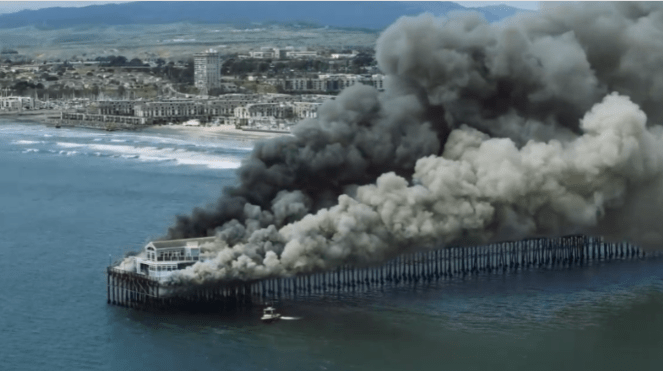
Oceanside Pier Fire April 24, 2024 (Fox 5 San Diego)

The Oceanside Pier has been built and rebuilt six times. It has become a part of our identity as a city. It is part of who we are and we feel emotionally connected to it.  
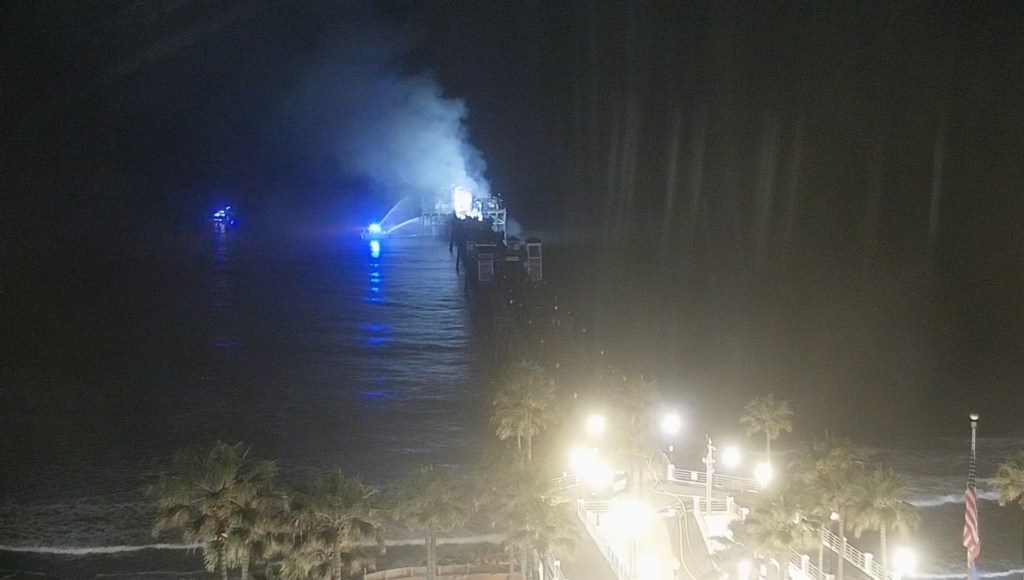
Pier smoldering into the night and next morning

One hundred thirty-six years ago, our first pier was built in 1888 at the end of Wisconsin Street (formerly Couts Street). That same year Oceanside incorporated as a city. The first pier was called a wharf and it was hoped that Oceanside would become a shipping port. Built by the American Bridge Company of San Francisco, by August the wharf was built to an impressive length of 1200 feet. But the first pier was damaged by storms in December of 1890 and reduced to 940 feet.  By January 1891 a larger stormed finished what was left and swept away all but 300 feet of Oceanside’s first pier and the beach was covered with its debris.

Only known photo of Oceanside’s first pier (in the far distance) taken 1890 (Oceanside Historical Society, Carpenter collection)

While short-lived, Oceanside was invested in having another wharf or pier. Melchior Pieper, manager of the South Pacific Hotel, initiated the idea of rebuilding as he gathered lumber from the first pier that had washed to shore and stored it behind his hotel on Pacific Street.

Pieper suggested that the pier be built at the foot of its present location, Third Street (now Pier View Way).  There was some resistance against the Third Street location, a site between Second and Third was favored, but A. P. Hotaling, the hotel owner, agreed to donate $350 so city officials relented. Pieper donated an additional $100 and offered to house the workmen for free.

The building of Oceanside’s second pier in 1894 (Oceanside Historical Society)

Oceanside’s second pier was completed in 1894. It was small, just initially 400 feet into the ocean, and braced with iron pilings, giving it the name of “the little iron wharf.” It was later extended a few hundred feet, but by 1902 it was damaged severely by heavy storms.

Residents were resolved to have a pier, however, and in 1903 Oceanside’s third pier was built. Supported by steel railway rails purchased from the Southern California Railway Co., it was nearly 1300 feet, later extended to 1400 feet.  It was hailed as Oceanside’s “steel pier.”

Oceanside’s third pier built in 1903 (Oceanside Historical Society)

Again, storms took a toll on our pier when in 1912 supports were swept away from the end of the structure, leaving the stumps of railway steel exposed. Since diving from the pier was allowed, this posed a danger.  A warning sign was put in place to prevent divers from diving from the extreme end. By 1915 the steel pier which once seemed almost invincible, was down to a little more than 800 feet. 

Voters approved a $100,000 bond issue in 1926 to build a fourth pier. In December of that year a single bid of $93,900 from Sidney Smith of Los Angeles was accepted and work began the same month.  Compromises were made as to the construction of the pier as many had called for a concrete pier but the cost was prohibitive. Instead, a concrete approach was built, 300 feet long, with the remaining 1,300 feet built of wood. ( That same concrete portion is still used today, but it now needs to be rebuilt.)

Oceanside’s 4th pier built in 1927 (Oceanside Historical Society)

When the 1600-foot pier was dedicated on July 4, 1927 Oceanside threw a three-day celebration that drew an estimated crowd of 15,000-20,000 to participate in the weekend of festivities.

Pier celebration 1927 (Oceanside Historical Society)

By the 1940s it was evident that the fourth pier would have to be replaced.  The pier that celebrated the roaring ’20s, and survived the Depression, had also aided in World War II. A lookout tower was erected on the end to aid in the search for enemy aircraft and submarines. The added weight of this tower left the pier weakened to a point where its safety was questioned.

Resident E.C. Wickerd, described as a “pier enthusiast”, circulated petitions in favor of saving the pier. He stated, “The pier has been one of Oceanside’s biggest advertising and tourist assets, and should be protected.” But with continuing heavy storms in 1945 and 1946, the pier was closed after being deemed unsafe by deep sea divers and engineers. 

In late February 1946 the proposal was made for a bond election to reconstruct the Oceanside pier.  Three hundred signatures were needed to get on the April 9th ballot.  The needed signatures were collected and the bond election passed. The $200,000 bond would build Oceanside next pier in 1947 to a length of 1,900 feet –the longest on the West Coast.
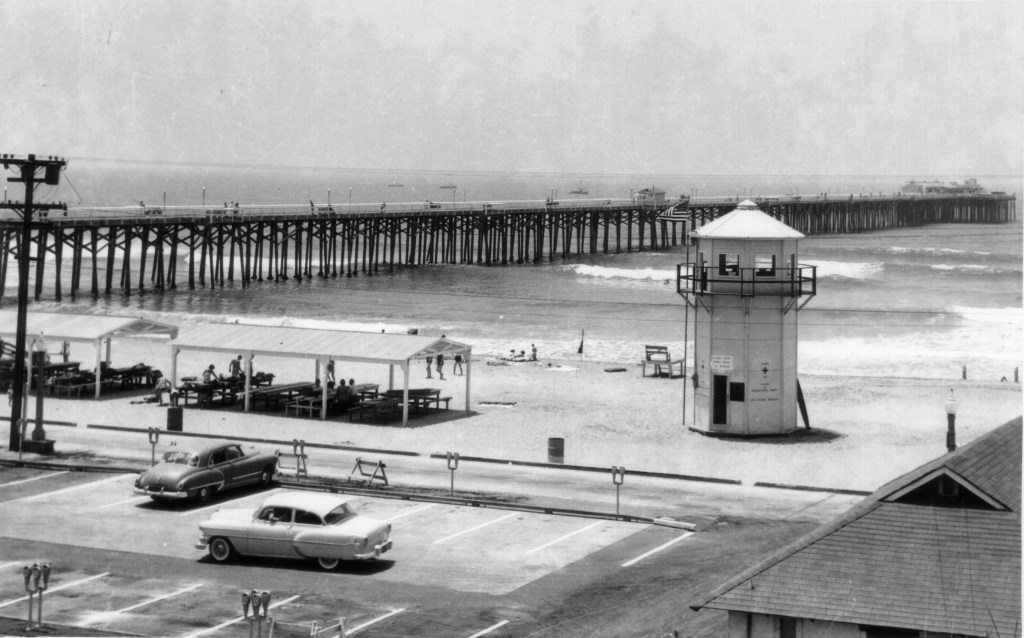
Fifth Pier built 1947 (Oceanside Historical Society)

The white-railed pier could take fisherman and pedestrians out farther than any of its predecessors.  A 28-passenger tram operated by the city could take guests out to the end of the pier and have room enough to turn around.  McCullah sportfishing took enthusiasts out to fishing barges anchored over the kelp beds a mile out. For years this pier stood longer than any other pier the city had built previous. 

California Dreamin’ … Oceanside’s beautiful 5th Pier (Oceanside Historical Society)

But piers do not last forever and after nearly 30 years, it was showing its age. In 1975 the pier was faced with closures after severe storm damage and in October, Public Works Director, Alton L. Ruden said that the “pier could collapse at any time, and it would cost more than $1.4 million to replace it.  Some morning we’re going to wake up and there won’t be a pier.  It can go in an hour.  It’s like a string of dominoes.  But it’s only during storms that it is dangerous and that’s why it’s closed, when necessary.”           

After nearly 30 years, it fell victim to the relentless storms. It was damaged in 1976 by heavy surf and then a fire at the Pier Cafe caused further damage. The end of the pier was open, vulnerable, angled to the north and had to be amputated.

The Oceanside Pier damaged by storms in 1978 (Oceanside Historical Society)

The pier was placed as “No. 1 priority in the redevelopment plans for downtown” but it would be over a decade before a sixth pier was built.

Funding of the pier came from the Wildlife Conservation Board, State Emergency Assistance, Community development, the State Coastal Conservancy and the Federal Emergency Management Agency.  The new pier proposed would be nearly 1,500 feet long and would include a restaurant, tackle shop, lifeguard tower and restrooms.  The total cost, including the demolition of the 1947 pier, was then estimated at $3 million dollars.

Oceanside’s Sixth Pier in 1988, photo by Lu DeLucy

In August of 1985 Good & Roberts, Inc. of Carlsbad was awarded the contract to restore the concrete portion from the 1927 pier. In early 1986 the construction contract was awarded to Crowely International of San Francisco, the same city that built our first wharf in 1888. The new pier was built 3 feet higher at the end than the previous piers.  This was because the waves do their greatest damage there.  By raising the end, the life of the pier could be extended.

Oceanside’s sixth and present pier was dedicated and formally opened September 29, 1987.  At a cost of $5 million dollars the pier was 1942 feet long and deemed the longest wooden pier on the west coast. Engineers said it could last 50 years.

Our pier is a beloved landmark. A wooden promenade out to the ocean that hundreds walk every day, thousands each year.  While there are other piers in a handful of coastal cities, our pier has been a testament to our resilience and determination.

The pier is synonymous with Oceanside. If history tells us anything, we can and will rebuild again. Will we see our seventh pier sooner than expected? If repairable, we will enjoy and appreciate this one for years to come. This isn’t the end, it’s only a new chapter in Oceanside Pier history.

History of Oceanside’s Fourth Pier

There’s a lot of buzz on social media about the Oceanside Pier. If you don’t already know, the current pier is Oceanside’s 6th pier, built in 1987 with a “life expectancy” of 50 years.

However, the concrete approach (steps and ramp that lead to the pier and beach) is nearing 100 years old and was built when Oceanside’s 4th pier was built in 1927.

The history of Oceanside’s fourth pier starts years before it was built. The third pier, built in 1903) had been damaged extensively by storms in April of 1915. The once 1,400 foot pier was now down to a little more than 800 feet.  Public sentiment for the pier was one of concern for the city’s beloved landmark and its importance in drawing tourists: “If the pier goes, with it goes all hope of the town having summer visitors.” 

1913 view of Oceanside from Oceanside’s 3rd pier, built in 1903

Later that year the Oceanside Blade reported that “Eighteen cedar pilings and six eucalyptus piles and other material arrived Wednesday for the repair of the wharf.  As soon as a suitable low tide arrives the piling will be put down to strengthen the places where the old rails are rusted through.” These repairs may have reinforced what was left of the Oceanside pier, but a new one was needed.

But before action could be taken, just months later in late January 1916, a devastating flood hit San Diego County, wiping out roads, railroads and bridges and killing several people countywide. Oceanside’s pier was the only way to get much needed food and supplies to residents and those in the surrounding area. Coal for the Santa Fe railroad was shipped in; The Swift Packing Co. sent several tons of meats for Oceanside and neighboring towns and the Pacific Coast Biscuit Co. landed about two tons of miscellaneous groceries and meats.  

Unloading freight and needed supplies after the 1916 Flood, (3rd Pier)

While the pier was a valuable resource during the flood and its aftermath, heavy equipment and cranes bringing the supplies to the pier caused damage, even making the pier lean to one side, forcing the closure of the pier for additional repairs after the emergency. 

Talk of a new pier was everywhere; letters to the editor; proposals and calls to action at city council meetings. With no consensus and no funding, no new pier.

However, a new pier was just within reach when George W. Houk, president of the chamber of commerce of Northern San Diego County, stated that he would donate up to $100,000 in matching funds for a new pier at Oceanside. Houk had made his fortune as a wheel manufacturer, and considered “the father of the wire wheel in America”. He even included this donation in his will which was written as follows:

My said trustee shall, subject to the conditions hereinafter mentioned, pay to the city of Oceanside, county of San Diego, state of California, such sum that may be necessary, up to, but not in excess of, the sum of one hundred thousand, ($100,000.) providing said city of Oceanside donates a like sum, and providing further that the said city builds within three years after my death with said money, a pleasure pier, the site to be selected by my trustee.  Upon the failure of the said city to perform said conditions, then the said sum shall be distributed with the residue of the trust property.

After Houk’s death on October 6, 1917 in Los Angeles, all of Oceanside was appropriately solemn but excited by the prospect of having a new pier. In anticipation, the Oceanside band was renamed the George Houk band in honor of the deceased benefactor.

Oceanside’s George Houk Band, 1917

Houk’s daughter, Mrs. Margaret Moody, promptly contested the will on the grounds that her father was not mentally competent at the time the will was written. She stated that in addition to the Oceanside bequest, her husband was to receive $100,000 on the condition he re-enter the army and attain the rank of captain within a good time! 

Oceanside, although somewhat discouraged, still made plans to go ahead and even invited Mrs. Moody and her husband to a concert on the pier given by the band that was named in honor of her father. The bequest was lost, however, in a decision handed down by the California Supreme Court in 1921. Oceanside would have to wait before its fourth pier was built.

Finally, in 1925 several designs for a new pier were proposed and the building of an all-concrete pier was considered. An election was to be held to vote for pier and beach improvements, but, the city council failed to pass the bond election ordinance.  Trustees E. W. Fairchild, Robert S. Reid and Ed Walsh voted for the ordinance that would allow a $100,000 bond issue for pier and beach improvements as well as fire equipment and water improvement.  Trustees George Dickson and Jesse Newton refused, saying that $100,000 was too much and that $75,000 was adequate. 

Voters angry that they were denied the opportunity to vote for the bond issue took measures to undertake a recall of Dickson and Newton. Still irritated, that when a $75,000 bond issue came to vote in September, residents rejected it with a vote of 330 to 207.

The following May, a petition with 726 names calling for an election to sell “not less than $100,000 in bonds” was filed and granted by the city council. Voters would get their chance at an election to be held in June, 1926.

The Oceanside Blade published an editorial in favor of the pier bonds and a plea to unite:

MAKE IT UNANIMOUS

For nearly two years Oceanside has been torn into factions and has been suffering daily injury because of a difference of opinion over the personalities of three or four of her citizens, and concerning the spending of $25,000.  The three or four citizens were all good men, and the $25,000 was but a comparatively small increase of a sum which practically everyone agreed must be spent for the replacement of the present pier and necessary improvements on the beach.

The stormy petrels in office are now gone since the election of trustees, and by the voluntary withdrawal of two of them in the interests of harmony.  A majority of the people have decided at an election, that in their judgment $75,000 is not enough for the needed pier and beach improvements.  We now are asked to vote for the proposed $100,000, a sum which is but $25,000 more than the amount that even the minority agreed was minimum.

It resolves itself into a question of whether or not the voters are prepared to defeat a very necessary improvement because of a mere difference of opinion over $25,000, a sum, which, when reflected in the taxes of a growing town like Oceanside will never be noticed, and by so doing keep alive the present controversy.

The Blade feels sure that to do so would be calamity, and so we say vote for the bond issue for a pier and beach improvements and MAKE IT UNANIMOUS.

On June 19, 1927, residents made their voices heard with a resounding decision: 685 to 94 in favor of the pier and beach improvements.

Plans began immediately, with Oceanside’s City Engineer, Ruel Leonard Loucks, designing a new pier which was presented to the city. 

Oceanside City Engineer Ruel Leonard Loucks, who designed the Oceanside Pier and The Strand

During the council discussion of the plans, Trustee Crandall asked about the “feasibility of supplying gasoline from the pier for pleasure boats.” Engineer Loucks replied that the proposed pier was not a commercial pier and it could not “withstand such use.”

The new pier is to be a pleasure pier pure and simple.  There is provided at the outer end a wider portion with a landing stage that may be let down to allow of receiving passengers from small boats when the condition of the sea will permit it, but as to any direct cargo or other commercial use such is out of the question.”

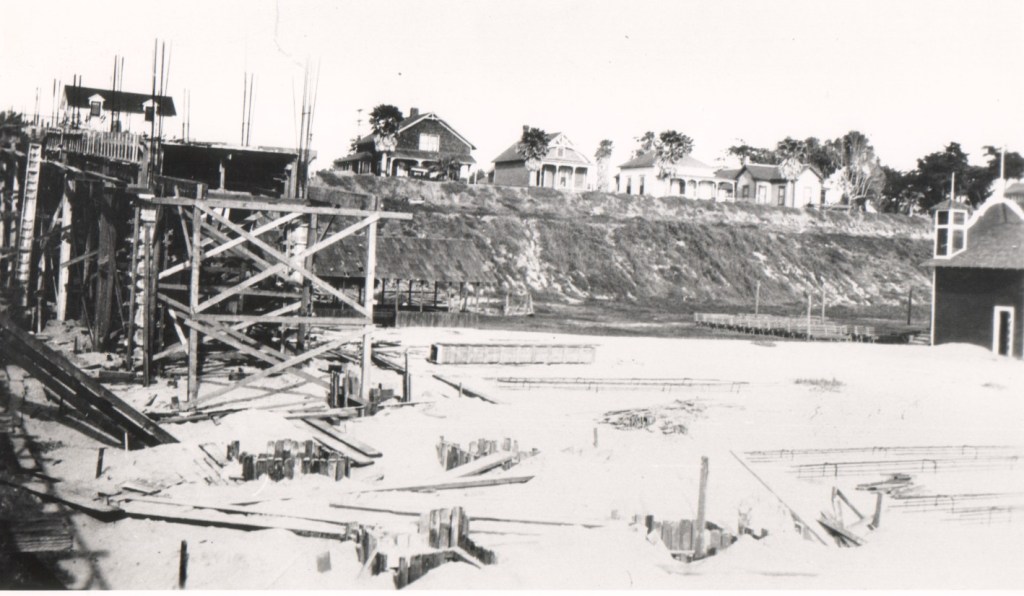
Sidney Smith of Los Angeles was the sole bidder in December of 1926, in the amount of $93,900. The bid was accepted and work began the same month.  Compromises were made as to the construction of the pier by building a concrete approach 340 feet long with the remaining 1,300 feet made from wood. 

Construction of the 4th Pier, 1927

The building of the new pier prompted other improvements including the paving of “The Strand”, also designed by Engineer Loucks. On January 12, 1927, it was reported that the city council approved the plans for the construction of a “concrete paving and driveway along the beach from Wisconsin street to Ninth street, a distance of nearly a mile.  This will have on the seaward side a concrete curb and will be lighted for the entire length, the plans calling for the installation of ornamental lighting posts for the entire distance.”

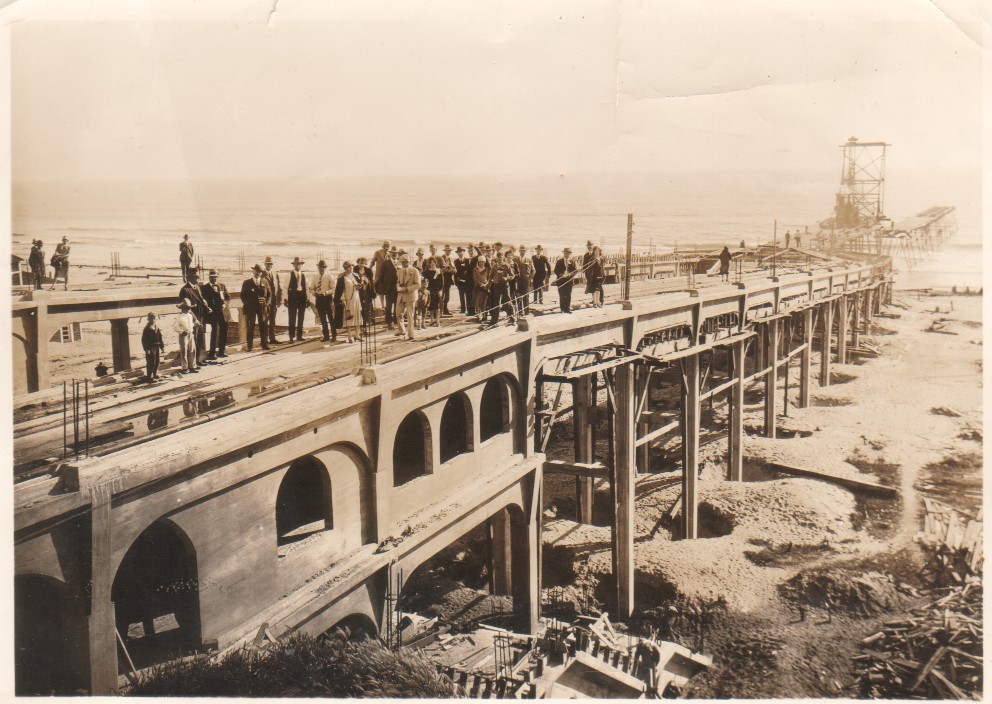
Officials gather on the cement approach as construction of the pier continues, 1927

Progress on Oceanside’s new pier went quickly. In April of 1927 it was reported that the pier would be finished in time to celebrate Independence Day.

Just two months before the pier would be complete the Oceanside City Council published the following announcement: announced:

“To the people of Oceanside, who, for the last five months have critically watched all the details of construction of the new pier it is not necessary to point out the completeness of the finished structure. This pier will stand for years to come, a monument of classic beauty, utility and permanence and be the pride and honor of the city.”

Crowds gather at the opening of the 4th pier, July 4, 1928

Over the Fourth of July weekend in 1927 Oceanside’s fourth pier was dedicated.  The celebration brought thousands of people from all over Southern California with the pier being the focal point of the festivities. Newspapers reported that 25,000 people came to Oceanside to celebrate those Independence Day festivities, at the time when the city’s population was just 3,500 residents.

Crowds line the Oceanside pier’s concrete approach or “bridge”

Oceanside’s fourth pier lasted nearly 20 years. However, in 1943 it was badly damaged due to storms. In addition, the weight of a Navy Observation Tower built as a lookout during World War II, was blamed for the weakening of the pier.  By the mid-1940s it was undermined to a point where its safety was questioned, prompting the need for yet another new pier. Oceanside’s fifth pier would be built in 1947.

Today, plans have been approved to rebuild the concrete portion (now called a “bridge”) keeping to Engineer Loucks’ original 1926 design. The current bridge or approach is coated with decades of paint which has changed its appearance from its original “art deco” look and its smooth gray concrete finish.

This photo captures the original beauty of Loucks’ design, 1927

So what is old becomes new again.

And as a reminder: As we “critically watch” (and sometimes complain on social media) “The pier has stood” and when rebuilt, “will stand for years to come, a monument of classic beauty” and may it ever be “the pride and honor of the city.”

The History of Oceanside’s 2nd Pier and the Promise of Gold

After the demise of Oceanside’s first wharf in 1890, the beach was covered with its debris. Rather than let the lumber float away, or rot in the sand, Melchior Pieper, proprietor of the grand and beautiful South Pacific Hotel, began collecting the pilings and planks. He loaded them up on wagons and stored the material behind his hotel. Pieper even stamped his initials on the pilings and lumber.

What was his intention? He was looking to build interest and financial support for a new wharf to be built at the end of Third Street (Pier View Way). It would be beneficial to have a wharf at that location, attracting more business and more guests to the hotel, which was located just north of Third Street, but also moving the pier to a more central location in Oceanside’s small downtown.

The South Pacific Hotel. Melchoir Pieper and wife standing center.

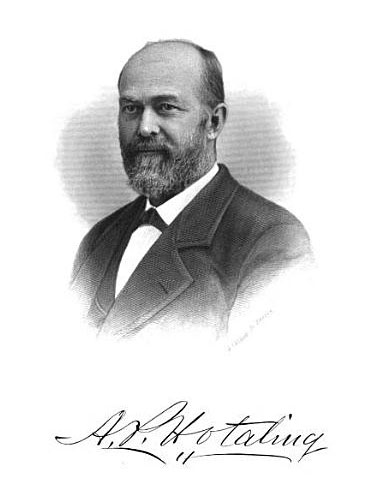
Determined, Pieper even traveled to San Francisco in December of 1893 to meet with Anson P. Hotaling, owner of the South Pacific Hotel, (as well as considerable property throughout the city and South Oceanside) to attempt to persuade him to support the building a pier that would be beneficial for the hotel.  Pieper’s trip was successful, as Hotaling agreed to support the construction of a wharf. 

In April of 1894 a committee was formed and plans for the new wharf began. There was some resistance against the Third Street location, (a site between Second and Third was favored), but with Hotaling donating $350 and Pieper donating $100 and offering to board the workmen free, the disagreement was set aside.

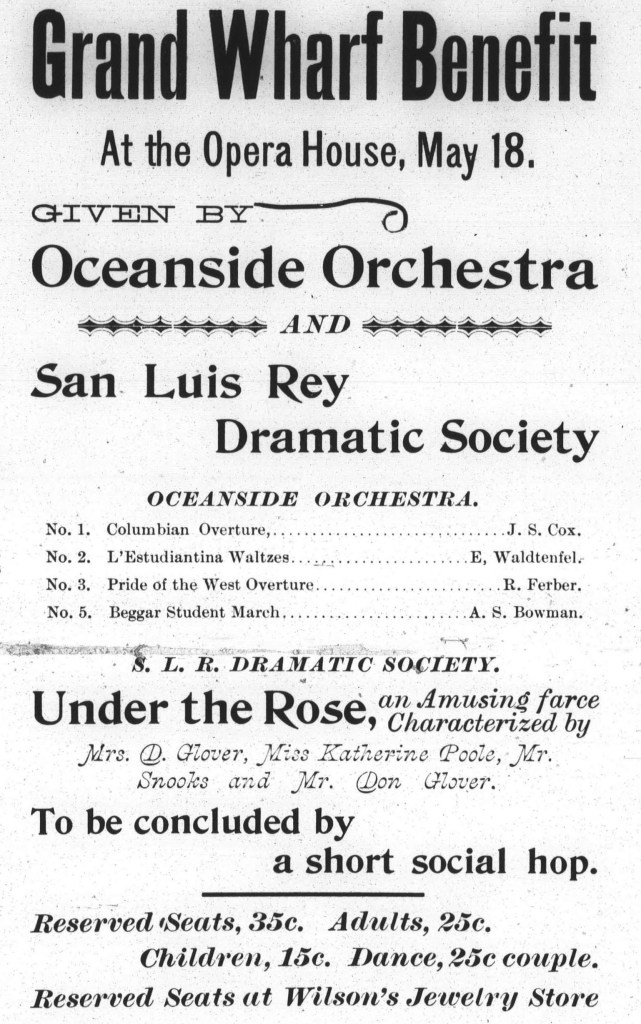
Modest fundraising began with the Oceanside Silver Cornet Band holding a benefit ball at the Oceanside Opera House.  Tickets were just a dollar but the Benefit, hailed as a success, and raised $50 for the wharf fund.

Oceanside’s Silver Cornet Band played at local events, including the Wharf Benefit Ball.

Specifications for the new pier were listed in the local paper: “The wharf will be 400 feet long from high water mark, 12 feet wide, and four inch iron pipe will be used for piling, which will be strongly braced.  It will be floored with two inch planing and a wooden railing of 3 x 4 material will surmount it.  The entire length from the bluff will be about 600 feet.  The total cost will be about $1200.

By June over $1,000 was pledged and two weeks of labor donated. John A. Tulip, a member of the wharf committee, persuaded a resident in joining him in digging the first hole for one of the pilings to be used in the wharf’s approach.  Within days several bents and stringers were put in place and 200 feet of the approach were ready for flooring.

In June the wharf committee ordered 440 feet of iron pipe, which arrived from St. Louis in August.  In September of 1894 the Oceanside Blade reported that, “Work on the wharf is at last underway.  An overhang derrick, as it is called, has been constructed by Mr. Cook, the piles have been asphalted, the joints been banded and strengthened and the work of putting them in place begun.”

Work was done quickly, largely due to the diminished length of the new structure. Oceanside’s second pier was known as the “iron” wharf because of the iron that braced its pilings. When finished, the little iron wharf measured at a modest length of just over 600 feet. 

The new pier was not without its hazards, as there was no railing added for the safety of fishermen, pedestrians and especially small children. Even after a railing was added in February of 1895, there is some speculation as to how really safe it was.

The Oceanside Pier in 1894, note the rear of the South Pacific Hotel faced the ocean.

In August of that year 14-year-old Fannie Halloran was a near victim after she fell from the pier, as the Blade reported: [Fannie] “while fishing on the wharf last Saturday, caught a fish and in trying to land it got the line fastened about one of the pile, and, in leaning over trying to get it loose, lost her balance and took a header to the water below, a distance of about 14 feet.  She had learned recently to swim, immediately applied her knowledge in the direction to getting ashore, which, with some assistance from her father was easily accomplished.  No injury resulted, but quite a different report would no doubt have been the result had the young lady not exhibited great coolness and presence of mind.”

Still, Oceanside’s new wharf was popular with residents and visitors as the Blade noted, “A great many people from the back country are enjoying fishing from the wharf here. It is a great attraction and the best investment the people of this place ever made.”

Additional view of the “little iron wharf” in 1894. Note the bathhouses on the beach.

But noting that the approaching Independence Day celebration and festivities it also added: “We should not forget the wharf, and its further extension into the Occident.  [The] wharf is an investment that is an all-the-year standby. It will bring people as no other attraction here will or can.  Fishing is almost a passion with many, and from observation often confirmed, it is–by virtue of the little iron wharf at the foot of Third Street–a source of the only meat supply of many others. But its length will not warrant many persons fishing at once, and for boating facilities, for the same cause, it affords none.  The season should not be permitted to go by without extending it at least 200 feet further. As an investment to the town it is worth ten celebrations.”

That July 4th celebration in 1895 was a success but only highlighted the need for a longer pier, prompting a meeting by city leaders: “Dr. Nichols explained the call of the meeting to be for the above purpose and gave estimates which he had carefully compiled, based upon what work and expense had already been done.  The amount necessary to extend the wharf two hundred feet further would entail an expenditure of close to six hundred dollars.  He went on to state in his most eloquent fashion, the large benefit the wharf had already been to the city of Oceanside and that there was an assurance of a large number of families who would spend the summer here, and the cause of this was that Oceansiders were awake to the fact that to get the people from the hot interior towns to spend the heated, term, here, that inducements in the way of a pleasure and fishing wharf was an absolute necessity in connection with our natural inducements of climate, location, etc.

Talk continued to extend the wharf, one hundred, two hundred and even three hundred feet but nothing was done because of lack of funding. However, on September 17, 1896, Matthew W. Spencer and Melchior Pieper, members of the wharf’s Executive Committee, officially deeded the pier to the City of Oceanside.

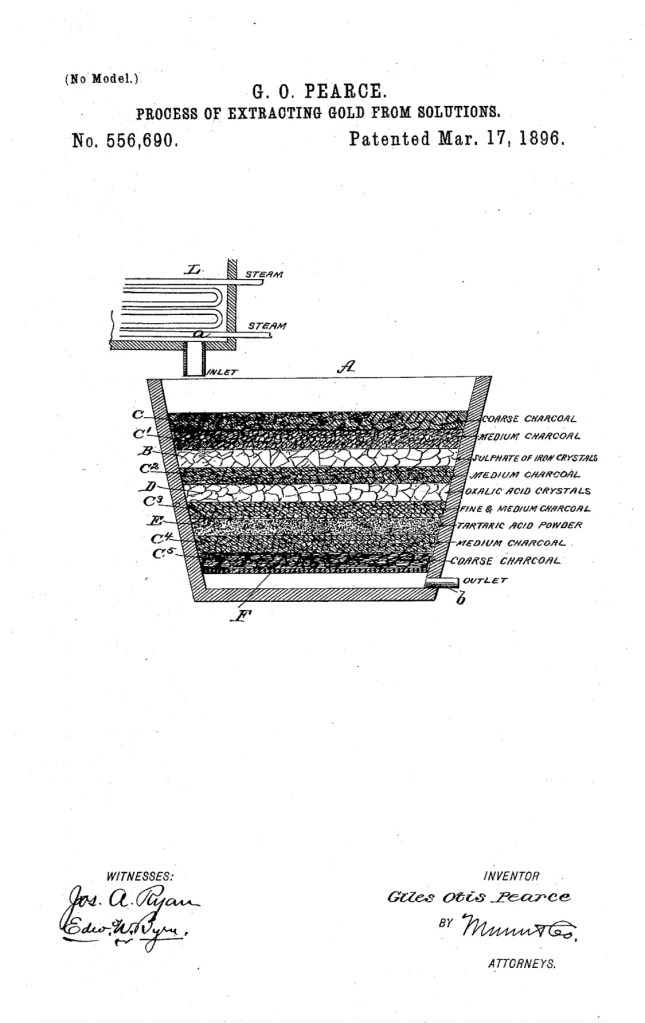
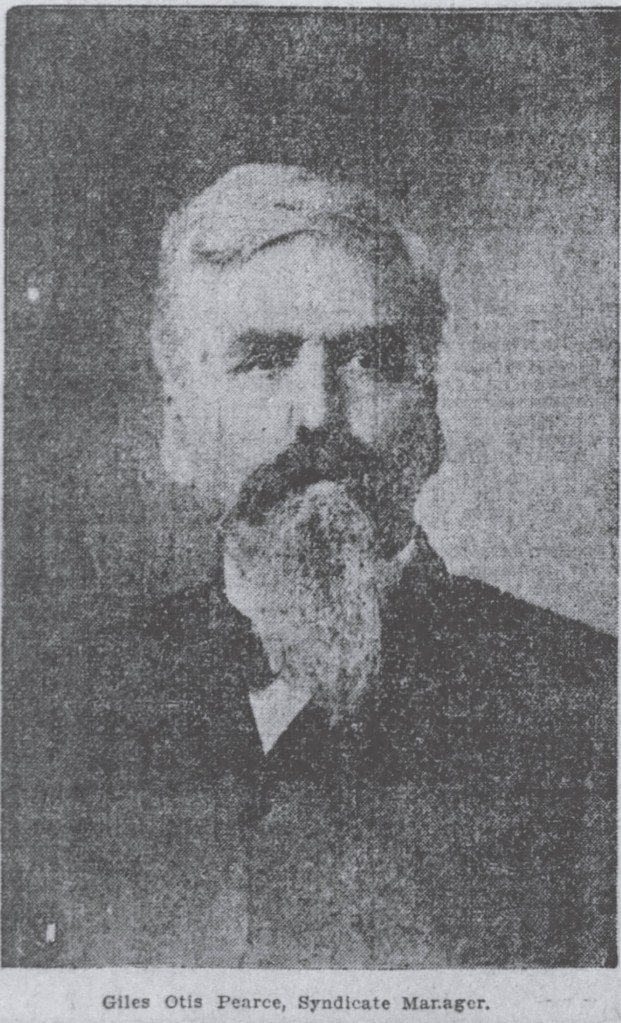
In May of 1897, Giles Otis Pearce, a self-described “assayer, metallurgist and mining expert” from Colorado, collaborated with Oceanside inventor Wilton S. Schuyler, son of businessman John Schuyler.

Wilton S. Schuyler, circa 1948

A legitimate inventor, Wilton actually designed and built an early automobile in 1898 which he called the “Oceanside Express.” He received a patent for the vehicle in 1899. He then invented and patented a “wave motor” which Pearce wanted to use for a dubious method to extract gold from the ocean after it was affixed to the Oceanside pier.

A detailed and lengthy article from the Oceanside Blade explained, in part, how it was supposed to work: “Mr. Pearce is the inventor and patentee of a process for extracting gold from the waters of the ocean, which are said to contain, in solution, four cents of gold to every ton of water.  By the use of chemicals the gold is precipitated and caught in a deposit of charcoal in the bottom of a barrel or other receptacle. The cost of elevating the ocean brine into such receptacles has been the chief difficulty in the way of a successful solution of the question.  It is believed that the Schuyler wave motor will accomplish the desired result.

“From each barrel, filled and refilled the proper number of times, it is claimed by Mr. Pearce that $153 gold per year can be saved.  He also claims that every cubic mile of sea water contains $65,000,000 in gold.  It is understood that negotiations are under way whereby the two patents will be consolidated.  His patent is controlled by the Carbon Gold Precipitant Company of Colorado.”

While the extraction of gold was questionable, Schuyler’s invention may have been ahead of its time: “A test machine will be put in during the present summer. It is hoped it will prove a success, and that the almost unlimited power of the ocean breakers at our door will be turned to account.  If this can be done, electric lights, manufacturing, water galore for irrigation and every other purpose, a railroad up the valley, all will come as a result of the capital that will surely follow the demonstration.”

The city council granted permission to use the wharf for “scientific purposes”, and to “erect such machinery necessary for the purpose of extracting gold from the ocean, such machinery not to interfere with the travel on same.”

Giles Otis Pearce may have been one of the first to perpetuate this ruse and claim he could extract gold from the ocean but he wasn’t the last. In 1898 Prescott Ford Jernegan claimed to have invented what he termed a “Gold Accumulator” that could extract gold from seawater using a process with “specially treated mercury and electricity.” His hoax was exposed and he was sued by investors.

Schuyler’s wave motor seemed to be a legitimate apparatus but its use to extract gold brought expected skepticism. The editor of the Escondido Advocate newspaper challenged the veracity of the editor of the Oceanside Blade to publish such claims: “The article states that Giles Otis, a mining expert, who has patented a process for precipitating the gold in ocean water, was in that city last week consulting with John Schuyler, who has patented a wave motor, and these two will join issue and put in an immense plant at Oceanside. It is estimated that each ton of ocean water contains five cents in gold or $65,000,000 for every cubic mile. It is proposed by the parties interested to handle about a cubic mile of ocean water daily, and with the surplus water power which is as unlimited as the confines of the ocean, a system of electrical power will be put in along the San Luis Rey for pumping plants and the entire country is confidently expected by be submerged under twenty feet of water by the first of October.  They then will have electric lights and street railways for Oceanside with all kinds of manufacturing industries to follow.  Ed, we take off our hat and unanimously vote you the greatest prosperity liar of the age.”

Giles Otis Pearce was a litigious eccentric. He filed dozens, if not hundreds of lawsuits, including the estate of Theodore Roosevelt. If he lost a suit, he promptly filed an appeal.

Born in 1851 in Muscatine, Iowa, Pearce was well known for his wild claims, and considered a “crank” by locals. He changed, or rather, collected, occupations including printer, journalist, assayer, chemist, smelter, and lawyer. He served as a private in the Ohio Calvary from 1872 to 1873.

In 1885 Pearce ran for governor for the territory of New Mexico. After President Grover Cleveland appointed someone else to that position, Pearce sued the government. In 1886 he claimed to be under the influence of spirits, threatening the lives of family members. He was placed in an asylum in Endicott, Nebraska, but escaped. In 1890 he was “judged insane but harmless” and allowed to retain his freedom as long as he “behaved” himself.

After moving to Colorado, he disputed the recorded height of Pike’s Peak and said that he had determined the actual altitude, which upset and angered locals. He then claimed to have the capital and means of driving a 17 mile tunnel through the Rocky Mountains, at an expense of $25 million. He did not win over any support for his claims and the residents of Cripple Creek asked him to leave. After leaving Colorado, Pearce made his way to Yuma, Arizona, San Diego and then to Oceanside.

But before Schuyler’s wave motor and Pearce’s gold extraction device could be put to the test, the pier needed to be extended and that would take another year.  It was extended one hundred feet into the Pacific but it was far too short to provide “boating facilities.”

In June of 1898 work on the pier continued and the Blade provided this update: “Things are progressing nicely toward finishing the wharf.  The money will be available in a few days and next season will find us provided with good boating facilities. It is suggested that the work of superintending further extensions be placed in experienced hands so that our pier may be a thing of beauty instead of bearing a resemblance to a tortured snake.”

In October of that same year, Schuyler had placed his wave motor on the pier and demonstrated that it would in fact pump water “in sufficient quantities to warrant the putting in as an experiment of a Pearce filter for extracting gold from sea water.”

However, little to mention of gold extraction and/or Giles Otis Pearce was made after that time. The experiment was apparently abandoned.

Pearce left for Los Angeles where he married (for a second time) to a 21-year-old woman (he was 49) in June of 1900. Just months later during a contentious divorce he declared publicly that his wife was insane. He tied her up to keep her from leaving him and then made a complaint to law enforcement that his wife’s aunt was trying to have him killed and insisted that she be arrested.  Pearce died in 1924 at the age of 73 in the National Soldiers Home in Los Angeles. His hometown newspaper noted his passing and his “eventful life.”

From the San Francisco Call, February 18, 1906, page 39

On November 9, 1898, the board of city trustees met in adjourned session, where it was reported that the wave motor on the wharf was “straining that structure and Trustees Paden and Nicholas were appointed a committee to investigate and report on same.”

A year later the pier had still not been extended. In November of 1899 the Oceanside Blade published a plea to citizens to step up or see the second pier face the same demise as the first: “While the necessity is apparent of finishing our wharf in a substantial manner and extending it enough to make a good boat landing, the necessary lucre is not in sight as yet.  We should be glad to publish suggestions or communications from any of our citizens, on the subject.  Something should be done or we will wake up some fine morning after a storm and find the present wharf not present, so to speak.  In other words washed away…defunct.”

The Pacific Ocean continued its assault on Oceanside’s little iron wharf until a new pier was built in 1903.

View of Oceanside looking east from the South Pacific Hotel, circa 1890

History of Oceanside’s First Pier

Oceanside’s Pier is iconic, a favorite landmark and one of its most photographed and visited features. Untold thousands enjoy Oceanside’s pier every year.  Fishermen, tourists and locals stroll along the wooden planking and gaze into the ocean, just as Oceanside’s early citizens did over 130 years ago. Oceanside’s pier is a tradition, one that despite relentless waves, high tides, low funds managed to survive.

Remnants of our first pier are now buried. An occasional storm or low tide uncovers the rows of the old, weathered pilings (or what’s left of them). In fact, they just made an appearance in 2020. Few people know they are there or realize their significance.

Pilings from the first pier at the end of Wisconsin Street in 2012

The first pier, called a wharf, was located at the end of what is now called Wisconsin Street, first named Couts Street (after Cave J. Couts, Jr., surveyor of the original townsite).

Talk of a wharf began in 1887 when soundings were made. This was no “pleasure pier” for sightseers but intended to be a shipping port with a price tag of $30,000. The National City Record reported that the wharf would be 1,596 feet long, 50 feet wide and would accommodate “vessels drawing 25 feet of water.” If that wasn’t impressive enough, it went on to say that the wharf would be connected to the railroad! A color lithograph done in 1887 depicts the railroad spur leading to the pier “with a turn-around track for cars” and a large ship docked at the wharf.

Portion of 1887 Lithograph depicting the railroad spur on the wharf (which never came to be). Photo from the Oceanside Historical Society Collection

On March 9th the South Oceanside Diamond reported: “Our citizens are determined to have a wharf. The plans have been drawn, money subscribed and it ought to be completed by July 4th.”

A year later, plans were drawn up for a more modest structure, without the railroad spur. The San Diego Union published the following: “A contract has been closed by the Oceanside Wharf Company, of Oceanside, for the building of a pier wharf at that place. It will be 1505 feet in length, will command a depth of 31 feet and the piles will be covered with parafine paint and felt, and will be braced by iron sway bracing. The estimated cost of the structure is $35,000, and it is contracted to be completed in four months.”

Everyone was overly optimistic but the first piling wasn’t even driven into the sand until May 12, 1888. The new date for completion was extended to September.

Oceanside was a boomtown then – real estate speculators came in and bought large lots with the hope of becoming rich. Men with big ideas and great plans for the city poured in. Some left as quickly as they came, while many stayed and made decisions and impressions that are with us today.

One of these men, Col. Daniel H. Horne, Oceanside’s first president of the Board of Trustees, along with banker Charles Morrill, proposed enterprising, if rather lofty ideas. They made rousing speeches of the future of Oceanside. They talked of the train, a Flume Company and the building of a wharf.  Real estate agent J. Chauncey Hayes advertised one would be “wearing diamonds” if they invested in the local real estate. Men like Hayes, Horne and Morrill supported the wharf and even backed it financially. Supporters of the wharf claimed that Oceanside would rival San Diego, Los Angeles and San Francisco with the help of a wharf. Citizens rallied, eager to help. They pledged labor and money for the wharf project that would bring them wealth and prosperity.

The wharf fund was raised by subscription. $28,000 was pledged by Oceanside residents and businessmen. The amounts ranged from $10 to $5,000. One year later, however, less than half of these pledges were paid and citizens were urged to “step up” and pay their subscriptions.

The lumber for the wharf came by railroad but also by boat. It was floated to the shore and guided by skiffs. But it was not without trouble. On June 29, 1888 the South Oceanside Diamond reported: “The sea has been unusually high the past week and the Starbuck has been unable to land any lumber. On Wednesday the water ran so high that not even a boat could cross the breakers, and the Starbuck’s crew stayed beyond them. Bob Simpson, the champion swimmer, carried a message to the boat through the surging sea.”

Delivering the lumber was a slow process. Two weeks later the Starbuck was still delivering wharf materials through the surf “slowly but surely”. By June 20, 1888 work finally began but a new completion date of December 1st was announced.

The building contract was given to the Great American Bridge Company of San Francisco and its superintendent was J.P. Sheldon.  By August 3rd the wharf was out 500 feet and fishing from it became the favorite pastime for residents.

The Diamond reported that another ship, the Olive S. Southard, had “unloaded 15,000 feet of lumber and 258 piles, which completes the amount of lumber required for the wharf.” Soon the wharf was stretching out at 1,000 feet.

Surely shipping vessels would be docking soon, people thought. With a wharf the costs of goods such as badly needed lumber would be reduced. Oceanside would become an important shipping port between Los Angeles and San Diego. Fifteen trains a day pulled into our train depot – count would soon begin of the steamers arriving at the wharf.

By the end of August the wharf was out 1,340 feet. However, the wharf company ran out of “silver-coppered nails” and work was been suspended for 60 days. In October the wharf sat unfinished, out of nails and out of money. The South Oceanside Diamond printed the following poem:

The Wail of the Wharf

Alone I am left, half clad in the cold; My long feeble legs are bare to the wave.

The reason is, I suppose, no shares have been sold. And slowly I’ll find me a watery grave.

I haven’t the piles, as some people think, nor is it the climate that’s breaking me up;

My lungs are first rate but the needful chink those doubting shareholders will not put up

Another setback occurred in December of 1888 when a storm swept pilings and planks from the Oceanside pier and lumber was washed down to Carlsbad.  Few people know that Carlsbad also had the makings of a small wharf, but the storm did greater damage to the Carlsbad wharf and it was completely destroyed. Unsympathetic, Oceanside citizens went to the beach and gathered the lumber from the Carlsbad wharf and used it for firewood!

Still determined, despite damage to its own wharf, Oceanside rallied and residents pledged 260 days of labor and donated a modest amount of money to finish the project. W. D. Frazee offered to begin work on the wharf each morning with much needed prayer.

The completion deadline came and went. Wharf lumber was being used as a boardwalk to the South Pacific Hotel from the train tracks rather than for decking. “When will the wharf be completed?” was a question echoed in the columns of the newspaper and on the streets of Oceanside.

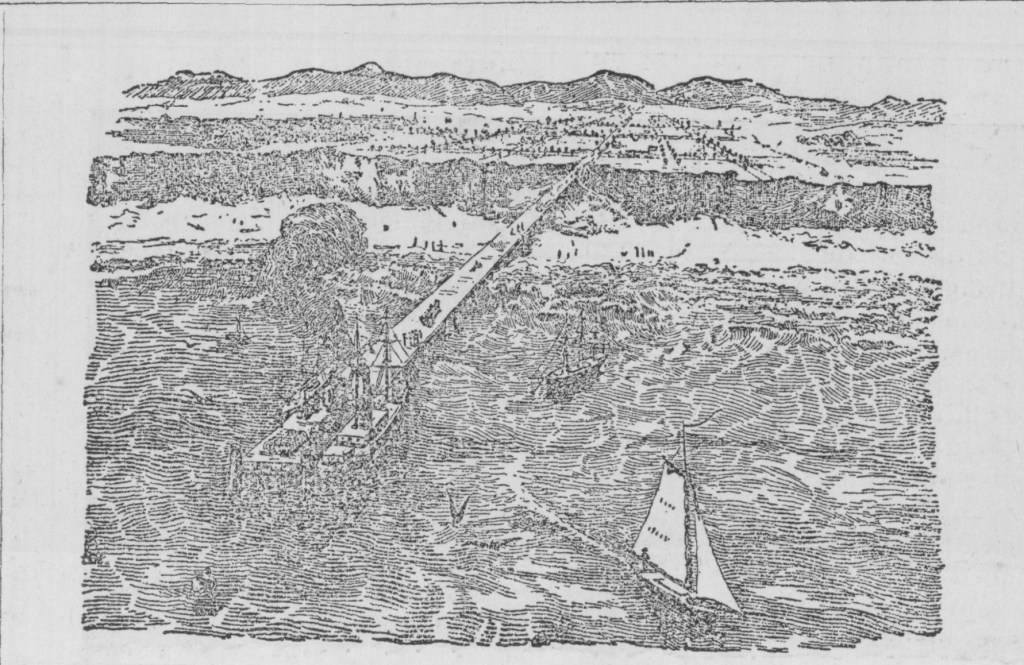
The February 1, 1889 edition of the South Oceanside Diamond ran a sketch of the wharf as it would appear by the new deadline: September, 1890! But bit by bit, the wharf was being whittled away by heavy seas. The portion remaining intact was said to “answer one purpose admirably–that of a barnacle roost.”

Sketch of the proposed Oceanside Pier from the South Oceanside Diamond newspaper

Optimism, although dim, remained. In April of 1889 the wharf was scheduled for repairs and was going to be braced and the talk of steamers began once again. In August Oceanside asked its citizens to raise an additional $4,000 and promised the wharf would be completed within 40 days when work commenced.

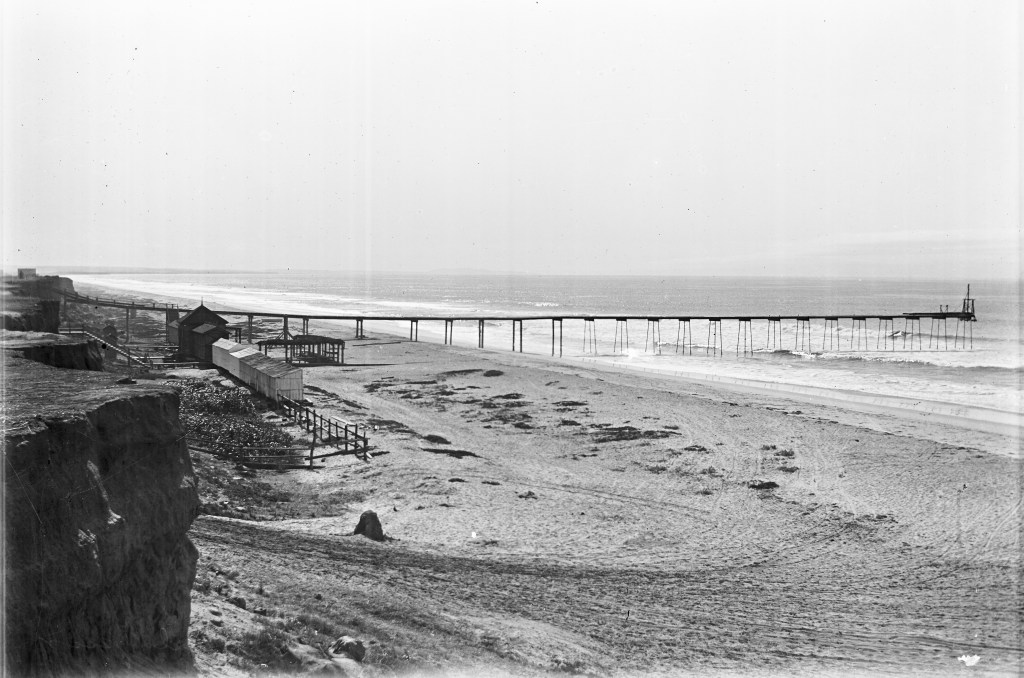
Only known photo of Oceanside’s first pier taken July 4, 1890. You can barely see it in the distance. Photo from the Oceanside Historical Society collection, courtesy Randy Carpenter.

Records are missing and it is unclear as to if Oceanside’s wharf was ever completed but winter storms had reduced the wharf to 940 feet.  On December 30, 1890 the final blow was dealt when the furious storms finished what was left and swept away all but 300 feet of the wharf. Newspapers from Los Angeles to San Diego reported its demise.

Oceanside’s first pier was gone but the dream was not forgotten. The wharf had become a fixture for the tiny town. If shipping vessels couldn’t dock, the wharf served another purpose, a fishing and pleasure pier.

Talk began immediately of building an iron wharf. It would take four years, but eventually Oceanside’ second pier was built at the end of Third Street (Pier View Way) in 1894. 

Oceanside’s 2nd pier, under construction in 1894. Photo from the Oceanside Historical Society collection.

Over the years we have had six piers, with our present pier being dedicated in September, 1987. We are proud of our beautiful pier. We are equally proud of the citizens who have persevered and have dared to dream. Oceanside has always loved its pier and it would not be the same without it.

The next time you walk the Strand, stand at the end of Wisconsin Street and look. During a low tide you might just catch a glimpse of those pilings. The pilings are placed 29 feet apart, (which would have provided a rather narrow decking) and a row of center pilings helped to brace it. Ten pilings were visible on June 7, 2012 at a minus 1.2 tide. They appeared again a year or so later. On June 25, 2020, the low tide exposed the pilings again.

Those worn down nubs of wood are all that is left of Oceanside’s first pier, but they represent the ambition and undying vision of Oceanside.

Close up of pier piling in 2012