History Uncovered: The Mystery of Ida Richardson of Rancho Guajome

I was recently asked about Ida Richardson of Rancho Guajome. Who was she? Who fathered her children? Where did she come from? These are some questions that have been asked for decades. Little to nothing could be found about her but after I found a few small clues, the hunt was on. What I discovered through vital records and recorded documents answers those questions and more.

Rancho Guajome, owned by the Couts family for nearly 100 years, Oceanside Historical Society

Ida K. Richardson, who would inherit the Rancho Guajome in Vista, California, from Cave Couts Jr. after his death in 1943, was often referred to as his housekeeper or secretary. Others have suggested that she was his common law wife. Some historians believe that Couts fathered her two children, Belda and Earl. Because of this assumption, it is often cited that the historic Rancho was passed down to his “descendants.”

But were Belda and Earl really the offspring of Cave Couts, Jr., the “Last of the Dons”? What was the relationship between Ida and Cave? Who was the father of her children?  Perhaps history will need to be rewritten as those questions now have answers.

Ida Kunzell Richardson was born June 3, 1898 in Ventura, California to William K. Richardson and Ida Kunzell Richardson. Her father was born in Leavenworth, Kansas and her mother in Germany. The couple were married October 14, 1897 and the Ventura Free Press published their marriage announcement under the headline “Married Before Breakfast.”  

Thursday morning, Reverend E. S. Chase, pastor of the Methodist Church was called upon to tie the nuptial knot making Mr. William K. Richardson of Randsburg, Kern County and Miss Ida Kunzell of this city, man and wife. The ceremony was performed before breakfast in order that Mr. and Mrs. Richardson might take the early train for their home at Randsburg.”

William King Richardson was 35 years old who worked as a miner. Ida was 25. (Their daughter Ida was born just 8 months later.)

While the newlyweds may have made their home in Randsburg, a mining town in Kern County, it appears they eventually returned to Ventura. Just 11 days after baby Ida Richardson was born there, her mother died, on June 14, 1898.

Ventura Free Press June 17 1898

Little Ida went to live with her maternal aunt and uncle, Minnie and Smith Towne, while her father returned to Kansas. When he died in 1948 his obituary mentioned his only survivor was a daughter living in California. It is unknown if Ida ever saw her father again.

Ida was raised by her Aunt Minnie and her uncle Smith D. Towne, who was a blacksmith. In 1910, he and Minnie, along with their son Frank and niece Ida were living in Pasadena. 

In early 1912 the Towne family, along with Ida, moved to Strathmore, Tulare County, California. Sadly, soon afterward, Ida’s aunt and surrogate mother, Minnie Kunzell Towne, died February 21, 1912. The Tulare Advance Register published her obituary:

“Mrs. Minnie Towne, wife of S. D. Towne, who resides 8 miles west of Tulare, passed from this life this morning at 2:30 and the funeral will take place tomorrow afternoon at 1:30 from the Goble undertaking parlors. The body will be shipped to Oakland for cremation. The deceased was 47 years, 11 months and six days of age and was born in Germany. Mr. Towne and his wife are newcomers to this section, having recently come from Los Angeles.”

Ida Richardson was not yet 14 years old when her Aunt Minnie died. She continued to live with her Uncle Smith Towne and local newspapers referred to her as Ida “Towne.” She and her cousin Frank attended high school in nearby Porterville. 
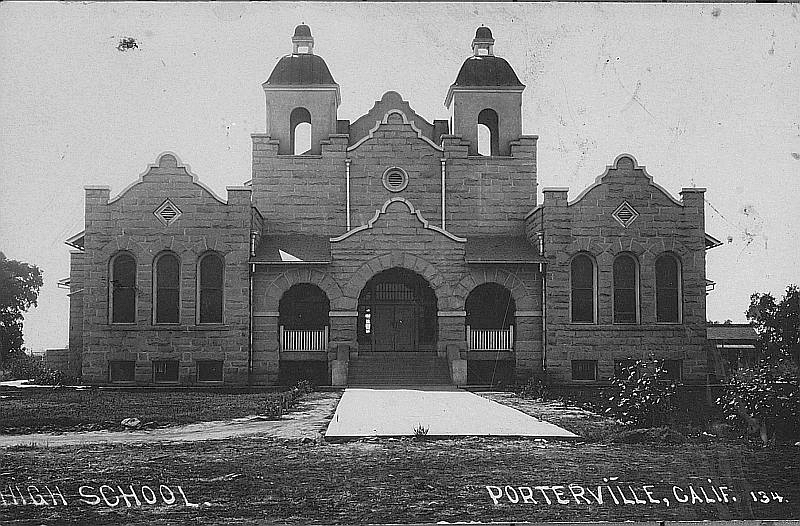
Porterville High School in Porterville, California where Ida Richardson attended school in 1916

While in school Ida was noted for her writing skills. In 1916 she came in 2nd place for an essay entitled “Alcohol and Tobacco”, a piece on the dangers of such, for the Porterville Woman’s Christian Temperance Union (WCTU). The organization campaigned against alcohol, advocated for abstinence, and also supported women’s suffrage. Ida won $2 for her writings. Another essay she wrote that year, called “Peace and War” about the futility and despair of war, was published in the Porterville Recorder May 15, 1916. She graduated from high school in June of that year.

Ida was included in several of the personal notes and columns in the newspaper, which included her trips to the mountains or visiting friends.

On Monday, May 7, 1917 readers of the Porterville Recorder would read that a Fred C. Wehmeyer of Success (another small town in Tulare County) had left for Los Angeles to get married. It was reported that his bride was “a Strathmore woman.” Who was Wehmeyer’s bride?

The newspaper revealed two weeks later that “Mr. and Mrs. F. C. Wehmeyer of Success, who returned recently from a wedding trip to Southern California, were given a merry charivari by their friends a few nights ago. Mrs. Wehmeyer was Mrs. Miss Ida Towne of Strathmore.

The following morning, a correction was published in the newspaper stating “It was Miss Ida Richardson of Strathmore, and not Miss Ida of Towne, who became the bride of F. C. Wehmeyer of Success recently.” Ida, who was raised with the Townes, did not mind to be included under the Towne family name for years, but her legal name of Richardson was used for her marriage and the clarification was made and noted.

The Los Angeles Times published a list of marriage licenses issued on May 7, 1917 which included Fred and Ida’s. Fred was listed as 44 years of age, while Ida’s age was 23. However, Ida was just a month shy of her 19th birthday and Fred was actually 56, near her father’s age.

The couple may have intentionally tried to disguise their age gap on the marriage application. Subsequent census records, however, were consistent with Fred’s birth year of 1861.

Frederick Christian Wehmeyer was born February 21, 1861 in Elkhart, Indiana. He first married Annie Bowlan in 1887 in Fresno, California. They had one son, Frederick Francis Wehmeyer, born in 1888. The two divorced and his son presumably stayed with his mother.  (He was later living with an aunt in 1910.) Fred C. Wehmeyer remarried in 1896 to Lena Rogers, who died in May of 1916.

Frederick Christian Wehmeyer

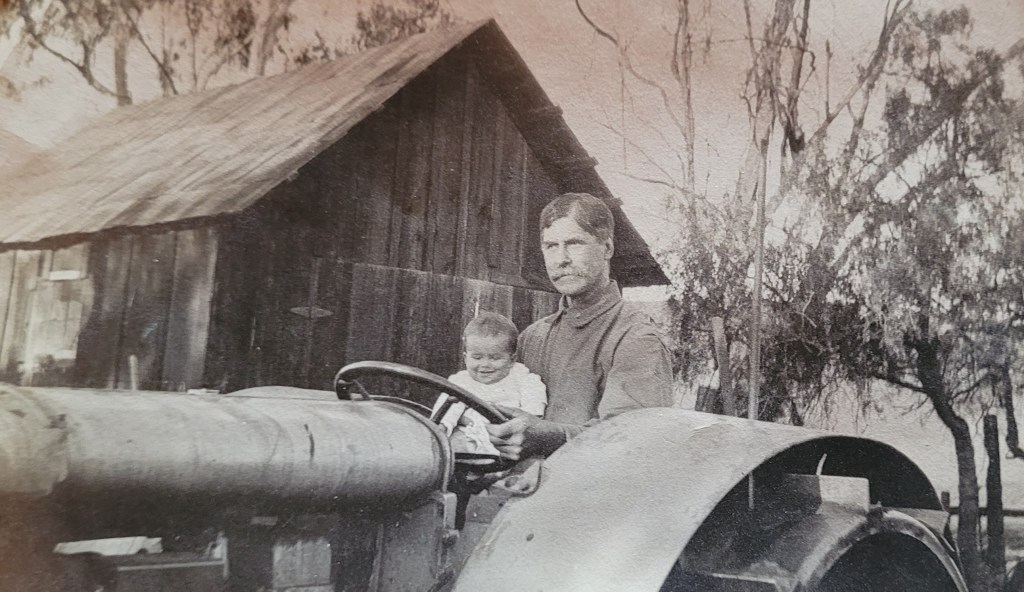
By the summer of 1919, Fred and Ida had moved to Vista, California and were living on or near the historic Rancho Guajome where Fred was working as a farmer.

Rancho Guajome is an important historic landmark in San Diego County, once the home of Col. Cave Johnson Couts and his wife, Ysidora Bandini. The rancho was given to the couple as a wedding gift. Couts designed a large Spanish-style ranch house built by local Native Americans, made of thick adobe walls. The ranch house, with 7,680 square feet of living space and 20 rooms included a dining room, study, pantry, a kitchen, and eight bedrooms. Cave and Ysidora had ten children, eight who lived to adulthood, and were raised at Guajome.
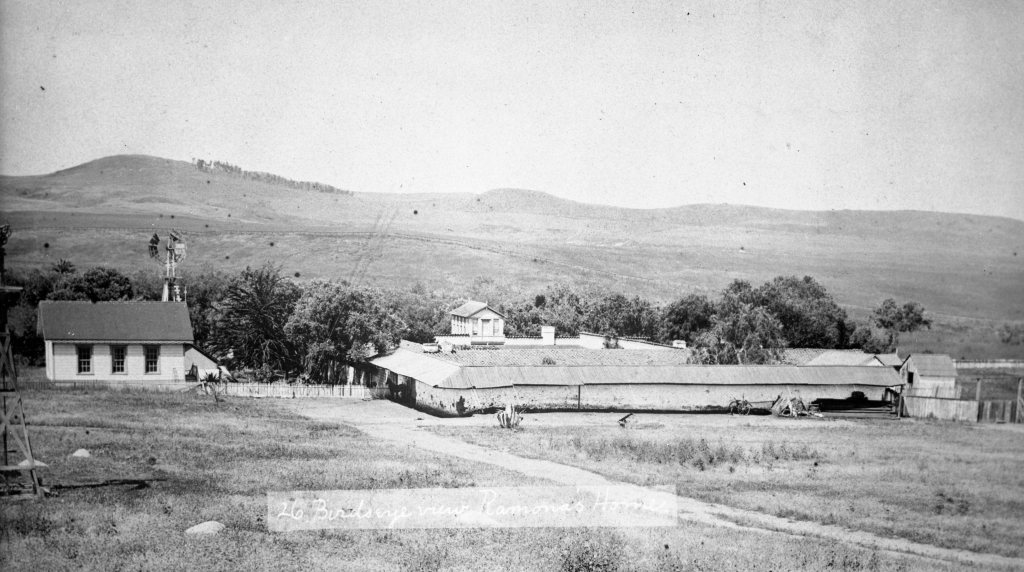
View of Rancho Guajome, Oceanside Historical Society

Col. Couts’ namesake, Cave J. Couts, Jr. was born 1856 and lived most of life on the Rancho. At the age of 20 he was deputy city engineer in Los Angeles, and was one of the first engineers of the California Southern Railway in San Diego.  He went on surveying trips for the Southern Pacific Railroad and was one of the engineers that made the first surveys for the Panama and Nicaragua canals. Couts also surveyed the new town of Oceanside and laid out streets.

Cave J. Couts, Jr.

Cave Couts, Jr. hired Fred Wehmeyer to work on the Rancho, where he and Ida may have lived as well.

On August 8, 1919 Ida and Fred welcomed their first child together, whose name appears on the birth certificate as Elnor Kunzell Wehmeyer. (Fred’s age is off by 10 years but was likely provided to the recorder as such.) The baby was delivered by Dr. Robert S. Reid, a well-known and beloved Oceanside physician.

Birth certificate of Elnor Kunzell Wehmeyer, later renamed Belda Richardson, Kristi Hawthorne research

In the 1920 census Fred and Ida’s daughter has been renamed Belda.

1920 US Census. Note the ages of Fred and Ida are accurate and Elnor is now renamed Belda.

The following year on October 13, 1920, Ida gave birth to a son whom she named Richardson Wehmeyer. Dr. Reid once again made the house call to deliver this baby.

Birth certificate of Richardson Wehmeyer, later renamed Earl Richardson, Kristi Hawthorne research

On October 14, 1922 the Oceanside Blade noted that “Mr. and Mrs. Fred Wehmeyer of Guajome Ranch were in Oceanside Tuesday.” Fred was employed by Cave Couts as ranch foreman.
Ida filed for divorce on December 1, 1923 in the Superior Court in San Diego. In the complaint for divorce she stated that she and Fred were separated on about October 8, 1923. The number of years from marriage to separation was given as 6 years, 1 month and 5 days.

The divorce complaint also states that the marriage produced two children: a daughter, “Bela” Wehmeyer, aged 4 years and 3 months, and a son “Sonny Boy” Wehmeyer, age 3 years and 1 month.
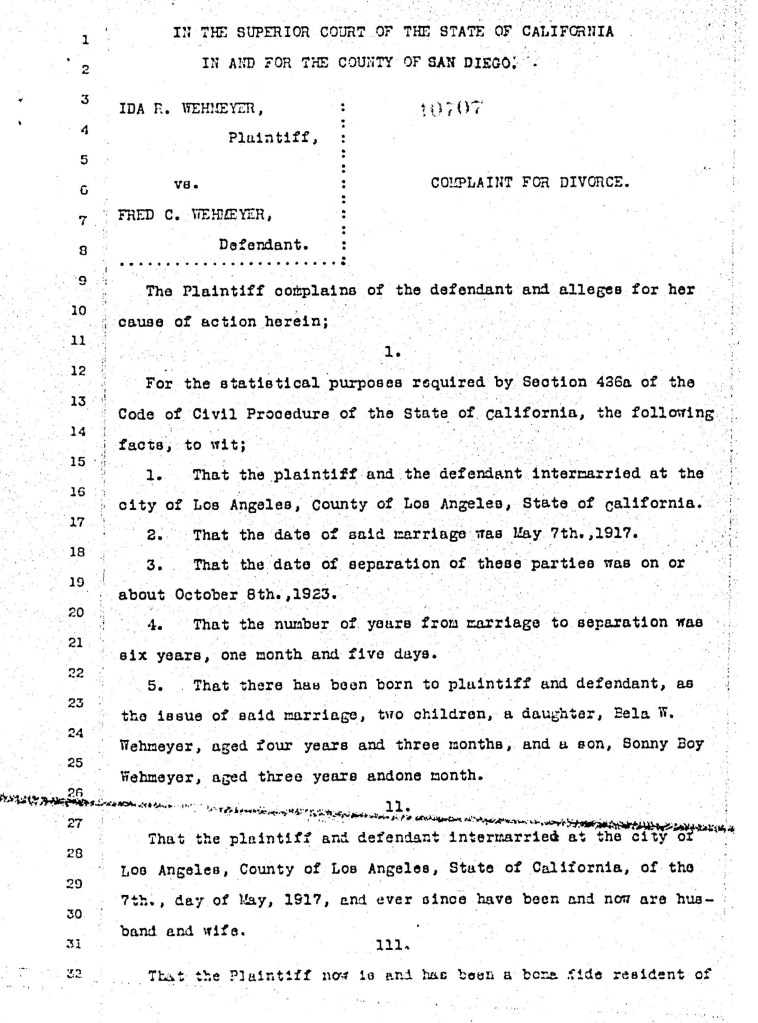
Complaint for Divorce filed by Ida Wehmeyer in 1923, Kristi Hawthorne Research

Ida stated that Fred had “disregarded the solemnity of his marriage vows for more than one year” and had failed and neglected to “provide for the common necessaries of life.” She further stated she had to “live upon the charity of friends” although Fred was capable of making “not less than $100 per month” and more than able to support her.

Local rancher Sylvester Marron served the complaint upon Fred Wehmeyer on December 4, 1923. It appears that Fred did not respond to the complaint and a default was entered. Fred was ordered to pay child support of $20 per month and the children would remain with Ida. The final judgment of divorce was not entered until February 26, 1925.

Was this charity that Ida noted in her divorce papers coming from Cave Couts? It is likely. However, that did not mean Couts terminated his friendship or working relationship with Fred Wehmeyer as he continued to work at Guajome. Couts even sold Fred property in 1925.

The North County Times reported on April 13, 1925 that an excursion of eight automobiles took a number of passengers to tour various parts of North San Diego County on Easter Sunday.  They traveled to the San Luis Rey Mission, the Rosicrucian Fellowship and Rancho Guajome.  J. B. Heath, author of the column, wrote that “At the Guajome ranch, buildings of which, covering two acres of ground, have just been restored at an expense of $20,000. The people were shown every attention by F. C. Wehmeyer foreman, in the absence of the owner.”
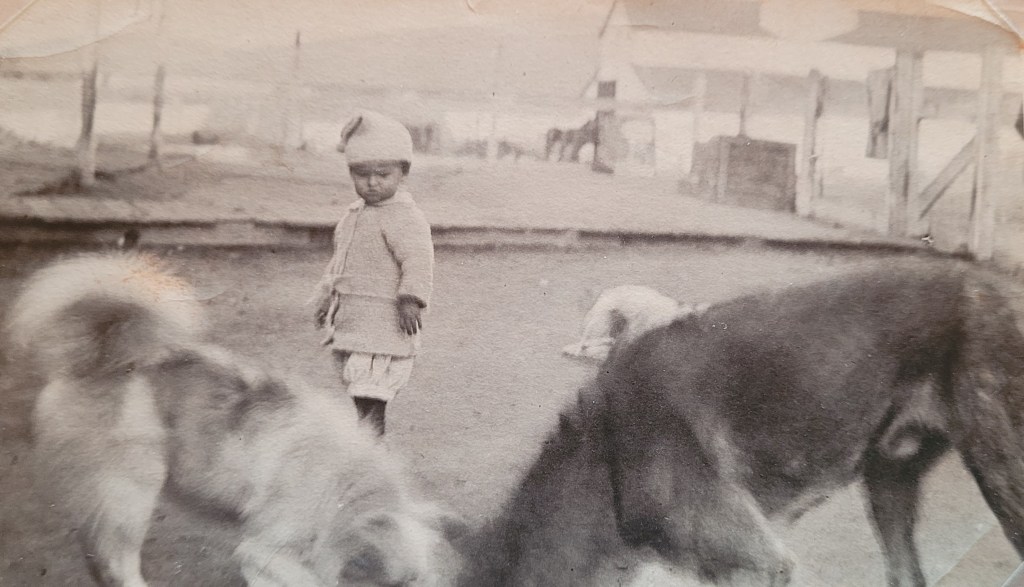
After the divorce it is likely that Ida returned her surname to her maiden name of Richardson. But she also changed the children’s names. Elnor was changed to Belda, and Richardson was changed to Earl. (To reiterate, the divorce record filed by Ida gave their names as Bela and Sonny Boy.)

There are no public images of Ida but two photographs of Ida and her children were included in a 2008 book entitled “Ranchos of San Diego County” by Lynne Newell Christenson Ph.D. and Ellen L. Sweet. Ida is clearly a beautiful woman, and the images show the rancho in the background. The children appear to be 2 and 3 years old.

In the 1930 census, Ida and her children were living with Cave Couts at Rancho Guajome and listed as his adopted daughters and son. It is very doubtful that there was such an adoption, but that this relationship was listed as such for the census records or taker.
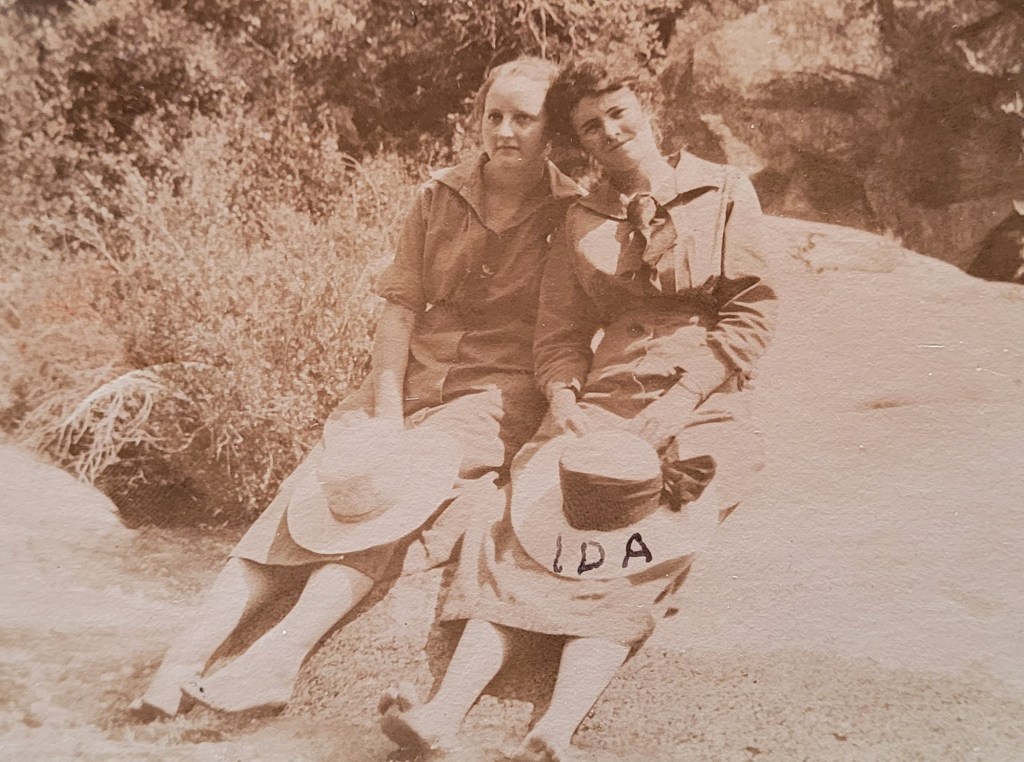
Fred Wehmeyer, listed in the same census district, was living on the property he purchased from Couts, just two miles south of Rancho Guajome, and operating a fruit farm. It is telling that Fred continued working for Cave Couts while Ida and her children lived on the rancho. Couts obviously maintained a relationship with both.

On September 22, 1930 the North County Times reported that Wehmeyer was working for Couts to restore the Bandini home in Old Town.

Cave Couts, who owns the old Bandini home at Old Town San Diego, has been having it thoroughly repainted and renovated. It is one of the historical places in the bay section and Colonel Couts is making of it a lasting monument. Nearby and in the next block to the famous Ramona’s Marriage place, Colonel Couts has built a court of adobe enclosing an entire block. It has 40 double apartments surrounding a center court. The work has been in progress for several months. F. C. Wehmeyer of Vista has been employed on the big construction job.”

Belda Richardson attended local schools and graduated from San Diego State College in 1940. On August 30, 1941 she married Millard “James” Marsh in Yuma, Arizona. James Marsh was a native of Indiana, born in 1914 and was employed as a photographer. After three years in San Diego, the couple relocated to San Francisco, living at 1 Jordan Avenue in the downtown area.
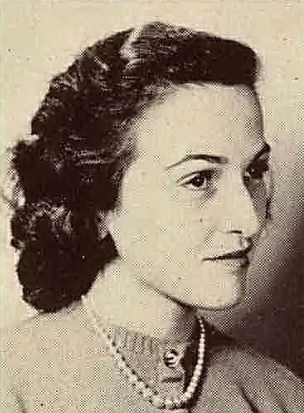
Belda Richardson, San Diego State College 1940

Belda divorced James in 1946 and continued to reside in San Francisco. James Marsh moved to his parents’ home in Fallbrook and two years later took his own life.  

Marriage certificate of Belda Richardson and Millard James Marsh, Kristi Hawthorne research

Earl Richardson married Geraldine Morris, the daughter of local businessman Oliver Morris. The couple had three children.

Upon the death of Cave Couts in 1943, his obituary stated that “his secretary, Mrs. Ida Richardson, managed all his affairs, according to the son and only child, Cave J. Couts III, 4188 Arden Way.” (Couts only marriage was to Lilly Bell Clemens, niece of Samuel Clemens, aka Mark Twain, and was a tumultuous one, ending in a bitter divorce and custody battle.)

In a variety of accounts Ida has been listed as a housekeeper, secretary and even common-law wife of Cave Couts. Respected historians have agreed with suggestions that Belda and Earl were fathered by Couts.

While Cave Couts died July 15, 1943, Fred C. Wehmeyer died one month earlier on June 12, 1943. His obituary, which ran in the Vista Press stated that he was 81 years old (he was 82) and had passed away at the general hospital in San Diego. It went on to state that:

He had been a resident of Vista for many years. He is survived by a daughter, Mrs. James March (sic) of San Diego; two sons, Earl Richardson, of Vista, Fred F. Wehmeyer of Hepner, Oregon, and four grandsons, all of whom are in the military service, and two granddaughters.”
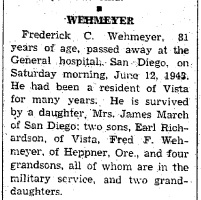
Obituary of Fred C. Wehmeyer, July 15 1943, Vista Press

Belda and Earl had grown up on Rancho Guajome with their father living just two miles away. Surely, they saw him working as foreman on the very ranch on which they lived. Fred knew of his children, and the marriage of his daughter. They were included in his obituary. Did they remember and acknowledge him? Did they read this obituary?
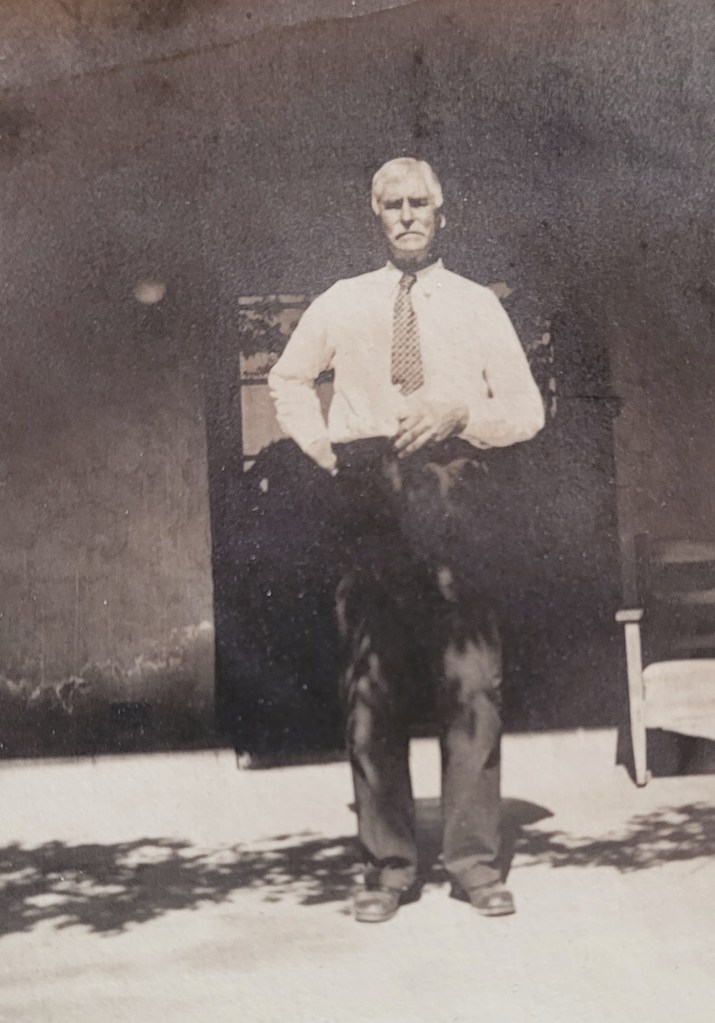
It is apparent that Fred Wehmeyer was not lost altogether to history but somehow Ida had managed to erase him from her life and that of her children. Did Ida ever offer information as to how she came to Vista? How she ended up at the Rancho Guajome? Did she every mention Fred Wehmeyer to anyone in her many interviews? Did she clarify the rumors or innuendos that her children were fathered by Cave Couts?

In an article written by Iris Wilson Engstrand and Thomas L. Scharf for the San Diego Historical Society Quarterly, Winter 1974, Volume 20, Number 1, entitled “Rancho Guajome, a California Legacy Preserved” the historians write that: “The will of Cave Couts Jr. provided that Rancho Guajome would pass to Mrs. Ida Richardson as a life estate —because of her loyalty and faithful service. Mrs. Richardson, who moved to the rancho in the 1920s as a housekeeper, became the constant companion and helpmate of Couts. She was the mother of his two youngest children, Belda Richardson, who died in 1971, and Earl Richardson, final heir to Rancho Guajome, the place of his birth.”

County historian Mary Ward also believed the children were Couts’ and that “successive generations of Couts heirs resided in the ranch house until 1973.” It seems no one knew that Fred Wehmeyer existed and he may have never been mentioned again by Ida.

When Belda Richardson Marsh died May 16, 1970 in San Francisco, at the age of 50, it was her brother Earl who was the informant on her death certificate. On the certificate Earl does not provide the name of Belda’s father, instead he simply put “No Record.”

Death Certificate of Belda Richardson Marsh

While Earl was just five years old when his parents’ divorce was final, did he not remember his father? Did he not see his father when he was working on Rancho Guajome for several years? Did Earl ever see or have his original birth certificate which clearly states his father as Fred Wehmeyer? Or did Ida hide this information from him? What is telling, is that he did not list Cave Couts, Jr. as her father. So Belda and Earl presumably did not know who their father was and did not believe him to be Couts.

Researchers and genealogists have not been able to obtain information on the children’s births for decades, and the identity of their father, because their last name was changed by Ida many years ago.

Ida and her two children died within four years of each other. Ida Kunzell Richardson died November 15, 1972. Her obituary states that she had lived in Vista for 74 years, but it was actually 55. Earl Richardson died December 4, 1974.

Early photo of Fred Francis Wehmeyer, oldest son of Fred C. Wehmeyer

Interestingly, Fred C. Wehmeyer’s son, Fred F. Wehmeyer, eventually came to live in Vista and died there in 1973. After his father’s death in 1943, Fred Francis, apparently unable to remain silent about his father, who had been forgotten by his two younger children or their memories of him erased by their mother Ida, wrote a loving eulogy that was printed alongside his father’s obituary.

A Son’s Tribute to His Father

“Dad was a great man, that simple greatness that encompassed all the old-fashioned, homely virtues, now considered obsolete by so many. As James Whitcombe Riley once described a friend, “his heart was as big as all outdoors.”

Born on an Indiana farm of a father who had fled Europe to escape Prussian tyranny as far back as 1837 and to a mother of Pennsylvania Dutch origin, he became a true pioneer, for he marched in the Vanguard of civilization as it pushed its way westward through Kansas, Nebraska, New Mexico, California, and Washington.

In later life, he returned to California, which, in his mind at least had developed to become the greatest state in the union. He loved California, especially that part of San Diego County around Vista and never tired of extolling its virtues.

In wealth, his friends were legion, in poverty they were few but more sincere. He never whined about the fickleness of fate or harbored a grudge against the vicissitudes of life. He never used harsh words or even thoughts for those who had betrayed him or expressed more than mild rebuke about those who had openly robbed him.

As a youth, his strength and agility gave rise to many Paul Bunyanesque tales along the frontier borders. A mighty man, his true feats of strength became greater with the retelling by admirers. Personally, he was modest, and I never heard him brag of himself; he was a clean spoken man, never given to profane or obscene language.

He died in his 83rd year, facing death as fearlessly as he always faced life.

He has now stepped through those somber shadows that curtain the future of all life. I am very proud to be his son.”

Fred F. Wehmeyer

In spite of this loving tribute which defended his father’s integrity and his memory, Fred C. Wehmeyer was forgotten in the history of Vista and Rancho Guajome. His family name was removed from his children Belda and Earl, and nearly lost altogether. It is my privilege to tell his story, along with Ida’s, so that history can be amended and even restored.

Kristi Hawthorne, Oceanside Historical Society

Learn more about the history of Rancho Guajome and the Couts family: https://sandiegohistory.org/journal/1974/january/guajome/

Deserted

This is the true story of Elsa and Edward, both of whom were given up for adoption as young children, both raised by physicians. They found each other in the midst of pain and loneliness, only to create more of the same. While the story is largely based in San Diego, their great granddaughter is a native of Oceanside. She has shared her tangled family tree with me in hopes of finding clarity and truth. Together we have searched for years to solve family mysteries and are left with questions still unanswered.

Elsa

Elsa Lamon grew up knowing that she was unwanted; her mother had given her away as a small child. She was sent to be raised by an aunt who was distant and cold. She never felt wanted or truly loved. Years later when Elsa grew to adulthood, her search for love resulted in unhappy and painful marriages which seemed to only validate what her mother knew: that Elsa was unlovable.

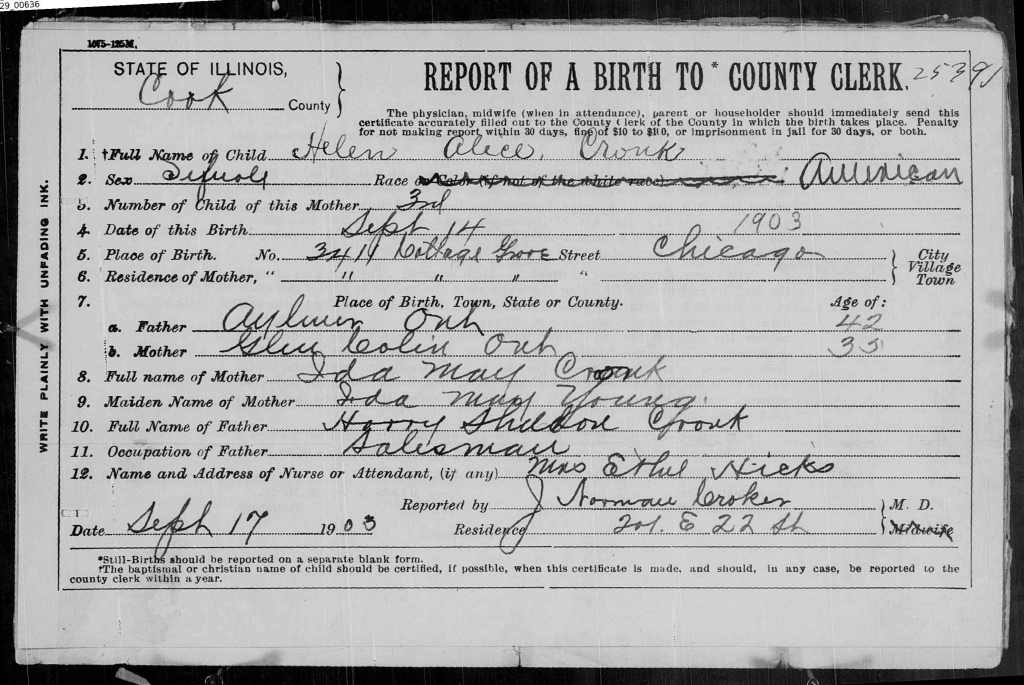
Her life was a series of unfortunate scenarios complicated by family dynamics and secrecy.  Born Helen Alice Cronk in Chicago, Illinois on September 14, 1903, she was the second child of Harry Sheldon Cronk and Ida May Young.

Elsa’s original birth certificate as Helen Alice Cronk

Harry Sheldon Cronk was a native of Canada born in 1861. He was previously married to Cecilia Monica Clark in 1889. They had one son, Harry Collins Cronk, born in 1891. Harry filed for divorce in 1892 and married his second wife, Ida Mae in 1893. Ida Mae bore a son in 1895, who was named Harold Cecil Cronk.

Elsa’s life abruptly changed after her father’s untimely death of meningitis in 1904, when she was just 15 months old. Ida Mae Cronk remarried in 1908 to William Ames and sent her daughter to Detroit, Michigan to live with her husband’s sister, Martha Imogene Cronk, and her husband Alois Thuner.

Her adoptive father, Alois Anthony Thuner, was a well-regarded physician in Detroit, Michigan. He and Imogene married in 1890. They had no children of their own and adopted Helen Alice and raised their niece to raise as their daughter, giving her a new name of Elsa Helena.

Dr. Alois Thuner, age 30 years old

In 1910 Imogene became pregnant and the family of three must have been excited about the prospect of a baby. Sadly, however, on February 24, 1911 Imogene gave birth to a stillborn daughter.

Imogene Cronk Thuner at age 18. Elsa’s adoptive mother

The Thuner’s provided Elsa with a comfortable lifestyle. They lived in spacious homes in well-to-do neighborhoods, including Detroit’s Boston-Edison neighborhood that was inhabited by the likes of Henry Ford and Sebastian Kresge.

Despite her affluent upbringing, Elsa must have wondered all those years: Why did her mother give her up?  She grew up knowing she was adopted. She even knew who her mother was, but family stories suggest that she had little or no contact with her biological mother throughout the years.

Elsa’s mother Ida Mae remained in Chicago and remarried in 1908. And while Ida had given up her daughter, Ida Mae continued to raise a stepson, Harry Collins, and a biological son Harold Cecil.  This must have had a lasting negative impact on Elsa, who knew her mother was alive and well, together with the knowledge her brothers were seemingly accepted and loved by her, while she was not. The sense of abandonment would reverberate throughout her life.

In 1920 Dr. Thuner retired from medicine and moved his wife and daughter Elsa to San Diego in the Point Loma neighborhood, in a beautiful home located on Goldsmith Street.

Thuner home on Goldsmith Street

From Detroit to San Diego, Elsa’s life was interrupted, leaving childhood friends behind. However, it appears she transitioned successfully, graduating from San Diego High School in 1921, attending junior college, as well as joining a sorority and a rowing club.  Her name was a familiar one in the society pages of the San Diego Union newspaper.

Elsa Lamon at age 18

In spite of her early start as a cast off, in San Diego Elsa was part of the “it” crowd and accepted in society circles. She would even “marry well”, a man from one of the most prominent families in San Diego. Perhaps meeting at the rowing club where they were both members, Elsa became acquainted with Ira Collier. 

Ira

Ira Clifton Collier was the son of David Charles Collier, an attorney, banker and real estate developer, as well as the president of the 1915 California Panama Exposition in San Diego. 

If Elsa’s privileged life was filled with less than happy circumstances, Ira’s surpassed hers both in privilege and perhaps unhappiness.

In 1896 David Collier, Sr. married Ella May Copley, the sister of Ira Clifton Copley, who formed Copley Press and would later own the San Diego Union-Tribune. They had two sons, David and Ira, who were sent to the Harvard Military School in Los Angeles for their education.

David C. Collier, father of Ira Clifton Collier

David Collier, Sr. filed for divorce from his wife Ella May in 1914. This very acrimonious divorce was made public, featured in newspaper headlines throughout Southern California and personal details about their marriage and split were published for all to read. 

Ella Collier claimed that her husband deserted her and their two sons for nearly a year and had refused financial support.  David Collier charged his wife with mental cruelty and that she looked down at the Collier family in social standing, and that she alienated him from their oldest son David. Photos of their two sons were published in the newspaper and the divorce proceedings packed the courtrooms as bitter accusations were exchanged.  

For several months the courtroom drama captivated San Diegans, after which Ella Collier was granted a divorce on November 13, 1915. After which, David Collier promptly remarried to Ruth E. Everson, on November 14, 1915.

If David Collier found happiness in his new marriage, it soon ended when his new wife died a year later in 1916.  Collier remarried yet again to Clytie Lyon in 1919. But tragedy struck once more when his oldest son David Collier, Jr. died later that year of pneumonia at the age of 22.

Despite the loss of his older son, Collier never reconciled with his youngest son Ira, for whom he had fought for during court proceedings with his wife. Father and son remained estranged all the way up until the elder Collier’s death in 1934.

Ira’s mother, Ella Mae Copley Collier died in 1921, and he remained in San Diego living with his maternal aunt. However, the newspaper reported that Ira was going to Los Angeles to be trained by a vocal coach where he intended to pursue “a musical career.”  His voice was described to be “a baritone tenor of unusual quality.”

In February of 1924 the San Diego Union posted an engagement announcement of Elsa Thuner and Ira Collier. Ira Collier would have been a most eligible bachelor, with handsome good looks and a notable family tree. The announcement stated that the two obtained a marriage license in Riverside County and that a June wedding was planned. However, a retraction was printed immediately.

Was there opposition to this union? If so, the couple had eloped and were actually married on February 9, 1924, days earlier, telling no one.  The hasty denial of the engagement was not replaced by an official wedding announcement — which normally would have graced the society columns of the local papers.

Mr. and Mrs. Ira Collier soon moved into a home on Palomar Avenue in La Jolla with beautiful ocean views. Later they settled in a more modest home on 32nd Street, located east of Pershing Drive in San Diego. The couple moved nearly every year, it seems. In 1929 they were living on Olive Street in Coronado, a decidedly tonier locale.

Married five years, and perhaps celebrating their anniversary, Ira and Elsa sailed to Honolulu, Hawaii aboard the S. S. Calawii, a glamorous ship known for its celebrity passengers.  The trip was an extensive one lasting from August to November.

After eight years of marriage, their union had produced no children. Whether this was by choice or because of infertility, one can only surmise. But something was taking a toll on the marriage and whether it was barrenness, boredom or something else altogether, the couple would soon separate.

In the summer of Ira Collier traveled to Reno, Nevada, notorious for its “quickie” divorces.  “Divorces Ranches” popped up all over the Silver State to accommodate such legal proceedings.  However, according to state law, a person must first establish just six weeks of residency before filing suit.

During his “residency” Ira found himself in a precarious situation when he and three other men visited the Heidleberg Inn, a nightclub situated five miles south of Reno.  A confrontation ensued and shots were fired, at least one striking their auto.  No other details came to light about the situation but the sheriff threatened to close the establishment.

On August 23, 1932 Ira fulfilled his residency requirement for divorce and filed suit to end the marriage which was summarily granted.  However, Elsa hired an attorney in San Diego and challenged the divorce and sued for support and judgment was found in her favor.

Nonetheless she found herself in a familiar place: unwanted.  Elsa would soon start a new chapter in her life with someone whom she had something in common: They were both given up by their mothers and coincidentally adopted by physicians.  Little did she know that in her pursuit to be loved and wanted, his cruelty would overshadow the abandonment by her own mother. 

Edward

Edward Bernard Lemen was born on November 13, 1907 in Denver, Colorado. His mother was an unwed teenager, the daughter of Theodore and Ella Lemen. Dorinda Lemen was born in 1892 (some records indicate 1891) and was the second of five children. Her father was a traveling minister, and it is because of this, his children were all born in different states.

In about 1902 the Lemen family resettled in Denver, Colorado where two of Theodore’s brothers, Lewis E. Lemen and Harrison A. Lemen, were established and practicing physicians.

Family stories suggest that Dorinda traveled with her father while he was sharing the gospel in the southern United States, particularly Atlanta, Georgia. During the trip Dorinda either engaged in under-aged sex, or perhaps was sexually assaulted, and became pregnant. After returning to Denver, at the age of 15, she gave birth to a male child.

Colorado recorded a very simple birth record devoid of any great detail. In the 1907 “Birth Book” the scant information provided is the date of birth of November 13, 1907, the child being a white male. The mother’s name is left blank (which is unusual) but the father’s name is listed as “D. Lemen”. The question of legitimate birth is answered by “yes.” (This was in fact not a legitimate birth, meaning the child was not born as a result of a marriage.)

Edward Lemen’s birth record from Colorado State Archives

The truth of the matter is there is no male person with the first initial of “D” in the Lemen household. It is most likely that Edward’s birth record was written in such a way to protect the young Dorinda (or her father’s reputation) and her first initial was placed under the “Father’s name”. Further, the home address listed on the birth record is 2830 W. 34th Street in Denver, Colorado — the home address of Rev. Theodore Lemen and his family in 1907.

In 1912 Dorinda Lemen married Warren F. Edwards, a traveling shoe salesman. They were married in Salt Lake City, Utah, which may be telling because Dorinda’s son was adopted soon after to a family living in Utah.

Warren and Dorinda Edwards were living in Denver in 1917, with Warren working for the Harsh & Edmonds Shoe Company based out of Milwaukee, Wisconsin. In the World War I registration card Warren signed on June 5, 1917, he states his sales route was from Denver to the Northwest. It also states that Warren Edwards was financially assisting his mother-in-law and Dorinda’s two youngest siblings, Sylvester and Elizabeth.

Just one month later, however, Dorinda Edwards would be involved in a scandalous affair.  So sensational, the headline of the St. Louis Post-Dispatch read: “St. Louisan Caught in Wild Taxi Pursuit in Milwaukee.”

On July 15, 1917, Warren and Dorinda traveled to Milwaukee for business and were staying at the Gilpatrick Hotel.  Apparently Warren Edwards had discovered Dorinda in the arms and bed of another man. A two mile chase through town ensued which resulted in Hamilton being arrested and subsequently sued by Edwards for $50,000 for “alienating his wife’s affection”.

Simultaneously, Warren filed for divorce from Dorinda. The divorce complaint stated that within a five day period Dorinda and Nightingale Hamilton had visited three separate hotels to carry on an illicit affair. According to Dorinda’s admission she met Hamilton just six months after her marriage, in 1913, while on another trip to Milwaukee with her husband. Warren Edwards was employed by Nightingale Hamilton, whose father owned the company.

The divorce proceedings revealed that on July 17, 1917 Warren, Dorinda and Nightingale had all gone to a “road house” and the following morning, at 6 am, Dorinda and Nightingale had slipped off together, and had taken a taxi to the Juneau Hotel, one mile away. Dorinda signed the hotel register as “H. H. Hartley from Des Moines, Iowa” and Nightingale as “Norman Colt”.

Dorinda was allowed to be questioned (or interrogated) by Warren’s divorce attorney W. B. Rubin. He asked Dorinda how long the couple remained in the hotel room and she replied “until one o’clock next day.”

Then Rubin pressed further: “You had intercourse with him that day?” To which Dorinda replied, “Yes.”

Rubin: How many times?

Dorinda: I don’t think that is necessary.

Rubin: Well it was more than once.

Dorinda: No.

Rubin continued his humiliating interrogation of Dorinda about each sexual encounter with Hamilton, at two other hotels, the Wisconsin Hotel and the Plankington, where she registered as Mrs. J. H. Harvey of Red Wing, Minnesota. Hotel registers were subpoenaed and entered into evidence.

On January 24, 1918 Warren Edwards was granted his divorce from Dorinda, who returned to Denver to live with her mother. Both Warren Edwards and Nighintgale Hamilton died that later that year of pneumonia, likely after contracting the Spanish Flu.

Dorinda’s escapades aside, she presumably gave Edward up for adoption when he was about six years old. Edward was adopted by a well-known and respected doctor, John J. Steiner, and his wife Georgina (Blanchett) Steiner, of Richfield, Utah.

Edward would have undoubtedly developed an attachment to and held memories of his mother, along with his maternal grandparents and extended family for those first six years of his life. There is no known reason that he was given up for adoption (other than Dorinda wanted to be unencumbered in her marriage or affairs) but certainly this would have been a devastating event for Edward.

His adoptive parents, Dr. John Steiner and his wife Georgina, had one biological son, Chauncey J. Steiner, born in 1896. The little boy died at the age of three. A little lamb graces the top of Chauncey’s headstone and below his name and date of birth and death is the tender inscription “We loved him.”

Thereafter the Steiners formally, and informally, adopted several children over the years. Edward was the only boy in this extended family, and it appears may have been only the second child of five to be formally adopted and although no such records have been found, Edward’s last name was legally changed to Steiner.

The Steiner family home in Richfield, Utah

Richfield, Utah is and was largely populated by the members of the Mormon Faith.  It became a regional center with the establishment of the Denver and Rio Grande Railroad in 1891.  Perhaps, Edward Lemen and his mother traveled from Denver and met the Steiner family, but it is only a guess.

The Steiner’s adopted and foster children were educated in the Richfield school system but when Edward was twelve years old he was sent to Oregon to a Catholic boys’ school. According to a newspaper account in the Richfield Reaper, Edward came home rather unexpectedly, prompting an educator from the school to travel to Richfield, to return Edward back to school. This is the first indication that all was not well and perhaps the heartache of a young boy given up by his mother was now being realized in resentment and anger.

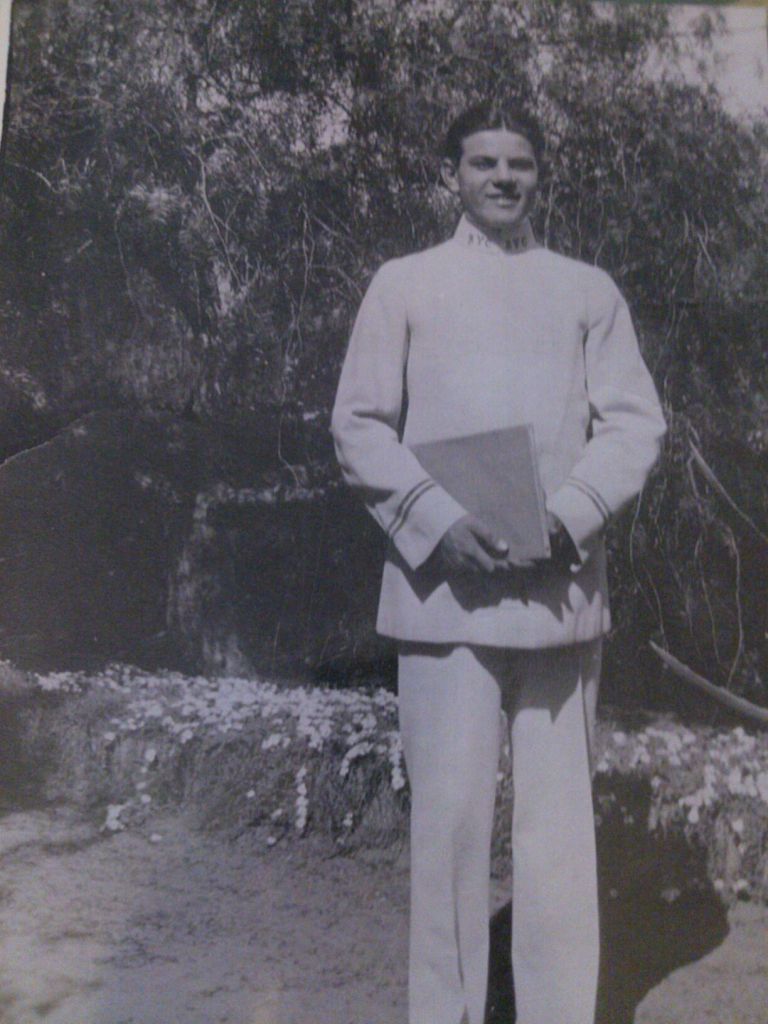
In August of 1921, Edward Steiner was sent to San Diego to the Raja Yoga Academy. He had yet turned 14 years old. Established by Katherine Tingley, this commune was located on Point Loma (now occupied by the Point Loma Nazarene University). There was a strict daily regimen for both children and adults. Accusations included that husbands and wives were separated and children from their parents, that speaking was forbidden and detractors were isolated. 

Edward Steiner aka Edward Lamon as a student at Raja Yoga Academy in San Diego

In spite of the criticism, there were over 300 people living at “Lomaland” in the community in the early 1920s.  Most residents were upper-middle-class and the Richfield newspaper stated that the schooling was just what young Edward needed as the school emphasized moral and spiritual development. Edward was at the academy for about two years. The Steiner family traveled to San Diego to visit him.

From Baptist birth to a Mormon community, to Catholic School and then a commune, Edward’s belief system was undoubtedly one of confusion and his sense of self must have been shaken. Sent away from his mother to live with the Steiner’s, who in turn sent him out of state for a “proper” education, only served to further isolate him both physically and emotionally.

By the time Edward was a young adult his religious belief system and moral compass may have been off kilter.  What was truth? For Edward there must have been no real answer to that question and he would later begin to live his life with half-truths, lies and deception.

Georgina Steiner, Edward’s adoptive mother, died on October 21, 1925. One month later, at 18 years of age, Edward Steiner was accompanied by his adoptive father to a U. S. Navy recruiting office in Los Angeles.  His enlistment papers state that Edward was living in Los Angeles and working as a bank clerk. At that age it is not required to have a parent’s authorization or approval so it would seem that this decision was forced upon Edward.  Just what had precipitated this action is unknown but Edward dutifully signed the paperwork and was sent to San Diego for training and then on to Mare Island.

It is worth noting that on the enlistment papers, Edward’s month and date of birth of November 13th are accurate, but for some unknown reason the birth year of 1904 was given instead of 1907.

Military training can be likened to religion or indoctrination, and it seems that Edward was a non-believer.  His military record was less than honorable and in a few short years he would go “AWOL”.  His military career aside, Edward would prove himself to be dishonorable in his personal life as well, manifested by infidelity and domestic violence.

Notations in his military record range from skipping out on small debts, to being absent from duty for several hours on different occasions. One particular document notes that he contracted syphilis in April of 1926 due to his “own misconduct”.

Desertion

On July 8, 1926 year, Edward married his first wife, Rosalie Ferrant in Oakland, California. Little is known of this union or even if it was legally dissolved. However, the first glint of perhaps reinventing himself is revealed on the marriage application as Edward listed his birth date as November 14th rather than November 13th and his birthplace as Georgia instead of Colorado.

Eleven days after his marriage to Rosalie, John J. Steiner died. He was the only father Edward would ever know. In the lengthy will, Edward was included as one of the heirs of the Steiner estate and received $600 and some stock.

Within six months of his marriage and his father’s death, Edward would enter into two additional relationships with other women, and then abandon them and his very own offspring with a calculated coldness. Perhaps this was learned behavior.

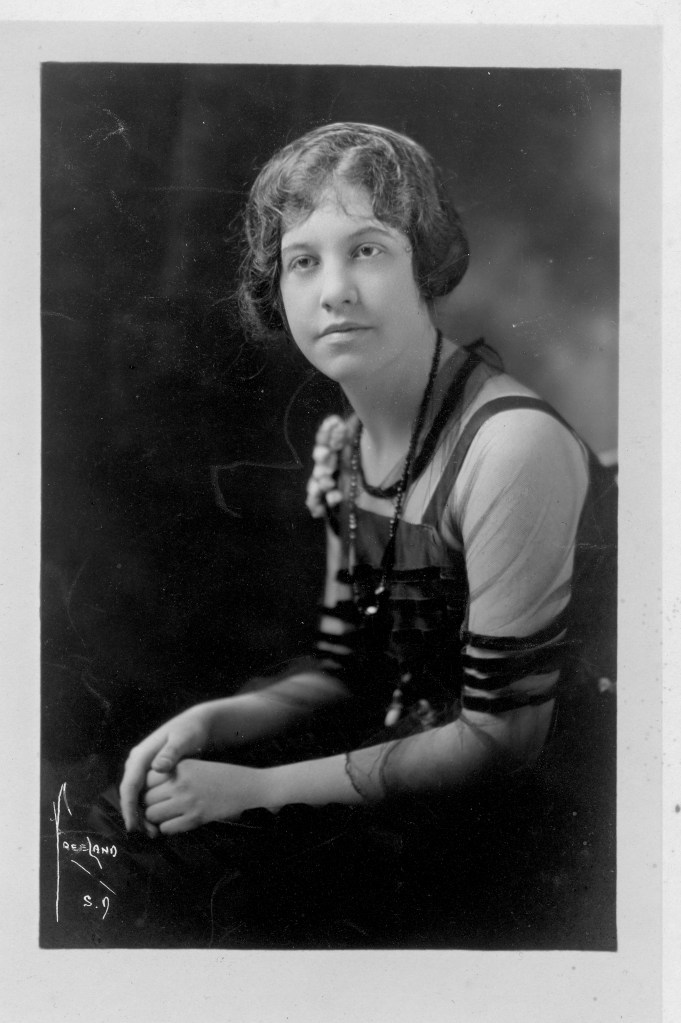
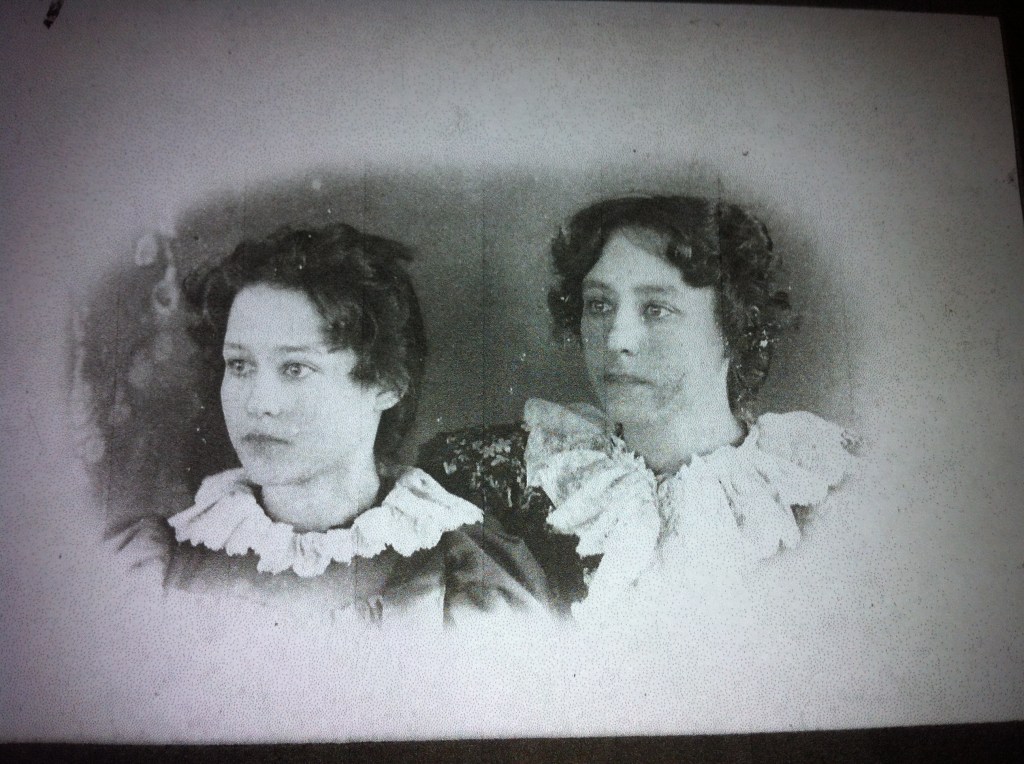
The very year he had married Rosalie Ferrant, Edward was also courting Bethel Mulick. Bethel was a native of Nebraska who moved to San Francisco with her mother and sister before 1920. 

Bethel and Bard Mulick as teenage girls.

Bethel followed Edward when he returned to San Diego when given orders by the Navy, and she got a job working at a hotel in downtown San Diego. Bethel and Edward very well may have been married at some point, although no record can be found. And if there was a marriage to Bethel, Edward was likely still married to his first wife Rosalie at the time.

On December 29, 1926 Edward Steiner went AWOL from the Navy. His military record notes he was “declared a stragler.” On January 8, 1927 he was declared a deserter. A notice of his desertion from the Navy was published in his hometown newspaper in Richfield, Utah, with a reward being offered for his whereabouts.

From the Garfield News, Feb. 11, 1927

Edward not only deserted the Navy but also Bethel. She gave birth to Edward’s daughter, in August of 1927. The address of the birth father is listed as “unknown”. Bethel had given birth alone as Edward had simply abandoned her.

The birth certificate of that baby girl reveals her father’s new persona — On the official birth record of Duane Reeves Lamon, her father’s birth name is given as “Ben” Edward Lamon, shedding the legal name of Steiner, Lamon is a seemingly deliberate variation of his birth name of Lemen.

Further information on the birth certificate listed Edward’s occupation as a medical student in Stanford. No record has ever been uncovered to verify that Edward ever attended Stanford, although he was a pharmacist’s mate in the Navy. (Apparently, he had told Bethel that he was attending Stanford, something he would repeat to other women in his life….)

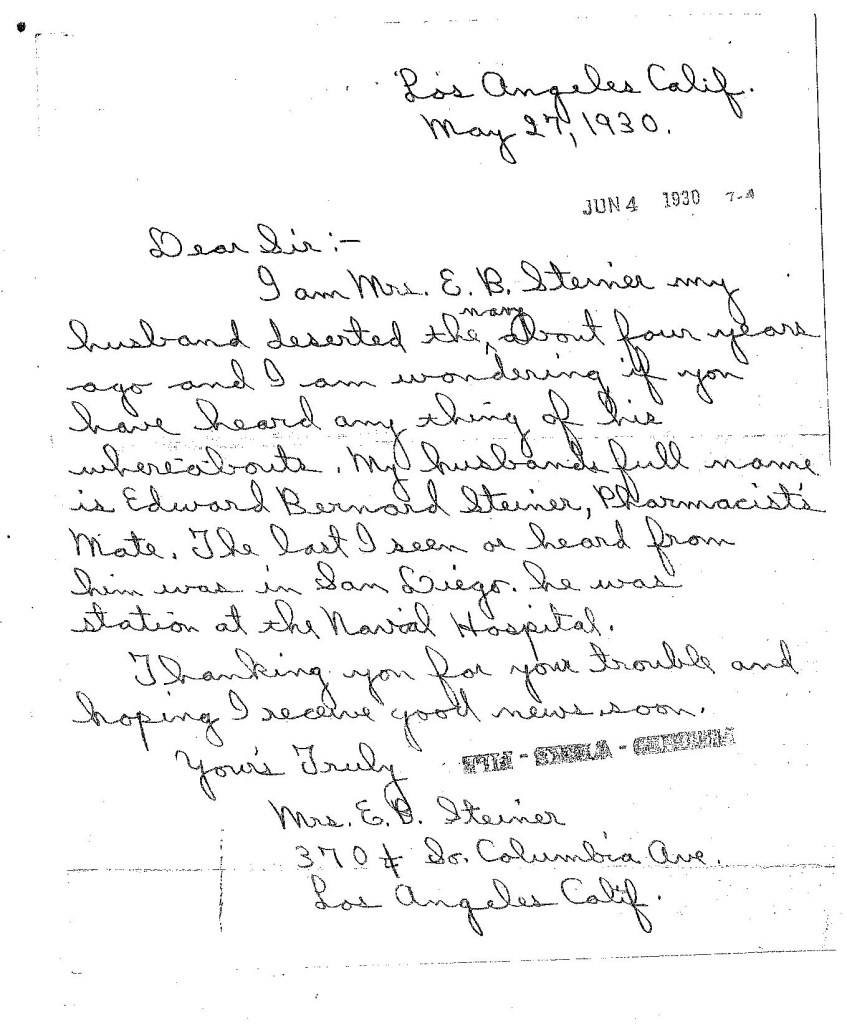
Bethel wrote heartbreaking letters to the Dept. of the Navy looking for the whereabouts of Edward, which were retained as part of his military record. Each time the Navy replied to her letters stating they did not know of Edward’s location. Bethel would continue the search for her husband for nearly three years.

Letter from Bethel to the Navy in search of her husband. This letter and others were contained in Edward’s military file. Note that Bethel clearly knew Edward’s adoptive name of Steiner, but she used his new surname of Lamon on her daughter’s birth certificate.

While Bethel searched for Edward, he was in the arms and bed of another woman. While Bethel was 3 months pregnant with Edward’s child, on Valentine’s Day in 1927 he married a new “sweetheart” Sadie Ingle, in Los Angeles.

Sadie and Edward would be married long enough to have two daughters: Mildred and Melody born about 2 ½ years apart. And while he had left two women and a baby daughter behind, it seemed that Edward was somewhat domesticated for a time. Although he was still wanted by the Navy as a deserter, Edward moved his wife and two daughters back to San Diego, living in Coronado. It is worth noting that Edward, a supposed medical student, was working a blue collar job at the garage of the Hotel Del Coronado.

Although Edward had managed to stay married to Sadie for six years, all was not wedded bliss – Edward met a beautiful divorcee – Elsa Thuner Collier and the two embarked on what would be another tumultuous relationship.

Elsa and Edward began an adulterous affair as early as 1932, while Edward and Sadie were still married. In November of 1933 the couple were in Berwyn, Illinois where Elsa gave birth to their child, Barbara Jean La Mon. 

Although the couple was not married the child is listed as “legitimate”.  (On Barbara’s birth certificate Edward’s occupation is listed as a real estate and a bond salesman, a profession he purported to have been in for 6 years.)

Edward’s wife Sadie responded by filing for divorce in March of 1934. In her complaint she contends that Edward “would frequently remain away from his home nights without informing” her and that Edward would make “insulting remarks” about her relatives. While this sounds somewhat tame, Sadie went on to say that Edward became so angry on one occasion, he struck his mother-in-law and knocked her down.”

Edward never responded to Sadie’s divorce complaint. Instead he and Elsa married in September of 1934 in Las Vegas, Nevada. Meanwhile, Edward and Elsa’s union produced another child, Valna, born in 1935.

With one wife, three exes and five daughters, Edward’s life and temper continued to spiral out of control. Less than one month after Elsa had given birth to daughter Valna, Edward attacked and choked her.  He later threatened to kill Elsa and the police were called. 

After Edward’s arrest his true identity was revealed and the authorities promptly delivered him to Navy officials.  The Navy, however, had no desire to prosecute Edward after an absence of 8 years and officially released him from duty. 

Edward left California and for a time was back in Richfield, Utah perhaps seeking refuge or financial assistance from his adopted sister. A notation from his father’s estate indicate he received a $250.00 stipend on September 13, 1935.

Elsa began divorce proceedings in October of 1935 detailing the cruelty of her husband. Edward never responded to the legal proceedings and never returned to San Diego. He continued to leave a wake of broken hearts and lives wherever he went, and left Elsa like he had left Sadie — alone to raise two little girls who would never know their father.

Edward found refuge in San Francisco and reconciled with Bethel.  Although she had remarried twice since they parted, Bethel single again, accepted Edward back and the two were married on November 26, 1935. On their marriage certificate Edward gives his address at 716 Wilshire in Santa Monica and states that his occupation is a salesman for a building and loan company.

He also states that he has had two previous marriages, although he had three previous wives. Other misinformation was included in the personal statistics portion of the marriage license. Most curiously and notable is that he lists his mother as Dorenda (sic) Blanchette. Dorinda his birth mother and Blanchette his adoptive mother.

Their reunion was short-lived when Edward left the longsuffering Bethel yet again. He moved to Stockton and took a job as a sales clerk.

One Less

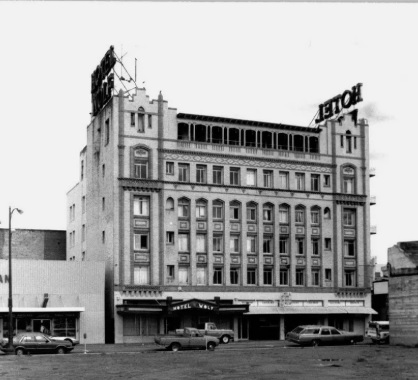
On July 30, 1936 Edward Bernard Steiner Lamon ended his life by hanging himself in Room 459 at the Wolf Hotel in downtown Stockton, California. He left a note requesting that his brother-in-law Andrew Desimone be notified. Desimone was married to Bethel’s sister Bard, and was in the casino business at the famed Cal Neva Lodge at Lake Tahoe.  Desimone contacted Bethel about the suicide and Edward’s remains were released to her.

3291 Mission Avenue (door to the right) in San Francisco where Bethel LaMon was living at the time of Edward’s death.

What led to Edward’s shocking decision to end his life? Was it a mounting debt of some kind? Was there a pending criminal action he wanted to avoid? Was it the terrible guilt of fathering and abandoning so many small children?

The Richfield, Utah newspaper reported that Edward Steiner had suddenly died, but skirted the issue of a suicide nor did it mention his other identity as Edward LaMon.

The Stockton newspaper reported that Edward left a wife and two daughters behind, but if this was referring to Bethel, they had just one known child together, Duane born in 1927, (Bethel had no other children).  And the names of the children the newspaper provided were Edna and Blanchette. (Blanchette was the maiden name of his adopted mother.) However, there are no known children by this name and one can only surmise as to the discrepancy. Was it simply an error by the reporter? Was there yet another woman who bore two additional daughters?

There was no mention of his former wives: Rosalie, Sadie and Elsa. No mention of daughters, Duane, Mildred, Melody, Barbara and Valna.

The Hotel Wolf in Stockton, California in the 1980s before it was demolished. Edward was found dead in Room 459.

His death certificate revealed additional misinformation that Edward no doubt perpetuated over the years to Bethel and others, as he reinvented himself. Particularly, his mother’s name is listed as “Blanchette Sorie”, who was supposedly born in Paris, which is all fabrication. 

The Coroner’s report stated that Edward was found hung in the shower by a belt. Curiously, he was dressed in riding togs.

His brief suicide note said, “Goodbye to all — one in particular.” “There is now one ‘lug” less in the world.”

Who was the “one in particular”? It was likely Bethel who had suffered longer with him than any other. Edward suffered, too, no doubt. His anguish had manifested into anger. His abandonment as a child, his changed name from Lemen to Steiner, being sent out of state to religious schooling; he tried to conform and then reinvent himself, but he could never find a way of escape or a way to redemption.

The Aftermath

Edward’s five wives (were there more?) eventually all remarried. 

Edward’s biological mother Dorinda relocated to California around 1937. Did she ever reach out to Edward at any time? After her mother died in 1948, Dorinda Lemen Edwards eventually moved to Oakland, where her older brother Timothy Lemen resided. She died in 1972. If Edward had any contact with the Lemen family after he was adopted or as an adult, it is unknown.

Edward’s five daughters, who never really knew or could remember their father, were left to wonder for the rest of their lives about him.

Barbara Jean Lamon revealed that her mother Elsa rarely, if ever, spoke about Edward…and his life and death were shrouded in mystery. She and Valna never knew their father had other wives and were astonished to find out they had three half-sisters, whom they never met.

After Edward’s death, Elsa and her daughters Barbara and Valna lived a very comfortable life with the Thuners. However, Elsa’s adopted father Alois died in 1937. Imogene and Elsa had a very strained relationship for years and without Alois alive, the tension grew. There was little joy or happiness in their upper-middle-class home.

Elsa walking with her daughters Valna and Barbara and Imogene Thuner in about 1939

It is worth noting that Elsa’s biological mother Ida Mae Ames had moved to Southern California by 1931. When Ida died in 1939, she was buried in Glen Abbey Memorial Park near San Diego. Elsa and her young daughters went to the graveside services but remained in the car and watched from afar. Elsa remained separated from her own mother even in death.

Imogene Thuner died in 1944. She left an inheritance to her two granddaughters, Barbara and Valna…not to her daughter Elsa. Their trust fund was over $90,000 in 1952, equivalent to nearly $900,000 today.

While Edward’s legal name was Steiner, his birth name was Lemen. The name of “Lamon” was Edward’s alias, a made up name used after he deserted the Navy. Ironically it was one that his offspring carried legally. Even his great granddaughter was given the middle name of “Lamon” in order to “carry on the memory of Edward”…only to find out later it was an invented name and not that of Edward’s at all.

The enigma surrounding Edward’s life, along with its truth and falsehoods continues, but he was just a faded or distant memory to the little daughters he deserted.

Kristi S. Hawthorne, historiesandmysteries.blog “Deserted”, 2020. Unauthorized use and/or duplication of this material without express consent and written permission from the author and owner is strictly prohibited. Links may be used, provided that full and clear credit is given to the author Kristi S. Hawthorne and historiesandmysteries.blog “Deserted”, with appropriate and specific direction to the original content.

Thelma Lawrence Garrigan

Thelma Lawrence was born in Oceanside, California in 1911.  She was the fifth of ten children born to Tom and Vera Lawrence.

Thelma’s father was born in Texas and came to California around 1898.  He met and courted Vera Sanders in Escondido.  He would often ride his bicycle 20 miles just to see her.  In 1903 they were married in Oceanside where they made their home.  Tom made a living painting houses and building boats. 

By the time she was ten years old, Thelma had seven brothers and sisters, all living in a small home on South Freeman Street.  Two of her siblings died at a young age. Her sister Eleanor died at the age of six weeks and her brother Billie died at the age of 10 from blood poisoning.  Her father worked hard to support his family, farming in various areas around town, and even working as a deputy for the Oceanside police department. 

Perhaps because her mother was so busy raising children, and her father preoccupied with feeding them, Thelma searched for love and attention outside the home. Rumors suggest that Thelma was engaged in illicit behavior when she was just 13 years old.

In 1925, at the age of 14 she married Adolph James Carpenter, of Carlsbad. The marriage took place in Orange County and was witnessed by her mother-in-law. It is unknown if Thelma’s parents were aware or approved of the marriage. On the marriage application Thelma gave her year of birth as 1906, to appear that she was 18 rather than a minor.  One year later she gave birth to a son, Adolph Keno Carpenter, at Fisher’s Hospital, which was located on Mission Road in Oceanside.  (Adolph was nicknamed “Jack” which he was called all of his life.) 

Thelma moved from Oceanside as early as 1926.  She and her young son Jack moved to Los Angeles and were living on West Temple Street. The 1930 Census records indicate that she was married but was obviously separated as her estranged husband was living in Carlsbad with his mother.  Later that year they divorced.  Census records indicate that Thelma was working as a dance instructor.  However, these were the Depression years, and it is possible that Thelma was making a living at dance halls that charged “a dime a dance.” 

According to census records, Thelma was sharing the rent with two Filipino men.  One was a “prize fighter”, the other a porter at a grocery store.  In the 1930 census Thelma’s place of birth is listed as Kentucky, although she was born in California, (and her mother’s place of birth is listed as France—she was actually born in Kentucky).  This could be due to the fact that Thelma was rewriting her personal history for any number of reasons, or more simply because someone other than Thelma provided the information to the census taker.

By 1932 Thelma and Jack moved to San Francisco.  Thelma met an Italian immigrant by the name of Alicide “Al” Pezzi.  He was a good 30 years older than Thelma and it is unknown whether they were ever married.  They were in fact living together at 1178 Hollister Avenue, (and the directory has Thelma listed with the last name of “Pezzi”). Al was a cook on a number of passenger ships that traveled back and forth from San Francisco to Honolulu.  Thelma’s niece, Dolly, remembered going to San Francisco to live with Thelma and Al Pezzi when she was 7 years old.  She remembers that Al was short in stature, to match his temper.  Dolly also vividly remembered that Al made them get rid of their family dog after it chewed his belongings. 

Alcide Pezzi

By the 1933 Thelma sent her son Jack back to Oceanside and he was raised by the Lawrence family—notably he was called Jack Pezzi rather than his birth name of Jack Carpenter.

Subsequently, Thelma then moved to Honolulu, Hawaii. Perhaps she went to Hawaii with Al Pezzi on one of his many trips and decided to stay. In 1936 Thelma was living at 1337 Pensacola Street in Honolulu. It was rumored that while she was in Hawaii she making her living as a madam at one of the many brothels in Honolulu. It has been reported that “working” in Honolulu was lucrative – $30,000 or more per year, which would be equivalent to over $500,000 today. When the Naval ships came in, the lines at the brothels would stretch around the block with prostitutes “servicing” as many as 250,000 men per month. The going rate was $2.00 (a full day’s wages) for locals and $3.00 for servicemen.

Thelma’s son Jack recalled that his mother was in Hawaii while he was attending grammar school in San Francisco and being raised by family members, his Grandma Vera, and Aunts Betty and Birdie, while Thelma sent the family money from Hawaii.

In the 1940 census, Thelma was living with or married to a William Dalton. Their residence was listed as 601 40th Avenue in San Francisco.  Her mother, son Jack and sister Betty are also listed as residing with them. Despite an apparent live-in relationship with Mr. Dalton, Thelma married Stanley Garrigan on November 13, 1940 in Reno, Nevada. They likely met in Honolulu, where Stanley was stationed. He was six years younger than Thelma, born 1917 in Orange County, California. 

Thelma made several trips back and forth from Hawaii to the mainland during the time she lived in Hawaii, either by passenger ship or plane.  Thelma’s sister Birdie visited her in 1941 and remembered that Thelma was living in a house on Booth Road and that a nightclub Thelma owned was at Waikiki Beach near the Luana Hotel. 

On December 7, 1941, Japan attacked U.S. military stationed at Pearl Harbor, Hawaii, just about 10 miles west of Honolulu.  After the bombing of Pearl Harbor, the U.S. declared war with Japan and catapulted the country into World War II.

Thelma and Birdie were both in Honolulu at the time of the attack and Jack remembered that when he and his Grandmother Vera were listening to the radio, there was a news report about an attack and at first, uninterested, Vera changed the station only to find out that the same report was on every station. It was the broadcast news of the attack on the Hawaiian Islands. Vera tried to call Thelma but there was no way to get through. The next day or so Thelma was able to contact her mother and said that she and Birdie were okay.  They had been volunteering with the ambulances and transporting bodies to a burial site.

Thelma and Birdie returned to the states, and Jack and his grandmother Vera came back to Oceanside. At the time Oceanside’s population was less than 5,000 but that would change as the Department of the Navy took over the historic Rancho Santa Margarita y Las Flores to be used as a training base for the Marine Corps. 20,000 Marines and civilian support flooded the base. The population more than doubled in five years. Restaurants, schools and hotels were bursting at the seams and there was an immediate housing crisis.

Shortly after coming back to California, Thelma purchased what was known as the “Borden building” located on the southeast corner of Third and Tremont Streets, presumably with the money she had made as a madam in Honolulu.  She went into business with her brother Jimmy and opened a nightclub called “Garrigan’s” in September of 1942.  Her husband Stanley was reportedly in Vancouver, Washington for officer’s training while Thelma and her brother went to work remodeling the building and preparing for the opening of the nightclub which offered live entertainment and dancing.

The Borden Building (built in 1929). Thelma Garrigan purchased this building for her nightclub

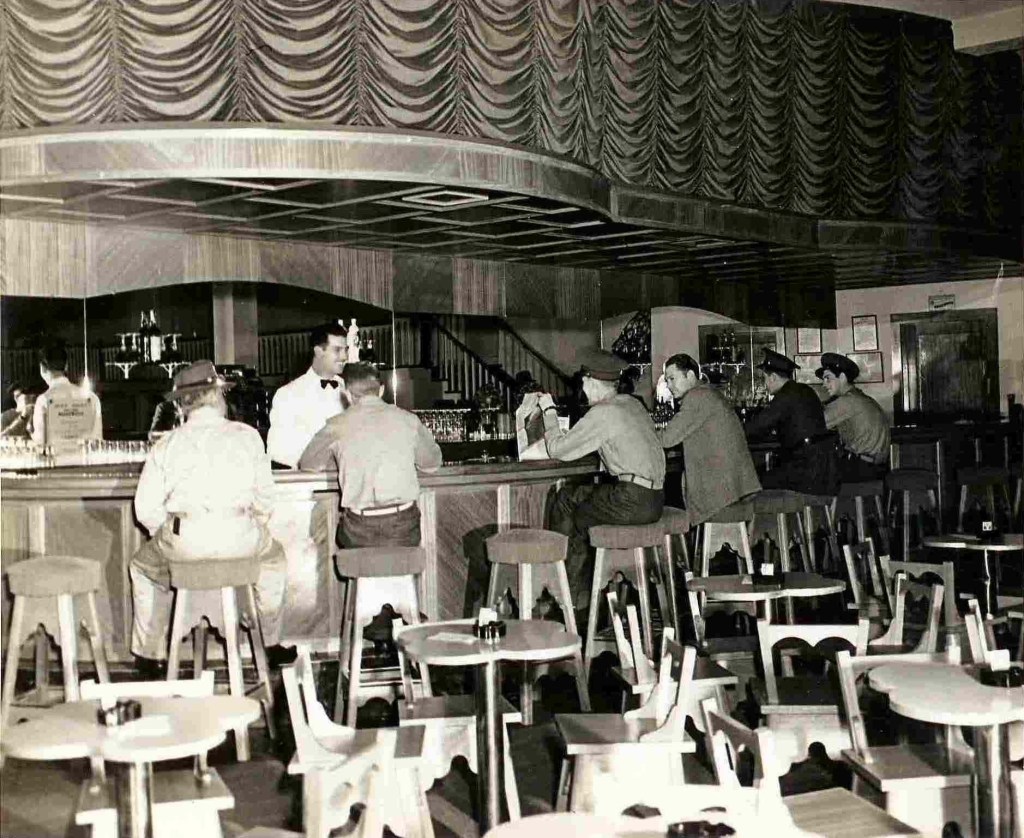
Charles O. Rowe, local contractor, was hired to remodel the main floor into a ballroom for dancing.  On one end of the room a large mahogany curved bar was built.  The mezzanine floor accommodated diners which featured a “high class steak house” and the upstairs contained rooms for employees and perhaps “overnight guests.” Thelma’s sister Vera (named after their mother) and her husband, Darrell Wilson, came to assist Thelma in the new nightclub. Darrell helped to manage the club and tended bar.

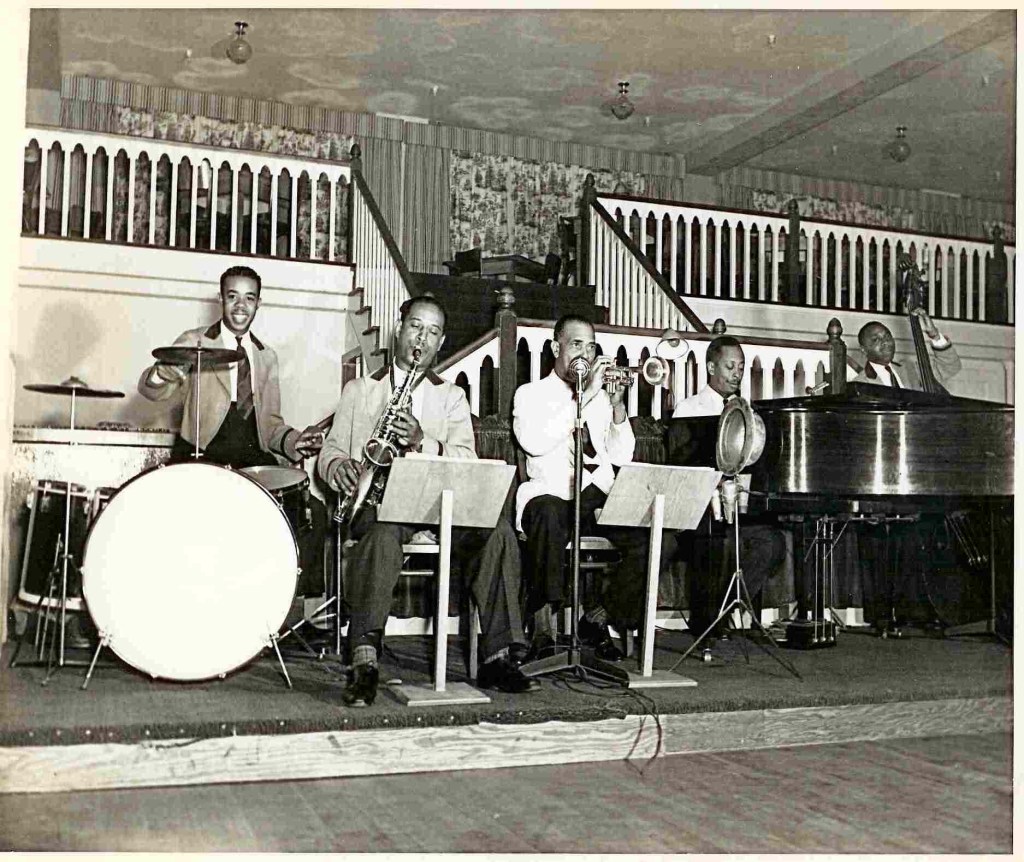
“Garrigan’s” offered live entertainment and dancing. Opened in September of 1942, Thelma’s nightclub was a huge success with over 500 people in attendance. There was nothing like it in Oceanside or surrounding communities.  The local newspaper described the nightclub:                                                             

The main floor of the building has been converted into a spacious lounge, with a dance floor, in the center.  Lamp lighted tables rim the floor.  On one side is the orchestra, “Billy Bryant and his Music,” which delighted the crowd gathered at the opening last evening. On the east of the building is the ultra-modern cocktail bar, watched over by a grand peacock on the south wall.  The peacock is radium treated and looks life like when illuminated during the evening. On the upper elevation, near the mahogany bar, are small deeply upholstered chairs that overlook the diners and the dance floor. Color effects of the entire establishment give it a rich tone.  The windows are heavily draped in blue and rust, with heavy rust carpeting on the floor.  Candle lighting is used on all tables. Even the banquet room was sold out last night, as every table was occupied by the opening night crowd.  There are two banquet rooms, which may be used for parties on the west side of the building.  These may be made into one large banquet room. Across the back of the building is the kitchen, open to the view of the diners.  It is separated by an illuminated showcase, displaying the feature of the house, Kansas City steaks.  Rest rooms are near the bar.  The office is on the mezzanine, overlooking the dance floor.

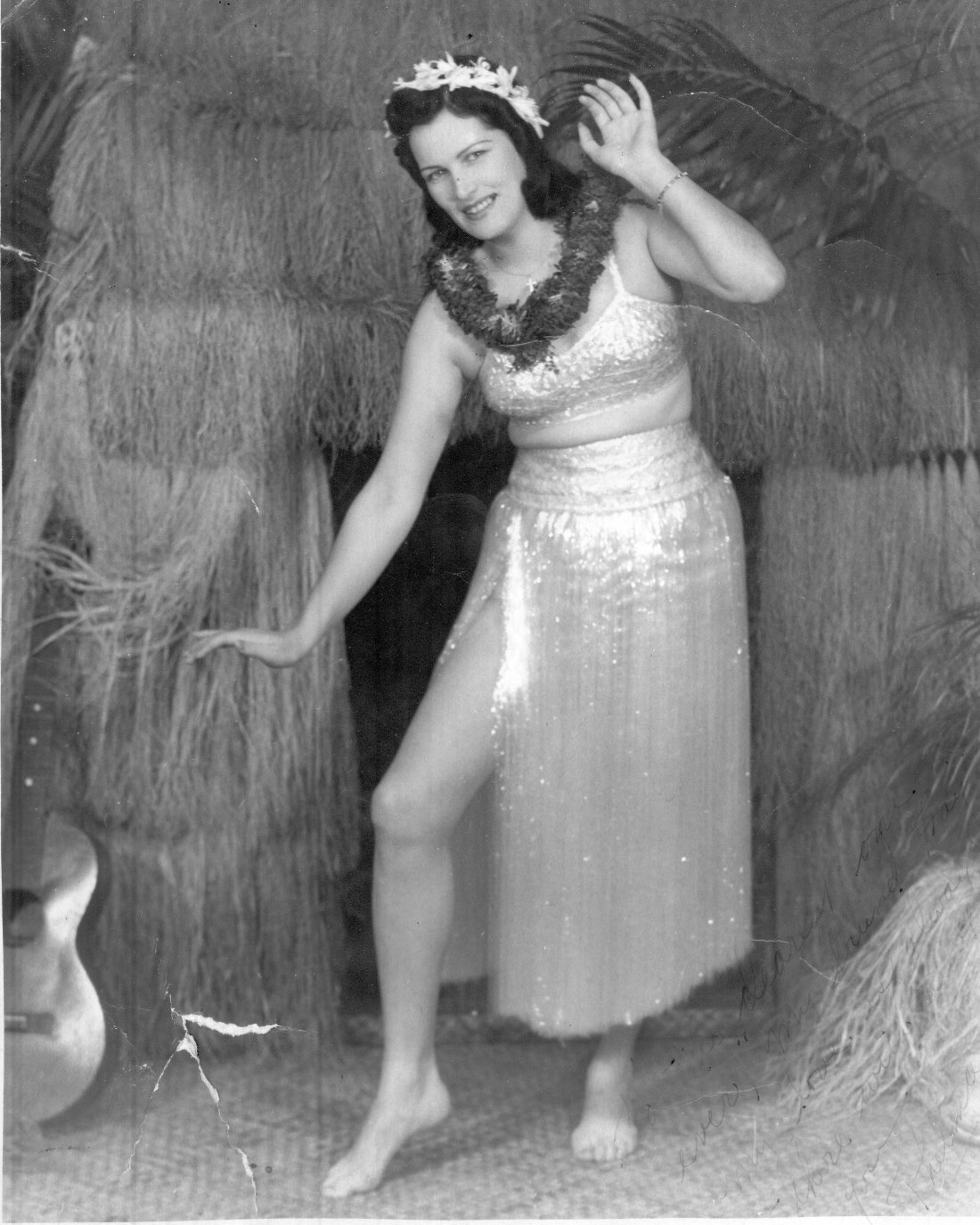
Son Jack remembered opening night when his mother made her welcoming speech to her many guests. After her opening remarks, Thelma left briefly and then reappeared in a see- through hula skirt and did a hula dance and the crowd went wild.

Thelma Lawrence Garrigan in her hula skirt

The Lawrence sisters, all beautiful, attracted attention from male customers, good for business but not marriages. Apparently sister Betty was the recipient of that attention and her husband was not pleased. He issued an ultimatum to Betty to return with him to San Francisco, which she dutifully did.

Sisters Vera and Thelma at Garrigan’s nightclub

In addition to a home on South Pacific Street, Thelma owned homes at 1931 South Horne Street and 911 Vista Way in South Oceanside, and owned a number of lots in North Oceanside. She also purchased a large ranch in Vista where she raised horses. The money she had purportedly made in Hawaii as a Madam provided Thelma a more than comfortable lifestyle but she also took care of her extended family and helped to support them.

Thelma’s nightclub success was short-lived, however, because the US government took control of the building to set up a USO for troops stationed at nearby Camp Pendleton, the largest Marine Corps Base at the time.  The family felt that Thelma was being unfairly targeted by city leaders, who pushed for the acquisition, and that many were jealous of her success. It is also possible that in addition to being a popular and swanky nightclub, Garrigan’s was doubling as a bordello. As the building was being transferred to the government, an inventory of items was taken and it included 26 mattresses and springs, 8 double beds and 10 single beds. (However, it could also be true that Thelma had to get help as far as Los Angeles to run her nightclub and that her employees stayed there for convenience.)

In any event, Thelma was poorly compensated for the loss of her nightclub, but she went on to open a smaller club in Carlsbad located on the 101 Highway. 

Garrigan’s Barrel House in Carlsbad

Her marriage to Stanley Garrigan was not a happy one. They separated just six months after they were married. After three years of separation, Thelma filed for divorce in 1944 from Stanley in San Diego County, which was finalized in 1945. She remarried that same year to a man by the last name of Robertson (identity unknown) and likely divorced again in 1946.

Thelma opened the Las Flores Inn, just north of the Del Mar racetrack, in the summer of 1948.  Her sister Vera recounted that there was a criminal element involved and one night Thelma was severely beaten by two men who may have had connections to the mafia. Her liquor license was withheld and she was forced to close just six months later.

By around 1950 Thelma moved to Phoenix, Arizona. She met Robert Lee Vint who was a newly divorced father of two. Thelma married Vint, in about 1951, her fourth (or fifth marriage if she was married to William Dalton). The union did not last and Robert Vint returned to his native state of Michigan. 

In 1962 Thelma married again to “Norman” Everett W. Holden in Las Vegas, Nevada. Holden was a native of Dillon, Montana, born in 1909 and a popular local athlete. Little to nothing is known of Thelma’s husbands. Family members, including her son Jack, had little or no particular memory of them (except for Al Pezzi). Thelma was not one to settle down. The marriage to Holden ended in divorce and Holden died in 1966.

Norman Everett W. Holden, mugshot 1942

Thelma lived for several years in Twenty-Nine Palms, California. She operated a bar out in the desert catering to the Marines stationed there. By 1969 she was living in Los Angeles where she owned a dressmaking shop in the garment district. Always generous, Thelma gave her family members gifts of clothing and fancy lingerie.

Later she moved to San Luis Obispo County, near a childhood friend, where she lived until her death on November 25, 1987. In death Thelma took many secrets with her. Only the rumors remain. She was cremated and her ashes spread in the waters of Hawaii.