Local history, local mysteries. Back stories, details and the truth about people and happenings in Oceanside and beyond.
Author: K Hawthorne
I’ve been an Oceanside local since 1983 and Oceanside history is my favorite subject.
As the Director of the Oceanside Historical Society, in Oceanside, California and Oceanside's historian after 35+ years of research, I know lots of interesting and (sometimes useless) information on people, places and things. My blog gives me the opportunity to share some of the back story on events, forgotten people, and sometimes a bit darker but interesting view of my hometown.
When I read on a particular person, subject or incident, I want all the details...so I endeavor to write that way. True stories have always intrigued me, they’re far more fascinating than fiction.
Do you have a local story you would like me to research? I would love to hear from you.
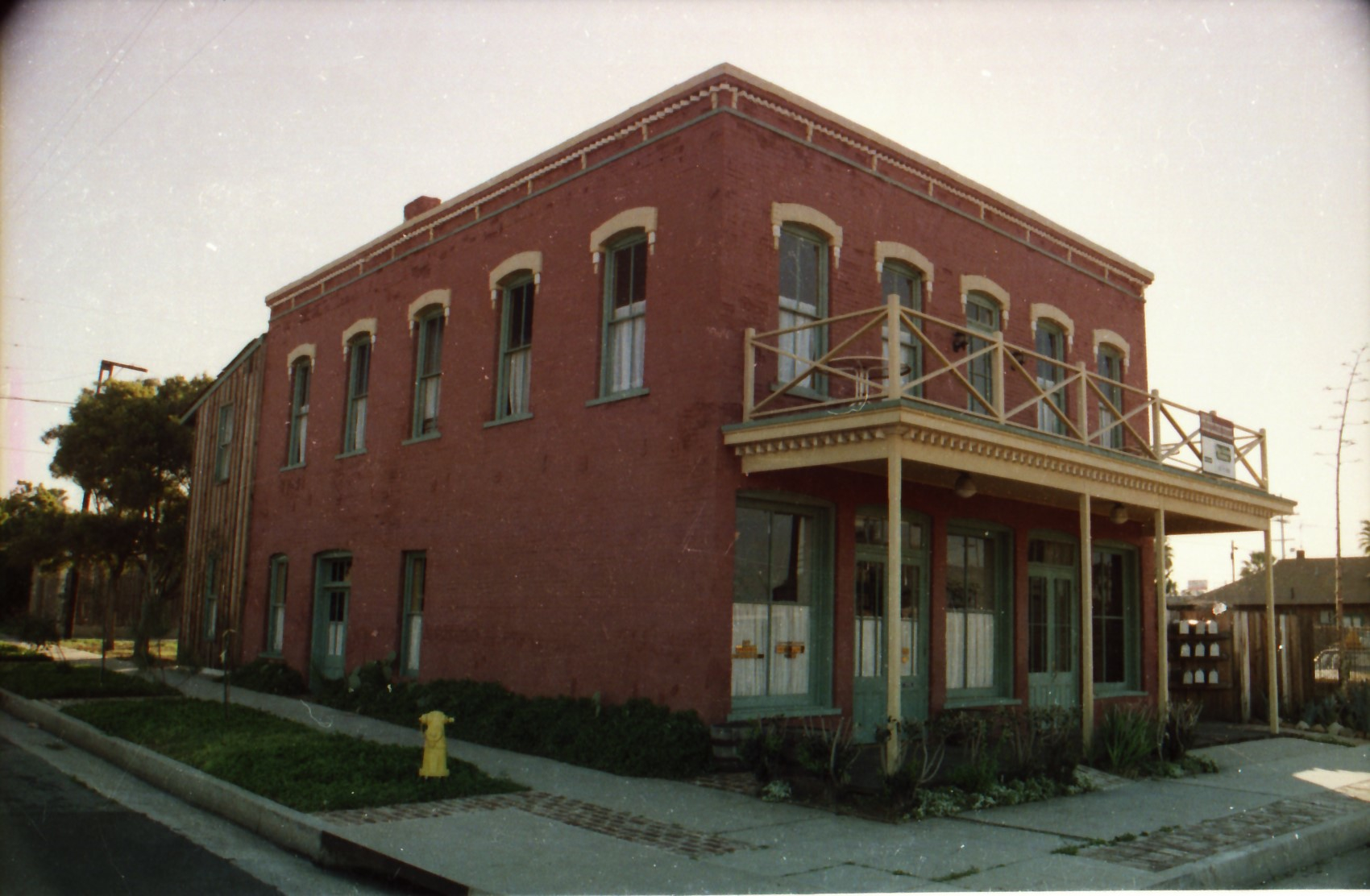
The Bunker House located at 322 North Cleveland Street was first owned in 1886 by Theodore C. Bunker. This two-story building is one of the first brick buildings in Oceanside and one of three brick buildings built in the 1880’s which are still standing.
The Bunker Family at their store and boarding house on North Cleveland Street, circa 1888
The
Bunker family arrived from Los Angeles and operated a store on the first floor and
a boarding house on the second. Bunker also owned a single-story wooden
structure next door, which served as a meat market. The Bunker House was used
as a meeting hall as well as for dances and church services.
After
Bunker’s death in 1892, Ysidora Bandini Couts, wife of Col. Cave J. Couts, held
the mortgage on the building and retained ownership. The local newspaper reported that Katherine
Mebach purchased the building in 1896.
Frederick
Rieke bought the brick building in 1904. Rieke was a general contractor and
built many homes and buildings in Oceanside, including the house located on the
same block at 312 North Cleveland Street.
In 1923 the building was sold to by H. J. Crawford and it was subsequently deeded to two other members of his family: Thomas J. Crawford, and then to Samuel J. Crawford, a prominent attorney in Los Angeles who maintained ownership until 1945 when it was sold to George Edmond Haddox of Los Angeles.
The building in the 1940s
Renamed the American Hotel in 1943, the building, which continued to serve as a boarding house, developed a rather “seedy reputation”. Longtime residents recalled as children they were forbidden to visit or linger near the building and its use by prostitutes rampantly rumored.
Those rumors were in fact true. Audrey Wetta, a 36 year old married woman from Louisiana, became the manager of the American Hotel in about 1945. She was arrested in December of 1946 for operating “a house of ill fame, and with prostitution.” During her trial Helen E. Shepherd was called to the stand and testified that she arrived in Oceanside in June of 1946 to visit her husband who was apparently stationed at Marine Corps Base Camp Pendleton. She returned to Oceanside “at the suggestion of Mrs. Wetta in December, where she entertained men for pay at the American Hotel, and part of the pay went to Mrs. Wetta.”
Adeline Vincenzo also testified, stating that she too worked at the hotel “entertaining men” until late December of 1946, when the Oceanside Police Department arrested Audrey Wetta.
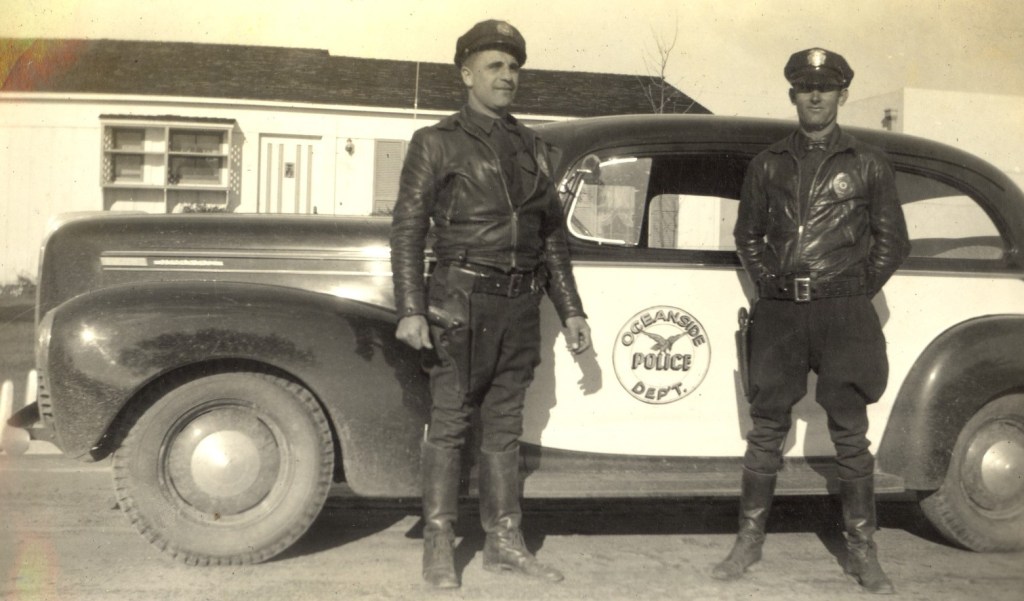
Police Captain Harold Davis testified that they had been notified from the Marine MP station in regard to the activities at the hotel. Captain Guy Woodward then submitted reports to the court from the San Diego county health department, “which showed they had on file two reports of VD infection, alleged to have originated from the hotel.”
Harold Davis and Guy Woodward of the Oceanside Police Department (1940)
Audrey Wetta did not deny her role as a Madam or even as a prostitute herself. She testified that “she believed correctly managed ‘houses’ were a service to men, as she had noted when she was employed in a hospital that 84 percent of the girls men picked up for immoral purposes transmitted a social disease to the men, while only four percent of the cases came from girls who were recognized prostitutes.”
Wetta told Judge D. A. Parson, “the first time she allowed her hotel to be used for illegal purposes was when a young Marine returned from a year and a half overseas to find the girl to whom he was engaged was going to marry someone else. In remorse he approached Mrs. Wetta and she arranged for a young wife in the hotel, who was in need of $10, to ‘entertain’ the remorseful Marine.”
She went on to say that after military personnel at Camp Pendleton diminished, so did her income. Wetta was $20 short in her monthly rent, and had “decided to entertain two men at $15 each, $10 of which was to go to a marine bringing the men to her, in order to raise the $20.”
After hearing her testimony, Judge Parsons sentenced Audrey Wetta to a year in the county jail.
Owner George Edward Haddox sold the hotel one week later to Ralph and Ella Rogers who promptly renamed their establishment the Traveler’s Hotel (as listed in phone directories) or Hotel Travelers (painted on building).
Rogers opened Rogers Music Co., also known as Rogers Phonograph Service, on the lower level and maintained the boarding house on the second floor.
1968 Ad for Rogers’ Phonograph Service
In 1959, Ella Rogers operated Gale’s Café near the Oceanside Pier at 300 1/2 North Strand, and in addition to his record store, Ralph Ross Rogers ran the Silver Dollar Tavern located at 312 Third Street (now Pier View Way). Rogers was described as “a goodhearted man who loved his parents dearly and was respected by many.”
Ralph Ross Rogers courtesy Ruby Rogers McCormick
True
to its reputation, in 1962, there was a very public arrest at the Traveler’s, which
made local papers and only solidified its reputation. A young woman from Ohio, who had recently arrived
in Oceanside, brought two 15 year old runaways from San Diego to the boarding
house to exploit for prostitution. The girls told Oceanside Police Detective Floyd
Flowers that they were to work in exchange for lodging, food and clothing.
Ella
Rogers died in 1973, as Ralph continued to operate his music business while living
in his building on Cleveland Street. On September 26, 1976 Ralph Rogers was
found murdered at the Traveler’s Hotel, stabbed multiple times and strangled.
Hotel Travelers in 1981
One
month later an arrest was made. Joseph Shavon Whitaker, age 21, was arrested
for not only Rogers’ murder, but that of William O. Clark’s in a San Diego
hotel. Whitaker went to trial in 1977, was found guilty and sentenced to life
in prison.
After
Rogers’ death the building was vacated and left to deteriorate. It seemed
destined for the wrecking ball until it was purchased by realtor Chris Parsons
in 1982. Parsons saw the potential in the weathered building and began its
restoration.
Chris Parsons on balcony during restorationAfter restoration
While its reputation has been tainted with scandal, the building itself is nearly unchanged from when the Bunkers owned it over 130 years and provides historic charm and character to Downtown Oceanside.
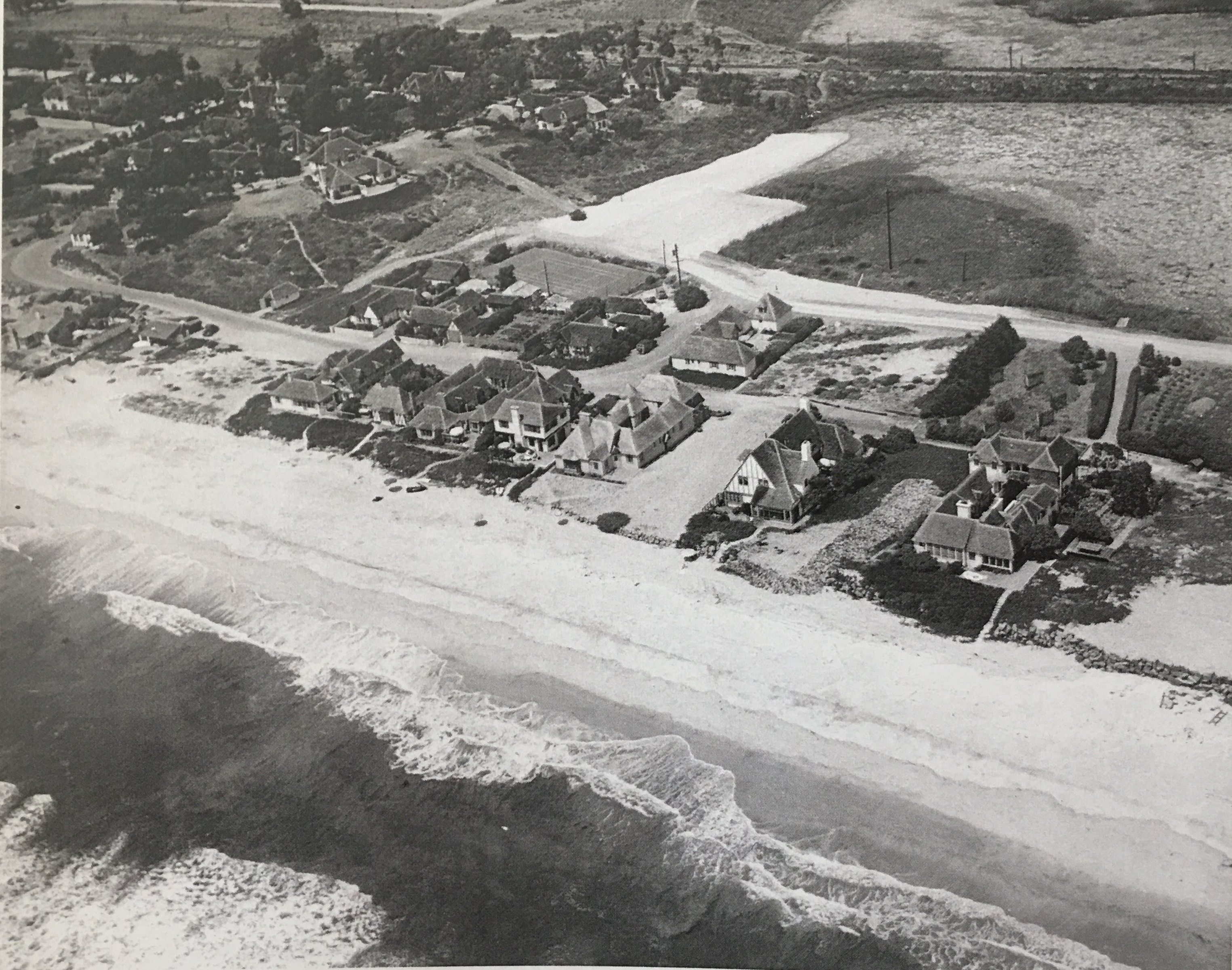
Over several decades many residents and visitors alike have often wondered who lived beyond the gate at the end of Oceanside’s South Pacific Street. An impressive entrance allowed but a sneak peek into beautiful homes with unique architectural features.
Kenyon A. Keith, a wealthy resident of Pasadena, purchased 28 acres of oceanfront property in 1928. The following year he began developing a colony with custom built homes that were designed to resemble a French fishing village, St. Malo. Residency was by invitation only and limited to family and hand selected friends.
The St. Malo Subdivision begins at Eaton and South Pacific Streets. However, the St. Malo community, also extends on either side of the 2000 block of South Pacific Street. As homes were constructed, and continue to be built, they are kept to a strict standard of architectural style and materials, built and weathered to appear as if they have been there for decades.
The entry way or St. Malo Gate, was designed by architect William McCay. Keith wanted an imposing entrance to the St. Malo Beach community and built it to represent “a sense of place.”
St. Malo Gate at the end of South Pacific Street, circa 1930 Courtesy of “The History of St. Malo” by Nancy Keith Tenaglia
St.
Malo homes weren’t just weekend hideaways for the wealthy, wanting to escape
from the city, they often “summered” there. Owners brought a full staff, with
maids and cooks as most homes were built with “servants’ quarters.”
Homes
were fondly described by owners as “story book cottages” or “chalets.” Nicknamed “Pasadena on the Rocks”, St. Malo
offered a private beach, playground, 3 tennis courts, a volleyball court and a
clubhouse cabana. Activities included
exclusive cocktail parties, barbeques and trips to the Delmar Races. Close friends of the owners were allowed to
rent or even borrow houses for social gatherings and vacations.
Courtesy of “The History of St. Malo” by Nancy Keith Tenaglia
Although
Oceanside residents were not likely privy to the comings and goings of
colonists, their activities were posted in the society pages of the Los Angeles
Times that featured headlines such as:
“St. Malo is Favorite for Pasadena Folk”; “St. Malo Beckons Social Set”;
“St. Malo Beach Hums with Activity.” The social columnists promoted the
exclusivity of St. Malo, but provided the names of the socialites and families
that were staying there, along with their activities and other gossip. They boasted that St. Malo parties were
better than any in Hollywood.
View of St. Malo, Jason Joy’s palatial residence far right Courtesy of “The History of St. Malo” by Nancy Keith Tenaglia
While
newspaper articles attributed the location of St. Malo as in or near Oceanside,
some attempted to place the community nearer tonier locales such La Jolla or
Delmar. However, in 1950 the City of Oceanside annexed the St. Malo
subdivision, at the owners’ request, which at the time had grown to 24
homes.
The
heyday of St. Malo was from the 1930s and 1960s. Owners included Desaix Myers, a mining
engineer; Dr. John Dunlop, pioneer orthopedic surgeon; Karl G. Von Platen,
lumber magnate; Attorney Steve Halsted; Lamar Trotti, writer and film producer;
W. John Kenney, Asst. Secretary of Navy; Frank Butler, screenwriter; songwriter
Nacio Herb Brown; Hugh Darling, mayor of Beverly Hills; painter Marge
Wilman. Another wealthy “colonist” was
Alice Pillsbury Forsman, daughter of the co-founder of the Pillsbury
Mills. St. Malo was such a way of life
for most, even when they passed away their obituaries mentioned their affection
of their St. Malo home away from home.
Other
notable residents were film director Jason S. Joy and author Ben Hecht. Joy’s St. Malo home was referred to as
“La Garde Joyeuse” and included an outdoor bowling alley and
volleyball court. Hecht, whose prolific
works include “Scarface”, purchased his St. Malo home in 1950. While living in
Oceanside, he wrote a children’s book about a cat who roamed the streets of
Oceanside. He said in an interview that he often wrote from his den overlooking
the Pacific Ocean.
Cover of the children’s book Ben Hecht wrote about a cat that lived in Oceanside, 1947
Homes
within the colony sold for $57,000 (and up) in the 1940s, however, ownership
was contingent upon “membership” and the approval of Kenyon Keith.
Over the years visitors have included Harpo Marx and James Maytag, (Maytag appliances). The most famous and royal visitors were none other than England’s Prince Phillip and Princess Anne, who stayed at St. Malo while attending events during the Los Angeles Olympics in 1984.
No longer quite as exclusive, new families mingle with the more “established” residents. While St. Malo is no longer a secret, it still remains private and the homes behind the gated entrance and those who live there, still evoke a bit of mystery.
The True Story of the Buena Vista Cemetery in South Oceanside – Adding to the Burial List
Editor’s Note (Oct 10, 2025): With continued research the body count at the Buena Vista Cemetery continues to grow, bringing the total to known burials to 52. As the number of burials rise so does the unsettling feeling that more have been left behind, on the site of the Hunter Steakhouse and the next door business (now a coffee shop).
Two previous unknown persons were Comfort Spencer who died in 1890 in Encinitas and Albert Vail who died in 1893. Both were buried in the South Oceanside Cemetery.
In 2020 death notices of three additional people who were buried in the Buena Vista Cemetery were discovered. Brothers Percy and Albert Laughlin, died in 1888 and 1895, their obituaries published in Kansas newspapers indicate they were buried at South Oceanside. Then, it was In addition, the Escondido newspaper reported that John Goss died in 1908 and was buried at Buena Vista Cemetery (and even at that time reported the sorry state of the cemetery…just 20 years after it was established).
History of the Buena Vista Cemetery
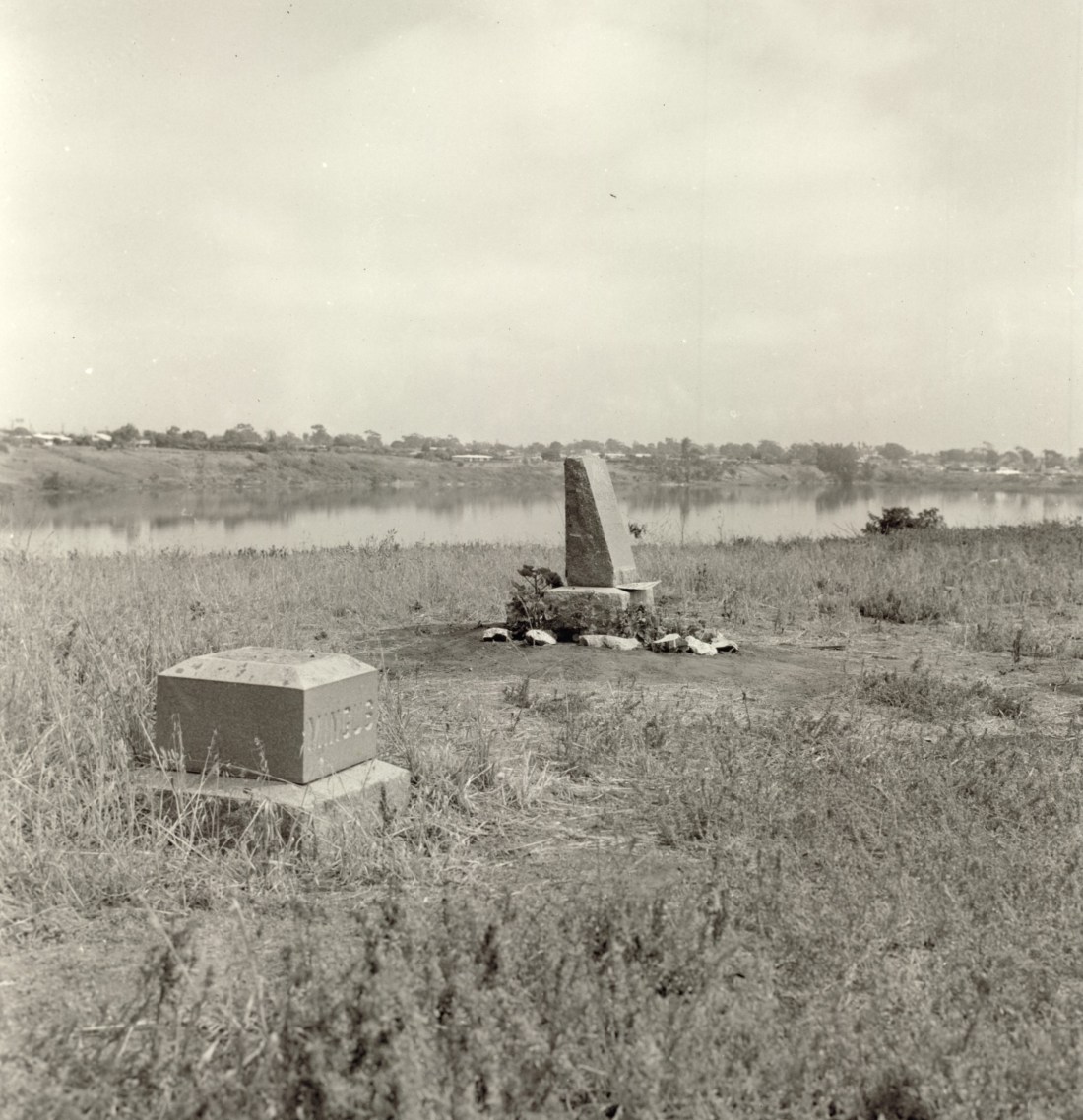
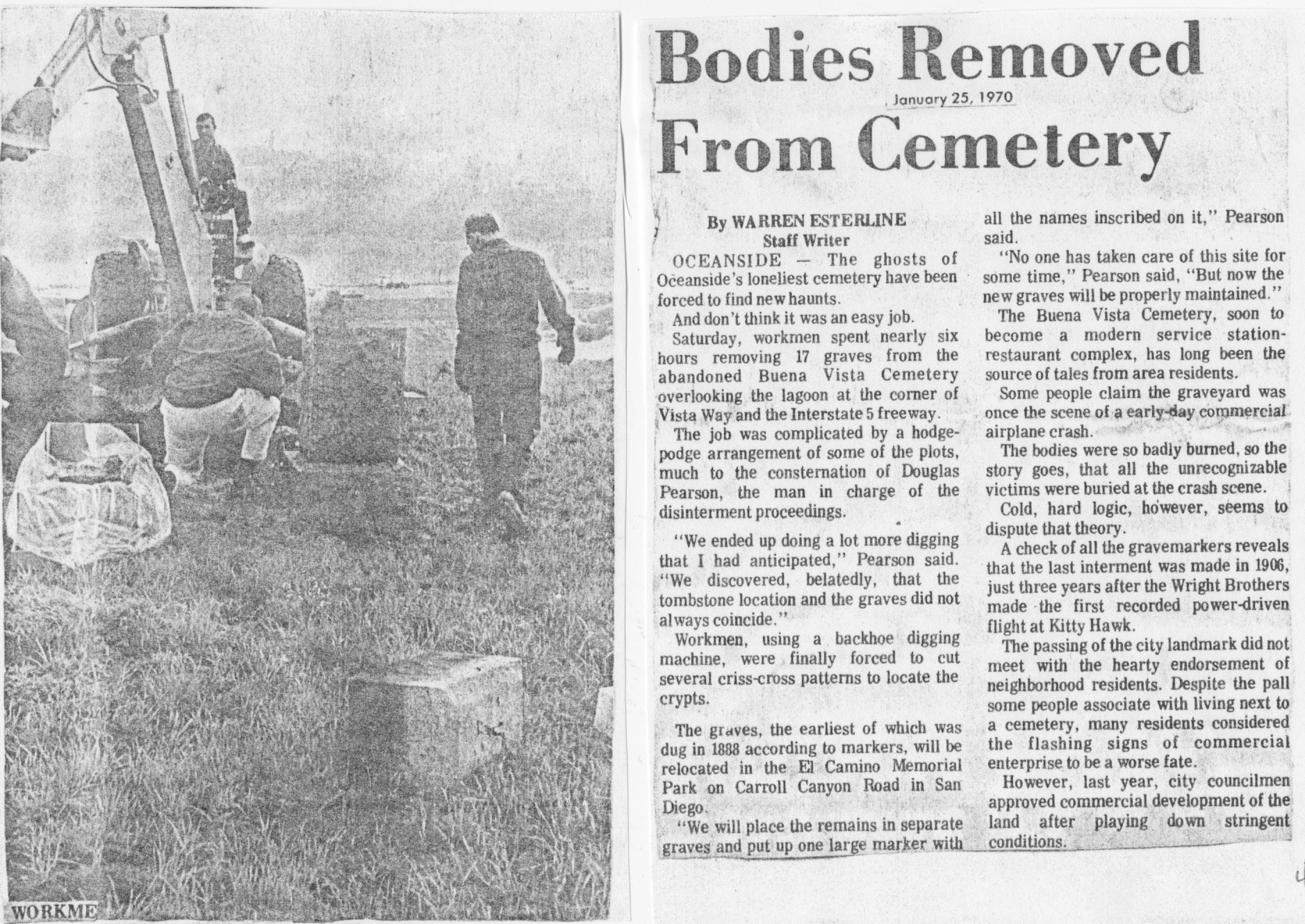
On Saturday, January 24, 1970, workmen began the task of removing graves from the Buena Vista Cemetery in South Oceanside. It took six hours to locate and remove 17 remains of the dead on the 2 acre site. People who had been buried there between 1888 and about 1916. The unidentified remains were removed to El Camino Memorial Park in Sorrento Valley.
The cemetery had been neglected for several decades. It was privately owned, not associated with any church or organization. Thus, there was no “perpetual care”. There was no official burial list or caretaker. Over the years, headstones had been likely stolen, wooden crosses removed, and memories faded as to who was buried there, and the cemetery became an overgrown field with a handful of toppled headstones.
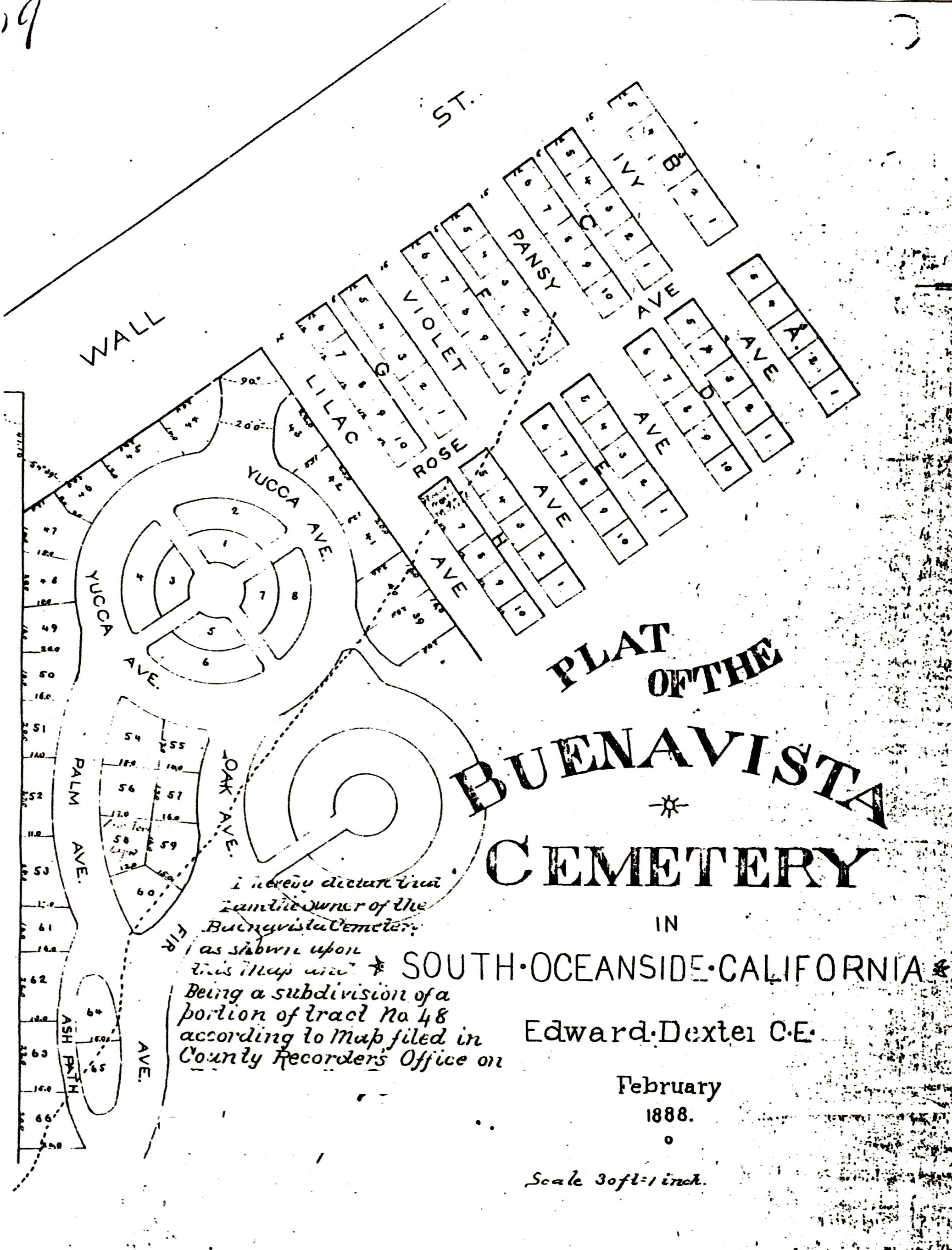
Despite the neglect, most of the people interred at Buena Vista Cemetery had families that attended their funerals, mourned their passing, and placed markers on their final resting place, whether wooden or stone. They were just not nameless, unfortunate souls who died alone. The dead were laid to rest in a peaceful, picturesque cemetery overlooking the Buena Vista Lagoon, which also provided expansive views of the Pacific Ocean. Lanes within the graveyard bore the names of trees and flowers: Fir, Oak,Yucca, Palm, Ivy, Lilac, Pansy, Rose and Violet.
The Buena Vista Cemetery was located in South Oceanside, a separate township of its own between Oceanside and Carlsbad. It was established by John Chauncey Hayes who was also heavily intertwined with the establishment of the City of Oceanside. Hayes became the exclusive real estate agent for Andrew Jackson Myers, Oceanside’s founder, and he also served as Justice of the Peace and postmaster.
John Chauncey Hayes, established the township of South Oceanside and owned the Buena Vista Cemetery in South Oceanside
Hayes began to develop his new township of South Oceanside which included a train depot, hotel and its own newspaper, The South Oceanside Diamond, of which Hayes was the editor.
Hayes hired Edward Dexter, a local engineer, to lay out the cemetery for him, which contained 106 burial plots. The earliest map of the cemetery gives credit to Dexter and is dated February 1888. However the cemetery was not officially recorded until 1893.
The cemetery was located along Wall Street, which is now called Vista Way. At the time Hayes established the cemetery there was no other burial ground for area residents, including Carlsbad, Oceanside and even Vista. The closest cemetery would be that of the Mission San Luis Rey, for Catholics; or a small public graveyard called the San Luis Rey Cemetery (known now as the Pioneer Cemetery). Both of these burial grounds were at least four miles away from downtown Oceanside and were likely considered inconvenient for coastal residents.
It did not take long for the new cemetery to be utilized, as perhaps one or two infants were laid to rest shortly by mid-March 1888. Sarah Perry may have been among the first few known adults to be buried at Buena Vista. She died of dropsy of the heart, an old fashioned term for congestive heart failure, at the age of 50 on March 27, 1888.
In June of that year, a Mr. P. Morton, a railroad laborer, died and was buried there. Ione Layne and her infant daughter Edith died tragically and were buried there in 1888 as well.
George Bronson, who was buried elsewhere, and had died in 1885, was moved to Buena Vista Cemetery by his wife Mary in December of 1888. She had a monument maker from San Diego place a new headstone for her husband.
Headstone of George Bronson, moved from the Buena Vista Cemetery to the Oceanview Cemetery
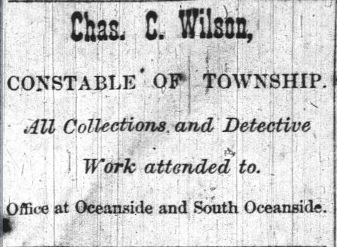
Charles C. Wilson was also buried at Buena Vista. He was the first Oceanside law officer to die in the line of duty in 1889. Wilson was gunned down on the streets of Oceanside by John Murray, a nephew of San Luis Rey pioneer Benjamin F. Hubbert. The City of Oceanside, set to celebrate the 4th of July, instead gathered to mourn the loss of their marshal.
!888 Advertisement for Charles C. Wilson
Five children all died in 1893 and were buried at the cemetery: Zoe Holman, her sibling, Johnnie Hunting, Lois Hunting and Henry Irwin.
Between 1888 and 1900, at least 38 persons were buried at Buena Vista Cemetery, and it is believed that 51 (or more) people were buried there, evidenced by death certificates, remaining headstones and published obituaries through 1916. Notable pioneers include John Henry Myers, the brother of Oceanside’s founder Andrew Jackson Myers, and members of the Weitzel, Frazee families.
John Henry Myers, brother of Oceanside’s founder, Andrew Jackson Myers, was buried at South Oceanside in 1894
The last known burial was in 1916. Meta Spaulding was just ten days old when she died on December 31, 1916. She had been adopted by the Warren Spaulding family, owners of a dairy in South Oceanside. Irma Spaulding Ratcliff said that she remembered walking to the cemetery as a little girl after the funeral for Meta’s burial.
Burials were probably discontinued due to a new and much closer cemetery in Oceanside, the I.O.O.F. Cemetery (now known as Oceanview Cemetery) that was established in 1894.
In 1929 Wall Street (aka Vista Way) was being widened, which necessitated the removal of several of the buried. It is unknown if there were any protests from family members but the cemetery by that time was considered “abandoned”. Eight remains of the dead were disinterred and removed to the I.O.O.F. Cemetery, (aka the Oceanview Cemetery) on Hill Street (Coast Highway). They included George Bronson (his second reburial), little Meta Spaulding, India D. Goetz, siblings Johnnie and Lois Hunting, Fred T. Walker, and James McCrea. The Weitzel family moved the bodies of their loved ones, Laura and Dr. Martin Weitzel, to Mt. Hope Cemetery in San Diego. Ida Squires was moved to the San Marcos Cemetery.
The Frazee family removed their family member, Don Blair Frazee to the I.O.O.F Cemetery on Hill Street. The Oceanside Blade newspaper reported the unusual circumstances regarding his disinterment with the headline: Body of Early Pioneer in Perfect Condition. It went on to say: In a state of almost perfect preservation, apparently from some mineral component of the soil, the body of Don Frazee, early Oceanside pioneer, has been exhumed after having been interred over 30 years, the casket and the clothing showing almost no signs of decay and a flower held in the hand of the dead man even retaining much of its color. The body was taken from its original resting place in the South Oceanside cemetery which is being abandoned in the course of street improvement work in the Tolle tract, on the east side of which the old cemetery was located, and was the first burial place after the settlement of Oceanside and Carlsbad.
With 51 known burials, and eleven known removals in 1929, that would have left a total of 40 remaining at the Buena Vista Cemetery, an important number to consider.
If the cemetery was abandoned by 1929, it is unknown how long Hayes owned the property. The land on which the cemetery was located was eventually sold to Carlsbad resident Harold Baumgartner. He sold the property in 1958/59 to an Oceanside school teacher, Beth Harris French, who acquired the Buena Vista Cemetery along with another portion of land to “preserve her view” of the lagoon from her home at 2020 Stewart Street.
While French was left wondering who was responsible for the care of the cemetery, she attempted to find an organization to take over the care and upkeep. Perhaps once a year, an occasional youth group or Boy Scout troop would tend to the headstones, at which time totaled twenty. Despite her concern, French asked the city to rezone her property and then sold it to a developer, who then petitioned the City of Oceanside to rezone the property for commercial use.
A clean up of the cemetery in 1968 shows several of the headstones
At the time James Swartz, of Encino, argued that the number of dead remaining in this abandoned cemetery was just nine. When asked by City officials what would happen if there were more than eleven remaining, Swartz said that if there were as many as forty or people buried there, he would abandon the project. (There may have been as many as 42 remaining burials as previously noted.)
A few dozen local residents signed letters of protests, most of which were residents of South Oceanside and not related to the buried. Some attempt was made to find descendants of the dead but it appears none came forward.
A lot of misinformation was floated around. Some people insisted that there just three people buried (despite over a dozen headstones); others suggested that the people buried all died in a plane crash (quite impossible as most people buried there died before the Wright Brothers historic flight in 1903).
Ultimately the decision was made to allow development of the property and to disinter the bodies, the cost of which was borne by the developer.
When excavation began, seventeen remains were discovered, not eleven as Swartz claimed. It turns out that Swartz may have simply counted the existing headstones, and did not consider there were more people than markers. The remaining headstones did not make their way to El Camino Memorial Park with the disinterred remains. They had been moved and no longer coincided with the proper burial location. Instead the grave markers were used as fill and are ‘buried’ under the onramp to Highway 78, just east of the cemetery location. Perhaps one day they will be discovered by a Caltrans crew who will have no idea as to their origin or rightful place.
It is well within reason to assume that as many as 42 set of remains were still buried at the cemetery before the project began. If 17 sets of remains were removed at the developer’s cost, that may have left 25 behind (or more).
Grading began on the property to ready it for development. Soon after which several remains, unceremoniously left behind, were discovered. This was confirmed by two reputable people. One such account was from Manny Mancillas, who worked for North County Soils Testing Laboratory in Escondido in 1969. His company was hired by an oil company, as a service station was to be built on the eastern portion of the former burial site, and the western half a restaurant, The Hungry Hunter.
Mancillas remembered that the gravestones had been gathered in a pile before they were used as fill on the I-5 offramp. He noted that some of headstones were “beautiful” and some were about four feet high.
After a couple of days on the job site, the front loader hit remains of one or two coffins. According to Mancillas, the City was called and an employee from the Engineering Department came out with a burlap bag and took the bones. The crew was told to continue their work. This “transaction” happened at least one other time, when an additional grave was discovered. And as digging continued, outlines of other coffins appeared.
One particular coffin the crew uncovered had a lead glass top, revealing a body of a woman with red hair in almost perfect condition. Her coffin was found near Vista Way towards the entrance of the present day Hunter Restaurant. He said that she was dressed in attire from the late 1800’s; a black buttoned dress with a high white collar. This mirrors the disinterment of Don Frazee in 1929, who was found “preserved.”
Work stopped after the discovery of the woman and the men were unnerved. The men were afraid she would be taken away in a burlap bag and not given a proper burial, so they made the decision to use the front loader to rebury her. Her discovery was kept secret and she was quietly buried down the slope of the lagoon. The construction crew felt that re-interment in the slope was a more decent and dignified burial for the “Lady in Black.”
Aerial of property containing restaurant and current bike shop
Mancillas said that at least six bodies were found during the time he was on site. Bill Hitt, who worked for K L Redfern out of Orange County, did the excavating for the gas station and his memories are similar to that of Mancillas, although Hitt felt more than six remains were found after the official removal; he remembered as many as 12.
Depending upon which numbers are used, that would still leave either 13 or 19 possible remains left at the cemetery.
While some might scoff at the idea that any other bodies or remains were left behind, consider this: In October of 1991, Texaco was on site of the former service station (now a bike shop) perhaps doing soils testing and they discovered an additional five sets of remains. There was no way to identify them, and the company paid to have them removed to Eternal Hills Memorial Park in Oceanside.
Even with the removal of 5 additional remains in 1991, there are likely still remains at the site to this day, perhaps 8 or as many as 14. (Depending on how many remains were actually removed by the two different grading companies).
There are some who believe the Hunter Restaurant is now haunted. Whether you believe in spirits or not, it is still an unsettling situation.
With the removal of Buena Vista Cemetery, Oceanside lost a part of its history. When those early pioneer families laid their loved ones to rest they never could have imagined they would suffer such indignities.
In the 1990’s the Oceanside Historical Society placed a granite marker on the sidewalk on Vista Way in front of the Hunter Restaurant, listing the known persons that were buried there at the time. (The plaque does not include persons found with additional research in recent years). It stands as the only reminder of the Buena Vista Cemetery and the pioneers buried there.
The video below was a live podcast about the Buena Vista Cemetery. There is a introduction into the haunting of the Avo Theatre in Vista and then an in depth talk and discussion about the cemetery under the Hunter Steakhouse!
Kristi S. Hawthorne, historiesandmysteries.blog “Death of a Cemetery”, 2019. Unauthorized use and/or duplication of this material without express consent and written permission from the author and owner is strictly prohibited. Links may be used, provided that full and clear credit is given to the author Kristi S. Hawthorne and historiesandmysteries.blog “Death of a Cemetery”, with appropriate and specific direction to the original content.
“WAS HE INSANE, IS HE INSANE NOW?” That was the actual headline of a print ad for Curran Real Estate in the 1920s. This unconventional advertisement was written by William Edward Curran, a local Oceanside businessman with an uncontrollable temper, who would do the unthinkable: commit murder.
Curran’s curious and odd newspaper ad went on to say: “I was called insane by some of the Oceanside mossbanks when I started to improve the James property. Take a look at it now. A few more green spots like this will make our city. Come one and all, it’s great to be crazy”.
Years
later his attorney would argue in court that Curran was indeed insane.
Curran’s advertisement as it appeared in the Oceanside Blade
William
Edward Curran came to Oceanside from Ohio in 1919. A married man and father of
two sons, he had a junk business. Soon afterwards he ventured into real estate,
which by all appearances was a successful enterprise.
Born
May 26, 1886, in Pocahontas, Virginia, Curran’s parents moved to Cleveland,
Ohio by 1900. William E. Curran’s earliest occupation was that of a decorator
or wall paper hanger. William Edward married Anna Hayer in Cleveland in 1911
and their sons Richard and Frank were both born in Ohio.
Shortly
after the Curran family settled in Oceanside, William purchased three lots near
the corner of Third and Myers Streets (Third is now Pier View Way). He later
acquired a business located at the corner of Third and Pacific Street called
the “Fox Den” which was a lucrative beach concession during the
summer months because of its proximity to the Oceanside Pier.
Curran
joined the local Chamber of Commerce but soon found himself at odds with one of
the directors. In June of 1922 he wrote an editorial calling out Secretary
Thomas Bakewell, saying “I think you are a joke” because Bakewell did not
endorse Curran’s idea of promoting Oceanside as an area rich with oil deposits.
He was later involved in a lawsuit regarding such claims.
Curran’s
unorthodox ideas and self-promotion might have been successful in getting a dig
in at his critics’ expense, it was apparent that his arrogance did not win him
friends or supporters. In July of 1922 Curran unsuccessfully ran for city
constable.
However eccentric Curran appeared to be, he soon proved to be volatile as well. In 1923 he was arrested and placed in jail after being charged with battery against Vere Scheunemann, a 16-year-old local boy. Curran was 37 years old at the time of the assault. He was a large man standing 6 feet tall and weighing 200 pounds, and at one time was an amateur boxer by the name of “Red Kenney”. On the day of the vicious attack, William Curran knocked out three of the young man’s front teeth, but after hiring an attorney was able to get out of jail on bail. His attorney petitioned the court to have the trial moved because Curran said that he couldn’t get a fair trial in Oceanside “owing to a prejudice in the community against him.” One month later Curran was arrested again for disturbing the peace. He again asked for a change of venue because of “prejudice against him.”
Another ad published by Curran in the Oceanside Blade
Despite
his erratic and violent behavior, Curran ran for city council in 1924. Not
surprisingly, he lost the election. He was a regular attendee at council
meetings, at which he voiced his concerns over competition from other beach
concessionaires. He was also a proponent of building a new pier made entirely
of concrete. The city council balked at the suggestion because of the “prohibitive cost.” The newspaper reported that W. E. Curran was
undaunted and “advocated this type of construction regardless of the cost
and addressed the board to that effect, but his suggestion met with no favor.”
Curran’s
unstable behavior continued when in 1925 Curran found himself again in court as
a defendant after he assaulted Frank Graff, in a dispute over a fish business
near the pier.
Even
though his reputation appeared to be ruined, Curran unapologetically ran again for
city council in 1930 stating: “My platform is reduction of taxes and to halt
further improvements for the present. I also am strongly in favor of home
labor. Being a large property owner in Oceanside, and always a staunch booster
for the welfare of the City, my interests are yours.” He was not elected.
Nothing
is known of the outcomes of Curran’s previous run-ins with the law or any
particular consequence he faced except for being ostracized. However, one
encounter with Curran years later would have a deadly outcome.
One
summer evening in 1944, two Marines stationed at Camp Pendleton stopped or
walked through Curran’s property at 107 Third Street (Pier View Way) where
Curran was living in a two-story building, which served both as a storefront as
well as his home.
The two men were on the way to view a side-show of sorts, where a two-headed cow was on display inside a tent, just east of Curran’s home and vacant lot. Curran spotted the Marines and believed that they were going to siphon his gasoline. Fuel was a hot commodity because gasoline and other items were rationed and in short supply during World War II.
Third Street at the corner of Myers. Note the tent which featured the two-headed cow the Marines were on their way to see. To the right, is an empty lot, and then Curran’s home and office.
According
to Curran’s account, he ordered the men off of his property and they became
combative. Curran then went inside his home to retrieve an unloaded gun and
confronted the Marines again. Despite being armed with a gun, the Marines
became more aggressive and came after him, according to Curran. He then ran back
into the home, threw down the gun and grabbed “some object”. That object was a “commando style” knife,
with a brass knuckle handle which Curran took with him to challenge the men. He
ran back to the Marines, “a scuffle ensued” and Corporal Erwin E. Koch was
stabbed three times, including a fatal blow straight to the heart. Koch fell to
the ground, bleeding profusely while his fellow Marine, Corporal August N.
Heveker, tried to render aid.
Before
police arrived, Curran hid the weapon in a pile of boxes and empty bottles
behind his home. He later produced a small knife to the police but it was
apparent that the deadly wound had been made by a much larger knife. The police
on the scene included Police Chief William L. Coyle and Captain Harold B. Davis,
who found the bloodied murder weapon after a 30 minute search, where Curran had
stashed it.
Police Captain Harold B. Davis searched through this pile of junk and bottles to find the murder weapon
Koch
died of his wounds and was taken to the Oceanside Mortuary at 602 South Hill
Street (now Coast Highway). There the police discovered a letter Koch had
written to his wife in Nebraska soaked in blood. Koch was just 29 years old,
and in addition to his grieving wife, left behind two small children. Family
back in his home town of Eustis, Nebraska were stunned and left to wonder of
the circumstances that took the life of their beloved son, husband and brother.
Erwin’s widow, Otalee Elizabeth, would later remarry.
William
Curran was arrested by local police and questioned, when he then claimed that
the Marines had followed him into his home, pushed him down and struck him in
the head. He was taken down to San Diego for an inquest just days later at
which Corporal August Heveker testified to the details leading up to the
murder.
“We had been out on the
Oceanside pier and had come up Third Street preparatory to entering a side show
to see a two-headed cow. Wishing to urinate before entering the show, we went
back along a building about 20 feet. As we did so, a man yelled to us from the
rear doorway, ordering us off. We left the place where we were standing and
went to the sidewalk toward the tent, going back again on the vacant lot just
west of the tent, believing we were off this man’s property. The man came out
again, this time with a gun in his hands. We started off again, and as we
neared the sidewalk, I happened to look back and saw this man coming toward us
with a shining instrument in his hand. I called for Koch to duck, and I ran
forward to the walk. Koch was between the man and me, and did not have time to
even turn around. As he fell, he yelled he had been stabbed.”
Heveker went on to
testify that the two had never followed after Curran, entered his home or
struck him. Police testified at the inquest saying that Curran had no marks or
cuts on him, although he did hold his head as though he were injured. There was
no evidence of a scuffle, as Curran had claimed, only a pool of blood on the
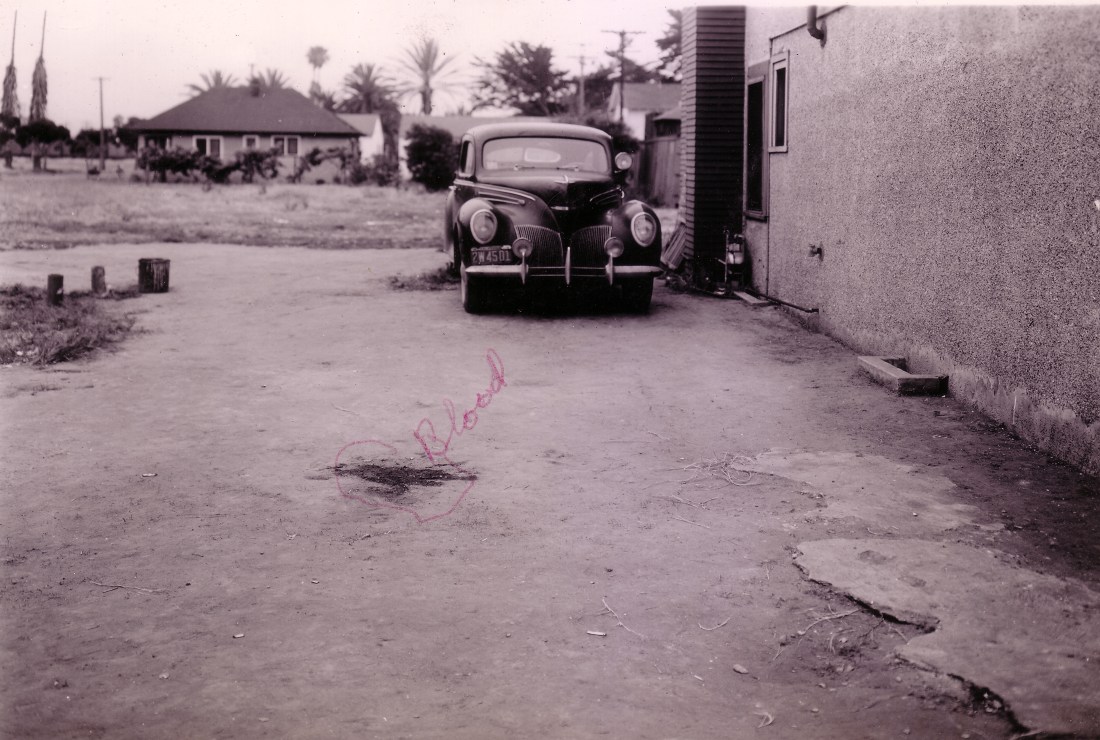
vacant lot where Koch was attacked.
This crime scene photo indicates the location of the stabbing.
The jury at the inquest
found Curran responsible for the death of Koch. The murder trial was held the
following month in July and Curran testified in his own defense. Inexplicably,
Curran left the stand, walked up to August Heveker and shouted: “That man lied
about me. Anyone could look at his face and tell that he was lying. He pushed
Koch towards me and incited him to attack me. He is responsible for Koch being
stabbed. After I struck Koch, he took two steps away from me and sagged to his
knees. After he fell, this man Heveker tried to drag his body off my property.”
Curran was found guilty
of second-degree murder. Defense witnesses included Curran’s brothers Frank and
Clarence, his wife Annie and his sister Mary. Oceanside’s Mayor Ted Holden,
Curran’s attorney James B. Abbey, along with the County Psychiatrist, also
testified that Curran was insane. The witnesses provided a number of incidents
to prove up their allegations that the Curran was “mentally unbalanced.” The
very next day the same jury that found him guilty of murder, determined that
Curran was insane. The newspaper reported that Curran would be sent to a “state
asylum for the criminally insane.”
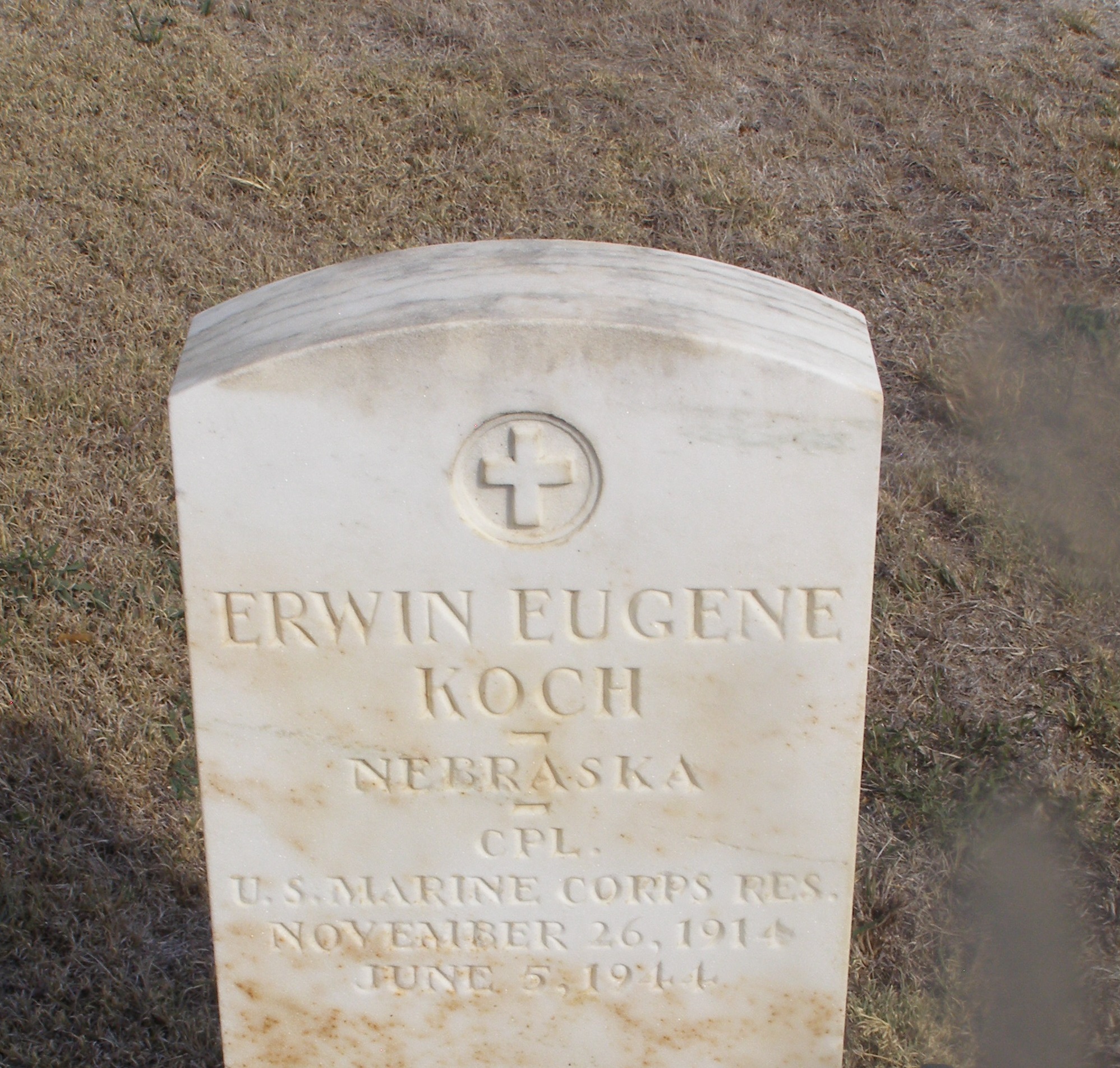
Erwin Eugene Koch was
laid to rest in the Eustis East Cemetery, in Eustis, Nebraska, a small town of
600, settled by German immigrants. A military headstone marks his grave. When
Koch went in the Marine Corps during wartime, his family might have worried
about the dangers that might befall him. He wasn’t killed in war by a foreign
enemy, but by a fellow countryman.
It is unknown how long William Curran was actually confined and when or if he was deemed “sane”. But by by March of 1950 he was back in Oceanside and still owned the property where the murder occurred. Curran’s son, Frank Earl Curran, was elected as Mayor of San Diego, serving from 1963 and 1971. William Edward Curran died on July 19, 1963. He was interred at Eternal Hills Memorial Park, in Oceanside, along with his wife who later died in 1989.
Thelma Lawrence was born in Oceanside, California in 1911. She was the fifth of ten children born to Tom and Vera Lawrence.
Thelma’s father was born in Texas and came to California around 1898. He met and courted Vera Sanders in Escondido. He would often ride his bicycle 20 miles just to see her. In 1903 they were married in Oceanside where they made their home. Tom made a living painting houses and building boats.
Thelma’s father, Thomas Madison Lawrence
By the time she was ten years old, Thelma had seven brothers and sisters, all living in a small home on South Freeman Street. Two of her siblings died at a young age. Her sister Eleanor died at the age of six weeks and her brother Billie died at the age of 10 from blood poisoning. Her father worked hard to support his family, farming in various areas around town, and even working as a deputy for the Oceanside police department.
Perhaps because her mother was so busy raising children, and her father preoccupied with feeding them, Thelma searched for love and attention outside the home. Family rumors and whispers suggest that Thelma was engaged in “illicit behavior” as a teenager.
In 1925, at the age of 14 she married Adolph James Carpenter, of Carlsbad. The marriage took place in Orange County and was witnessed by her mother-in-law. It is unknown if Thelma’s parents were aware or approved of the marriage. On the marriage application Thelma gave her year of birth as 1906, to appear that she was 18 rather than a minor. One year later she gave birth to a son, Adolph Keno Carpenter, at Fisher’s Hospital, which was located on Mission Road in Oceanside. (Adolph was nicknamed “Jack” which he was called all of his life.)
Thelma moved from Oceanside as early as 1926. She and her young son Jack moved to Los Angeles and were living on West Temple Street. The 1930 Census records indicate that she was married but was obviously separated as her estranged husband was living in Carlsbad with his mother. Later that year they divorced. Census records indicate that Thelma was working as a dance instructor.
According to census records, Thelma was sharing the rent with two Filipino men. One was a “prize fighter”, the other a porter at a grocery store. In the 1930 census Thelma’s place of birth is listed as Kentucky, although she was born in California, (and her mother’s place of birth is listed as France—she was actually born in Kentucky). This could be due to the fact that Thelma was rewriting her personal history for any number of reasons, or more simply because someone other than Thelma provided the information to the census taker.
By 1932 Thelma and Jack moved to San Francisco. Thelma met an Italian immigrant by the name of Alicide “Al” Pezzi. He was a good 30 years older than Thelma and it is unknown whether they were ever married. They were in fact living together at 1178 Hollister Avenue, (and the directory has Thelma listed with the last name of “Pezzi”). Al was a cook on a number of passenger ships that traveled back and forth from San Francisco to Honolulu. Thelma’s niece, Dolly, remembered going to San Francisco to live with Thelma and Al Pezzi when she was 7 years old. She remembers that Al was short in stature, to match his temper. Dolly also vividly remembered that Al made them get rid of their family dog after it chewed his belongings.
Alcide Pezzi
By the 1933 Thelma sent her son Jack back to Oceanside and he was raised by the Lawrence family—notably he was called Jack Pezzi rather than his birth name of Jack Carpenter.
Subsequently, Thelma then moved to Honolulu, Hawaii. Perhaps she went to Hawaii with Al Pezzi on one of his many trips and decided to stay. In 1936 Thelma was living at 1337 Pensacola Street in Honolulu. It was rumored that while she was in Hawaii she making her living as a madam at one of the many brothels in Honolulu. It has been reported that “working” in Honolulu was lucrative – $30,000 or more per year, which would be equivalent to over $500,000 today. When the Naval ships came in, the lines at the brothels would stretch around the block with prostitutes “servicing” as many as 250,000 men per month. The going rate was $2.00 (a full day’s wages) for locals and $3.00 for servicemen.
Thelma’s son Jack recalled that his mother was in Hawaii while he was attending grammar school in San Francisco and being raised by family members, his Grandma Vera, and Aunts Betty and Birdie, while Thelma sent the family money from Hawaii.
In the 1940 census, Thelma was living with or married to a William Dalton. Their residence was listed as 601 40th Avenue in San Francisco. Her mother, son Jack and sister Betty are also listed as residing with them. Despite an apparent live-in relationship with Mr. Dalton, Thelma married Stanley Garrigan on November 13, 1940 in Reno, Nevada. They likely met in Honolulu, where Stanley was stationed. He was six years younger than Thelma, born 1917 in Orange County, California.
Thelma made several trips back and forth from Hawaii to the mainland during the time she lived in Hawaii, either by passenger ship or plane. Thelma’s sister Birdie visited her in 1941 and remembered that Thelma was living in a house on Booth Road and that a nightclub Thelma owned was at Waikiki Beach near the Luana Hotel.
On December 7, 1941, Japan attacked U.S. military stationed at Pearl Harbor, Hawaii, just about 10 miles west of Honolulu. After the bombing of Pearl Harbor, the U.S. declared war with Japan and catapulted the country into World War II.
Thelma and Birdie were both in Honolulu at the time of the attack and Jack remembered that when he and his Grandmother Vera were listening to the radio, there was a news report about an attack and at first, uninterested, Vera changed the station only to find out that the same report was on every station. It was the broadcast news of the attack on the Hawaiian Islands. Vera tried to call Thelma but there was no way to get through. The next day or so Thelma was able to contact her mother and said that she and Birdie were okay. They had been volunteering with the ambulances and transporting bodies to a burial site.
Thelma and Birdie returned to the states, and Jack and his grandmother Vera came back to Oceanside. At the time Oceanside’s population was less than 5,000 but that would change as the Department of the Navy took over the historic Rancho Santa Margarita y Las Flores to be used as a training base for the Marine Corps. 20,000 Marines and civilian support flooded the base. The population more than doubled in five years. Restaurants, schools and hotels were bursting at the seams and there was an immediate housing crisis.
Shortly after coming back to California, Thelma purchased what was known as the “Borden building” located on the southeast corner of Third and Tremont Streets, presumably with the money she had made as a madam in Honolulu. She went into business with her brother Jimmy and opened a nightclub called “Garrigan’s” in September of 1942. Her husband Stanley was reportedly in Vancouver, Washington for officer’s training while Thelma and her brother went to work remodeling the building and preparing for the opening of the nightclub which offered live entertainment and dancing.
The Borden Building (built in 1929). Thelma Garrigan purchased this building for her nightclub
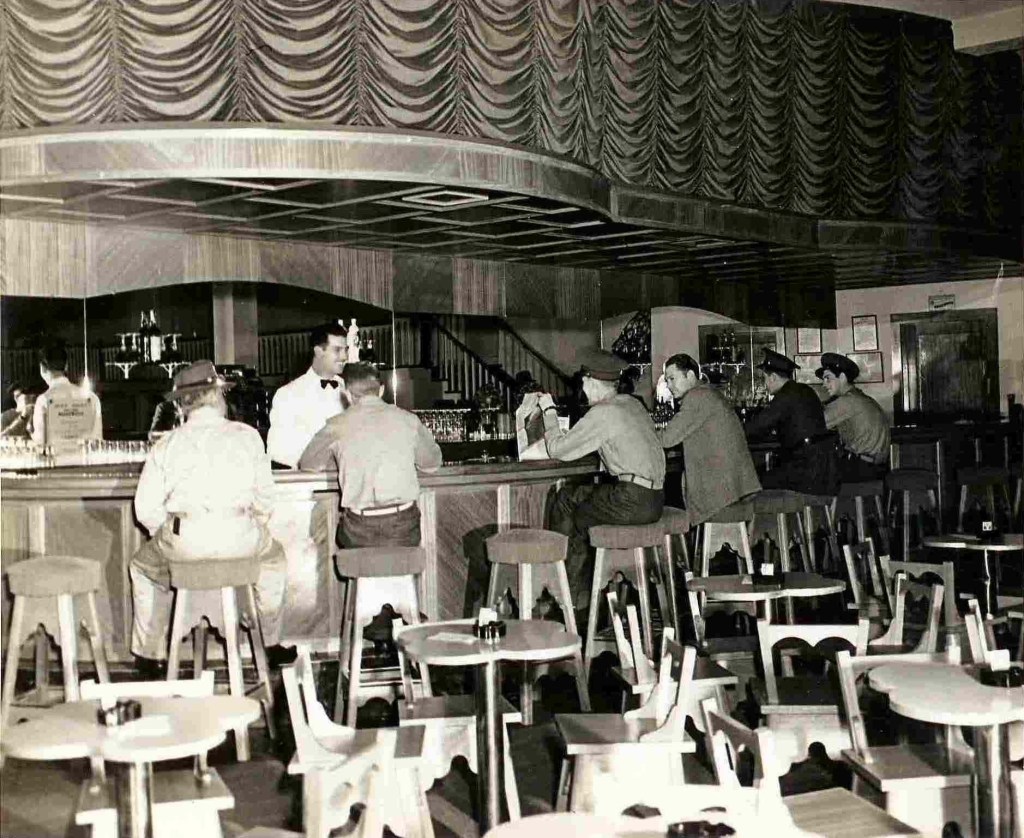
Charles O. Rowe, local contractor, was hired to remodel the main floor into a ballroom for dancing. On one end of the room a large mahogany curved bar was built. The mezzanine floor accommodated diners which featured a “high class steak house” and the upstairs contained rooms for employees and perhaps “overnight guests.” Thelma’s sister Vera (named after their mother) and her husband, Darrell Wilson, came to assist Thelma in the new nightclub. Darrell helped to manage the club and tended bar.
Darrell Wilson, Thelma’s brother-in-law, tending bar at Garrigan’s
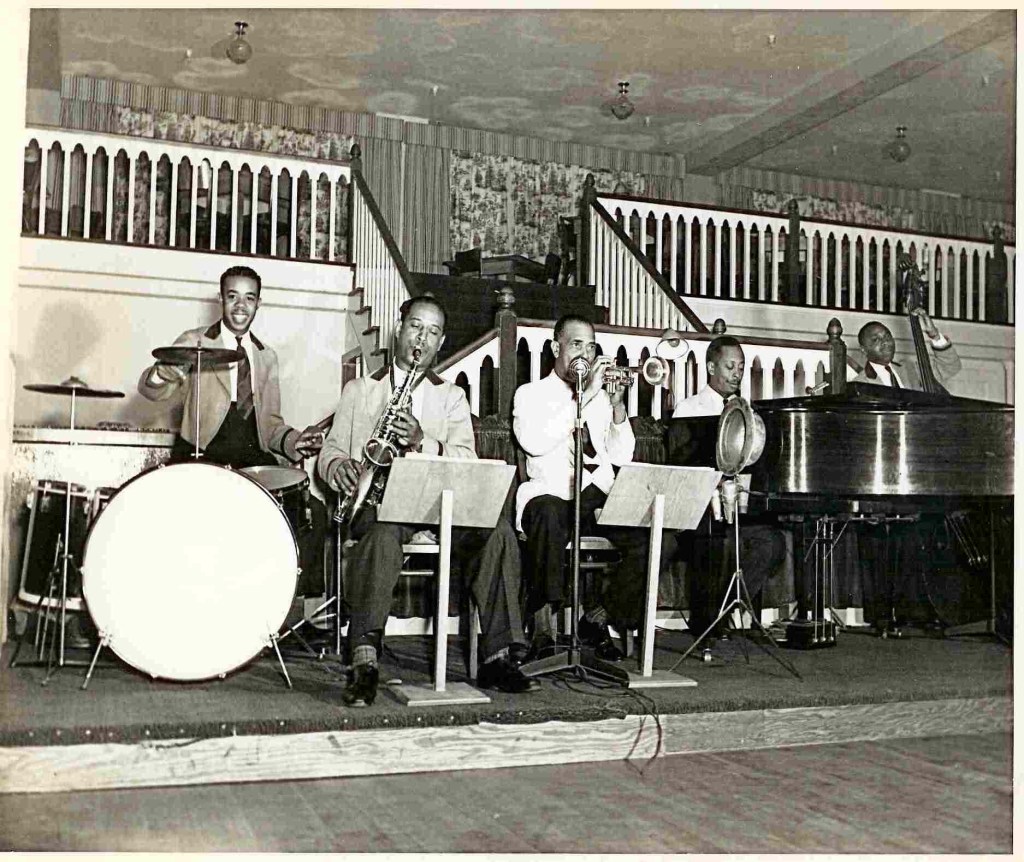
“Garrigan’s” offered live entertainment and dancing. Opened in September of 1942, Thelma’s nightclub was a huge success with over 500 people in attendance. There was nothing like it in Oceanside or surrounding communities. The local newspaper described the nightclub:
The main floor of the building has been converted into a spacious lounge, with a dance floor, in the center. Lamp lighted tables rim the floor. On one side is the orchestra, “Billy Bryant and his Music,” which delighted the crowd gathered at the opening last evening. On the east of the building is the ultra-modern cocktail bar, watched over by a grand peacock on the south wall. The peacock is radium treated and looks life like when illuminated during the evening. On the upper elevation, near the mahogany bar, are small deeply upholstered chairs that overlook the diners and the dance floor. Color effects of the entire establishment give it a rich tone. The windows are heavily draped in blue and rust, with heavy rust carpeting on the floor. Candle lighting is used on all tables. Even the banquet room was sold out last night, as every table was occupied by the opening night crowd. There are two banquet rooms, which may be used for parties on the west side of the building. These may be made into one large banquet room. Across the back of the building is the kitchen, open to the view of the diners. It is separated by an illuminated showcase, displaying the feature of the house, Kansas City steaks. Rest rooms are near the bar. The office is on the mezzanine, overlooking the dance floor.
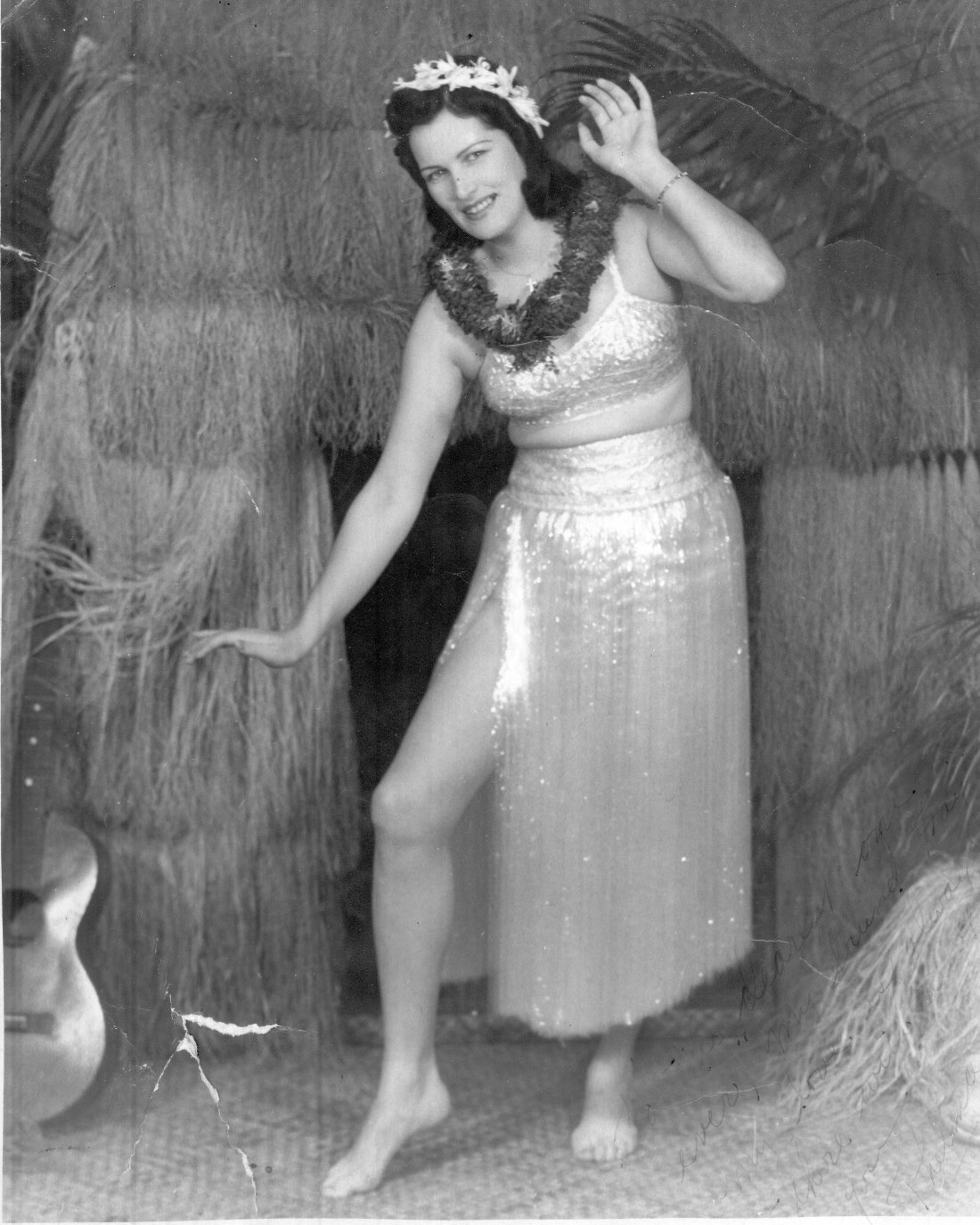
Son Jack remembered opening night when his mother made her welcoming speech to her many guests. After her opening remarks, Thelma left briefly and then reappeared in a see- through hula skirt and did a hula dance and the crowd went wild.
Thelma Lawrence Garrigan in her hula skirt
The Lawrence sisters, all beautiful, attracted attention from male customers, good for business but not marriages. Apparently sister Betty was the recipient of that attention and her husband was not pleased. He issued an ultimatum to Betty to return with him to San Francisco, which she dutifully did.
Sisters Vera and Thelma at Garrigan’s nightclub
In addition to a home on South Pacific Street, Thelma owned homes at 1931 South Horne Street and 911 Vista Way in South Oceanside, and owned a number of lots in North Oceanside. She also purchased a large ranch in Vista where she raised horses. The money she had purportedly made in Hawaii as a Madam provided Thelma a more than comfortable lifestyle but she also took care of her extended family and helped to support them.
Band performing at Garrigan’s in Oceanside
Thelma’s nightclub success was short-lived, however, because the US government took control of the building to set up a USO for troops stationed at nearby Camp Pendleton, the largest Marine Corps Base at the time. The family felt that Thelma was being unfairly targeted by city leaders, who pushed for the acquisition, and that many were jealous of her success. It is also possible that in addition to being a popular and swanky nightclub, Garrigan’s was doubling as a bordello. As the building was being transferred to the government, an inventory of items was taken and it included 26 mattresses and springs, 8 double beds and 10 single beds. (However, it could also be true that Thelma had to get help as far as Los Angeles to run her nightclub and that her employees stayed there for convenience.)
In any event, Thelma was poorly compensated for the loss of her nightclub, but she went on to open a smaller club in Carlsbad located on the 101 Highway.
Garrigan’s Barrel House in Carlsbad
Her marriage to Stanley Garrigan was not a happy one. They separated just six months after they were married. After three years of separation, Thelma filed for divorce in 1944 from Stanley in San Diego County, which was finalized in 1945. She remarried that same year to a man by the last name of Robertson (identity unknown) and likely divorced again in 1946.
Thelma opened the Las Flores Inn, just north of the Del Mar racetrack, in the summer of 1948. Her sister Vera recounted that there was a criminal element involved and one night Thelma was severely beaten by two men who may have had connections to the mafia. Her liquor license was withheld and she was forced to close just six months later.
By around 1950 Thelma moved to Phoenix, Arizona. She met Robert Lee Vint who was a newly divorced father of two. Thelma married Vint, in about 1951, her fourth (or fifth marriage if she was married to William Dalton). The union did not last and Robert Vint returned to his native state of Michigan.
In 1962 Thelma married again to “Norman” Everett W. Holden in Las Vegas, Nevada. Holden was a native of Dillon, Montana, born in 1909 and a popular local athlete. Little to nothing is known of Thelma’s husbands. Family members, including her son Jack, had little or no particular memory of them (except for Al Pezzi). Thelma was not one to settle down. The marriage to Holden ended in divorce and Holden died in 1966.
Norman Everett W. Holden, mugshot 1942
Thelma lived for several years in Twenty-Nine Palms, California. She operated a bar out in the desert catering to the Marines stationed there. By 1969 she was living in Los Angeles where she owned a dressmaking shop in the garment district. Always generous, Thelma gave her family members gifts of clothing and fancy lingerie.
Later she moved to San Luis Obispo County, near a childhood friend, where she lived until her death on November 25, 1987. In death Thelma took many secrets with her. Only the rumors remain. She was cremated and her ashes spread in the waters of Hawaii.